Professional Development of
Paraprofessionals in a
Training-of-Trainers Model
Thaisa Fiering
Master thesis
Professional Development of
Paraprofessionals in a
Training-of-Trainers Model
T. M. Fiering
s1080180
Master Educational Science and Technology
Universiteit Twente Enschede
Universiteit Twente
First supervisor: Dr. A. Handelzalts
Second supervisor: Dr. S. McKenney
Centre for learning Resources
External supervisor: Dr. H. Raval
I. Table of Contents
I. Table of Contents ... 3
II. List of Tables and Figures ... 5
III. Acknowledgements ... 6
IV. Abstract ... 7
1. Introduction ... 8
1.1 Problem statement ... 8
1.2 Context of the Study... 8
1.3 Goal of the Study ... 10
2. Education of Trainers in Training Programs ...11
2.1 Training-of-Trainers ... 11
2.2 Professional Development Programs for Trainers ... 12
2.2.1 Components of a Professional Development Program ... 12
2.2.2 Effectiveness of a Professional Development Program ... 15
2.3 Theoretical Framework ... 16
3. Research Design ...18
3.1 Research Method ... 18
3.2 Respondents ... 18
3.3 Instrumentation ... 19
3.4 Data Analysis ... 20
4. Results ...22
4.1 Characteristics of the Professional Development Program in Sajag ... 22
4.1.1 Rationale and Goals ... 22
4.1.2 Organization ... 22
4.1.3 Means ... 23
4.1.4 Teacher Role ... 24
4.1.5 Assessment ... 25
4.2 Experiences of the Master Trainers ... 25
4.2.1 Organization ... 25
4.2.2 Means ... 26
4.2.3 Teacher role ... 26
4.2.4 Assessment ... 27
4.2.5 Problems and Concerns ... 27
4.3 Learning Effects of the Participation of Master Trainers in Sajag ... 28
4.3.1 Knowledge ... 28
4.3.2 Skills ... 29
4.3.3 Attitudes ... 29
5. Conclusion ...31
5.1 Characteristics of the Professional Development Program in Sajag ... 31
5.2 Experiences of the Master Trainers ... 32
5.3 Learning Effects of the Participation of Master Trainers in Sajag ... 33
6. Discussion ...36
6.1 Reflections on the Current Study ... 36
6.2 Recommendations for Practice and Future Research ... 37
7. References ...38
Appendix 1. Instrument for Semi-Structured Interview Master Trainers...40
Appendix 2. Final Version Coding Scheme Master Trainers ...41
Appendix 3. Learning Effects Master Trainers in the Sample ...42
II. List of Tables and Figures
Figures
Figure 1. India, the state Chattisgarh and district Rajandgoan. ... 9 Figure 2. Multiple layers in the Sajag program. ... 10 Figure 3. Curricular spiderweb.. ... 12
Tables
III. Acknowledgements
This thesis was established in the context of graduation for the Master Educational Science and Technology. The current study has started on the basis of the request for help of the Centre for Learning Resources in Pune, India. Hopefully this study can contribute to the improvement of the TOT based professional development program in Sajag and other TOT based professional development programs.
Special thanks go to Dr. Adam Handelzalts and Dr. Susan McKenney for their support, guidance and enthusiasm during the whole period of this study. I also want to thank my fellow students and all other people from the department Educational Science and Technology of the University of Twente, who supported me in undertaking this project.
I also to thank all employees of the Centre of Learning Resources for their warm welcome in their company and their help with facilitating the study. In particular I want to thank Dr. Harini Raval and Anaga Ramanchandran. Harini has inspired me with regard to her commitment to the improvement of well-being of underprivileged people. She also made me feel like home and I loved her stories about the Netherlands. I want to thank Anaga for her overwhelming contribution in the data collection of the study. But above all, she has been my guide and friend in the beautiful country India.
IV. Abstract
In developing countries, there is a need for effective training programs aimed at improving the welfare of the population. The training-of-trainers (TOT) model is often used for these training programs in developing, poor-resources countries, because of its advantages in these countries with regard to the cost-effectiveness. The TOT model can be compared with professional development, because the goals are the same, namely acquiring educated personnel. Personnel is educated for dissemination of the learning content, but a big disadvantage of this model is the dilution of learning content due to training through different layers. By identifying factors which foster or inhibit the success a TOT based professional development program, the disadvantages of the TOT model can be minimized and the TOT based program can be improved.
1. Introduction
In this chapter, the problem statement, the context of the study and the goal of the study which led to the research question, are outlined.
1.1 Problem statement
In developing countries, there is a need for effective training programs aimed at improving the welfare of the population. The training-of-trainers (TOT) model is often used for these training programs in developing countries, because of its advantages. In this model, trainers are educated for the dissemination of the training program. The education of these trainers is aimed at requiring an adequate level of understanding and expertise (Ray, et al. 2012), which corresponds with the goals of professional development.
In the TOT model training can be conducted in various layers. In this way, the content of the training program can reach a lot of people in a short period of time (Orfaly, Frances, Campbell, Whittemore, Joly, & Koh, 2005; Ray, Wilson, Wandersman, Meyers, & Katz, 2012). Another advantage of this model is the cost-effectiveness, as local trainers instead of experts can be recruited for the dissemination of the program (Hiner, Mandel, Weaver, Bruce, McLaughlin, & Anderson, 2009). However, due to training through different layers and due to lacking skills of the first generation of trainers (Ray, et al. 2012), the TOT model has a big disadvantage: the dilution of learning content during the process of dissemination.
Still, there is a lot unknown about the process of a TOT model in developing countries and the effects of this model on the professional development of participants and on the ultimate goal of the training program. According to Orfaly et al. (2005), there is no prescription for implementing the TOT model and Hiner et al. (2009) state that more information is needed about the effectiveness and sustainability of the TOT model in developing countries, as well as the factors that influence the success of the model. If these factors are identified, the disadvantages of the TOT model can be minimized and the TOT based program can be improved.
1.2 Context of the Study
More than 200 million children all over the world do not get an optimal child care environment, because of stunting and poverty (United Nations Children's Fund [UNICEF], 2012). In the first three years the development of a child is largely determined by caregivers (Centre for Learning Resources [CLR], 2013; Engle, Black, & Behrman, 2007; Britto, Engle, & Alderman, 2009). Especially in developing countries, which are described by the World Bank as countries with a relatively low standard of living, undeveloped industrial base, and moderate to low Human Development Index, caregivers are lacking in basic conditions for an optimal environment in which children can develop to their full potential (European Committee of Domestic Equipment Manufacturers [CECED], 2013; Engle, et al. 2007). Additionally, caregivers are not aware of their important role and do not have a holistic understanding of the important aspects in the development of a child (Hanssen, & Zimany, 2000; World Health Organization [WHO], 2004). These caregivers should be supported by in training programs to achieve a behavioral change in parent’s involvement in children’s learning and development (Britto, et al. 2009; Evans, 2006) and to improve the welfare of the population. To achieve this goal, educated and competent personnel is required in these training programs.
the whole family and sometimes the community. Paying attention to all these components during the early years is essential for the children's development (CLR, 2013; Naudeau, et al. 2011) but also for the future well-being of nations and the global community (Association for Childhood Education International [ACEI], 2013).
Figure 1. India, the state Chattisgarh (red) and district Rajandgoan (black).
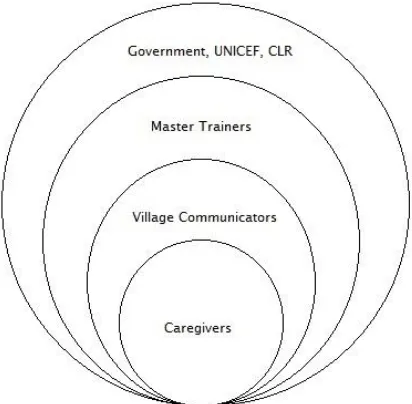
The Sajag program is an initiative of several governmental departments at state level, namely SHRC (State Health Resource Centre), SLMA (State Literacy Mission Authority) and ICDS (Integrated Child Development Services). These departments set up this program in January 2012 in collaboration with UNICEF, for funding, and a non-governmental educational institution (NGO) named Centre for Learning Resources (CLR), for technical support. To reach the goal in Sajag, personnel is educated with the use of a multi layered TOT based professional development program. CLR designed and conducted a professional development program for the first generation of trainers, 33 master trainers (MT's). They are selected from the several departments:
15 MT's of SHRC
9 MT's of SLMA
4 MT's of ICDS
The remaining five MT's are not attached to a governmental department. All MT's are local trainers and paraprofessionals, because they live in the communities and do not have formal qualifications for training.
Figure 2. Multiple layers in the Sajag program. Adapted from "Supporting para-educators in an Indian NGO: The plan-enact-reflect cycle" by H. Raval (2010, p. 25).
1.3 Goal of the Study
Little literature can be found about factors that have a significant influence on a TOT based professional development program in a developing country (Hiner, et al. 2009). The current study took place in the context of an Indian TOT based professional development program which is part of an early intervention program called Sajag. The main goal of this study was to identify factors that foster or inhibit an Indian multi layered TOT based professional development program in the sector of child development. This lead to the research question:
What are factors that foster or inhibit a multi layered Indian TOT based professional development program in the sector of child development?
2. Education of Trainers in Training Programs
The current study took place in the context of an Indian multi layered TOT based professional development program in the sector of child development. The ultimate goal of the training program to improve the welfare of the population, but to reach this goal educated personnel is needed. In this chapter a theoretical framework is developed in which the concepts in the context of the current study are elaborated which are used to answer the research question and to shape the sub questions.
2.1 Training-of-Trainers
A widely used educational model in various sectors, is the training-of-trainers (TOT), also known as training-the-trainers (TTT) (Orfaly, et al. 2005; Ray, et al. 2012). This model uses a cascade approach, in which a first generation of trainers is educated by an organization or experts who also provide instructional tools and guidelines (Orfaly, et al. 2005). Once the first generation of trainers is proficient, they will be the educators of a second generation of trainers (Evans, Myers, & Ilfeld, 2000). The cascade approach can continue through several layers, like in the Sajag program. The first generation of trainers needs to achieve an adequate level of understanding and expertise in the concepts and techniques contained in the training, so they have the ability and confidence to effectively train the next generation (Ray, et al. 2012). Additionally, the first generation of trainers needs communication skills and mentoring skills to support their students: the second generation. These two goals correspond to the goals of professional development and that is why a TOT based program can also be seen as a professional development program, which is discussed in the second section.
In the current study, the TOT model is used in an Indian early intervention program in which a professional development program for paraprofessionals is established to disseminate this program. Some concepts which are connected to the current study, are defined in the next section. Additionally, requirements for these concepts will be outlined as well.
2.2 Professional Development Programs for Trainers
Professional development refers to systematic efforts that promote the education, training and development opportunities of professionals in the work field (Guskey, 2002; Sheridan, Edwards, Marvin, & Knoche, 2009), which is aimed at acquiring educated, experienced and competent personnel (Urban, Vandenbroeck, Lazzari, Van Laere, & Peeters, 2012). The process of professional development entails the move from awareness to action and to adoption of particular dispositions (Sheridan, et al. 2009) and professional development programs pursue this goal and process. The characteristics of the executed program and the effectiveness of the program are two important aspects of professional development.
2.2.1 Components of a Professional Development Program
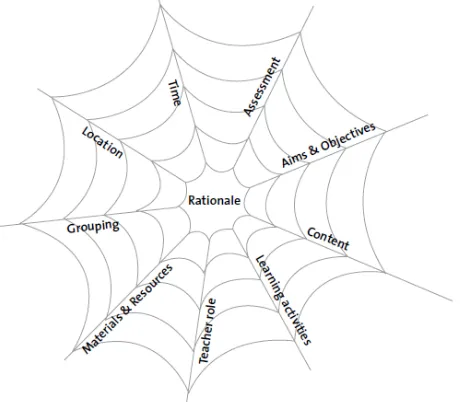
[image:12.595.89.323.372.573.2]The components a professional development program determine the success of the program. Consequently, it is important to identify effective elements within these components. The effective elements within the components of a professional development program are described based on a general model for curricula, namely 'the spiderweb' of Van den Akker (2009). In this spiderweb, ten components of a curriculum are pointed out and are connected with each other (figure three). The intention is to reach balance and consistency between the various components in this spiderweb (Van den Akker, 2009).
Figure 3. Curricular spiderweb. Reprinted from "Curriculum Design Research" by J. van den Akker, (2009, p. 41).
In the current study, the components of the spiderweb are reflected on the characteristics of the professional development program in Sajag to draw conclusions if the program reaches balance and consistency within and between the components. In literature requirements for all these components requirements are found. In the current study, the ten components of Van den Akker (2009) are combined into five categories:
Rationale and goals
The category rationale and goals includes the components rationale and aims and objectives from the spiderweb of Van den Akker (2009). The goals of a professional development program are mostly set by an organization who designs the program. Organizational characteristics, like organizational policies and practices can have an influence on the implementation and effectiveness of the program (Guskey, 2000). That is why Hiner et al. (2009), Anand (2011) and Institute for Small Business and Entrepreneurship [ISBE] (2006) all state that the organization of a professional development program should have a strong leadership with accountability.
The goal of a professional development program is dependent on the context. Sheridan et al (2009) state that in the context of child development, professional development is aimed at promoting indirectly the development of young children (Sheridan, et al. 2009). Two general objectives are created to reach this goal. First, it is essential to increase the knowledge and skills and to change the attitudes and beliefs of a professional (Desimone, 2009; Sheridan, et al. 2009; Guskey, 2002; Borko, 2004). However, in the context of the study paraprofessionals instead of professionals are part of the professional development program, the goal is the same. Second, a culture for ongoing professional growth in individuals and systems should be promoted (Sheridan, et al. 2009).
Organization
The category organization includes the components grouping, time and location. Borko (2004), Guskey (2002) and Raval et al. (2002) all state that professional development should be collaborative which relates to the component grouping. In literature two requirements for the timing of the professional development program is found. First, Hiner et al. (2009) explain that the program should be from sufficient length. In their study they conclude that a course of four days is better than five days in a TOT model, because it give the participants, like HIV counselors in their study, more flexibility to attend or conduct a training. Second, the program needs to be ongoing and sustainable (Sheridan, et al. 2009; Fullan, 2009; Hiner, et al. 2009; Engle, et al. 2007; Fulligni, Howes, Lara-Cinisomo, & Karoly, 2009). However, no requirements for the location of a professional development program are found in literature, but this component is equally important as the other components. Hence, the location should be convenient for the participants of the program.
Means
The category means includes the components content, learning activities and materials and resources. Sheridan et al. (2009), Hunzicker (2010), Desimone (2009) and Garet, Porter, Desimone, Birman, and Yoon (2001) all state that the professional development program needs to focus on content and instruction. The program also needs to be job embedded (Guskey, 2002; Raval, et al. 2002; Garet, et al. 2001), which relate to the learning activities and the materials. The participants of the professional development program in the context of child development also need observational methods and good theoretical and learning-material support, to make their work more effective (Engle, et al. 2007).
Teacher role
The component teacher role is a separate category, which refers to the teaching quality and the support of the facilitator of the professional development program. The facilitator plays an important role in the process of professional development. In the context of the study, the facilitators of the TOT based professional development program in Sajag are the project leaders and project officers who are connected to the company CLR. In literature some requirements can be found for an effective facilitator of professional development. The facilitator needs to:
Have sufficient education, materials and resources and a clear view of their role (Borko, 2004);
Take into account the diversity of the background of participants and meet the needs of the participants (Fulligni, et al. 2009; Evans, 2006);
Engage the participants in active learning (Garet, et al. 2001; Borko, 2004; Desimone, 2009);
Address the intrinsic motivation of participants (Quigley, & Tymon, 2006);
These requirements for an effective facilitator of professional development are reflected on the facilitators in the context of the study. However, in the context of the study the facilitators of the professional development program work with participants who are adult paraprofessionals. That is why requirements for adult learning should also be considered about.
Adult learners are according to Hunzicker (2010) self-directed learners who want to have a voice in the direction and pace of their learning, who are ready to learn, task-centered and intrinsically motivated. They prefer actual practice in which they apply their prior and new knowledge and experiences (Byington, & Tannock, 2011). Above all, they want to have a respectful, safe and comfortable learning environment (Byington, & Tannock, 2011), which is also a general desire. It is important that the program and the facilitator of the program take into account these characteristics of adults learners to structure the professional development process for MT's effectively.
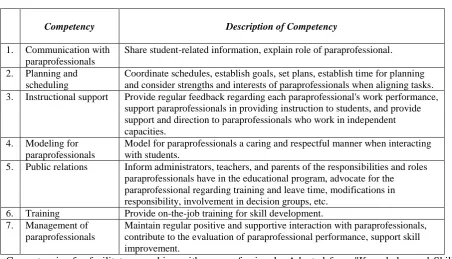
The participants of the professional development program in the current study are paraprofessionals, because they do not have formal qualification for their function as a trainer of the second generation of trainers. Paraprofessionals frequently do not have a higher education degree like Bachelor of Arts or Master of Arts, which most professionals have (Fulligni, et al. 2009). That is why paraprofessionals mostly have less prior knowledge about the subject and they mostly have a lower status than professionals (Anand, 2011). Wallace, Shin, Bartholomay and Stahl (2001) name seven competencies for the facilitators of professional development who work with paraprofessionals (see table four). Two of these competencies match with requirements for the program itself. The competency training relates to the requirement job embedded and the competency instructional support relates to the requirement that the program should be instructionally focused. Both requirements are described in the category means. In the current study, the other five competencies are compared with the competencies of the facilitators of the professional development program in Sajag. Although, Wallace et al. (2001) state that a lot of facilitators do not have all competencies due to a lack of pre-service preparation or a lack in professional staff development opportunities.
Table 1.
Competency Description of Competency
1. Communication with paraprofessionals
Share student-related information, explain role of paraprofessional.
2. Planning and scheduling
Coordinate schedules, establish goals, set plans, establish time for planning and consider strengths and interests of paraprofessionals when aligning tasks. 3. Instructional support Provide regular feedback regarding each paraprofessional's work performance,
support paraprofessionals in providing instruction to students, and provide support and direction to paraprofessionals who work in independent capacities.
4. Modeling for paraprofessionals
Model for paraprofessionals a caring and respectful manner when interacting with students.
5. Public relations Inform administrators, teachers, and parents of the responsibilities and roles paraprofessionals have in the educational program, advocate for the paraprofessional regarding training and leave time, modifications in responsibility, involvement in decision groups, etc.
6. Training Provide on-the-job training for skill development. 7. Management of
paraprofessionals
Maintain regular positive and supportive interaction with paraprofessionals, contribute to the evaluation of paraprofessional performance, support skill improvement.
Competencies for facilitators working with paraprofessionals. Adapted from "Knowledge and Skills for Teachers Supervising the Work of Paraprofessionals" by T. Wallace, J. Shin, T. Bartholomay, & B.J. Stal (2001, p. 525).
Assessment
[image:14.595.65.518.414.673.2]In professional development, assessment includes the measurements in order to identify the learning effects with regard to the knowledge, skills and attitudes of the participants (Desimone, 2009; Sheridan, et al. 2009; Guskey, 2002; Borko, 2004) and to compare these outcomes with the goals set at the start of the program (Guskey, 2000). The learning effects can be measured with various instruments, like questionnaires, interviews, personal reflections, skill demonstrations or a portfolio (Guskey, 2000; Garet, et al. 2001). Additionally, direct observations of a training can yield very useful information about the learning effects of the participants, but as Guskey (2000) mentions, these observations should be as unobtrusive as possible. The learning effects that can be measured by these instruments are described in the next section.
2.2.2 Effectiveness of a Professional Development Program
A professional development program should be evaluated in order to measure the effectiveness of the program. Various methods and techniques can be used to evaluate the effectiveness of the program (Van den Akker, 2009). Evaluation can take place during the implementation of the program to improve the effectiveness, known as formative evaluation, and it can take place at the end of the program to proof the effectiveness, known as summative evaluation. According to Van den Akker (2009) effectiveness refers to "the extent that the experiences and outcomes with the intervention are consistent with the intended aims" (p. 47). In the current study these two aspects, the experiences and outcomes, are combined into the impact of the program on the participants. These two aspects can also be found in the levels of evaluation of professional development described by (Guskey, 2000):
1) Participants' reactions; 2) Participants' learning;
3) Organization support and change;
4) Participants' use of new knowledge and skills; 5) Student learning outcomes.
The first level is focused on the reactions with the experiences of the participants. The second and fourth level are both focused on participants outcomes, in other words, the learning effects.
Experiences
The experiences of the participants with the professional development program are included in the first level of evaluation of professional development stated by Guskey (2000). He explains that measuring participants' reaction to the experience provides information about the initial satisfaction with the actual practice of the program that can help improve the design and delivery of programs or activities. The participants can have positive reactions in which they explain their satisfaction, but they can also explain their problems or concerns within the program. The seven stages of concerns which are described by Hall, George and Rutherford (1986) are part of the Concern Based Adoption Model (CBAM) which is a hierarchical framework for conceptualizing the concerns professionals have about an innovation. The seven stages of concerns are:
0. Awareness; 1. Informational; 2. Personal; 3. Management; 4. Consequence; 5. Collaboration; 6. Refocusing.
innovation, but Hord et al. (1987) state that these concerns will not be as intense as in the other dimensions.
Learning effects
In the context of the study, the participants of the professional development program need to require the prevalent knowledge, skills and attitudes related to child care to convey the early intervention program effectively and to promote indirect the development of young children within a certain community (CLR, 2013; Evans, 2006; ISBE, 2006; Sheridan, et al. 2009).
In more detail, with regard to the knowledge, the participants need to require an adequate understanding of early childhood care with regard to the facts, concepts, ideas, vocabulary and best practice in this field (Sheridan, et al. 2009).
The skills the participants need to require, consist of units of action which are observable or easily inferred (Sheridan, et al. 2009). The participants of the professional development program in the current study need to require effective training- and communication skills to disseminate the content of the program effectively in the TOT model.
At last, with regard to the attitudes, the participants need to have a strong role perception towards their work in an early intervention program. Additionally, they need to be highly motivated to use their own knowledge and skills to be disseminated through the TOT model.
The requirements from literature for the different characteristics of a professional development program is mostly based on settings in a developed country and on professional development of teachers. However, these requirements are reflected on the professional development program for MT's in Sajag, because the MT's can be compared with teachers. Still, it is important to take into account the context of the study with reflecting every requirement.
2.3 Theoretical Framework
Based on literature, the theoretical framework is established which shapes the sub questions and the research design of the study.
The focus of the current study is on two aspects: the characteristics of the executed program and the impact of the program. The second aspect, impact, is divided into the experiences of the participants and the learning effects of the participants. Two concepts from literature, the spiderweb designed by Van den Akker (2009) and the five levels of evaluation of professional development described by Guskey (2000), are the two main concepts used in the current study. The components of the spiderweb are used to describe the executed professional development program in Sajag and to describe the experiences of the MT's with these components. The levels of evaluation of Guskey (2000) are included in all three sub questions. However, the last level of Guskey (2000), student learning outcomes, is not described in the current study.
Based on these aspects, three sub questions are formulated in order to answer the research question: 1. What are the characteristics of the TOT based professional development program in Sajag? 2. What are the experiences of the participants of the TOT based professional development
program in Sajag?
3. What are the learning effects of the participation in the professional development program in Sajag?
connected to the first sub question, because it gives information about the organization’s advocacy, support and facilitation of the program in Sajag which can be a key of success of the program.
Because of the importance for the whole process, the focus of the study is on the first generation of educated trainers, the MT's. They play an important role in the program, because they have a strong influence on the dissemination of the program. That is why the second and third questions are aimed at exploring the impact of the professional development program on the participants. The impact on the participants is divided into the experiences of the participants and the learning effects of the participants, because the experiences of the participants can describe factors that have an influence on the learning effects and thus on the success of the program. This division is based on the levels of evaluation of professional development described by Guskey (2000). The second sub question which is focused on the experiences of the participants is connected with the first level of Guskey (2000) which is focused on the reactions of the participants on the program. Guskey (2000) states that the reaction on the experiences of the participants can give information about the implementation and the success of the professional development. Additionally, the stages of concerns described by Hall et al. (1986) are used to describe the problems MT's face during the program and the concerns they have. Question three is meant to identify the learning effects of professional development with regard to the change in knowledge, skills and attitudes (Desimone, 2009). This question is connected with the second and fourth level of Guskey (2000). The second level focuses on measuring the knowledge, skills, and perhaps attitudes participants gained and the fourth level is focused on whether participants are using their new knowledge and skills on the job.
3. Research Design
Based on the research question and the sub questions, the research design is described in this chapter. The research method, respondents, instrumentation and data analysis are outlined. Additionally, the reliability, construct validity, internal validity and external validity of the research design are described.
3.1 Research Method
The main aim of this study is to identify factors that foster or inhibit an Indian multi layered TOT based professional development program in the context of child development. This study is an exploratory qualitative study which gives the opportunity to better understand the setting, because little research is done on the factors that have a significant influence on a TOT based professional development program in the sector of child development. Additionally, little information was available in official documents about the TOT based professional development program in Sajag.
As was described in chapter one, this program was aimed at improving the understanding and capacities of MT's with respect to the integrated aspects of child development. The ultimate goal of Sajag was namely to enhance the quality of home-based holistic care for children between birth to three years in a particular area in India. This goal needed to be reached with the use of dissemination of the content educated to the MT's through several layers, also called the cascade approach. After the MT's received their training, they educate VC's and the VC's take care of training the families in the villages. As the MT's have a strong influence on the dissemination of the program, the focus of the current study is on them. However, also other respondents are selected in the current study to gain information about the TOT based professional development program in Sajag and to answer the research question.
3.2 Respondents
The participants of the TOT based professional development program in Sajag, the MT's and their students, the VC's are selected as the respondents of the study. Additionally, staff from CLR, the program managers, project leaders and project officers, are selected as respondents.
The MT's are selected with the use of mixed purposeful sampling which involves mixing of more than one non-random sampling strategy (Onwuegbuzie, & Leech, 2007). According to Miles and Huberman (1994) this sampling method can help to triangulate data. First, stratifying is used to select MT's from the two biggest and most influential governmental departments within the program, SHRC and SLMA, because the company CLR pursued a continuation of the collaboration with these two departments in future. Next, convenience sampling is used in which the project officers contacted the MT's if they are able and willing to participate. Based on availability, feasibility and voluntarism, three MT's of SHRC and four MT's of SLMA are selected. These seven MT's covered almost one third of the MT's in these two departments and this enabled the researcher to draw a conclusion for a large group of MT's.
3.3 Instrumentation
In line with the theoretical framework, research method, and research question, qualitative data collection techniques are used in the current study.
First, secondary data of the organization CLR is collected to gain information about the objectives for the characteristics of the program and for participant's learning effects. The secondary data included the proposal of the program, taped video's of several trainings and other documents.
Second, semi-structured interviews are executed to collect data about the characteristics, the experiences of the MT's and the learning effects of the TOT based professional development program in the context of the study. In these interviews, an interview scheme is used to give the interviewer some guidelines.
To answer the first and second sub question, the topics for the interview schemes were based on the curricular spiderweb of Van den Akker (2009). In the current study, the curricular spiderweb was divided into five categories: 1) rationale and goals, 2) organization, 3) means, 4) teacher role and 5) assessment. Semi-structured interviews with CLR staff were conducted to collect data about the characteristics and the actual practice of the program with regard to these five categories. The CLR staff were asked to describe and explain what has happened in the training with regard to every category, for example: "Can you describe the organization of the program?". Semi-structured interviews with MT's were conducted to collect data about the participant's experiences with the program with regard to these five categories. An example of a question to ask about their experience with a category is: "What did you like and dislike about the organization of the program?". However, it was expected that the MT's were not able to describe their experiences with the rationale and goals, because they were not involved in the development of the program. Consequently, the questions about the rationale and goals of the program are removed from the interview scheme for the MT's. Instead of these questions, information about the background information of the program and information about the work of MT's related to their students, the VC's was collected in the interviews. In these topics also the problems and concerns the MT's have with regard to their work are addressed. Later these problems are connected with the stages of concerns described by Hall et al. (1986) to identify in which stage and dimension their concerns are present.
The third sub question is focused on the learning effects of the participation of the MT's in the professional development program with regard to the current level and improvement of the knowledge, skills and attitudes of the MT's. That is why the interview schemes also included questions about the knowledge, skills and attitudes of the MT's. This information is collected in semi-structured interviews with several respondents: MT's, VC's and CLR staff. In the interviews with MT's they described their self-reported learning effects. In the interviews with the CLR staff, the learning effects on the entire group of MT's is described based on their experience.A part of the CLR staff, the project officers were able to give information about the seven MT's in the sample. In the interviews with VC's, they described their experiences with the MT's as their teacher.
[image:19.595.65.485.602.765.2]In table two an overview is given what instrument is used and which respondent is selected to answer the three sub questions.
Table 2.
Instrumentation
Semi-structured interviews Secondary data
MT's VC's CLR staff Proposal, taped
video's etc.
Sub question 1.
Characteristics of the program
x x
Sub question 2
Experiences of the participants
x
Sub question 3
Learning effects of the participants
To ensure the quality of the instrumentation, the quality of the interview scheme and the internal and external validity of the study are taken into account. A pilot interview was conducted to ensure the quality of the developed interview scheme. The interview scheme needed to be translated in Hindi by the interviewer, considering the fact that MT's cannot speak English. Because of this pilot, the interviewer had the opportunity to practice an interview. In addition, the quality and relevance of the translation of the questions were tested. One MT, who is not part of the respondents in the current study, joined voluntarily. After this pilot, some adjustments in the interview scheme for MT's were carried out. For example, in the interview scheme specific questions were removed, to give the interviewer a better overview of the main questions. Along with the removals, some questions were added, because the information collected in the pilot interview did not yield enough information to answer the research question and the sub questions. For example, to test the knowledge of the MT's, the following question was added: "What are the main messages that you deliver the VC's and what is the importance of these messages?". In appendix one the final version of hte interview scheme for the interviews with MT's is included.
To ensure the internal validity of the data collected in the interviews, triangulation, the use of multiple sources of evidence, is applied. In the current study, triangulation takes place at respondent level and instrument level (Meijer, et al. 2002; Miles, & Huberman, 1994). In the previous section is already explained that triangulation on respondent level is applied, because various persons are selected for the semi-structured interviews. On instrument level triangulation is applied, because two types of instruments were used to answer the research question: semi-structured interviews and secondary data. Finally, to ensure external validity, replication logic is applied (Yin, 1984), because in the current study a clear research design is described and the interviews are recorded and later transcribed. Noted that in qualitative research and in semi-structured interviews the collected data can deviate.
3.4 Data Analysis
The collected data from the semi-structured interviews are transcribed and coded (Boeije, 2005; Miles, & Huberman, 1994). Coding is a way to diminish the big quantity of data (Boeije, 2005). In the collected data, the researcher has distinguished themes or categories which are connected to a code. A code is a summarizing notation, for a piece of text in various ways of size (Miles, & Huberman, 1994), in which the meaning of a fragment is expressed (Boeije, 2005). To make this process of coding easier, qualitative computer software 'NVivo.10' is used.
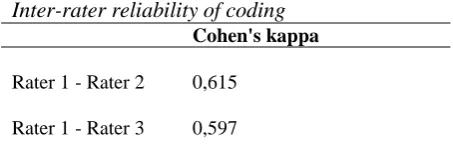
Table 3.
Inter-rater reliability of coding
Cohen's kappa
Rater 1 - Rater 2 0,615 Rater 1 - Rater 3 0,597
4. Results
In this chapter, the results from the current study are presented to answer the research question. In the first section the characteristics of the TOT based professional development program in Sajag are presented. In the second section the impact of the program with regard to the experiences of the MT's with these characteristics is described. Additionally, their problems faced and concerns with regard to their work in the program are pointed out. In the third section, the impact of the program with regard to the learning effects of the MT's of their participation in the program are presented regarding the knowledge, skills and attitudes.
4.1 Characteristics of the Professional Development Program in Sajag
To answer the first sub question, the characteristics of the TOT based professional development program in Sajag are described with regard to five categories: rationale and goals, organization, means, teacher role and assessment. Data is collected in secondary data and in semi-structured interviews with CLR staff.
4.1.1 Rationale and Goals
The rationale and goals of the professional development program in Sajag are described in the proposal and by the CLR staff in the interviews. However, the project officers were not able to describe these components, because they were not involved in the development of the program.
The ultimate goal of Sajag is to support and provide caregivers with information about optimizing their caregiving skills in an early intervention program in a particular area in India. A TOT based professional development program was developed to disseminate the program with the use of a cascade approach. One of the program managers explains:
"The areas that we work in include about 12.000 till 15.000 families who fall under the category of pregnant women or parents with children between zero and three years of age. There is no way that CLR has the resources to reach all of them themselves. And the idea was to reach the entire population instead of a few of them. The only way of doing that is to use what we call a cascade approach, where we train trainers and they train the next level and who will work with the actual target group. There are issues with that model, because there is a segment of loss, but we try with monitoring and support to minimize this loss."
The professional development program for MT's was focused on the improvement of the understanding and capacities of MT's with respect to the integrated aspects of child development, which includes health care, nutritional care and psychosocial stimulation. The program is also focused on improving their training competencies and communication skills, because the MT's conduct training for the second generation of trainers, the VC's.
This program was intended to be for one year. However, UNICEF and the governmental departments extended the funding with one extra year, because they acknowledged the added value of the program. Additionally, they saw a lot of motivation of the people involved in the program and they saw an impact on the caregivers. However, the collaboration between CLR and the governmental departments entailed problems, because it was hard to strategize and even work together, because their vision and goals were different than from CLR. The CLR staff explain that the ultimate goal of Sajag is not reached yet because of these problems, but when the program will continue for more years, the impact on the caregivers will be immense.
4.1.2 Organization
The organization of the professional development program in Sajag is described with regard to the grouping, location and time.
Grouping
could not provide this amount of trainers. Then CLR decided to involve the departments SHRC and ICDS as well. Ultimately 33 MT's from these three departments were selected based on self nomination and screening. However, it took a long time before the selected MT's actually went to the training, because the CLR staff had to go through a lot of channels to get permission of the governmental departments and to let them send the MT's to the training.
As stated in the proposal, the MT's were divided into two groups in the first training, notably one group with MT's from SHRC and one group with MT's from SLMA and ICDS. This division was established, because a difference between the MT's from the different departments was noticed with regard to their knowledge, skills and attitudes. The MT's from SHRC already had previous knowledge about health and nutrition and they also had more experience in receiving training and working in the communities than the other MT's. The other MT's from SLMA and ICDS were given an extra day of training to improve their content knowledge and to gain confidence in conducting training and working in the communities. In the fourth training, the 33 MT's all brought together again, because the CLR staff had noticed that the other MT's had matched the MT's from SHRC with regard to their knowledge, skills and attitudes. After the training, the MT's were paired to conduct their sector level trainings for VC's. These pairs changed over time, because the MT's needed to learn to work with anyone, but it is not analyzed by CLR what worked best.
Location
The training for MT's took place at different locations. The location Maharashtra Mandal is easily accessible, because it is very close to the bus station and people can sleep over as well. Another training location, the PACE Centre, has good facilitations, but it is difficult to commute. The CLR staff explain that in the seasons of weddings it is hard to find a convenient location.
Time
Based on the proposal, the training was planned to be in three rounds of five days, but the CLR staff explained that already four rounds were executed. This was the consequence of the extra funding of UNICEF and the governmental departments. Every two months the trainings took place, but every round did not include the planned five days of training, but three or four days of training. Three days were given to the MT's from SHRC and four days to the MT's from SLMA and ICDS. In the fourth round, the MT's were brought together and then they all received three days of training. According to the CLR staff, all MT's were able to come for all trainings, but the problem was that they mostly come late. The trainings were supposed to start at ten o'clock and go on till five o'clock, but mostly the training started at twelve o'clock and the MT's had to leave early.
4.1.3 Means
The means of the professional development program in Sajag is described with regard to the content, learning activities and materials and resources.
Content
At the start of the program, the focus of the professional development program in Sajag was only on content. The content was focused on what the MT's should deliver the VC's: Information about promoting the holistic development of young children between birth and three years old. In the proposal is stated that each round of training will cover five of the fifteen modules of the entire content, but the CLR staff explain that the modules are reduced and combined to seven modules. For example, the needs based on developmental characteristics of children of different ages are included in the activities for the different age groups. The seven modules are:
1. Pregnancy care 2. Holistic child care 3. Post pregnancy care
Learning activities
In the training for MT's the learning activities are connected to the content. In the proposal many activities are described, for example role plays about parenting skills and discussions on qualities and skills of a good trainer. Additionally, field visits were planned. After the project officers had observed the MT's in conducting the sector level training for the first time, they realized that the activities in the training needed to change, because the communication and facilitating skills of the MT's were weak. That is why the activities changed or were added to improve the skills of the MT's. For example, demonstrations about asking questions were included and they went actually to the field to show live a sector level training. Additionally, some games were introduced to improve MT's understanding of the content, but these activities were not useful in the trainings for VC's or caregivers.
Materials and resources
In the proposal is stated that CLR would provide materials and resources for MT's, named as the Caregiver Education Package, which would contain the following materials and resources:
Manual;
Discussion photo booklet;
Other visual materials (puzzles and discussion pictures);
Handouts for caregivers;
Study container for package.
During the implementation of the program, the CLR staff noticed that the MT's needed better materials and resources to improve their training skills. Especially the manual needed to be modified, as one project leader explains:
"They did not match the local specificities, the capacities of learners and the language. The previous manual was theoretical and a lot of text and that was a big barrier for MT's who did not study for a long time."
The main messages in the materials did not change, but the new manual is smaller and includes simple messages with pictures, so the MT's will understand and remember it better.
4.1.4 Teacher Role
The teacher role in the professional development program in Sajag refers to the functions, tasks and teaching quality of the facilitators of the program, the project leaders and project officers who are attached to the company CLR.
The facilitators of the training for MT's supposed to be different people from CLR who had a lot of experience in training. Three people were selected as project leaders who also would be facilitators of the training for MT's. The main strength of the project leaders was that they were interactive and participatory trainers. Additionally, they had experience in conducting trainings, but they did not have experience with the TOT model and the cascade approach. They needed some training to improve their facilitation skills in this model. One of the program managers explains:
"When a training need to be designed that has to go down four layers, the structure of the training has to be such that the main messages are already very clearly pulled out. The facilitation is dependent on them, because they do not directly go to the ground level."
However, little time was available to build the facilitation skills of the CLR staff. To improve the facilitation of the CLR staff, feedback was given to each other in reflection meetings after every training. Also the MT's were given the opportunity in reflection meetings to give their opinion about the training and the facilitators.
CLR offers two types of support to MT's: tele-support and face to face mentoring. Mentoring is a more intensive type of support in which the project officers observe the sector level training conducted by the MT and reflect on it. Additionally, they provide help with the preparation of the sector level training, planning and problem solving. The MT's who are not mentored, get help on the phone with problem solving, but the goal is to mentor every MT at the end of all round of training for MT's. In the current study, three of the four MT's from the department SLMA are mentored by CLR and two of the three MT's from the department SHRC.
4.1.5 Assessment
The assessment in the professional development program in Sajag refers to the to the measurement of the learning effects of MT's.
The CLR staff explained that there is no structural plan to keep updated about the learning effects of MT's. However, they have some data from observations that are executed by the project officers in the sector level trainings. In appendix four the observation sheet they used to assess the MT's in the sector level trainings is displayed. In this sheet, especially the skills the MT's needed to require are described. However, the skills in the sheet are not structured and there is a big difference between general skills and specific skills. An example of a general skill which is described in the sheet is: The MT is able to create an environment of encouragement and comfort where participant feel ready to participate. At the same time, in the sheet some specific skills are described, for example: The MT is able to use sufficient 'energizer's/breaks to keep the training atmosphere alive.
Concerning the characteristics of the TOT based professional development program in Sajag, the most prominent finding is that a lot of changes are carried out during the implementation of the program with regard to the planned program in the proposal. These changes were especially carried out to make the program more convenient for the MT's and to meet their needs. Additionally, during implementation, CLR also faced some problems, especially within the collaboration with governmental departments. However, the extended funding ensured the continuation of the program for as well the MT's as the VC's and caregivers.
4.2 Experiences of the Master Trainers
In this section, the impact on the participants of the program is described with regard to their experiences with the program. In the semi-structured interviews, the MT's described their experiences with the organization, means, teacher role and assessment of the program. Additionally the problems MT's face or concerns they have during their work are described.
4.2.1 Organization
The MT's explained their experiences with the organization of the professional development program in Sajag with regard to the grouping, location and time.
Grouping
The MT's had different preferences for grouping. Five MT's mentioned that they wanted to learn together with all MT's of the different departments, which was established in the fourth round of trainings. Their argument is that they could meet new people and they can learn from each other, because they had different backgrounds. One MT of SHRC and one MT of SLMA, told they liked to learn in groups with MT's from only their own departments, because they explained it becomes crowded when all MT's are trained together. Moreover, they explained they were not able to learn effectively when all MT's are together.
Location
Time
The MT's had different opinions about the timing. A little majority, four MT's, are satisfied about the duration and frequency of the trainings, but one of them would like that the frequency of the trainings will be increased in future. On the other hand, two MT's of SHRC wanted to decrease the frequency of the trainings. They wanted more gap between the trainings, because they mentioned they had a lot of work in Sajag. One MT did not give her opinion about the frequency and duration, but she agreed that she is busy as a MT in Sajag.
4.2.2 Means
The MT's explained their experiences with the means of the professional development program in Sajag with regard to the content, learning activities and materials and resources.
Content
All MT's mentioned that they have gained a lot of new content knowledge. One MT explains:
"In the first training, we learned about the cognitive development of children between zero and three. By what age children start learning. This was not what I knew before. I am a mother of three children myself, but I never knew that children start learning from birth. We were taught about the kind of things we should do to foster the cognitive development of a child."
Three MT's, all of SLMA, said they did not have difficulty with understanding the content, because it is relevant for everyday life. However, one of these MT's admitted that she had some difficulty with adapting the content of the training to the training for VC's, the sector level training.
Learning activities
All MT's declared they enjoyed the activities, because they were learning along with having fun. All MT's explained they especially liked the role plays. Four MT's also explained they especially liked the songs and games in the trainings. However, one MT explains she had some difficulty with particular activities, but she received help from the CLR staff. She and all other MT's did explain that the activities are useful in the trainings for VC's or caregivers. One MT explains:
"Whatever activity that was taught for us, we noted down in our notebook and we used that for our sector level training. So it becomes very systematic."
Materials and resources
All MT's are satisfied with the materials and resources they received. They especially liked the new manual, because four MT's explain that the pictures with the short sentences helped them to better understand the content and it helped them to better explain the content to the VC's and caregivers. Three MT's emphasized on that the materials are useful as teaching tools, but they should not be distributed to caregivers, because they do not use it at home or lose it.
4.2.3 Teacher role
The MT's clarified their experiences with the category teacher role which refers to the facilitators of the professional development program in Sajag, the project leaders and the project officers.
All MT's are satisfied about the teaching quality of the CLR staff in their training. Generally, they explained they are fun, respectful and inspiring. One of the MT's explained why she was satisfied and inspired by the CLR staff (she uses 'didi's' to indicate the CLR staff):
Another MT explained that she liked the CLR staff, because they discuss topics which are rarely discussed in their communities:
"They are very genuine and they are very attached to us. [..] Our hearts melt, just to the fact that they are talking about holistic development of a child, where nobody usually talks about."
All MT's in the sample mentioned that the CLR staff were supportive during the training they conduct for the VC's. To clarify, all MT's explained they received help when they asked for it and when they got stuck in the training. One MT explained she has no time to be supported and some other MT's admitted they still need support, for example for recruiting VC's or during their work in the communities with caregivers. One of them, explained that she look forward to the support from the CLR staff, because the VC's are pleased when they come (she uses 'didi's' to indicate the project officers):
"When the didi's come for the sector level training, the VC's like it a lot. When someone from outside comes for our training and teach them, the VC's feel very good”.
4.2.4 Assessment
The MT's described their experiences with the assessment of their learning effects.
All MT's mentioned the support they got from the CLR staff in the sector level trainings and that they liked to have them around in the training, but they did not describe extensively their experiences with the assessment during these support. However, five MT's explained briefly they are observed by the CLR staff in these trainings. From these five MT's, three are mentored by the CLR staff. One of them explained what the CLR staff is doing during the observations (she uses didi to indicate a project officer):
"When didi came for the sector level training, she just observes, she does not tell us anything in front of the VC's. Whatever mistakes we have made, she tells us about it afterwards."
The MT's did not describe any other experiences with the assessment of their learning effects by CLR.
4.2.5 Problems and Concerns
The MT's described their problems and concerns with regard to their work.
With regard to their work load, three MT's in the sample told that their work as a MT in the Sajag program is a lot of work. One of them and also two other MT's said that they were able to combine the work for the Sajag program with their work of the department. However, one MT of SLMA is the only one who said her work of Sajag clashes with her other work.
With regard to their work with VC's, all MT's declared they had problems with working with the VC's, especially with supporting them due to commuting problems and time problems. Additionally, five MT's discussed the money problem for the VC's. Their work is voluntarily, but the VC's and their families complained about not getting anything for the two days of training. According to three MT's the money problem is a cause for the attendance problem in the sector level training and according to three other MT's this also caused the recruiting problems they had. In addition, according to two MT's, the VC's did not do their work properly because of the money problem. However, according to all MT's, their VC's have benefitted from the sector level trainings, but there are still differences in the competencies of the VC's.
the communities were slowly changing, because they were willing to learn, enjoyed the messages and became aware of the importance of psychosocial stimulation. However, the MT's explained that the uneducated people were difficult to change, because they still had a lot of superstitions and the older people in the houses did not respect the VC's. Three MT's mentioned that it is also difficult to check who has implemented the messages.
Concerning the overall experiences of the MT's with the characteristics of the program, a major finding is that the MT's have mainly positive experiences with the program, because they enjoy being part of the program. Additionally, all MT's are satisfied about the facilitators of the program, the CLR staff. However, all MT's have their own preferences and opinions about the characteristics of the program. To clarify, some MT's explained their problems with VC's and caregivers and for this reason they asked for more support. In addition, some MT's expressed their dissatisfaction with the organization of the program. For example, two MT's from SHRC wanted to change the timing of the trainings.
4.3 Learning Effects of the Participation of Master Trainers in Sajag
In this section the impact on the participants of the program are described with regard to learning effects of the MT's based on the semi-structured interviews with MT's, the CLR staff and also the VC's. The current level of MT's' knowledge, skills and attitudes and their improvement during the program are pointed out. In appendix three, the learning effects for the seven MT's in the sample are displayed in a table along with personal background information.
4.3.1 Knowledge
In the proposal of the program is stated that MT's needed to require knowledge with respect to the integrated aspects of child development, which includes health care, nutritional care and psychosocial stimulation. In more detail the MT's needed to require knowledge about:
The holistic child development and role of caregivers
The prime messages in:
o Reproductive health, child and maternal health
o Child nutrition
o Importance of psychosocial stimulation and how to promote it
o Child safety and age-appropriate discipline
Play materials
Gender equity in care-giving practices
The CLR staff explained that there was a difference in prior knowledge between the MT's from the different departments when the program started. The MT's from SHRC had especially knowledge of health and nutrition and the MT's from SLMA and ICDS had little knowledge of health, nutrition or psychosocial stimulation. According to the CLR staff, all MT's have improved their knowledge during the program, but there is no structural plan to keep updated about the knowledge of MT's.
In the sample, six out of seven MT's had sufficient prior knowledge. The three MT's of SHRC in the sample especially had knowledge of health and nutrition, like all other MT's of SHRC. Although, in the sample one MT from SLMA had also knowledge of health and nutrition, which can be explained because her husband is a doctor. Another MT of SLMA was the only MT in the sample who had some knowledge of education and teaching parents. According to the CLR staff, the MT's from SHRC all improved their understanding of psycho-social stimulation of young children as well as two MT's of SLMA. This can be the consequence that this aspect of the content is new to every MT. The other two MT's of SLMA improved their understanding of all aspects according to the CLR staff.
"The point is that, even if we do not do anything, the child begins learning on his own. The five senses that a child has, are all working from the day he is born. Even if we do not provide stimulation, they are all still active. Even though we have not done much with our children, they are still very smart."
The other three MT's were weak in describing the content, because they did not describe examples of the content and they only described the general content, for example the two aspects which every MT described: The cognitive development of children and the age groups they are focused on. It is not clear why some MT's can describe the content better than the other MT's. Just one MT stand out, because she already had little prior knowledge and she could not describe the content well.
4.3.2 Skills
In secondary data information is found about the goals for the skills of MT's. In appendix four these goals can be found. The goals are especially focused on require skills with regard to MT's' work with VC's.
According to the CLR staff, there was a difference in skills between the MT's of the different departments at the start of the program. The MT's of SHRC were familiar with the method of training, but the MT's of SLMA and ICDS had little experience with receiving training. Additionally, the MT's of SLMA and ICDS were not in the MT position until Sajag started, because they were VC's before. That is why the MT's of SLMA and ICDS were separated in the first training from the MT's of SHRC. In the fourth training all MT's were trained together again, because at that moment the MT's of SLMA and ICDS could match the MT's of SHRC with regard to their competencies. However, during the program the CLR staff noticed that many MT's still lack training- and communication skills to conduct a sector level training for VC's effectively and to support them well. This is the consequence of that most MTs focus too much on arranging food and searching for a convenient location for the sector level training instead of focusing on revising the content, preparing for the training and preparing for supporting their VC's.
Likewise, in the sample a distinction can be made between MT's with effective or weak training-, communication- and observation skills. According to the CLR staff, four MT's have weak training skills. However, in the interviews with these four MT's, they all give arguments that they are able to conduct the sector level training and to communicate well. Three MT's in the sample have effective skills according to the CLR staff, but just two MT's have a high degree of education and they are also the only MT's who have previous experience in conducting training. One of them explains she thinks the training is very useful for her skills:
"Because of this training, I am able to communicate very well and people are able to understand what I am trying to teach".
Additionally, the MT's need to support their VC's. In the sample, according to the CLR staff two MT's are very supportive towards their VC's. This is also addressed by their VC's in the interviews. However, all other VC's who are interviewed also explained they have learned a lot from their MT's and that their MT's are supportive. Nevertheless, the VC's from one MT explain they need more support from their MT and the VC's of four other MT's explain the like to have people from outside their village to come to their trainings.