Master Thesis Rapport
Exploratory Study: Use of Instant Messaging Tactics to Increase Loyalty
Master Thesis – Media & Communications
Communication Studies
University of Twente
Student: Peter de Witte
Student number: S1665693
First supervisor: DR. de Vries
Second assessor: DR. Constantinides
Date: 23 September 2016
Structured abstract
This study objective is to present a reference model whereby using different instant messaging tactics the consumer loyalty develops towards the company where product is bought. If a consumer become loyal to a company, a loyalty loop occurs. This loop will occur if the consumer bond with the company is strong enough, resulting in a repurchase without considering other brands (Edelman, 2010). Claimed by Court (2009) and Edelman (2010) social media plays an important role before and after purchasing a product for customers becoming loyal. This study conducts to science to research ‘What is the potential influence of instant messaging tactics on loyalty during the customer journey?’.
From the literature emerges that the use of the smartphone is rising and that instant messaging is deployed on the same touchpoints as social media. The instant messaging reference model is drafted (Figure 2.11 Instant Messaging Reference Model) with three different tactics spread across the different phases of the customer decision journey; Whole Journey Service, Chatbot services and After-sale Service, these tactics are based the different customer relationships and phase properties (Chapter 2.5 Instant Messaging tactics).
To test the usability of the instant messaging reference model and to answer the research question this study conducted an online survey. The participants are given two (of the three) different cases (each case represented an instant messaging tactic) where the use of WhatsApp within the different phases of the Instant messaging reference model is described. The questions after each phase of the case provide an indication if potential loyalty arise by using WhatsApp.
The results of the conducted study show that the appreciation of the use of WhatsApp during the different instant messaging reference model phases shows regression with the loyalty rate score. The drawn instant messaging tactics contribute to the potential loyalty of the consumer. On an eight-point scale the Whole Journey Service scores 4,76 points, the Chatbot Service scores 4,71 points and the After-sale Service scores 5,30 points average.
The effects within the different phases of the tested reference model are (on an eight-point scale); 4,56 points for the Orientation/ Consider phase, 4,92 points for the Orientation / Evaluate phase, 5,25 points for the Experience (positive) phase, 4,51 points for the Experience (negative) phase, 5,42 points for the Advocate phase and 4,67 points for the Bonding phase. The results of the online survey do not show a significant difference between gender, age or educational level.
The conclusion drawn after the conducted literature study and the online survey is; within the Instant messaging reference model the design instant messaging tactics contributes to the potential loyalty of a consumer. The tactic with the biggest potential influence on loyalty during the customer journey is the After-sale service The tactic with the least potential influence on loyalty during the customer journey is the Chatbot service tactic. The Advocate phase scores the highest score for the potential influence on loyalty and the phase with the lowest loyalty score is measured within the Experience phase (when the expectations of the consumer are not met).
Table of content
Structured abstract
2
Table of content
3
1. Introduction
5
2. Literature review
6
2.1 Journey of The Customer
6
2.1.1 The Funnel Metaphor
6
2.1.2 The Customer Decision Journey
7
2.1.3 Zero Moment of Truth
10
2.1.4 The Customer Lifetime Cycle
12
2.2 Social Media
13
2.2.1 Current Channel Strategies
15
2.2.2 Social CRM
16
2.3 Instant Messaging
17
2.4 Loyalty
18
2.4.1 Customer Relationships
18
2.5 Instant Messaging Tactics
19
2.5.1 Different Customer Relationships
19
2.5.2 Chatterbots
20
2.5.3 Tactics
20
2.6 Implementation of WhatsApp
22
2.6.1
WhatsApp Business Applications
22
2.6.2
WhatsApp Business Cases Examples
23
2.7 Instant Messaging Reference Model
24
2.7.1 Loyalties and Tactics
26
3. Methods
27
3.1 Research Design
27
3.1.1 The Cases
27
3.1.2 The Survey
27
3.2 Phases of Research
28
3.2.1 Phase 1: Desk Research
28
3.2.2 Phase 2: Quantitative Research
28
3.3.3 Phase 3: Qualitative Research
28
3.3 Pre-test
28
4.1
Results Desk Research
29
4.2
Results Quantitative Research
30
4.2.1 Whole Journey Service Tactic Results
31
4.2.2 Chatbot Service Tactic Results
33
34
4.2.3 After-sale Service Tactic Results
35
4.2.4 Overall Results
37
4.2.5 Interaction Effects
40
4.2.6 Practical Usability of the Instant Messaging Reference Model.
42
4.3 Results Qualitative Research
43
4.3.1 Whole Journey Service
43
4.3.2 Chatbot Service
44
5. Conclusion
46
5.1 Conclusion Literature Study
46
5.1.2 Where In The Customer Journey Should Instant Messaging Be Applied?
46
5.1.3 How Should Instant Messaging Be Applied?
47
5.2 Conclusion Results Field Study
48
5.2.1 Conclusion Desk Research
48
5.2.2 Conclusion Quantitative Research.
48
5.2.3 Conclusion Qualitative Research
50
5.3 Conclusions overall
51
5.4 Recommendations
52
5.4.1. Recommendations for companies
55
6. Discussion
56
Reference
57
Appendix
59
1.
Questionnaire
59
2.
Questionnaire Responses
66
1. Introduction
Consumers are changing the way they research and buy products all the time. The challenge of companies, especially their marketers is to respond to that behaviour (Court et al., 2009).
In an era where consumers getting more choice between different products and brands, the supply side sees an increase of channels through where they can interact with their consumers. Nowadays the diversity of channels keeps increasing, especially the so-called ‘online channels’; (search) websites, web shops, email, etc. The latest online channels due to the rise of the Internet as smart phones/tablets and social media sites (e.g. Facebook, Instagram, LinkedIn, YouTube, Twitter) create new opportunities and challenges (Hennig-Thurau et al., 2010).
To the increase of the above named channels, the way consumers obtain and consume products is changed. Consumers no longer need a desktop pc to gather all information they need before purchasing a product. Mobile phones, social portals, on the spot information gathering and exchange is a fully
integrated element of the way consumers act before making a purchase. Besides consumers gathering real-time information anywhere and anytime, customers also create content about products, this so called ‘user-generated content’ has become a mass phenomenon (Hennig-Thurau et al., 2010). Because of this evolution, the todays variation of the online channels to reach the potential buyers has increased
extremely, but it also has changed the settled business models. This exploratory study aims to contribute theoretical by explore the potential influence of instant messaging on loyalty.
Companies who are selling products are curious all the time about what their potential buyers think, how and why they decide to buy, or not to buy their products. The marketing departments of these companies have summarized one goal; reach potential buyers and persuade them to buy the product. Reach the consumers at the points where they are most vulnerable for stimuli that influence their decisions (Quarterly, 2009). To understand the buying behaviour of consumers companies trying to map all the steps a potential buyer takes before making a purchase decision; the so called customer journey (Nouhuys, 2004). This study aims inter alia to develop a customer journey which focus on letting the consumer return to the organisation to buy another product, also called making the customer loyal (Oliver, 1999). By matching the different characteristics of instant messaging to the different phases of the customer journey this study aims to develop a reference model that serve the potential customer
optimally on his journey of buying a product. By deploying instant messaging tactics into the model this research aims to show the potential influence of instant messaging on loyalty. The practical use of this exploratory study; give companies an overview on how they can respond to the changes within the instant messaging market with different instant messaging tactics that influence the loyalty of the customer.
The popularity of sending online texts from one smartphone to another smartphone is huge in Europe, but as with most technologies hypes Asia is running ahead. Almost all smartphones in China have the instant messaging service WeChat installed (WeChat is in the fundamentals similar to WhatsApp). Besides sending text messages the WeChat application is evolved from a mobile chat program to a powerful marketing tool, a personal wallet and a bot-type program that automatic replay on messages. Comparing with China the use of instant messaging as a marketing tool is not so far developed in the Netherlands and also the use of a chatbot-type program is not a common used technique. However, on the Facebook Developers Conference (F8, April) Mark Zuckerberg and his team announced that the Facebook chat application will focus on the implementation of chat bots (Olson, 2016). These developments indicate that there is a high probability that the European and Dutch instant messaging market will change.
The instant messaging market starts moving, this research conduct socially by giving
professionals insight into the use of instant messaging for commercial purposes by developing an instant messaging reference model. This model aims to provide answer to following two points; at which touchpoint is the customer open for interaction with a company and which instant messaging tactics contributes at those points to make a customer loyal to a brand or company?
From scientific point of view, this research contributes with an exploratory study on how companies can use instant messaging to influence the potential loyalty of their customer.
This study aims to present and test the Instant messaging reference model and answering the research question: ‘What is the potential influence of instant messaging tactics on loyalty during the customer journey?’. This is one of the first scientific research on instant messaging and the effects hereof on loyalty. Therefor in the discussion part, this study aims to identify new areas for future research.
2. Literature review
In this theoretical framework the relevant theories for answering the research question are discussed. The first part of the literature review explains the journey a customer makes when purchasing a product. Subsequently the contribution of social media and the trends in online channels are discussed. The chapter concludes with the Instant messaging reference model, providing an answer on where in the customer journey instant messaging tactics are implemented to create loyalty among customers.
2.1 Journey of The Customer
There are different theories that describe the journey of the customer, theories about the journey a customer makes when buying a product are based on ‘touchpoints’. A touchpoint is a moment where the company has (or could have) contact with the potential customer. A touchpoint is any time a (potential) customer comes in contact with a product before, during, or after they purchase something from a company. During this contact the customer is most open for influence related to their decision to buy, or not to buy the product (Rawson, 2013).
By identifying the different touchpoints, a customer journey map is created. The following part will describe the most relevant theories about the journey a customer makes before buying a product. 2.1.1 The Funnel Metaphor
The classic sales and marketing funnels all show a map of how a potential buyer eventually becomes a customer, Elmo Lewis creates the first one in the late 1800s. His idea about the first customer funnel is also known as the AIDA-model, this model describes four different stages before making a purchase; Awareness, Interest, Desire and Action (Barry & Howard, 1990). Recent funnels all follow the same principle; they all start with a large number of potential brands and by different steps they bring it down to one, as is shown in the following figure:
Figure 2.1: The funnel metaphor. Adapted from ‘Branding in the Digital Age’ by David C. Edelman 2010.
The steps customers take from becoming aware of a product to eventually making a purchase differences in the different funnel metaphors, but generally they follow the same pattern of customer behaviour.
1. Contemplating a purchase 2. Narrowing down a choice 3. Purchasing the chose product 4. Experience post-purchase effects
[image:6.595.68.256.362.476.2]As is seen in the above model there is no ‘after purchase’ interaction. After the purchase the relationship between consumer and brand normally focuses on the use of the product itself, partly because of this annulated contact the relationship between the company and the consumer weakens (Edelman, 2010). Mckinsey, one of the biggest companies in the marketing constancy business adds a fifth step to the traditional purchase funnel, as seen in the following figure.
As the figure shows this purchase funnel is a linear process, a large group of people starts at the left and finally a smaller percentage of that group ends at the right. Models that use linearity mapping of the customer journey assume that every customer starts at the same point (left of the purchase funnel) and that the last point (loyalty) is an end station. This traditional way of visualizing the customer journey may be useful when mapping the journey of a new customer, but by following this model and creating loyalty after the purchase makes no sense. By making a consumer loyal to a brand increase the chance of future purchases of that same brand and/or recommending it to others. If a company manages to make a consumer loyal to them, the consumer will skip the ‘awareness’ and ‘familiarity’ phases at their next purchase and will go straight to ‘consideration’ phase (Edelman, 2010). Given this fact it would make more sense to create a circular model that includes the effects of a loyal consumer.
2.1.2 The Customer Decision Journey
The variety of products customers can choose nowadays is wide, customers are better informed through all the (social) digital channels and therefore more exacting. As result of research it seems that consumers subtract and add brands from consideration during an extended evaluation phase. Reason for this
phenomenon is due to the rise of social media, after purchasing the consumer can follow his bought brand/company online and/or can share content about his experience (Edelman, 2010). Partly by this extended evaluation phase and the influences of the social media the consumer, when satisfied about the purchase, can become ‘bond’ to a brand/company. If the bond with the brand and or company is strong enough the consumer will skip the early decision-journey phases ‘consider’ and ‘evaluate’ at their next purchase (Edelman, 2010).
The following figure shows an improved and circular funnel metaphor where the effects of content sharing trough social media and the effects of a loyal consumer are taken into account.
Figure 2.3: The Customer Decision Journey. Adapted from ‘Branding in the Digital Age’ by David C. Edelman 2010.
The above customer decision journey shows six phases; the consider phase, the evaluate phase, the buy phase, the enjoy phase, the advocate phase and the bond phase. These phases are also touchpoints for marketers to communicate with the potential customer, below an explanation of each different phase.
1. Consider phase, the customer considers to buy a product. Within this first phase the number of brands is the biggest, after this phase the customer is going to reduce this number of brands.
2. Evaluate phase, the customer is evaluating the brands that are available on the market. By obtaining certain information the customer will reduce brands. According the latest trends from the McKinsey Quartely company the collected information will come moreover from user-created content on social media sites.
3. The buy phases, the main question here is; Will the customer buy, or not to buy the product. The purchase is in a web shop or physical store, next to all the information about the product, the price, availability and packaging, sales interaction plays a part in this phase.
4. The enjoy phase, also called the Experience phase. The consumer has the first experience with the bought product and will evaluate the experience during this phase.
5. The advocate phase, regarding the outcome of the previous phase the consumer advocates the product or criticizes it. According the trend, the consumer place content about the experience of the enjoy phase on social media (see table 2.1) during the advocate phase. 6. The bond phase, is heavily relying on digital interactions. If satisfied, the consumer remains
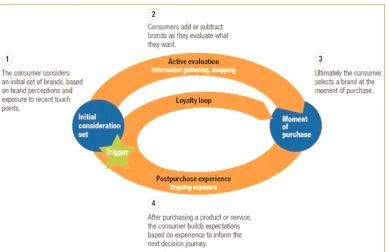
McKinsey developed after the traditional funnel metaphor (figure 2.2) also a version of the customer decision journey. The reason for this development is due to the shift from a one-way communication (form company to customer) towards a two-way communication trough social media, where consumers can respond to companies. The companies marketers needed a more systematic way to satisfy customer demands and manage word-of-mouth (Court, 2009). Instead of using six different phases McKinsey appoints four primary phases, but is using a similar circular consumer decision journey, as shown in the following figure.
Figure 2.4: The circular customer decision journey. Adapted from ‘The consumer decision journey’ by D. Court, D. Elzinga and O.J. Vetvik, 2009, McKinsey Quartely. Retrieved from
http://marketing-made-simple.com/articles/purchase-funnel.htm
The customer decision journey by McKinsey has four phases; initial consideration, active evaluation, closure and post purchase. These four phases representing potential battlegrounds where companies can try to ‘drive home’ the customer. Below the explanation of the different phases.
0. ‘Trigger’ stand for the stimuli that make someone a potential customer.
1. Initial consideration set, the customer considers an initial set of brands, based on brand perception and exposure to recent touchpoints.
2. Active evaluation (information gathering, shopping), customer add or subtract brands as they evaluating what they want.
3. Moment of purchase (closure), ultimately the costumer selects a brand to buy.
4. Post purchase experience (ongoing exposure), after purchasing a product, the consumer builds expectations based on experience to inform the next decision journey.
As result of research it seems that consumers subtract and add brands from consideration during an extended evaluation phases. Reason for this phenomenon is due to the rise of social media, after purchasing the consumer can follow his bought brand online and/or can share content about his experience (Edelman, 2010).
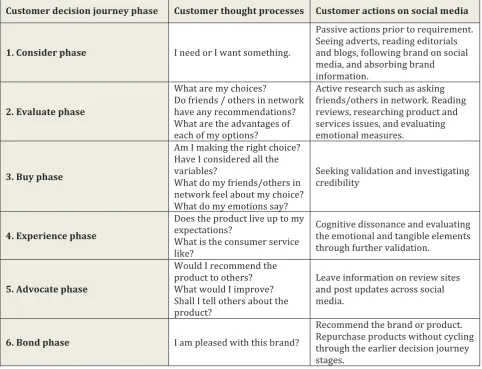
[image:9.595.66.549.211.580.2]Claimed by court (2009) and Edelman (2010) social media plays an important role before and after purchasing a product. The different phases of the customer decision journey are attuned to the possibilities of the two-way communication that occurs on social media sites. Sutton (2011) has combined the different customer decisions journey phases with the actions customers make on social media, as shown in the following table.
Table 2.1
Customer actions on social media during the Customer Decision Journey (Sutton, 2011).
Customer decision journey phase Customer thought processes Customer actions on social media
1. Consider phase I need or I want something.
Passive actions prior to requirement. Seeing adverts, reading editorials and blogs, following brand on social media, and absorbing brand information.
2. Evaluate phase
What are my choices?
Do friends / others in network have any recommendations? What are the advantages of each of my options?
Active research such as asking friends/others in network. Reading reviews, researching product and services issues, and evaluating emotional measures.
3. Buy phase
Am I making the right choice? Have I considered all the variables?
What do my friends/others in network feel about my choice? What do my emotions say?
Seeking validation and investigating credibility
4. Experience phase
Does the product live up to my expectations?
What is the consumer service like?
Cognitive dissonance and evaluating the emotional and tangible elements through further validation.
5. Advocate phase
Would I recommend the product to others? What would I improve? Shall I tell others about the product?
Leave information on review sites and post updates across social media.
6. Bond phase I am pleased with this brand?
2.1.3 Zero Moment of Truth
Where preview explained models of the consumer journey came up with up to six different touchpoints, Google uses a way more simplified model. Google places more emphasis on how customers think about a brand than the different steps a customer takes on the way of eventually buying a product (Gentner et al., 2014). The following figure illustrates a 3-step mental model that has been ‘the mental model of
[image:10.595.86.357.146.256.2]marketing’ for a long time.
Figure 2.5: The traditional 3-step mental model. Adapted from ‘Winning the zero moment of truth’ by Jim Lecinski, 2011, Google.
1. The stimulus, the trigger a potential buyer gets by seeing an advertisement.
2. The Shelf, the customer goes to the store, sees the product for the first time, gets an answer to questions about the product and eventually buys it.
3. Experience, consumer takes the product home and uses it for the first time. Google conducted a comprehended study with 5,000 shoppers across 12 categories.
The goal; ‘show where influence takes places as shoppers move from undecided to decided.’ Google asked shoppers what sources they used to make decisions, when they used it and how influential each source is. The sources an average shopper uses has risen form 5.3 sources in 2010 to 10.4 sources in 2011 (Lecinksi, 2011). Based on the data that was collected during this research Google developed ‘the new mental model of marketing’ as is shown in the figure below.
Figure 2.6: The new mental model. Adapted from ‘Winning the zero moment of truth’ by Jim Lecinski, 2011, Google.
By lining up the results Google saw a fourth step appearing in the marketing mental model, the zero moment of truth. This is when consumers do their research; get smart about alternatives, read reviews, look for coupons and comparing shop. All before going to the shelf. Comparing the ‘ZMOT’ with other steps consumers take (FMOT and SMOT) it pops out as highly relevant and influential (Lecinksi, 2011). In the conducted study of Google 84% of the shoppers said that ZMOT shapes their decision while moving from undecided to decided.
Actions during the ZMOT are split up in four different categories; 1. Search
2. Read reviews 3. Watch videos 4. Ask your network
[image:10.595.82.350.424.532.2]At both, the customer decision journey ‘phases’ and at the mental model ‘moments’ social media plays an important role while interacting whit the customer (Cohen, 2013). The different ‘moments’ of the mental model are attuned to the possibilities of the two-way communication that occurs trough social media. Cohen (2013) has combined the different ‘moments’ with the social media engagement, as shown in the following table.
Table 2.2
Social media engagement during the moments of truth (Cohen, 2013). Moments
of truth Content marketing needed Social media engagement
ZMOT
1. Blog post answering customer questions.
2. YouTube videos showing how to use your product.
3. Pinterest and Instagram images
Leverage the power of your social media presence across venues to provide product information and answer questions.
FMOT
1. Offer product specifics, product availability, pricing and shipping information.
2. Provide reviews, ratings, customer stories and testimonials
Customers are close to purchase; they are seeking answers to specific questions. If you do not supply them, others in their network (including your competitors) will. Ensure sales and/or customer service representatives present. Also include the company physical address, phone number and email contact.
SMOT
1. Provide targeted information that helps customers use products or helps them to return or fix them. 2. Think in terms of showing customers how to use products. 3. Distribute how-to videos and user guides.
4. Provide or participate in user forums to support customers.
Be available to answer customer questions
LMOT
1. Targeted communications post-purchase. Use this opportunity to ensure that customers are satisfied with the product.
This involves a combination of customer ratings and reviews as well as sharing their product experiences through a variety of platforms including Facebook, Twitter, Instagram, Pinterest and YouTube.
2.1.4 The Customer Lifetime Cycle
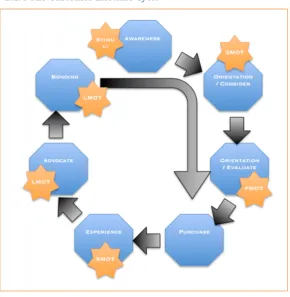
Figure 2.7: ‘The Customer Lifecycle’
In the above customer lifecycle model the moments of truths from Google are combined with the customer decision journey phases. The blue coloured octagons are the required stages a customer goes through before coming loyal to a brand. If loyalty is achieved a consumer will skip the early journey phases ‘consider’ and ‘evaluate’ at their next purchase (Edelman, 2010).
The orange stars in the presented customer lifecycle represent Googles moments of truth. According the researches Google conducted these touchpoints are important moments for shaping customer’s decisions (Lecincki, 2015). The last moment of truth star (LMOT) is added as a result of the findings of the Mckinsey Company (2009) and the researches of David Edelman (2010); the chance of creating a ‘loyalty loop’ increase by give the consumer the opportunity to follow the brand after purchase. Before this research decide if or where instant messaging should be used to improve the relationship with the customer, this research will analyse how customer relationships are built. In addition to the customer relationship, the (social media) channels companies use to communicate with their customers are examined as well.
[image:12.595.67.358.81.379.2]2.2 Social Media
Due to the fact that the described customer decision journey and the new mental model stresses that social media is the key for building up a good relationship, this chapter will indicate what the
characteristics of social media are. Based on the social media characteristics this research examined if instant messaging is applied on the same touchpoints as social media, with the aim to create loyalty among customers.
Social media is defined as "a group of Internet-based applications that is built on the ideological and technological foundations of Web 2.0, and that allow the creation and exchange of user-generated content" (Kaplan & Haenlen, 2010). Most noticeable part in this quote is; the creation and exchange of user generated content. As described in chapter 2.1.2 The Consumer Decision Journey this exchange part is crucial for creating a loyalty loop. Disadvantage of this description of social media is that it is described five years ago. The Internet is changing rapidly and it seems above definition of social media has become a little vague (Nations, 2015).
These days social media is an expression that is use a lot, often describing what people post on social media sites like Facebook and twitter, but also describing what people post on apps like Instagram, Pinterest and Snapchat. At almost every (new) website on the world wide web users can post context, for example; websites including blogs, video content websites (YouTube and Vine), Wikipedia websites and even pages with memes such as 9gag. This phenomenon is making the term social media almost
applicable for every website nowadays. Due to this reason most people and companies refer to ‘online social networking’ when talking about social media. The term ‘online social networking’ referred to an online platform (with profiles) to build social relations among people who have similar interest,
backgrounds, activities or real-life connections (Ellison, 2007). Most famous and used social network site in The Netherlands is Facebook, followed by YouTube, LinkedIn and Twitter (Turpijn et al., 2015). These social media websites are particularly useful for the customer decision journey because of their user-generated content sharing opportunities.
By splitting up the term ‘social media’ in two individually words create a broader but more simplify definition. The ‘social’ part’ refers to interacting with people by sharing and receiving information including a sender and receiver. Also known as two-way communication (Scaglione, 1988). Creating a two-way interaction with the customer comes back in all the described strategies in this paper and is seen as the goal of the concerned strategies. The ‘media’ part refers to a tool of communication, like the
Internet. So a more basic broad definition for social media; ‘A web-based communication tool that enable people to interact with each other by both sharing and consuming information (Nations, 2015).
According the zero moment of truth the smartphone becomes more important and plays a key role in the customer journey. The basic communication functions on a phone such as calling or text messaging are not web based and therefore not seen as social media. The so-called ‘instant messaging applications’ on the other hand offers more perspective (further explained in chapter 2.3 Instant Messaging). Knowing that instant messaging diverse from the ‘classic’ social media channels such as Facebook and Twitter this study investigates what the influence of instant messaging tactics is on loyalty during the customer journey.
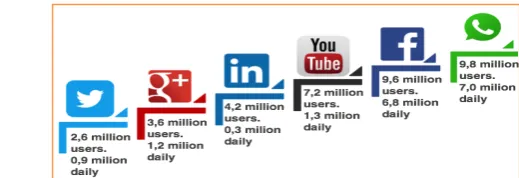
Since 2010 Newcom Research & Consultancy conducts a large-scale study about the social media use among Dutch citizens older than 15 years. This longitudinal study shows that social media platforms are very popular among the Dutch citizens. The number of users has grown in recent years; 9 out of 10 Dutch people are active on social media in 2016. The largest platforms used in the year 2016 WhatsApp; 9.8 million users, Facebook; 9.6 million users and YouTube; 7.2 million users (van de Veer, 2016). Some interesting conclusions from this report are:
• WhatsApp is the largest platform in 2016. Facebook and YouTube continue to grow
• Facebook is growing especially among the elderly, youth drop stabilizes in 2016.
[image:13.595.105.365.665.754.2]• The use of social media continues to rise, concerns about privacy are high.
WhatsApp is originally build as an instant messaging service but due to it large platform of users, content share options and social media characteristics WhatsApp nowadays is often seen as a social media channel (Newcom Research & Consultancy, 2010). This research will not participate in the discussion if WhatsApp is classified as social media but will look at the possibilities of this media for creating loyalty among consumers.
Next to the conclusions of the rapport from New Research & Consultancy the statement of Fred Wilson is favourable for the implementation of instant messaging into the consumer journey. Wilson (2014)
predicts that social media platforms are matured and that there is almost no more room for innovation, he also claims that ‘messaging’ will be the new social media. According Thompson (2014) the fourth
computer era has arrived, after the three eras of PC, Internet and mobile this era will be dominated by messaging services. At last Marcus (2015), CEO PayPal and head Facebook’s messaging department states to companies; ‘Implement your own WhatsApp channel, or your simply not involved’. He also claims that he wants to reinvent the messaging between customers and companies.
[image:14.595.93.292.315.476.2]All the above-described predictions are favourable for the implementations of instant messaging service, therefore this study aims to investigate how and where instant messaging should be implemented during the customer journey to create loyalty among customers. This research focuses on the Dutch population but it is interesting to check if the trends among social media and instant messaging in the Netherlands correspond with trends worldwide. Below an overview of the monthly active users of the top four social networking applications and the top four instant messaging applications.
Figure 2.9: Messaging Apps Have Surpassed Social Networks. Schlicht, M (2016).
The conclusions that is drown from the above study; the four biggest messaging applications have seen a huge increase in users since 2014 and now even have more users than the big four social networking applications. These figures are worldwide measured but similar to the trends in the Netherlands (see figure 2.8: Top 6 most used platforms). In general, more people use instant messaging than people use social networking applications. If a company wants to be where the people are, they need to be inside the instant messaging applications.
The most powerful company worldwide in the social media and the instant messaging business is Facebook. Alongside the famous social networking website facebook.com they are in possession of one of the most popular instant messenger services; Facebook messenger which is integrated within the Facebook social networking application and the popular (especially in the Netherlands) application WhatsApp. These two instant messaging applications process sixty billion messages each day, which is three times more than text messages sent each day on the absolute peak of texting (Facebook F8
2.2.1 Current Channel Strategies
Social media is popular among the Dutch population (van de Veer, 2016) and improve customer
relationship (Edelman, 2010) (Mckinsey Company, 2009). The characteristics of social media match with the characteristics of instant messaging (Newcom Research & Consultancy, 2010), additionally instant messaging applications are nowadays more used that social networking applications. Instant messaging can only be used trough a channel that communicates using a smartphone. The following part highlights the current channels companies use reach out to their customers, the focus is on finding possibilities for smartphone and instant messaging use.
There are four different channel strategies, below the strategies are ranked from old fashion to a more modern way of communicating with the customer. In addition, the different channel strategies are shown in figure 2.10.
1. Single channel: customers can buy through one channel.
2. Multichannel: customers can buy through multiple channels, compare physical shop and web shop, but the channels operate independently.
3. Cross-channel: customers can purchase products and switch between different channels during this process, the sale takes place on one of these channels (Wallace et al., 2004).
4. Omni-channel is an evolution of multi-channel and cross channel. The goal is to optimally serve consumers through multiple channels.
According the blog of Van der Kooi (2015) on frankwatching.com is Omni-channel the latest development in channel strategies.
More than Multichannel and Cross-channel, Omni-channel is more an ideology that is pursued. In this ideology, the customer is placed central while the channels are rotating in harmony around him. The channels complement each other and complement such that there is synergy. Each channel has its own unique properties and therefore can fulfil a specific purpose (Piotrowicz et al., 2014). Nowadays a
[image:15.595.112.438.451.579.2]customer does not distinguish between channels, consumers do not see a channel, but a brand. Customers do not buy or orientate in a (web)shop, but they buy (for a reason) a certain brand. Depending on timing, location or ‘phase’ (consider phase, evaluate phase or buy phase) they choose a channel that fits best at the time. The customer must be able to move seamlessly between the channels (Verhoef et al., 2015). The smartphone plays a key role, because this device connects the online world with the offline world and the customer has this device with them in the (physical) shop (Agrebi et al., 2015).
Figure 2.10: Different channel strategies. Adapted from ‘all you need to know about Omni channel’ by Marketing Abacus. Retrieved from http://www.abacus.nl/wat-is-omnichannel
On the blog of Frankwatching Van der Kooi (2015) explains that customer relationship management is more imported than it has ever been before. Customers increasingly choose a channel where they already operating, companies and brands follow afterwards. With this fast switching behaviour of the customer between devices (tablet, desktop, laptop, smartphones) and communication channel (Facebook,
Instagram, LinkedIn, email, WhatsApp) the customer also expected that organizations switch that quickly.
‘ Sending the right message, to the right person, through the right channel, at the right moment. ‘
2.2.2 Social CRM
The Omni channel concludes positive for smartphone use and therefor positive for the possibilities for instant messaging. The social CRM strategy combines social media with the channel where the customer is already active, according van de Veer (2016) the smartphone. The next paragraph will highlight the characteristics of the social CRM strategy to find out if these characteristics are applicable for instant messaging as well.
The first part of the literature review concludes that being active on social channels is extremely
important to build loyalty among customers. Therefore, a detailed look to the social channels strategies is required. Beside on the Marketing Technology Trade 2015 Will Dongeleur (2015) emphasized the
importance of social media channels by combining the Omni-channel strategy with Customer Relationship Management, the so called Social CRM. The Omni-channel strategy explains it is about communicate through the channel where the customer on that moment already active is. The social CRM strategy amplifies this by engaging customers through social media with goal of building trust and brand loyalty (Kotadia, 2010).
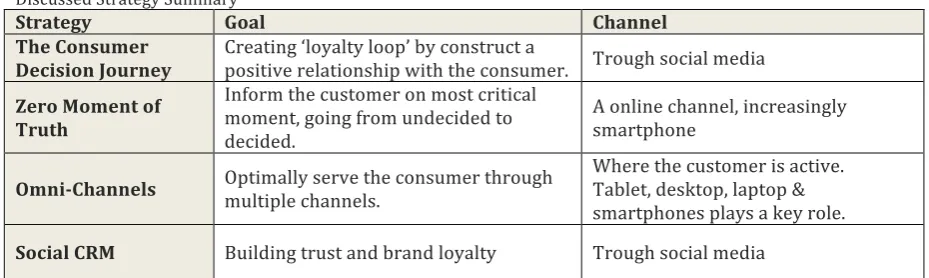
[image:16.595.64.529.521.660.2]To understand how customers should be engaged through social media the term social CRM needs to be dissects; Social CRM combines the features of Web 2.0 and social networking with the current CRM system (Mohan et al., 2008). The web 2.0 describes websites that emphasize user generated content, usability and interoperability. Web 2.0 sites allow users to interact and collaborate with each other in a social media dialogue (Maness, 2006 and O’Reilly (2007). Examples of Web 2.0 are; video sharing sites, blogs, wikis and social networking sites. The customer relation management part of social CRM has little in common with technologies from a traditional CRM system but stands for a company strategy. The purpose of social CRM is getting closer to customers, holding conversations with customers, creating customer engagement and building stronger relationship with the customer (Faase et al., 2011). The best way to achieve this is by creating a two-way interaction between customer and company where the customer has the leading role during this conversation (Greenberg, 2009). Again the two-way interaction comes forward in a popular strategy, a smartphone is designed for having conversations therefore it is suitable to use during the social CRM strategy. This given is positive for the use of instant messaging, how instant messaging is applied on smartphones is explained in the next chapter; 2.3 Instant Messaging. Creating a two-way interaction with the customer comes back in all the described strategies and is seen as the key element to achieve the goal of the concerned strategies. The goal of these strategies slightly differs from each other (see table 2.3) but all focus on creating a positive relationship and serving the customer optimally. Remarkable is the shift from the traditional sale focused AIDA model (Strong, 1925), to the present relationship building strategies. The following table shows an overview of the treated strategies and their matching goal and channels.
Table 2.3
Discussed Strategy Summary
Strategy Goal Channel
The Consumer Decision Journey
Creating ‘loyalty loop’ by construct a
positive relationship with the consumer. Trough social media Zero Moment of
Truth
Inform the customer on most critical moment, going from undecided to decided.
A online channel, increasingly smartphone
Omni-Channels Optimally serve the consumer through multiple channels. Where the customer is active. Tablet, desktop, laptop & smartphones plays a key role.
Social CRM Building trust and brand loyalty Trough social media
By summarizing the goals and channels of the concerned strategies in the above showed table the following trends are concluded:
• Companies should focus on relationship building with the customer.
• Creating a ‘loyalty loop’ during the consumer decision journey.
• Building trust and brand loyalty.
• Be present on the critical moments (deciding to buy or not to buy a product).
2.3 Instant Messaging
The applications that give the user the opportunity to send messages to other users are named instant messaging. The definitions of this type of communication is stated as followed: Instant messaging (often shortened as IM) is the exchange of text messages through a software application in real time. One of the features an instant messaging applications has is the function to see if your chat partner is online and connected through the selected service (day et all., 2000). The applications are mainly based on text sending but most (used) applications also support video chat, file sharing and sending voice messaging. The following table contains an overview of the most popular used instant messaging applications. Table 2.4
Instant Messaging Applications (Corpuz, 2015).
Instant Messaging App Features Special Features
WhatsApp Easy setup, send text, photos,
voice and video
Ad-free, Most use chat app in The Netherlands
Viber Send text, emoticons, photos,
voice and video
Call non-viber numbers
Yahoo Messenger Cloud-based photo sharing, GIF
search
Offline mode, Social media features PlayStation Messages Chat for PlayStation users Focus on gamers and games
Telegram Encrypted messaging Secure mode, self-destruct
Signal Military grade encryption Open source
Blackberry Messenger Control who sends you text PIN system
Facebook Messenger Messaging for Facebook users. PC
based Larges worldwide network 7 million Dutch users
Skype Focus on video and call Call to landlines
WeChat Friend Radar, People Nearby 438 million users. Dominates
Chinese market
For this research an instant messaging application including the following two conditions is desirable; large market share on the Dutch market and build for primarily smartphone use (this due to the recommendations of the zero moment of truth and the Omni channel strategy). In the Netherlands the most used instant messaging applications are; Facebook Messaging and WhatsApp (Corpuz, 2015). The Facebook Messenger is built within the Facebook application, as result the same (Facebook) network is used, therefore users do not need a smartphone to operate this application. According the zero moment of truth and the Omni-channel strategy the smartphone becomes more important and plays a key role in the customer journey. Based on these earlier findings in the literature study the online channel with the most opportunities within the consumer journey is the smartphone. WhatsApp is for that reason the most applicable instant messaging application for this study, chapter 2.5 Implementation of WhatsApp, focuses on the instant messaging application WhatsApp.
‘ Messaging is where we spend a ton of our time and expect to communicate. It is ridiculous we still have to call most businesses. ‘
2.4 Loyalty
The first part of this literature study concludes that loyal consumers will skip the early journey phases ‘consider’ and ‘evaluate’ at their next purchase, the so called loyalty loop (Edelman, 2010). According the Mckinsey Company (2009) and the researches of David Edelman (2010) the chance of creating a ‘loyalty loop’ increases by given the customer the opportunity to follow the brand after purchase, respond to the phenomenon of content sharing and meet all the consumer expectations. The opportunity to follow the brand after purchase match with the previously described social media characteristics. By looking deeper into the literature, this part of the research aims to find other features that influence the loyalty of a consumer and aims to characteristics of a customer indicating loyalty.
Richard Oliver (1999) contribute a whole research to get an answer to the question: ‘Whence is a consumer a loyalty?’ Consumer loyalty and satisfaction are connected to each other; loyal customers are satisfied customers but it is not guaranteed the other way around; a satisfied customer is not
automatically converted to a loyal customer. According the research of Oliver (1999) the factors superiority of the product, determination and social bonding influence the loyalty of a customer.
Ranade (2012) follows up that loyalty is seen as a customer believes that the brand or product is their best option, the customers think the bought product fulfils the best value proposition. Therefore, the customer wants to do business with a certain brand, even when there may has been a problem with the product. This phenomenon can occur due to the reason that the company where the product is bought has been good to the consumer in the past. This loyal behaviour is recognized by that the consumers does not seek for other companies but are willing to stick with the chosen company even when they need to put extra time and/or effort into communication with the concerned company (Ranade, 2012). In the same article Ranade (2012) describes other factors that recognizes a loyal customer:
• Likelihood to recommend the bought products/company to others
• Likelihood of purchasing other product of the same brand/company
• Likelihood of continue purchasing products form the same brand/company
• Believing that products from the company are superior comparing to products from others
• Not seeking to alternative products, brands or companies
• Giving the company/brand the opportunity to correct problem, without compromising the build-up relationship.
The above describe loyalty characteristics are of importance to measure the effect on loyalty of the different instant messaging tactics. Due to this reason these points will be used as input for the questions in chapter three.
2.4.1 Customer Relationships
The goal of all the treated strategies in this study slightly differs from each other (see table 2.3) but all focus on creating a positive relationship and serving the customer optimally. Before diving into the possibilities of instant messaging during the customer journey this section want to state clearly what customer relationships is.
According the commitment- trust Theory of Relationship Marketing from Morgan and Hunt (1994) two factors must exist before a relationship is successful, trust and commitment. In comparison with short-terms goals such as profit, relationship-marketing focus on the long-term goals, forming bonds by meeting the customer needs and honouring their commitment. When the strategies are applied well, the customer will trust the organization and the mutual loyalty helps both parties fulfil their needs (Morgen & Hunt, 1994). The first factor trust means; the confidence both parties in the relationship have that the other party will not do something harmful of risky. The second factor commitment; involves a long-term desire for a partnership (Brink & Brendt, 2008). This desire ensures that the company invests in developing and maintaining a relationship with it customer. Result of a relationship that is built on trust and commitment is that the customer not only gets the product, the customer feels valued as well. In return the company receive loyalty from the customers, which ensures that the customer at the next purchases will not consider another set of companies but stays loyal to the company where the
2.5 Instant Messaging Tactics
On basis of the existing literature this research aims to see a distinction on how companies should use instant messaging. Every customer is different and therefore need another approach (Meyer et all., 2007). By looking at different customers and the different relationship with these customers this chapter creates different customer relationship groups. Matching these different customer relationships with different customer approaches will result in personas and the corresponding instant messaging tactic. 2.5.1 Different Customer Relationships
According the business Model Canvas there are nine business model building blocks, the customer relationship block describes different examples of relationships (Osterwalder et all., 2010). By pointing out the different relationship types and link them to the different instant messaging features the earlier presented customer life cycle is extensive with more detailed information on how companies should use instant messaging.
1. Personal Assistance
A relationship based on interaction between the customer and the company. The client communicates with a real person. Such assistance is performed during sales and/or after sales. This form of customer relationships is often used at accounting firms and consulting companies.
2. Dedicated Personal Assistance
Most intimate and hands on personal assistance relationship off the different described customer relationships. Within this relationship it is common to assign a representative to handle all the needs and questions of these customers.
3. Self-Service
A relationship in which there is no direct relationship, so an indirect relationship between a company and the customer. The company provides resources that allow customers to help themselves effectively and easy. This kind of relationship is often seen in web shops.
4. Automated Services
This type of relationship is a digital relationship through automated services. It is similar to self-service but more personalized and it has the ability to identify individual customers and their corresponding preferences. This type of customer relationship is found at an automated help desk and at companies that send newsletters to their clients. Automated services relationship is also often applied when companies are solely online like Amazon.com and Bol.com.
5. Communities
A company wants to show more commitment to the customer, companies facilitate a community for their customers. Within these community platforms customers can share knowledge and solve problems (user-generated content is favourless for loyalty (Edelman, 2010)). This form is suitable for specific groups with specific problems / needs.
6. Co-creation
A superlative form of communities is co-creation. Together with the customers input a company creates new value, during this process their products better aligned with the expectations and needs of the customer. Through this process the engagement of the customer will increase and the chance of becoming loyal to the company increases (Osterwalder et all., 2010).
Instant messaging is highly suitable for customer relationships that require a lot of personal contact, for instance the (dedicated) personal assistance. This is due to the fact that instant messaging is in
comparison with other (social) media a quite closed platform, hereby the customer feels personally helped. The low degree of openness and by the easy approachability instant messaging triggers the customer to fully express themselves.
2.5.2 Chatterbots
Alan M. Turing (1950) once opened his research paper with the following famous quote: ‘I propose to consider the question, ‘Can machines think?’ Turing developed a philosophical framework to find an answer to this question. The most famous section from Turing’s philosophical framework is ‘The Imitation Game’. This test was to assess a machine’s ability to exhibit intelligent behaviour equivalent to, or
indistinguishable from, that of a human (Turing, 1936). A ‘Chatterbot’ is a computer program, which conducts a conversation through textual methods (Mauldi, 1994). Chatterbots are highly suitable to pass the ‘Imitation game’ of Turning. 60 years after Turing’s death on 7 June 2014 the first chatterbot ‘Eugene Goostman’ past the Turning test (C.A.C.M Staff, 2014).
Due to the fact that a chatterbot can imitate human behaviour, a chatterbot can replace an instant messaging user. As mentioned in the introduction of this research the biggest messaging application in china WeChat is making use of the chatterbot technique. Beside WeChat the CEO (mark Zuckerberg) of Facebook Messenger and WhatsApp invite more developers and business to build bots for his instant messaging services (Olson, 2016). The use of chatterbots for leisure, imitating a (fictive) person (for example the chat account of Miss Piggy) or a simple (poker) game within the chat application belongs to the modern options a chatterbot can perform (Luckerson, 2016). From this commercial research point of view not interesting for further analysis.
The chatterbot applications focused on business is seen as an instant messaging tactic. The bot can answer continuously, on simple questions concerning opening hours, directions, terms and conditions or handle simple orders. The big advantage compared to a real person answering the incoming messages; a chatterbot can replay within seconds, in multiple chat conversation at any time of the day (Olson, 2016). These facts are consistent with the findings of Duursma (2016) about the implementation of WhatsApp for business. One of the conclusions off his research mention that the biggest challenge of implementing WhatsApp in a company is the response time; ‘only start with WhatsApp if you are sure you can respond quite quickly. Otherwise, this is a difficult medium’ (Duursma, 2016). By using chatterbots this
requirement is met. 2.5.3 Tactics
A strategy is a larger, overall plan (that can include several tactics), has a broad perspective and is oriented on the future. A tactic is defined in literature as a conceptual action aiming at the achievement of a goal and or strategy. Tactics contains tasks, procedures or plans that are carried out and may be part of a larger strategy (Sundar, 2007). According the research question of this study (‘What is the influence of instant messaging tactics on loyalty during the customer journey’) the strategy is to create more loyalty among customers. A tactic address how a company should succeed in making customers more loyal by deploying instant messaging on the different touchpoint during the customer journey.
Personas are defined as ‘fictitious user representations created in order to embody behaviours and motivations that a group of real users might express, representing them during the project
development process’ (Junior, & Filgueiras, 2005). In other words, personas are representations of target group user(s), in this research they are called customers. The use of target group user profiles and
personas have a lot of advantages; one of the benefits of personas is to enable the sales team of a company to identify the target group and to communicate effectively with them (LeRouge et all., 2013).
By combining the different customer relationships, phases of the customer lifecycle and customer touchpoints this research aims to creates three different groups of fictitious customers, the so-called persona’s. On this basis of these persona’s different instant messaging tactics will be assigned, these tactics will be implemented in the Instant messaging reference model.
Four from the six different described customer relationships have favourable characteristics for instant messaging;
Personal assistance,
Dedicated personal assistance, Automated services,
Co-creation.
The following phases in the customer lifecycle are suitable for instant messaging: Orientation consider / evaluate,
Purchase, Experience,
Advocate,
Bonding loyalty loop
• Persona 1 Whole Journey Service Tactic
+ Orientation consider / evaluate, Purchase and Experience phase This first persona describes a customer who wants personal assistance during almost the whole journey; after getting the motivation / stimuli to buy a certain product, this type of customer wants or needs information on each touchpoint in the customer journey. By interacting trough instant messaging the customer is guided through the whole process of buying a product, from giving product information till sending a payment link. Due to the reason that this type of customer needs or wants a lot of personal assistance before purchase, this persona also has a high need of assistance after the purchase on how the product is used. The need of assistance after sales matches with the SMOT touchpoint in the Experience phase. When the communication between this persona and the company is good, instant messaging is used for follow-up or new sales in the last phases of the customer journey.
• Persona 2 Chatbot Service Tactic
+ Orientation consider / evaluate, Purchase and Experience phase The seconded persona is aimed at the consumer that wants immediate answers on relativity simple questions. Just as the first persona this customer goes through the same stages, however, there is less need for specific customized information. This type of customer does not want to read through long product specifications, instructions or the Frequently Asked Questions pages, but wants a quick answer to questions or place an order. For example, a customer wants to visit the cinema next week. By sending a text message with the question: ‘Which movies are playing next week?’ followed up by;’ What day and time is movie X playing?’ After the customer has confirmed the movie, the chatterbot sends the available seat numbers including a link with a payment request. When for example a product needs to be returned, the chatterbot can serve this consumer by sending information that helps to return the bought product.
• Persona 3 After-sale S’erviceTactic + Experience and Advocate phase
At this type of consumer, it is all about the SMOT and the LMOT, the after sales communications. This persona is open for customer relationships build after the product is bought. By asking feedback as a company this consumer feels important and appreciated (Osterwalder et all., 2010). In the Advocate phase the consumer leaves information on review sites and post updates across social media (Sutton, 2011). This persona wants to be involved in further development of the product. If satisfied, this consumer remains engaged with the brand through social media after purchase, which increases the chance that the consumer becomes loyal to the brand (Edelman, 2010). This engagement is set up through instant messaging because that is the online channel where the customer is most active. By combining different customer relationship types with the different phases from the customer lifecycle the three above describe personas are created. The personas describe how different customers want to be treated during their customer journey, by adding the instant messaging possibilities to these customers creates the following tactics;
Table 2.5
Instant Messaging Tactics.
Customer Relationship Type Instant Messaging Tactic Title of Tactic
Personal Assistance Communicate with real person during whole
customer journey Whole Journey
Service Dedicated Personal Assistance One-on-one conversation on a closed platform,
personal guidance during entire purchasing process
Self-Service No need for instant messaging None
Automated Services Chatterbot, automatic reply Chatbot service
Communities Other (social) media offer better characteristics
for creating a community After-sale
service
2.6 Implementation of WhatsApp
To get a clear picture on how instant messaging should be use, this chapter illustrate some field case examples. WhatsApp is the chosen instant messaging application to serve as case example. The reason for using WhatsApp is based on the fact that WhatsApp is the most used instant messaging service within the Netherlands.
2.6.1 WhatsApp Business Applications
Before implementing the instant messaging tactics into a new designed customer journey the four different WhatsApp business applications, the added value and some case examples of WhatsApp are described.
The way WhatsApp is implemented for company use is distinguished in four different ways:
1. Share button to WhatsApp, a quick way to let users share a website or service with other WhatsApp users.
With the share button to WhatsApp on a (mobile) website or an app, users can share content or sending a page to contacts or groups within WhatsApp. The share button is the least intensive way to fit WhatsApp in a company. Most sites use some kind of share buttons to quickly share pages on Facebook, Twitter and now it is also possible for WhatsApp. Links that are shared by Facebook, Twitter are public but WhatsApp sharing data always comes into an atmosphere of trust, according Duursma (2015) this is favourable for customer trust.
2. Mailing list within WhatsApp, possibility to create a mailing list of recipients to approach a target audience with a message directly.
With the mailing list option in WhatsApp a company can send a message to a list of recipients. Just like a normal chat message text, photo, voice clips, video, location or contact information is send this way. Messaging in a mailing list is only possible if the recipient has the senders phone number in their contact list, this is a measure to prevent spam. Another measure from WhatsApp to prevent spam is the maximum amount of 256 recipients in each mailing list, but it is allowed to create multiple mailing lists.
3. Group chat in WhatsApp, approach more people in a group chat.
Group chats on WhatsApp are group discussions, where participants (with a maximum of 99) can send each other text messages, photos, videos, voice clips and locations.
Group chats differ crucially from the mailing lists. In a group chat recipients are together in a chat group. They can see each other's contact data without restrictions and read each other's messages. Group chats lend themselves for discussions without interaction from the outside word. Important note is that there is no control over the chat, if the group is fanatically in exchanging messages, there is a chance that own (company) send messages quickly disappears from sight.
4. Web care through WhatsApp, improve customer relationship by answering questions posed by customer trough WhatsApp.
2.6.2 WhatsApp Business Cases Examples
According the described implementation options WhatsApp is used for similar objectives as social media. If implementing social media in a customer journey to build a better customer relationship is the mail goal, sub goals for creating a better customer relationship are inter alia; engage customers, inform customers, persuade customer and bind customers (Gummerus et all., 2012). With the four discussed functions WhatsApp is used to achieve the same goals. To get an overall picture on the four discussed WhatsApp implementation, several business cases are presented.
1. Styling advice in the clothing industry
With WhatsApp users/customers can send simple (clothing) graphics. Clothing brands give their customers advice by sending recommended clothing. Some brands (Zalando, Wehkamp and Bijenkorf) are still testing, while other brands have the necessary experience. Suitsupply has its CRM system linked to WhatsApp, therefore payments are possible with a simple link within the WhatsApp application.
2. Questions for airline companies
Airlines companies (like KLM and Transavia) use WhatsApp mostly as a customer service. For example, customers have booked a trip but still have a question about the luggage conditions? Customers can make this easy and quick by sending the question trough WhatsApp.
3. Citizen municipalities
The channel is fast, accessible and citizens do not have to leave their house. WhatsApp for municipalities is seen as citizen service; where can I put my trash? Or what is the price of a new passport?
4. Support for insurance
An accident report is time consuming, but through WhatsApp it goes much faster; scan, e-mail is no longer needed according Ditzo, Interpolis and Ohra. These companies made promises about rapid response. According them this is crucial, the same applies to the 'opening' hours of the service.
5. Apply for a job
The youth often use WhatsApp. Employment agencies (Young Capital) anticipate on this
phenomenon with the possibilities of applying for a job by sending a video message. This way the agencies immediately see if someone has a customer-friendly appearance and it offers a candidate an easy opportunity to show enthusiasm for the job.
6. Support for banking
SNS, ING and ABN are testing the use of WhatsApp since 2015. WhatsApp is maybe not suitable for balances and privacy-sensitive information, but it can help with simple explanations of the national budget, new regulations or when a customer does not have the time to check the opening hours online (on a website), a simple message could solve it.
7. Grocery shopping
Send your grocery-shopping list (to Spar or Albert Heijn) by WhatsApp and within an hour the grocery will be delivered at your door (Duursma, 2015).
Most of above mention companies are using the ‘web care’ and the ‘mailing list’ option of WhatsApp and experienced the use of it positive. According the companies of the described cases the most difficult aspect of using WhatsApp is the preferred fast response time towards the customer. They also emphasize that the business use of WhatsApp will grow the upcoming years.
2.7 Instant Messaging Reference Model
Based on the findings in chapter 2.1.2 The Customer Decision Journey and chapter 2.1.3 Zero Moment of Truth a new customer journey model is presented. One of the conclusion that is drawn after this literature study; instant messaging has enough similarities with the social media characteristics to ensure the same effect; creates loyalty among customers during the customer journey. During the designing of the new reference model the following points are taken into account; the latest trends such as smartphone use (Googles Zero Moment of Truth) and focus on customer relations by using two-way communication trough social media (Edelman, 2010), the different customer relationships and the possible
implementation of the instant messaging application WhatsApp. Table 2.6
Instant Messaging Reference Model. Customer Lifecycle Phase Customer Relationship Type Touch point
Title of the Instant Messaging Tactic
Customer Action Company
Action Instant Messaging Tactics Implementation 1. Awareness
None. Stimuli None. The trigger a potential buyer gets by seeing an advertisement.
Make sure the target group sees the advertisement. None. 2. Orientation Consider (Dedicated) personal assistance & Automated services
ZMOT Whole Journey Service & Chatbot service. Seeking (online) information.
Be present (on social media) to provide product information and answer
questions.
Show instant
messaging number on site. Make sure the company is reachable to provide product information. 2. Orientation Evaluate (Dedicated) personal assistance & Automated services
FMOT Whole Journey Service & Chatbot service.
Sees the product for the first time, gets an answer to questions about the product. Customers are close to purchase; they are seeking answers to specific questions. Show instant messaging number with the product. Be reachable for questions. Anticipate on customer needs. 3. Purchase (Dedicated) personal assistance & Automated services
Buy Whole
Journey Service & Chatbot service.
Buys the product. Online or offline, make the payment easy approachable.
Send the customer a personal payment link.
4.
Experience (Dedicated) personal assistance &
Automated services & Co-creation.
SMOT Whole Journey Service, Chatbot service & After-sale service.
Consumer takes the product home and uses it for the first time.
Be available to answer customer questions.
‘Webcare’
answer questions posed by customer.
5.
Advocate Co-creation.
LMOT
After-sale service.
Combination of customer ratings and reviews as well as sharing their product experiences through a variety of online platforms.
Facilitate online platforms where consumers can place and share content (public).
‘Share button’ for sharing content with other users and involve the consumer in product development. 6. Bonding Loyalty loop Co-creation.
LMOT Whole Journey Service &
After-sale service.
Recommend the product. Repurchase products without cycling through the earlier customer journey phases.
Stay connected with the consumer for follow up sales or stimuli to buy other products.