Dealing With Existential Themes In Acceptance And Commitment Therapy
A Qualitative Interview Study
Sebastian Wilms Master Thesis (10 EC) Enschede, The Netherlands
2016
Supervisors Dr. Elian de Kleine Drs. Vincent van Bruggen
Faculty of Behavioral, Management and Social Sciences
2 Abstract
3
Existential themes, like death anxiety and meaning in life do not play an important role in traditional Cognitive Behavior Therapy (CBT) and it remains unclear, whether CBT interventions are helpful for existential anxieties (Bunting & Hayes, 2007; Grober, Heidenreich, & Rief, 2016; Prasko, Mainerova, Jelenova, Kamaradova, & Sigmundova, 2012; van Bruggen, Vos, Bohlmeijer, & Glas, 2013). Since the trend in the Netherlands leans towards the use of CBT as the mainstream psychotherapy, the question arises whether clients, who struggle with death anxiety and a lack of meaning in life, find adequate help in the current Dutch landscape of psychotherapy. To answer this question, the present paper firstly investigates the importance of death anxiety and meaning in life in the context of psychopathology. Secondly, this paper describes the place of death anxiety and meaning in life in two forms of psychotherapy: (a) Existential Therapies (ET), a number of closely related therapies that among other things, focus on how clients deal with existential questions in life, like death and meaning (Cooper, 2003), and (b) Acceptance and Commitment Therapy (ACT), a third-wave behavior therapy, which is promising to overcome CBT limitations regarding existential themes (Bunting & Hayes, 2007; van Bruggen et al., 2013). Following, a qualitative interview study explores how ACT therapists deal with clients who face death anxiety and a lack of meaning in life. Finally, the paper discusses whether ACT provides an adequate framework to help clients who struggle with existential themes.
The relationship of death anxiety and meaning in life with psychopathology
Death anxiety
4
Also in correlational research, a number of publications indicate a relationship between death anxiety and psychological disorders. Fortner and Neimeyer (1999) found that higher levels of death anxiety were related to more physical and psychological problems, as well as lower levels of ego integrity. Additionally, a study showed significant correlations between existential anxiety (apprehension about death and the meaning of life) and symptoms of depression and anxiety (Berman, Weems, & Stickle, 2006). A recent review on the role of death anxiety in psychopathology, emphasizes the importance of death anxiety as a transdiagnostic factor underlying many forms of psychopathology such as panic disorder, hypochondriasis, anxiety and depressive disorders (Iverach, Menzies, & Menzies, 2014). In line with this, a study on the etiology of hypochondriasis found that an existential model of explaining hypochondriasis through death anxiety, matched better than a perceptual or an interpersonal model of explanation (Noyes, Stuart, Longley, Langbehn, & Happel, 2002).
Although death anxiety is an occurring and measurable phenomenon (Berman et al., 2006; Popescu, 2015), psychotherapy research has not paid much attention to the clinical aspects of death anxiety (Furer & Walker, 2008). Given the broad empirical base of TMT research on death anxiety, several authors therefore suggest to further integrate TMT findings into psychotherapy research (Lewis, 2014; Major, Whelton, & Duff, 2016; Maxfield et al., 2014; Vance, 2014). In conclusion, the existing literature on death anxiety indicates the impact of death anxiety on psychological processes and its relation with psychological disorders, such as depression and anxiety disorders. Therefore, including death anxiety into treatment of psychological disorders, could benefit the therapeutic process.
Meaning in life
The literature on the relation between meaning in life and psychopathology demonstrates the relevance of this concept for mental health. Numerous studies across different populations show that meaning in life is associated with increased well-being and less psychopathological symptoms (Debats, 1996; Fischer et al., 2016; Lucette, Ironson, Pargament, & Krause, 2016; Mascaro & Rosen, 2005, 2006, 2008; Moomal, 1999; Volkert, Schulz, Brütt, & Andreas, 2014; Yee Ho, Cheung, & Fai Cheung, 2010). A series of studies point out that levels of meaning predict changes in depressive symptoms and hope (Lucette et al, 2016; Mascaro & Rosen, 2005, 2006, 2008). Furthermore, lower levels of meaning in life are also related to anxiety and somatic disorders (Moomal, 1999; Volkert et al., 2014; Yee Ho et al., 2010). Additonally, a study with abused women has shown that purpose in life is associated with lower suicidal ideation (Fischer et al., 2016). Other studies also demonstrate the role of meaning in life as a predictor of well-being (Debats, 1996; Dezutter, Luyckx, & Wachholtz, 2015).
5
psychological disorders, demonstrate the need to pay special attention to meaning in life in psychotherapy.
Dealing with death anxiety and meaninglessness in psychotherapy
In the following, it will be investigated how Existential Therapies and Acceptance and Commitment Therapy approach the topics death anxiety and meaning in life.
Existential Therapies
Numerous forms of therapy have emerged under the umbrella of ET such as Logotherapy, the American Existential-Humanistic Approach or the British School of Existential Analysis. This study focuses on the American Existential-Humanistic Approach, as it most explicitly addresses the topics of death anxiety and meaninglessness (Cooper, 2003). Yalom (1980, p.5) defines this approach in the following way: “Existential psychotherapy is a dynamic approach to therapy which focuses on concerns that are rooted in the individual's existence”. He argues that the existential givens of being human, play an underlying role in many forms of psychopathology. In this context, he proposes a classification of existential themes into four ultimate concerns that all humans have to face and which are the roots of humans’ anxieties and psychopathology (Yalom, 2003). These ultimate concerns are (a) death anxiety, the realization of our finitude and the inevitability of death; (b) meaninglessness, the realization that there is no absolute meaning and that the individual has to create meaning itself; (c) freedom, the possibility but also the necessity to choose, which also entails that we are responsible for our choices and (d) isolation, the unbridgeable gap between you and your surroundings or other persons. Following this framework, psychopathology is the consequence of using non-adaptive defense mechanisms in trying to ward off the existential anxieties (Yalom, 1980). This implies discovering and identifying defense mechanisms that are functional to avoid the painful death anxiety and experience of meaninglessness (Yalom, 1980). Accordingly, it is the therapist’s task to put emphasis on “uncovering the clients’ subjective experiences and encouraging clients to face up to the existential questions which play a part in their lived experience” (Cooper, 2003, p.3).
However, Existential Therapies lack scientific evidence and only recent studies have addressed their empirical efficacy (Vos, Cooper, Correia, & Craig, 2015; Vos, Cooper, & Craig, 2015). This is one of the reasons, why ET are to a large extent unknown and are hardly represented in the overall psychotherapeutic landscape. In The Netherlands, the existential approach is practically not present in mental health care and is also not funded by the health insurances. Therefore, it is unlikely that clients, who face existential anxieties, like death anxiety or a lack of meaning in life, find an existential therapist in The Netherlands.
6
A promising help for these clients could be Acceptance and Commitment Therapy (Hayes, Strosahl, & Wilson, 1999). Several authors state that ACT could overcome the limitations of traditional CBT regarding existential topics (Bunting & Hayes, 2007; Iverach et al., 2014; van Bruggen et al., 2013). Numerous studies underline this view, as they point out distinct similarities between ET and ACT (Badiee, 2008; Bunting & Hayes, 2007; Claessens, 2010; Garcia-Montes & Perez-Alvarez, 2010; Hickes & Mirea, 2012; Ramsey-Wade, 2015; Sharp, Schulenberg, Wilson, & Murrell, 2004). These similarities include (a) a non-pathologising stance towards human suffering and distress, (b) an emphasis on acceptance of suffering as part of our existence, (c) a non-hierarchical relationship between client and therapist, (d) a focus on freedom and choice and also (e) a focus on meaning and values (Ramsey-Wade, 2015).
The framework of ACT is developed in the context of Relational Frame Theory (RFT) (Hayes et al., 1999). RFT is a theory on language and cognition that emphasizes the human capacity to make use of language and develop systems of meaning. Within RFT, it is argued that humans, contrary to animals, are able to establish language-meaning relationships that enable to experience a fear response in an objectively safe situation. As an example, imagine being safe at home, while thinking of a natural disaster, like a Tsunami - Simply this thought can elicit a fear response. Although the situation is objectively harmless, humans can experience anxiety through the connection between a thought and its meaning. The ACT approach that emerges from this theory, focuses on lessening the impact of thoughts, counteracting experiential avoidance and developing psychological flexibility (flexible attention to the present moment) (Hayes, Strosahl, & Wilson, 2012). To help clients develop psychological flexibility, ACT makes use of six core principles: (a) defusion: learning to see cognitions, such as thoughts, memories and images as language processes, instead of objective truths or facts; (b) acceptance: providing room for unpleasant feelings and sensations, instead of avoiding them; (c) contact with the present moment: fostering a conscious awareness of the present experience with openness, interest and receptiveness; (d) self-as-context: letting the client experience the distinction between thoughts and the self that observes these thoughts; (e) values: exploring and identifying the client’s values and meaning in life; and (f) committed action: fostering and supporting value-guided action (Harris, 2006; Hayes & Strosahl, 2004).
7
Therefore, the aim of this research is firstly, to explore to which extend ACT therapists encounter clients with death anxiety and a lack of meaning in life and secondly, how ACT therapists try to help these clients with their existential anxieties. These questions are approached by performing a qualitative analysis of semi-structured interviews.
Methods
In this qualitative study semi-structured interviews were used as method of data collection. The 32-item checklist ‘Consolidated criteria for reporting qualitative studies’ (COREQ) was used to get an explicit and comprehensive description of the research process (Tong, Sainsbury, & Craig, 2007). This chapter is divided into the three sections ‘Research team and reflexivity’, ‘Study design’ and ‘Analysis and findings’, according to the three domains of COREQ.
Research team and reflexivity
The interviews were conducted by the first author, student in a master program for clinical psychology. The researcher had gained prior experience in conducting interviews during his bachelor thesis. The researcher’s interest in the research topic stems from personal engagement with the philosophy of existentialism and Acceptance and Commitment Therapy. There was no relationship established with the participants prior to the study. The first contact with the participants was in context of this study, except one participant who twice gave a lecture in the researcher’s master program. Apart from this participant, the participants had no information about the researcher and his personal motivation or reasons for performing this study. The study design was approved by the ethics committee of the faculty of psychology of the University of Twente.
Study design
Selection procedure
8 Participants
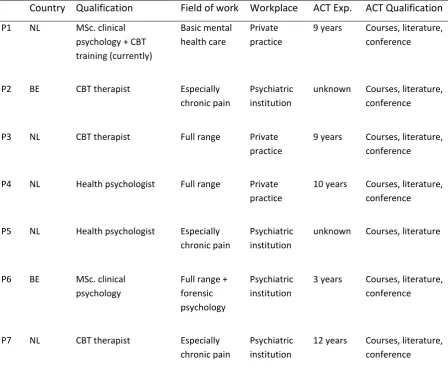
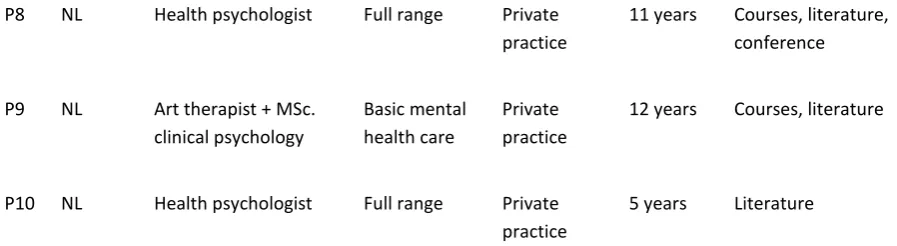
10 participants were interviewed of which eight participants practicing in The Netherlands and two participants practicing in Belgium. In relation to officially-approved qualifications, three of the participants were trained in CBT, four participants absolved the 3-year training to health psychologist, three participants held a master degree in clinical psychology, of which one participant was additionally trained in art therapy. Regarding the field of work, five participants treated the full range of psychological problems, whereas four participants primarily dealt with chronic pain and one participant especially focused on forensic psychology. Further on, six of the participants worked in a private practice, whereas the other four worked in psychotherapeutic institutions. The participants’ experience with ACT ranges from three to 12 years, with a mean of 8,9 years. Regarding the qualification within ACT, all participants studied literature, nine participants absolved a number of ACT training courses and seven participants visited conferences of ACT. Table 1 provides an overview over the participants’ characteristics.
Table 1
Participants’ characteristics
Country Qualification Field of work Workplace ACT Exp. ACT Qualification P1 NL MSc. clinical
psychology + CBT training (currently)
Basic mental health care
Private practice
9 years Courses, literature, conference
P2 BE CBT therapist Especially chronic pain
Psychiatric institution
unknown Courses, literature, conference
P3 NL CBT therapist Full range Private practice
9 years Courses, literature, conference
P4 NL Health psychologist Full range Private practice
10 years Courses, literature, conference
P5 NL Health psychologist Especially chronic pain
Psychiatric institution
unknown Courses, literature
P6 BE MSc. clinical psychology
Full range + forensic psychology
Psychiatric institution
3 years Courses, literature, conference
P7 NL CBT therapist Especially chronic pain
Psychiatric institution
[image:8.595.75.524.380.760.2]9
P8 NL Health psychologist Full range Private practice
11 years Courses, literature, conference
P9 NL Art therapist + MSc. clinical psychology
Basic mental health care
Private practice
12 years Courses, literature
P10 NL Health psychologist Full range Private practice
5 years Literature
Note: Qualification presents the participant’s highest degree. CBT therapist is seen as the highest degree, followed by Health psychologist and a MSc. degree in clinical psychology.
Data collection
Prior to the interview the participants signed an informed consent brochure which informed them of their right to withdraw from the study at any time, the respectful dealing with their privacy, the guarantee of anonymity and the possibility of insight into their audio recording and the transcript of the interview.
[image:9.595.74.523.70.193.2]The interviews were conducted in the period from November 2015 until April 2016. Most interviews took place in an adequate room at the therapists’ workplace. All interviews were conducted in Dutch language. The interview scheme (see Table 2) was used as a guideline throughout the interview. First, information on the participant’s background with ACT was collected. Secondly, the interview questions 2-4 addressed the definition of existential themes and the first research question. Here, the researcher provided two brief case examples of client’s, who struggle with death anxiety and meaninglessness (see Appendix A.). Thirdly, the interview questions 5-6 addressed the second research question. Finally, the participant had the possibility to leave further comments. This interview scheme was pilot tested with the first two participants and no major difficulties with the research procedure were identified. Therefore, it was decided to treat the data from these interviews as part of the main body of data. Furthermore, the interviewer paid attention to take up a non-directive stance as far as possible. No field notes were made during the interview to fully concentrate on the interaction and the participants’ answers. The interviews lasted between 30 and 75 minutes and were recorded with an audio recording device. The transcripts were not returned to the participants for comments or correction.
Table 2
Interview scheme
1. How did you get in contact with ACT and what is your experience with it?
2. What do you associate with the term ‘existential topics’?
10
4. In how far are you encountering death anxiety and meaninglessness in therapy practice?
5. In how far are you addressing these topics? What approaches or strategies do you use?
6. Are you feeling well-equipped to deal with these topics?
7. Do you have any other comments?
Data analysis
The data were coded by the first author and it was made use of the software ‘Atlas.ti’ to manage the data. In a first step, it was made use of deductive coding by linking quotations either to (a) occurrence of death anxiety or meaninglessness or to (b) strategies used to approach the themes. In this context, there was already made a distinction between general strategies and strategies in relation to death anxiety, respectively meaninglessness. In a second step, it was made use of inductive coding to specify the contexts in which the themes occur, as well as the specific strategies. During this second step, open coding was used in combination with a constant comparative analysis. This means that while coding a new quotation, it is always compared to the already created codes. In a third step, thematic categories were developed, followed by analyzing and minimizing redundancy between the codes. Afterwards, the whole data were coded again with the developed coding frame and it was analyzed how the codes and categories relate to each other. The final coding frame consisted of 54 codes (see Appendix B).
Results
The findings are presented in the order of the research questions. Respondents’ quotations were translated from Dutch into English.
Research question 1: To what extend do ACT therapists encounter clients with death anxiety and a lack of meaning in life?
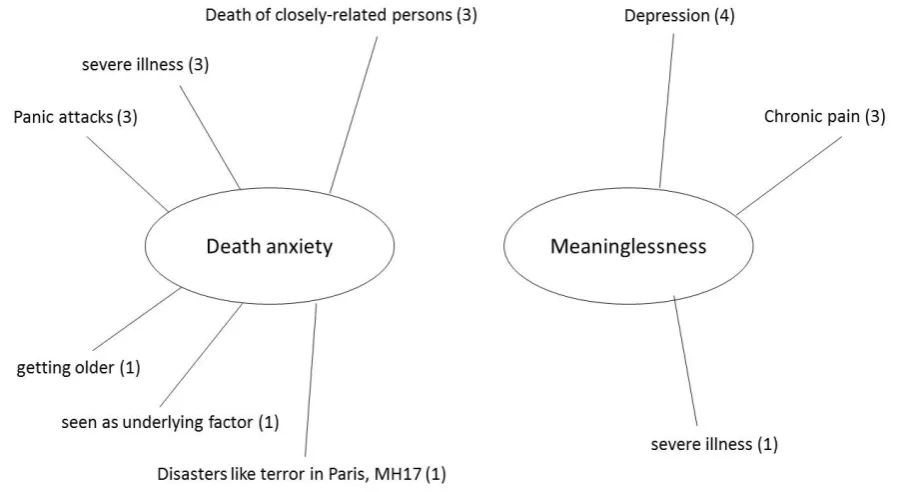
9 out of 10 respondents reported situations in therapy, in which death anxiety, respectively meaninglessness played a role. This section lists the contexts in which death anxiety and meaninglessness occurred and how many respondents reported these contexts, which is also shown in Figure 1.
11
respondent regarded death anxiety as a factor underlying many fears. In relation to panic attacks, clients were afraid of getting a heart attack, which is comparable to clients with a severe illness, who are confronted with vulnerability and their possible death. It speaks for itself that the death of a closely-related person and getting older confronted clients with death and the finiteness of life. In the context of hypochondriasis death anxiety came to the fore in the constant need to check the health status, in worry of being severely ill. In relation to the terror in Paris or the MH17 incident, clients were struck by the fact that also they could fall victim to such a disaster. The sheer arbitrariness and unpredictability of death bothered some clients. Finally, one respondent attributed many common fears, like fear of failure, to death anxiety.
[image:11.595.74.523.407.653.2]Meaninglessness occurred in relation to mood disorders, chronic pain and severe illness. Four respondents reported it in the context of depression, when clients experienced a lack of meaning in life or dealt with important changes in life, like retirement. Regarding chronic pain, three respondents encountered meaninglessness with clients who could not live their life as they did before due to the chronic pain. By that, these clients lost their sources of personal meaning. Concerning severe illness, one respondent referred to clients who have difficulties to find meaning in their future life, due to a severe illness.
12
Research question 2: How do ACT therapists try to help clients with death anxiety and a lack of meaning in life?
Firstly, the strategies that the respondents reported will be presented, organized in the seven thematic categories. Secondly, it will be illustrated that the use of strategies can be clustered into two kinds of approaches. Furthermore, respondents reported that most of the strategies can be used interchangeably for both death anxiety and meaninglessness. Therefore the distinction between death anxiety and meaninglessness in the use of strategies is only made for strategies that are used exclusively for one of the two.
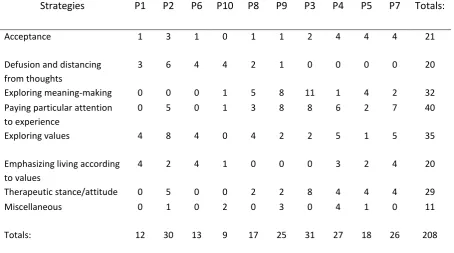
[image:12.595.72.527.462.715.2]It comes to the fore that the respondents use strategies that can be subsumed under seven thematic categories. These categories are (a) defusion and distancing from thoughts, (b) exploring meaning-making regarding death or meaning in life, (c) paying particular attention to the client’s experience, (d) exploring values, (e) emphasizing living according to values, (f) showing therapeutic attitudes, and (g) miscellaneous strategies, which could not be subsumed under the other categories. These categories and their strategies all serve the purpose of fostering acceptance and successful coping among the clients. Thus, acceptance can be seen as an overarching super category, as all respondents aim for acceptance in the end. In the following, the categories and their strategies will be described. An overview over the respondents’ use of the strategies is provided in Table 3.
Table 3
The respondents’ use of strategies
Strategies P1 P2 P6 P10 P8 P9 P3 P4 P5 P7 Totals:
Acceptance 1 3 1 0 1 1 2 4 4 4 21
Defusion and distancing from thoughts
3 6 4 4 2 1 0 0 0 0 20
Exploring meaning-making 0 0 0 1 5 8 11 1 4 2 32 Paying particular attention
to experience
0 5 0 1 3 8 8 6 2 7 40
Exploring values 4 8 4 0 4 2 2 5 1 5 35
Emphasizing living according to values
4 2 4 1 0 0 0 3 2 4 20
Therapeutic stance/attitude 0 5 0 0 2 2 8 4 4 4 29
Miscellaneous 0 1 0 2 0 3 0 4 1 0 11
Totals: 12 30 13 9 17 25 31 27 18 26 208
13 Defusion and distancing from thoughts
Respondents use different ACT techniques of defusion to reduce the impact of thoughts about death or meaninglessness on behavior and emotions. According to respondents, defusion means that instead of identifying with their thoughts, clients should learn to realize that their thoughts are merely thoughts and not the truth. This should create a certain distance towards the thoughts, which gives room for other things. The following quotation illustrates how this room is then used to link to emphasize living according to values.
“Then I try to, how can we create distance towards this thought and how can we achieve, that you are going to do something that is important enough for you?” (Respondent 6)
Furthermore respondents disagree on whether one should explore the client’s content of thoughts and meaning-making regarding death or meaninglessness. Some respondents argue that in context of the Relational Frame Theory, this would be counterproductive to defusion. The following quotation illustrates this view in the context of death anxiety:
“But once the thoughts are articulated, I would use these thoughts only to elicit physical agitation. And then again, to let it go. Thus, I would not remain working on a purely cognitive level [..] And by exploring again and again where the thoughts are coming from, you only train the client in adding more language and you probably only reinforce the network of associations that evoke death anxiety.” (Respondent 2)
Exploring meaning-making regarding death or meaning
Respondents reported to explore how the client thinks about death and meaning in life. In particular, this means zooming in on the client’s meaning-making or worldview regarding death and meaning. Respondents reported that they ask questions like (a) what does death mean to you, (b) how are you thinking about death/meaning in life, but also (c) what kind of images arise when you think about death. A similar strategy is to explore the source of the fear, in the sense of: What makes death or meaninglessness so painful? The following quotation illustrates this strategy in the context of a client dealing with death anxiety:
14
One respondent who thinks that death anxiety possibly underlies many fears, uses the strategy the other way round. Together with an adolescent struggling with fear of failure, it is explored why this fear of failure is so painful:
“I am not satisfied with: ‘Yes, it is simply nasty to fail an exam.’ Because why? And then it is always ‘But if I do that, then…’ It is always ‘if I do this, then…’ And at a certain point there comes an end, where they cannot fill this with words anymore. Because it is purely about the feeling. And when they try to describe it, they come up with death anxiety. ‘Like dying’ Yes and it really feels like that” (Respondent 9)
Furthermore, respondents reported to suggest clients to read books about death or meaning in life as a possible source of inspiration and perspective change. Similarly, one respondent would suggest the client to talk with friends about these topics. This is thought to let the client develop his own meaning-making or worldview regarding death and meaninglessness.
Paying particular attention to the client’s experience
This thematic category is characterized by paying special attention to the client’s present experience of death anxiety or meaninglessness in the therapy session, as well as past experiences. Together with the client, the therapist tries to foster a precise description and exploration of the experience in all facets, including sensations, feelings, thought or images. Some respondents used this as the possibility for a physical exposure to the sensations, in order to let the client perceive that the sensations subside after a certain time. Also respondents stated that paying particular attention is important in order to counteract the avoidance of these unwanted experiences. Additionally, some respondents put emphasis on exploring the client’s coping approach, once they have explored the client’s experience. The following quotation exemplifies some of these strategies:
“First, I show that I understand how it feels for this person. And to let it be. Thus, when the client drifts off the subject in order to push it aside, [..] then I would always go back, in order to experience the feeling in all its facets. [..] And then I would investigate how the person is coping with it until now.” (Participant 7)
Exploring Values
15
here despite the experience that everything is meaningless. With this, the therapists try to figure out the values and meaning that are hidden for the client.
“Regarding the second case example, I would especially investigate why the person is still here. Why he stands up in the morning. Why he chooses to live nevertheless. What are the minimal positive aspects for him, that make him doing things, although they are meaningless” (Respondent 2)
In the context of death anxiety, some respondents try to point out the other side of the coin. When a client is afraid of death, it also means that there is a desire for life within the client.
“’I understand that you try to calm yourself down, but nevertheless it is a fact that we are all mortal. And how is it for you to look at this?’ [..] And of course, this is very unpleasant for the person, as it evokes the fear. But again, it is also a stairway to values and meaning. ‘It seems that it is very frightening. Thus, seemingly life is valuable for you?” (Respondent 4)
Emphasizing living according to values
Respondents reported a number of strategies that all focus on the importance of living according to the own values. One strategy is to emphasize that the client’s behavior and thoughts, with which he tries to avoid existential anxiety, ultimately hinder him from living a meaningful life according to the own values:
“What is the good of feeling that in the present moment? What does it give you, if you are busy with it? And if this feeling takes so much space, then it hinders you from doing other things. Other nice and valuable things. Is it worth it?” (Respondent 1)
When clients have difficulties with translating their values to concrete actions or behaviors, some respondents also reported to help clients with giving shape to value-based behavior. Furthermore, regarding terminal patients, one respondent reported to ask the client how he could be a role-model for other people in the last stage of his life:
“In the context of a severe disease, I would also ask: ‘Suppose you are dead soon. In what way did you want to be a role-model for other people in this last stage of life?’” (Respondent 1) Showing therapeutic attitudes
16
“And I think that it is especially important to show: It is ok! It is ok, to talk about it. It is ok to feel that and it is ok that you get frightened. Leave room for that feeling. Perhaps it wants to tell you something? What could it tell you?” (Respondent 8)
Furthermore, some respondents find it important to show that suffering and pain is common to all human beings, even to the therapists themselves. In that sense, they show common humanity: that existential anxieties are common to all humans.
“ACT also stands for admitting your own vulnerability. And I think that this is a very effective component, because then people realize that they are not the only ones who struggle. That’s part of the therapeutic attitude [..] Within ACT, you simply sit at the same table, in the same boat. If you are the client now, then this is simply random, because next week I could be the one who struggles, so to say” (Respondent 2)
When clients come up with existential themes, some respondents reported to underline that death anxiety and the experience of meaninglessness are important topics that somehow everybody has to deal with, also the therapists.
Miscellaneous
A number of strategies could not be subsumed under the thematic categories. Some respondents reported the successful use of Eye Movement Desensitization and Reprocessing (EMDR) with clients who struggle with death anxiety. With EMDR, they focus on the client’s flash forwards that accompany the death anxiety. These flash forwards are the client’s images that evoke anxiety, like seeing yourself dead in the coffin or buried. Furthermore, respondents reported to use mindfulness with clients who face existential anxieties. They emphasized to focus on the experience of the here and now. But respondents did not further explain the concrete practice of mindfulness. One client reported to firstly investigate, why the client wants to talk about death or meaning of life:
“At first, I want to know why the client is seeking an answer for that question. The meaning of life. Suppose, you then grasp the meaning of life – Why do you want that? And often this has a function. That people want to feel happier or they want to suffer less. Yet the question is: Is the question of the meaning of life, the right way to achieve that? And most often, this question of the meaning gets less important” (Respondent 10)
Use of strategies in relation to respondents
17
that in the light of Relational Frame Theory, it is not reasonable to intensively talk about the meaning-making and worldview regarding death anxiety and meaninglessness. Instead, respondents of this approach focus on defusion, in order to lessen the impact that the client’s thoughts have on his behavior and emotions. The three respondents who lean towards this approach, generally put more emphasis on defusion and distancing from thoughts and omit strategies that involve exploration of the client’s experience and meaning-making. On the other side, there are four respondents that put most emphasis on exploring the client’s worldview and meaning-making. They find it most important to let the client develop his worldview regarding death and meaning in life. These respondents in turn, did not report to use strategies connected to defusion or distancing from thoughts. Not all respondents can be clearly categorized into these approaches, which are the two extreme poles. Three participants lie in the midst between these two poles. (See Table 3). But still, the contrasting views, on whether it is counterproductive or helpful to explore the client’s worldview and meaning-making, distinguish between two types of approaches towards existential anxieties.
Discussion
Overview over the results
The first objective of this study was to investigate, in what way ACT therapists encounter the existential themes death anxiety and meaninglessness. Nearly all respondents were familiar with clients who struggle with death anxiety or meaninglessness. Respondents reported death anxiety especially in relation to panic attacks, severe illness and death of closely-related persons, but also in relation to advancing in age, disasters like the MH17 incident or the terror in Paris. One respondent saw death anxiety as a factor underlying many kinds of fears. Meaninglessness most often occurred in relation to depression, chronic pain, but also with severe illness.
18
greater use of defusion, whereas proponents put most emphasis on the exploration of the client’s meaning-making and omit defusion strategies.
Interpretation
Existential themes in the form of death anxiety and a lack of meaning in life, seem to be phenomena that nearly every therapist will encounter in his career. It has to be considered that this study investigated the therapists’ perception of existential themes in therapy. A therapists who is not aware of existential themes, will probably less often detect these themes, although they may play a role in the client’s story (van Bruggen et al., 2013). Indeed, in a study where patients rated the relevance of existential themes for their psychological problems, at least three out of four participants could immediately link concrete personal experiences to death anxiety and a lack of meaning in life (Grober et al., 2016). This further indicates that existential themes regularly play a role in the patients’ lives. Additionally, Grober et al. (2016) emphasize that therapists need to develop an own stance towards existential themes in order to act as a role-model for the client. As a conclusion, it seems reasonable to address existential themes in psychotherapy training, so that firstly, psychotherapists are able to detect these themes in a patient’s story, and secondly, develop an own stance towards existential themes (Grober et al, 2016; Van Bruggen, 2013; Vogel, 2011).
The disagreement on whether it is reasonable to explore the client’s meaning-making regarding death and meaning in life is connected with the interpretation of Relational Frame Theory. Assuming that all ACT therapists are familiar with the philosophical foundation of ACT, it seems that they interpret the RFT in different ways or at least, draw different conclusions from it. These conclusions lead to two different approaches regarding existential themes. One approach focuses on defusion techniques and avoids exploring the client’s meaning-making, whereas the other approach focuses on exploring the client’s meaning-making regarding death and meaning in life. This indicates differences between ACT therapists regarding the interpretation and application of ACT.
19
constitutes an important and helpful feature in dealing with existential themes (Claessens, 2010). Further on, studies in the field of Terror Management Theory show that a meaningful worldview and an own contribution to this worldview, enhance the experience of meaning in life and the client’s self-esteem (Greenberg & Arndt, 2011). Since meaning in life and self-self-esteem act as a buffer against death anxiety, the corresponding strategies of ‘exploring values’ (meaningful worldview) and ‘emphasizing living according to values’ (contribution to the own worldview), also foster the buffering of death anxiety (Batthyany & Russo-Netzer, 2014; Greenberg & Arndt, 2011). Regarding the strategy ‘exploring values’, the Epitaph exercise (writing the own funeral speech) could be especially effective, because a confrontation with death “increases the accessibility of cultural values, which the client may be able to better articulate in session, as opposed to when just asked to describe their values” (Lewis, 2014). Furthermore, the therapeutic alliance, which represents a close relationship between therapist and client, may act as a possible buffer against death anxiety (Greenberg & Arndt, 2011; Grober et al., 2016; Vance, 2014). In the context of the current findings, especially the reported therapeutic attitudes like showing an accepting stance and showing common humanity enhance the therapeutic alliance. Here, the therapist’s admittance of the own vulnerability (to death), which is similar to ‘showing common humanity’ is an important aspect. As Vance (2014) puts it: “Such a disclosure of the therapist’s mortality is not only authentic, but it reminds the patient that the therapist is human and therefore subject to the same existential limitations.”
Conclusions
In conclusion, this study supports the already found commonalities between Acceptance and Commitment Therapy and Existential Therapies and provides first indications that ACT can be helpful for clients who struggle with existential anxieties, like death anxiety and a lack of meaning in life. Additionally, it seems to be reasonable that existential themes should find a place in the psychotherapy trainings in order to make therapists aware of these themes and to foster the development of an own stance towards existential themes. Ultimately, this should prepare the therapists and enable them to deal with the client’s existential anxieties.
Limitations
Due to the limited time frame of this master thesis, the preceding literature review did not address other important forms of therapy.
20
Further on, eventually some respondents did not mention certain strategies in how they approach death anxiety or meaninglessness, because they took it for granted. Nevertheless, the researcher tried to minimize this effect, by giving the respondents enough time for their answers and as a last point of the interview, the researcher asked whether the respondent does have any further comments. Finally, the internal validity and generalizability suffers from a lack of inter-rater reliability, because only one researcher coded the data. The small sample size also cannot guarantee data saturation and a larger sample could possibly extend the current findings. These are aspects that could be eliminated in following studies with a larger time frame and more researchers.
Suggestions for further research
Regarding the different interpretations of Relational Frame Theory, it is reasonable to investigate the philosophical assumptions of ACT therapists and which conclusions they draw from RFT. In this context, an experimental study could also compare two groups of clients that struggle with death anxiety. One group is treated with the strategies of ‘defusion’ and the other group with the strategies of ‘exploring the client’s meaning-making’. Afterwards the levels of death anxiety could be compared to draw conclusions about the effectiveness of an RFT approach in relation to death anxiety.
21
References
Badiee, M. (2008). On the Road to Being: My Personal Journey Into Existential Theory and Practice. Journal of Humanistic Psychology,, 48, 477-488.
Batthyany, A., & Russo-Netzer, P. (2014). Meaning in Positive and Existential Psychology. New York: Springer Science + Business Media.
Belviso, F., & Gaubatz, M. D. (2014). An Exploratory Study of Death Anxiety and Trainees' Choice of Theoretical Orientation. Journal of Death and Dying, 68, 143-159.
Berman, S. L., Weems, C. F., & Stickle, T. R. (2006). Existential Anxiety in Adolescents: Prevalence, Structure, Association with Psychological Symptoms and Identity Development. Journal of Youth and Adolescence, 35, 303-310.
Bunting, K., & Hayes, S. C. (2007). Language and Meaning: Acceptance and Commitment Therapy and the EI Model. In K. J. Schneider, Existential-Integrative Psychotherapy: Guideposts to the core of practice (pp. 217-234). New York: Routledge.
Burke, B. L., Martens, A., & Faucher, E. H. (2010). Two Decades of Terror Management Theory: A Meta-Analysis of Mortality Salience Research. Personality and Social Psychology Review, 14(2), 155-195.
Claessens, M. (2010). Mindfulness Based-Third Wave CBT Therapies and Existential-Phenomenology. Friends or Foes? Existential Analysis, 21, 295-308.
Cooper, M. (2003). Existential Therapies. London: SAGE Publications.
Debats, D. L. (1996). Meaning in life: Clinical relevance and predictive power. British Journal of Clinical Psychology, 35, 503- 516.
Dezutter, J., Luyckx, K., & Wachholtz, A. (2015). Meaning in life in chronic pain patients over time: associations with pain experience and psychological well-being. Journal of Behavioral Medicine, 38, 384–396.
Fischer, N. L., Lamis, D. A., Peterson-Coleman, M. N., Moore, C. S., Zang, H., & Kaslow, N. J. (2016). Mediating Effects of Existential and Religious Well-Being Among Abused, Suicidal African American Women. Journal of Family Violence, 31, 315-323.
22
Furer, P., & Walker, J. R. (2008). Death Anxiety: A Cognitive-Behavioral Approach. Journal of Cognitive Psychotherapy: An International Quarterly, 22, 167-182.
Garcia-Montes, J. M., & Perez-Alvarez, M. (2010). Exposition in existential terms of a case of “Negative Schizophrenia” approached by means of Acceptance and Commitment Therapy. International Journal of Existential Psychology and Psychotherapy, 3, 1-18.
Greenberg, J., & Arndt, J. (2011). Terror Management Theory. In P. A. van Lange, A. W. Kruglanski, & T. E. Higgins, Handbook of Theories of Social Psychology (pp. 398-415). New York: SAGE Publications.
Grober, C., Heidenreich, T., & Rief, W. (2016). Existenzielle Themen in der kognitiven Verhaltenstherapie. Psychotherapeut.
Harris, R. (2006). Embracing Your Demons: an Overview of Acceptance and Commitment Therapy. Psychotherapy in Australia, 12, 2-8.
Harris, R. (2010). Acceptatie en commitment therapie in de praktijk - een heldere en toegankelijke introductie op ACT. Amsterdam: Hogrefe.
Hayes, J., Schimel, J., Faucher, E. H., & Arndt, J. (2010). A Theoretical and Empirical Review of the Death-Thought Accessibility Concept in Terror Management Theory. Psychological Bulletin, 136(5), 699-739.
Hayes, S. C., & Strosahl, K. D. (2004). A Practical Guide to Acceptance and Commitment Therapy. New York: Springer Science + Business Media.
Hayes, S. C., Strosahl, K. D., & Wilson, K. G. (1999). Acceptance and Commitment Therapy. An Experiential Approach to Behavior Change. New York: The Guilford Press.
Hayes, S. C., Strosahl, K. D., & Wilson, K. G. (2012). Acceptance and Commitment Therapy. The Process and Practice of Mindful Change. New York: The Guilford Press.
Hickes, M., & Mirea, D. (2012). Cognitive Behavioural Therapy and Existential-Phenomenological Psychotherapy. Existential Analysis, 23, 15-31.
Iverach, L., Menzies, R. G., & Menzies, R. E. (2014). Death anxiety and its role in psychopathology: Reviewing the status of a transdiagnostic construct. Clinical Psychology Review, 34, 580-593. Lewis, A. W. (2014). Terror Management Theory Applied Clinically: Implications for
23
Lucette, A., Ironson, G., Pargament, K. I., & Krause, N. (2016, in press). Spirituality and Religiousness are Associated With Fewer Depressive Symptoms In Individuals With Medical Conditions. Psychosomatics.
Major, R. J., Whelton, W. J., & Duff, C. D. (2016). Secure Your Buffers or Stare at the Sun? Terror Management Theory and Psychotherapy Integration. Journal of Psychotherapy Integration, 26, 22-35.
Mascaro, N., & Rosen, D. H. (2005). Existential Meaning’s Role in the Enhancement of Hope and Prevention of Depressive Symptoms. Journal of Personality, 73, 986-1013.
Mascaro, N., & Rosen, D. H. (2006). The Role of Existential Meaning As a Buffer Against Stress. Journal of Humanistic Psychology, 46, 168-190.
Mascaro, N., & Rosen, D. H. (2008). Assessment of Existential Meaning and Its Longitudinal Relations With Depressive Symptoms. Journal of Social and Clinical Psychology, 27, 576–599.
Maxfield, M., John, S., & Pyszczynski, T. (2014). A Terror Management Perspective on the Role of Death-Related Anxiety in Psychological Dysfunction. The Humanistic Psychologist, 42, 35-53. Moomal, Z. (1999). The relationship between meaning in life and mental well-being. South African
Journal of Psychology, 29(1), 36-41.
Noyes, R. J., Stuart, S., Longley, S. L., Langbehn, D. R., & Happel, R. L. (2002). Hypochondriasis and Fear of Death. The Journal of Nervous and Mental Disease, 190, 503-509.
Popescu, B. A. (2015). Moral Dilemmas and Existential Issues Encountered Both in Psychotherapy and Philosophical Counseling Practices. Europe's Journal of Psychology, 11(3), 509–521.
Prasko, J., Mainerova, B., Jelenova, D., Kamaradova, J., & Sigmundova, Z. (2012). Existential
perspectives and cognitive behavioral therapy. Activitas Nervosa Superior Rediviva, 54(1), 3-14.
Ramsey-Wade, C. E. (2015). Acceptance and Commitment Therapy: An Existential Approach to Therapy? Existential Analysis, 26, 256-269.
24
Tong, A., Sainsbury, P., & Craig, J. (2007). Consolidated criteria for reporting qualitative research (COREQ): a 32-item checklist for interviews and focus groups. International Journal for Quality in Health Care, 19, 349–357.
van Bruggen, V., Vos, J., Bohlmeijer, E. T., & Glas, G. (2013). Over de plaats van existentiele thema's in cognitieve gedragstherapie. Gedragstherapie, 46, 119-134.
Vance, L. M. (2014). Death Anxiety and the Relational. Journal of Humanistic Psychology, 54(4), 414– 433.
Vogel, R. T. (2011). Psychotherapie auf Palliativstationen. Empirische Bestandsaufnahme. Psychotherapeut, 56, 379-385.
Volkert, J., Schulz, H., Brütt, A. L., & Andreas, S. (2014). Meaning in Life: Relationship to Clinical Diagnosis and Psychotherapy Outcome. Journal of Clinical Psychology, 70(6), 528-535. Vos, J., Cooper, M., & Craig, M. (2015). Existential Therapies: A Meta-Analysis of Their Effects on
Psychological Outcomes. Journal of Consulting and Clinical Psychology, 83, 115–128.
Vos, J., Cooper, M., Correia, E., & Craig, M. (2015). Existential Therapies: A Review Of Their Scientific Foundations and Efficacy. Existential Analysis, 26, 49-69.
Yalom, I. D. (1980). Existential Psychotherapy. New York: Basic Books.
Yalom, I. D. (2003). Was Hemmingway von Freud hätte lernen können. München: Random House. Yee Ho, M., Cheung, F. M., & Fai Cheung, S. (2010). The role of meaning in life and optimism in
25
Appendix A.The provided case examples
Doodsangst: Sinds een maand ben ik in behandeling vanwege paniekaanvallen. Het lukt me al wat
beter om met de plotselinge angsten om te gaan, maar nu pieker ik er steeds vaker over
dat ik ooit dood zal zijn. Ik snap wel dat ik niet zomaar neer zal vallen op straat, maar dat
neemt niet weg dat mijn leven eindig is. Nog een jaar of dertig, hooguit veertig, dan ben
ik er niet meer en alles zal gewoon verder gaan. Dat besef grijpt me naar de keel, daar
kan ik van wakker liggen.
Zinloosheid: Sinds het ontslag voelt alles anders. Ik ben nog wel actief en kan zelfs wel genieten, maar
ik vraag me steeds vaker af wat de zin van alles is. Waar heb ik het allemaal voor gedaan?
Waarom zou ik me nog inzetten? Zelfs wat ik altijd zo waardevol vond - mijn gezin,
contacten met vrienden, iets toevoegen aan de wereld - voelt nu als zinloos. Het gaat
26
Appendix B. The final coding frame
1st level code / category 2nd level code / category 3rd level code Occurrence existential
themes
Death anxiety (Deadly) disease Meaninglessness As an underlying factor
Chronic pain
Death of closely-related persons Depression
Fear of failure Getting older Hypochondriasis Panic attacks With disasters
Dealing generally / Dealing with death / Dealing with meaning
Acceptance as an overarching aim
Emphasizing living according to values
being a role-model in last stage of life emphasize that thoughts/behavior hinder from committed action emphasizing living according to values giving shape to value-based behavior
Defusion and distancing from thoughts
defusion and distancing from thoughts Not focusing on the content of thoughts and meaning-making ACT-theorie verdiepen door boeken
Pay particular attention to the experience
bodily exposure to fear counteract avoidance exploring coping approach
Exploring experience in all its facets make room for experience/feeling
Exploring meaning-making exploring client's worldview / meaning-making regarding death or meaning in life
exploring function of fear
suggesting books & talking about new insights
suggest to talk with friends over death
Exploring values ask client about his/her values exercises to discover own values from acknowledging fear to the other side of the same coin
27
Therapeutic stance/attitude acknowledging importance of these existential questions/givens agree with finiteness of life agree with meaninglessness of life showing an accepting stance towards anxiety/unwanted feelings
showing common humanity
Miscellaneous EMDR
investigating the function of the question
Mindfulness: living/experiencing in the here and now