University of Warwick institutional repository: http://go.warwick.ac.uk/wrap
This paper is made available online in accordance with publisher policies. Please scroll down to view the document itself. Please refer to the repository record for this item and our policy information available from the repository home page for further information.
To see the final version of this paper please visit the publisher’s website. Access to the published version may require a subscription.
Author(s): Kunar, Melina A.; Watson, Derrick G.
Article Title: Visual search in a multi-element asynchronous dynamic (MAD) world.
Year of publication: 2011 Link to published article:
http://dx.doi.org/10.1037/a0023093
Visual Search in a Multi-element
Asynchronous Dynamic (MAD) World
Melina A. Kunar & Derrick G. Watson
Department of Psychology,
The University of Warwick,
Coventry,
CV4 7AL,
UK
Tel: +44 2476 522133
Email: [email protected]
Abstract
In visual search tasks participants search for a target among distractors in strictly controlled
displays. We show that visual search principles observed in these tasks do not necessarily
apply in more ecologically valid search conditions, using dynamic and complex displays. A
Multi-element Asynchronous Dynamic (MAD) visual search was developed where the
stimuli could either be moving, stationary and/or changing in luminance. The set sizes were
high and participants did not know the specific target template. Experiments 1 – 4 showed
that, contrary to previous studies, search for moving items was less efficient than search for
static items and targets were missed a high percentage of the time. However, error rates were
reduced when participants knew the exact target template (Experiment 5) and the difference
in search efficiency for moving and stationary targets disappeared when lower set sizes were
used (Experiment 6). In all experiments there was no benefit to finding targets defined by a
luminance change. The data show that visual search principles previously shown in the
Introduction
People regularly perform visual search tasks where they search for a target among a variety
of distracting items (e.g. finding a friend in a crowd, detecting a tumour in a mammogram or
finding a threat on security surveillance footage). In the laboratory, scientists investigate
visual search behaviour by asking participants to search for a pre-specified target item among
competing distractor items (e.g., Duncan & Humphreys, 1989; Treisman & Gelade, 1980;
Wolfe, Cave & Franzel, 1989). By recording reaction times (RTs) and accuracy it can be
determined how the visual system prioritizes certain display properties (like color, movement
and orientation) to help us find a target (e.g., Treisman & Gelade, 1980; Wolfe & Horowitz,
2004). The search slope (RT x set size function) indicates how efficiently participants search
a display, with steeper slopes indicating less efficient search than shallower slopes. Past
research has proposed many visual search principles that tell us how the cognitive system
processes information. One would hope that the information obtained from these past studies
would directly apply to more ‘realistically’ driven search tasks. However, here we show that
this is not necessarily the case.
Laboratory tasks tell us how the visual system and search behaviour works. Ultimately, their
aim is to help us to understand how humans search in the real world. However, there are
many differences between laboratory experiments and real world search. In a typical lab
search task participants may be presented with a static display and asked to search for a single
specific item (e.g., look for a T) among a relatively small number of distractors (displays
typically have a set size of less than 20 items e.g. Chun & Jiang, 1998; Duncan &
Humphreys, 1989; Horowitz & Wolfe, 1998; Hubner & Malinowski, 2001; Jonides, 1981;
& Sato, 1990; Smilek et al., 2006; Von Mühlenen et al., 2003; Watson & Humphreys, 1999;
Wolfe & Friedman-Hill, 1992; Wolfe, Klempen & Dahlen, 2000). Participants often perform
accurately in these searches, with error rates of up to 10%, and usually less than 5% (Wolfe,
1998). However, search in the real world usually does not look like this. For example,
imagine you are a security guard being asked to search for something ‘suspicious’ in
surveillance footage of a busy airport. In order to conduct this search effectively, you are
likely to search through a myriad of stimuli (e.g., people, baggage, dustbins etc.) some of
which may be stationary and others which may be moving in different directions and at
different speeds. Some items may also temporarily disappear from view (e.g. if they are
occluded), or change in luminance (e.g. if they pass through a shadow). The scene may also
be comprised of a high number of distracting items and if you were looking for something
‘suspicious’, for example, you would not have a detailed visual description of what you are
looking for (threatening objects or behaviour could take on many different forms so that the
searcher does not have a single, well-defined ‘target template’). Clearly, these real-world
search tasks differ greatly from the types of search tasks that have typically been used in the
lab.
Of course, within a scientific study it is important to keep experimental situations as
controlled as possible. Scientists often use artificial and rigorously manipulated stimuli with
the intention of understanding how search in the real world works. Using these tightly
controlled displays is a good strategy and has told us much about the visual system. However,
it can mean that some lab based studies become highly constrained and do not reflect the
complexity and sheer number of variables that co-occur in more realistic search tasks. As
such, there has been a recent trend in the literature to move towards investigating visual
have employed dynamic broadband (1/f) noise displays to investigate saccade orientating in
more naturalistic settings, Wolfe et al. (2007) and Van Wert et al. (2009) have used search
displays adapted from real-life baggage screening tasks and Brockmole et al. (2006),
Swallow & Jiang, (2010) and Torralba et al., (2006), among others, have all investigated
visual attention using photographs of naturalistic scenes. In this study, we further bridge the
gap between lab and real-world search, by combining and adding basic but important
elements of real-world search into lab-based visual search tasks (i.e. static and moving items
within the same display, changes in luminance to some objects, high set sizes, poorly-defined
target template/target uncertainty). Using a more complex, and yet still highly controlled,
‘Multi-element Asynchronous Dynamic’ search methodology we ask whether search
principles previously demonstrated in the lab apply to these more dynamic, unpredictable
scenes. If even relatively modest changes to traditional search tasks lead to important
differences in behaviour then this calls into question the validity, and generality, of previous
lab results in real world search tasks.
First we look at the effects of motion in visual search. Generally there have been two schools
of thought: motion either aids target detection, or has no effect on it. Taking the first point,
previous work suggests that participants are able to filter search displays on the basis of
motion so that they can search through moving items efficiently (e.g. McLeod et al., 1988;
1991). More recently Pinto et al., (2008) found that participants can search efficiently for a
moving target among blinking distractor items. Furthermore, it has been suggested that
motion onsets and perhaps motion itself can capture attention in a relatively automatic
fashion (Abrams & Christ, 2003, 2005; Franconeri & Simons, 2003; 2005, although this may
depend on factors such as how relevant the motion is to the search task, see Hillstrom &
attention if they are deemed task irrelevant and Folk, Remington & Wright, 1994, who show
that apparent motion only captures attention when participants form attentional sets for
dynamic changes). In contrast, others have argued that although there is no cost to searching
moving stimuli, neither is there a benefit. Hulleman (2009) found no difference in search
efficiency between searching through static targets compared with moving ones. In his study
search slopes to find a target in a display where all the elements were static did not differ
from search slopes in displays where all the stimuli moved at a constant rate of 3.6, 7.2 or
10.8 degrees per second (see also Horowitz & Rich, 2007). Although past opinions differ, the
overall story suggests that motion cues have a tendency to either benefit or have no effect on
search efficiency. However, here we show that in tasks which more closely reflect the
properties encountered in real-world situations, search efficiency for moving targets is worse
than search for static targets.
Second, we examined the effect of having items disappear and re-appear from view. Previous
literature suggests that items appearing with an abrupt luminance onset, capture attention
(e.g. Christ & Abrams, 2006; Schreij, Owens, & Theeuwes, 2008; Theeuwes, 1994; Yantis &
Jonides, 1984; 1996). However, in the real-world, when items appear they rarely show an
abrupt luminance onset. Let us return to the example of searching surveillance footage.
People do not suddenly appear out of thin air but are more likely to gradually appear into
view. Moreover, they may undergo gradual luminance transients as they walk in and out of
shadows. Do these more naturalistic onset/offset luminance changes also capture attention?
Here we show that there is no difference between searching for items which show a gradual
Finally, we consider how accurate participants are at finding the target in these more complex
search tasks. Typically, accuracy in lab based visual search tasks is high (Wolfe, 1998).
However, we find that when the display is made more complex, participants miss a large
percentage of the targets. One of the reasons for this may be that participants are searching
for multiple possible targets and do not know from trial to trial what the target will look like.
In the majority of previous visual search tasks participants knew in advance the exact target
template (e.g., look for the letter T among distracting letter Ls, look for the green vertical bar
among red vertical and green horizontal bars etc). However, in the real world, participants
often have to search for more than one potential target (e.g., baggage screeners search for
guns, knives, I.E.D.s, cigarette lighters etc. all in one display). Sometimes observers may not
even have a clear representation of what they are searching for (e.g., search for something
‘suspicious’). Recently, Menneer et al. (2004, 2009) have shown a dual target cost when
participants have to search for one of two possible target items. Our experiments address the
situation in which targets are even less well defined and are presented within much more
complex search contexts. Under these conditions, we show that participants fail to find a
large proportion of targets.
In the current study, we developed a Multi-element Asynchronous Dynamic (MAD) search
task. This task was designed to retain the scientific control of lab-based tasks (in accordance
with other work in the field) but also better reflect the complexities of real-world visual
search within one display. MAD search consists of a mix of moving (different speeds and
directions) and stationary stimuli, and items that maintain a constant luminance over time or
change in luminance by ‘blinking’ off and on1. Target uncertainty was produced by having
1
the target appear in any of these stimulus types. Furthermore, participants did not know from
trial to trial what the target would look like (it could be one of five vowels) or if it was even
there (on 50% of the trials there was no target). The number of objects on the screen (set size)
was also high. Overall the data suggest that previous findings from the lab do not apply when
artificial search displays are made (even modestly) more like those encountered in the
real-world.
In Experiment 1 participants searched a MAD display of 16, 24 or 32 items for the presence
of any one of five target vowels. Here, the blinking stimuli did not offset entirely but
gradually changed in luminance from 38.2 cd/m2 to 0.7 cd/m2 and back again. In Experiment
2 the blinking stimuli entirely offset and re-onset again, while Experiment 3 positioned
‘placeholders’ around the stimuli that never changed in luminance, allowing participants to
keep better track of the positions of the blinking items. To preview the results, in all
experiments, search slopes for moving targets were less efficient than those for static targets,
there was no difference in search slopes between blinking and non-blinking targets and miss
errors were high.
In Experiment 4 the motion and blinking type of the target was blocked so that in each
condition participants were told in advance what motion and blinking categorical group the
target would fall into (e.g., in one block of trials the target would always be moving and
blinking, in another block the target would always be static and not blinking etc). Even when
participants knew the overall characteristics of the target, the results showed that search
efficiency for moving targets was worse than that for static targets. Again there was no
difference in search slopes for blinking and non-blinking targets and error rates, although
somewhat reduced, were still relatively high. In Experiment 5 participants knew the identity
of the target (it was always the letter A). Here, error rates were reduced but participants were
still less efficient at finding a moving target than a static one (there was no difference in
blinking versus non-blinking search slopes). Finally, in Experiment 6 the set size of the
display was reduced to 4, 8 or 12 items. With these smaller set sizes, search slopes for
moving and static stimuli were similar, aligning the results of MAD search to those from
other previous search tasks (e.g. Hulleman, 2009). In this experiment, again there was no
difference in blinking versus non-blinking search slopes and error rates were reduced. The
results of these experiments suggest that by changing the complexity of the search task to
resemble more ‘realistic’ search displays, participants use different search principles than
those that have been previously suggested.
Experiment 1
Method
Participants:
Twelve participants (5 female) were recruited from the University of Warwick’s participant
scheme in exchange for course credit or payment. Their ages ranged from 18 to 20 (M = 18.9
years, SD = 0.8 years). All participants had normal or corrected to normal vision.
Displays were generated and responses recorded by custom written computer programs
running on a PC attached to a Sony 19” CRT monitor running at 75Hz. Stimuli were letters of
the alphabet and were white (average luminance 14.9 cd/m2) presented on a black
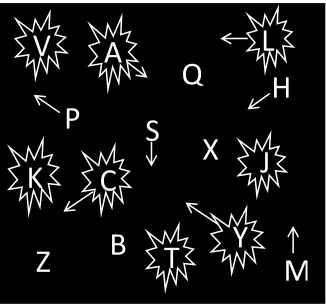
background (see Figure 1). Participants were instructed to search for a target vowel (A, E, I,
O or U) among distractor consonants and respond whether the target was present or absent by
pressing ‘m’ or ‘z’, respectively (please note, the letter ‘W’ was not included in the display as
it’s dimensions were wider than the other consonants). Fifty percent of trials contained a
target (on any given trial only one target was presented), on the other fifty percent of trials
there was no target. When present, the target was equally likely to be any one of the five
vowels. Set sizes of 16, 24 or 32 items were used and participants were given a short practice
session before the experiment proper.
---
Figure 1 about here
‐‐‐‐‐‐‐‐‐‐‐‐‐‐‐‐‐‐‐‐‐‐‐‐‐‐‐‐‐‐‐‐‐‐‐‐‐‐‐‐‐‐‐‐‐
Half the stimuli were stationary and remained in the same location throughout the trial. The
rest of the stimuli were moving and could move in any direction and each item’s speed was
randomly generated from a range of 1.9 to 3.3 degrees/second (from a viewing distance of 57
cm). Moving stimuli passed transparently over each other and bounced off the sides of an
invisible rectangle of size 14.5 degrees by 14.5 degrees. Half of the moving stimuli and half
of the static stimuli also changed in luminance to fade off and on the screen (‘blinking
items’). The blinking items did not offset entirely from the screen but faded from a luminance
value of 38.2 cd/m2 to 0.7 cd/m2 and back again. To avoid grouping of the blinking items into
one set, and thus mimic the unpredictability of real-world conditions, all the blinking items
luminance all had smooth random oscillating frequencies to fade in and out, randomly
ranging from one luminance cycle of 1 second to 3 seconds (i.e. each item took between 1
and 3 seconds to change from the upper luminance level to the lower level and back to the
highest level). Stimulus luminance was varied by changing the transparency (alpha level) of
each stimulus between the values of 1 and 0.3 by a value ranging from 0.0184 units (1 sec
oscillation) to 0.0062 units (3s oscillation) per screen retrace. Each blinking item initially
appeared on the screen at any luminance level (randomly generated) between 38.2 cd/m2 to
0.7 cd/m2. As such, each blinking item offset and re-onset at a different rate and they all
‘blinked’ out of phase. Items remained blinking until participants made a response. The target
was equally likely to be in the moving and/or blinking set. For each experiment there were
480 trials per participant. Participants were instructed to respond as quickly but as accurately
as possible. Error rates and RTs were recorded. No feedback was given for either correct or
incorrect responses similar to real world conditions (e.g., security guards are not likely to
receive immediate feedback if they miss a target during real-time surveillance tasks).
Results and Discussion
Trials with RTs less than 200 msec or greater than 10000 msec were removed as outliers
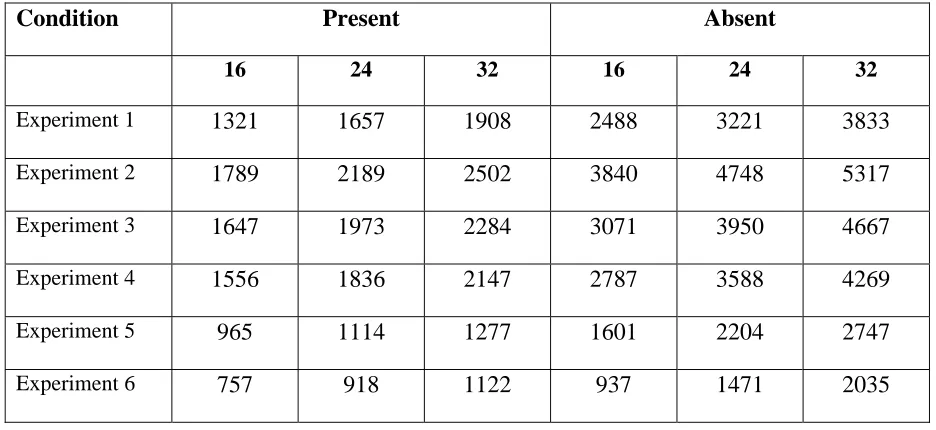
(0.6% of the data). Overall RTs for present and absent trials, for all experiments, are shown in
Table 1. Looking at the RT data, unsurprisingly and consistent with previous research (e.g.
Chun & Wolfe, 1996; Treisman 1988; Wolfe, 1998), there was a main effect of target
presence. RTs for target present trials were faster than those for target absent trials, F(1,11) =
56.2, p < 0.01, overall RTs increased with set size, F(2, 22) = 123.7, p < 0.01, and RTs
increased more for target absent trials across set size than for target present trials, F(2, 22) =
not important to the questions in hand, in subsequent sections we do not report them further.
Our primary interest was how the different motion and blinking patterns affected the time and
accuracy to find the target. To investigate this, both here and in the ensuing experiments, we
separated the target present trials into whether the target was moving or stationary and
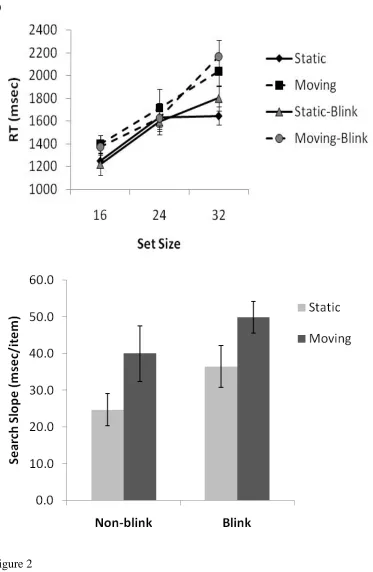
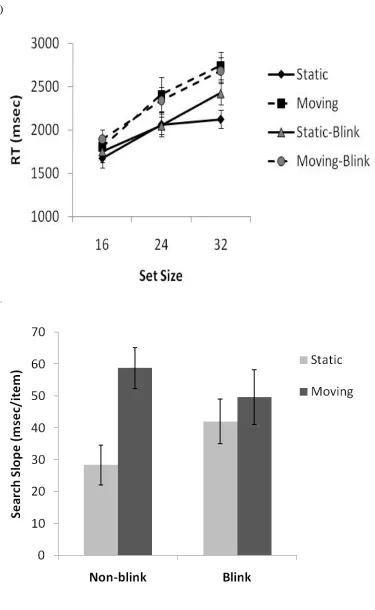
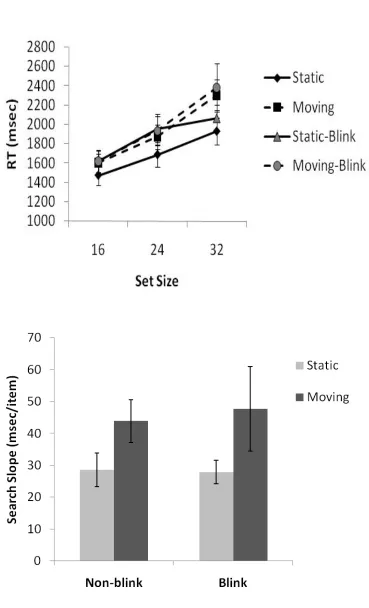
whether it was blinking or non-blinking2. Figure 2a shows mean RTs for target present trials
across set size and Figure 2b shows the search slopes. RTs for correct trials were entered into
a within-participants analysis of variance (ANOVA), with main factors of motion type (static
vs moving), blinking (blinking vs non-blinking) and set size. RTs to detect static targets were
faster than RTs to detect moving targets, F(1,11) = 15.8, p < 0.01, and RTs increased with set
size, F(2, 22) = 52.8, p < 0.01. There was no difference between RTs to detect blinking
targets or non-blinking targets, F < 1. More importantly the Motion type x Set size interaction
was significant, F(2, 22) = 10.7, p < 0.01. RTs increased more across set size when the target
was moving compared with when it was static. No other interaction was significant (all Fs <
1.5, ps > 0.2).
---
Figures 2 and 3 about here
‐‐‐‐‐‐‐‐‐‐‐‐‐‐‐‐‐‐‐‐‐‐‐‐‐‐‐‐‐‐‐‐‐‐‐‐‐‐‐‐‐‐‐‐‐
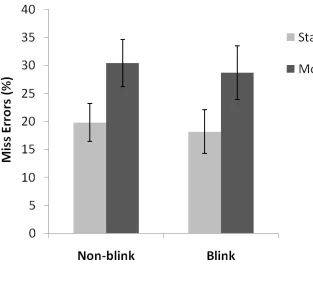
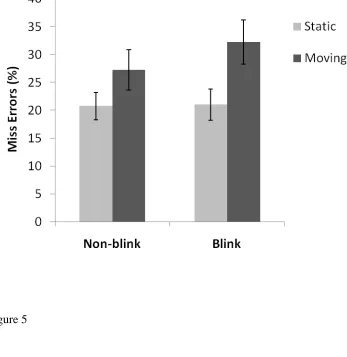
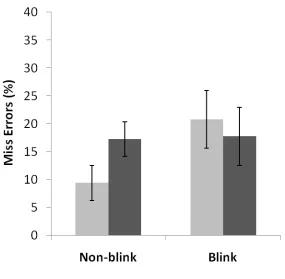
Miss errors in MAD search were higher than in most previous traditional lab search tasks (see
Figure 3). There were very few false alarms (2%). In typical lab search experiments
participants tend to make miss errors of less than 5% (Wolfe, 1998). In this more complex
display participants were missing moving targets, on average, 30% of the time and static
targets 19% of the time. Miss errors were greater for moving stimuli than for static stimuli,
2
F(1,11) = 59.4, p < 0.01 and there was a main effect of set size, F(2, 22) = 7.4, p < 0.01, with
participants making more miss errors as set size increased. There was no main effect of
having the target blink, F < 1. Neither were any of the interactions significant (all Fs < 1, ps >
0.4). As MAD search was designed to better reflect the dynamic aspects of real world search
this high proportion of miss errors suggest that previous lab work has greatly overestimated
people’s realistic, search capability. We will return to this point later.
When searching through this complex MAD display, search slopes for moving targets were
steeper than those for static targets. This contradicts previous lab-based findings where search
for and/or the filtering of moving items was efficient (e.g., Franconeri & Simons, 2003; 2005;
McLeod et al., 1988; 1991) or there was no difference between searching through moving
and static items (Hulleman, 2009). When the search task becomes more complex, designed
to reflect some of the dynamic and unpredictable aspects of real-world search, searching
through moving items is actually less efficient than searching through static items.
Furthermore, luminance changes made to stimuli in these displays do not affect search.
Previous work has suggested that items showing an abrupt luminance onset capture attention
(e.g., Yantis & Jonides, 1984). However, when the change in luminance is made to be more
gradual, as demonstrated in MAD search, there was no difference in search slopes between
items that showed luminance changes and those that did not. The data suggest that luminance
changes do not capture our attention when they exhibit properties more like those that occur
in the naturalistic world.
Perhaps one of the reasons why luminance changes did not capture attention in Experiment 1
might not be interpreted as the appearance of a new perceptual object. Perhaps such
luminance changes would be more effective if the items totally disappeared from the screen?
In order to investigate this possibility, Experiment 2 used blinking stimuli which fully offset
from the screen during their luminance cycle.
Experiment 2
Method
Participants:
Eighteen participants (11 female) were recruited from the University of Warwick’s
participant scheme in exchange for course credit or payment. Their ages ranged from 18 to 39
(M = 19.8 years, SD = 4.9 years). All participants had normal or corrected to normal vision.
Stimuli and Procedure:
The stimuli and procedure were similar to that of Experiment 1 except that here the blinking
stimuli offset entirely. Across the trial the blinking items changed from a luminance value of
38.2 cd/m2 to 0.0 cd/m2 and back again, so that when the stimuli re-appeared they showed a
full (but gradual) luminance onset. As in Experiment 1, items that changed in luminance all
smoothly faded in and out, with a random transition time ranging (to avoid grouping) from
one luminance cycle of 1 second to 3 seconds. Luminance values were manipulated by
varying the alpha level between the values of 1 and 0 at a rate between 0.0263 units per trace
for 1s oscillations to 0.0088 units per retrace for 3s oscillations. Stimuli with alpha values of
less than 0.075 were not visible on the screen. Thus, a blinking stimulus was invisible for
anywhere between a minimum of approximately 80 msec (6 screen retraces), corresponding
corresponding to the oscillating frequency of 3 seconds. Participants were given a short
practice session before the experiment proper and told to respond as quickly but as accurately
as possible.
Results and Discussion
Trials with RTs less than 200 msec or greater than 10000 msec were removed as outliers
(1.8% of the data). Overall RTs for present and absent trials are shown in Table 1. Figure 4a
shows mean RTs for target present trials across set size and Figure 4b shows the search
slopes. RTs for correct trials were entered into a within-participants analysis of variance
(ANOVA), with main factors of motion type (static vs moving), blinking (blinking vs
non-blinking) and set size. RTs to detect static targets were faster than RTs to detect moving
targets, F(1,17) = 39.0, p < 0.01 and RTs increased with set size, F(2, 34) = 66.0, p < 0.01.
There was no difference between RTs to detect blinking targets or non-blinking targets, F <
1. The Motion type x Set size interaction was significant, F(2, 34) = 4.5, p < 0.05. RTs
increased more across set size when the target was moving compared with when it was static.
No other interaction was significant (all Fs < 1.6, ps > 0.2).
---
Figures 4 and 5 about here
‐‐‐‐‐‐‐‐‐‐‐‐‐‐‐‐‐‐‐‐‐‐‐‐‐‐‐‐‐‐‐‐‐‐‐‐‐‐‐‐‐‐‐‐‐
Again miss errors were higher than in most previous traditional lab search tasks (see Figure
5). There were very few false alarms (1.1%). Miss errors were greater for moving stimuli
(30%) than for static stimuli (21%), F(1,17) = 21.4, p < 0.01 and there was a main effect of
set size, F(2, 34) = 27.4, p < 0.01, with participants making more miss errors at higher set
Blink x Move interaction, F(1, 17) = 4.6, p < 0.05, where the effect of blinking increased
errors more for moving items than it did for static items. None of the other interactions were
significant (all Fs < 1.3, ps > 0.2).
Response times in Experiment 2 were longer than in Experiment 1, F(1, 28) = 12.8, p < 0.01.
We believe this was due to individual differences in participants between experiments.
However, of most importance, none of the interactions with experiment were significant (all
Fs < 2.2, ps > 0.12). Neither was there a difference in error rates, either as a main effect (F <
0.05, p > 0.8), or in any of the interactions (all Fs < 2.7, ps > 0.11). Although participants
responded more quickly in Experiment 1, the same overall pattern of results was found in
both Experiments 1 and 2.
Experiment 2 replicated the results of Experiment 1. Search efficiency for moving targets was
worse than search efficiency for static targets and miss errors were generally high.
Interestingly, there was again no effect of items blinking on and off. Search efficiency for
blinking items was not different to that of non-blinking items. This occurred even though the
blinking items offset entirely so that their subsequent onset could be interpreted as the
appearance of a new object. It seems that unlike abrupt onsets, in MAD search, gradual
luminance changes do not benefit search efficiency. This finding contrasts with previous
work showing that abrupt luminance onsets or the appearance of perceptually new objects
automatically capture attention (e.g., Hillstrom & Yantis, 1994; Yantis & Jonides, 1984;
One reason why blinking items failed to capture attention might have been due to the period
of time for which they were invisible. Yantis & Gibson (1994) showed that an item needed to
offset for approximately 100 msec (before it re-onset) in order to fully capture attention. In
our experiment each blinking stimulus could offset for any time period between 80 to 240
msec (depending on its randomly generated blinking frequency). Blinking items that only
offset for 80 to 100 msec may not have disappeared for long enough to capture attention on
their return3. For trials where this occurred there would not have been a search slope benefit
for blinking items. However, we calculate that there was an 87.5% probability that the target
would offset for 100 msec or longer, thus, the majority of targets had the potential to capture
attention. Despite this, there was no overall benefit (or even a hint of a benefit) of having the
target blink compared to a target that did not blink.
The data from Experiments 1 and 2 suggest that search for moving items was less efficient
than search for static items and that there was no benefit of having the items blink. One could
argue that if items were blinking their luminance fluctuations made it harder for participants
to consistently monitor their locations, which may in turn negate any improvement in search
efficiency. This seems unlikely as in Experiment 1 the blinking stimuli were always visible.
Nevertheless, in Experiment 3 we directly tested this possibility by placing
constant-luminance, square, place holders around all of the letter stimuli. This procedure made the
locations of all the stimuli, blinking or not, continuously available to the observer.
Experiment 3
3
Method
Participants:
Twelve participants (11 female) were recruited from the University of Warwick’s participant
scheme in the exchange for course credit or payment. Their ages ranged from 18 to 20 (M =
18.7 years, SD = 0.8 years). All participants had normal or corrected to normal vision.
Stimuli and Procedure:
The stimuli and procedure were similar to that of Experiment 2 except that all the search
stimuli were surrounded by the outline of a white box (1.2 deg x 1.2 deg) which was visible
throughout the trial and did not change in luminance. These boxes acted as placeholders to
mark the locations of all stimuli.
Results and Discussion
Trials with RTs less than 200 msec or greater than 10000 msec were removed as outliers
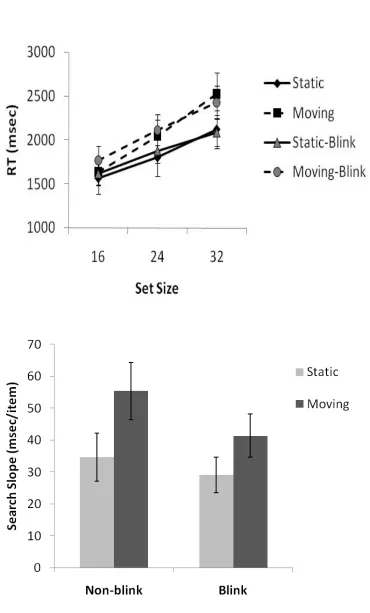
(0.7% of the data). Overall RTs for present and absent trials are shown in Table 1. Figure 6a
shows mean RTs for target present trials across set size and Figure 6b shows the search
slopes. RTs for correct trials were entered into a within-participants analysis of variance
(ANOVA), with main factors of motion type (static or moving), blinking (blinking or
non-blinking) and set size. RTs to detect static targets were faster than RTs to detect moving
targets, F(1,11) = 16.1, p < 0.01 and RTs increased with set size, F(2, 22) = 35.9, p < 0.01.
There was no difference between RTs to detect blinking targets or non-blinking targets, F <
1. The Motion type x Set size interaction was also significant, F(2, 22) = 4.7, p < 0.05. RTs
increased more across set size when the target was moving compared with when it was static.
---
Figures 6 and 7 about here
‐‐‐‐‐‐‐‐‐‐‐‐‐‐‐‐‐‐‐‐‐‐‐‐‐‐‐‐‐‐‐‐‐‐‐‐‐‐‐‐‐‐‐‐‐
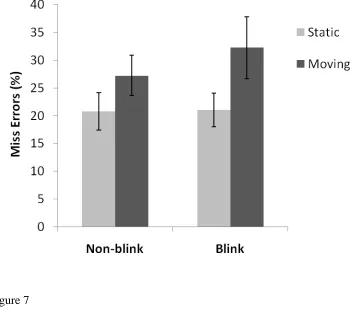
Again miss errors were higher than in most traditional lab search tasks (see Figure 7). There
were very few false alarms (2.1%). Overall, miss errors were greater for moving stimuli than
for static stimuli, F(1,11) = 24.3, p < 0.01, where participants missed 35% of moving targets
and 24% of static targets and there was a marginal effect of set size, F(2, 22) = 2.7, p = 0.09,
with a trend for participants to make more miss errors with higher set sizes. There was no
main effect of having the target blink, F < 2.3. There was a significant Blink x Move
interaction, F(1, 11) = 5.5, p < 0.05, where blinking increased errors more for moving items
than it did for static items. The Blink x Set Size interaction was also borderline significant
F(2, 22) = 3.4, p = 0.051, with fewer errors at set size 24 when the target was non-blinking
than when it was blinking but not at set size 16 or 32.
The results from Experiment 3 replicated those from Experiments 1 and 2. Search for moving
targets was again less efficient than those for static targets. Furthermore, there was no
difference in search efficiency for blinking versus non-blinking targets. As the stimuli in
Experiment 3 had placeholders around each of them, that never changed in luminance, the
lack of a blinking effect in Experiment 1 and 2 was not because it was harder to monitor the
positions of the blinking items. Even when the locations of the blinking items were
continuously available, luminance changes did little to benefit (or disrupt) search.
Clearly, the results of Experiments 1 to 3 are different from previous findings in the
moving targets or that motion does not affect search efficiency. Taking the first point, it could
be argued that in past work, motion usually defined the target (e.g. McLeod et al., 1988):
participants were more efficient at finding a moving target because they knew to look for a
moving target. Furthermore, it is possible that in Experiments 1 – 3, participants had
intentionally adopted a strategy of first searching through the static items before switching to
the moving items. This would have the effect of artificially inflating the moving target search
slopes compared with the static target slopes. This strategy seems unlikely because the target
was equally likely to be either moving or static. However, even if this were the case, it would
suggest that moving items do not automatically capture attention or enjoy privileged
processing in these types of display conditions (see also Abrams & Christ, 2003, Hillstrom &
Yantis, 1994 and Yantis & Egeth, 1999).
In Experiment 4, we blocked MAD search by target motion and/or blinking type in order to
test, firstly, whether there was a benefit of motion when participants knew to look for a
moving target, and secondly whether the lack of a motion benefit in Experiments 1-3
occurred because participants had intentionally adopted a default attentional set for static
items. In this experiment, participants knew in advance what category the target would fall
into. This gave them the opportunity, if possible, to adopt the most appropriate attentional set
in order to try to restrict their search to the target defined group (Egeth, Virzi, & Garbart,
1984; Folk et al., 1994). Accordingly, any default attentional set (e.g., for static items) should
not apply to search under these conditions (e.g., in a block when the target was always
moving).
Method
Participants:
Eleven participants (3 female) were recruited from the University of Warwick’s participant
scheme in the exchange for course credit or payment. Their ages ranged from 18 to 22 (M =
19.3 years, SD = 1.3 years). All participants had normal or corrected to normal vision.
Stimuli and Procedure:
The stimuli and procedure were similar to that of Experiment 2. However, here the conditions
were blocked so that in each block participants would know what motion and blinking subset
the target would fall in (e.g. in one block the target would always appear in the static items
and not be blinking, in another the target would be static and blinking, in another the target
would be moving and not blinking and in another condition the target would be moving and
blinking). In each block there were 120 trials of which fifty percent contained a target. As in
Experiment 1 there were three set sizes of 16, 24 and 32 items. The order of the blocks was
randomized.
Results and Discussion
Trials with RTs less than 200 msec or greater than 10000 msec were removed as outliers
(0.2% of the data). Overall RTs for present and absent trials can be found in Table 1. Figure
8a shows mean RTs for target present trials across set size and Figure 8b shows the search
slopes. RTs for correct trials were entered into a within-participants analysis of variance
(ANOVA), with main factors of motion type (static vs moving), blinking (blinking vs
non-blinking) and set size. RTs to detect static targets were marginally faster than RTs to detect
0.01. Although RTs appeared to be slower for blinking targets compared with non-blinking
targets (particularly in the static conditions) this difference was not significant, F < 2.7. More
importantly, as in Experiments 1 – 3 above, the Motion type x Set size interaction was
significant, F(2, 20) = 4.9, p < 0.05. RTs increased more across set size when the target was
moving compared to when it was static. None of the other interactions were significant (all Fs
< 1, ps > 0.5).
---
Figures 8 and 9 about here
‐‐‐‐‐‐‐‐‐‐‐‐‐‐‐‐‐‐‐‐‐‐‐‐‐‐‐‐‐‐‐‐‐‐‐‐‐‐‐‐‐‐‐‐‐
Knowing the motion and blinking type of the target in advance reduced the error rate
somewhat in comparison to Experiments 1-3 (see Figure 9). There were very few false alarms
(0.5%). However error rates were still relatively high. Miss errors were greater for blinking
stimuli than for non-blinking stimuli, F(1,10) = 5.5, p < 0.05 and there was a main effect of
set size, F(2, 20) = 13.9, p < 0.01, with participants missing more targets at the higher set
sizes. There was no main effect of motion type (participants missed 18% of moving targets
and 15% of static targets), F < 1.8. There was a significant Blink x Motion type interaction,
F(1, 10) = 5.9, p < 0.05, with participants missing more moving than static targets when the
targets were non-blinking but not when they blinked. None of the other interactions were
significant (all Fs < 1.5, ps > 0.2).
The main findings from this experiment suggest that even when participants knew in advance
what category the target would appear in, search for moving items was less efficient than
by previous work where search for motion defined targets was found to be efficient (e.g.,
McLeod et al., 1988).
Neither were the results predicted by theories suggesting that search becomes efficient if
participants form an attentional set for the target: for example, that motion may only capture
attention when it was relevant to target detection (e.g., Hillstrom & Yantis, 1994, Yantis &
Egeth, 1999, see also Pinto et al., 2006, for the reverse case of efficient search for a static
target among moving distractors). Here, participants should have been able to set up an
attentional bias to prioritise moving stimuli in blocks where the target was known to be
moving (e.g., Folk et al., 1994). Although participants were theoretically able to form these
attentional sets (thus prioritising search for moving items) search for moving targets was still
worse than search for static ones. One of the main differences between previous work and
that presented here is the complexity of the display. By using higher set sizes, different
motion and blinking types, and uncertainty of the exact target template, MAD search is more
complex than the previous search tasks investigating motion. With these more complex
displays different search strategies seemed to be used to help find the target. We return to this
idea in the General Discussion.
In summary, knowing the target category in advance did not allow participants to restrict
search to the correct motion/blinking groups. However, there was a small benefit in accuracy
as miss errors were lower in Experiment 4 than in previous experiments. Comparing
Experiment 4 to Experiment 1, for example, a between experiments ANOVA showed that the
Motion x Experiment (F(1,21) = 6.4, p < 0.05), Blinking x Experiment (F(1,21) = 12.9, p <
significance, demonstrating fewer errors in Experiment 4 than in Experiment 1. One reason
for this might be that prior knowledge of the target category helped participants to reject
distractors from other categories more readily. However, error rates were still high as
participants had to search for one of five target templates. This is in line with Menneer et al.
(2009) who showed a dual-task cost when participants had to search for one of two possible
targets (see also Fisk & Rogers, 1991, Kramer et al., 1986, Kunar et al., 2008, Schneider &
Fisk, 1982 and Schneider & Shiffrin, 1977, who showed an impairment in search
performance as the memory search set increased). Experiment 5 investigated what happens in
MAD search when target uncertainty was reduced, by giving participants knowledge of the
target identity in advance. Here participants were only asked to search for the letter A. With
this precise target template, were people better at determining whether a target was present or
absent in MAD search?
Experiment 5
Method
Participants:
Sixteen participants (9 female) were recruited from the University of Warwick’s participant
scheme in exchange for course credit or payment. Their ages ranged from 18 to 29 (M = 20.0
years, SD = 2.8 years). All participants had normal or corrected to normal vision.
Stimuli and Procedure:
The stimuli and procedure were similar to those of Experiment 1 except that, here,
participants knew in advance what they were looking for as the target was always the letter A
showed that, although participants responded slightly faster and more accurately to the letter
I, there was no difference in RTs or error rates to detect any of the other vowels. Thus, the
letter A was chosen to be a typical target. The target A could appear in any of the motion or
blinking types and participants were asked to press the letter ‘m’ if it was present and the
letter ‘z’ if it was absent. Participants were asked to respond as quickly but as accurately as
possible.
Results and Discussion
Trials with RTs less than 200 msec or greater than 10000 msec were removed as outliers
(0.03% of the data). Overall RTs for present and absent trials are shown in Table 1. Figure
10a shows mean RTs for target present trials across set size and Figure 10b shows the search
slopes. RTs for correct trials were entered into a within-participants analysis of variance
(ANOVA), with main factors of motion type (static or moving), blinking (blinking or
non-blinking) and set size. RTs to detect static targets were faster than RTs to detect moving
targets, F(1,15) = 15.8, p < 0.01 and RTs increased with set size, F(2, 30) = 45.1, p < 0.01.
There was no difference between RTs to detect blinking targets or non-blinking targets, F <
1.5. The Motion type x Set size interaction was significant, F(2, 30) = 4.9, p < 0.05. RTs
increased more across set size when the target was moving compared with when it was static.
No other interactions were significant (all Fs < 1, ps > 0.4).
---
Figures 10 and 11 about here
‐‐‐‐‐‐‐‐‐‐‐‐‐‐‐‐‐‐‐‐‐‐‐‐‐‐‐‐‐‐‐‐‐‐‐‐‐‐‐‐‐‐‐‐‐
Knowing the identity of the target dramatically reduced the error rate in comparison to
alarms (0.8%). Participants missed 8% of moving targets and 6% of static targets. There was
a trend for miss errors to be greater for moving stimuli than for static, F(1,15) = 3.2, p =
0.095, however, there was no main effect of blinking or set size. There was a significant
Blink x Motion type interaction, F(1, 15) = 11.8, p < 0.01, with blinking increasing errors
more for moving items than for static items. No other interactions were significant (all Fs < 1,
ps > 0.4).
As hypothesised, knowing the identity of the target reduced the observed miss errors. By
having participants hold only one target template in working memory rather than five items
(as was the case in Experiments 1 – 4), the effective memory search set was reduced which
led to an improvement in search accuracy (see also Fisk & Rogers, 1991, Kramer et al., 1986,
Kunar et al., 2008, Schneider & Fisk, 1982 and Schneider & Shiffrin, 1977, for similar
examples of improvements in search performance with a reduced memory search set). This
may be because there was less confusion from distractors when there was only one target
template compared to multiple possible targets. With many possible targets it becomes harder
to reject distractors, as they have greater chance of sharing at least one of the target features
and thus will compete for selection (e.g., Menneer et al., 2009). However, when there is just
one target, distractors can easily be discounted from search if they do not share any of the
target’s features. Of note, in MAD search, this only affected the search accuracy and did not
affect the overall search efficiency. Search to find moving targets was still less efficient than
search to find static targets, and there was no effect of having the target gradually blink off
As mentioned above, one of the reasons why the findings from MAD search differ from
previous work might be because the search task is more complex. The design of MAD search
has allowed us to manipulate many factors together in one paradigm. The observed effect of
increasing the complexity of the display produces a different overall search pattern where
there is greater search efficiency for static targets than moving ones. In contrast, in a recent
study, Hulleman (2009) found that the search rate for static targets was the same as that for
moving ones. There are many differences between MAD search and the search displays used
by Hulleman (2009), one of which is the set size. Hulleman used smaller set sizes of 6, 12
and 18 items compared with the ones presented here. Perhaps with smaller set sizes
participants opt to search the display purely from vision (Hulleman, 2009; Horowitz &
Wolfe, 1998; Oliva et al., 2004; Wolfe et al., 2000), whereas with higher set sizes other
search strategies are used. For example, Kristjannson (2000) showed evidence that memory
benefitted search at higher set sizes of up to 56 items although this effect was not visible with
set sizes below 16 items (Horowitz & Wolfe, 1998). Theoretically, if different search
strategies are used at higher set sizes, the difference between moving and static search slopes
may disappear if the set sizes were reduced. This was investigated in Experiment 6.
Experiment 6
Method
Participants:
Sixteen participants (6 female) were recruited from the University of Warwick’s participant
scheme in exchange for course credit or payment. Their ages ranged from 18 to 25 (M = 19.7
Stimuli and Procedure:
The stimuli and procedure was similar to that of Experiment 1 except that here the set sizes of
4, 8 and 12 were used.
Results and Discussion
Trials with RTs less than 200 msec or greater than 10000 msec were removed as outliers
(0.04% of the data). Overall RTs for present and absent trials can be found in Table 1. Figure
12a shows mean RTs for target present trials across set size and Figure 12b shows the search
slopes. RTs for correct trials were entered into a within-participants analysis of variance
(ANOVA), with main factors of motion type (static or moving), blinking (blinking or
non-blinking) and set size. RTs increased with set size, F(2, 30) = 123.1, p < 0.01. There was no
difference between RTs to detect blinking targets or non-blinking targets, F < 1, nor was
there a main effect of Motion type, F(1, 15) = 3.0, p = 0.1. Unlike Experiments 1-5, the
Motion type x Set size interaction was not significant, F(2, 30) = 1.0, p = 0.4. Neither were
any of the other interactions significant (all Fs < 1.9, ps > 0.1).
---
Figures 12 and 13 about here
‐‐‐‐‐‐‐‐‐‐‐‐‐‐‐‐‐‐‐‐‐‐‐‐‐‐‐‐‐‐‐‐‐‐‐‐‐‐‐‐‐‐‐‐‐
Error rates were relatively low (Figure 13). There were very few false alarms (1.5%).
Participants missed 8% of moving targets and 7% of static targets. There was a trend for miss
errors to be greater for moving stimuli than for static stimuli, F(1,15) = 3.4, p = 0.09. There
was no main effect of blinking or set size. None of the interactions were significant (all Fs <
Decreasing the set size changed the pattern of search efficiency found previously in
Experiments 1–5. With smaller set sizes there was now no difference in search slopes
between search for moving targets and search for static ones. These results have a number of
implications. Firstly, they rule out the idea that moving items were simply harder to perceive.
One reason why search for a moving target was less efficient than search for a static target
might have been because a moving target was less easy to detect on a perceptual level,
leading to a deficit in RTs. However, if this was driving the main differences between static
and moving stimuli in Experiments 1-5 we would expect to see a similar difference here.
Secondly, the pattern of results in Experiment 6 was similar to that of Hulleman (2009) who
found that search efficiency through static items was the same as that through moving items.
The difference between the results in Experiment 6 and those presented above is that, here,
participants were searching through fewer elements. Search strategies seem to differ as the
range of set sizes change.
Of final note, we observe that there was no effect of having the items blink. Whether the set
size was low or high there was no benefit (or cost) of gradual luminance changes. Error rates
on the other hand were reduced at lower set sizes. With fewer items on the screen participants
were better able to perform a more exhaustive search and so miss fewer items that, in turn, go
undetected at a higher set size.
Visual search tasks allow us to investigate how we search our environment. Past work has
shown that the visual system prioritises certain stimulus properties, such as motion and abrupt
onsets, to better find a target. These properties are important in understanding how we
visually process the world. However, when these attributes are combined into one display,
making search more complex, we find that the pattern of data changes. We present six
experiments that used a Muti-element Asynchronous Dynamic (MAD) visual search design,
incorporating elements of motion (as well as static stimuli), gradual luminance onsets, target
uncertainty and high set sizes into one overall search display. Experiment 1 found that when
using these types of displays: (i) search for moving targets was less efficient than search for
static targets; (ii) there was no difference in search efficiency for finding a gradually
luminance changing ‘blinking’ target versus a non-blinking one and (iii) error rates were
higher than those observed in many past experiments. This pattern of data was replicated in
Experiment 2, where the blinking items fully offset (becoming invisible) before re-appearing
and in Experiment 3 where all stimuli were surrounded by a placeholder to help participants
keep track of the position of each stimulus regardless of whether it was blinking or not.
Experiment 4 investigated whether there was a difference in search efficiency between
moving and static items when participants knew in advance the target’s moving and blinking
category. However, even with knowledge of a target’s category, participants were still less
efficient at using motion to find the target compared with when the target was static. As in
Experiments 1-3 there was no effect of having the target blink on or off, although there was a
slight reduction in error rates. Experiment 5 had participants only look for the target letter A
(opposed to looking for any vowel in Experiments 1-4) which could appear in any of the
motion or blinking types. The search efficiency data for the moving and blinking targets
previous experiments. In Experiment 6, the set size was reduced from 16, 24 and 32 items (in
Experiments 1-5) to 4, 8 and 12. With this reduction in set size search efficiency for moving
and static items was equivalent and error rates were low overall. However, there was still no
benefit (or cost) of having the target gradually change in luminance. On the whole, the data
observed in MAD search has shown a different pattern of results than that which would be
predicted by previous literature.
Motion in Visual Search
Experiments 1 to 5 showed that search for moving targets was less efficient than search for
static targets – even when the motion type was known in advance and could be used to define
the target (Experiment 4). These findings differ from previous experiments which have
shown that motion either makes search more efficient (especially when it defines the target
and/or participants form an attentional set for a moving target, e.g. Franconeri & Simons,
2003; 2005; Hillstrom & Yantis, 1994; McLeod et al., 1988; Yantis & Egeth, 1999) or that
there was no difference in search rates between static and moving items (Hulleman, 2009).
One reason for this difference can be gleaned from Experiment 6. When the set size was
reduced, search efficiency between moving and static items was equated, mimicking the
results of Hulleman (2009). Hulleman (2009) found that search efficiency through a display
containing 6, 12 or 18 static items was similar to search through a display where all the items
were moving at an identical speed. Similarly, Experiment 6 presented here, showed that with
relatively small set sizes search efficiency for moving targets was again identical to that of
static targets. Furthermore, our results extend those of Hulleman (2009) because in MAD
work all the stimuli had the same velocity within the same display). At smaller set sizes,
motion and static search efficiencies were similar.
However, the pattern of data changed when the set size increased. With this increase
participants became less efficient at finding a moving item than a static item. It is not the first
time in the literature that increasing the set size has changed the observed search pattern of
results. For example, Horowitz & Wolfe (1998) showed that search efficiency through a
static display was similar to search efficiency through a display which changed every
111msec (the ‘random’ condition). However, Kristjansson (2000) found that this was no
longer the case if the set size was increased to up to 56 items. Here search in the static display
was more efficient than search in the random display. Kristjansson (2000) argued that
increasing the set size of the display highlighted the potential use of memory in visual search.
Other work has shown that although participants can use memory in visual search it is
generally a less efficient strategy than searching from vision (Kunar et al., 2008, see also
Wolfe et al. 2000 and Oliva et al. 2004). As such, it has been suggested that the default in
visual search is to search from vision rather than memory (Oliva et al., 2004). Most of these
studies have used small set sizes, however. One could theorize that with higher set sizes, and
a more complex and laborious search display, other strategies are needed alongside a purely
visual one. For example, it could be that at lower set sizes, participants search the display
from vision but at higher set sizes participants search the display from a mixture of vision and
memory. Let us consider the results in terms of Inhibition of Return (IOR), a mechanism
proposed to prevent attention from returning to previously attended and discounted locations
Kingstone, 2001). Kristjansson (2000) suggested that, with an increase in set size, some static
items undergo IOR and so participants do not re-search these stimuli. This memory of what
has already been searched leads to a reduction in search slopes for static items. However,
given that humans have a limited ability to track moving objects (e.g., Pylyshyn & Storm,
1988; Pylyshyn, 2001), and as moving stimuli are constantly changing their positions, then
with larger set sizes, participants may not remember which moving items have been
previously searched. Under these circumstances participants would instead search the display
from vision and, thus, may re-search some moving items more than once. This would lead to
an increase in search slopes. Further research is needed to investigate this. However, for
present purposes it is enough to note that search through moving and static displays operates
differently under these more complex conditions than would be predicted from past research.
One final point of interest can be seen if we examine the results of Experiments 1 and 2,
where there is a levelling off of RTs from set sizes 24 to 32 in the static conditions. This
asymptote at the higher set sizes could occur because with higher display densities, more
stimuli fall within the foveated area, within each glance, enabling better detection of the
target. Furthermore, it has been suggested that in some displays (particularly feature searches)
search becomes more efficient at higher densities because local feature contrasts allow the
target to be more distinguishable from surrounding distractors (e.g. Nothdurft, 2000).
However, please note, that we view this result with some caution because the effect was not
replicated in Experiments 3 to 5.
Previous research has shown that items showing an abrupt luminance onset capture attention
(e.g. Christ & Abrams, 2006; Schreij, Owens, & Theeuwes, 2008; Theeuwes, 1994; Yantis &
Jonides, 1984; 1996). However, when items appear in the real world they may not necessarily
show an abrupt luminance onset. Many items may instead gradually appear in our field of
view over a number of milliseconds (e.g., a person re-appearing from being occluded by
another object). MAD search investigated how these gradual luminance onsets affected
attention. In contrast to abrupt luminance onsets there was no advantage of having the target
show a gradual luminance change (even from a fully offset luminance value, Experiment 2).
Interestingly, neither was there a cost. Having items display these luminance fluctuations did
not affect the overall search rate, and, furthermore, the visual system was able to compensate
for these luminance changes so that search effectiveness did not deteriorate.
Another point to consider is the uniqueness of each gradual onset. Previous work showing
onset capture has often used a design where the abrupt onset was unique in the field (e.g.
Yantis & Jonides, 1984). In contrast, in MAD search there were many gradual onsets and the
changes were asynchronous. Perhaps there was no benefit of blinking targets, here, as their
unique luminance change was lost in the midst of the other luminance changes that occurred.
This idea fits with work by Von Muhlenen et al. (2005) who tested a unique-event hypothesis
and found that color, motion and luminance changes captured attention strongly when they
were temporally and spatially unique but not when their transients coincided with other
display transitions (see also O’Regan, Rensink & Clark, 1999; Watson & Kunar, 2010).
Further research will need to investigate whether a unique luminance change captures
attention in MAD search, or whether even this unique transient is lost in the more dynamic
the important point that the capturing potential of stimuli depend on the circumstances of the
display.
Rauschenberger (2003) also noted that the degree of luminance change should be considered
when asking whether luminance onsets capture attention. In his work he found that both
small and large abrupt luminance changes captured attention when participants formed an
attentional set for them, however, large luminance changes (approximately a 1:3 ratio
change) always captured attention regardless of whether there was an attentional set or not
(although see Watson, Braithwaite & Humphreys, 2008, who showed that large luminance
changes do not necessarily capture attention under some conditions). In the work presented
here perhaps the luminance onsets were not large enough to capture attention automatically.
This seems unlikely given that the luminance changes were greater than the 1:3 ratio change
needed to capture attention (e.g., 0.7 cd/m2 to 38.2 cd/m2 in Experiment 1). Furthermore,
even if the luminance changes were not large enough to capture attention automatically, they
should still have captured attention in Experiment 4 where participants were able to form an
attentional set for them. However, this was not the case.
Error rates in visual search
Error rates in MAD search were higher than in most previous traditional lab search tasks (e.g.
Wolfe, 1998). In Experiments 1–3, miss errors hovered around the 30% mark (for moving
stimuli) and 20% for static stimuli. This elevated error rate makes sense if we remember that
MAD search was designed to be more complex than other previous visual search tasks.
puts pressure on the visual system, resulting in an increase in errors. The data demonstrate
that previous visual search tasks might have overestimated how well humans search their
environment. When the display is comprised of twelve static stimuli, for example, search
accuracy is fairly high. However, search in the real world often comprises of more noisy and
complex scenes, involving search through many items independently varying in their motion,
luminance and velocities. By creating a hybrid of lab and ‘real world’ search, data from
MAD search suggest that miss errors in real-world tasks are higher than previously
anticipated.
Reviewing other work in the literature we see glimmers of this pattern before. For example,
Hulleman (2009) reports miss errors of 19% in one of his conditions (where stimuli were
moving at 10.8 degrees/second in a Brownian motion). This display is on the whole more
complex than a standard visual search task comprised of solely static elements. Although
Hulleman does not discuss these error rates in detail it again suggests that increasing the
complexity of visual search reduces accuracy.
Furthermore, putting pressure on the visual search system in other ways, for example, by
reducing the target prevalence, also elevates miss errors4. Wolfe et al. (2005) showed that
reducing the prevalence rate of a target to 1-2% increased the number of miss errors from 7%
to 30-40% (see also Fleck & Mitroff, 2007; Kunar et al., 2010; Rich et al., 2008; Van Wert,
Horowitz & Wolfe, 2009; Wolfe et al., 2007). One could argue that the high error rates
shown in MAD search were a result of low prevalence (LP) factors. For example, in
4
Experiment 1, the target could appear in any of the four different motion/blinking categories
(static, moving, static-blinking or moving-blinking). Participants did not know from trial to
trial which category the target (if present) would appear in giving the target a 12.5%
prevalence of appearing in each category. Furthermore, if each combination of target vowel
and motion/blinking status was considered to be different then the individual target
prevalence rates reduce even further (i.e. if a static, non-blinking letter A is considered a
different target to a static, blinking letter A, which is different to a static, blinking letter E,
etc. then the prevalence of each target drops to 2.5%). Perhaps it is this lower prevalence rate
that caused the elevated errors? Experiments 4 and 5 give some credibility to this theory. In
both these experiments the target prevalence increased (either by blocking the
motion/blinking type of the target, Experiment 4, or by keeping the identity of the target
constant, Experiment 5) and a reduction in miss errors was observed (see also Wolfe et al.,
2005). Please note, however, that MAD search differs from typical low prevalence studies as
the overall target prevalence is high. It has been suggested that part of the LP Effect is caused
by a criterion shift: due to the infrequency of the targets, participants form a bias to respond
‘target absent’ (Van Wert et al., 2009; Wolfe et al., 2007). Clearly, such a bias is unlikely to
occur in MAD search where the target occurs, overall, 50% of the time.
The high error rates observed in MAD search can be better explained, however, by Wolfe and
Van Wert’s (2010) model of how participants reach a decision to terminate search. Wolfe and
Van Wert suggested that search does not simply involve a two alternative forced choice
(2AFC) decision of whether a target is present or not. Instead, once a stimulus has been
selected participants have to make a series of decisions. First, they decide if the stimulus is
the target or not. If it is the target, they press ‘present’. If it is not the target then they are
low prevalence conditions both the decision criteria and the point where participants decide
to terminate search is affected. In the latter case the search termination threshold is lowered.
We suggest that the same principle is happening in MAD search. In conditions where there
are high set sizes of complex stimuli and when participants do not know the exact template of
what they are looking for, in a bid to constrain their time, participants set their quitting
threshold as lower than it should be to accurately perform this search task. Many targets are
missed as a result.
In terms of real-world implications, low prevalence visual search tasks mimic the applied
search of looking for a threat at airport security checkpoints. Missing approximately 30% of
dangerous items in baggage screening is an unsettling statistic. If we apply our experiments
in a similar fashion, our data show that, in more complex displays, even when the target has a
frequent (50%) occurrence, people also fail to find the target up to 30% of the time. If we
compare these search tasks to operators monitoring surveillance footage for poorly defined
events, objects or people (e.g. under the category of suspicious behaviour in an airport) our
data show that human observation will often fail. This statistic will presumably be even
greater in the real world if target prevalence is also low. It is for further research to
investigate this.
Conclusions
When lab tasks are changed, even modestly, to reflect realistic visual search the observed
pattern of visual search is changed. Data from MAD search shows that when faced with more
reported in lab experiments, do not apply. Search for moving targets is less efficient than
search for static targets, gradual luminance changes do not benefit (or cost) search and
participants miss a large percentage of the targets. Of course, search conditions in the real
world are often still more complex and diverse than those shown in MAD displays.
Nevertheless, these data warn that even slight changes, towards more realistic stimuli, greatly
Acknowledgements
This research was supported by a Research Development Fund Grant from the University of
Warwick to M.A. Kunar. We are grateful to David Fencsik and Craig Scott for help with the
experiments. We would like to thank Yuhong Jiang, Liqiang Huang and two anonymous
References
Abrams, R. A., & Christ, S. E. (2003). Motion onset captures attention. Psychological
Science, 14, 427-432.
Abrams, R. A., & Christ, S. E. (2005). The onset of receding motion captures attention:
Comment on Franconeri & Simons (2003). Perception & Psychphysics, 67, 219-223.
Brockmole, J. R., Castelhano, M. S., & Henderson, J. M. (2006). Contextual cueing in
naturalistic scenes: Global and local contexts. Journal of Experimental Psychology:
Learning, Memory, and Cognition, 32,699-706.
Christ, S. E., & Abrams, R. A. (2006). Abrupt onsets cannot be ignored. Psychonomic
Bulletin and Review, 13, 875-880.
Chun, M. M., & Jiang, Y. (1998). Contextual cueing: implicit learning and memory of visual
context guides spatial attention. Cognitive Psychology, 36, 28-71
Chun, M.M. & Wolfe, J.M. (1996) Just Say No: How Are Visual Searches Terminated When
There Is No Target Present? Cognitive Psychology, 30, 39-78
Danziger, S., Kingstone, A., & Snyder, J. J. (1998). Inhibition of return to successively
stimulated locations in a sequential visual search paradigm. Journal of Experimental