http://wrap.warwick.ac.uk/
Original citation:
Yang, Shanshan, Joy, Mike and Laine, T. H. (2011) An educational services architecture
to share e-learning resources. In: 3rd International Conference on Computer Supported
Education (CSEDU2011), Noordwijkerhout, Netherlands, 06-08 May 2011 pp. 372-375.
Permanent WRAP url:
http://wrap.warwick.ac.uk/45695
Copyright and reuse:
The Warwick Research Archive Portal (WRAP) makes this work by researchers of the
University of Warwick available open access under the following conditions. Copyright ©
and all moral rights to the version of the paper presented here belong to the individual
author(s) and/or other copyright owners. To the extent reasonable and practicable the
material made available in WRAP has been checked for eligibility before being made
available.
Copies of full items can be used for personal research or study, educational, or
not-for-profit purposes without prior permission or charge. Provided that the authors, title and
full bibliographic details are credited, a hyperlink and/or URL is given for the original
metadata page and the content is not changed in any way.
A note on versions:
The version presented in WRAP is the published version or, version of record, and may
be cited as it appears here.
AN EDUCATIONAL SERVICES ARCHITECTURE
TO SHARE E-LEARNING RESOURCES
Shanshan Yang, Mike Joy
Department of Computer Science, University of Warwick, Coventry, UK [email protected], [email protected]
Teemu H. Laine
School of Computing, University of Eastern Finland, Joensuu, Finland [email protected]
Keywords: E-learning, Service Oriented Architecture, Educational Services, Share Resources, Interoperability, Discoverability, Reusability.
Abstract: Today many quality e-learning applications have been developed. They are widely used to cover varied aspects of learning and teaching activities, such as developing learning materials, delivering learning activities, and performing assessment tasks. Different applications rely on different technologies, require different access characteristics, and are distributed on different servers across many organisations. However, people cannot fully benefit from these valuable resources as they have not been shared effectively and efficiently — there are many varieties of these resources, but these have not been properly described and linked. In this paper, we propose a service oriented approach as a potential solution to better sharing and reuse of e-learning resources, because it allows resources to be better discovered, accessed and linked.
1
INTRODUCTION
E-learning resources refer to e-learning applications and their content that support learning activities including delivering learning activities, developing learning materials and assessing learning performances. The typical content these applications handle include e-learning materials, assessment submissions, marks, students’ records, and course information (Zhou et al., 2009). In our research, sharing e-learning resources means redistribution, remix and reuse of currently available e-learning systems and their supported content.
The rapid development of the Internet has created opportunities to offer various e-learning resources that rely on different technologies (Su et al., 2005). However, there are barriers to sharing and reusing these e-learning resources and include the following problems in current practices:
e-learning resources are difficult to be discovered, as they are described poorly;
e-learning resources are difficult to interoperate, as they rely on different implementation technologies; and
e-learning resources are difficult to be reused, as they have not been shared well enough. We propose a novel service oriented architecture as a potential solution for these issues, since it supports the principles of discoverability, interoperability and reusability. It allows resources to be outwardly described and linked, so that they can be better found, accessed and reused, without much work being required for reimplementation.
quality e-learning resources if they can be better shared (Liuet al., 2007).
Many people from both industry and research communities have attempted to apply service technologies in e-learning (Zhou et al., 2009). However, current research is not comprehensive enough as some of them have only addressed one type of e-learning resource. For example, Simoneet al. (2005) have proposed a framework to share learning objects using service technologies, and Luciaet al.(2008) have developed a model to share learning content together with systems which run using the shared content. However, their work has covered neither the sharing of students’ records nor other applications to support assessment tasks.
Some current research about e-learning services is not comprehensive and focuses only on the principle of interoperability. For instance, Phankokkruad and Woraratpanya (2009) have proposed an architecture to allow e-learning services to be better communicated. Sun and Fu (2005) have also investigated the interoperability issues, but have not mentioned other principles such as discoverability or reusability.
3
Educational Services Architecture
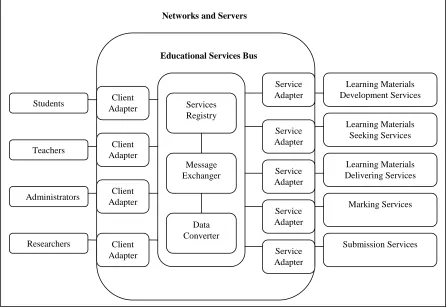
Service technologies have been successfully applied in the business domain (Li et al., 2009), and we argue that service technologies could be used to share resources in e-learning. The diagram above (Fig. 1) is the design of the educational services architecture we are proposing. Our approach inserts a layer between users and e-learning resource providers – the Educational Services Bus (ESB). There are four main components in the ESB —
Service Registry, Message Exchanger, Data Converter and Adapters.— and these are supported by networks and web servers.
3.1
Message Exchanger
The Message Exchanger acts as a data transport engine. Its main purpose is to provide message communications for interactions between service clients and providers which carry educational data. This component supports the service-oriented principle of interoperability, and SOAP (Simple Object Access Protocol) is one of the default
Services Registry
Message Exchanger
Data Converter
Educational Services Bus
Learning Materials Delivering Services
Administrators
Service Adapter
Learning Materials Development Services
Learning Materials Seeking Services Service
Adapter
Marking Services Service
Adapter
Submission Services Service
Adapter
Service Adapter Client
Adapter
Client Adapter Students
Teachers
Researchers
Client Adapter
Client Adapter
[image:3.595.73.520.98.406.2]Networks and Servers
communication mechanisms to implement interoperability. Apache Axis2 is a popular technology which supports this (Luciaet al.,2008).
3.2
Data Converter
The main role of aData Converter is to transform the format of educational content in order to reuse it for other purposes. This component supports the principle of reusability in service technologies and tackles problems caused by data format mismatch (Kongdenfhaet al., 2009). However, currently there are few tools for converting the format of e-learning content (Chung and Chao, 2007). Lack of existing generic conversion tools can be partly explained by the many different data formats for various e-learning content. We suggest that the conversion could contain two stages. The first converts selected content to a transitional format, which is subsequently changed to a specific format which the target service can accept. For example, student essays, which are generated as Word format, are first converted to HTML, and then converted to XML format before another service is able to process them later on for detecting plagiarism (for example).
3.3
Service Registry
The Service Registry (also called Service Broker), and publishes descriptions of services developed by service providers. This component supports the principle of discoverability. Many technologies have been developed for the Service Registry, and most service deployment platforms, such as the NetBeans IDE or Eclipse supports service publication features (Simoneet al., 2005).
3.4
Adapters
The purpose of adapters is to support the principle of interoperability. The Service Adapters enable platform independence while deploying educational services. They are connectors that map different service interfaces and protocols into a common model which can be accepted by the ESB. AClient Adapter (also called a Client Gateway) receives requests from clients and routes them to the appropriate components in the ESB. Currently, there is no single approach to the implementation of such adapters, and a variety of technologies have been adopted (Kongdenfhaet al., 2009).
3.5
Discussion on ESB
The core component in our educational services bus is the Message Exchanger, as it allows other components to be connected together. Adapters are an optional component in our ESB and they are implemented only if the clients or services so require. The integration of these two components allows resources to be better interoperated. Collaboration between the Message Exchanger, Service Registry and the Adapters enable e-learning resources to be better linked and discovered. The cooperation between the Message Exchanger, Data Converter and Adapters enables e-learning resources to be better reused.
Much of the proposed architecture can be implemented by using standard and open source technologies (Sun and Fu, 2005). However, some components such as the Data Converter and the Adapters may require customised implementations because they must cater for a wide variety of different data formats and platforms (Kongdenfhaet al., 2009). We suggest that to find optimal, generalisable solutions for implementing these components requires further research.
3.7
Educational Services
Educational services in our research refer to software components that provide certain functionality to support certain learning and teaching related tasks. For each service, its functionalities, operations, data types and binding information are specified in a service interface. In previous research (Yang and Joy, 2009), we conducted a case study within a university and proposed that there should be nine types of educational services. The five services we presented in Figure 1 are for illustrative purposes. Each user can access more than one type of service, and for each type of service there is more than one type of user who can reuse it.
3.6
Use Case Example
The following is an example to explain how our architecture supports the sharing of a typical resource — plagiarism detection software.
plagiarism already exists, including the Turnitin (2010) products for essays, and JPlag (2010) and Sherlock (Joy and Luck, 1999) for computer programming assignments. However, users may not know that they exist at all, and they cannot access all of them easily since their user interfaces differ substantially. By using our ESB, plagiarism detection resources can be better described and linked, so that teachers can choose appropriate plagiarism detection software to reuse for different assessment tasks from multiple service providers. The following explains how the various components work together to support the task of detecting plagiarism.
In our architecture, each plagiarism detection tool is wrapped as a service — for example, the Turnitin service, the JPlag service and the Sherlock service. Details about each service are stored and published in the Service Registry. Teachers will first send a request to use a plagiarism detection service to the Message Exchanger, which in turn will contact the Service Registry, and return a number of available services with descriptions. Users can then make selections simply between these services depending on their needs. The Message Exchanger will pass messages containing student assignments to the service that has been selected. The selected service will then process the assignments and return the detection results to users via the Message Exchanger. By using the Data Converter in the ESB, the format of the coursework can then be converted so that it can be easily reused in any plagiarism detection application. As users might access these plagiarism detection services in different locations at different times, and these services might be hosted on different servers by different providers, the current users and available services will change dynamically over time. For these reasons, we also suggest that both Service Adapters and Client Adapters should be adopted in our ESB.
4
CONCLUSIONS AND FUTURE
WORK
This paper has proposed the design of our educational services architecture, and has also highlighted potential problems our service approach can solve in current e-learning practices. In the near future, we plan to implement a part of the proposed architecture and conduct an experiment to evaluate if our service approach is actually feasible, in order to better support our research question: how could we
share e-learning resources effectively and efficiently using services technologies?
REFERENCES
Bean, J., 2010.SOA and Web Services Interface Design: Principles, Techniques, and Standards, Morgan Kaufmann. Amsterdam.
Chung, J., Chao, K., 2007. A View on Service Oriented Architecture, International Journal on Service-Oriented Computing and Applications,1(2), pp.93-95. Joy, M.S., Luck, M., 1999. Plagiarism in Programming
Assignments,IEEE Transactions on Education,42(2) pp. 129-133.
JPlag, 2010.https://www.ipd.uni-karlsruhe.de/jplag/, [29th Sep 2010].
Kongdenfha, W., Motahari-Nezhad, H., Benatallah, B., Casati, F., Saint-Paul, R., 2009. Mismatch Patterns and Adaptation Aspects, IEEE Transactions on Services Computing,2(2), pp.94-107.
Li, J., Wang, Y., Zhang, J., Zhang, Z., 2009. A Web Service Adapter with Contract Oriented Methodology, IEEE Conference on Computer and Information Science, pp.1144-1149.
Liu, J., Wu, Y., Zhao, W., 2007. Modelling Learning Contents Based on Web Services, International Conference on Next Generation Web Services Practices, pp.135-140.
Lucia, A., Francese, R., Passero, I., Tortora, G., 2008. A Service Oriented Collaborative Distributed Learning Object Management System. Lecture Notes in Business Information Processing, Springer Berlin. Phankokkruad, M., Woraratpanya, K., 2009. Web services
for Learning Management Systems. International Conference on Communication architecture, pp.403-408.
Simone, L., Fabio. C., Sean. W., Rubens. N., Saulo. V., 2005. Integrating Repositories of Learning Objects Using Web-Services to Implement Mediators and Wrappers, International Conference on Next Generation Web Services Practices, IEEE Computer Society.
Sun, L., Fu, Y., 2005. Interoperability for Elearning Services Management and Provision. International Journal of World Wide Web, Springer. Netherlands. Turnitin, 2010. http://turnitin.com/static/index.html, [29th
Sep 2010].
Yang, S., Joy, M., 2008. SOA Services in Higher Education,International Conference on Education and Educational Technology, pp. 145-150.
Yang, S., Joy, M., 2009. Designing E-learning Services: A Case Study,iJAC2(4), pp. 35-43.