Optimizing a production line
A simulation study
Bachelor Thesis Industrial Engineering & Management
Mark Bergman
Industrial Engineering & Management
Bachelor year 3
3
Author
Mark Bergman S1732501
Bsc Industrial Engineering & Management
University of Twente
Drienerlolaan 5 7522 NB, Enschede
The Netherlands
Supervisors University of Twente
Dr. M.C. van der Heijden Dr.ir. L.L.M. van der Wegen
Behavioural, Management and Social sciences
Optimizing a production line
A simulation study
5
Preface
This report is the result of the bachelor thesis that I have conducted for my bachelor Industrial Engineering & Management at the University of Twente. I have conducted my bachelor thesis at Company X. At Company X, I have made an analysis on the new to be built production line by means of a simulation model to detect possible bottlenecks and to come up with methods to eliminate those bottlenecks.
I would like to thank several people that have assisted me during the creation of my bachelor thesis. At first, I would like to thank my supervisor at Company X, for his pleasant guidance and his useful feedback. Even though he was very busy, he always created a gap in his agenda to help me out. Second, I would like to thank all the other employees at Company X that made sure that I had a good time working there and who gave very useful input for my bachelor thesis.
Next to that, I would like to thank my first supervisor at the University of Twente, Matthieu van der Heijden, for his help during my bachelor thesis. Matthieu always provided very critical and very useful feedback, of which I have learned a lot. I would also like to thank Sandor Löwik and Hans Heerkens, who taught me a lot during the preparation of my bachelor thesis. Besides that, I would like to thank my second supervisor at the University of Twente, Leo van der Wegen, for his useful feedback on my bachelor thesis.
Finally, I would like to thank Tim van Benthem, a very good friend and my buddy in reviewing our bachelor theses. Tim always came up with very useful feedback and had a lot of creative ideas to improve my bachelor thesis.
6
Summary
Introduction
Company X produces products varying from 150ml bottles to 1000L boxes. Both the current 5L production line and 10L production line have a throughput of around 30 cans per minute. This amount is too low, implying that the operational costs per can are too high. In order to decrease the operational costs, those production lines will be combined into one production line with new workstations, which will increase the throughput a lot.
I am asked to create a simulation model of the new production line and my assignment is to “maximize the throughput of the combined 5L and 10L production line while taking into account the use of resources”.
Production line optimization techniques
To maximize the throughput while taking into account the use of resources, I first detected the bottleneck in the production line by looking at the lowest effective processing speed; the other bottleneck detection method that I used provided incorrect results. After that, I have performed one iteration of the Theory of Constraints, which focusses on the elimination of production line bottlenecks. To eliminate the bottleneck, I used different production line optimization techniques, namely: buffering techniques, the V-curve principle and the extended version of the V-curve principle. Experiments with the simulation model
After having acquired a lot of information about the production line and production line optimization techniques, I have created a simulation model with which I performed a lot of experiments. I first detected the bottleneck, performed experiments with production line optimization techniques and I conducted additional experiments regarding the placement of boxes on the buffer of the box erector, the processing speed of the depalletizer and the buffer size in front of and behind the bottleneck. Conclusions and recommendations
The experiments with the simulation model showed that the filler capper is the bottleneck, using the second bottleneck detection method, for both production schemes. However, only a buffer of 210 5L cans in front of the filler capper and 90 5L cans behind the filler capper will increase the throughput. As this buffer size is not feasible given the costs and space, I recommend Company X to not use any production line optimization technique. This will lead to an average throughput of either about 70 5L cans per minute or 45 5L cans per minute and a corresponding OEE of 26.5% or 31.5%.
Next to that, Company X should purchase the box erector that was expected to be purchased. This workstation will double the average time between the filling of the buffer of the box erector to 10 minutes, which will create even better working conditions for the operators.
Also, the depalletizer is not the bottleneck, which is contradictory to the first bottleneck detection method. Increasing the processing speed of the depalletizer did not increase the average throughput of the production line, as the filler capper could not handle the increased supply from the depalletizer and the sleever. Therefore, I advise Company X to not purchase a depalletizer with a processing speed higher than a processing speed of 100 5L cans per minute or 60 10L cans per minute.
7
Table of contents
Preface ... 5
Summary ... 6
Reader’s guide ... 9
Definitions ... 10
1 Introduction ... 11
1.1 Introduction to Company X ... 11
1.2 Motivation for the research ... 11
1.3 Assignment description ... 11
1.4 Problem statement ... 12
1.5 Introduction to problem approach... 12
1.6 Problem approach and research design ... 14
2 Information about the production line ... 17
2.1 Products to be produced on the production line ... 17
2.2 Workstations in the production line ... 17
2.3 Batch changing process ... 19
2.4 KPIs that determine production line performance ... 20
2.5 Conclusion: KPIs that will be optimized ... 21
3 Information about production line optimization techniques ... 22
3.1 Bottleneck detection ... 22
3.2 Effects of a standstill of the bottleneck ... 22
3.3 Production line optimization methodologies ... 23
3.4 Production line optimization techniques ... 25
3.5 Choices regarding the optimization of the production line ... 29
4 Conceptual model of the production line ... 30
4.1 Simplifications in the simulation model ... 30
4.2 Input data for the simulation model ... 32
4.3 Output variables of the simulation model ... 37
4.4 Summary... 37
5 Implementation, verification and validation of the simulation model... 38
5.1 Implementation of the simulation model ... 38
5.2 Verification and validation of the simulation model ... 40
5.3 Summary... 41
6 Experiments with the simulation model ... 42
6.1 Preparations for the experiments ... 42
8
6.3 Experiments with the production line optimization techniques ... 44
6.4 Additional experiments with the production line ... 51
6.5 The influence of variability on the simulation output ... 54
7 Deterministic model of the production line ... 55
7.1 Explanation of the deterministic model ... 55
7.2 The use of the deterministic model for each product type ... 56
7.3 Outcomes of the deterministic model ... 56
7.4 Comparison between the deterministic model and the simulation model ... 57
8 Conclusion, recommendations and discussion ... 58
8.1 Conclusion ... 58
8.2 Recommendations... 59
8.3 Discussion ... 60
References ... 61
Appendix 1 Detailed time schedule of a batch changing process ... 62
Appendix 2 Systematic Literature Review protocol ... 63
A2.1 Theoretical perspective and key theoretical concepts ... 63
A2.2 Define search strings ... 63
A2.3 Inclusion and exclusion criteria ... 64
A2.4 Overview of the searching process ... 66
A2.5 Overview of the conceptual matrix ... 66
A2.6 List of sources used for the systematic literature review ... 67
Appendix 3 Probability of three failures occurring at the same time ... 68
Appendix 4 Conceptual process models of other product types ... 69
Appendix 5 Figures containing all data from the experiments ... 73
Appendix 6 Figures for the influence of the variability ... 76
9
Reader’s guide
This reader’s guide is created to give the reader a better understanding of the structure of my bachelor thesis. I will first give a short overview of the different chapters in my bachelor thesis, which is presented below.
Chapter 1 Introduction covers the introduction to my bachelor assignment. This chapter covers, amongst others, an introduction to my assignment, the problem statement, the problem approach and the research design.
Chapter 2 Information about the production line covers information about the production line in terms of the products that will be produced, the workstations in the production line, the batch changing process, and the KPIs that will be optimized in this bachelor thesis.
Chapter 3 Information about production line optimization techniques covers information about production line optimization techniques. It covers a method to detect a bottleneck in the production line, theory on the effects of a standstill of a bottleneck, a systematic literature review about production line optimization methodologies, and theory on production line optimization techniques. Chapter 4 Conceptual model of the production line covers the conceptual model of the production line, that is used to create a simulation model of the production line. It covers, amongst others, simplifications made in the simulation model, input variables for the simulation model, and output variables of the simulation model.
Chapter 5 Implementation, verification and validation of the simulation model elaborates on the implementation of the conceptual model into a simulation model and a verification and validation of the simulation model.
Chapter 6 Experiments with the simulation model covers the experiments with the simulation model. At first, a statistical preparation of the experiments and an introduction to the experiments are presented. After that, a lot of experiments are conducted with the simulation model.
Chapter 7 Deterministic model of the production line covers the deterministic model of the production line. At first, the model is explained and after that, the outcomes are presented. Finally, the outcomes of the deterministic model are compared to the outcomes of the simulation model. Chapter 8 Conclusion, recommendations and discussion covers the conclusion on my experiments conducted in chapter 6. Next to that, I have made recommendations to Company X in terms of production line parametrization, data collection, and regarding the continuation of my bachelor thesis and models. I will also critically look at things that could improve the quality of my bachelor thesis and I will discuss the effects of the simplifications that I have made in my simulation model.
Each chapter is structured in the same way. At first, a short introduction to the chapter is given, after which the structure of the chapter (in terms of sections) is outlined by means of a bullet list. This will increase the structure of my bachelor thesis and with that also the readability of my bachelor thesis. I wish you a lot of pleasure when reading my bachelor thesis.
10
Definitions
In this bachelor thesis, I might use some terms that have other definitions in other contexts. To avoid that the reader misunderstands the terms that I have used in my bachelor thesis, I have created a list of definitions below.
Workstation Another word for machine. I use the term workstation as the filler capper consists of two machines, the filler and the capper, but can be seen as one machine. Therefore, I use the term workstation to avoid uncertainties.
Processing speed The number of products that can be processed in a certain time period. In this case, the processing speed is measured in terms of the number of products that can be processed per minute.
Workstation cycle time The time spent in a workstation by a product. The workstation cycle time is much longer than the processing time of a product in a workstation. The product often stays in the workstation, while the product behind that product is processed.
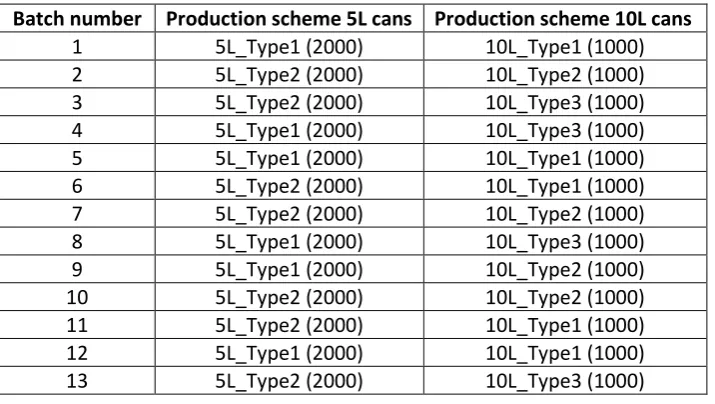
Batch size The number of products that are produced in one production run. In my bachelor assignment, either 2000 5L cans or 1000 10L cans form one batch.
11
1 Introduction
In this chapter, I will give an introduction to my bachelor assignment by introducing Company X, presenting my assignment and my problem approach and research design. This chapter is structured as follows:
• Section 1.1 gives an introduction to Company X. • Section 1.2 describes the motivation for the research. • Section 1.3 presents the assignment description. • Section 1.4 presents the problem statement.
• Section 1.5 gives an introduction to the problem approach.
• Section 1.6 presents the problem approach and the research design.
1.1 Introduction to Company X
Because of confidentiality agreements, information about the type of products that are produced by Company X and any information that could be linked to the company is not presented.
Company X produces products varying from 150ml bottles to 1000L boxes. The company particularly excels in terms of automation, as almost every production line is fully automated, which results in having a small number of operators working at each production line. Most of the production lines only need one operator who is checking the products produced on the line and who performs maintenance activities on the machines. At the end of the production line, there is an automatic guided vehicle that transports the final product from each production line, a pallet with boxes containing the product, to the wrapping machine.
1.2 Motivation for the research
During the last few years, Company X had the task of reducing the operational costs. Many small projects have been conducted to reduce the operational costs, only those reductions were not large enough. Right now, Company X is conducting a big project to reduce the operational costs heavily by combining the 5L and the 10L production line into a line with almost a double throughput. As this project asks for an enormous investment, I am asked to advise Company X on how to maximize the throughput of this production line, while taking into account the use of resources, which is the goal of my research. A more in-depth explanation of my assignment can be found in Section 1.3.
1.3 Assignment description
My assignment will be conducted in the Filling Department, which is part of the Operations section in the Value Chain of Company X. This assignment is created to increase the throughput of 5L and 10L cans from the combined production line.
Both the current 5L production line and 10L production line have a throughput of around 30 cans per minute. This amount is too low, therefore the operational costs per can are too high. In order to decrease the operational costs, those production lines will be combined into one production line containing workstations with a much higher processing speed.
The assignment that Company X gave me is described as follows:
12 The primary goal is thus to maximize the throughput of the production line, but I have to do this by taking into account the use of resources. Just maximizing the throughput will be very easy, as I will use the maximum production speed of the workstations and place huge buffers between the workstations. With the constraint of taking the use of resources, I should decrease the buffers and the production speed as much as possible when this has little effect on the throughput. Resources that can be thought of in this assignment are, buffers, space and money.
1.4 Problem statement
The action problem (Heerkens & Van Winden, 2012, p. 22) regarding this project is that the combined throughput from the 5L can production line and the 10L can production line from Company X is too low. Both production lines have a throughput of around 30 cans per minute.
Company X wants a production line, that can be used for both the 5L cans and 10L cans, that has the highest possible throughput that can be acquired with the workstations that will be bought. So, in terms of a reality and a norm (Heerkens & Van Winden, 2012, p. 23), the reality is that the 5L can throughput is around 30 cans per minute and the norm is the highest possible throughput of 5L cans per minute that can be acquired with the workstations that will be bought. Regarding the 10L can throughput, the reality is that the throughput is around 30 cans per minute and the norm is the highest possible throughput of 10L cans per minute that can be acquired with the workstations that will be bought.
Company X will purchase workstations which are all able to produce at least 100 5L cans or 60 10L cans per minute. However, just purchasing new workstations will not solve the action problem completely. The complete production line has to be designed. Company X already received a part of the suggested design (from the supplier of the workstations) for the production line. The project team that is responsible for the project of building the combined production line will finish this design. After the production line is designed, the production line has to be configured in such a way that the throughput will be maximized. With this configuration, the parametrization of the workstations in terms of production speed and the parametrization of the buffer locations is meant.
As described in Section 1.3, I am asked to optimize the production line, in terms of maximizing the throughput while taking into account the use of resources. In order to answer this question, I will need to answer, amongst others, the following questions:
1. What should be the production speeds of the workstations?
2. What is the effect of a certain buffer size between certain workstations?
I created a problem approach to solve the problem. The introduction to my problem approach is presented in Section 1.5.
1.5 Introduction to problem approach
13
1.5.1 Motivation for conducting a simulation study
To solve the action problem, I will conduct a simulation study in Plant Simulation. I have chosen to conduct a simulation study for the following reasons:
1. With a simulation model, there is a visual representation of the future production line, in which the product flow through the production line is visible. This is more convincing than difficult formulas that arise from queueing theory (Robinson, 2014, p. 15).
2. With a simulation study, you can use a lot of KPIs, while this is much harder with queueing theory.
3. Assumptions about for example distributions can more easily be made in a simulation model than when using queueing theory (Robinson, 2014, p. 15).
4. The level of detail can be much higher in a simulation model than a queueing model.
1.5.2 Overview of my solution process
To create a clearly structured solution process, the solution process is divided into 6 different phases. In this section, I will further elaborate upon these phases. These phases are:
Phase 1: Collect information about the combined production line
In this phase, I will collect information about the combined production line. I will find out what products will be produced on this production line and which workstations are to be included in this production line and what main activities are performed at each workstation. After that, I will find out which KPIs will be used to determine the performance of a production line configuration. Next to that, I will conduct an interview regarding which KPIs I have to optimize the production line.
Phase 2: Collect information about production line optimization techniques
In this phase, I will first collect information on how I can detect the bottleneck in the production line and what the effects of a standstill of the bottleneck are. After that, I will conduct a systematic literature review about production line optimization methodologies, in terms of theory explanation and case studies. After that, I will search for production line optimization techniques, that can be used to support the production line optimization methodologies, in textbooks. At the end of this chapter, I will describe which production line optimization methodologies and production line optimization techniques I will use to optimize the production line.
Phase 3: Create a conceptual model of the combined production line
In this phase, I will build a conceptual model of the combined production line. I will first look for simplifications that can be made in the simulation model, for which I will ask for confirmation from the management team. After that, I will determine which input and output variables I have to use in my simulation model, by integrating the information acquired in Phase 1 and by conducting interviews with the management team and the project team.
Phase 4: Implement, verify and validate the simulation model
In this phase, I will implement my conceptual model in a simulation model. After that, I will verify and validate my simulation model, by using the techniques described by Robinson (2014).
Phase 5: Conduct experiments with production line optimization techniques
14 Phase 6: Advise a production line configuration to Company X
In this phase, I will first conclude on the experiments conducted in Phase 5. After that, I will present recommendations to Company X in terms of production line parametrization. Finally, I will have a critical discussion on my simulation model.
1.6 Problem approach and research design
In this section, I will describe the problem approach that I will follow in order to be able to propose a solution to Company X. I will, for each phase, present the main the research question followed by sub-questions that need to be answered in order to answer the main research question. After that, a short explanation of the research design for each sub-question is presented.
1.6.1 Phase 1: Collect information about the combined production line
For this phase, I have created the main research question, supported by five sub-questions. These questions are answered in Chapter 2.
1) What will the future production line look like and what are my degrees of freedom regarding production line optimization?
a) Which products will be produced on this production line?
b) Which workstations are part of this production line and what are the main activities performed on each workstation?
c) What does the batch changing process look like?
d) What KPIs are currently used to determine the performance of a production line configuration?
e) Regarding which KPIs do I have to optimize the production line?
First, it is important to understand the future production line. Information about the products that will be produced, which workstations are part of the production line and what activities are performed on each workstation, and what the batch changing process looks like will help to understand the production line. These three sub-questions are answered by conducting interviews with the production line operators, as they have a lot of experience with the current 5L and 10L production line. It is also important to acquire information about how Company X measures the performance of a production line and regarding which KPIs I have to optimize the production line. These two sub-questions are answered by conducting an interview with the management team.
1.6.2 Phase 2: Collect information about production line optimization techniques
For this phase, I have created the main research question, supported by five sub-questions. These questions are answered in Chapter 3.
2) How can I optimize the production line of Company X? a) How can I detect the bottleneck in the production line? b) What are the effects when the bottleneck has a standstill?
c) Which production line optimization methodologies exist in the literature and how are they applied in practice?
d) Which production line optimization techniques can I use to optimize the production line? e) Which production line optimization methodologies and techniques will be tested in a
15 Second, it is important to understand how a production line can be optimized. At first, it is important to know how to detect a bottleneck in a production line and what the effects of a bottleneck standstill are. Both sub-questions are answered by conducting a literature study (Kikolski, 2016). After that, it is important to learn about production line optimization methodologies and production line optimization techniques that can be used to optimize the production line. Those questions are answered by conducting a systematic literature review and a literature review respectively. The final sub-question is very important, as this sets the basis for the experiments that will be conducted in Phase 5. This sub-question is answered by conducting a discussion session with the management team, as I want to shape my advice according to their preferences.
1.6.3 Phase 3: Create a conceptual model of the combined production line
For this phase, I have created the main research question, supported by three sub-questions. These questions are answered in Chapter 4.
3) What does the conceptual model of the combined production line look like? a) What simplifications can be made in this simulation model?
b) What are the input data for the simulation model? c) What are the output variables of the simulation model?
Third, it is important to create a conceptual model of the production line as this can be used to create a simulation model of the production line. At first, it is important to look for simplifications that can be made in the simulation model. This question is answered by conducting interviews with the operators and the management team, in which I have proposed simplifications and asked for confirmation to use those simplifications. Next to that, input variables should be created for the simulation model. This is done by using the information received in Phase 1 and by conducting additional interviews with the operators and the management team about data of the production line. Finally, it is important to create output variables on which the production line performance can be judged. These output variables are created by using the information acquired in Phase 1.
1.6.4 Phase 4: Implement, verify and validate the simulation model
For this phase, I have created the main research question, supported by two sub-questions. These questions are answered in Chapter 5.
4) How can I implement, verify and validate the simulation model? a) How can I implement the simulation model?
b) How can I verify and validate and the simulation model?
Fourth, the production line has to be implemented in the simulation model, and the simulation model has to be verified and validated. The first sub-question is answered by creating a simulation model using the information acquired in Phase 3. After the simulation model is created, it is very important to verify and validate the simulation model as the simulation model should be accurate. This sub-question is answered by conducting a literature study (Robinson, 2014).
1.6.5 Phase 5: Conduct experiments with production line optimization techniques
For this phase, I have created the main research question, supported by three sub-questions. These questions are answered in Chapter 6.
5) Which experiments will be conducted in my simulation study? a) Which preparations have to be made before experimenting?
16 Fifth, experiments should be conducted to optimize the production line. Before conducting experiments, it is very important to statistically prepare the experiments to make sure that the conclusions that will be made are statistically correct. This question is answered by conducting a literature study (Robinson, 2014). After that, the experiments that will be conducted have to be created. This sub-question is answered by using the information acquired in Phase 3. After determining which experiments will be performed, the results of each experiment have to be presented.
1.6.6 Phase 6: Advise a production line configuration to Company X
For this phase, I have created the main research question, supported by three sub-questions. The first question is answered in Chapter 7, the second question is answered in Chapter 8 and the third question is answered in Chapter 9.
6) Which configuration should be used by Company X?
a) What conclusions can be drawn from the experiments?
b) Which production line parametrization do I recommend to Company X? c) Which limitations might have influenced the accuracy of my simulation model?
Finally, a production line configuration should be advised to Company X. First, conclusions have to be drawn from the experiments. After that, I have to recommend a production line parametrization to Company X, based on the conclusions drawn from the experiments. At last, it is important to critically discuss the simulation model, as there might be some limitations that might have influenced the accuracy of my simulation model.
17
2 Information about the production line
In this chapter, I will present more general information about the production line. I will answer the following research question in this chapter: “What will the future production line look like and what are my degrees of freedom regarding production line optimization?”. This chapter is structured as follows:
• Section 2.1 describes the products to be produced on the production line.
• Section 2.2 describes the workstations in the production line and the product routes. • Section 2.3 describes the batch changing process.
• Section 2.4 describes the KPIs that determine production line performance. • Section 2.5 describes the KPIs that will be optimized in this simulation study.
2.1 Products to be produced on the production line
This section answers the question: “Which products will be produced on this production line?”. There are two types of products that are to be produced on the production line: the 5L cans and 10L cans, which are described below. In Section 2.1.3, I have created different product groups.
2.1.1 5L cans
There are roughly 200 different SKUs that are produced on the current 5L production line. Further details about the SKUs are not presented because of confidentiality agreements. The 5L cans are placed into a box, which is labeled afterwards. The cans contain either a sleeve or a label.
2.1.2 10L cans
There are roughly 80 different SKUs that are produced on the current 10L production line. Further details about the SKUs are not presented because of confidentiality agreements. The 10L cans contain only a sleeve, only a label or both a sleeve and a label. The 10L cans are not placed into boxes.
2.1.3 Product groups
By summarizing Sections 2.1.1 and 2.1.2, I have created five different product groups. Those product groups are presented in Table 2.1 in which the characteristics of each group are described. These product groups are created based on the way in which they are packed. No distinction is made between the type of product.
Product group Type of product Sleeve? Label on can? Packed in a box? Label on box?
5L_Type1 5L YES NO YES YES
5L_Type2 5L NO YES YES YES
10L_Type1 10L YES NO NO NO
10L_Type2 10L NO YES NO NO
10L_Type3 10L YES YES NO NO
Table 2.1 | Product groups
2.2 Workstations in the production line
18
2.2.1 List of workstations in the production line
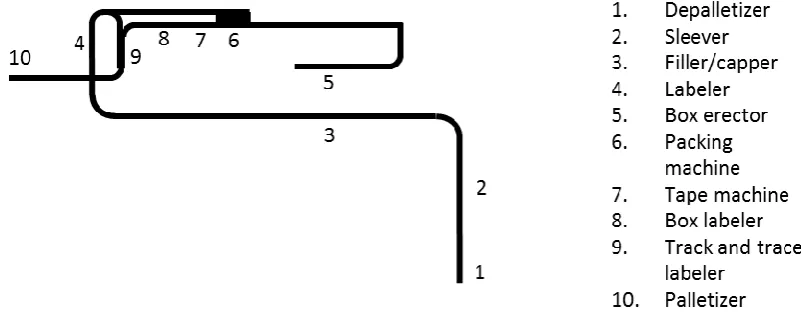
There are 10 workstations that will be part of the production line. The production process starts at the depalletizer and ends at the palletizer. All workstations are completely automated, meaning that the operator only has to monitor if the process is going well and repair the workstations if needed. All workstations in the production line are listed below. Next to that, the layout of the production line including these workstations is presented in Figure 4.2 in Section 4.2.6.
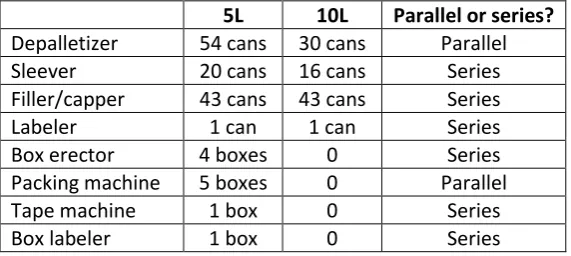
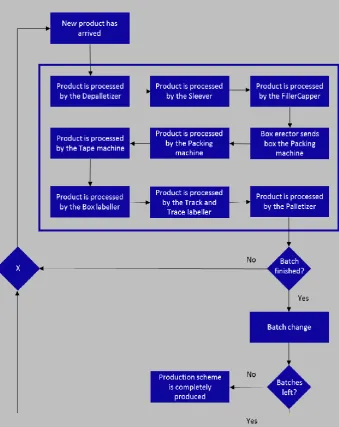
1. Depalletizer: At the depalletizer, all cans that arrive on a pallet are placed onto the production line. The depalletizer unpacks a pallet layer by layer. Each layer consists of either 54 5L cans or 30 10L cans.
2. Sleever: At the sleever, the can will be provided with a sleeve, which is pulled over the can. The sleeves are applied in series, meaning that the application of the sleeve to the first can begins slightly earlier than the application of the sleeve to the second can. The sleever has a processing size of either 20 5L cans or 16 10L cans.
3. Filler/capper: The filler and the capper are two machines that are synchronized to each other and can, therefore, be seen as one workstation. In the filler, 43 cans (5L or 10L) are simultaneously filled with the product. After that, the capper puts a cap on the can.
4. Labeler: At the labeler, a label is placed onto the can. One can is provided with a label at the time, meaning that the labeler has a processing size of 1 can.
5. Box erector: The box erector delivers the boxes that are used to pack the cans with the product. In front of the box erector, there is a stock of folded up boxes. These boxes are unfolded in batches of 4 by the box erector, which makes them ready to be used by the packing machine.
6. Packing machine: The packing machine picks up ten cans at a time and places them into five boxes that are provided by the box erector. There is a maximum speed at the packing machine, to make sure that the cans are placed into the box correctly.
7. Tape machine: The tape machine seals the boxes by placing a stroke of tape at the top of the box and at the bottom of the box. This makes sure that the box is closed correctly. One box is foreseen by a stroke of tape at the time, meaning that the tape machine has a processing size of 1 box.
8. Box labeler: The box labeler places a label on the box. The front of the box will always contain a label; for some orders, an additional label on the back of the box is required. One box is foreseen by a label at the time, meaning that the box labeler has a processing size of 1 box. 9. Track and trace labeler: The track and trace labeler prints a track and trace code on the can or
box. This track and trace code contains the product number, the batch number, the date and time of filling. With this, the product can be linked to the operator who ‘created’ the product. If there are some errors in the products, this can be fed back to the operator, such that he can improve himself by learning from mistakes. This will make sure that he will not make the same mistake anymore. One box is provided with a track and trace code at the time, meaning that the track and trace labeler has a processing size of 1 can or box.
10. Palletizer: At the palletizer, all boxes with cans that are filled with the product, are placed on a pallet. The boxes are pushed in the position of a pallet layer. If a pallet layer is created, then this layer is pushed away and a new layer can be filled. The layers are then stacked by bringing a layer down, such that the next layer can be pushed on it.
19
2.2.2 Different routes for different products
As mentioned in Section 2.1.3, there are different product groups. Each product group has its own route on the production line, meaning that some product groups are processed (“YES”) or not (“NO”) on certain workstations. These different routes for the product groups are presented in Table 2.2 below.
5L_Type1 5L_Type2 10L_Type1 10L_Type2 10L_Type3
Depalletizer YES YES YES YES YES
Sleever YES NO YES NO YES
Filler/capper YES YES YES YES YES
Labeler NO YES NO YES YES
Box erector YES YES NO NO NO
Packing machine YES YES NO NO NO
Tape machine YES YES NO NO NO
Box labeler YES YES NO NO NO
Track and trace labeler YES YES YES YES YES
Palletizer YES YES YES YES YES
Table 2.2 | Routes for different product groups
As can be seen in Table 2.2, some product groups pass the sleever or the labeler. For the 5L cans, there is a switch at the sleever, which can either activate the sleever and simultaneously deactivate the labeler. For the 10L cans, there is a switch at both the sleever and the labeler, which can activate and deactivate the corresponding workstation.
2.3 Batch changing process
This section answers the question: “What does the batch changing process look like?”. I will elaborate on what the batch changing process looks like, what operators have to do and the batch changing time. At the end of a batch, the production line has to be cleaned. The filler capper is emptied and after that, the buffer tank is cleaned and the remaining product in the pipes is flushed away into a waste box. Next to that, the complete production line has to be configured according to the product that has to be produced. The operator has to change, amongst others, the labels of the labeler and the box labeler, the roll of tape of the tape machine, the sleeves and the pressure of the filler capper. All the materials are replaced by the operator himself. Also, the operator receives a checklist with, amongst others, the codes of the labels and the sleeves, which have to be checked. No activities are performed on the depalletizer, the packing machine and the palletizer. Therefore, the depalletizer places the cans for the next batch on the line during the batch changing process, which will save a lot of time.
After everything is configured in the right way, the operator has to take a sample of the product to determine if the product quality and the concentration of the product are good. Next to that, the operator should check whether the labels are correctly placed onto the cans and boxes. If this sample is approved by the operator, the new batch can be produced.
There is no fixed time for the batch changing process; the required cleaning time is only dependent on the type of product that was produced in this batch. The cleaning process of some products can be finished very fast; the cleaning process of other products takes much longer to finish.
20 In Appendix 1, a detailed time schedule of a batch changing process is presented. I observed a batch changing process of the current 5L production line on a random day in which two operators performed the batch change.
2.4 KPIs that determine production line performance
This section answers the question: “What KPIs are currently used to determine the performance of a production line configuration?”. I will elaborate on how Company X used to determine production line performance and how this determination has changed over time.
In the past, Company X used one measurement to determine production line performance: Overall Equipment Effectiveness (OEE). One part of the OEE includes the average throughput, which will be the first objective of my simulation study. I will first elaborate on the average throughput and after that, I will elaborate on the OEE. Next to that, I will elaborate on the use of resources, as this also influences production line performance.
2.4.1 Average Throughput
The average throughput is measured in terms of cans per minute, in which batch changing times are excluded. As the goal of my assignment is to “maximize the throughput of the combined 5L and 10L production line while taking into account the use of resources”, the average throughput is my first objective.
2.4.2 Overall Equipment Effectiveness (OEE)
The OEE includes availability, performance, and quality. The formula that is used to determine the OEE is:
OEE (%) = availability (%) × performance (%) × quality (%)
The availability is defined as follows: “a comparison of the potential operating time with actual time the equipment is producing products”. The availability can be calculated by dividing the running time by the net operating time. The net operating time is the time that is scheduled for the batches. The running time is the time that the production line is operational, so it excludes workstation downtimes. The performance is defined as follows: “a comparison of the actual output and what the equipment can produce.”. The performance can be calculated by dividing the actual output by the target output. The target output is determined is the target number of products that should be produced per minute and the actual output is the actual number of products that are produced per minute.
21 Company X used to determine the performance by setting a target throughput for each batch, in terms of products to be produced per minute, and by calculating the actual number of products that are produced per minute.
Company X did not determine the quality of the of the products, as they did not track the number of products that were thrown away during the production process.
2.4.3 The use of resources
Company X also takes into account the use of resources, for example the use of buffers, space, money and the number of operators. These resources have to be minimized, as this is stated in the goal of my assignment, which is “maximize the throughput of the combined 5L and 10L production line while taking into account the use of resources”.
2.5 Conclusion: KPIs that will be optimized
This section answers the question: “Regarding which KPIs do I have to optimize the production line?”. I will elaborate on how I will optimize the production line and I will describe other measurements that have to be taken into account when determining the performance of a production line.
2.5.1 Average Throughput
My first objective is to maximize the average throughput, as this is the goal of my assignment. The average throughput will be determined by dividing the total number of cans produced by the total time of producing, which excludes batch changing processes.
2.5.2 Overall Equipment Effectiveness
My second objective is to maximize the OEE of the production line. The availability will be determined by the average availability of the workstations in the production line. During a 10L production process, the availability of the box erector, the packing machine and the tape machine will not be taken into account. The performance will also be calculated at the end of the simulation run. I will not model product defects, so I will assume that the quality of the products equals 100%.
2.5.3 Use of resources
After having maximized the average throughput and after that OEE, I will look at the use of resources. If a buffer will be placed in the production line, I will determine the minimum capacity at which it can increase the average throughput. So, if the average throughput is the same with a buffer capacity of 50 cans as with buffer capacity of 75 cans, I will use a buffer capacity of 50 cans.
Another thing that I will look at is the average time between two consecutive fillings of the buffer of the box erector, which is performed by the operator. I will minimize this buffer capacity as much as possible, as it saves space and money, to such a level that it is feasible for the operators.
22
3 Information about production line optimization techniques
In this chapter, I will elaborate on production line optimization techniques. I will answer the following research question in this chapter: “How can I optimize the production line of Company X?”. This chapter is structured as follows:
• Section 3.1 describes how a bottleneck can be detected in a production line. • Section 3.2 describes the effects of a standstill of the bottleneck.
• Section 3.3 describes production line optimization methodologies. • Section 3.4 describes production line optimization techniques.
• Section 3.5 describes the choices that I made regarding the optimization of the production line.
3.1 Bottleneck detection
This section answers the question: “How can I detect the bottleneck in the production line?”. I will elaborate on the characteristics of a bottleneck in a production line and how I can detect the bottleneck in Plant Simulation.
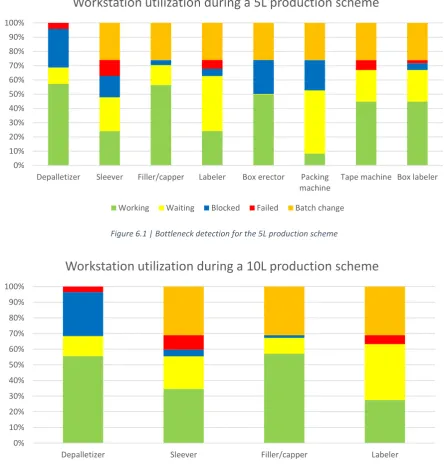
In Plant Simulation, I can detect the bottleneck by looking at the resource statistics, which show the activities of the workstations (Kikolski, 2016, p. 108). It shows, amongst others, what fraction of the time the workstation is working, waiting and blocked. The bottleneck is the workstation that is working the highest portion of the time (Kikolski, 2016, p. 108). Another characteristic of the bottleneck, in a production line without buffers, is that the workstation after the bottleneck is waiting a high fraction of the time (Kikolski, 2016, p. 108). This can also be seen in the resource statistics.
Another way to detect the bottleneck is to calculate the effective processing speed of each workstation. Consider the following example: workstation 1 has an availability of 5%, having a processing speed of 10 units per minute. Workstation 2 has an availability of 100%, having a processing speed of 1 unit per minute. Thus, the effective processing speed of workstation 1 is 0.5 unit per minute and the effective processing speed of workstation 2 is 1 unit per minute; thus workstation 2 is not the bottleneck, while its utilization is higher than the utilization of workstation 1.
The bottleneck is thus the workstation with the lowest effective processing speed, which can be calculated by multiplying the processing speed of the workstation by the availability of the workstation. The availability of the workstation is the portion of the time that the workstation is operational, which can be calculated as follows: 𝑎𝑣𝑎𝑖𝑙𝑎𝑏𝑖𝑙𝑖𝑡𝑦(%) = 1 − 𝑓𝑎𝑖𝑙𝑢𝑟𝑒 𝑝𝑜𝑟𝑡𝑖𝑜𝑛 − 𝑏𝑎𝑡𝑐ℎ 𝑐ℎ𝑎𝑛𝑔𝑖𝑛𝑔 𝑝𝑜𝑟𝑡𝑖𝑜𝑛.
3.2 Effects of a standstill of the bottleneck
This section answers the question: “What are the effects when the bottleneck has a standstill?”. I will first elaborate on the effects on the workstations in front of the bottleneck and after that, I will elaborate on the effects on the workstations behind the bottleneck.
3.2.1 Effects on workstations in front of the bottleneck
23
3.2.2 Effects on workstations behind the bottleneck
If the bottleneck has a standstill, this means that the workstations behind the bottleneck, in case there are no buffers behind the bottleneck, do not have products to process. Therefore, the workstations are waiting for the bottleneck to process the products. The workstations behind the bottleneck can only start processing products again if the bottleneck has recovered from its failure. Therefore, several workstations in the production line are standing still, which decreases the production line throughput.
3.3 Production line optimization methodologies
In the literature, there are methodologies that can be used to improve the performance of the production line by optimizing bottlenecks. One of those methodologies is OPT, also known as Optimized Production Technology, which states that bottlenecks determine the throughput of the production line (Goldratt & Cox, Het doel: Een proces van voortdurende verbetering, 1988, p. 283). Another methodology is the TOC, also known as the Theory of Constraints, which is a methodology that iteratively improves the performance of a production line by exploiting the bottlenecks (Goldratt, Theory of Constraints, 1999). The DBR methodology, also known as the Drum-Buffer-Rope methodology comes from the Theory of Constraints and the Optimized Production Technology. The DBR methodology helps to decide exactly where in a process control should occur because the amount of work loaded onto each workstation in the production line is often not perfectly balanced (Slack, Chambers, & Johnston, 2010, p. 290).
I want to find more information about those three production line optimization methodologies in terms of theory explanation and case studies. Therefore, I will answer the question: “Which production line optimization methodologies exist in the literature and how are they applied in practice?” by means of a systematic literature review. The systematic literature review protocol that I used to find the information in this section is presented in Appendix 2.
In the following sections, I will describe my findings from my systematic literature review. This section is split into three different sub-sections: each section covers one production line optimization methodology regarding theory and case studies. Section 3.3.1 describes the Theory of Constraints, Section 3.3.2 describes the Optimized Production Technology and Section 3.3.3 describes the DBR methodology. Section 3.3.4 gives a summary of my findings with the systematic literature review.
3.3.1 The Theory of Constraints (TOC)
Slack, Chambers, & Johnston (2010) describe the Theory of Constraints. Slack, Chambers, & Johnston (2010) state that any bottleneck will disrupt the smooth flow of items in processes and that is therefore “important to recognize the significance of capacity constraints to the planning and control process” (Slack, Chambers, & Johnston, 2010, p. 449). The Theory of Constraint focusses the attention on the capacity constraints or bottleneck in processes. This methodology consists out of five steps: (1) identify the bottleneck, (2) decide how to exploit the bottleneck, (3) subordinate everything to the bottleneck, (4) eliminate the bottleneck and (5) start again from step 1. The Theory of Constraints is thus an iterative process of eliminating bottlenecks to improve the process during each cycle of this methodology.
24 Atwater & Chakravorty (2001) critically look at the Theory of Constraints, which states that only the system’s primary resource constraint(s) should be scheduled at 100% of capacity and all other resources should have excess capacity. Atwater & Chakravorty (2001) conducted a simulation study that studies how changes in the capacity utilization of a system’s two most heavily utilized resources affect the performance of a drum-buffer-rope scheduling system. With this case study, Atwater & Chakravorty (2001) showed that the 100% utilization of the primary constraint is not optimal. This is further explained by using basic queueing theory: “Anyone with a basic understanding of queueing theory knows that if arrival rates always equal or exceed processing speeds, work-in-process (WIP) and lead times will go to infinity” (Atwater & Chakravorty, 2001, p. 260).
3.3.2 The Optimized Production Technology (OPT)
Goldratt & Cox (1988) describe the Optimized Production Technology and present the most important rules of the OPT methodology. Goldratt & Cox (1988) state that the utilization of a non-bottleneck is not determined by its own capacity, but by other constraints in the plant. Also, one hour of standstill of a bottleneck is said to be one hour of standstill for the whole plant. The most important rule of the OPT methodology is that bottleneck determines the throughput of the plant.
Gelders & Van Wassenhove (1985) conducted a case study by looking at production-inventory control systems. Three control systems were used: MRP, JIT and OPT. Gelders & Van Wassenhove (1985) state that there is nothing new in the rules of OPT and that few people will disagree with them. However, Gelders & Van Wassenhove (1985) state that some of these basic rules are not respected in practice. “JIT has a better potential than MRP for respecting them in practice” (Gelders & Van Wassenhove, 1985, pp. 207-208). In terms of capacity utilization, the OPT methodology is very similar to the JIT methodology. Gelders & Van Wassenhove (1985) suggest that the best solution to smooth production when capacity limitations are a problem is to use the “best of three worlds” approach, in which OPT is the first step to plan carefully the bottleneck facilities followed by the use of MRP and JIT.
3.3.3 The Drum-Buffer-Rope methodology (DBR)
Slack, Chambers, & Johnston (2010) describe the drum-buffer-rope methodology. This methodology comes from the Theory of Constraints and the Optimized Production Technology. The DBR methodology describes exactly where in a process control should occur. The work loaded onto each separate work center is often not perfectly balanced, meaning that there is likely to be a bottleneck in the process. Slack, Chambers, & Johnston (2010) state that the bottleneck should be the control point of the whole process, called the drum, as “it sets the ‘beat’ for the rest of the process to follow” (Slack, Chambers, & Johnston, 2010, p. 290). As the bottleneck does not have sufficient capacity, Slack, Chambers, & Johnston (2010) argue that it is sensible to keep a buffer of inventory in front of the bottleneck to make sure that it has always something to work on. Slack, Chambers, & Johnston (2010) state that “some form of communication between the bottleneck and the input to the process is needed to make sure that activities before the bottleneck do not overproduce” (Slack, Chambers, & Johnston, 2010, p. 290), which is called the rope.
25 Huang, Pei, Wu, & May (2013) conducted a case study on a mixed production line and the re-scheduling, by applying both the Theory of Constraints and a Drum-Buffer-Rope algorithm. Huang, Pei, Wu, & May (2013) found that the buffer and buffer management are able to manage the production fluctuation. The bottleneck was identified by using the Theory of Constraints and the DBR algorithm was used to determine the buffer size that was needed for the bottleneck. Huang, Pei, Wu, & May (2013) also found that placing a buffer in front of the bottleneck was beneficial to minimize the chances of products to get delayed.
Atwater & Chakravorty (2001) showed that the drum-buffer-rope methodology works very well to relatively low levels of increased capacity at the operation’s second most heavily utilized resource.
3.3.4 Summary of Production line optimization methodologies
From this Systematic Literature Review, we have seen that the Theory of Constraints, the Optimized Production Technology and the Drum-Buffer-Rope methodology are very similar. All methodologies are focused on minimizing the negative effects of a bottleneck in a production line. Next to that, all methodologies state that the bottleneck determines the throughput from the production line. These methodologies therefore prescribe to first identify the bottleneck in the production line and after that, to eliminate the bottleneck. The Theory of Constraints and the Optimized Production Technology do not prescribe one type of elimination technique, however the Drum-Buffer-Rope methodology does. The DBR-methodology prescribes that a buffer has to be created in front of the bottleneck to make sure that the bottleneck always has something to work on.
The case studies regarding the Theory of Constraints in this Systematic Literature Review provided very useful information additional to the theory description. Two case studies criticized the Theory of Constraints by mentioning that a 100% utilization of the bottleneck is not optimal. Chakravorty & Atwater (2006) showed that that the optimal bottleneck utilization was 80.3% and that any attempt to increase the utilization brought disastrous results for the door manufacturing plant. Atwater & Chakravorty (2001) explained, by using Queueing Theory, that lead time will go to infinity if the utilization of the bottleneck equals 100%.
The case study on the Optimized Production Technology showed a useful application of the Optimized Production Technology. Gelders & Van Wassenhove (1985) showed that the Optimized Production Technology is very useful to use as a first step to plan the bottleneck facilities, which can be followed by the use of MRP and JIT.
The case studies regarding the Drum-Buffer-Rope methodology in this Systematic Literature Review provided very useful information additional to the theory description. Thürer, Stevenson, Silva & Qu (2017) showed that the DBR-methodology works particularly well in case of high bottleneck severity. Huang, Pei, Wu & May (2013) showed that placing a buffer in front of the bottleneck was beneficial to minimize the chances of products to get delayed, which confirms the theory description. Atwater & Chakravorty (2001) showed that the DBR-methodology works very well to relatively low levels of increased capacity at the operation’s second most heavily utilized resource.
3.4 Production line optimization techniques
26
3.4.1 Buffering
One of the production line optimization techniques is buffering. In this section, I will elaborate on buffering in front of the bottleneck and buffering behind the bottleneck and give an estimation of the buffer capacity that is needed.
Buffering in front of the bottleneck
As already described in Section 3.3.3, it is beneficial to buffer in front of the bottleneck, because this will make sure that the bottleneck always has something to work on. The workstations in front of the bottleneck will most of the time work faster than the bottleneck; therefore, line accumulation will occur if there is no buffer space in front of the bottleneck. The buffer space makes it possible to buffer, such that the workstations in front of the bottleneck will not be blocked when the line is fully occupied and can continue to process products.
Next to that, in case a workstation in front of the bottleneck fails, the buffer will make sure that bottleneck can process the items that are currently in the buffer, making sure that the bottleneck has something to work on. The buffer thus makes sure that the bottleneck does not suffer from that workstation failure. Of course, the buffer size determines the extent to which a bottleneck suffers from that workstation failure. The higher the buffer size, the less the bottleneck suffers from that workstation failure.
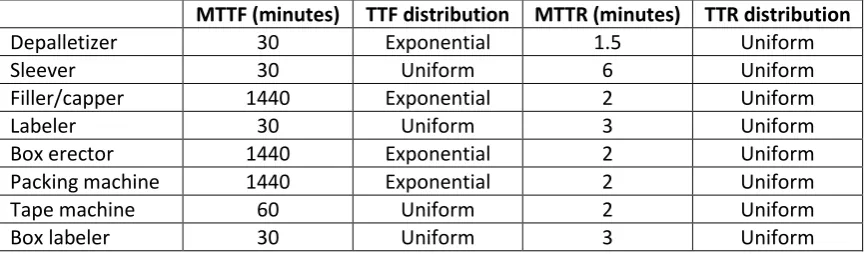
To optimally benefit from the buffer that is created, the buffer should be able to provide enough products to the bottleneck if the workstation in front of the bottleneck fails. The buffer size thus has to be determined by using data from the workstation in front of the bottleneck. These data are the processing speed and the repair time.
The buffer size between the workstations can be estimated as follows: during a failure, the buffer size should be equal to the number of products that can be processed during that failure. So, if a workstation takes on average 5 minutes to get repaired and the processing speed is 100 products per minute, the buffer between the two workstations should be around 500 products. If the conveyor belt between the workstations can accommodate 100 products, the buffer station should have a capacity of 400 products.
Buffering behind the bottleneck
Next to buffering in front of the bottleneck, it is beneficial to buffer behind the bottleneck. Buffering behind the bottleneck compensates for failures of workstations behind the bottleneck. If a workstation behind the bottleneck fails and there is no buffer space, line accumulation after the bottleneck will occur, which will in time make sure that the bottleneck is ‘blocked’ and cannot process products. As the bottleneck determines the production line throughput, any time that the bottleneck is ‘blocked’ leads to a decrease in production line throughput.
A buffer behind the bottleneck makes sure that the bottleneck can still process products in case a workstation behind the bottleneck fails, which means that the bottleneck does not suffer from that workstation failure. Of course, the buffer size determines the extent to which a bottleneck suffers from that workstation failure. The higher the buffer size, the less the bottleneck suffers from that workstation failure.
27 The buffer size between the workstations can be estimated as follows: during a failure, the buffer size should be equal to the number of products that can be processed during that failure. So, if the workstation behind the bottleneck takes on average 3 minutes to get repaired and the processing speed of the bottleneck is 100 products per minute, the buffer between the two workstations should be around 300 products. If the conveyor belt between the workstations can accommodate 100 products, the buffer station should have a capacity of 200 products.
3.4.2 V-curve principle
The V-curve principle is a Line Balancing principle that can be used to optimize a production line. The objective of the V-curve principle is to maximize the output of the bottleneck in the production line (Optimumfx, 2018, p. 4). In this section, I will explain how the V-curve principle can be applied and how the V-curve principle minimizes the negative effects of workstation failures.
V-curve principle: application
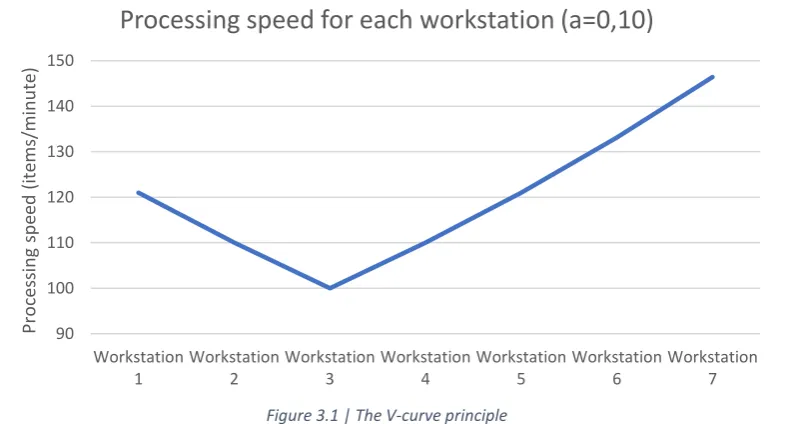
The V-curve principle works as follows: the processing speed of the bottleneck in the production line is the base for determining the processing speeds from the other workstations. The processing speeds from the other workstations are determined as follows: the processing speeds from the workstations next to the bottleneck are calculated by multiplying the processing speed from a workstation with a variable 1+a. The processing speed of the workstation that is next to that workstation is calculated by multiplying the processing speed of the bottleneck with (1+a)2, etcetera. However, the processing
speeds that are calculated should also be feasible. If the calculated processing speed is higher than the maximum processing speed, the maximum processing speed should be used instead of the calculated processing speed.
[image:27.595.104.497.459.671.2]An example of the V-curve principle is shown in Figure 3.1, in which the value of ‘a’ equals 0.10. In this situation, workstation 3 is the bottleneck with a processing speed of 100 items per minute. The graph in this figure has a V-shape; this explains why this technique is called the V-curve principle.
Figure 3.1 | The V-curve principle
90 100 110 120 130 140 150 Workstation 1 Workstation 2 Workstation 3 Workstation 4 Workstation 5 Workstation 6 Workstation 7 Pro ce ss in g sp ee d (ite m s/m in u te)
28
V-curve principle: a workstation behind the bottleneck fails
The V-curve principle corrects for workstation breakdowns. In case a workstation behind the bottleneck fails, the production line throughput will not decrease. The production line throughput is determined by the throughput from the bottleneck and the bottleneck can still process products in case another workstation fails. These processed products will accumulate in front of the failed workstation; however, the processing speed of this workstation is higher than the processing speed of the bottleneck, thus this workstation can compensate for its failure. Therefore, the throughput from the production line will equal the throughput from the bottleneck. However, there should be enough space on the production line for products to accumulate. If this is not the case, the V-curve principle will be less effective than is the case when there is a lot of space on the production line for products to accumulate.
V-curve principle: a workstation in front of the bottleneck fails
In case a workstation in front of the bottleneck fails, the production line throughput will not decrease. The production line throughput is determined by the throughput from the bottleneck and the bottleneck can still process products in case another workstation fails. Because of the higher processing speeds from the workstations in front of the bottleneck, a lot of products will be accumulated in front of the bottleneck, such that the bottleneck always has something to work on. However, there should be enough space on the production line for products to accumulate. If this is not the case, the V-curve principle will be less effective than is the case when there is a lot of space on the production line for products to accumulate.
V-curve principle: the bottleneck fails
In case the bottleneck fails, the production line throughput will decrease, as the production line throughput is determined by the throughput from the bottleneck. The V-curve principle cannot minimize the negative effects that are caused by the bottleneck failure. However, because of the higher production speeds from the workstations in front of the bottleneck, the production line will become fully occupied with products in front of the bottleneck, which will make sure that the bottleneck has enough products to process after it has recovered from its failure.
3.4.3 Extended version of the V-curve principle
In this section, I will elaborate on an extended version of the V-curve principle. This extension is that the V-curve only exists after a workstation failure (other than a bottleneck failure) and will continue to exist until the workstation failure is solved (Optimumfx, 2018, p. 4). There are two implementation possibilities for this extended version of the V-curve principle: the V-curve is activated automatically or by the operators. The processing speeds of all workstations first equal the target processing speed of 100 or 60 cans per minute and during a workstation failure (other than a bottleneck failure), the V-curve is activated.
Automatic V-curve activation
29
Manual V-curve activation
In case implementing the V-curve automatically is too complicated or too expensive, the V-curve can be activated manually. The effectiveness of the V-curve will, of course, be less than the V-curve when it is automatically activated, because some time, which I estimated at 30 seconds, will be lost due to the manual activation. If a workstation fails (other than a bottleneck failure), then the operator first has to activate the V-curve and then has to solve the workstation failure.
3.5 Choices regarding the optimization of the production line
This section answers the question: “Which production line optimization techniques will be tested in a simulation study?”. I will elaborate on how I will integrate the aforementioned theory in this chapter and how I will experiment with those theories.
3.5.1 Integration of theories
In my experiments with the simulation model of the production line, I will integrate the aforementioned theories in this chapter. At first, I will identify the bottleneck using the resource statistics and the effective processing speed, which is described in Section 3.1. After that, I will perform one iteration of the Theory of Constraints as a production line optimization methodology, as I think that the widely applicable approach of the Theory of Constraints will be perfect to optimize this production line. I will also use additional production line optimization techniques, described in Section 3.4, to support the Theory of Constraints in deciding on how to eliminate the bottleneck.
3.5.2 Experiments with production line optimization techniques
I will perform different experiments with buffering in front of the bottleneck and behind the bottleneck, the V-curve principle and the extended version of the V-curve principle. For all experiments, I will evaluate the values of the KPIs described in Section 2.5 and based on that, I will determine which production line optimization technique has the best overall score on the KPIs. This production line optimization technique will then be used to optimize the production line.