Getting the structure right for word alignment: LEAF
Alexander Fraser
ISI / University of Southern California 4676 Admiralty Way, Suite 1001
Marina del Rey, CA 90292
Daniel Marcu
ISI / University of Southern California 4676 Admiralty Way, Suite 1001
Marina del Rey, CA 90292
Abstract
Word alignment is the problem of annotating parallel text with translational correspon-dence. Previous generative word alignment models have made structural assumptions such as the 1-to-1, 1-to-N, or phrase-based consecutive word assumptions, while previ-ous discriminative models have either made such an assumption directly or used features derived from a generative model making one of these assumptions. We present a new gen-erative alignment model which avoids these structural limitations, and show that it is effective when trained using both unsuper-vised and semi-superunsuper-vised training methods.
1 Introduction
Several generative models and a large number of discriminatively trained models have been proposed in the literature to solve the problem of automatic word alignment of bitexts. The generative propos-als have required unrealistic assumptions about the structure of the word alignments. Two assumptions are particularly common. The first is the 1-to-N as-sumption, meaning that each source word generates zero or more target words, which requires heuristic techniques in order to obtain alignments suitable for training a SMT system. The second is the consec-utive word-based “phrasal SMT” assumption. This does not allow gaps, which can be used to particular advantage by SMT models which model hierarchi-cal structure. Previous discriminative models have either made such assumptions directly or used
fea-tures from a generative model making such an as-sumption. Our objective is to automatically produce alignments which can be used to build high quality machine translation systems. These are presumably close to the alignments that trained bilingual speak-ers produce. Human annotated alignments often contain M-to-N alignments, where several source words are aligned to several target words and the re-sulting unit can not be further decomposed. Source or target words in a single unit are sometimes non-consecutive.
In this paper, we describe a new generative model which directly models M-to-N non-consecutive word alignments. The rest of the paper is organized as follows. The generative story is presented, fol-lowed by the mathematical formulation. Details of the unsupervised training procedure are described. The generative model is then decomposed into fea-ture functions used in a log-linear model which is trained using a semi-supervised algorithm. Experi-ments show improveExperi-ments in word alignment accu-racy and usage of the generated alignments in hier-archical and phrasal SMT systems results in an in-creased BLEU score. Previous work is discussed and this is followed by the conclusion.
2 LEAF: a generative word alignment model
2.1 Generative story
We introduce a new generative story which enables the capture of non-consecutive M-to-N alignment structure. We have attempted to use the same la-bels as the generative story for Model 4 (Brown et
al., 1993), which we are extending.
Our generative story describes the stochastic gen-eration of a target string f (sometimes referred to as the French string, or foreign string) from a source stringe(sometimes referred to as the English string), consisting oflwords. The variablem is the length off. We generally use the indexito refer to source words (eiis the English word at positioni), andjto
refer to target words.
Our generative story makes the distinction be-tween different types of source words. There are head words, non-head words, and deleted words. Similarly, for target words, there are head words, non-head words, and spurious words. A head word is linked to zero or more head words; each non-head word is linked to from exactly one non-head word. The purpose of head words is to try to provide a ro-bust representation of the semantic features neces-sary to determine translational correspondence. This is similar to the use of syntactic head words in sta-tistical parsers to provide a robust representation of the syntactic features of a parse sub-tree.
A minimal translational correspondence consists of a linkage between a source head word and a target head word (and by implication, the non-head words linked to them). Deleted source words are not in-volved in a minimal translational correspondence, as they were “deleted” by the translation process. Spu-rious target words are also not involved in a min-imal translational correspondence, as they sponta-neously appeared during the generation of other tar-get words.
Figure 1 shows a simple example of the stochas-tic generation of a French sentence from an English sentence, annotated with the step number in the gen-erative story.
1. Choose the source word type.
for each i = 1,2, ..., l choose a word type χi = −1 (non-head word), χi = 0(deleted
word) orχi = 1(head word) according to the
distributiong(χi|ei)
letχ0 = 1
2. Choose the identity of the head word for each non-head word.
for each i = 1,2, ..., l if χi = −1 choose a
“linked from head word” valueµi(the position
of the head word whicheiis linked to)
accord-ing to the distributionw−1(µi−i|classe(ei))
for eachi= 1,2, ..., lifχi= 1letµi =i for eachi= 1,2, ..., lifχi= 0letµi = 0
for eachi = 1,2, ..., l ifχµi 6= 1 return
“fail-ure”
3. Choose the identity of the generated target head word for each source head word.
for each i = 1,2, ..., l if χi = 1 choose τi1
according to the distributiont1(τi1|ei)
4. Choose the number of words in a target cept conditioned on the identity of the source head word and the source cept size (γiis 1 if the cept
size is 1, and 2 if the cept size is greater). for eachi = 1,2, ..., lifχi = 1choose a
For-eign cept sizeψi according to the distribution
s(ψi|ei, γi)
for eachi= 1,2, ..., lifχi<1letψi = 0
5. Choose the number of spurious words.
choose ψ0 according to the distribution s0(ψ0|
P
iψi)
letm=ψ0+
Pl
i=1ψi
6. Choose the identity of the spurious words. for eachk = 1,2, ..., ψ0 chooseτ0kaccording
to the distributiont0(τ0k)
7. Choose the identity of the target non-head words linked to each target head word.
for each i = 1,2, ..., l and for each k = 2,3, ..., ψichooseτikaccording to the
distribu-tiont>1(τik|ei,classh(τi1))
8. Choose the position of the target head and non-head words.
for each i = 1,2, ..., l and for each k = 1,2, ..., ψichoose a positionπikas follows:
• if k = 1 choose πi1
accord-ing to the distribution d1(πi1 −
cρi|classe(eρi),classf(τi1))
• ifk = 2choose πi2 according to the
source absolutely [comma] they do not want to spend that money word type(1) DEL. DEL. HEAD non-head HEAD HEAD non-head HEAD HEAD HEAD
linked from(2) THEY do|| NOT WANT to{{ SPEND THAT MONEY
head(3) ILS PAS DESIRENT DEPENSER CET ARGENT
cept size(4) 1 2 1 1 1 1
num spurious(5) 1
spurious(6) aujourd’hui
non-head(7) ILS PAS ""ne DESIRENT DEPENSER CET ARGENT
placement(8) aujourd’hui ILS neww DESIRENT PAS DEPENSER CET ARGENT
[image:3.612.319.536.294.611.2]spur. placement(9) ILS neww DESIRENT PAS DEPENSER CET ARGENT aujourd’hui
Figure 1: Generative story example, (number) indicates step number
• ifk > 2choose πik according to the dis-tributiond>2(πik−πik−1|classf(τi1))
if any position was chosen twice, return “fail-ure”
9. Choose the position of the spuriously generated words.
for eachk= 1,2, ..., ψ0 choose a positionπ0k
fromψ0−k+ 1remaining vacant positions in 1,2, ..., maccording to the uniform distribution
letf be the stringf πik =τik
We note that the steps which return “failure” are required because the model is deficient. Deficiency means that a portion of the probability mass in the model is allocated towards generative stories which would result in infeasible alignment structures. Our model has deficiency in the non-spurious target word placement, just as Model 4 does. It has addi-tional deficiency in the source word linking deci-sions. (Och and Ney, 2003) presented results sug-gesting that the additional parameters required to en-sure that a model is not deficient result in inferior performance, but we plan to study whether this is the case for our generative model in future work.
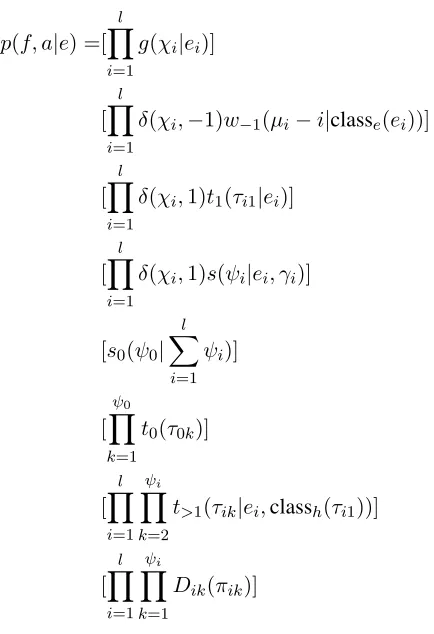
Given e, f and a candidate alignment a, which represents both the links between source and tar-get head-words and the head-word connections of the non-head words, we would like to calculate p(f, a|e). The formula for this is:
p(f, a|e) =[ l
Y
i=1
g(χi|ei)]
[ l
Y
i=1
δ(χi,−1)w−1(µi−i|classe(ei))]
[ l
Y
i=1
δ(χi,1)t1(τi1|ei)]
[ l
Y
i=1
δ(χi,1)s(ψi|ei, γi)]
[s0(ψ0| l
X
i=1
ψi)]
[ ψ0
Y
k=1
t0(τ0k)]
[ l
Y
i=1 ψi
Y
k=2
t>1(τik|ei,classh(τi1))]
[ l
Y
i=1 ψi
Y
k=1
Dik(πik)]
where:
δ(i, i0) is the Kronecker delta function which is
equal to 1 ifi=i0and 0 otherwise.
classe(ei)is the word class of the English word at
positioni, classf(fj)is the word class of the French
word at position j, classh(fj) is the word class of
the French head word at positionj.
p0 and p1 are parameters describing the
proba-bility of not generating and of generating a target spurious word from each non-spurious target word, p0+p1= 1.
m0 = l
X
i=1
ψi (1)
s0(ψ0|m0) =
µ
m0
ψ0

pm0−ψ0
0 pψ10 (2)
Dik(j) =
d1(j−cρi|classe(eρi),classf(τik))
ifk= 1
d2(j−πi1|classf(τik))
ifk= 2
d>2(j−πik−1|classf(τik))
ifk >2
(3)
γi =min(2,
l
X
i0=1
δ(µi0, i)) (4)
ci =
½
ceiling(Pψi
k=1πik/ψi) ifψi 6= 0
0 ifψi = 0 (5)
The alignment structure used in many other mod-els can be modeled using special cases of this frame-work. We can express the 1-to-N structure of mod-els like Model 4 by disallowingχi =−1, while for
1-to-1 structure we both disallowχi = −1and
de-terministically setψi = χi. We can also specialize
our generative story to the consecutive word M-to-N alignments used in “phrase-based” models, though in this case the conditioning of the generation deci-sions would be quite different. This involves adding checks on source and target connection geometry to the generative story which, if violated, would return “failure”; naturally this is at the cost of additional deficiency.
2.2 Unsupervised Parameter Estimation
We can perform maximum likelihood estimation of the parameters of this model in a similar fashion
to that of Model 4 (Brown et al., 1993), described thoroughly in (Och and Ney, 2003). We use Viterbi training (Brown et al., 1993) but neighborhood es-timation (Al-Onaizan et al., 1999; Och and Ney, 2003) or “pegging” (Brown et al., 1993) could also be used.
To initialize the parameters of the generative model for the first iteration, we use bootstrapping from a 1-to-N and a M-to-1 alignment. We use the intersection of the 1-to-N and M-to-1 alignments to establish the head word relationship, the 1-to-N alignment to delineate the target word cepts, and the M-to-1 alignment to delineate the source word cepts. In bootstrapping, a problem arises when we en-counter infeasible alignment structure where, for in-stance, a source word generates target words but no link between any of the target words and the source word appears in the intersection, so it is not clear which target word is the target head word. To ad-dress this, we consider each of the N generated tar-get words as the tartar-get head word in turn and assign this configuration 1/N of the counts.
For each iteration of training we search for the Viterbi solution for millions of sentences. Evidence that inference over the space of all possible align-ments is intractable has been presented, for a sim-ilar problem, in (Knight, 1999). Unlike phrase-based SMT, left-to-right hypothesis extension using a beam decoder is unlikely to be effective because in word alignment reordering is not limited to a small local window and so the necessary beam would be very large. We are not aware of admissible or inad-missible search heuristics which have been shown to be effective when used in conjunction with a search algorithm similar to A* search for a model predict-ing over a structure like ours. Therefore we use a simple local search algorithm which operates on complete hypotheses.
opera-tion results in an improvement. (Och and Ney, 2003) discussed efficient implementation.
In our model, because the alignment structure is richer, we define the following operations: move French non-head word to new head, move English non-head word to new head, swap heads of two French non-head words, swap heads of two English non-head words, swap English head word links of two French head words, link English word to French word making new head words, unlink English and French head words. We use multiple restarts to try to reduce search errors. (Germann et al., 2004; Marcu and Wong, 2002) have some similar operations with-out the head word distinction.
3 Semi-supervised parameter estimation
Equation 6 defines a log-linear model. Each feature function hm has an associated weight λm. Given
a vector of these weights λ, the alignment search problem, i.e. the search to return the best alignment
ˆ
aof the sentenceseandfaccording to the model, is specified by Equation 7.
pλ(f, a|e) = exp(
P
mλmhm(a, e, f))
P
a0,f0exp(
P
mλmhm(a0, e, f0))
(6)
ˆ
a= argmax a
X
m
λmhm(f, a, e) (7)
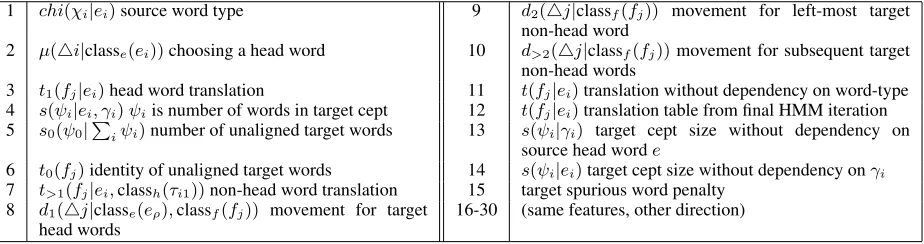
We decompose the new generative model pre-sented in Section 2 in both translation directions to provide the initial feature functions for our log-linear model, features 1 to 10 and 16 to 25 in Table 1.
We use backoffs for the translation decisions (fea-tures 11 and 26 and the HMM translation tables which are features 12 and 27) and the target cept size distributions (features 13, 14, 28 and 29 in Table 1), as well as heuristics which directly control the num-ber of unaligned words we generate (features 15 and 30 in Table 1).
We use the semi-supervised EMD algorithm (Fraser and Marcu, 2006b) to train the model. The initial M-step bootstraps parameters as described in Section 2.2 from a M-to-1 and a 1-to-N alignment. We then perform the D-step following (Fraser and
A B C
D
n n n n n n n n n n n n n n
E
@@@
@@@@ ~~~~ ~ ~ ~
A B C
D
n n n n n n n n n n n n n n
E
@@@
[image:5.612.332.536.76.131.2]@@@@ ~~~~ ~ ~ ~
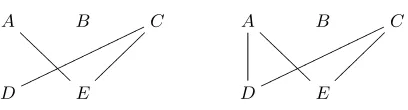
Figure 2: Two alignments with the same transla-tional correspondence
Marcu, 2006b). Given the feature function param-eters estimated in the M-step and the feature func-tion weightsλdetermined in the D-step, the E-step searches for the Viterbi alignment for the full train-ing corpus.
We use 1 − F-Measure as our error criterion. (Fraser and Marcu, 2006a) established that it is im-portant to tune α (the trade-off between Precision and Recall) to maximize performance. In working with LEAF, we discovered a methodological prob-lem with our baseline systems, which is that two alignments which have the same translational cor-respondence can have different F-Measures. An ex-ample is shown in Figure 2.
To overcome this problem we fully interlinked the transitive closure of the undirected bigraph formed by each alignment hypothesized by our baseline alignment systems1. This operation maps the
align-ment shown to the left in Figure 2 to the alignalign-ment shown to the right. This operation does not change the collection of phrases or rules extracted from a hypothesized alignment, see, for instance, (Koehn et al., 2003). Working with this fully interlinked rep-resentation we found that the best settings ofαwere α= 0.1for the Arabic/English task andα= 0.4for the French/English task.
4 Experiments
4.1 Data Sets
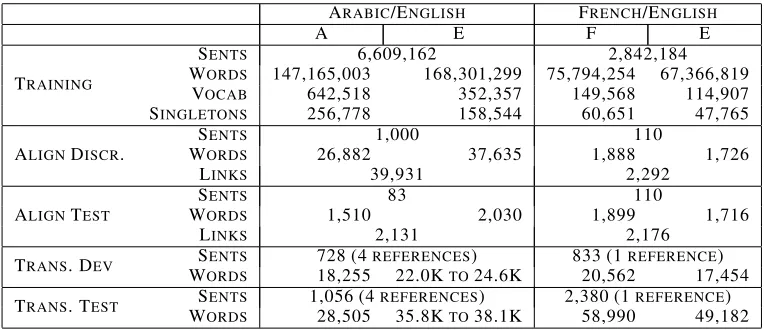
We perform experiments on two large alignments tasks, for Arabic/English and French/English data sets. Statistics for these sets are shown in Table 2. All of the data used is available from the Linguis-tic Data Consortium except for the French/English
1 chi(χi|ei)source word type 9 d2(4j|classf(fj)) movement for left-most target non-head word
2 µ(4i|classe(ei))choosing a head word 10 d>2(4j|classf(fj))movement for subsequent target non-head words
3 t1(fj|ei)head word translation 11 t(fj|ei)translation without dependency on word-type 4 s(ψi|ei, γi)ψiis number of words in target cept 12 t(fj|ei)translation table from final HMM iteration 5 s0(ψ0|
P
iψi)number of unaligned target words 13 s(ψi|γi) target cept size without dependency on source head worde
6 t0(fj)identity of unaligned target words 14 s(ψi|ei)target cept size without dependency onγi 7 t>1(fj|ei,classh(τi1))non-head word translation 15 target spurious word penalty
8 d1(4j|classe(eρ),classf(fj)) movement for target head words
[image:6.612.75.537.60.182.2]16-30 (same features, other direction)
Table 1: Feature functions
gold standard alignments which are available from the authors.
4.2 Experiments
To build all alignment systems, we start with 5 iter-ations of Model 1 followed by 4 iteriter-ations of HMM (Vogel et al., 1996), as implemented in GIZA++ (Och and Ney, 2003).
For all non-LEAF systems, we take the best per-forming of the “union”, “refined” and “intersection” symmetrization heuristics (Och and Ney, 2003) to combine the 1-to-N and M-to-1 directions resulting in a M-to-N alignment. Because these systems do not output fully linked alignments, we fully link the resulting alignments as described at the end of Sec-tion 3. The reader should recall that this does not change the set of rules or phrases that can be ex-tracted using the alignment.
We perform one main comparison, which is of semi-supervised systems, which is what we will use to produce alignments for SMT. We compare semi-supervised LEAF with a previous state of the art semi-supervised system (Fraser and Marcu, 2006b). We performed translation experiments on the align-ments generated using semi-supervised training to verify that the improvements in F-Measure result in increases in BLEU.
We also compare the unsupervised LEAF sys-tem with GIZA++ Model 4 to give some idea of the performance of the unsupervised model. We made an effort to optimize the free parameters of GIZA++, while for unsupervised LEAF there are no free parameters to optimize. A single iteration of unsupervised LEAF2 is compared with heuristic
2Unsupervised LEAF is equivalent to using the log-linear model and settingλm= 1form= 1to10andm= 16to25,
symmetrization of GIZA++’s extension of Model 4 (which was run for four iterations). LEAF was boot-strapped as described in Section 2.2 from the HMM Viterbi alignments.
Results for the experiments on the French/English data set are shown in Table 3. We ran GIZA++ for four iterations of Model 4 and used the “re-fined” heuristic (line 1). We ran the baseline semi-supervised system for two iterations (line 2), and in contrast with (Fraser and Marcu, 2006b) we found that the best symmetrization heuristic for this sys-tem was “union”, which is most likely due to our use of fully linked alignments which was discussed at the end of Section 3. We observe that LEAF unsupervised (line 3) is competitive with GIZA++ (line 1), and is in fact competitive with the baseline semi-supervised result (line 2). We ran the LEAF semi-supervised system for two iterations (line 4). The best result is the LEAF semi-supervised system, with a gain of 1.8 F-Measure over the LEAF unsu-pervised system.
For French/English translation we use a state of the art phrase-based MT system similar to (Och and Ney, 2004; Koehn et al., 2003). The translation test data is described in Table 2. We use two trigram lan-guage models, one built using the English portion of the training data and the other built using additional English news data. The BLEU scores reported in this work are calculated using lowercased and tok-enized data. For semi-supervised LEAF the gain of 0.46 BLEU over the semi-supervised baseline is not statistically significant (a gain of 0.78 BLEU would be required), but LEAF semi-supervised compared with GIZA++ is significant, with a gain of 1.23 BLEU. We note that this shows a large gain in
ARABIC/ENGLISH FRENCH/ENGLISH
A E F E
TRAINING
SENTS 6,609,162 2,842,184
WORDS 147,165,003 168,301,299 75,794,254 67,366,819
VOCAB 642,518 352,357 149,568 114,907
SINGLETONS 256,778 158,544 60,651 47,765
ALIGNDISCR.
SENTS 1,000 110
WORDS 26,882 37,635 1,888 1,726
LINKS 39,931 2,292
ALIGNTEST
SENTS 83 110
WORDS 1,510 2,030 1,899 1,716
LINKS 2,131 2,176
TRANS. DEV SENTS 728 (4REFERENCES) 833 (1REFERENCE)
WORDS 18,255 22.0KTO24.6K 20,562 17,454 TRANS. TEST SENTS 1,056 (4REFERENCES) 2,380 (1REFERENCE)
[image:7.612.114.496.59.224.2]WORDS 28,505 35.8KTO38.1K 58,990 49,182
Table 2: Data sets
lation quality over that obtained using GIZA++ be-cause BLEU is calculated using only a single refer-ence for the French/English task.
Results for the Arabic/English data set are also shown in Table 3. We used a large gold standard word alignment set available from the LDC. We ran GIZA++ for four iterations of Model 4 and used the “union” heuristic. We compare GIZA++ (line 1) with one iteration of the unsupervised LEAF model (line 2). The unsupervised LEAF system is worse than four iterations of GIZA++ Model 4. We be-lieve that the features in LEAF are too high dimen-sional to use for the Arabic/English task without the backoffs available in the semi-supervised models. The baseline semi-supervised system (line 3) was run for three iterations and the resulting alignments were combined with the “union” heuristic. We ran the LEAF semi-supervised system for two iterations. The best result is the LEAF semi-supervised system (line 4), with a gain of 5.4 F-Measure over the base-line semi-supervised system.
For Arabic/English translation we train a state of the art hierarchical model similar to (Chiang, 2005) using our Viterbi alignments. The translation test data used is described in Table 2. We use two tri-gram language models, one built using the English portion of the training data and the other built using additional English news data. The test set is from the NIST 2005 translation task. LEAF had the best per-formance scoring 1.43 BLEU better than the base-line semi-supervised system, which is statistically significant.
5 Previous Work
The LEAF model is inspired by the literature on gen-erative modeling for statistical word alignment and particularly by Model 4 (Brown et al., 1993). Much of the additional work on generative modeling of 1-to-N word alignments is based on the HMM model (Vogel et al., 1996). (Toutanova et al., 2002) and (Lopez and Resnik, 2005) presented a variety of re-finements of the HMM model particularly effective for low data conditions. (Deng and Byrne, 2005) described work on extending the HMM model us-ing a bigram formulation to generate 1-to-N align-ment structure. The common thread connecting these works is their reliance on the 1-to-N approx-imation, while we have defined a generative model which does not require use of this approximation, at the cost of having to rely on local search.
There has also been work on generative models for other alignment structures. (Wang and Waibel, 1998) introduced a generative story based on ex-tension of the generative story of Model 4. The alignment structure modeled was “consecutive M to non-consecutive N”. (Marcu and Wong, 2002) defined the Joint model, which modeled consec-utive word M-to-N alignments. (Matusov et al., 2004) presented a model capable of modeling 1-to-N and 1 alignments (but not arbitrary M-to-N alignments) which was bootstrapped from Model 4. LEAF directly models non-consecutive M-to-N alignments.
symmetriza-FRENCH/ENGLISH ARABIC/ENGLISH
SYSTEM F-MEASURE(α= 0.4) BLEU F-MEASURE(α= 0.1) BLEU
GIZA++ 73.5 30.63 75.8 51.55
(FRASER ANDMARCU, 2006B) 74.1 31.40 79.1 52.89
LEAFUNSUPERVISED 74.5 72.3
[image:8.612.106.509.59.123.2]LEAFSEMI-SUPERVISED 76.3 31.86 84.5 54.34
Table 3: Experimental Results
tion of the output of a 1-to-N model and a M-to-1 model resulting in a M-to-N alignment, this was ex-tended in (Koehn et al., 2003). We have used in-sights from these works to help determine the struc-ture of our generative model. (Zens et al., 2004) introduced a model featuring a symmetrized lexi-con. (Liang et al., 2006) showed how to train two HMM models, a 1-to-N model and a M-to-1 model, to agree in predicting all of the links generated, re-sulting in a to-1 alignment with occasional rare 1-to-N or M-to-1 links. We improve on these works by choosing a new structure for our generative model, the head word link structure, which is both sym-metric and a robust structure for modeling of non-consecutive M-to-N alignments.
In designing LEAF, we were also inspired by dependency-based alignment models (Wu, 1997; Alshawi et al., 2000; Yamada and Knight, 2001; Cherry and Lin, 2003; Zhang and Gildea, 2004). In contrast with their approaches, we have a very flat, one-level notion of dependency, which is bilingually motivated and learned automatically from the paral-lel corpus. This idea of dependency has some sim-ilarity with hierarchical SMT models such as (Chi-ang, 2005).
The discriminative component of our work is based on a plethora of recent literature. This lit-erature generally views the discriminative modeling problem as a supervised problem involving the com-bination of heuristically derived feature functions. These feature functions generally include the predic-tion of some type of generative model, such as the HMM model or Model 4. A discriminatively trained 1-to-N model with feature functions specifically de-signed for Arabic was presented in (Ittycheriah and Roukos, 2005). (Lacoste-Julien et al., 2006) created a discriminative model able to model 1, 1-to-2 and 1-to-2-to-1 alignments for which the best results were obtained using features based on symmetric HMMs trained to agree, (Liang et al., 2006), and
intersected Model 4. (Ayan and Dorr, 2006) de-fined a discriminative model which learns how to combine the predictions of several alignment algo-rithms. The experiments performed included Model 4 and the HMM extensions of (Lopez and Resnik, 2005). (Moore et al., 2006) introduced a discrimi-native model of 1-to-N and M-to-1 alignments, and similarly to (Lacoste-Julien et al., 2006) the best re-sults were obtained using HMMs trained to agree and intersected Model 4. LEAF is not bound by the structural restrictions present either directly in these models, or in the features derived from the generative models used. We also iterate the gener-ative/discriminative process, which allows the dis-criminative predictions to influence the generative model.
6 Conclusion
We have found a new structure over which we can robustly predict which directly models translational correspondence commensurate with how it is used in hierarchical SMT systems. Our new generative model, LEAF, is able to model alignments which consist of M-to-N non-consecutive translational cor-respondences. Unsupervised LEAF is comparable with a strong baseline. When coupled with a dis-criminative training procedure, the model leads to increases between 3 and 9 F-score points in align-ment accuracy and 1.2 and 2.8 BLEU points in trans-lation accuracy over strong French/English and Ara-bic/English baselines.
7 Acknowledgments
This work was partially supported under the GALE program of the Defense Advanced Research Projects Agency, Contract No. HR0011-06-C-0022. We would like to thank the USC Center for High Per-formance Computing and Communications.
References
Yaser Al-Onaizan, Jan Curin, Michael Jahr, Kevin Knight, John D. Lafferty, I. Dan Melamed, David Purdy, Franz J. Och, Noah A. Smith, and David Yarowsky. 1999. Statistical machine translation, final report, JHU workshop.
Hiyan Alshawi, Srinivas Bangalore, and Shona Douglas. 2000. Learning dependency translation models as col-lections of finite state head transducers. Computa-tional Linguistics, 26(1):45–60.
Necip Fazil Ayan and Bonnie J. Dorr. 2006. A maxi-mum entropy approach to combining word alignments. In Proceedings of HLT-NAACL, pages 96–103, New York.
Peter F. Brown, Stephen A. Della Pietra, Vincent J. Della Pietra, and R. L. Mercer. 1993. The mathematics of statistical machine translation: Parameter estimation. Computational Linguistics, 19(2):263–311.
Colin Cherry and Dekang Lin. 2003. A probability model to improve word alignment. InProceedings of ACL, pages 88–95, Sapporo, Japan.
David Chiang. 2005. A hierarchical phrase-based model for statistical machine translation. In Proceedings of ACL, pages 263–270, Ann Arbor, MI.
Yonggang Deng and William Byrne. 2005. Hmm word and phrase alignment for statistical machine trans-lation. In Proceedings of HLT-EMNLP, Vancouver, Canada.
Alexander Fraser and Daniel Marcu. 2006a. Measuring word alignment quality for statistical machine transla-tion. InTechnical Report ISI-TR-616, ISI/University of Southern California.
Alexander Fraser and Daniel Marcu. 2006b. Semi-supervised training for statistical word alignment. In Proceedings of COLING-ACL, pages 769–776, Syd-ney, Australia.
Ulrich Germann, Michael Jahr, Kevin Knight, Daniel Marcu, and Kenji Yamada. 2004. Fast decoding and optimal decoding for machine translation. Artificial Intelligence, 154(1-2):127–143.
Abraham Ittycheriah and Salim Roukos. 2005. A max-imum entropy word aligner for Arabic-English ma-chine translation. In Proceedings of HLT-EMNLP, pages 89–96, Vancouver, Canada.
Kevin Knight. 1999. Decoding complexity in word-replacement translation models. Computational Lin-guistics, 25(4):607–615.
Philipp Koehn, Franz J. Och, and Daniel Marcu. 2003. Statistical phrase-based translation. InProceedings of HLT-NAACL, pages 127–133, Edmonton, Canada.
Simon Lacoste-Julien, Dan Klein, Ben Taskar, and Michael Jordan. 2006. Word alignment via quadratic assignment. In Proceedings of HLT-NAACL, pages 112–119, New York, NY.
Percy Liang, Ben Taskar, and Dan Klein. 2006. Align-ment by agreeAlign-ment. InProceedings of HLT-NAACL, New York.
Yang Liu, Qun Liu, and Shouxun Lin. 2005. Log-linear models for word alignment. InProceedings of ACL, pages 459–466, Ann Arbor, MI.
Adam Lopez and Philip Resnik. 2005. Improved hmm alignment models for languages with scarce resources. InProceedings of the ACL Workshop on Building and Using Parallel Texts, pages 83–86, Ann Arbor, MI.
Daniel Marcu and William Wong. 2002. A phrase-based, joint probability model for statistical machine trans-lation. In Proceedings of EMNLP, pages 133–139, Philadelphia, PA.
Robert C. Moore, Wen-Tau Yih, and Andreas Bode. 2006. Improved discriminative bilingual word align-ment. In Proceedings of COLING-ACL, pages 513– 520, Sydney, Australia.
Franz J. Och and Hermann Ney. 2002. Discriminative training and maximum entropy models for statistical machine translation. In Proceedings of ACL, pages 295–302, Philadelphia, PA.
Franz J. Och and Hermann Ney. 2003. A systematic comparison of various statistical alignment models. Computational Linguistics, 29(1):19–51.
Franz J. Och and Hermann Ney. 2004. The alignment template approach to statistical machine translation. Computational Linguistics, 30(1):417–449.
Franz J. Och. 2003. Minimum error rate training in sta-tistical machine translation. In Proceedings of ACL, pages 160–167, Sapporo, Japan.
Kristina Toutanova, H. Tolga Ilhan, and Christopher D. Manning. 2002. Extensions to hmm-based statistical word alignment models. InProceedings of EMNLP, Philadelphia, PA.
Stephan Vogel, Hermann Ney, and Christoph Tillmann. 1996. HMM-based word alignment in statistical trans-lation. In Proceedings of COLING, pages 836–841, Copenhagen, Denmark.
Ye-Yi Wang and Alex Waibel. 1998. Modeling with structures in statistical machine translation. In Pro-ceedings of COLING-ACL, volume 2, pages 1357– 1363, Montreal, Canada.
Dekai Wu. 1997. Stochastic inversion transduction grammars and bilingual parsing of parallel corpora. Computational Linguistics, 23(3):377–403.
Kenji Yamada and Kevin Knight. 2001. A syntax-based statistical translation model. In Proceedings of ACL, pages 523–530, Toulouse, France.
Richard Zens, Evgeny Matusov, and Hermann Ney. 2004. Improved word alignment using a symmetric lexicon model. In Proceedings of COLING, Geneva, Switzerland.