Proceedings of the Beyond Vision and LANguage: inTEgrating Real-world kNowledge (LANTERN), pages 18–23
18
Big
Generalizations with
Small
Data:
Exploring the Role of Training Samples in Learning Adjectives of Size
Sandro Pezzelle and Raquel Fern´andez
[image:1.595.307.527.219.331.2]Institute for Logic, Language, and Computation University of Amsterdam
{s.pezzelle|raquel.fernandez}@uva.nl
Abstract
In this paper, we experiment with a re-cently proposed visual reasoning task dealing with quantities – modeling the multimodal, contextually-dependent meaning of size adjec-tives (‘big’, ‘small’) – and explore the impact of varying the training data on the learning
behavior of a state-of-art system. In
previ-ous work, models have been shown to fail in
generalizing tounseen adjective-noun
combi-nations. Here, we investigate whether, and to what extent, seeing some of these cases dur-ing traindur-ing helps a model understand the rule
subtending the task, i.e., that beingbigimplies
beingnot small, and vice versa. We show that
relatively few examples are enough to under-stand this relationship, and that developing a specific, mutually exclusive representation of size adjectives is beneficial to the task.
1 Introduction
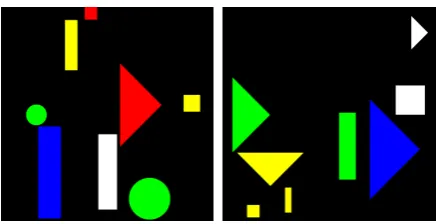
A recently proposed visual reasoning task chal-lenges models to learn the meaning ofsize adjec-tives (‘big’, ‘small’) from visually-grounded con-texts (MALeViC;Pezzelle and Fern´andez,2019). Differently from standard approaches in language and vision treating size as afixedattribute of ob-jects (Johnson et al., 2017), in MALeViC what counts as ‘big’ or ‘small’ is defined contextually, based on a cognitively-motivated threshold func-tion evaluating the size of all therelevantobjects in a scene (Schmidt et al.,2009). In the most chal-lenging version of the task, SET+POS, the subset of relevant objects (i.e., the reference set) com-prises all the objects belonging to the same cate-gory as the queried one. Given a scene depicting a number of colored shapes (e.g., the leftmost im-age in Figure1) and a sentence about one object’s size (e.g., ‘The white rectangle is abigrectangle’), models have to assess whether the sentence istrue
orfalsein that context; i.e., whether the white rect-angle isbiggiven the other rectangles in the scene.
Figure 1: SET+POS. Two original (ORIG) examples.
Left (ORIG): The white rectangle is a bigrectangle,
True. Right (ORIG): The blue triangle is asmall
tri-angle,False. To test model abilities in handling
unex-pected cases, an increasing number of ORIG training
samples is modified byswappingboth the size
adjec-tive and its ground-truth (SWAP).Left (SWAP):small,
False.Right (SWAP):big,True. Best viewed in color.
Among the tested models, FiLM (Perez et al.,
2018) turned out to be the best overall architecture for the task. However, when tested with adjective-noun combinations that were neverseen in train-ing (i.e., the model has been taught what means to be big for circles and rectangles orsmall for tri-angles and squares, but not, e.g., what means to be small for a circle), FiLM was shown to use a default strategy which ignores the adjective rather than applying itcompositionally. This finding is in line with previous evidence showing the lack of compositionality in neural networks (Baroni,
In this work, we focus on a tightly related prob-lem, that is, generalization with little data. Since models do not learn anabstract representation of ‘big’ and ‘small’ that can be applied composi-tionally tounseenexamples, we test whether, and to what extent, this problem can be alleviated by seeing some of these ‘unseen’ cases during train-ing. We refer to these cases as unexpected (due to their low frequency compared to the more fre-quent, expected ones), and test whether injecting an increasing proportion of these examples in the training data helps models understand the rule sub-tending the task, i.e., that beingbigimplies being
not small, and vice versa. Intuitively, the model could (1) stick to the default strategy and correctly predict only theexpectedexamples, or (2) learn a more general rule that also accounts for the unex-pectedcases. Here, we are interested in checking how much data is required to start adopting the lat-ter strategy, and aim to understand what informa-tion the model exploits while performing the task. To explore these issues, we focus on the SET+POS task and the best-performing FiLM model, and build 7 new training settings with an increasing proportion ofunexpectedcases.1 Such examples are obtained by simply swapping the original size adjective and its ground-truth answer, as described in Figure1. By training the model on each of these settings, we show that very little un-expecteddata is needed to obtain high generaliza-tions in testing, and that seeing these examples is beneficial to learn the rule subtending the task.
2 Generalizing toUnexpectedData
Method We explore whether injecting some un-expectedcases in training data helps the model un-derstand the relation that holds between the adjec-tives ‘big’ and ‘small’. We use the 10K-datapoint (8K training, 1K val, 1K test) SET+POS dataset (hence, A) used byPezzelle and Fern´andez(2019) in theircompositionalexperiment, and build 7 new training settings containing an increasing percent-age ofunexpectedexamples. We refer to these set-tings using capital letters from B to H. They con-tain 0.8%, 1.6%, 3.2%, 6.4%, 12.8%, 25.6%, and 50.0% unexpected cases, respectively. To gener-ate the new training settings, we sample a given percentage of datapoints (e.g., 0.8% for B) from the original training/validation files and simply
1Data, code, and trained models are available at:https:
//github.com/sandropezzelle/malevic.
swap the original adjective and ground-truth an-swer (see Figure 1). While doing so, we ensure that a balanced number of cases is modified for each<adjective-noun, ground truth>tuple. To il-lustrate, out of the 8 modified cases in the valida-tion split of B, 2 involve circles; out of these, one is originally a<big-circle, true>case, the other a <big-circle, false>. This makes all 7 settings perfectly balanced with respect to shape, size, and ground truth.2 This prevents biases in the data,
e.g., that circles are more likely to be big than squares. It is worth mentioning that, compared to A, only (some) sentences and answers are modi-fied. As for the visual data, all settings employ the exact same 10K images and visual features pre-computed using ResNet-101 (He et al.,2016).
Model We experiment with FiLM (Perez et al.,
2018) using the best configuration of hyper-parameters and the same experimental pipeline re-ported inPezzelle and Fern´andez(2019). In each setting, the model is trained for 40 epochs with 3 random initializations. For each of these 3 runs, the best model epoch based on accuracy on the validation split is selected and then tested on 3 dif-ferent test sets: (a)seen(1K datapoints), where all the examples areexpected, (b)unseen(1K), where all the examples areunexpected, and (c)balanced
(2K), where a balanced number of expected and
unexpectedcases is present. All test sets are taken fromPezzelle and Fern´andez(2019).
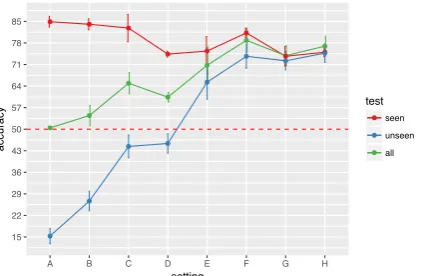
Results In Table 1 we report, for each setting, average model accuracy and standard deviation (sd) over 3 runs (the same results are visualized in Figure2). Starting from theunseentest set, we notice that injecting an extremely low percentage ofunexpectedcases in B (0.8%, i.e., 64/8000 cases in training) has already some impact on the accu-racy, with a 12-point increase (27%) compared to A (15%). This pattern is observed in the subse-quent settings, with accuracy increasing to 44% in C and to 45% in D. The most striking result is observed in setting E, where model accuracy gets well above chance level (65%) with a percentage of just 6.4%unexpectedcases seen in training (see also Figure2, where the blue line exceeds chance level in E). This clearly indicates that the model, instead of just trying to correctly predict all the
expectedcases, which would potentially lead to a
2Note that we do not balance with respect to color since
test set average accuracy±sd
A [0.0]* B [0.8] C [1.6] D [3.2] E [6.4] F [12.8] G [25.6] H [50.0] 16K [50.0]*
seen 0.85±0.01 0.84±0.02 0.83±0.04 0.74±0.01 0.75±0.04 0.81±0.01 0.74±0.03 0.75±0.01 0.91±0.02
unseen 0.15±0.02 0.27±0.03 0.44±0.00 0.45±0.03 0.65±0.04 0.74±0.03 0.72±0.02 0.75±0.03 0.90±0.02
[image:3.595.73.524.64.113.2]balanced 0.50±0.00 0.54±0.03 0.65±0.04 0.60±0.01 0.71±0.05 0.79±0.03 0.73±0.03 0.77±0.03 0.88±0.02
Table 1: Average accuracy±standard deviation by FiLM on 3 test sets in settings A-H (in brackets, proportion
ofunexpectedcases seen in training). For comparison, performance by best model trained with 16K datapoints is
reported (16K). * refers to models trained inPezzelle and Fern´andez(2019). Inbold, highest number in the row.
93.6% accuracy, employs a learning strategy that is valuable also forunexpectedexamples.
It is interesting to note, in this regard, that on the
seentest set the model experiences a performance drop from A (85%) to H (75%), which shows how an increasing proportion ofunexpectedcases makes guessing the expected ones a bit harder (this is, to some extent, intuitive since in A there are only 4seenadjective-noun combinations); in-deed, the overall best accuracy in seen is ob-tained with A, while the best accuracy inunseen
is obtained with H, where the highest proportion of unexpected examples is given in training. As for the balanced test set, we observe that an in-creasing proportion of unexpected cases in train-ing boosts model generalization, though F turns out to slightly outperform H (79% vs 77%) due to its better performance on theexpected (seen) in-stances. Finally, it should be noted that training with twice as many samples (16K) leads to a sig-nificantly higher accuracy in all test sets (+11-16 points compared to H), which shows a ‘the big-ger, the better’ effect of training set size on model performance in the task.
15 22 29 36 43 50 57 64 71 78 85
A B C D E F G H
setting
accuracy
test
seen unseen all
Figure 2: FiLM performance on 3 test sets across set-tings A-H. Average accuracy over 3 runs (dots) and standard deviation (bars) are reported. The red dashed line indicates chance level. Best viewed in color.
3 Analysis
Linguistic representations In FiLM, the repre-sentation of the sentence obtained via the Gated Recurrent Unit (GRU; Chung et al., 2014) influ-ences the CNN computation to focus on image features that are important to solve the task. Thus, examining it could shed light on the type of lin-guistic information exploited by the model. Here, we are interested in checking how muchsize infor-mation is encoded by the GRU in each setting. We run each setting’s best trained model on the bal-anced test set and, for each sentence, we extract the final 4096-d GRU hidden state. We then per-form a 2-dimensional PCA analysis on these 2K embeddings: if the model pays attention to size adjectives, embeddings containing ‘big’ (‘small’) should be overall similar/close to each other, but different/far from those containing ‘small’ (‘big’).
[image:3.595.77.291.561.699.2]● ● ● ● ● ● ● ● ● ● ● ● ● ● ● ● ● ● ● ● ● ● ● ● ● ● ● ● ● ● ● ● ● ● ● ● ● ● ● ● ● ● ● ● ● ● ● ● ● ● ● ● ● ● ● ● ● ● ● ● ● ● ● ● ● ● ● ● ● ● ● ● ● ● ● ● ● ● ● ● ● ● ● ● ● ● ● ● ● ● ● ● ● ● ● ● ● ● ● ● ● ● ● ● ● ● ● ● ● ● ● ● ● ● ● ● ● ● ● ● ● ● ● ● ● ● ● ● ● ● ● ● ● ● ● ● ● ● ● ● ● ● ● ● ● ● ● ● ● ● ● ● ● ● ● ● ● ● ● ● ● ● ● ● ● ● ● ● ● ● ● ● ● ● ● ● ● ● ● ● ● ● ● ● ● ● ● ● ● ● ● ● ● ● ● ● ● ● ● ● ● ● ● ● ● ● ● ● ● ● ● ● ● ● ● ● ● ● ● ● ● ● ● ● ● ● ● ● ● ● ● ● ● ● ● ● ● ● ● ● ● ● ● ● ● ● ● ● ● ● ● ● ● ● ● ● ● ● ● ● ● ● ● ● ● ● ● ● ● ● ● ● ● ● ● ● ● ● ● ● ● ● ● ● ● ● ● ● ● ● ● ● ● ● ● ● ● ● ● ● ● ● ● ● ● ● ● ● ● ● ● ● ● ● ● ● ● ● ● ● ● ● ● ● ● ● ● ● ● ● ● ● ● ● ● ● ● ● ● ● ● ● ● ● ● ● ● ● ● ● ● ● ● ● ● ● ● ● ● ● ● ● ● ● ● ● ● ● ● ● ● ● ● ● ● ● ● ● ● ● ● ● ● ● ● ● ● ● ● ● ● ● ● ● ● ● ● ● ● ● ● ● ● ● ● ● ● ● ● ● ● ● ● ● ● ● ● ● ● ● ● ● ● ● ● ● ● ● ● ● ● ● ● ● ● ● ● ● ● ● ● ● ● ● ● ● ● ● ● ● ● ● ● ● ● ● ● ● ● ● ● ● ● ● ● ● ● ● ● ● ● ● ● ● ● ● ● ● ● ● ● ● ● ● ● ● ● ● ● ● ● ● ● ● ● ● ● ● ● ●●●●●●●●●●●●●●●●●●●●●●●●●● ● ● ● ● ● ● ● ● ● ● ● ● ● ● ● ● ● ● ● ● ● ● ● ● ● ● ● ● ● ● ● ● ● ● ● ● ● ● ● ● ● ● ● ● ● ● ● ● ● ● ● ● ● ● ● ● ● ● ● ● ● ● ● ● ● ● ● ● ● ● ● ● ● ● ● ● ● ● ● ● ● ● ● ● ● ● ● ● ● ● ● ● ● ● ● ● ● ● ● ● ● ● ● ● ● ● ● ● ● ● ● ● ● ● ● ● ● ● ● ● ● ● ● ● ● ● ● ● ● ● ● ● ● ● ● ● ● ● ● ● ● ● ● ● ● ● ● ● ● ● ● ● ● ● ● ● ● ● ● ● ● ● ● ● ● ● ● ● ● ● ● ● ● ● ● ● ● ● ● ● ● ● ● ● ● ● ● ● ● ● ● ● ● ● ● ● ● ● ● ● ● ● ● ● ● ● ● ● ● ● ● ● ● ● ● ● ● ● ● ● ● ● ● ● ● ● ● ● ● ● ● ● ● ● ● ● ● ● ● ● ● ● ● ● ● ● ● ● ● ● ● ● ● ● ● ● ● ● ● ● ● ● ● ● ● ● ● ● ● ● ● ● ● ● ●●●●●●●●●●●●●●●●●●●●●●●●●● ● ● ● ● ● ● ● ● ● ● ● ● ● ● ● ● ● ● ● ● ● ● ● ● ● ● ● ● ● ● ● ● ● ● ● ● ● ● ● ● ● ● ● ● ● ● ● ● ● ● ● ● ● ● ● ● ● ● ● ● ● ● ● ● ● ● ● ● ● ● ● ● ● ● ● ● ● ● ● ● ● ● ● ● ● ● ● ● ● ● ● ● ● ● ● ● ● ● ● ● ● ● ● ● ● ● ● ● ● ● ● ● ● ● ● ● ● ● ● ● ● ● ● ● ● ● ● ● ● ● ● ● ● ● ● ● ● ● ● ● ● ● ● ● ● ● ● ● ● ● ● ● ● ● ● ● ● ● ● ● ● ● ● ● ● ● ● ● ● ● ● ● ● ● ● ● ● ● ● ● ● ● ● ● ● ● ● ● ● ● ● ● ● ● ● ● ● ● ● ● ● ● ● ● ● ● ● ● ● ● ● ● ● ● ● ● ● ● ● ● ● ● ● ● ● ● ● ● ● ● ● ● ● ● ● ● ● ● ● ● ● ● ● ● ● ● ● ● ● ● ● ● ● ● ● ● ● ● ● ● ● ● ● ● ● ● ● ● ● ● ● ● ● ● ● ● ● ● ● ● ● ● ● ● ● ● ● ● ● ● ● ● ● ● ● ● ● ● ● ● ● ● ● ● ● ● ● ● ● ● ● ● ● ● ● ● ● ● ● ● ● ● ● ● ● ● ● ● ● ● ● ● ● ● ● ● ● ● ● ● ● ● ● ● ● ● ● ● ● ● ● ● ● ● ● ● ● ● ● ● ● ● ● ● ● ● ● ● ● ● ● ● ● ● ● ● ● ● ● ● ● ● ● ● ● ● ● ● ● ● ● ● ● ● ● ● ● ● ● ● ● ● ● ● ● ● ● ● ● ● ● ● ● ● ● ● ● ● ● ● ● ● ● ● ● ● ● ● ● ● ● ● ● ● ● ● ● ● ● ● ● ● ● ● ● ● ● ● ● ● ● ● ● ● ● ● ● ● ● ● ● ● ● ● ● ● ● ● ● ● ● ● ● ● ● ● ● ● ● ● ● ● ● ● ● ● ● ● ● ● ● ● ● ● ● ● ● ● ● ● ● ● ● ● ● ● ● ● ● ● ● ● ● ● ● ● ● ● ● ● ● ● ● ● ● ● ● ● ● ● ● ● ● ● ● ● ● ● ● ● ● ● ● ● ● ● ● ● ● ●●●●●●●●●●●●●●●●●●●●●●●●●● ● ● ● ● ● ● ● ● ● ● ● ● ● ● ● ● ● ● ● ● ● ● ● ● ● ● ● ● ● ● ● ● ● ● ● ● ● ● ● ● ● ● ● ● ● ● ● ● ● ● ●●●●●●●●●●●●●●●●●●●●●●●●● ● ● ● ● ● ● ● ● ● ● ● ● ● ● ● ● ● ● ● ● ● ● ● ● ● ● ● ● ● ● ● ● ● ● ● ● ● ● ● ● ● ● ● ● ● ● ● ● ● ● ● ● ● ● ● ● ● ● ● ● ● ● ● ● ● ● ● ● ● ● ● ● ● ● ● ● ● ● ● ● ● ● ● ● ● ● ● ● ● ● ● ● ● ● ● ● ● ● ● ● ● ● ● ● ● ● ● ● ● ● ● ● ● ● ● ● ● ● ● ● ● ● ● ● ● ● ● ● ● ● ● ● ● ● ● ● ● ● ● ● ● ● ● ● ● ● ● ● ● ● ● ● ● ● ● ● ● ● ● ● ● ● ● ● ● ● ● ● ● ● ● ● ● ● ● ● ● ● ● ● ● ● ● ● ● ● ● ● ● ● ● ● ● ● ● ● ● ● ● ● ●●●●●●●●●●●●●●●●●●●●●●●●●●●●●●●●●●●●●●●●●●●●●●●●●● ● ● ● ● ● ● ● ● ● ● ● ● ● ● ● ● ● ● ● ● ● ● ● ● ● ● ● ● ● ● ● ● ● ● ● ● ● ● ● ● ● ● ● ● ● ● ● ● ● ● ● ● ● ● ● ● ● ● ● ● ● ● ● ● ● ● ● ● ● ● ● ● ● ● ● ● ● ● ● ● ● ● ● ● ● ● ● ● ● ● ● ● ● ● ● ● ● ● ● ● ● ● ● ● ● ● ● ● ● ● ● ● ● ● ● ● ● ● ● ● ● ● ● ● ● ● ● ● ● ● ● ● ● ● ● ● ● ● ● ● ● ● ● ● ● ● ● ● ● ● ● ● ● ● ● ● ● ● ● ● ● ● ● ● ● ● ● ● ● ● ● ● ● ● ● ● ● ● ● ● ● ● ● ● ● ● ● ● ● ● ● ● ● ● ● ● ● ● ● ● ● ● ● ● ● ● ● ● ● ● ● ● ● ● ● ● ● ● ● ● ● ● ● ● ● ● ● ● ● ● ● ● ● ● ● ● ● ● ● ● ● ● ● ● ● ● ● ● ● ● ● ● ● ● ● ● ● ● ● ● ● ● ● ● ● ● ● ● ● ● ● ● ● ● ● −0.02 −0.01 0.00 0.01 0.02
−0.02 −0.01 0.00 0.01 0.02 0.03
PC1 (21.56%)
PC2 (18.32%)
●big●small
● ● ● ● ● ● ● ● ● ● ● ● ● ● ● ● ● ● ● ● ● ● ● ● ● ● ● ● ● ● ● ● ● ● ● ● ● ● ● ● ● ● ● ● ● ● ● ● ● ● ● ● ● ● ● ● ● ● ● ● ● ● ● ● ● ● ● ● ● ● ● ● ● ● ● ● ● ● ● ● ● ● ● ● ● ● ● ● ● ● ● ● ● ● ● ● ● ● ● ● ● ● ● ● ● ● ● ● ● ● ● ● ● ● ● ● ● ● ● ● ● ● ● ● ● ● ● ● ● ● ● ● ● ● ● ● ● ● ● ● ● ● ● ● ● ● ● ● ● ● ● ● ● ● ● ● ● ● ● ● ● ● ● ● ● ● ● ● ● ● ● ● ● ● ● ● ● ● ● ● ● ● ● ● ● ● ● ● ● ● ● ● ● ● ● ● ● ● ● ● ● ● ● ● ● ● ● ● ● ● ● ● ● ● ● ● ● ● ● ● ● ● ● ● ● ● ● ● ● ● ● ● ● ● ● ● ● ● ● ● ● ● ● ● ● ● ● ● ● ● ● ● ● ● ● ● ● ● ● ● ● ● ● ● ● ● ● ● ● ● ● ● ● ● ● ● ● ● ● ● ● ● ● ● ● ● ● ● ● ● ● ● ● ● ● ● ● ● ● ● ● ● ● ● ● ● ● ● ● ● ● ● ● ● ● ● ● ● ● ● ● ● ● ● ● ● ● ● ● ● ● ● ● ● ● ● ● ● ● ● ● ● ● ● ● ● ● ● ● ● ● ● ● ● ● ● ● ● ● ● ● ● ● ● ● ● ● ● ● ● ● ● ● ● ● ● ● ● ● ● ● ● ● ● ● ● ● ● ● ● ● ● ● ● ● ● ● ● ● ● ● ● ● ● ● ● ● ● ● ● ● ● ● ● ● ● ● ● ● ● ● ● ● ● ● ● ● ● ● ● ● ● ● ● ● ● ● ● ● ● ● ● ● ● ● ● ● ● ● ● ● ● ● ● ● ● ● ● ● ● ● ● ● ● ● ● ● ● ● ● ● ● ● ● ● ● ● ● ● ● ● ● ● ● ● ● ● ● ● ● ● ● ● ● ● ● ● ● ● ● ● ● ● ● ● ● ● ● ● ● ● ● ● ● ● ● ● ● ● ● ● ● ● ● ● ● ● ● ● ● ● ● ● ● ● ● ● ● ● ● ● ● ● ● ● ● ● ● ● ● ● ● ● ● ● ● ● ● ● ● ● ● ● ● ● ● ● ● ● ● ● ● ● ● ● ● ● ● ● ● ● ● ● ● ● ● ● ● ● ● ● ● ● ● ● ● ● ● ● ● ● ● ● ● ● ● ● ● ● ● ● ● ● ● ● ● ● ● ● ● ● ● ● ● ● ● ● ● ● ● ● ● ● ● ● ● ● ● ● ● ● ● ● ● ● ● ● ● ● ● ● ● ● ● ● ● ● ● ● ● ● ● ● ● ● ● ● ● ● ● ● ● ● ● ● ● ● ● ● ● ● ● ● ● ● ● ● ● ● ● ● ● ● ● ● ● ● ● ● ● ●●●●●●●●●●●●●●●●●●●●●●●●● ● ● ● ● ● ● ● ● ● ● ● ● ● ● ● ● ● ● ● ● ● ● ● ● ● ● ● ● ● ● ● ● ● ● ● ● ● ● ● ● ● ● ● ● ● ● ● ● ● ● ● ● ● ● ● ● ● ● ● ● ● ● ● ● ● ● ● ● ● ● ● ● ● ● ● ● ● ● ● ● ● ● ● ● ● ● ● ● ● ● ● ● ● ● ● ● ● ● ● ● ● ● ● ● ● ● ● ● ● ● ● ● ● ● ● ● ● ● ● ● ● ● ● ● ● ● ● ● ● ● ● ● ● ● ● ● ● ● ● ● ● ● ● ● ● ● ● ● ● ● ● ● ● ● ● ● ● ● ● ● ● ● ● ● ● ● ● ● ● ● ● ● ● ● ● ● ● ● ● ● ● ● ● ● ● ● ● ● ● ● ● ● ● ● ● ● ● ● ● ● ● ● ● ● ● ● ● ● ● ● ● ● ● ● ● ● ● ● ● ● ● ● ● ● ● ● ● ● ● ● ● ● ● ● ● ● ● ● ● ● ● ● ● ● ● ● ● ● ● ● ● ● ● ● ● ● ● ● ● ● ● ● ● ● ● ● ● ● ● ● ● ● ● ● ● ● ● ● ● ● ● ● ● ● ● ● ● ● ● ● ● ● ● ● ● ● ● ● ● ● ● ● ● ● ● ● ● ● ● ● ● ● ● ● ● ● ● ● ● ● ● ● ● ● ● ● ● ● ● ● ● ● ● ● ● ● ● ● ● ● ● ● ● ● ● ● ● ● ● ● ● ● ● ● ● ● ● ● ● ● ● ● ● ● ● ● ● ● ● ● ● ● ● ● ● ● ● ● ● ● ● ● ● ● ● ● ● ● ● ● ● ● ● ● ● ● ● ● ● ● ● ● ● ● ● ● ● ● ● ● ● ● ● ● ● ● ● ● ● ● ● ● ● ● ● ●●●●●●●●●●●●●●●●●●●●●●●●● ● ● ● ● ● ● ● ● ● ● ● ● ● ● ● ● ● ● ● ● ● ● ● ● ● ● ● ● ● ● ● ● ● ● ● ● ● ● ● ● ● ● ● ● ● ● ● ● ● ● ● ● ● ● ● ● ● ● ● ● ● ● ● ● ● ● ● ● ● ● ● ● ● ● ● ● ● ● ● ● ● ● ● ● ● ● ● ● ● ● ● ● ● ● ● ● ● ● ● ● ● ● ● ● ● ● ● ● ● ● ● ● ● ● ● ● ● ● ● ● ● ● ● ● ● ● ● ● ● ● ● ● ● ● ● ● ● ● ● ● ● ● ● ● ● ● ● ● ● ● ● ● ● ● ● ● ● ● ● ● ● ● ● ● ● ● ● ● ● ● ● ● ● ● ● ● ● ● ● ● ● ● ● ● ● ● ● ● ● ● ● ● ● ● ● ● ● ● ● ● ● ● ● ● ● ● ● ● ● ● ● ● ● ● ● ● ● ● ● ● ● ● ● ● ● ● ● ● ● ● ● ● ● ● ● ● ● ● ● ● ● ● ● ● ● ● ● ● ● ● ● ● ● ● ● ● ● ● ● ● ● ● ● ● ● ● ● ● ● ● ● ● ● ● ● ● ● ● ● ● ● ● ● ● ● ● ● ● ● ● ● ● ● ● ● ● ● ● ● ● ● ● ● ● ● ● ● ● ● ● ● ● ● ● ● ● ● ● ● ● ● ● ● ● ● ● ● ● ● ● ● ● ● ● ● ● ● ● ● ● ● ● ● ● ● ● ● ● ● ● ● ● ● ● ● ● ● ● ● ● ● ● ● ● ● ● ● ● ● ● ● ● ● ● ● ● ● ● ● ● ● ● ● ● ● ● ● ● ● ● ● ● ● ● ● ● ● ● ● ● ● ● ● ● ● ● ● ● ● ● ● ● ● ● ● ● ● ● ● ● ● ● ● ● ● ● ● ● ● ● ● ● ● ● ● ● ● ● ● ● ● ● ● ● ● ● ● ● ● ● ● ● ● ● ● ● ● ● ● ● ● ● ● ● ● ● ● ● ● ● ● ● ● ● ● ● ● ● ● ● ● ● ● ● ● ● ● ● ● ● ● ● ● ● ● ● ● ● ● ● ● ● ● ● ● ● ● ● ● ● ● ● ● ● ● ● ● ● ● ● ● ● ● ● ● ● ● ● ● ● ● ● ● ● ● ● ● ● ● ● ● ● ● ● ● ● ● ● ● ● ● ● ● ● ● ● ● ● ● ● ● ● ● ● ● ● ● ● ● ● ● ● ● ● ● ● ● ● ● ● ● ● ● ● ● ● ● ● ● ● ● ● ● ● ● ● ● ● ● ● ● ● ● ● ● ● ● ● ● ● ● ● ● ● ● ● ● ● ● ● ● ● ● ● ● ● ● ● ● ● ● ● ● ● ● ● ● ● ● ● ● ● ● ● ● ● ● ● ● ● ● ● ● ● ● ● ● ● ● ● ● ● ● ● ● ● ● ● ● ● ● ● ● ● ● ● ● ● ● ● ● ● ● ● ● ● ● ● ● ● ● ● ● ● ● ● ● ● ● ● ● ● ● ● ● ● ● ● ● ● ● ● ● ● ● ● ● ● ● ● ● ● ● ● ● ●●●●●●●●●●●●●●●●●●●●●●●●● ● ● ● ● ● ● ● ● ● ● ● ● ● ● ● ● ● ● ● ● ● ● ● ● ● ● ● ● ● ● ● ● ● ● ● ● ● ● ● ● ● ● ● ● ● ● ● ● ● ● ● ● ● ● ● ● ● ● ● ● ● ● ● ● ● ● ● ● ● ● ● ● ● ● ● −0.04 −0.02 0.00 0.02 0.04
−0.04 −0.02 0.00 0.02 0.04
PC1 (19.31%)
PC2 (18.29%)
●big●small
● ● ● ● ● ● ● ● ● ● ● ● ● ● ● ● ● ● ● ● ● ● ● ● ● ● ● ● ● ● ● ● ● ● ● ● ● ● ● ● ● ● ● ● ● ● ● ● ● ● ● ● ● ● ● ● ● ● ● ● ● ● ● ● ● ● ● ● ● ● ● ● ● ● ● ● ● ● ● ● ● ● ● ● ● ● ● ● ● ● ● ● ● ● ● ● ● ● ● ● ● ● ● ● ● ● ● ● ● ● ● ● ● ● ● ● ● ● ● ● ● ● ● ● ● ● ● ● ● ● ● ● ● ● ● ● ● ● ● ● ● ● ● ● ● ● ● ● ● ● ● ● ● ● ● ● ● ● ● ● ● ● ● ● ● ● ● ● ● ● ● ● ● ● ● ● ● ● ● ● ● ● ● ● ● ● ● ● ● ● ● ● ● ● ● ● ● ● ● ● ● ● ● ● ● ● ● ● ● ● ● ● ● ● ● ● ● ● ● ● ● ● ● ● ● ●●●●●●●●●●●●●●●●●●●●●●●●● ● ● ● ● ● ● ● ● ● ● ● ● ● ● ● ● ● ● ● ● ● ● ● ● ● ● ● ● ● ● ● ● ● ● ● ● ● ● ● ● ● ● ● ● ● ● ● ● ● ● ● ● ● ● ● ● ● ● ● ● ● ● ● ● ● ● ● ● ● ● ● ● ● ● ● ● ● ● ● ● ● ● ● ● ● ● ● ● ● ● ● ● ● ● ● ● ● ● ● ● ● ● ● ● ● ● ● ● ● ● ● ● ● ● ● ● ● ● ● ● ● ● ● ● ● ● ● ● ● ● ● ● ● ● ● ● ● ● ● ● ● ● ● ● ● ● ● ● ● ● ● ● ● ● ● ● ● ● ● ● ● ● ● ● ● ● ● ● ● ● ● ● ● ● ● ● ● ● ● ● ● ● ● ● ● ● ● ● ● ● ● ● ● ● ● ● ● ● ● ● ● ● ● ● ● ● ● ● ● ● ● ● ● ● ● ● ● ● ● ● ● ● ● ● ● ● ● ● ● ● ● ● ● ● ● ● ● ● ● ● ● ● ● ● ● ● ● ● ● ● ● ● ● ● ● ● ● ● ● ● ● ● ● ● ● ● ● ● ● ● ● ● ● ● ● ● ● ● ● ● ● ● ● ● ● ● ● ● ● ● ● ● ● ● ● ● ● ● ● ● ● ● ● ● ● ● ● ● ● ● ● ● ● ● ● ● ● ● ● ● ● ● ● ● ● ● ● ● ● ● ● ● ● ● ● ● ● ● ● ● ● ● ● ● ● ● ● ● ● ● ● ● ● ● ● ● ● ● ● ● ● ● ● ● ● ● ● ● ● ● ● ● ● ● ● ● ● ● ● ● ● ● ● ● ● ● ● ● ● ● ● ● ● ● ● ● ● ● ● ● ● ● ● ● ● ● ● ● ● ● ● ● ● ● ● ● ● ● ● ● ● ● ● ● ● ● ● ● ● ● ● ● ● ● ● ● ● ● ● ● ● ● ● ● ● ● ● ● ● ● ● ● ● ● ● ● ● ● ● ● ● ● ● ● ● ● ● ● ● ● ● ● ● ● ● ● ● ● ● ● ● ● ● ● ● ● ● ● ● ● ● ● ● ● ● ● ● ● ● ● ● ● ● ● ● ● ● ● ● ● ● ● ● ● ● ● ● ● ● ● ● ● ● ● ● ● ● ● ● ● ● ● ● ● ● ● ● ● ● ● ● ● ● ● ● ● ● ● ● ● ● ● ● ● ● ● ● ● ● ● ● ● ● ● ● ● ● ● ● ● ● ● ● ● ● ● ● ● ● ● ● ● ● ● ● ● ● ● ● ● ● ● ● ● ● ● ● ● ● ● ● ● ● ● ● ● ● ● ● ● ● ● ● ● ● ● ● ● ● ● ● ● ● ● ● ● ● ● ● ● ● ● ● ● ● ● ● ● ● ● ● ● ● ● ● ● ● ● ● ● ● ● ● ● ● ● ● ● ● ● ● ● ● ● ● ● ● ● ● ● ● ● ● ● ● ● ● ● ● ● ● ● ● ● ● ● ● ● ● ● ● ● ● ● ● ● ● ● ● ● ● ● ● ● ● ● ● ● ● ● ● ● ● ● ● ● ● ● ● ● ● ● ● ● ● ● ● ● ● ● ● ● ● ● ● ● ● ● ● ● ● ● ● ● ● ● ● ● ● ● ● ● ● ● ● ● ● ● ● ● ● ● ● ● ● ● ● ● ● ● ● ● ● ● ● ● ● ● ● ● ● ● ● ● ● ● ● ● ● ● ● ● ● ● ● ● ● ● ● ● ● ● ● ● ● ● ● ● ● ● ● ● ● ● ● ● ● ● ● ● ● ● ● ● ● ● ● ● ● ● ● ● ● ● ● ● ● ● ● ● ● ● ● ● ● ● ● ● ● ● ● ● ● ● ● ● ● ● ● ● ● ● ● ● ● ● ● ● ● ● ● ● ● ● ● ● ● ● ● ● ● ● ● ● ● ● ● ● ● ● ● ● ● ● ● ● ● ● ● ● ● ● ● ● ● ● ● ● ● ● ● ● ● ● ● ● ● ● ● ● ● ● ● ● ● ● ● ● ● ● ● ● ● ● ● ● ● ● ● ● ● ● ● ● ● ● ● ● ● ● ● ● ● ● ● ● ● ● ● ● ● ● ● ● ● ● ● ● ● ● ● ● ● ● ● ● ● ● ● ● ● ● ● ● ● ● ● ● ● ● ● ● ● ● ● ● ● ● ● ● ● ● ● ● ● ● ● ● ● ● ● ● ● ● ● ● ● ● ● ● ● ● ● ● ● ● ● ● ● ● ● ● ● ● ● ● ● ● ● ● ● ● ● ● ● ● ● ● ● ● ● ● ● ● ● ● ● ● ● ● ● ● ● ● ● ● ● ● ● ● ● ● ● ● ● ● ● ● ● ● ● ● ● ● ● ● ● ● ● ● ● ● ● ● ● ● ● ● ● ● ● ● ● ● ● ● ● ● ● ● ● ● ● ● ● ● ● ● ● ● ● ● ● ● ● ● ● ● ● ● ● ● ● ● ● ● ● ● ● ● ● ● ● ● ● ● ● ● ● ● ● ● ● ● ● ● ● ● ● ● ● ● ● ● ● ● ● ● ● ● ● ● ● ● ● ● ● ● ● ● ● ● ● ● ● ● ● ● ● ● ● ● ● ● ● ● ● ● ● ● ● ● ● ● ● ● ● ● ● ● ● ● ● ● ● ● ● ● ● ● ● ● ● ● ● ● ● ● ● ● ● ● ● ● ● ● ● ● ● ● ● ● ● ● ● ● ● ● ● ● ● ● ● ● ● ● ● ● ● ● ● ● ● ● ● ● ● ● ● ● ● ● ● ● ● ● ● ● ● ● ● ● ● ● ● ● ● ● ● ● ● ● ● ● ● ● ● ● ● ● ● ● ● ● ● ● ● ● ● ● ● ● ● ● ● ● ● ● ● ● ● ● ● ● ● ● ● ● ● ● ● ● ● ● ● ● ● ● ● ● ● ● ● ● ● ● ● ● ● ● ● ● ● ● ● ● ● ● ● ● ● ● ● ● ● ● ● ● ● ● ● ● ● ● ● ● ● ● ● ● ● ● ● ● ● ● ● ● ● ● ● ● ● ● ● ● ● ● ● ● ● ● ● ● ● ● ● ● ● ● ● ● ● ● ● ● ● ● ● ● ● ● ● ● ● ● ● ● ● ● ● ● ● ● ● ● ● ● ● ● ● ● ● ● ● ● ● ● ● ● ● ● ● ● ● ● ● ● ● ● ● ● ● ● ● ● ● ● ● ● ● ● ● ● ● ● ● ● ● ● ● ● ● ● ● ● ● ● ● ● ● ● ● ● ● ● ● ● ● ● ● ● ● ● ● ● ● ● ● ● ● ● ● ● ● ● ● ● ● ● ● ● ● ● ● ● ● ● ● ● ● ● ● ● ● ● ● ● ● ● ● ● ● ● ● ● ● ● ● ● ● ● ● ● ● ● ● ● ● ● ● ● ● ● ● ● ● ● ● ● ● ● ● ● ● ● ● ● ● ● ● ● ● ● ● ● ● ● ● ● ● ● ● ● ● ● ● ● ● ● ● ● ● ● ● ● ● ● ● ● ● ● ● ● ● ● ● ● ● ● ● ● ● ● ● ● ● ● ● ● ● ● ● ● ● ● ● ● ● ● ● ● ● ● ● ● ● ● ● ● ● ● ● ● ● ● ● ● ● ● ● ● ● ● ● ● ● ● ● ● ● ● ● ● ● ●●●●●●●●●●●●●●●●●●●●●●●●● ● ● ● ● ● ● ● ● ● ● ● ● ● ● ● ● ● ● ● ● ● ● ● ● ● ● ● ● ● ● ● ● ● ● ● ● ● ● ● ● ● ● ● ● ● ● ● ● ● ● −0.04 −0.02 0.00 0.02 0.04
−0.04 −0.02 0.00 0.02
PC1 (30.8%)
PC2 (14.17%)
●big●small
● ● ● ● ● ● ● ● ● ● ● ● ● ● ● ● ● ● ● ● ● ● ● ● ● ● ● ● ● ● ● ● ● ● ● ● ● ● ● ● ● ● ● ● ● ● ● ● ● ● ● ● ● ● ● ● ● ● ● ● ● ● ● ● ● ● ● ● ● ● ● ● ● ● ● ● ● ● ● ● ● ● ● ● ● ● ● ● ● ● ● ● ● ● ● ● ● ● ● ● ● ● ● ● ● ● ● ● ● ● ● ● ● ● ● ● ● ● ● ● ● ● ● ● ● ● ● ● ● ● ● ● ● ● ● ● ● ● ● ● ● ● ● ● ● ● ● ● ● ● ● ● ● ● ● ● ● ● ● ● ● ● ● ● ● ● ● ● ● ● ● ● ● ● ● ● ● ● ● ● ● ● ● ● ● ● ● ● ● ● ● ● ● ● ● ● ● ● ● ● ● ● ● ● ● ● ● ● ● ● ● ● ● ● ● ● ● ● ● ● ● ● ● ● ● ● ● ● ● ● ● ● ● ● ● ● ● ● ● ● ● ● ● ● ● ● ● ● ● ● ● ● ● ● ● ● ● ● ● ● ● ● ● ● ● ● ● ● ● ● ● ● ● ● ● ● ● ● ● ● ● ● ● ● ● ● ● ● ● ● ● ● ● ● ● ● ● ● ● ● ● ● ● ● ● ● ● ● ● ● ● ● ● ● ● ● ● ● ● ● ● ● ● ● ● ● ● ● ● ● ● ● ● ● ● ● ● ● ● ● ● ● ● ● ● ● ● ● ● ● ● ● ● ● ● ● ● ● ● ● ● ● ● ● ● ● ● ● ● ● ● ● ● ● ● ● ● ● ● ● ● ● ● ● ● ● ● ● ● ● ● ● ● ● ● ● ● ● ● ● ● ● ● ● ● ● ● ● ● ● ● ● ● ● ● ● ● ● ● ● ● ● ● ● ● ● ● ● ● ● ● ● ● ● ● ● ● ● ● ● ● ● ● ● ● ● ● ● ● ● ● ● ● ● ● ● ● ● ● ● ● ● ● ● ● ● ● ● ● ● ● ● ● ● ● ● ● ● ● ● ● ● ● ● ● ● ● ● ● ● ● ● ● ● ● ● ● ● ● ●●●●●●●●●●●●●●●●●●●●●●●●●● ● ● ● ● ● ● ● ● ● ● ● ● ● ● ● ● ● ● ● ● ● ● ● ● ● ● ● ● ● ● ● ● ● ● ● ● ● ● ● ● ● ● ● ● ● ● ● ● ● ● ● ● ● ● ● ● ● ● ● ● ● ● ● ● ● ● ● ● ● ● ● ● ● ● ● ● ● ● ● ● ● ● ● ● ● ● ● ● ● ● ● ● ● ● ● ● ● ● ● ● ● ● ● ● ● ● ● ● ● ● ● ● ● ● ● ● ● ● ● ● ● ● ● ● ● ● ● ● ● ● ● ● ● ● ● ● ● ● ● ● ● ● ● ● ● ● ● ● ● ● ● ● ● ● ● ● ● ● ● ● ● ● ● ● ● ● ● ● ● ● ● ● ● ● ● ● ● ● ● ● ● ● ● ● ● ● ● ● ● ● ● ● ● ● ● ● ● ● ● ● ● ● ● ● ● ● ● ● ● ● ● ● ● ● ● ● ● ● ● ● ● ● ● ● ● ● ● ● ● ● ● ● ● ● ● ● ● ● ● ● ● ● ● ● ● ● ● ● ● ● ● ● ● ● ● ● ● ● ● ● ● ● ● ● ● ● ● ● ● ● ● ● ● ● ● ● ● ● ● ● ● ● ● ● ● ● ● ● ● ● ● ● ● ● ● ● ● ● ● ● ● ● ● ● ● ● ● ● ● ● ● ● ● ● ● ● ● ● ● ● ● ● ● ● ● ● ● ● ● ● ● ● ● ● ● ● ● ● ● ● ● ● ● ● ● ● ● ● ● ● ● ● ● ● ● ● ● ● ● ● ● ● ● ● ● ● ● ● ● ● ● ● ● ● ● ● ● ● ● ● ● ● ● ● ● ● ● ● ● ● ● ● ● ● ● ● ● ● ● ● ● ● ● ● ● ● ● ● ● ● ● ● ● ● ● ● ● ● ● ● ● ● ● ● ● ● ● ● ● ● ● ● ● ● ● ● ● ● ● ● ● ● ● ● ● ● ● ● ● ● ● ● ● ● ● ● ● ● ● ● ● ● ● ● ● ● ● ● ● ● ● ● ● ● ● ● ● ● ● ● ● ● ● ● ● ● ● ● ● ● ● ● ● ● ● ● ● ● ● ● ● ● ● ● ● ● ● ● ● ● ● ● ● ● ● ● ● ● ● ● ● ● ● ● ● ● ● ● ● ● ● ● ● ● ● ● ● ● ● ● ● ● ● ● ● ● ● ● ● ● ● ● ● ● ● ● ● ● ● ● ● ● ● ● ● ● ● ● ● ● ● ● ● ● ● ● ● ● ● ● ● ● ● ● ● ● ● ● ● ● ● ● ● ● ● ● ● ● ● ● ● ● ● ● ● ● ● ● ● ● ● ● ● ● ● ● ● ● ● ● ● ● ● ● ● ● ● ● ● ● ● ● ● ● ● ● ● ● ● ● ● ● ● ● ● ● ● ● ● ● ● ● ● ● ● ● ● ● ● ● ● ● ● ● ● ● ● ● ● ● ● ● ● ● ● ● ● ● ● ● ● ● ● ● ● ● ● ● ● ● ● ● ● ● ● ● ● ● ● ● ● ● ● ● ● ● ● ● ● ● ● ● ● ● ● ● ● ● ● ● ● ● ● ● ● ● ● ● ● ● ● ● ● ● ● ● ● ● ● ● ● ● ● ● ● ● ● ● ● ● ● ● ● ● ● ● ● ● ● ● ● ● ● ● ● ● ● ● ● ● ● ● ● ● ● ● ● ● ● ● ● ● ● ● ● ● ● ● ● ● ● ● ● ● ● ● ● ● ● ● ● ● ● ● ● ● ● ● ● ● ● ● ● ● ● ● ● ● ● ● ● ● ● ● ● ● ● ● ● ● ● ● ● ● ● ● ● ● ● ● ● ● ● ● ● ● ● ● ● ● ● ● ● ● ● ● ● ● ● ● ● ● ● ● ● ● ● ● ● ● ● ● ● ● ● ● ● ● ● ● ● ● ● ● ● ● ● ● ● ● ● ● ● ● ● ● ● ● ● ● ● ● ● ● ● ● ● ● ● ● ● ● ● ● ● ● ● ● ● ● ● ● ● ● ● ● ● ● ● ● ● ● ● ● ● ● ● ● ● ● ● ● ● ● ● ● ● ● ● ● ● ● ● ● ● ● ● ● ● ● ● ● ● ● ● ● ● ● ● ● ● ● ● ● ● ● ● ● ● ● ● ● ● ● ● ● ● ● ● ● ● ● ● ● ● ● ● ● ● ● ● ● ● ● ● ● ● ● ● ● ● ● ● ● ● ● ● ● ● ● ● ● ● ● ● ● ● ● ● ● ● ● ● ● ● ● ● ● ● ● ● ● ● ● ● ● ● ● ● ● ● ● ● ● ● ● ● ● ● ● ● ● ● ● ● ● ● ● ● ● ● ● ● ● ● ● ● ● ● ● ● ● ● ● ● ● ● ● ● ● ● ● ● ● ● ● ● ● ● ● ● ● ● ● ● ● ● ● ● ● ● ● ● ● ● ● ● ● ● ● ● ● ● ● ● ● ● ● ● ● ● ● ● ● ● ● ● ● ● ● ● ● ● ● ● ● ● ● ● ● ● ● ● ● ● ● ● ● ● ● ● ● ● ● ● ● ● ● ● ● ● ● ● ● ● ●●●●●●●●●●●●●●●●●●●●●●●●● ● ● ● ● ● ● ● ● ● ● ● ● ● ● ● ● ● ● ● ● ● ● ● ● ● ● ● ● ● ● ● ● ● ● ● ● ● ● ● ● ● ● ● ● ● ● ● ● ● ● ● ● ● ● ● ● ● ● ● ● ● ● ● ● ● ● ● ● ● ● ● ● ● ● ● ●●●●●●●●●●●●●●●●●●●●●●●●● ● ● ● ● ● ● ● ● ● ● ● ● ● ● ● ● ● ● ● ● ● ● ● ● ● ● ● ● ● ● ● ● ● ● ● ● ● ● ● ● ● ● ● ● ● ● ● ● ● ● ● ● ● ● ● ● ● ● ● ● ● ● ● ● ● ● ● ● ● ● ● ● ● ● ● ● ● ● ● ● ● ● ● ● ● ● ● ● ● ● ● ● ● ● ● ● ● ● ● ● ● ● ● ● ● ● ● ● ● ● ● ● ● ● ● ● ● ● ● ● ● ● ● ● ● ● ● ● ● ● ● ● ● ● ● ● ● ● ● ● ● ● ● ● ● ● ● ● ● ● ● ● ● ● ● ● ● ● ● ● ● ● ● ● ● ● ● ● ● ● ● ● ● ● ● −0.02 0.00 0.02 0.04
−0.02 0.00 0.02
PC1 (21.97%)
PC2 (14.89%)
[image:4.595.78.523.62.159.2]●big●small
Figure 3: PCA analysis on 2K GRU sentence embeddings by each best model on thebalancedtest set in settings
A, B, C, and H (from left to right). Red dots correspond to sentences embedding ‘big’, blue to ‘small’. ‘Big’,
‘small’ become progressively separated as the proportion ofunexpectedsamples increases. Best viewed in color.
PC1. This distance increases in the subsequent settings (not reported), and becomes extreme in H, where the size adjective is the most discriminative linguistic feature. By testing the models trained in H on the ‘without adjective’ test sentences, in-deed, we obtain an accuracy that is close to chance level (i.e., 0.49 in seen; 0.53 in unseen), which clearly indicates that the model is unable to per-form the task without the size adjective. In sum, seeing more and moreunexpectedcases helps the model develop an increasingly specific, mutually exclusive representation of size adjectives, which goes hand in hand with a better performance.
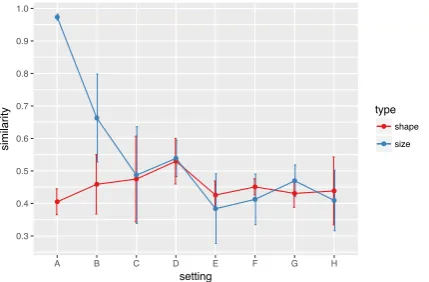
To quantitatively assess this pattern, we evaluate the similarity between ‘big’/‘small’ embeddings by (1) averaging all the embeddings containing the same adjective, (2) computing the cosine similar-ity between the two centroids. If the model pro-gressively develops a mutually exclusive represen-tation for ‘big’ and ‘small’, the similarity should decrease across settings; in contrast, such a pat-tern should not be found for shape (the meaning of, e.g.,squareis not supposed to change).3 The expected pattern is shown in Figure4, with simi-larity starting very high in A and rapidly decreas-ing with an increasdecreas-ing proportion of unexpected
cases. Note that, in A, there is almost no difference between ‘big’ and ‘small’. This is somehow intu-itive since, in thebalanced test set, the sentences in the ‘big’ centroid are exactly the same as those in the ‘small’ one, except for the size adjective. As for shape, a rather ‘flat’ pattern is observed.
Mutual exclusivity of predictions An insight-ful way to test whether FiLM has learned a mutually exclusive representation for ‘big’ and ‘small’ is to consider its predictions for the
orig-3For shape, we obtain an average representation for each
shape (circle,square, etc.), compute all pairwise similarities between the 4 centroids, and compute the average similarity.
inal (ORIG) and swapped (SWAP) test samples. If the model has learned that beingbigimplies being
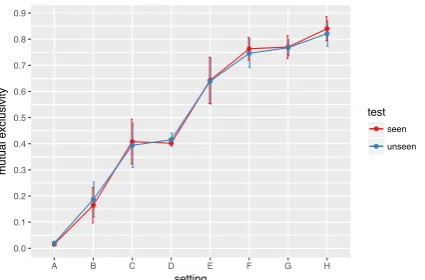
not small, and vice versa, we should expect it not to output the same answer (e.g.,true) to both ques-tions. To explore this issue, we first obtain model predictions on both the seen andunseen test set. We then take either test set and, for each sample, we swap the size adjective and the ground truth (see Figure 1). This way, we obtain two SWAP test sets where ground truths are systematically re-versed compared to ORIG. We obtain model pre-dictions on each SWAP test set, compare them to those on the corresponding ORIG, and count the number of non-overlapping (i.e., mutually exclu-sive) predictions. As shown in Figure5, mutual exclusivity is close to 0 in A, where FiLM outputs (almost) always the same answer to both ORIG and SWAP samples, and progressively increases across settings, which boosts FiLM’s generaliza-tion ability. This pattern of results is in line with what is reported byGandhi and Lake(2019), i.e., that standard neural networks lack the ability to reason with mutual exclusivity. Until there is a balanced enough number of ‘big’ and ‘small’
ex-0.3 0.4 0.5 0.6 0.7 0.8 0.9 1.0
A B C D E F G H
setting
similarity
type
shape
size
Figure 4: Similarity between sentence embeddings
[image:4.595.310.525.585.726.2]0.0 0.1 0.2 0.3 0.4 0.5 0.6 0.7 0.8 0.9
A B C D E F G H
setting
mutual exclusivity
test
[image:5.595.76.289.63.203.2]seen unseen
Figure 5: Mutual exclusivity (ME) of predictions
be-tween ORIGand SWAPseen/unseen. The less
overlap-ping predictions, the higher ME. Best viewed in color.
amples in training, indeed, the model does not fully understand the mutually exclusive relation tying the two adjectives; rather, it makes predic-tions that are biased toward the most frequent, ex-pectedinstances.
4 Generalization vs Compositionality
The results described above show the ability of FiLM to make powerful generalizations with lit-tle data. However, this is not informative of its
compositional skills since, in settings B-H, the same proportion of unexpected cases is seen by the model for each shape type. As a conse-quence, the model is not required to apply the ‘big’/‘small’ relation learned for, say, circles to, say, squares. Here, we test whether learning the rule for some shape types makes the model able to apply it to other shapes. Crucially, this is differ-ent from the compositional experimdiffer-ent inPezzelle and Fern´andez (2019) (here referred to as set-ting A) where the ‘big’/‘small’ relation had to be learned across shapes.
We train the model with perfectly balanced data (as in H) for triangles and circles, and perfectly unbalanced data (as in A) for squares and rectan-gles. More in detail, the model is trained with sen-tences containing the following queries:4 big tri-angle(1K datapoints),small triangle(1K),big cir-cle(1K),small circle(1K),small square(2K),big rectangle (2K), and is then tested with the usual
seenandunseentest sets. If the model learns the abstract, mutually exclusive relation between ‘big’ and ‘small’ by being exposed to examples of these two adjectives combined with two different shape
4We employ the same 8K training datapoints and images
used in the previous experiments.
types, it should then be able tocompositionally ap-ply the rule to the other two types of shape. Other-wise, a similar pattern as the one observed in set-ting A should be found for squares and rectangles. On the seen test set, where all the adjective-noun combinations are seen in training, the model obtains an average accuracy (over 3 runs) of 0.81. On the unseen one, in contrast, it stops at 0.64. As expected, this worse performance is due to the extremely low accuracy onbig square(0.22) and
small rectangle (0.23), i.e., the cases that were never seen in training. This opposite pattern of re-sults (triangle and circle vs square and rectangle) suggests that the model learns a ‘big’/‘small’ rule that is shape-dependent and cannot be composi-tionallyapplied to other shapes. This is confirmed by the results obtained when testing the model on the ‘without adjective’ test sentences: in the best model run, e.g., chance-level accuracy is observed for triangles and circles in either test set (i.e., the model ‘needs’ the adjective to perform the task), while the same numbers as those obtained with the default sentences are observed for squares and rectangles (i.e., the adjective is ‘ignored’).
5 Conclusion
Previous work has reported the inability of FiLM to apply ‘big’, ‘small’ to unseen adjective-noun combinations (Pezzelle and Fern´andez, 2019). Here, we show that seeing some of these cases in training mitigates the problem, leading to high generalizations (in line with Lake and Baroni,
2018) and helping the model understand the mutu-ally exclusive status of size adjectives. Although the model can learn the ‘big’/‘small’ rule, this rule is shown to be shape-dependent; i.e., it cannot be learned for some nouns and compositionally ap-plied to others for which direct evidence was not observed during training. Taken together, these findings indicate that models fail to apply rules
compositionally, but are extremely good at gen-eralizing to even rarelyseenexamples.
Acknowledgments
References
Aishwarya Agrawal, Dhruv Batra, Devi Parikh, and
Aniruddha Kembhavi. 2018. Don’t just assume;
look and answer: Overcoming priors for visual
ques-tion answering. InProceedings of the IEEE
Confer-ence on Computer Vision and Pattern Recognition, pages 4971–4980.
Aishwarya Agrawal, Aniruddha Kembhavi, Dhruv Ba-tra, and Devi Parikh. 2017. C-VQA: A composi-tional split of the Visual Question Answering (VQA)
v1.0 dataset. arXiv preprint arXiv:1704.08243.
Marco Baroni. 2019. Linguistic generalization and
compositionality in modern artificial neural net-works. ArXiv preprint arXiv:1904.00157, to appear in the Philosophical Transactions of the Royal Soci-ety B.
Junyoung Chung, Caglar Gulcehre, Kyunghyun Cho, and Yoshua Bengio. 2014. Empirical evaluation of gated recurrent neural networks on sequence
model-ing. InWorkshop on Deep Learning at NIPS-2014.
Kanishk Gandhi and Brenden M Lake. 2019. Mutual
exclusivity as a challenge for neural networks. arXiv
preprint arXiv:1906.10197.
Kaiming He, Xiangyu Zhang, Shaoqing Ren, and Jian Sun. 2016. Deep residual learning for image
recog-nition. In Proceedings of the IEEE conference on
computer vision and pattern recognition, pages 770– 778.
Justin Johnson, Bharath Hariharan, Laurens van der Maaten, Li Fei-Fei, C Lawrence Zitnick, and Ross Girshick. 2017. CLEVR: A diagnostic dataset for compositional language and elementary visual
rea-soning. In Proceedings of the IEEE Conference
on Computer Vision and Pattern Recognition, pages 2901–2910.
Kris Korrel, Dieuwke Hupkes, Verna Dankers, and Elia
Bruni. 2019. Transcoding compositionally:
Us-ing attention to find more generalizable solutions.
In Proceedings of the 2019 ACL Workshop Black-boxNLP: Analyzing and Interpreting Neural Net-works for NLP, pages 1–11, Florence, Italy. Asso-ciation for Computational Linguistics.
Brenden Lake and Marco Baroni. 2018. Generalization without systematicity: On the compositional skills
of sequence-to-sequence recurrent networks. In
In-ternational Conference on Machine Learning, pages 2879–2888.
Joao Loula, Marco Baroni, and Brenden Lake. 2018.
Rearranging the familiar: Testing compositional
generalization in recurrent networks. In
Proceed-ings of the 2018 EMNLP Workshop BlackboxNLP: Analyzing and Interpreting Neural Networks for
NLP, pages 108–114.
Ethan Perez, Florian Strub, Harm De Vries, Vincent Dumoulin, and Aaron Courville. 2018. Film: Vi-sual reasoning with a general conditioning layer. In
Thirty-Second AAAI Conference on Artificial Intelli-gence.
Sandro Pezzelle and Raquel Fern´andez. 2019. Is the
Red Square Big? MALeViC: Modeling
Adjec-tives Leveraging Visual Contexts. In Proceedings
of the 2019 Conference on Empirical Methods in Natural Language Processing and 9th International Joint Conference on Natural Language Processing. Forthcoming.
Sainandan Ramakrishnan, Aishwarya Agrawal, and Stefan Lee. 2018. Overcoming language priors in visual question answering with adversarial
regular-ization. InAdvances in Neural Information
Process-ing Systems, pages 1541–1551.