Proceedings of the 2nd Workshop on Deep Learning Approaches for Low-Resource NLP (DeepLo), pages 132–142 132
Unlearn Dataset Bias in Natural Language Inference by Fitting the
Residual
He He1,2 and Sheng Zha1 and Haohan Wang3
1Amazon Web Services,2New York University,3Carnegie Mellon University
{hehea,zhasheng}@amazon.com, [email protected]
Abstract
Statistical natural language inference (NLI)
models are susceptible to learning dataset
bias: superficial cues that happen to asso-ciate with the label on a particular dataset, but are not useful in general, e.g., negation words indicate contradiction. As exposed by sev-eral recent challenge datasets, these models perform poorly when such association is ab-sent, e.g., predicting that “I love dogs.” con-tradicts “I don’t love cats.”. Our goal is to design learning algorithms that guard against
known dataset bias. We formalize the
con-cept of dataset bias under the framework of distribution shift and present a simple debias-ing algorithm based on residual fittdebias-ing, which we call DRiFt. We first learn a biased model that only uses features that are known to re-late to dataset bias. Then, we train a deased model that fits to the residual of the bi-ased model, focusing on examples that cannot be predicted well by biased features only. We use DRiFt to train three high-performing NLI models on two benchmark datasets, SNLI and MNLI. Our debiased models achieve signifi-cant gains over baseline models on two chal-lenge test sets, while maintaining reasonable performance on the original test sets.
1 Introduction
Machine learning models have surpassed human-performance on multiple language understanding benchmarks. However, transferring the success to real-world applications has been much slower due to the brittleness of these systems. For example,
McCoy et al.(2019) show that models blindly
pre-dict the entailment relation for two sentences with high word overlap even if they have very different meanings, e.g., “The man hit a dog” and “The dog
hit a man”.Jia and Liang(2017) show that reading
comprehension models are easily distracted by ir-relevant sentences containing key phrases from the
g(x)
<latexit sha1_base64="5MdSH+jBhLb9upJWOdxkrEde8/M=">AAAB63icbVBNS8NAEJ3Ur1q/qh69LBahXkoigh6LXjxWMG2hDWWz3bRLdzdhdyOW0L/gxYMiXv1D3vw3btoctPXBwOO9GWbmhQln2rjut1NaW9/Y3CpvV3Z29/YPqodHbR2nilCfxDxW3RBrypmkvmGG026iKBYhp51wcpv7nUeqNIvlg5kmNBB4JFnECDa5NKo/nQ+qNbfhzoFWiVeQGhRoDapf/WFMUkGlIRxr3fPcxAQZVoYRTmeVfqppgskEj2jPUokF1UE2v3WGzqwyRFGsbEmD5urviQwLracitJ0Cm7Fe9nLxP6+Xmug6yJhMUkMlWSyKUo5MjPLH0ZApSgyfWoKJYvZWRMZYYWJsPBUbgrf88ippXzQ8t+HdX9aaN0UcZTiBU6iDB1fQhDtogQ8ExvAMr/DmCOfFeXc+Fq0lp5g5hj9wPn8AbeaN0g==</latexit><latexit sha1_base64="5MdSH+jBhLb9upJWOdxkrEde8/M=">AAAB63icbVBNS8NAEJ3Ur1q/qh69LBahXkoigh6LXjxWMG2hDWWz3bRLdzdhdyOW0L/gxYMiXv1D3vw3btoctPXBwOO9GWbmhQln2rjut1NaW9/Y3CpvV3Z29/YPqodHbR2nilCfxDxW3RBrypmkvmGG026iKBYhp51wcpv7nUeqNIvlg5kmNBB4JFnECDa5NKo/nQ+qNbfhzoFWiVeQGhRoDapf/WFMUkGlIRxr3fPcxAQZVoYRTmeVfqppgskEj2jPUokF1UE2v3WGzqwyRFGsbEmD5urviQwLracitJ0Cm7Fe9nLxP6+Xmug6yJhMUkMlWSyKUo5MjPLH0ZApSgyfWoKJYvZWRMZYYWJsPBUbgrf88ippXzQ8t+HdX9aaN0UcZTiBU6iDB1fQhDtogQ8ExvAMr/DmCOfFeXc+Fq0lp5g5hj9wPn8AbeaN0g==</latexit><latexit sha1_base64="5MdSH+jBhLb9upJWOdxkrEde8/M=">AAAB63icbVBNS8NAEJ3Ur1q/qh69LBahXkoigh6LXjxWMG2hDWWz3bRLdzdhdyOW0L/gxYMiXv1D3vw3btoctPXBwOO9GWbmhQln2rjut1NaW9/Y3CpvV3Z29/YPqodHbR2nilCfxDxW3RBrypmkvmGG026iKBYhp51wcpv7nUeqNIvlg5kmNBB4JFnECDa5NKo/nQ+qNbfhzoFWiVeQGhRoDapf/WFMUkGlIRxr3fPcxAQZVoYRTmeVfqppgskEj2jPUokF1UE2v3WGzqwyRFGsbEmD5urviQwLracitJ0Cm7Fe9nLxP6+Xmug6yJhMUkMlWSyKUo5MjPLH0ZApSgyfWoKJYvZWRMZYYWJsPBUbgrf88ippXzQ8t+HdX9aaN0UcZTiBU6iDB1fQhDtogQ8ExvAMr/DmCOfFeXc+Fq0lp5g5hj9wPn8AbeaN0g==</latexit><latexit sha1_base64="5MdSH+jBhLb9upJWOdxkrEde8/M=">AAAB63icbVBNS8NAEJ3Ur1q/qh69LBahXkoigh6LXjxWMG2hDWWz3bRLdzdhdyOW0L/gxYMiXv1D3vw3btoctPXBwOO9GWbmhQln2rjut1NaW9/Y3CpvV3Z29/YPqodHbR2nilCfxDxW3RBrypmkvmGG026iKBYhp51wcpv7nUeqNIvlg5kmNBB4JFnECDa5NKo/nQ+qNbfhzoFWiVeQGhRoDapf/WFMUkGlIRxr3fPcxAQZVoYRTmeVfqppgskEj2jPUokF1UE2v3WGzqwyRFGsbEmD5urviQwLracitJ0Cm7Fe9nLxP6+Xmug6yJhMUkMlWSyKUo5MjPLH0ZApSgyfWoKJYvZWRMZYYWJsPBUbgrf88ippXzQ8t+HdX9aaN0UcZTiBU6iDB1fQhDtogQ8ExvAMr/DmCOfFeXc+Fq0lp5g5hj9wPn8AbeaN0g==</latexit>
y
<latexit sha1_base64="l29WxoUb9DEbvmhLG7jHtZ0OU24=">AAAB6HicbVBNS8NAEJ34WetX1aOXxSJ4KokIeix68diC/YA2lM120q7dbMLuRgihv8CLB0W8+pO8+W/ctjlo64OBx3szzMwLEsG1cd1vZ219Y3Nru7RT3t3bPzisHB23dZwqhi0Wi1h1A6pRcIktw43AbqKQRoHATjC5m/mdJ1Sax/LBZAn6ER1JHnJGjZWa2aBSdWvuHGSVeAWpQoHGoPLVH8YsjVAaJqjWPc9NjJ9TZTgTOC33U40JZRM6wp6lkkao/Xx+6JScW2VIwljZkobM1d8TOY20zqLAdkbUjPWyNxP/83qpCW/8nMskNSjZYlGYCmJiMvuaDLlCZkRmCWWK21sJG1NFmbHZlG0I3vLLq6R9WfPcmte8qtZvizhKcApncAEeXEMd7qEBLWCA8Ayv8OY8Oi/Ou/OxaF1zipkT+APn8wfnvYz9</latexit>
<latexit sha1_base64="l29WxoUb9DEbvmhLG7jHtZ0OU24=">AAAB6HicbVBNS8NAEJ34WetX1aOXxSJ4KokIeix68diC/YA2lM120q7dbMLuRgihv8CLB0W8+pO8+W/ctjlo64OBx3szzMwLEsG1cd1vZ219Y3Nru7RT3t3bPzisHB23dZwqhi0Wi1h1A6pRcIktw43AbqKQRoHATjC5m/mdJ1Sax/LBZAn6ER1JHnJGjZWa2aBSdWvuHGSVeAWpQoHGoPLVH8YsjVAaJqjWPc9NjJ9TZTgTOC33U40JZRM6wp6lkkao/Xx+6JScW2VIwljZkobM1d8TOY20zqLAdkbUjPWyNxP/83qpCW/8nMskNSjZYlGYCmJiMvuaDLlCZkRmCWWK21sJG1NFmbHZlG0I3vLLq6R9WfPcmte8qtZvizhKcApncAEeXEMd7qEBLWCA8Ayv8OY8Oi/Ou/OxaF1zipkT+APn8wfnvYz9</latexit><latexit sha1_base64="l29WxoUb9DEbvmhLG7jHtZ0OU24=">AAAB6HicbVBNS8NAEJ34WetX1aOXxSJ4KokIeix68diC/YA2lM120q7dbMLuRgihv8CLB0W8+pO8+W/ctjlo64OBx3szzMwLEsG1cd1vZ219Y3Nru7RT3t3bPzisHB23dZwqhi0Wi1h1A6pRcIktw43AbqKQRoHATjC5m/mdJ1Sax/LBZAn6ER1JHnJGjZWa2aBSdWvuHGSVeAWpQoHGoPLVH8YsjVAaJqjWPc9NjJ9TZTgTOC33U40JZRM6wp6lkkao/Xx+6JScW2VIwljZkobM1d8TOY20zqLAdkbUjPWyNxP/83qpCW/8nMskNSjZYlGYCmJiMvuaDLlCZkRmCWWK21sJG1NFmbHZlG0I3vLLq6R9WfPcmte8qtZvizhKcApncAEeXEMd7qEBLWCA8Ayv8OY8Oi/Ou/OxaF1zipkT+APn8wfnvYz9</latexit><latexit sha1_base64="l29WxoUb9DEbvmhLG7jHtZ0OU24=">AAAB6HicbVBNS8NAEJ34WetX1aOXxSJ4KokIeix68diC/YA2lM120q7dbMLuRgihv8CLB0W8+pO8+W/ctjlo64OBx3szzMwLEsG1cd1vZ219Y3Nru7RT3t3bPzisHB23dZwqhi0Wi1h1A6pRcIktw43AbqKQRoHATjC5m/mdJ1Sax/LBZAn6ER1JHnJGjZWa2aBSdWvuHGSVeAWpQoHGoPLVH8YsjVAaJqjWPc9NjJ9TZTgTOC33U40JZRM6wp6lkkao/Xx+6JScW2VIwljZkobM1d8TOY20zqLAdkbUjPWyNxP/83qpCW/8nMskNSjZYlGYCmJiMvuaDLlCZkRmCWWK21sJG1NFmbHZlG0I3vLLq6R9WfPcmte8qtZvizhKcApncAEeXEMd7qEBLWCA8Ayv8OY8Oi/Ou/OxaF1zipkT+APn8wfnvYz9</latexit>
b(x)
<latexit sha1_base64="6bfZhmIPs+auSOFP/BVfCvkg+rY=">AAAB63icbVBNS8NAEJ3Ur1q/qh69LBahXkoigh6LXjxWMG2hDWWz3bRLdzdhdyOW0L/gxYMiXv1D3vw3btoctPXBwOO9GWbmhQln2rjut1NaW9/Y3CpvV3Z29/YPqodHbR2nilCfxDxW3RBrypmkvmGG026iKBYhp51wcpv7nUeqNIvlg5kmNBB4JFnECDa5FNafzgfVmttw50CrxCtIDQq0BtWv/jAmqaDSEI617nluYoIMK8MIp7NKP9U0wWSCR7RnqcSC6iCb3zpDZ1YZoihWtqRBc/X3RIaF1lMR2k6BzVgve7n4n9dLTXQdZEwmqaGSLBZFKUcmRvnjaMgUJYZPLcFEMXsrImOsMDE2nooNwVt+eZW0Lxqe2/DuL2vNmyKOMpzAKdTBgytowh20wAcCY3iGV3hzhPPivDsfi9aSU8wcwx84nz9mQ43N</latexit>
<latexit sha1_base64="6bfZhmIPs+auSOFP/BVfCvkg+rY=">AAAB63icbVBNS8NAEJ3Ur1q/qh69LBahXkoigh6LXjxWMG2hDWWz3bRLdzdhdyOW0L/gxYMiXv1D3vw3btoctPXBwOO9GWbmhQln2rjut1NaW9/Y3CpvV3Z29/YPqodHbR2nilCfxDxW3RBrypmkvmGG026iKBYhp51wcpv7nUeqNIvlg5kmNBB4JFnECDa5FNafzgfVmttw50CrxCtIDQq0BtWv/jAmqaDSEI617nluYoIMK8MIp7NKP9U0wWSCR7RnqcSC6iCb3zpDZ1YZoihWtqRBc/X3RIaF1lMR2k6BzVgve7n4n9dLTXQdZEwmqaGSLBZFKUcmRvnjaMgUJYZPLcFEMXsrImOsMDE2nooNwVt+eZW0Lxqe2/DuL2vNmyKOMpzAKdTBgytowh20wAcCY3iGV3hzhPPivDsfi9aSU8wcwx84nz9mQ43N</latexit>
<latexit sha1_base64="6bfZhmIPs+auSOFP/BVfCvkg+rY=">AAAB63icbVBNS8NAEJ3Ur1q/qh69LBahXkoigh6LXjxWMG2hDWWz3bRLdzdhdyOW0L/gxYMiXv1D3vw3btoctPXBwOO9GWbmhQln2rjut1NaW9/Y3CpvV3Z29/YPqodHbR2nilCfxDxW3RBrypmkvmGG026iKBYhp51wcpv7nUeqNIvlg5kmNBB4JFnECDa5FNafzgfVmttw50CrxCtIDQq0BtWv/jAmqaDSEI617nluYoIMK8MIp7NKP9U0wWSCR7RnqcSC6iCb3zpDZ1YZoihWtqRBc/X3RIaF1lMR2k6BzVgve7n4n9dLTXQdZEwmqaGSLBZFKUcmRvnjaMgUJYZPLcFEMXsrImOsMDE2nooNwVt+eZW0Lxqe2/DuL2vNmyKOMpzAKdTBgytowh20wAcCY3iGV3hzhPPivDsfi9aSU8wcwx84nz9mQ43N</latexit>
<latexit sha1_base64="6bfZhmIPs+auSOFP/BVfCvkg+rY=">AAAB63icbVBNS8NAEJ3Ur1q/qh69LBahXkoigh6LXjxWMG2hDWWz3bRLdzdhdyOW0L/gxYMiXv1D3vw3btoctPXBwOO9GWbmhQln2rjut1NaW9/Y3CpvV3Z29/YPqodHbR2nilCfxDxW3RBrypmkvmGG026iKBYhp51wcpv7nUeqNIvlg5kmNBB4JFnECDa5FNafzgfVmttw50CrxCtIDQq0BtWv/jAmqaDSEI617nluYoIMK8MIp7NKP9U0wWSCR7RnqcSC6iCb3zpDZ1YZoihWtqRBc/X3RIaF1lMR2k6BzVgve7n4n9dLTXQdZEwmqaGSLBZFKUcmRvnjaMgUJYZPLcFEMXsrImOsMDE2nooNwVt+eZW0Lxqe2/DuL2vNmyKOMpzAKdTBgytowh20wAcCY3iGV3hzhPPivDsfi9aSU8wcwx84nz9mQ43N</latexit>
a
<latexit sha1_base64="b7/vCs5ze5KtVd66W3yyALYBfbk=">AAAB6HicbVBNS8NAEJ3Ur1q/qh69LBbBU0lEqMeiF48t2A9oQ9lsJ+3azSbsboQS+gu8eFDEqz/Jm//GbZuDtj4YeLw3w8y8IBFcG9f9dgobm1vbO8Xd0t7+weFR+fikreNUMWyxWMSqG1CNgktsGW4EdhOFNAoEdoLJ3dzvPKHSPJYPZpqgH9GR5CFn1FipSQflilt1FyDrxMtJBXI0BuWv/jBmaYTSMEG17nluYvyMKsOZwFmpn2pMKJvQEfYslTRC7WeLQ2fkwipDEsbKljRkof6eyGik9TQKbGdEzVivenPxP6+XmvDGz7hMUoOSLReFqSAmJvOvyZArZEZMLaFMcXsrYWOqKDM2m5INwVt9eZ20r6qeW/Wa15X6bR5HEc7gHC7BgxrU4R4a0AIGCM/wCm/Oo/PivDsfy9aCk8+cwh84nz/DXYzl</latexit>
<latexit sha1_base64="b7/vCs5ze5KtVd66W3yyALYBfbk=">AAAB6HicbVBNS8NAEJ3Ur1q/qh69LBbBU0lEqMeiF48t2A9oQ9lsJ+3azSbsboQS+gu8eFDEqz/Jm//GbZuDtj4YeLw3w8y8IBFcG9f9dgobm1vbO8Xd0t7+weFR+fikreNUMWyxWMSqG1CNgktsGW4EdhOFNAoEdoLJ3dzvPKHSPJYPZpqgH9GR5CFn1FipSQflilt1FyDrxMtJBXI0BuWv/jBmaYTSMEG17nluYvyMKsOZwFmpn2pMKJvQEfYslTRC7WeLQ2fkwipDEsbKljRkof6eyGik9TQKbGdEzVivenPxP6+XmvDGz7hMUoOSLReFqSAmJvOvyZArZEZMLaFMcXsrYWOqKDM2m5INwVt9eZ20r6qeW/Wa15X6bR5HEc7gHC7BgxrU4R4a0AIGCM/wCm/Oo/PivDsfy9aCk8+cwh84nz/DXYzl</latexit>
<latexit sha1_base64="b7/vCs5ze5KtVd66W3yyALYBfbk=">AAAB6HicbVBNS8NAEJ3Ur1q/qh69LBbBU0lEqMeiF48t2A9oQ9lsJ+3azSbsboQS+gu8eFDEqz/Jm//GbZuDtj4YeLw3w8y8IBFcG9f9dgobm1vbO8Xd0t7+weFR+fikreNUMWyxWMSqG1CNgktsGW4EdhOFNAoEdoLJ3dzvPKHSPJYPZpqgH9GR5CFn1FipSQflilt1FyDrxMtJBXI0BuWv/jBmaYTSMEG17nluYvyMKsOZwFmpn2pMKJvQEfYslTRC7WeLQ2fkwipDEsbKljRkof6eyGik9TQKbGdEzVivenPxP6+XmvDGz7hMUoOSLReFqSAmJvOvyZArZEZMLaFMcXsrYWOqKDM2m5INwVt9eZ20r6qeW/Wa15X6bR5HEc7gHC7BgxrU4R4a0AIGCM/wCm/Oo/PivDsfy9aCk8+cwh84nz/DXYzl</latexit>
<latexit sha1_base64="b7/vCs5ze5KtVd66W3yyALYBfbk=">AAAB6HicbVBNS8NAEJ3Ur1q/qh69LBbBU0lEqMeiF48t2A9oQ9lsJ+3azSbsboQS+gu8eFDEqz/Jm//GbZuDtj4YeLw3w8y8IBFcG9f9dgobm1vbO8Xd0t7+weFR+fikreNUMWyxWMSqG1CNgktsGW4EdhOFNAoEdoLJ3dzvPKHSPJYPZpqgH9GR5CFn1FipSQflilt1FyDrxMtJBXI0BuWv/jBmaYTSMEG17nluYvyMKsOZwFmpn2pMKJvQEfYslTRC7WeLQ2fkwipDEsbKljRkof6eyGik9TQKbGdEzVivenPxP6+XmvDGz7hMUoOSLReFqSAmJvOvyZArZEZMLaFMcXsrYWOqKDM2m5INwVt9eZ20r6qeW/Wa15X6bR5HEc7gHC7BgxrU4R4a0AIGCM/wCm/Oo/PivDsfy9aCk8+cwh84nz/DXYzl</latexit>
Semantics:
P: The little girl is sad.
H: The girl is not sad.
Word choice:
“not”
Label:
contradiction
Bias cause:
annotation strategy
g(x)
<latexit sha1_base64="5MdSH+jBhLb9upJWOdxkrEde8/M=">AAAB63icbVBNS8NAEJ3Ur1q/qh69LBahXkoigh6LXjxWMG2hDWWz3bRLdzdhdyOW0L/gxYMiXv1D3vw3btoctPXBwOO9GWbmhQln2rjut1NaW9/Y3CpvV3Z29/YPqodHbR2nilCfxDxW3RBrypmkvmGG026iKBYhp51wcpv7nUeqNIvlg5kmNBB4JFnECDa5NKo/nQ+qNbfhzoFWiVeQGhRoDapf/WFMUkGlIRxr3fPcxAQZVoYRTmeVfqppgskEj2jPUokF1UE2v3WGzqwyRFGsbEmD5urviQwLracitJ0Cm7Fe9nLxP6+Xmug6yJhMUkMlWSyKUo5MjPLH0ZApSgyfWoKJYvZWRMZYYWJsPBUbgrf88ippXzQ8t+HdX9aaN0UcZTiBU6iDB1fQhDtogQ8ExvAMr/DmCOfFeXc+Fq0lp5g5hj9wPn8AbeaN0g==</latexit><latexit sha1_base64="5MdSH+jBhLb9upJWOdxkrEde8/M=">AAAB63icbVBNS8NAEJ3Ur1q/qh69LBahXkoigh6LXjxWMG2hDWWz3bRLdzdhdyOW0L/gxYMiXv1D3vw3btoctPXBwOO9GWbmhQln2rjut1NaW9/Y3CpvV3Z29/YPqodHbR2nilCfxDxW3RBrypmkvmGG026iKBYhp51wcpv7nUeqNIvlg5kmNBB4JFnECDa5NKo/nQ+qNbfhzoFWiVeQGhRoDapf/WFMUkGlIRxr3fPcxAQZVoYRTmeVfqppgskEj2jPUokF1UE2v3WGzqwyRFGsbEmD5urviQwLracitJ0Cm7Fe9nLxP6+Xmug6yJhMUkMlWSyKUo5MjPLH0ZApSgyfWoKJYvZWRMZYYWJsPBUbgrf88ippXzQ8t+HdX9aaN0UcZTiBU6iDB1fQhDtogQ8ExvAMr/DmCOfFeXc+Fq0lp5g5hj9wPn8AbeaN0g==</latexit><latexit sha1_base64="5MdSH+jBhLb9upJWOdxkrEde8/M=">AAAB63icbVBNS8NAEJ3Ur1q/qh69LBahXkoigh6LXjxWMG2hDWWz3bRLdzdhdyOW0L/gxYMiXv1D3vw3btoctPXBwOO9GWbmhQln2rjut1NaW9/Y3CpvV3Z29/YPqodHbR2nilCfxDxW3RBrypmkvmGG026iKBYhp51wcpv7nUeqNIvlg5kmNBB4JFnECDa5NKo/nQ+qNbfhzoFWiVeQGhRoDapf/WFMUkGlIRxr3fPcxAQZVoYRTmeVfqppgskEj2jPUokF1UE2v3WGzqwyRFGsbEmD5urviQwLracitJ0Cm7Fe9nLxP6+Xmug6yJhMUkMlWSyKUo5MjPLH0ZApSgyfWoKJYvZWRMZYYWJsPBUbgrf88ippXzQ8t+HdX9aaN0UcZTiBU6iDB1fQhDtogQ8ExvAMr/DmCOfFeXc+Fq0lp5g5hj9wPn8AbeaN0g==</latexit><latexit sha1_base64="5MdSH+jBhLb9upJWOdxkrEde8/M=">AAAB63icbVBNS8NAEJ3Ur1q/qh69LBahXkoigh6LXjxWMG2hDWWz3bRLdzdhdyOW0L/gxYMiXv1D3vw3btoctPXBwOO9GWbmhQln2rjut1NaW9/Y3CpvV3Z29/YPqodHbR2nilCfxDxW3RBrypmkvmGG026iKBYhp51wcpv7nUeqNIvlg5kmNBB4JFnECDa5NKo/nQ+qNbfhzoFWiVeQGhRoDapf/WFMUkGlIRxr3fPcxAQZVoYRTmeVfqppgskEj2jPUokF1UE2v3WGzqwyRFGsbEmD5urviQwLracitJ0Cm7Fe9nLxP6+Xmug6yJhMUkMlWSyKUo5MjPLH0ZApSgyfWoKJYvZWRMZYYWJsPBUbgrf88ippXzQ8t+HdX9aaN0UcZTiBU6iDB1fQhDtogQ8ExvAMr/DmCOfFeXc+Fq0lp5g5hj9wPn8AbeaN0g==</latexit>
y<latexit sha1_base64="l29WxoUb9DEbvmhLG7jHtZ0OU24=">AAAB6HicbVBNS8NAEJ34WetX1aOXxSJ4KokIeix68diC/YA2lM120q7dbMLuRgihv8CLB0W8+pO8+W/ctjlo64OBx3szzMwLEsG1cd1vZ219Y3Nru7RT3t3bPzisHB23dZwqhi0Wi1h1A6pRcIktw43AbqKQRoHATjC5m/mdJ1Sax/LBZAn6ER1JHnJGjZWa2aBSdWvuHGSVeAWpQoHGoPLVH8YsjVAaJqjWPc9NjJ9TZTgTOC33U40JZRM6wp6lkkao/Xx+6JScW2VIwljZkobM1d8TOY20zqLAdkbUjPWyNxP/83qpCW/8nMskNSjZYlGYCmJiMvuaDLlCZkRmCWWK21sJG1NFmbHZlG0I3vLLq6R9WfPcmte8qtZvizhKcApncAEeXEMd7qEBLWCA8Ayv8OY8Oi/Ou/OxaF1zipkT+APn8wfnvYz9</latexit><latexit sha1_base64="l29WxoUb9DEbvmhLG7jHtZ0OU24=">AAAB6HicbVBNS8NAEJ34WetX1aOXxSJ4KokIeix68diC/YA2lM120q7dbMLuRgihv8CLB0W8+pO8+W/ctjlo64OBx3szzMwLEsG1cd1vZ219Y3Nru7RT3t3bPzisHB23dZwqhi0Wi1h1A6pRcIktw43AbqKQRoHATjC5m/mdJ1Sax/LBZAn6ER1JHnJGjZWa2aBSdWvuHGSVeAWpQoHGoPLVH8YsjVAaJqjWPc9NjJ9TZTgTOC33U40JZRM6wp6lkkao/Xx+6JScW2VIwljZkobM1d8TOY20zqLAdkbUjPWyNxP/83qpCW/8nMskNSjZYlGYCmJiMvuaDLlCZkRmCWWK21sJG1NFmbHZlG0I3vLLq6R9WfPcmte8qtZvizhKcApncAEeXEMd7qEBLWCA8Ayv8OY8Oi/Ou/OxaF1zipkT+APn8wfnvYz9</latexit><latexit sha1_base64="l29WxoUb9DEbvmhLG7jHtZ0OU24=">AAAB6HicbVBNS8NAEJ34WetX1aOXxSJ4KokIeix68diC/YA2lM120q7dbMLuRgihv8CLB0W8+pO8+W/ctjlo64OBx3szzMwLEsG1cd1vZ219Y3Nru7RT3t3bPzisHB23dZwqhi0Wi1h1A6pRcIktw43AbqKQRoHATjC5m/mdJ1Sax/LBZAn6ER1JHnJGjZWa2aBSdWvuHGSVeAWpQoHGoPLVH8YsjVAaJqjWPc9NjJ9TZTgTOC33U40JZRM6wp6lkkao/Xx+6JScW2VIwljZkobM1d8TOY20zqLAdkbUjPWyNxP/83qpCW/8nMskNSjZYlGYCmJiMvuaDLlCZkRmCWWK21sJG1NFmbHZlG0I3vLLq6R9WfPcmte8qtZvizhKcApncAEeXEMd7qEBLWCA8Ayv8OY8Oi/Ou/OxaF1zipkT+APn8wfnvYz9</latexit><latexit sha1_base64="l29WxoUb9DEbvmhLG7jHtZ0OU24=">AAAB6HicbVBNS8NAEJ34WetX1aOXxSJ4KokIeix68diC/YA2lM120q7dbMLuRgihv8CLB0W8+pO8+W/ctjlo64OBx3szzMwLEsG1cd1vZ219Y3Nru7RT3t3bPzisHB23dZwqhi0Wi1h1A6pRcIktw43AbqKQRoHATjC5m/mdJ1Sax/LBZAn6ER1JHnJGjZWa2aBSdWvuHGSVeAWpQoHGoPLVH8YsjVAaJqjWPc9NjJ9TZTgTOC33U40JZRM6wp6lkkao/Xx+6JScW2VIwljZkobM1d8TOY20zqLAdkbUjPWyNxP/83qpCW/8nMskNSjZYlGYCmJiMvuaDLlCZkRmCWWK21sJG1NFmbHZlG0I3vLLq6R9WfPcmte8qtZvizhKcApncAEeXEMd7qEBLWCA8Ayv8OY8Oi/Ou/OxaF1zipkT+APn8wfnvYz9</latexit>
b(x)
<latexit sha1_base64="6bfZhmIPs+auSOFP/BVfCvkg+rY=">AAAB63icbVBNS8NAEJ3Ur1q/qh69LBahXkoigh6LXjxWMG2hDWWz3bRLdzdhdyOW0L/gxYMiXv1D3vw3btoctPXBwOO9GWbmhQln2rjut1NaW9/Y3CpvV3Z29/YPqodHbR2nilCfxDxW3RBrypmkvmGG026iKBYhp51wcpv7nUeqNIvlg5kmNBB4JFnECDa5FNafzgfVmttw50CrxCtIDQq0BtWv/jAmqaDSEI617nluYoIMK8MIp7NKP9U0wWSCR7RnqcSC6iCb3zpDZ1YZoihWtqRBc/X3RIaF1lMR2k6BzVgve7n4n9dLTXQdZEwmqaGSLBZFKUcmRvnjaMgUJYZPLcFEMXsrImOsMDE2nooNwVt+eZW0Lxqe2/DuL2vNmyKOMpzAKdTBgytowh20wAcCY3iGV3hzhPPivDsfi9aSU8wcwx84nz9mQ43N</latexit>
<latexit sha1_base64="6bfZhmIPs+auSOFP/BVfCvkg+rY=">AAAB63icbVBNS8NAEJ3Ur1q/qh69LBahXkoigh6LXjxWMG2hDWWz3bRLdzdhdyOW0L/gxYMiXv1D3vw3btoctPXBwOO9GWbmhQln2rjut1NaW9/Y3CpvV3Z29/YPqodHbR2nilCfxDxW3RBrypmkvmGG026iKBYhp51wcpv7nUeqNIvlg5kmNBB4JFnECDa5FNafzgfVmttw50CrxCtIDQq0BtWv/jAmqaDSEI617nluYoIMK8MIp7NKP9U0wWSCR7RnqcSC6iCb3zpDZ1YZoihWtqRBc/X3RIaF1lMR2k6BzVgve7n4n9dLTXQdZEwmqaGSLBZFKUcmRvnjaMgUJYZPLcFEMXsrImOsMDE2nooNwVt+eZW0Lxqe2/DuL2vNmyKOMpzAKdTBgytowh20wAcCY3iGV3hzhPPivDsfi9aSU8wcwx84nz9mQ43N</latexit>
<latexit sha1_base64="6bfZhmIPs+auSOFP/BVfCvkg+rY=">AAAB63icbVBNS8NAEJ3Ur1q/qh69LBahXkoigh6LXjxWMG2hDWWz3bRLdzdhdyOW0L/gxYMiXv1D3vw3btoctPXBwOO9GWbmhQln2rjut1NaW9/Y3CpvV3Z29/YPqodHbR2nilCfxDxW3RBrypmkvmGG026iKBYhp51wcpv7nUeqNIvlg5kmNBB4JFnECDa5FNafzgfVmttw50CrxCtIDQq0BtWv/jAmqaDSEI617nluYoIMK8MIp7NKP9U0wWSCR7RnqcSC6iCb3zpDZ1YZoihWtqRBc/X3RIaF1lMR2k6BzVgve7n4n9dLTXQdZEwmqaGSLBZFKUcmRvnjaMgUJYZPLcFEMXsrImOsMDE2nooNwVt+eZW0Lxqe2/DuL2vNmyKOMpzAKdTBgytowh20wAcCY3iGV3hzhPPivDsfi9aSU8wcwx84nz9mQ43N</latexit>
<latexit sha1_base64="6bfZhmIPs+auSOFP/BVfCvkg+rY=">AAAB63icbVBNS8NAEJ3Ur1q/qh69LBahXkoigh6LXjxWMG2hDWWz3bRLdzdhdyOW0L/gxYMiXv1D3vw3btoctPXBwOO9GWbmhQln2rjut1NaW9/Y3CpvV3Z29/YPqodHbR2nilCfxDxW3RBrypmkvmGG026iKBYhp51wcpv7nUeqNIvlg5kmNBB4JFnECDa5FNafzgfVmttw50CrxCtIDQq0BtWv/jAmqaDSEI617nluYoIMK8MIp7NKP9U0wWSCR7RnqcSC6iCb3zpDZ1YZoihWtqRBc/X3RIaF1lMR2k6BzVgve7n4n9dLTXQdZEwmqaGSLBZFKUcmRvnjaMgUJYZPLcFEMXsrImOsMDE2nooNwVt+eZW0Lxqe2/DuL2vNmyKOMpzAKdTBgytowh20wAcCY3iGV3hzhPPivDsfi9aSU8wcwx84nz9mQ43N</latexit>
Semantics:
P: The little girl is sad.
H: The girl is not happy.
Word choice:
“not”
Label:
entailment
Unknown cause a<latexit sha1_base64="c9NesRyxyqsx3mTie9T9rgIQLPo=">AAAB6XicbVBNS8NAEJ3Ur1q/qh69LBbRU0mkoMeiF49V7Ae0oWy2m3bpZhN2J0IJ/QdePCji1X/kzX/jts1BWx8MPN6bYWZekEhh0HW/ncLa+sbmVnG7tLO7t39QPjxqmTjVjDdZLGPdCajhUijeRIGSdxLNaRRI3g7GtzO//cS1EbF6xEnC/YgOlQgFo2ilB3reL1fcqjsHWSVeTiqQo9Evf/UGMUsjrpBJakzXcxP0M6pRMMmnpV5qeELZmA5511JFI278bH7plJxZZUDCWNtSSObq74mMRsZMosB2RhRHZtmbif953RTDaz8TKkmRK7ZYFKaSYExmb5OB0JyhnFhCmRb2VsJGVFOGNpySDcFbfnmVtC6rnlv17muV+k0eRxFO4BQuwIMrqMMdNKAJDEJ4hld4c8bOi/PufCxaC04+cwx/4Hz+ACPNjRY=</latexit><latexit sha1_base64="c9NesRyxyqsx3mTie9T9rgIQLPo=">AAAB6XicbVBNS8NAEJ3Ur1q/qh69LBbRU0mkoMeiF49V7Ae0oWy2m3bpZhN2J0IJ/QdePCji1X/kzX/jts1BWx8MPN6bYWZekEhh0HW/ncLa+sbmVnG7tLO7t39QPjxqmTjVjDdZLGPdCajhUijeRIGSdxLNaRRI3g7GtzO//cS1EbF6xEnC/YgOlQgFo2ilB3reL1fcqjsHWSVeTiqQo9Evf/UGMUsjrpBJakzXcxP0M6pRMMmnpV5qeELZmA5511JFI278bH7plJxZZUDCWNtSSObq74mMRsZMosB2RhRHZtmbif953RTDaz8TKkmRK7ZYFKaSYExmb5OB0JyhnFhCmRb2VsJGVFOGNpySDcFbfnmVtC6rnlv17muV+k0eRxFO4BQuwIMrqMMdNKAJDEJ4hld4c8bOi/PufCxaC04+cwx/4Hz+ACPNjRY=</latexit><latexit sha1_base64="c9NesRyxyqsx3mTie9T9rgIQLPo=">AAAB6XicbVBNS8NAEJ3Ur1q/qh69LBbRU0mkoMeiF49V7Ae0oWy2m3bpZhN2J0IJ/QdePCji1X/kzX/jts1BWx8MPN6bYWZekEhh0HW/ncLa+sbmVnG7tLO7t39QPjxqmTjVjDdZLGPdCajhUijeRIGSdxLNaRRI3g7GtzO//cS1EbF6xEnC/YgOlQgFo2ilB3reL1fcqjsHWSVeTiqQo9Evf/UGMUsjrpBJakzXcxP0M6pRMMmnpV5qeELZmA5511JFI278bH7plJxZZUDCWNtSSObq74mMRsZMosB2RhRHZtmbif953RTDaz8TKkmRK7ZYFKaSYExmb5OB0JyhnFhCmRb2VsJGVFOGNpySDcFbfnmVtC6rnlv17muV+k0eRxFO4BQuwIMrqMMdNKAJDEJ4hld4c8bOi/PufCxaC04+cwx/4Hz+ACPNjRY=</latexit><latexit sha1_base64="c9NesRyxyqsx3mTie9T9rgIQLPo=">AAAB6XicbVBNS8NAEJ3Ur1q/qh69LBbRU0mkoMeiF49V7Ae0oWy2m3bpZhN2J0IJ/QdePCji1X/kzX/jts1BWx8MPN6bYWZekEhh0HW/ncLa+sbmVnG7tLO7t39QPjxqmTjVjDdZLGPdCajhUijeRIGSdxLNaRRI3g7GtzO//cS1EbF6xEnC/YgOlQgFo2ilB3reL1fcqjsHWSVeTiqQo9Evf/UGMUsjrpBJakzXcxP0M6pRMMmnpV5qeELZmA5511JFI278bH7plJxZZUDCWNtSSObq74mMRsZMosB2RhRHZtmbif953RTDaz8TKkmRK7ZYFKaSYExmb5OB0JyhnFhCmRb2VsJGVFOGNpySDcFbfnmVtC6rnlv17muV+k0eRxFO4BQuwIMrqMMdNKAJDEJ4hld4c8bOi/PufCxaC04+cwx/4Hz+ACPNjRY=</latexit> Training
[image:1.595.308.527.227.374.2]Testing
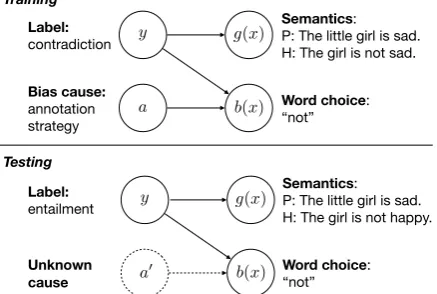
Figure 1: An example of dataset bias in NLI. On the training data, the biased feature (“not”) is affected by crowd workers’ strategy of negating the premise to cre-ate a contradicting pair. However, at test time the word
choice is affected byunknownsources, thus “not” may
not be associated with the label “contradiction”. A model relying on the negation word to predict “con-tradiction” would fail on the shown test example.
question. Similar failures have also been observed
on paraphrase identification (Zhang et al.,2019c)
and story cloze test (Schwartz et al.,2017).
A common problem behind these failures is dis-tribution shift. Our training data is often not a rep-resentative sample of real-world data due to their different data-generating processes, thus models are susceptible to learning simple cues (e.g., lex-ical overlap) that work well on the majority of training examples but fail on more challenging test examples. Consider generating a contradicting pair of sentences for natural language inference
(NLI) in Figure1. Crowd workers tend to
fail. In this paper, we formalizedataset bias
(Tor-ralba and Efros, 2011) under the label shift
as-sumption: the conditional distribution of the la-bel given biased features changes at test time. Our goal is to design learning algorithms that are ro-bust to dataset bias with a focus on NLI, i.e.
pre-dicting whether the premise sentence entails the
hypothesissentence.
Typical debiasing approaches aim to remove bi-ased features (e.g., gender and image texture) in
the learned representation (Wang et al.,2019b,a).
However, biased features in textual data often con-flate useful semantic information and superficial cues, thus completely removing them might sig-nificantly hurt prediction performance. Even when we are confident that the bias is irrelevant to
pre-diction (e.g., gender),Gonen and Goldberg(2019)
show that existing bias removal methods are insuf-ficient.
Instead of debiasing the data representation, our
method (along with the concurrent work ofClark
et al.(2019)) accounts for label shift given biased
features by focusing on “hard” examples that can-not be predicted well using only biased features. We train a model in two steps. First, we train a
biased model using insufficient features such as
overlapping words between the premise and the
hypothesis. Next, we train adebiased modelby
fit-ting to the residuals of the biased model. This step “unlearns” the bias by taking additional negative gradient updates on examples with low loss under
the biased model (Section3.2).1At test time, only
the debiased model is used for prediction. We call
this learning algorithm DRiFt (Debias byResidual
Fitting).
We use DRiFt to train three high-performing NLI models on two benchmark datasets,
SNLI (Bowman et al.,2015) and MNLI (Williams
et al., 2017). Compared to baseline models
trained by maximum likelihood estimation, our debiased models improve performance on several challenge datasets with only slight degradation on the original test sets.
2 Problem Statement
Dataset bias. Letx2X be the input andy2Y
be the label we want to predict. Given training
examples(x, y) drawn from a distributionP, we
1 Note that dataset bias is flagged by good performance
despite insufficient input, e.g., a high-accuracy hypothesis-only classifier (Gururangan et al.,2018).
define dataset bias as (partial) representation of
x that exhibits label shift (Lipton et al., 2018;
Scholkopf et al.,2012) on the test distributionQ.
Formally, assume thatxcan be represented by two
componentsb(x)andg(x)conditionally
indepen-dent giveny. We have
p(x, y) =p(b(x), g(x), y) (1) =p(g(x)|y)p(y|b(x))p(b(x)). (2)
Letg(x)be the true effect ofysuch that their
re-lationship does not change normally, i.e. p(g(x) |
y) =q(g(x)|y). Letb(x)bebiased featuresthat
happen to be predictive ofyonP. For example, in
Figure1,g(x)represents semantics of the premis
and hypothesis sentences, whereasb(x)represents
specific word choices affected by varying sources. In the training data, the word “not” has a strong as-sociation with “contradiction” due to crowd work-ers’ writing strategies. Consequently, a model
learned on the training data distributionP would
degrade when such association no longer exists. Formally, both training and testing examples may
exhibit biased features: p(b(x)) = q(b(x)), but
dependence between these features and the label
can change:p(y|b(x))=6 q(y|b(x)).
In a typical supervised learning setting with dataset bias, we do not observe examples from
Q thus b(x) is unknown. Without additional
in-formation, achieving good performance on Q is
impossible. Fortunately, oftentimes we do have
domain-specific knowledge on what b(x) might
be, e.g., the word overlapping heuristic in NLI. Therefore, our goal is to correct the model trained
on P to perform well on Q givenknown dataset
bias.
Bias in NLI data. Dataset bias in SNLI
(Bow-man et al.,2015) and MNLI (Williams et al.,2017)
are largely due to the crowdsourcing process. Both are created by asking crowd workers to write three sentences (hypotheses) that are entailed by, neutral with, or contradict a given sentence drawn from a
corpus (the premise). Gururangan et al. (2018);
Poliak et al.(2018) show that certain words in the
solved without much reasoning about sentence
meanings. Subsequently,McCoy et al.(2019)
re-port that models rely on high word overlap to
pre-dict entailment;Glockner et al.(2018);Naik et al.
(2018) demonstrate that models struggle at even lexical-level inference involving antonyms, hyper-nyms, etc.
A natural question to ask then is whether there exist better data collection procedures that guard against these biases. We argue that this is not easy because in practice, we almost always have different data-generating processes during train-ing (generated from selected corpora and anno-tators) and test (generated by end users). Then, can we remove biased features from training ex-amples? This is also infeasible because sometimes they contain the necessary information for predic-tion, e.g., removing words may destroy the sen-tence meaning. It is not the features that are biased but their relation with the label. Next, we describe our approach to mitigating this biased relation.
3 Approach
3.1 Overview
The key idea of our approach is to first detect bi-ased examples given prior knowledge on potential dataset bias, then focus on learning from unbiased, hard examples. We describe the two steps in de-tails below.
Detect biased examples. How do we know if an example exhibits biased features? Although we cannot directly measure label shift without access-ing the test data, we know that NLI models are unlikely to work well given insufficient features. When it does work well given only partial seman-tics of the input, the good performance is likely
due to dataset bias. For example, Gururangan
et al.(2018) exposes annotation artifacts by
show-ing that hypothesis-only models have unexpected
high accuracy. Similarly, we train abiased
clas-sifierusing insufficient featuresI(x), e.g., the
hy-pothesis sentence. We assume that examples pre-dicted well by the biased classifier exhibit dataset
bias, i.e.p(y|I(x))is high butq(y|I(x))is low.
Importantly, while I(x) approximates b(x)
given our prior knowledge, it does not necessar-ily capture all dataset bias, which depends on the
unknown test distribution. In addition,I(x)may
include useful information. For example, although bag-of-words (BOW) features are insufficient to
represent precise sentence meaning, it encodes a distribution of possible meanings. Thus good per-formance of a BOW classifier is not fully due to fitting dataset bias. In practice, as we will see
in the experiments (Section4.5), good choices of
I(x)capture biased features precisely, resulting in
significant performance drop of the biased
classi-fier onQ.
Learn residuals of the biased classifier. Our in-tuition is that the debiased classifier should cap-ture information beyond those contained in the bi-ased classifier. If the bibi-ased classifier already has a small loss on an example, then there is not much to learn beyond the biased features; otherwise, the debiased classifier should correct predictions of the biased classifier.
We implement the idea through a residual fitting
procedure (DRiFt). Letfs:X ! Randfd:X !
Rbe the biased and the debiased classifiers, and
letLbe the loss function. First, we learnfswith
insufficient featuresI(x)as the input:
✓⇤= arg min
✓ EP
[L(fs(I(x);✓), y)]. (3)
Letf⇤(x)be the optimal predictor that minimizes
the empirical risk onP. We define
f⇤(x)def= fs(I(x);✓⇤) +fd(x; ⇤). (4)
Thusfdfits the residual offs with respect to the
targetf⇤. To estimate parameters offd, we fix
parameters offsand minimize the loss:
minEP [L(fs(I(x);✓⇤) +fd(x; ), y)]. (5)
At test time, we only use the debiased classifierfd.
Consider the typical empirical risk
minimiza-tion approach that estimates by minimizing
EP[L(fd(x; ), y)]. It is susceptible to relying on
biased features when they predict well on the
ma-jority examples. In contrast, DRiFt first learnsfs
which is intended to fit potential bias in the data. It
then learnsfdthat compensatesfswithout fitting
to the bias already captured by it.
Next, we analyze the behavior of DRiFt using the cross-entropy loss function, which is typically used for classification problems.
3.2 Analysis with the Cross-Entropy Loss
Given the cross-entropy loss, our goal is to maximize the expected conditional log-likelihood
of the data, EP[logp(y|x)]. A classifier
out-puts a vector of scores for each of theK classes,
f(x) = (f1(x), . . . , fK(x)) 2 RK, which are
then mapped to a probability distributionp(y |x)
by the softmax function. Given classifiersfs and
fd, we have three choices of parametrization of the
conditional probabilityp(y|x):
ps(y|I(x))/exp (fsy(I(x);✓)) (6)
pd(y|x)/exp fdy(x; ) (7)
pa(y|x)/exp fsy(I(x);✓) +fdy(x; )
/ps(y|I(x))pd(y|x). (8)
To learn the classifierfd, standard maximum
like-lihood estimation (MLE) usespd(y |x), whereas
DRiFt uses pa(y | x) given pretrained fs with
fixed parameters.
Let us first compare the two learning objectives.
Denote ps(y | I(x);✓⇤) by p⇤s(y | I(x)). DRiFt
maximizes
JD( ) = X
(x,y)⇠D
logpa(y|x;✓⇤, ) (9)
=C+ X
(x,y)⇠D
[logpd(y|x; )
log
K
X
k=1
p⇤s(k|I(x))pd(k|x; )], (10)
where D denotes the training set and C =
P
(x,y)⇠Dlogp⇤s(k|I(x))is a constant. Compare
(10) with the MLE objective:
JMLE( ) = X
(x,y)⇠D
logpd(y|x; ). (11)
We see thatJD( )has an additional regularizer for
each examplex:
R(x)def= log
K
X
k=1
p⇤s(k|I(x))pd(k|x). (12)
Geometrically, it encourages output from the
debi-ased classifier,pd, to have minimal projection on
pspredicted by the biased classifier.
Next, let’s look at the effect of this regularizer
through its gradient. Let Z(x)be the normalizer
P
kp⇤s(k|I(x))pd(k|x). Then, we have
r R(x) =
P
kp⇤s(k|I(x))r pd(k|x)
P
kp⇤s(k|I(x))pd(k|x)
= X
k
pa(k|x)r logpd(k|x),
which is derived by writingr pdaspdr logpd.
Taking a negative step in the direction of
r logpd(k | x)corresponds to down-weighting
the probabilitypd(k | x). Intuitively, the model
tries to reweight the output distribution by the
gra-dient weightspa(k|x). Note that
pa(k|x)/p⇤s(k|I(x))pd(k|x). (13)
For an example(x, y), large values ofp⇤s(y|I(x))
indicate thatI(x)is likely to contain biased
fea-tures. If pd(y | x) is also large, the model is
probably picking up the bias sincepd has access
to complete information inxincluding the biased
features, in which case a relatively large negative step is taken to correct it. In the extreme case where the biased classifier makes perfect
predic-tion, we havep⇤s(y |I(x)) ! 1thusr R(x) !
r logpd(y | x), canceling the MLE gradient
r logpd(y |x). As a result, the gradient on this
example is zero, and there is nothing to be learned.
At the other end whereI(x)does not provide any
useful information, the biased classifier outputs a
uniform distribution p⇤s(y | I(x)) = 1/K, thus
pa(y | x) = pd(y | x) and the gradient on this
example is reduced to the MLE gradient. 4 Experiments
We first evaluate our method using synthetic bias to show its effectiveness under different amount of dataset bias. We then test on two challenge datasets using different biased classifiers. We show that DRiFt consistently outperforms MLE on the challenge datasets given different NLI models, especially when the insufficient features capture dataset bias exploited by the challenge data.
4.1 Training Data
We evaluate DRiFt on two benchmarking NLI
datasets: SNLI (Bowman et al., 2015) and
MNLI (Williams et al., 2017). Each pair of
premise and hypothesis sentences has a label from one of “entailment”, “contradiction”, or “neutral”. Sentences from SNLI are derived from image cap-tions, whereas MNLI covers a broader range of styles and topics. Statistics of the two datasets are
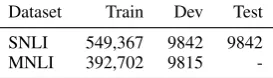
shown in Table 1. All MNLI results are on the
matched development set.2
2 MNLI has two development sets, one from the same
Dataset Train Dev Test SNLI 549,367 9842 9842 MNLI 392,702 9815
-Table 1: Statistics of training datasets. The test sets of MNLI are hosted through Kaggle competitions.
4.2 Models and Training Details
DRiFt is a general learning algorithm that works
with any biased/debiased models. Below we
describe the three key components of our ap-proaches: the learning algorithm, the biased model with its insufficient features, and the debiased model.
Learning algorithms. We compare DRiFt with MLE, as well as a simpler variant of DRiFt: in-stead of the residual fitting, we remove the ex-amples predicted correctly by the biased classi-fier and train on the rest. We call this baseline
RM, which is also conceived byGururangan et al.
(2018). MLE only trains the debiased model. Both
DRiFt and RMrely on an additional biased model
that captures potential dataset bias.
Biased models. We consider three insufficient representations that exploit various NLI dataset bi-ases reported in prior work.
HYPO is a finetuned BERT classifier that uses
only the hypothesis sentence.
CBOW is a continuous bag-of-words classifier.
Similar toMou et al.(2016), we represent both the
premise and the hypothesis as the respective sums of their word embeddings. We then concatenate the premise and the hypothesis embeddings, their difference, and their element-wise product. The final representation is passed through a one-layer fully connected network with ReLU activation.
HAND is a classifier using handcrafted features
based on error analysis in Naik et al. (2018).
Specifically, we include tokens in the hypothe-sis that are also in the premise, tokens unique to the hypothesis, Jaccard similarity between the two sentences, whether negation words (“not” and “n’t”) are included, and length difference
com-puted by |Lp Lh|
Lp+Lh where Lp andLh are numbers
of tokens in the premise and the hypothesis. We represent the overlapping and the non-overlapping tokens as the respective sums of their word embed-dings. The embeddings are then concatenated with
the dense features and passed through a one-layer fully connected network with ReLU activation.
Debiased models. We choose three high-performing models of different capability.
DA is the Decomposable Attention model
intro-duced by Parikh et al. (2016), which relies on
the interaction between words in the premise and the hypothesis. It does not use any word order information. We used the variant without
intra-sentence attention.3
ESIM is the Enhanced Sequential Inference
Model (Chen et al., 2017). It first encodes the
premise and the hypothesis by a bidirectional LSTM, aligns the contextual word embeddings
similar to Parikh et al.(2016), and uses another
“inference” bidirectional LSTM to aggregate in-formation. Thus it has access to the non-local con-text.
BERT is the Bidirectional Encoder
Representa-tions from Transformers (Devlin et al.,2019) that
recently improved performance on MNLI signifi-cantly. It uses contextual embeddings pretrained from large corpora.
Hyperparameters. For non-BERT mod-els, word embeddings are initialized with the
840B.300d pretrained GloVe (Pennington
et al., 2014) word vectors and finetuned during
training. For DA and ESIM,
hyperparame-ters of the model architecture are the same as those reported in the original papers. We finetune all BERT models from the pretrained
BERT-base-uncased model.4 We train all
models using the Adam (Kingma and Ba, 2014)
optimizer with 1 = 0.9, 2 = 0.999, L2 weight
decay of 0.01, learning rate warmup for the first
10%of updates and linear decay afterwards. We
use a dropout rate of 0.1 for all models except ESIM, which has a dropout rate of 0.5. BERT and non-BERT models are trained with a learning rate of 2e-5 and 1e-4, respectively. For MLE, we train BERT for 4 epochs and the rest for 30 epochs. When training the debiased model in DRiFt, we find that the models converge slowly thus we train BERT for 8 epochs and the rest for 80 epochs.
3 We removed the projection layers of the word
embed-dings as it speeds up training without hurting performance in our experiments.
[image:5.595.112.249.65.104.2]model
0.6 0.7 0.8 0.9 1.0
accu
racy
BERT DA ESIM
0.2 0.4 0.6 0.8
cheating rate
0.2 0.4 0.6 0.8
cheating rate
0.2 0.4 0.6 0.8
cheating rate
DRiFt-hypo MLE Rm-cheat
[image:6.595.78.524.76.232.2]method
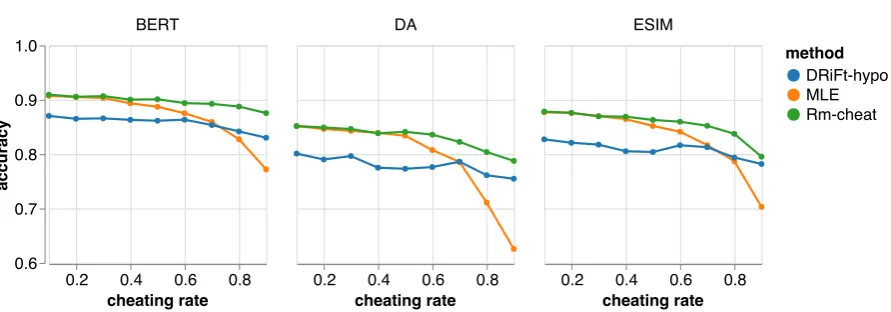
Figure 2: Accuracy on SNLI test set augmented with cheating features, which leak the groundtruth labels on training data but not on test data. Models trained by MLE degrade significantly when a majority of examples are cheatable, whereas debiased models trained by DRiFt maintain similar accuracies across different cheating rates.
4.3 In-Distribution Performance
We first evaluate the models’ in-distribution per-formance where they are trained and evaluated on splits from the same dataset. Results of the biased
models are reported in Table 2. All exceeds the
majority-class baseline by a large margin, indicat-ing that a majority of examples can be solved by superficial cues.
Results of the debiased models are reported in
Table 3. Baseline results from our
implemen-tations are comparable to prior reported perfor-mance (row “MLE”). Debiased models trained by DRiFt show some degradation on in-distribution data, especially for the less powerful DA and ESIM models. The accuracy drop is expected due to two reasons. First, DRiFt assumes distri-bution shift thus does not optimize performance
on the training distributionP. Second, the
effec-tive training data size is reduced by negaeffec-tive gra-dients on potentially biased examples; this effect
is exaggerated by RM, which shows significant
in-distribution degradation. Similar trade-off be-tween in-distribution accuracy and robustness on out-of-distribution data has also been observed in
adversarial training (Zhang et al.,2019b;Tsipras
et al.,2019).
Dataset majority HYPO CBOW HAND
SNLI 34.2 61.8 81.2 76.7 MNLI 35.4 52.5 66.1 65.4
Table 2: Accuracy of biased classifiers on SNLI test set and MNLI development set. All exceeds the majority-class baseline by a large margin, signaling dataset bias.
SNLI MNLI
BERT DA ESIM BERT DA ESIM MLE 90.8 85.3 88.0 84.5 72.2 78.1 DRiFt-HYPO 89.8 83.9 86.3 84.3 68.6 75.0
DRiFt-CBOW 84.7 62.6 62.3 82.1 56.3 68.8 DRiFt-HAND 86.5 75.0 79.2 81.7 58.8 68.9
RM-HYPO 71.2 67.0 70.3 65.5 57.5 63.0
RM-CBOW 35.8 27.1 22.2 54.9 26.8 27.1
RM-HAND 46.3 37.2 38.1 51.7 34.6 37.4
Table 3: Accuracy of models trained by MLE, DRiFt,
and RM with different biased models. Training and
test examples are from the same dataset. Intensity of
the red highlights corresponds toabsolutedrop in
ac-curacy with respect to the MLE baseline. RM
signifi-cantly hurts in-distribution performance. DRiFt main-tains reasonable performance.
4.4 Synthetic Bias
In this section, we evaluate our model under con-trolled, synthetic dataset bias on SNLI. Recall our definition of dataset bias: the conditional
distribu-tion of the label y given biased features are
dif-ferent on training and test sets. Therefore, we
in-ject bias into each example by adding acheating
featurethat encodes its label. On training and
de-velopment examples, the cheating feature encodes
the ground truth label with probabilitypcheat (the
cheating rate), and a random label otherwise. On test examples, the cheating feature always encodes a random label. Thus a model relying on the cheat-ing feature would perform poorly on the test set.
Specifically, we prepend the hypothesis with
a string “{label} and” where label 2
the fact that we often cannot pinpoint biased fea-tures until the model fails on some test examples,
we choose HYPO as our biased classifier. That is
to say, we have a rough idea that the bias might be in the hypothesis but do not know what it is ex-actly.
We train all three base models (DA, ESIM, and BERT) using MLE and DRiFt, respectively. Our
results are shown in Figure2. All MLE models are
reasonably robust to a mild amount of bias.
How-ever, when a majority (pcheat >0.6) of training
ex-amples contains the bias, their accuracy decreases
significantly: about20%drop atpcheat = 0.9
com-pared to the baseline accuracy when no cheating features are injected. BERT is slightly more robust than DA and ESIM, possibly due to the regulariza-tion effect of pretrained embeddings. In contrast,
our debiased models (DRiFt-HYPO) maintain
sim-ilar accuracies with increasing cheating rates and
have a maximum accuracy drop of about5%.
Two questions remain, though: (1) Why does the accuracy of debiased models still drop a bit at high cheating rates? (2) Why is the baseline accuracy of DRiFt lower than MLE? We answer these questions by analyzing the upper bound per-formance of our method below.
Best-case scenario. In the ideal case, we know precisely what the bias is. Consider a biased clas-sifier that only uses the cheating feature as its input. It predicts biased examples perfectly, i.e.
ps(y | b(x)) = 1andps(k |b(x)) = 0 8k 6= y, and predicts the rest unbiased examples uniformly at random. Based on our discussion at the end of
Section3.2, the biased examples have zero
ents and unbiased examples have the same gradi-ents as in MLE. In this case, our method is equiv-alent to removing biased examples and training a
classifier on the rest, i.e. RM-cheat. In Figure2,
we see that it completely dominates MLE. The
ac-curacy of RM-cheat still drops whenpcheatis large,
because there are fewer “good” examples to learn from, not due to fitting the bias. Similarly,
DRiFt-HYPO has lower overall accuracy compared to
RM-cheat, because HYPOcaptures additional
(un-biased) features that cannot be fully learned by the debiased model.
Worst-case scenario. In the extreme case when
pcheat = 1, all models’ predictions on the test set
are random guesses. For MLE, the biased fea-tures are no longer differentiable from the
gener-alizable ones, thus there is no reason not to use them. For DRiFt, since the biased model achieves perfect prediction on all training examples, the de-biased model receives zero gradient. Therefore, when strong bias presents on all examples, we need more information to correct the bias, e.g., collecting additional data or augmenting exam-ples.
method lexical subseq const
E ¬E E ¬E E ¬E
HYPO 52.6 44.4 54.5 44.3 45.6 16.7 CBOW 63.2 16.0 66.2 33.7 63.2 38.5 HAND 66.7 0.0 66.7 0.0 66.7 0.0
model: BERT
MLE 67.2 7.8 66.7 0.4 68.1 11.9 DRiFt-HYPO 84.7 79.8 69.0 23.7 72.7 40.8 DRiFt-CBOW 80.8 75.2 68.5 29.5 71.5 40.3 DRiFt-HAND 77.4 70.9 71.2 41.2 75.8 61.0 RM-HYPO 67.2 46.0 65.2 36.6 75.5 72.2 RM-CBOW 5.4 66.4 8.5 64.2 34.8 65.3 RM-HAND 10.0 66.0 4.7 66.3 9.1 67.3
model: DA
MLE 66.6 0.5 66.6 0.3 66.5 0.4 DRiFt-HYPO 66.3 1.7 66.9 5.5 66.3 8.4
DRiFt-CBOW 65.3 7.2 66.1 9.6 65.1 9.1 DRiFt-HAND 60.5 27.1 61.4 44.9 55.9 48.3
RM-HYPO 65.1 9.6 66.2 15.0 66.2 18.8
RM-CBOW 0.4 66.6 1.3 66.7 0.8 66.5
RM-HAND 10.3 65.8 8.9 65.7 13.9 64.7
model: ESIM
[image:7.595.312.517.182.555.2]MLE 65.8 3.2 67.2 4.6 65.5 2.8 DRiFt-HYPO 64.3 10.5 68.3 16.3 68.1 29.3 DRiFt-CBOW 63.2 14.4 66.8 20.1 64.9 22.7 DRiFt-HAND 61.2 19.6 63.7 39.4 64.8 48.3 RM-HYPO 63.3 12.8 64.1 24.8 71.3 46.0 RM-CBOW 4.5 65.7 6.0 65.2 16.9 63.8 RM-HAND 25.8 60.8 18.3 67.3 13.1 65.9
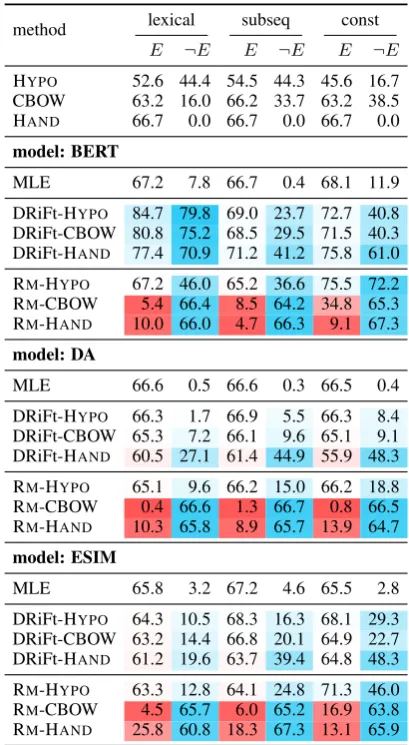
Table 4: F1 scores of the entailment (E) and
non-entailment (¬E) classes on HANS. All models are
trained on MNLI and results are shown on three subsets targeting at different biases: lexical overlap (lexical), subsequence overlap (subseq), and constituent overlap (const). Intensity of the Blue and red highlights
cor-responds toabsolute increase and decrease of scores
with respect to MLE. DRiFt significantly improves
re-sults on challenging¬Eexamples without hurting
per-formance onE, whereas RMimproves scores on¬Eat
the cost of performance onE.
4.5 Word Overlap Bias
We evaluate our method on word overlap bias
trained on MNLI largely rely on word overlap between the premise and the hypothesis to make entailment predictions. They created a challenge dataset (HANS) where premises may not entail high word-overlapping hypotheses. Specifically, a model biased by word overlap would fail on three types of non-entailment examples: (1) Lexical
overlap, e.g., “The doctor visited the lawyer.” ;
“The lawyer visited the doctor.”. (2) Subsequence,
e.g., “The senator near the lawyer danced.” ;
“The lawyer danced.”. (3) Constituent, e.g., “The
lawyers resigned, or the artist slept.” ; “The
artist slept.”.
We evaluate both biased and debiased models on the three subsets of HANS and show F1 scores
for each class in Table 4. As expected,
mod-els trained by MLE almost always predict
entail-ment (E), and thus performs poorly for the
non-entailment class (¬E). DRiFt improves
perfor-mance on¬E in all cases with little degradation
on E. In contrast, RMimproves performance on
¬Eat the cost of significant degradation onE.
Among all biased models, HANDproduces the
best debiasing results because it is designed to fit the word overlap bias, and indeed has zero recall
on¬Ewhen tested on HANS. On the contrary, the
improvement from HYPOis lower because it does
not capture any word overlap bias. Correspond-ingly, its performance drop on HANS is mini-mal compared to its in-distribution performance. Among all debiased models, BERT has the best overall performance. We hypothesize that pre-training on large data improves model robustness in addition to the debiasing effect from DRiFt.
4.6 Stress Tests
In addition to the word overlap bias exploited by HANS, there are other known biases such as
nega-tion words and sentence lengths.Naik et al.(2018)
conduct a detailed error anlaysis on MNLI and
create six stress test sets (STRESS) targeting at
each type of error. We focus on the word overlap and negation stress test sets, which expose dataset bias as opposed to model weakness according to
Liu et al.(2019). A model biased by word overlap
rate and negation words are expected to have low accuracy on the entailment class on challenge data.
The complete results are shown in AppendixA.
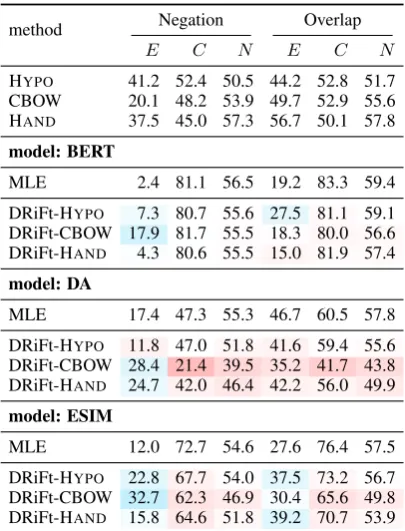
In Table5, we show the F1 scores of each class
for all models on STRESS.5 Compared to results
5Since results of RMare similar to those in Table4, we
method Negation Overlap
E C N E C N
HYPO 41.2 52.4 50.5 44.2 52.8 51.7
CBOW 20.1 48.2 53.9 49.7 52.9 55.6 HAND 37.5 45.0 57.3 56.7 50.1 57.8
model: BERT
MLE 2.4 81.1 56.5 19.2 83.3 59.4 DRiFt-HYPO 7.3 80.7 55.6 27.5 81.1 59.1
DRiFt-CBOW 17.9 81.7 55.5 18.3 80.0 56.6 DRiFt-HAND 4.3 80.6 55.5 15.0 81.9 57.4
model: DA
MLE 17.4 47.3 55.3 46.7 60.5 57.8 DRiFt-HYPO 11.8 47.0 51.8 41.6 59.4 55.6 DRiFt-CBOW 28.4 21.4 39.5 35.2 41.7 43.8 DRiFt-HAND 24.7 42.0 46.4 42.2 56.0 49.9
model: ESIM
MLE 12.0 72.7 54.6 27.6 76.4 57.5 DRiFt-HYPO 22.8 67.7 54.0 37.5 73.2 56.7
[image:8.595.314.517.61.327.2]DRiFt-CBOW 32.7 62.3 46.9 30.4 65.6 49.8 DRiFt-HAND 15.8 64.6 51.8 39.2 70.7 53.9
Table 5: F1 scores of each class on STRESS. Intensity
of the Blue and red highlights corresponds to
ab-soluteincrease and decrease of scores with respect to
MLE. DRiFt improves results onE(that exhibits label
shift) with some degradation on other classes for DA and ESIM.
on HANS, STRESS sees lower overall
improve-ment from debiasing. One reason is that STRESS
decreases word overlap rate and injects negation
words by appending distractor phrases, i.e. “true is true” and “false is not true”. While this troduces label shift on biased features, it also in-troduces covariate shift on the input. For
exam-ple, although HAND contains features designed
to use word overlap rate (Jaccard similarity) and negation words, its does not have big performance drop on the challenge data compared to its in-distribution performance, showing that that dis-tractor phrases may affect the model in other ways. While all debiased models show improvement
onE, both DA and ESIM suffer from degradation
on the other two classes, especially when trained by DRiFt-CBOW. We posit two reasons. First, while CBOW is insufficient to represent complete sentence meaning, it does encode a distribution of possible meanings. Thus models debiased by DRiFt-CBOW might discard useful information. Second, model capacity limits what is learned be-yond a BOW representation. DA shows the most
degradation since it only uses local word interac-tion, thus is essentially a BOW model. In contrast, BERT has little degradation on in-distribution ex-amples regardless of the biased classifier.
5 Related Work and Discussion
Adversarial data collection. Aside from NLI, dataset bias has been exposed on benchmarks for other NLP tasks as well, e.g., paraphrase
identification (Zhang et al., 2019c,a), story close
test (Schwartz et al., 2017), reading
comprehen-sion (Kaushik and Lipton,2018), coreference
res-olution (Zhao et al., 2018a), and visual question
answering (Agrawal et al., 2016). Most bias is
resulted from artifacts in the data selection pro-cedure and shortcuts taken by crowd workers. To systematically minimize bias during data col-lection, adversarial filtering methods (Sakaguchi
et al., 2019;Zellers et al., 2019) have been
pro-posed to discard examples predicted well by a
sim-ple classifier. This is similar to the RM baseline,
except that we apply “filtering” at training time. In general, our debiasing methods are complemen-tary to adversarial data collection methods.
Debiased representation. Our work is closely related to the line of work on removing bias in
data representations.Bolukbasi et al.(2016);Zhao
et al. (2018b) learn gender-neutral word
embed-dings by forcing certain dimensions to be free
of gender information. Similarly, Wang et al.
(2019a) construct a biased classifier and project its representation out of the model’s
representa-tion. For NLI,Belinkov et al.(2019) use
adversar-ial learning to remove hypothesis-related bias in the sentence representations. However, for some NLP applications it may not be easy to separate biased features from useful semantic representa-tions, thus we correct the conditional distribution of the class label given these biased features in-stead of removing them from the input.
Concur-rently,Clark et al.(2019) take the same approach
and further show its effectiveness on additional tasks including reading comparehension and vi-sual question answering.
Distribution shift. Covariate shift (Shimodaira,
2000;Ben-David et al.,2006) and label shift
(Lip-ton et al.,2018;Zhang et al.,2013) are two
well-studied settings under distribution shift, which
makes different assumptions on how p(x, y)
changes. However, most works in these settings
assume access to unlabeled data from the tar-get distribution. Our objective is more related to distributionally robust optimization (Duchi and
Namkoong, 2018; Hu et al., 2018), which does
not assume access to target data and optimizes the
worst-case performance underunknown, bounded
distribution shift. In contrast, we leverage prior knowledge on potential dataset bias.
Data augmentation. An effective way to tackle the challenge datasets is to train or finetune
on similar examples (McCoy et al., 2019; Liu
et al., 2019;Jia and Liang, 2017), which
explic-itly correct the training data distribution. How-ever, constructing challenge examples often rely on handcrafted rules that target a specific type of bias, e.g., swapping male and female
enti-ties (Zhao et al.,2018a,2019), synonym/antonym
substitution (Glockner et al.,2018), and syntactic
rules (McCoy et al., 2019; Ribeiro et al., 2018),
and may require human verification (Zhang et al.,
2019c;Jia and Liang,2017). Data augmentation
provides a way to encode our prior knowledge on the task, e.g., swapping genders does not affect coreference resolution result, and syntactic trans-formations may affect sentence meanings. There-fore, a related direction is to develop generic aug-mentation techniques with linguistic priors
(An-dreas,2019;Karpukhin et al.,2019).
6 Conclusion
Across all different dataset biases, the fundamen-tal problem is that the majority training examples are not representative of the real-world data dis-tribution (including the challenge data), thus min-imizing the average training loss no longer accu-rately describes our objective. In this paper, we tackle the problem by adapting the learning ob-jective to focus on examples that cannot be easily solved by biased features. We show that our de-biasing method improves model performance on
challenge data givenknowndataset bias. However,
current improvements largely rely on task-specific prior knowledge, thus an important next step is to develop more general methods that tackle different types of biases.
Acknowledgments
References
A. Agrawal, D. Batra, and D. Parikh. 2016. Analyzing the behavior of visual question answering models.
InEmpirical Methods in Natural Language
Process-ing (EMNLP).
J. Andreas. 2019. Good-enough compositional data
augmentation. arXiv.
Y. Belinkov, A. Poliak, S. M. Shieber, B. V. Durme, and A. M. Rush. 2019. Don’t take the premise for granted: Mitigating artifacts in natural language
in-ference. InAssociation for Computational
Linguis-tics (ACL).
S. Ben-David, J. Blitzer, K. Crammer, and F. Pereira. 2006. Analysis of representations for domain
adap-tation. InAdvances in Neural Information
Process-ing Systems (NeurIPS), pages 137–144.
T. Bolukbasi, K. Chang, J. Y. Zou, V. Saligrama, and A. T. Kalai. 2016. Man is to computer programmer as woman is to homemaker? debiasing word
embed-dings. InAdvances in Neural Information
Process-ing Systems (NeurIPS), pages 4349–4357.
S. Bowman, G. Angeli, C. Potts, and C. D. Manning. 2015. A large annotated corpus for learning natural
language inference. InEmpirical Methods in
Natu-ral Language Processing (EMNLP).
Q. Chen, X. Zhu, Z. Ling, S. Wei, H. Jiang, and D. Inkpen. 2017. Enhanced LSTM for natural
lan-guage inference. InAssociation for Computational
Linguistics (ACL).
C. Clark, M. Yatskar, and L. Zettlemoyer. 2019. Don’t take the easy way out: Ensemble based methods for
avoiding known dataset biases. InEmpirical
Meth-ods in Natural Language Processing (EMNLP).
J. Devlin, M. Chang, K. Lee, and K. Toutanova. 2019. Bert: Pre-training of deep bidirectional transformers
for language understanding. InNorth American
As-sociation for Computational Linguistics (NAACL).
J. Duchi and H. Namkoong. 2018. Learning models with uniform performance via distributionally robust
optimization. arXiv preprint arXiv:1810.08750.
M. Glockner, V. Shwartz, and Y. Goldberg. 2018. Breaking NLI systems with sentences that require
simple lexical inferences. InAssociation for
Com-putational Linguistics (ACL).
H. Gonen and Y. Goldberg. 2019. Lipstick on a pig: Debiasing methods cover up systematic gender bi-ases in word embeddings but do not remove them. arXiv preprint arXiv:1903.03862.
S. Gururangan, S. Swayamdipta, O. Levy, R. Schwartz, S. R. Bowman, and N. A. Smith. 2018. Annota-tion artifacts in natural language inference data. In North American Association for Computational Lin-guistics (NAACL).
W. Hu, G. Niu, I. Sato, and M. Sugiyama. 2018. Does distributionally robust supervised learning give
ro-bust classifiers? InInternational Conference on
Ma-chine Learning (ICML).
R. Jia and P. Liang. 2017. Adversarial examples for
evaluating reading comprehension systems. In
Em-pirical Methods in Natural Language Processing (EMNLP).
V. Karpukhin, O. Levy, J. Eisenstein, and
M. Ghazvininejad. 2019. Training on
syn-thetic noise improves robustness to natural noise in
machine translation. arXiv.
D. Kaushik and Z. C. Lipton. 2018. How much read-ing does readread-ing comprehension require? a
criti-cal investigation of popular benchmarks. In
Em-pirical Methods in Natural Language Processing (EMNLP).
D. Kingma and J. Ba. 2014. Adam: A method
for stochastic optimization. arXiv preprint
arXiv:1412.6980.
Z. C. Lipton, Y. Wang, and A. J. Smola. 2018. De-tecting and correcting for label shift with black box
predictors. InInternational Conference on Machine
Learning (ICML).
N. F. Liu, R. Schwartz, and N. A. Smith. 2019. Inocu-lation by fine-tuning: A method for analyzing
chal-lenge datasets. InNorth American Association for
Computational Linguistics (NAACL).
R. T. McCoy, E. Pavlick, and T. Linzen. 2019. Right for the wrong reasons: Diagnosing syntactic
heuris-tics in natural language inference. arXiv preprint
arXiv:1902.01007.
L. Mou, R. Men, G. Li, Y. Xu, L. Zhang, R. Yan, and Z. Jin. 2016. Natural language inference by
tree-based convolution and heuristic matching. In
Asso-ciation for Computational Linguistics (ACL).
A. Naik, A. Ravichander, N. Sadeh, C. Rose, and G. Neubig. 2018. Stress test evaluation for natural
language inference. InInternational Conference on
Computational Linguistics (COLING).
A. Parikh, O. T¨ackstr¨om, D. Das, and J. Uszkoreit. 2016. A decomposable attention model for natural
language inference. InEmpirical Methods in
Natu-ral Language Processing (EMNLP).
J. Pennington, R. Socher, and C. D. Manning. 2014. GloVe: Global vectors for word representation. In Empirical Methods in Natural Language Processing (EMNLP), pages 1532–1543.
A. Poliak, J. Naradowsky, A. Haldar, R. Rudinger, and B. V. Durme. 2018. Hypothesis only
base-lines in natural language inference. arXiv preprint
M. T. Ribeiro, S. Singh, and C. Guestrin. 2018. Se-mantically equivalent adversarial rules for
debug-ging NLP models. InAssociation for Computational
Linguistics (ACL).
K. Sakaguchi, R. L. Bras, C. Bhagavatula, and Y. Choi.
2019. WINOGRANDE: An adversarial
wino-grad schema challenge at scale. arXiv preprint
arXiv:1907.10641.
B. Scholkopf, D. Janzing, J. Peters, E. Sgouritsa, K. Zhang, and J. Mooij. 2012. On causal and
anti-causal learning. InInternational Conference on
Ma-chine Learning (ICML).
R. Schwartz, M. Sap, Y. Konstas, L. Zilles, Y. Choi, and N. A. Smith. 2017. The effect of different writ-ing tasks on lwrit-inguistic style: A case study of the
ROC story cloze task. In Computational Natural
Language Learning (CoNLL).
H. Shimodaira. 2000. Improving predictive inference under covariate shift by weighting the log-likelihood
function. Journal of Statistical Planning and
Infer-ence, 90:227–244.
A. Torralba and A. Efros. 2011. Unbiased look at
dataset bias. InComputer Vision and Pattern
Recog-nition (CVPR).
D. Tsipras, S. Santurkar, L. Engstrom, A. Turner, and A. Madry. 2019. Robustness may be at odds with
accuracy. InInternational Conference on Learning
Representations (ICLR).
H. Wang, Z. He, Z. C. Lipton, and E. P. Xing. 2019a. Learning robust representations by projecting
super-ficial statistics out. InInternational Conference on
Learning Representations (ICLR).
T. Wang, J. Zhao, M. Yatskar, K. Chang, and V. Or-donez. 2019b. Balanced datasets are not enough: Estimating and mitigating gender bias in deep
im-age representations. InInternational Conference on
Computer Vision (ICCV).
A. Williams, N. Nangia, and S. R. Bowman. 2017. A broad-coverage challenge corpus for sentence
understanding through inference. arXiv preprint
arXiv:1704.05426.
R. Zellers, A. Holtzman, Y. Bisk, A. Farhadi, and Y. Choi. 2019. HellaSwag: Can a machine really
finish your sentence? InAssociation for
Computa-tional Linguistics (ACL).
G. Zhang, B. Bai, J. Liang, K. Bai, S. Chang, M. Yu, C. Zhu, and T. Zhao. 2019a. Selection bias explo-rations and debias methods for natural language
sen-tence matching datasets. InAssociation for
Compu-tational Linguistics (ACL).
H. Zhang, Y. Yu, J. Jiao, E. P. Xing, L. E. Ghaoui, and M. I. Jordan. 2019b. Theoretically principled
trade-off between robustness and accuracy.arXiv preprint
arXiv:1901.08573.
K. Zhang, B. Schlkopf, K. Muandet, and Z. Wang. 2013. Domain adaptation under target and
condi-tional shift. InInternational Conference on Machine
Learning (ICML).
Y. Zhang, J. Baldridge, and L. He. 2019c. PAWS:
Para-phrase adversaries from word scrambling. InNorth
American Association for Computational Linguis-tics (NAACL).
J. Zhao, T. Wang, M. Yatskar, R. Cotterell, V. Ordonez, and K. Chang. 2019. Gender bias in contextualized
word embeddings. In North American Association
for Computational Linguistics (NAACL).
J. Zhao, T. Wang, M. Yatskar, V. Ordonez, and K. Chang. 2018a. Gender bias in coreference
reso-lution:evaluation and debiasing methods. InNorth
American Association for Computational Linguis-tics (NAACL).
J. Zhao, Y. Zhou, Z. Li, W. Wang, and K. Chang. 2018b. Learning gender-neutral word embeddings.
InEmpirical Methods in Natural Language