CD
ER: Efficient MT Evaluation Using Block Movements
Gregor Leusch and Nicola Ueffing and Hermann Ney Lehrstuhl f¨ur Informatik VI, Computer Science Department
RWTH Aachen University D-52056 Aachen, Germany
{leusch,ueffing,ney}@i6.informatik.rwth-aachen.de
Abstract
Most state-of-the-art evaluation measures for machine translation assign high costs to movements of word blocks. In many cases though such movements still result in correct or almost correct sentences. In this paper, we will present a new eval-uation measure which explicitly models block reordering as an edit operation. Our measure can be exactly calculated in quadratic time.
Furthermore, we will show how some evaluation measures can be improved by the introduction of word-dependent substitution costs. The correlation of the new measure with human judgment has been investigated systematically on two different language pairs. The experimental results will show that it significantly outperforms state-of-the-art approaches in sentence-level correlation. Results from experiments with word dependent substi-tution costs will demonstrate an additional increase of correlation between automatic evaluation measures and human judgment.
1 Introduction
Research in machine translation (MT) depends heavily on the evaluation of its results. Espe-cially for the development of an MT system, an evaluation measure is needed which reliably assesses the quality of MT output. Such a measure will help analyze the strengths and weaknesses of different translation systems or different versions of the same system by comparing output at the sentence level. In most applications of MT, understandability for humans in terms of readability as well as semantical correctness should be the evaluation criterion. But as human evaluation is tedious and cost-intensive, automatic evaluation measures are used in most MT research tasks. A high correlation between these automatic evaluation measures and human evaluation is thus desirable.
State-of-the-art measures such as BLEU (Pap-ineni et al., 2002) or NIST (Doddington, 2002) aim at measuring the translation quality rather on the document level1 than on the level of single sentences. They are thus not well-suited for sentence-level evaluation. The introduction of smoothing (Lin and Och, 2004) solves this problem only partially.
In this paper, we will present a new automatic error measure for MT – the CDER – which is designed for assessing MT quality on the sentence level. It is based on edit distance – such as the well-known word error rate (WER) – but allows for reordering of blocks. Nevertheless, by defining reordering costs, the ordering of the words in a sentence is still relevant for the measure. In this, the new measure differs significantly from the position independent error rate (PER) by (Tillmann et al., 1997). Generally, finding an optimal solution for such a reordering problem is NP hard, as is shown in (Lopresti and Tomkins, 1997). In previous work, researchers have tried to reduce the complexity, for example by restricting the possible permutations on the block-level, or by approximation or heuristics during the calculation. Nevertheless, most of the resulting algorithms still have high run times and are hardly applied in practice, or give only a rough approximation. An overview of some better-known measures can be found in Section 3.1. In contrast to this, our new measure can be calculated very efficiently. This is achieved by requiring complete and disjoint coverage of the blocks only for the reference sentence, and not for the candidate translation. We will present an algorithm which computes the new error measure in quadratic time.
The new evaluation measure will be investi-gated and compared to state-of-the-art methods on two translation tasks. The correlation with human assessment will be measured for several different statistical MT systems. We will see that the new measure significantly outperforms the existing approaches.
As a further improvement, we will introduce word dependent substitution costs. This method will be applicable to the new measure as well as to established measures like WER and PER. Starting from the observation that the substitution of a word with a similar one is likely to affect translation quality less than the substitution with a completely different word, we will show how the similarity of words can be accounted for in automatic evaluation measures.
This paper is organized as follows: In Section 2, we will present the state of the art in MT evaluation and discuss the problem of block reordering. Section 3 will introduce the new error measure CDER and will show how it can be calculated efficiently. The concept of word-dependent substitution costs will be explained in Section 4. In Section 5, experimental results on the correlation of human judgment with the CDER and other well-known evaluation measures will be presented. Section 6 will conclude the paper and give an outlook on possible future work.
2 MT Evaluation
2.1 Block Reordering and State of the Art
In MT – as opposed to other natural language processing tasks like speech recognition – there is usually more than one correct outcome of a task. In many cases, alternative translations of a sentence differ from each other mostly by the ordering of blocks of words. Consequently, an evaluation measure for MT should be able to detect and allow for block reordering. Neverthe-less, a higher “amount” of reordering between a candidate translation and a reference translation should still be reflected in a worse evaluation score. In other words, the more blocks there are to be reordered between reference and candidate sentence, the higher we want the measure to evaluate the distance between these sentences.
State-of-the-art evaluation measures for MT penalize movement of blocks rather severely: n -gram based scores such as BLEU or NIST still yield a high unigram precision if blocks are reordered. For higher-ordern-grams, though, the precision drops. As a consequence, this affects the overall score significantly. WER, which is based on Levenshtein distance, penalizes the reordering of blocks even more heavily. It measures the distance by substitution, deletion and insertion operations for each word in a relocated block. PER, on the other hand, ignores the ordering of the words in the sentences completely. This often leads to an overly optimistic assessment of translation quality.
2.2 Long Jumps
The approach we pursue in this paper is to extend the Levenshtein distance by an additional operation, namely block movement. The number of blocks in a sentence is equal to the number of gaps among the blocks plus one. Thus, the block movements can equivalently be expressed
as long jump operations that jump over the
gaps between two blocks. The costs of a long jump are constant. The blocks are read in the order of one of the sentences. These long jumps are combined with the “classical” Levenshtein edit operations, namely insertion,
deletion, substitution, and the zero-cost operation
identity. The resulting long jump distance dLJ
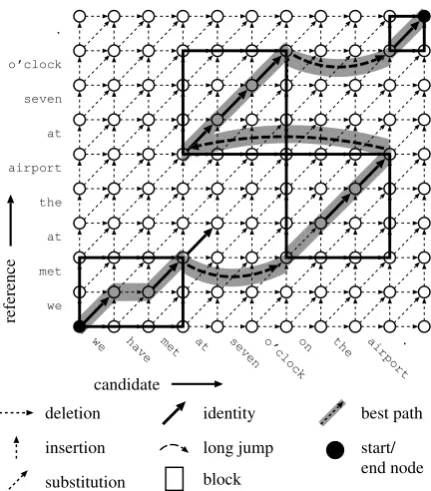
gives the minimum number of operations which are necessary to transform the candidate sentence into the reference sentence. Like the Levenshtein distance, the long jump distance can be depicted using an alignment grid as shown in Figure 1: Here, each grid point corresponds to a pair of inter-word positions in candidate and reference sentence, respectively.dLJis the minimum cost of
a path between the lower left (first) and the upper right (last) alignment grid point which covers all reference and candidate words. Deletions and insertions correspond to horizontal and vertical edges, respectively. Substitutions and identity operations correspond to diagonal edges. Edges between arbitrary grid points from the same row correspond to long jump operations. It is easy to see thatdLJis symmetrical.
In the example, the best path contains one dele-tion edge, one substitudele-tion edge, and three long jump edges. Therefore, the long jump distance between the sentences is five. In contrast, the best Levenshtein path contains one deletion edge, four identity and five consecutive substitution edges; the Levenshtein distance between the two sentences is six. The effect of reordering on the BLEU measure is even higher in this example: Whereas 8 of the 10 unigrams from the candidate sentence can be found in the reference sentence, this holds for only 4 bigrams, and 1 trigram. Not a single one of the 7 candidate four-grams occurs in the reference sentence.
3 CDER: A New Evaluation Measure
3.1 Approach
we met at the airport at seven o’clock .
we have met at seven o’clockon the airport.
candidate
reference
deletion
insertion
substitution
identity best path
start/ end node long jump
block
Figure 1: Example of a long jump alignment grid. All possible deletion, insertion, identity and substitution operations are depicted. Only long jump edges from the best path are drawn.
A possible way to achieve polynomial run-time is to restrict the number of admissible block permutations. This has been implemented by (Leusch et al., 2003) in theinversion word error rate. Alternatively, a heuristic or approximative distance can be calculated, as in GTMby (Turian et al., 2003). An implementation of both approaches at the same time can be found in TERby (Snover et al., 2005). In this paper, we will present another approach which has a suitable run-time, while still maintaining completeness of the calculated measure. The idea of the proposed method is to drop some restrictions on the alignment path.
The long jump distance as well as the Lev-enshtein distance require both reference and candidate translation to be covered completely
and disjointly. When extending the metric by
block movements, we drop this constraint for the candidate translation. That is, only the words in the reference sentence have to be covered exactly once, whereas those in the candidate sentence can be covered zero, one, or multiple times. Dropping the constraints makes an efficient computation of the distance possible. We drop the constraints for the candidate sentence and not for the reference sentence because we do not want any information contained in the reference to be omitted. Moreover, the reference translation will not contain unnecessary repetitions of blocks.
The new measure – which will be called
CDER in the following – can thus be seen as a measure oriented towardsrecall, while measures like BLEU are guided by precision. The CDER is based on the CDCD distance2 introduced in (Lopresti and Tomkins, 1997). The authors show there that the problem of finding the optimal solution can be solved in O(I2
·L) time, where I is the length of the candidate sentence and L the length of the reference sentence. Within this paper, we will refer to this distance asdCD . In
the next subsection, we will show how it can be computed inO(I·L)time using a modification of the Levenshtein algorithm.
We also studied the reverse direction of the described measure; that is, we dropped the coverage constraints for the reference sentence instead of the candidate sentence. Addition-ally, the maximum of both directions has been considered as distance measure. The results in Section 5.2 will show that the measure using the originally proposed direction has a significantly higher correlation with human evaluation than the other directions.
3.2 Algorithm
Our algorithm for calculating dCD is based
on the dynamic programming algorithm for the Levenshtein distance (Levenshtein, 1966). The Levenshtein distance dLev(e
I
1,e˜
L
1
between two strings eI
1 and e˜
L
1 can be calculated in
con-stant time if the Levenshtein distances of the substrings, dLev(e
I−1 1 ,˜e
L
1
, dLev(eI1,e˜
L−1 1
, and dLev(e
I−1 1 ,e˜
L−1 1
, are known.
Consequently, an auxiliary quantity
DLev(i, l) :=dLev e
i
1,˜e
l
1
is stored in anI×Ltable. This auxiliary quantity can then be calculated recursively fromDLev(i−
1, l), DLev(i, l − 1), and DLev(i − 1, l − 1).
Consequently, the Levenshtein distance can be calculated in timeO(I·L).
This algorithm can easily be extended for the calculation of dCD as follows: Again we define
an auxiliary quantityD(i, l)as
D(i, l) :=dCD e
i
1,˜e
l
1
Insertions, deletions, and substitutions are handled the same way as in the Levenshtein algorithm. Now assume that an optimaldCDpath
has been found: Then, each long jump edge within
2Cstands for
[image:3.595.74.290.60.306.2]...
i l
deletion insertion subst/id long jump
[image:4.595.72.290.74.141.2]l-1 i-1
Figure 2: Predecessors of a grid point (i, l) in Equation 1
this path will always start at a node with the lowest Dvalue in its row3.
Consequently, we use the following modifica-tion of the Levenshtein recursion:
D(0,0) = 0
D(i, l) = min
D(i−1, l−1) + (1−δ(ei,˜el)), D(i−1, l) + 1, D(i, l−1) + 1,
min
i0 D(i
0, l) + 1
(1)
whereδis the Kronecker delta. Figure 2 shows the possible predecessors of a grid point.
The calculation ofD(i, l)requires all values of D(i0, l) to be known, even fori0 > i. Thus, the
calculation takes three steps for eachl:
1. For eachi, calculate the minimum of the first three terms.
2. Calculatemin
i0 D(i
0, l).
3. For eachi, calculate the minimum according to Equation 1.
Each of these steps can be done in time O(I). Therefore, this algorithm calculates dCD in time
O(I·L)and spaceO(I).
3.3 Hypothesis Length and Penalties
As the CDERdoes not penalize candidate trans-lations which are too long, we studied the use of alength penalty ormiscoverage penalty. This determines the difference in sentence lengths between candidate and reference. Two definitions of such a penalty have been studied for this work.
3Proof: Assume that the long jump edge goes from(i0, l)
to (i, l), and that there exists ani00 such that D(i00, l) < D(i0, l). This means that the path from(0,0)to (i00, l)is
less expensive than the path from(0,0)to(i0, l). Thus, the
path from(0,0)through(i00, l)to(i, l)is less expensive than
the path through(i0, l). This contradicts the assumption.
Length Difference
There is always an optimaldCDalignment path
that does not contain any deletion edges, because each deletion can be replaced by a long jump, at the same costs. This is different for a dLJ path,
because here each candidate word must be covered exactly once. Assume now that the candidate sentence consists of I words and the reference sentence consists of L words, with I > L. Then, at mostL candidate words can be covered by substitution or identity edges. Therefore, the remaining candidate words (at leastI −L) must be covered by deletion edges. This means that at leastI−Ldeletion edges will be found in anydLJ
path, which leads todLJ −dCD ≥ I −Lin this
case.
Consequently, the length difference between the two sentences gives us a useful miscoverage penaltylplen:
lplen := max I −L,0
This penalty is independent of thedCD alignment
path. Thus, an optimal dCD alignment path
is optimal for dCD + lplen as well. Therefore
the search algorithm in Section 3.2 will find the optimum for this sum.
Absolute Miscoverage
Letcoverage(i) be the number of substitution, identity, and deletion edges that cover a candidate wordei in adCDpath. If we had a complete and
disjoint alignment for the candidate word (i.e., a dLJpath),coverage(i)would be1for eachi.
In general this is not the case. We can use the
absolute miscoverageas a penaltylpmiscfordCD:
lpmisc:=
X
i
|1−coverage(i)|
This miscoverage penalty is not independent of the alignment path. Consequently, the proposed search algorithm will not necessarily find an optimal solution for the sum ofdCDandlpmisc.
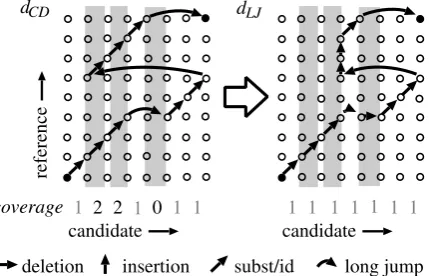
The idea behind the absolute miscoverage is that one can construct a valid – but not necessarily optimal –dLJ path from a given dCD path. This
procedure is illustrated in Figure 3 and takes place in two steps:
1. For each block of over-covered candidate words, replace the aligned substitution and/or identity edges by insertion edges; move the long jump at the beginning of the block accordingly.
candidate
reference
2 2 0 coverage
candidate
1 1 1 1 1 1 1 1 1 1 1
dCD dLJ
[image:5.595.77.292.66.204.2]deletion insertion subst/id long jump
Figure 3: Transformation of adCDpath into adLJ
path.
deletion edges; move the long jump at the beginning of the block accordingly.
This also shows that there cannot be4 a polynomial time algorithm that calculates the minimum of dCD +lpmisc for arbitrary pairs of
sentences, because this minimum is equal todLJ.
With these miscoverage penalties, inexpensive lower and upper bounds fordLJcan be calculated,
because the following inequality holds:
(2) dCD+lplen ≤ dLJ ≤ dCD+lpmisc
4 Word-dependent Substitution Costs
4.1 Idea
All automatic error measures which are based on the edit distance (i.e. WER, PER, and CDER) apply fixed costs for the substitution of words. However, this is counter-intuitive, as replacing a word with another one which has a similar meaning will rarely change the meaning of a sentence significantly. On the other hand, replacing the same word with a completely different one probably will. Therefore, it seems advisable to make substitution costs dependent on the semantical and/or syntactical dissimilarity of the words.
To avoid awkward case distinctions, we assume that a substitution cost function cSUB for two
wordse,˜emeets the following requirements:
1. cSUBdepends only oneand˜e.
2. cSUBis a metric; especially
(a) The costs are zero if e = ˜e, and larger than zero otherwise.
(b) The triangular inequation holds: it is always cheaper to replaceebye˜than to replaceebye0 and thene0 bye˜.
4
provided thatP6=N P, of course.
3. The costs of substituting a worde by e˜are always equal or lower than those of deleting eand then insertinge˜. In short,cSUB≤2.
Under these conditions the algorithms for WER and CDER can easily be modified to use word-dependent substitution costs. For example, the only necessary modification in the CDER algorithm in Equation 1 is to replace1−δ(e,e˜)
bycSUB(e,˜e).
For the PER, it is no longer possible to use a linear time algorithm in the general case. Instead, a modification of the Hungarian algorithm (Knuth, 1993) can be used.
The question is now how to define the word-dependent substitution costs. We have studied two different approaches.
4.2 Character-based Levenshtein Distance
A pragmatic approach is to compare the spelling of the words to be substituted with each other. The more similar the spelling is, the more similar we consider the words to be, and the lower we want the substitution costs between them. In English, this works well with similar tenses of the same verb, or with genitives or plurals of the same noun. Nevertheless, a similar spelling is no guarantee for a similar meaning, because prefixes such as “mis-”, “in-”, or “un-” can change the meaning of a word significantly.
An obvious way of comparing the spelling is the Levenshtein distance. Here, words are compared on character level. To normalize this distance into a range from 0 (for identical words) to 1
(for completely different words), we divide the absolute distance by the length of the Levenshtein alignment path.
4.3 Common Prefix Length
Another character-based substitution cost function we studied is based on the common prefix length of both words. In English, different tenses of the same verb share the same prefix; which is usually the stem. The same holds for different cases, numbers and genders of most nouns and adjectives. However, it does not hold if verb prefixes are changed or removed. On the other hand, the common prefix length is sensitive to critical prefixes such as “mis-” for the same reason. Consequently, the common prefix length, normalized by the average length of both words, gives a reasonable measure for the similarity of two words. To transform the normalized common prefix length into costs, this fraction is then subtracted from 1.
Table 1: Example of word-dependent substitution costs.
Levenshtein prefix
e e˜ distance substitution cost similarity substitution cost
usual unusual 2 27 = 0.29 1 1−
1
6 = 0.83
understanding misunderstanding 3 163 = 0.19 0 1.00
talk talks 1 1
5 = 0.20 4 1− 4
4.5 = 0.11
4.4 Perspectives
More sophisticated methods could be considered for word-dependent substitution costs as well. Examples of such methods are the introduction of information weights as in the NISTmeasure or the comparison of stems or synonyms, as in METEOR (Banerjee and Lavie, 2005).
5 Experimental Results
5.1 Experimental Setting
The different evaluation measures were assessed experimentally on data from the Chinese–English and the Arabic–English task of the NIST 2004 evaluation workshop (Przybocki, 2004). In this evaluation campaign, 4460 and 1735 candidate translations, respectively, generated by different research MT systems were evaluated by human judges with regard to fluency and adequacy. Four reference translations are provided for each candidate translation. Detailed corpus statistics are listed in Table 2.
For the experiments in this study, the candidate translations from these tasks were evaluated using different automatic evaluation measures. Pear-son’s correlation coefficientr between automatic evaluation and the sum of fluency and adequacy was calculated. As it could be arguable whether Pearson’sris meaningful for categorical data like human MT evaluation, we have also calculated Kendall’s correlation coefficient τ. Because of the high number of samples (= sentences, 4460) versus the low number of categories (= out-comes of adequacy+fluency, 9), we calculated τ separately for each source sentence. These experiments showed that Kendall’sτ reflects the same tendencies as Pearson’s r regarding the ranking of the evaluation measures. But only the latter allows for an efficient calculation of confidence intervals. Consequently, figures of τ are omitted in this paper.
Due to the small number of samples for eval-uation on system level (10 and 5, respectively), all correlation coefficients between automatic and human evaluation on system level are very close to 1. Therefore, they do not show any significant differences for the different evaluation
Table 2: Corpus statistics. TIDES corpora, NIST2004 evaluation.
Source language Chinese Arabic Target language English English
Sentences 446 347
Running words 13 016 10 892
Ref. translations 4 4
Avg. ref. length 29.2 31.4
Candidate systems 10 5
measures. Additional experiments on data from the NIST 2002 and 2003 workshops and from the IWSLT 2004 evaluation workshop confirm the findings from the NIST 2004 experiments; for the sake of clarity they are not included here. All correlation coefficients presented here were calculated for sentence level evaluation. For comparison with state-of-the-art evaluation measures, we have also calculated the correlation between human evaluation and WER and BLEU, which were both measures of choice in several international MT evaluation campaigns. Further-more, we included TER (Snover et al., 2005) as a recent heuristic block movement measure in some of our experiments for comparison with our measure. As the BLEU score is unsuitable for sentence level evaluation in its original definition, BLEU-S smoothing as described by (Lin and Och, 2004) is performed. Additionally, we added sentence boundary symbols for BLEU, and a different reference length calculation scheme for TER, because these changes improved the correlation between human evaluation and the two automatic measures. Details on this have been described in (Leusch et al., 2005).
5.2 CDER
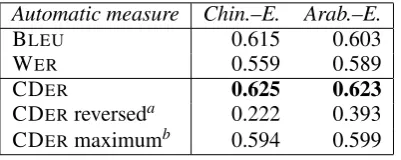
Table 3: Correlation (r) between human evalua-tion (adequacy + fluency) and automatic evalu-ation with BLEU, WER, and CDER (NIST 2004 evaluation; sentence level).
Automatic measure Chin.–E. Arab.–E.
BLEU 0.615 0.603
WER 0.559 0.589
CDER 0.625 0.623
CDERreverseda 0.222 0.393 CDERmaximumb 0.594 0.599
a
CD constraints for candidate instead of reference.
b
[image:7.595.72.266.293.359.2]Sentence-wise maximum of normal and reversed CDER
Table 4: Correlation (r) between human evalua-tion (adequacy + fluency) and automatic evalua-tion for CDERwith different penalties.
Penalty Chin.–E. Arab.–E.
− 0.625 0.623
lplen 0.581 0.567
lpmisc 0.466 0.528
(lplen+lpmisc)/2 0.534 0.557
English task. So none of these two measures is superior to the other one, but they are both outperformed by CDER.
If the direction of CDER is reversed (i.e, the CD constraints are required for the candidate instead of the reference, such that the measure hasprecisioninstead ofrecallcharacteristics), the correlation with human evaluation is much lower.
Additionally we studied the use of the maxi-mum of the distances in both directions. This has a lower correlation than taking the original CDER, as Table 3 shows. Nevertheless, the maximum still performs slightly better than BLEUand WER.
5.3 Hypothesis Length and Penalties
The problem of how to avoid a preference of overly long candidate sentences by CDERremains unsolved, as can be found in Table 4: Each of the proposed penalties infers a significant decrease of correlation between the (extended) CDER and human evaluation. Future research will aim at finding a suitable length penalty. Especially if CDER is applied in system development, such a penalty will be needed, as preliminary optimization experiments have shown.
5.4 Substitution Costs
Table 5 reveals that the inclusion of word-dependent substitution costs yields a raise by more than 1% absolute in the correlation of CDER with human evaluation. The same is true for
Table 5: Correlation (r) between human evalua-tion (adequacy + fluency) and automatic evalu-ation for WER and CDER with word-dependent substitution costs.
Measure Subst. costs Chin.–E. Arab.–E.
WER const (1) 0.559 0.589
prefix 0.571 0.605
Levenshtein 0.580 0.611
CDER const (1) 0.625 0.623
prefix 0.637 0.634
Levenshtein 0.638 0.637
WER: the correlation with human judgment is increased by about 2% absolute on both language pairs. The Levenshtein-based substitution costs are better suited for WERthan the scheme based on common prefix length. For CDER, there is hardly any difference between the two methods. Experiments on five more corpora did not give any significant evidence which of the two substitution costs correlates better with human evaluation. But as the prefix-based substitution costs improved correlation more consistently across all corpora, we employed this method in our next experiment.
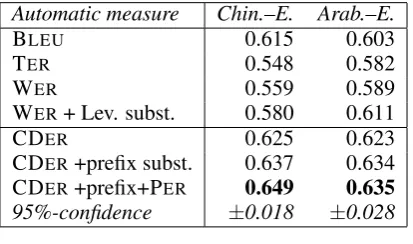
5.5 Combination of CDERand PER
An interesting topic in MT evaluation research is the question whether a linear combination of two MT evaluation measures can improve the correlation between automatic and human evalu-ation. Particularly, we expected the combination of CDER and PER to have a significantly higher correlation with human evaluation than the mea-sures alone. CDER (as opposed to PER) has the ability to reward correct local ordering, whereas PER(as opposed to CDER) penalizes overly long candidate sentences. The two measures were combined with linear interpolation. In order to determine the weights, we performed data analysis on seven different corpora. The result was consistent across all different data collections and language pairs: a linear combination of about 60% CDER and 40% PER has a significantly higher correlation with human evaluation than each of the measures alone. For the two corpora studied here, the results of the combination can be found in Table 6: On the Chinese–English task, there is an additional gain of more than 1% absolute in correlation over CDERalone. The combined error measure is the best method in both cases.
Table 6: Correlation (r) between human evalua-tion (adequacy + fluency) and automatic evalua-tion for different automatic evaluaevalua-tion measures.
Automatic measure Chin.–E. Arab.–E.
BLEU 0.615 0.603
TER 0.548 0.582
WER 0.559 0.589
WER+ Lev. subst. 0.580 0.611
CDER 0.625 0.623
CDER+prefix subst. 0.637 0.634 CDER+prefix+PER 0.649 0.635
95%-confidence ±0.018 ±0.028
and WERon both corpora.
6 Conclusion and Outlook
We presented CDER, a new automatic evalua-tion measure for MT, which is based on edit distance extended by block movements. CDER allows for reordering blocks of words at constant cost. Unlike previous block movement measures, CDER can be exactly calculated in quadratic time. Experimental evaluation on two different translation tasks shows a significantly improved correlation with human judgment in comparison with state-of-the-art measures such as BLEU.
Additionally, we showed how word-dependent substitution costs can be applied to enhance the new error measure as well as existing approaches. The highest correlation with human assessment was achieved through linear interpolation of the new CDERwith PER.
Future work will aim at finding a suitable length penalty for CDER. In addition, more sophisticated definitions of the word-dependent substitution costs will be investigated. Furthermore, it will be interesting to see how this new error measure affects system development: We expect it to allow for a better sentence-wise error analysis. For system optimization, preliminary experiments have shown the need for a suitable length penalty.
Acknowledgement
This material is partly based upon work supported by the Defense Advanced Research Projects Agency (DARPA) under Contract No. HR0011-06-C-0023, and was partly funded by the Euro-pean Union under the integrated project TC-STAR – Technology and Corpora for Speech to Speech Translation
References
S. Banerjee and A. Lavie. 2005. METEOR: An automatic metric for MT evaluation with improved correlation with human judgments. ACL Workshop on Intrinsic and Extrinsic Evaluation Measures for Machine Translation and/or Summarization, pages 65–72, Ann Arbor, MI, Jun.
G. Doddington. 2002. Automatic evaluation of machine translation quality using n-gram co-occurrence statistics. ARPA Workshop on Human Language Technology.
D. E. Knuth, 1993. The Stanford GraphBase: a platform for combinatorial computing, pages 74–87. ACM Press, New York, NY.
G. Leusch, N. Ueffing, and H. Ney. 2003. A novel string-to-string distance measure with applications to machine translation evaluation. MT Summit IX, pages 240–247, New Orleans, LA, Sep.
G. Leusch, N. Ueffing, D. Vilar, and H. Ney. 2005. Preprocessing and normalization for automatic eval-uation of machine translation. ACL Workshop on Intrinsic and Extrinsic Evaluation Measures for Machine Translation and/or Summarization, pages 17–24, Ann Arbor, MI, Jun.
V. I. Levenshtein. 1966. Binary codes capable of correcting deletions, insertions and reversals. Soviet Physics Doklady, 10(8):707–710, Feb.
C.-Y. Lin and F. J. Och. 2004. Orange: a method for evaluation automatic evaluation metrics for machine translation. COLING 2004, pages 501– 507, Geneva, Switzerland, Aug.
D. Lopresti and A. Tomkins. 1997. Block edit models for approximate string matching. Theoretical Computer Science, 181(1):159–179, Jul.
K. Papineni, S. Roukos, T. Ward, and W.-J. Zhu. 2002. BLEU: a method for automatic evaluation of machine translation. 40th Annual Meeting of the ACL, pages 311–318, Philadelphia, PA, Jul.
M. Przybocki. 2004. NIST machine translation 2004 evaluation: Summary of results. DARPA Machine Translation Evaluation Workshop, Alexandria, VA.
M. Snover, B. J. Dorr, R. Schwartz, J. Makhoul, L. Micciulla, and R. Weischedel. 2005. A study of translation error rate with targeted human annotation. Technical Report LAMP-TR-126, CS-TR-4755, UMIACS-TR-2005-58, University of Maryland, College Park, MD.
C. Tillmann, S. Vogel, H. Ney, A. Zubiaga, and H. Sawaf. 1997. Accelerated DP based search for statistical translation. European Conf. on Speech Communication and Technology, pages 2667–2670, Rhodes, Greece, Sep.
J. P. Turian, L. Shen, and I. D. Melamed. 2003. Evaluation of machine translation and its evaluation.