A Comparative Study of Reinforcement Learning Techniques on
Dialogue Management
Alexandros Papangelis NCSR ”Demokritos”, Institute of Informatics & Telecommunications
and
Univ. of Texas at Arlington, Comp. Science and Engineering
Abstract
Adaptive Dialogue Systems are rapidly be-coming part of our everyday lives. As they progress and adopt new technologies they become more intelligent and able to adapt better and faster to their environment. Re-search in this field is currently focused on how to achieve adaptation, and particularly on applying Reinforcement Learning (RL) techniques, so a comparative study of the related methods, such as this, is necessary. In this work we compare several standard and state of the art online RL algorithms that are used to train the dialogue manager in a dynamic environment, aiming to aid re-searchers / developers choose the appropri-ate RL algorithm for their system. This is the first work, to the best of our knowledge, to evaluate online RL algorithms on the di-alogue problem and in a dynamic environ-ment.
1 Introduction
Dialogue Systems (DS) are systems that are able to make natural conversation with their users. There are many types of DS that serve various aims, from hotel and flight booking to provid-ing information or keepprovid-ing company and formprovid-ing long term relationships with the users. Other in-teresting types of DS are tutorial systems, whose goal is to teach something new, persuasive sys-tems whose goal is to affect the user’s attitude to-wards something through casual conversation and rehabilitation systems that aim at engaging pa-tients to various activities that help their rehabili-tation process. DS that incorporate adaprehabili-tation to their environment are called Adaptive Dialogue Systems (ADS). Over the past few years ADS
have seen a lot of progress and have attracted the research community’s and industry’s interest.
There is a number of available ADS, apply-ing state of the art techniques for adaptation and learning, such as the one presented by Young et al., (2010), where the authors propose an ADS that provides tourist information in a fictitious town. Their system is trained using RL and some clever state compression techniques to make it scalable, it is robust to noise and able to recover from errors (misunderstandings). Cuay´ahuitl et al. (2010) propose a travel planning ADS, that is able to learn dialogue policies using RL, building on top of existing handcrafted policies. This en-ables the designers of the system to provide prior knowledge and the system can then learn the de-tails. Konstantopoulos (2010) proposes an affec-tive ADS which serves as a museum guide. It is able to adapt to each user’s personality by assess-ing his / her emotional state and current mood and also adapt its output to the user’s expertise level. The system itself has an emotional state that is af-fected by the user and affects its output.
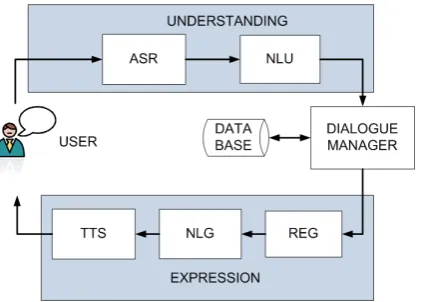
An example ADS architecture is depicted in Figure 1, where we can see several components trying to understand the user’s utterance and sev-eral others trying to express the system’s re-sponse. The system first attempts to convert spo-ken input to text using the Automatic Speech Recognition (ASR) component and then tries to infer the meaning using the Natural Language Un-derstanding (NLU) component. At the core lies the Dialogue Manager (DM), a component re-sponsible for understanding what the user’s utter-ance means and deciding which action to take that will lead to achieving his / her goals. The DM may also take into account contextual information
Figure 1: Example architecture of an ADS.
or historical data before making a decision. After the system has decided what to say, it uses the Referring Expression Generation (REG) compo-nent to create appropriate referring expressions, the Natural Language Generation (NLG) compo-nent to create the textual form of the output and last, the Text To Speech (TTS) component to con-vert the text to spoken output.
Trying to make ADS as human-like as possi-ble researchers have focused on techniques that achieve adaptation, i.e. adjust to the current user’s personality, behaviour, mood, needs and to the environment in general. Examples include adap-tive or trainable NLG (Rieser and Lemon, 2009), where the authors formulate their problem as a statistical planning problem and use RL to find a policy according to which the system will de-cide how to present information. Another exam-ple is adaptive REG (Janarthanam and Lemon, 2009), where the authors again use RL to choose one of three strategies (jargon, tutorial, descrip-tive) according to the user’s expertise level. An example of adaptive TTS is the work of Boidin et al. (2009), where the authors propose a model that sorts paraphrases with respect to predictions of which sounds more natural. Jurˇc´ıˇcek et al. (2010) propose a RL algorithm to optimize ADS parameters in general. Last, many researchers have used RL to achieve adaptive Dialogue Man-agement (Pietquin and Hastie, 2011; Gaˇsi´c et al., 2010; Cuay´ahuitl et al., 2010).
As the reader may have noticed, the current trend in training these components is the appli-cation of RL techniques. RL is a well established field of artificial intelligence and provides us with robust frameworks that are able to deal with
un-certainty and can scale to real world problems. One sub category of RL is Online RL where the system can be trained on the fly, as it interacts with its environment. These techniques have re-cently begun to be applied to Dialogue Manage-ment and in this paper we perform an extensive evaluation of several standard and state of the art Online RL techniques on a generic dialogue prob-lem. Our experiments were conducted with user simulations, with or without noise and using a model that is able to alter the user’s needs at any given point. We were thus able to see how well each algorithm adapted to minor (noise / uncer-tainty) or major (change in user needs) changes in the environment.
In general, RL algorithms fall in two cate-gories, planning and learning algorithms. Plan-ning or model-based algorithms use traiPlan-ning ex-amples from previous interactions with the envi-ronment as well as a model of the envienvi-ronment that simulates interactions. Learning or model-free algorithms only use training examples from previous interactions with the environment and that is the main difference of these two categories, according to Sutton and Barto, (1998). The goal of an RL algorithm is to learn a good policy (or strategy) that dictates how the system should in-teract with the environment. An algorithm then can follow a specific policy (i.e. interact with the environment in a specific, maybe predefined, way) while searching for a good policy. This way of learning is called “off policy” learning. The op-posite is “on policy” learning, when the algorithm follows the policy that it is trying to learn. This will become clear in section 2.2 where we pro-vide the basics of RL. Last, these algorithms can be categorized as policy iteration or value itera-tion algorithms, according to the way they evalu-ate and train a policy.
Table 1 shows the algorithms we evaluated along with some of their characteristics. We se-lected representative algorithms for each category and used the Dyna architecture (Sutton and Barto, 1998) to implement model based algorithms.
enough memory), as also supported by our results in section 5. Least Squares SARSA(λ) (Chen and Wei, 2008) is a variation of SARSA(λ) that uses the least squares method to find the optimal pol-icy. Incremental Actor Critic (IAC) (Bhatnagar et al., 2007) and Natural Actor Critic (NAC) (Pe-ters et al., 2005) are actor - critic algorithms that follow the expected rewards gradient and the nat-ural or Fisher Information gradient respectively (Szepesv´ari, 2010).
An important attribute of many learning algo-rithms is function approximation which allows them to scale to real world problems. Function approximation attempts to approximate a target function by selecting from a class of functions that closely resembles the target. Care must be taken however, when applying this method, be-cause many RL algorithms are not guaranteed to converge when using function approximation. On the other hand, policy gradient algorithms (algo-rithms that perform gradient ascend/descend on a performance surface), such as NAC or Natural Actor Belief Critic (Jurˇc´ıˇcek et al., 2010) have good guarantees for convergence, even if we use function approximation (Bhatnagar et al., 2007).
Algorithm Model Policy Iteration SARSA(λ) No On Value LS-SARSA(λ) No On Policy
Q Learning No Off Value
Q(λ) No Off Value
Actor Critic - QV No On Policy
IAC No On Policy
NAC No On Policy
DynaSARSA(λ) Yes On Value
DynaQ Yes Off Value
DynaQ(λ) Yes Off Value DynaAC-QV Yes On Policy Table 1: Online RL algorithms used in our
evaluation.
While there is a significant amount of work in evaluating RL algorithms, this is the first attempt, to the best of our knowledge, to evaluate online learning RL algorithms on the dialogue manage-ment problem, in the presence of uncertainty and changes in the environment.
Atkeson and Santamaria (1997) evaluate model based and model free algorithms on the single pendulum swingup problem but their algorithms are not the ones we have selected and the prob-lem on which they were evaluated differs from
ours in many ways. Ross et al. (2008) com-pare many online planning algorithms for solving Partially Observable Markov Decision Processes (POMDP). It is a comprehensive study but not di-rectly related to ours, as we model our problem with Markov Decision Processes (MDP) and eval-uate model-based and model-free algorithms on a specific task.
In the next section we provide some back-ground knowledge on MDPs and RL techniques, in section 3 we present our proposed formulation of the slot filling dialogue problem, in section 4 we describe our experimental setup and results, in section 5 we discuss those results and in section 6 we conclude this study.
2 Background
In order to fully understand the concepts dis-cussed in this work we will briefly introduce MDP and RL and explain how these techniques can be applied to the dialogue policy learning problem.
2.1 Markov Decision Process
A MDP is defined as a tripletM = {X, A, P}, whereX is a non empty set of states,Ais a non empty set of actions andPis a transition probabil-ity kernel that assigns probabilprobabil-ity measures over X×Rfor each state-action pair(x, a)∈X×A. We can also define the state transition probabil-ity kernel Pt that for each triplet (x1, a, x2) ∈
X × A ×X would give us the probability of moving from statex1to statex2 by taking action a. Each transition from a state to another is as-sociated with an immediate reward, the expected value of which is called the reward function and is defined asR(x, a) =E[r(x, a)], wherer(x, a)
is the immediate reward the system receives after taking action a(Szepesv´ari, 2010). An episodic MDP is defined as an MDP with terminal states, Xt+s =x,∀s >1. We consider an episode over
when a terminal state is reached.
2.2 Reinforcement Learning
policies and thus maximize user satisfaction. An-other benefit of RL is that it can be trained using either real or simulated users and continue to learn and adapt with each interaction (in the case of on-line learning). To use RL we need to model the dialogue system using MDPs, POMDPs or Semi Markov Desicion Processes (SMDP). POMDPs take uncertainty into account and model each state with a distribution that represents our belief that the system is in a specific state. SMDPs add tem-poral abstraction to the model and allow for time consuming operations. We, however, do not deal with either of those in an attempt to keep the prob-lem simple and focus on the task of comparing the algorithms.
More formally, RL tries to maximize an objec-tive function by learning how to control the ac-tions of a system. A system in this setting is typ-ically formulated as an MDP. As we discussed in section 2.1 for every MDP we can define a pol-icyπ, which is a mapping from statesx ∈Xand actionsα∈Ato a distributionπ(x, α)that repre-sents the probability of taking actionα when the system is in statex. This policy dictates the be-haviour of the system. To estimate how good a policy is we define thevalue functionV:
Vπ(x) =E[
∞
X
t=0
γtRt+1|x0 =x], x∈X (1)
which gives us the expected cumulative rewards when beginning from statexand following policy π, discounted by a factorγ ∈ [0,1]that models the importance of future rewards. We define the
returnof a policyπas:
Jπ =
∞
X
t=0
γtRt(xt, π(xt)) (2)
A policyπ is optimal ifJπ(x) =Vπ(x),∀x∈ X. We can also define theaction-value function
Q:
Qπ(x, α) =E[
∞
X
t=0
γtRt+1|x0 =x, a0 =α] (3)
where x ∈ X, α ∈ A, which gives us the ex-pected cumulative discounted rewards when be-ginning from state x and taking action α, again following policy π. Note that Vmax = r1max−γ,
whereR(x)∈[rmin, rmax].
The goal of RL therefore is to find the optimal policy, which maximizes either of these functions (Szepesv´ari, 2010).
3 Slot Filling Problem
We formulated the problem as a generic slot fill-ing ADS, represented as an MDP. This model has been proposed in (Papangelis et al., 2012), and we extend it here to account for uncertainty. Formally the problem is defined as: S =< s0, ..., sN >∈
M, M =M0×M1×...×MN, Mi ={1, ..., Ti},
whereS are theN slots to be filled, each slotsi
can take values fromMi andTi is the number of
available values slotsi can be filled with.
Dia-logue state is also defined as a vector d ∈ M, where each dimension corresponds to a slot and its value corresponds to the slot’s value. We call the set of all possible dialogue statesD. System actions A ∈ {1, ...,|S|} are defined as requests for slots to be filled andai requests slot si. At
each dialogue statediwe define a set of available
actionsa˜i ⊂ A. A user queryq ⊂ S is defined
as the slots that need to be filled so that the sys-tem will be able to accurately provide an answer. We assume actionaNalways meansGive Answer.
The reward function is defined as:
R(d, a) =
−1, if a6=aN
−100, if a=aN,∃qi|qi =∅
0, if a=aN,¬∃qi|qi=∅
(4) Thus, the optimal reward for each problem is−|q| since|q|<|S|.
Available actions for every state can be mod-elled as a matrixA˜∈ {0,1}|D|×|A|, where:
˜
Aij =
(
1, if aj ∈a˜i
0, if aj 6∈a˜i
(5)
When designing A˜ one must keep in mind that the optimal solution depends on A˜’s structure and must take care not to create an unsolvable problem, i.e. a disconnected MDP. This can be avoided by making sure that each action is avail-able at some state and that each state has at least one available action. We should now define the necessary conditions for the slot filling problem to be solvable and the optimal reward be as de-fined before:
∃α˜ij = 1, 1< j <|A|,∀i (7)
Note thatj >1sinced1 is our starting state. We also allowGive Answer(which isaN) to be
avail-able from any state:
˜
Ai,N = 1, 1≤i≤ |D| (8)
We define available action density to be the ra-tio of1s over the number of elements ofA˜:
Density= |{(i, j)|A˜ij = 1}|
|D| × |A|
We can now incorporate uncertainty in our model. Rather than allowing deterministic transi-tions from a state to another we define a distribu-tion Pt(dj|di, am) which models the probability
by which the system will go from state di to dj
when taking actionam. Consequently, when the
system takes actionamfrom statedi, it transits to
statedkwith probability:
Pt(dk|di, am) =
Pt(dj|di, am), k=j
1−Pt(dj|di,am)
|D|−1 , k6=j (9) assuming that under no noise conditions action amwould move the system from statedito state
dj. The probability of not transiting to state dj
is uniformly distributed among all other states. Pt(dj|di, am) is updated after each episode with
a small additive noise ν, mainly to model unde-sirable or unforeseen effects of actions. Another distribution,Pc(sj = 1)∈[0,1], models our
con-fidence level that slotsjis filled:
sj =
(
1, Pc(sj = 1)≥0.5
0, Pc(sj = 1)<0.5
(10)
In our evaluationPc(sj)is a random number
be-tween[1−,1]where models the level of un-certainty. Last, we can slightly alterA˜after each episode to model changes or faults in the avail-able actions for each state, but we did not in our experiments.
The algorithms selected for this evaluation are then called to solve this problem online and find an optimal policy π? that will yield the highest possible reward.
Algorithm α β γ λ
SARSA(λ) 0.95 - 0.55 0.4 LS-SARSA(λ) 0.95 - 0.55 0.4 Q Learning 0.8 - 0.8
-Q(λ) 0.8 - 0.8 0.05 Actor Critic - QV 0.9 0.25 0.75
-IAC 0.9 0.25 0.75 -NAC 0.9 0.25 0.75 -DynaSARSA(λ) 0.95 - 0.25 0.25
DynaQ 0.8 - 0.4
-DynaQ(λ) 0.8 - 0.4 0.05 DynaAC-QV 0.9 0.05 0.75
-Table 2: Optimized parameter values.
4 Experimental Setup
Our main goal was to evaluate how each algo-rithm behaves in the following situations:
• The system needs to adapt to a noise free en-vironment.
• The system needs to adapt to a noisy envi-ronment.
• There is a change in the environment and the system needs to adapt.
To ensure each algorithm performed to the best of its capabilities we tuned each one’s parameters in an exhaustive manner. Table 2 shows the pa-rameter values selected for each algorithm. The parameterin-greedy strategies was set to 0.01 and model-based algorithms trained their model for 15 iterations after each interaction with the environment. Learning ratesαandβ and explo-ration parameter decayed as the episodes pro-gressed to allow better stability.
At each episode the algorithms need enough it-erations to explore the state space. At the initial stages of learning, though, it is possible that some algorithms fall into loops and require a very large number of iterations before reaching a terminal state. It would not hurt then if we bound the num-ber of iterations to a reasonable limit, provided it allows enough “negative” rewards to be accumu-lated when following a “bad” direction. In our evaluation the algorithms were allowed2|D| iter-ations, ensuring enough steps for exploration but not allowing “bad” directions to be followed for too long.
times on a slot filling problem with 6 slots, 6 ac-tions and 300 episodes. The average reward over a high number of episodes indicates how stable each algorithm is after convergence. User queryq was set to be{s1, ..., s5}and there was no noise in the environment, meaning that the action of querying a slot deterministically gets the system into a state where that slot is filled. This can be formulated as: Pt(dj|di, am) = 1,Pc(sj) = 1∀j,
ν = 0andA˜i,j = 1,∀i, j.
To evaluate the algorithms’ performance in the presence of uncertainty we run each for 100 times, on the same slot filling problem but with Pt(dj|di, am) ∈ [1−,1], with varying and
available action density values. At each run, each algorithm was evaluated using the same transition probabilities and available actions. To assess how the algorithms respond to environmental changes we conducted a similar but noise free experiment, where after a certain number of episodes the query q was changed. Remember thatq models the re-quired information for the system to be able to an-swer with some degree of certainty, so changingq corresponds to requiring different slots to be filled by the user. For this experiment we randomly gen-erated two queries of approximately 65% of the number of slots. The algorithms then needed to learn a policy for the first query and then adapt to the second, when the change occurs. This could, for example, model scenarios where hotel booking becomes unavailable or some airports are closed, in a travel planning ADS. Last, we evalu-ated each algorithm’s scalability, by running each for 100 times on various slot filling problems, be-ginning with a problem with 4 slots and 4 actions up to a problem with 8 slots and 8 actions. We measured the return averaged over the 100 runs each algorithm achieved.
Despite many notable efforts, a standardized evaluation framework for ADS or DS is still con-sidered an open question by the research commu-nity. The work in (Pietquin and Hastie, 2011) provides a very good survey of current techniques that evaluate several aspects of Dialogue Systems. When RL is applied, researchers typically use the reward function as a metric of performance. This will be our evaluation metric as well, since it is common across all algorithms. As defined in section 2.3, it penalizes attempts to answer the user’s query with incomplete information as well as lengthy dialogues.
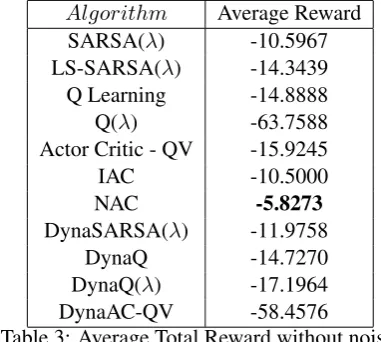
Algorithm Average Reward SARSA(λ) -10.5967 LS-SARSA(λ) -14.3439 Q Learning -14.8888 Q(λ) -63.7588 Actor Critic - QV -15.9245
IAC -10.5000
NAC -5.8273
DynaSARSA(λ) -11.9758 DynaQ -14.7270 DynaQ(λ) -17.1964 DynaAC-QV -58.4576
Table 3: Average Total Reward without noise.
As mentioned earlier in the text we opted for user simulations for our evaluation experiments instead of real users. This method has a number of advantages, for example the fact that we can very quickly generate huge numbers of training exam-ples. One might suggest that since the system is targeted to real users it might not perform as well when trained using simulations. However, as can be seen from our results, there are online algo-rithms, such as NAC or SARSA(λ), that can adapt well to environmental changes, so it is reasonable to expect such a system to adapt to a real user even if trained using simulations. We can now present the results of our evaluation, as described above and in the next section we will provide insight on the algorithms’ behaviour on each experiment.
Alg. E1 E2 E3 E4
S(λ) -7.998 -13.94 -23.68 -30.01 LSS -9.385 -12.34 -25.67 -32.33 Q -6.492 -15.71 -23.36 -30.56 Q(λ) -22.44 -23.27 -27.04 -29.37 AC -8.648 -17.91 -32.14 -38.46 IAC -6.680 -18.58 -33.60 -35.39
NAC -3.090 -9.142 -19.46 -21.33
DS(λ) -8.108 -15.61 -38.22 -41.90 DQ -6.390 -13.04 -23.64 -28.69 DQ(λ) -16.04 -17.33 -39.20 -38.42 DAC -28.39 -32.25 -44.26 -45.01 Table 4: Average Total Reward with noise.
[image:6.595.310.501.72.243.2]4.1 Average reward without noise
answer when all slots are filled. The optimal re-ward in this case was−5. Remember that during the early stages of training the algorithms receive suboptimal rewards until they converge to the op-timal policy that yieldsJπ∗ =−5. The sum of re-wards an algorithm received for each episode then can give us a rough idea of how quickly it con-verged and how stable it is. Clearly NAC outper-forms all other algorithms with an average reward of−5.8273showing it converges early and is sta-ble from then on. Note that the differences in per-formance are statistically significant except be-tween LS-SARSA(λ), DynaSARSA(λ) and Dy-naQ Learning.
[image:7.595.322.492.250.431.2]4.2 Average reward with noise
Table 4 shows results from four similar exper-iments (E1, E2, E3 and E4), with 4 slots, 4 actions, q = {s1, s2, s3} and 100 episodes but in the presence of noise. For E1 we set Pt(dj|di, am) = 1 and Density to 1, for E2 we
setPt(dj|di, am) = 0.8and Density to0.95, for
E3 we set Pt(dj|di, am) = 0.6 and Density to
0.9 and for E4 we set Pt(dj|di, am) = 0.4 and
Density to 0.8. After each episode we added a small noiseν ∈ [−0.05,0.05]toPt(·).
Remem-ber that each algorithm run for 2|D| iterations (32 in this case) for each episode, so an aver-age lower than −32 indicates slow convergence or even that the algorithm oscillates. In E1, since there are few slots and no uncertainty, most algo-rithms, except for IAC, NAC and Q(λ) converge quickly and have statistically insignificant differ-ences with each other. In E2 we have less pairs with statistically insignificant differences, and in E3 and E4 we only have the ones mentioned in the previous section. As we can see, NAC han-dles uncertainty better, by a considerable margin, than the rest algorithms. Note here that Q(λ) con-verges late while Q Learning, Dyna Q Learning, SARSA(λ) AC-QV and Dyna SARSA(λ) oscil-late a lot in the presence of noise. The optimal reward is−3, so it is evident that most algorithms cannot handle uncertainty well.
4.3 Response to change
In this experiment we let each algorithm run for 500 episodes in a problem with 6 slots and 6 actions. We generated two queries, q1 and q2, consisting of 4 slots each, and begun the algo-rithms with q1. After 300 episodes the query
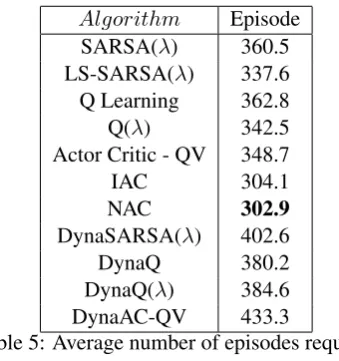
was changed to q2 and the algorithms were al-lowed another 200 episodes to converge. Table 5 shows the episode at which, on average, each algorithm converged after the change (after the
300th episode). Note here that the learning rates αandβwere reset at the point of change. Differ-ences in performance, with respect to the average reward collected during this experiment are statis-tically significant, except between SARSA(λ), Q Learning and DynaQ(λ). We can see that NAC converges only after 3 episodes on average, with IAC converging after 4. All other algorithms re-quire many more episodes, from about 38 to 134.
Algorithm Episode SARSA(λ) 360.5 LS-SARSA(λ) 337.6 Q Learning 362.8 Q(λ) 342.5 Actor Critic - QV 348.7
IAC 304.1
NAC 302.9
DynaSARSA(λ) 402.6
DynaQ 380.2
DynaQ(λ) 384.6 DynaAC-QV 433.3
Table 5: Average number of episodes required for convergence after the change.
4.4 Convergence Speed
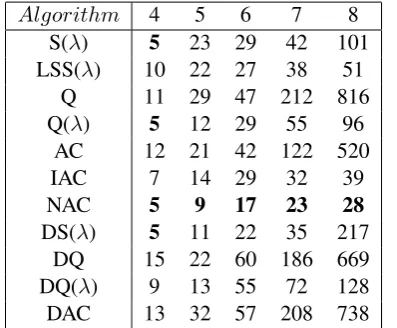
To assess the algorithms’ convergence speed we run each algorithm 100 times for problems of “di-mension” 4 to 8 (i.e. 4 slots and 4 actions, 5 slots and 5 actions and so on). We then marked the episode at which each algorithm had converged and averaged it over the 100 runs. Table 6 shows the results. It is important to note here that LS-SARSA, IAC and NAC use function approxima-tion while the rest algorithms do not. We, how-ever, assume that we have enough memory for problems up to 8 slots and 8 actions and are only interested in how many episodes it takes each algorithm to converge, on average. The results show how scalable the algorithms are with respect to computational power.
converge compared to simpler algorithms (eg Q Learning) who might require more episodes but each episode is completed faster.
Algorithm 4 5 6 7 8
S(λ) 5 23 29 42 101 LSS(λ) 10 22 27 38 51
Q 11 29 47 212 816 Q(λ) 5 12 29 55 96
AC 12 21 42 122 520
IAC 7 14 29 32 39
NAC 5 9 17 23 28
[image:8.595.83.282.118.282.2]DS(λ) 5 11 22 35 217 DQ 15 22 60 186 669 DQ(λ) 9 13 55 72 128 DAC 13 32 57 208 738 Table 6: Average number of episodes required for convergence on various problem dimensions.
5 Discussion
SARSA(λ) performed almost equally to IAC at the experiment with deterministic transitions but did not react well to the change in q. As we can see in Table 6, SARSA(λ) generally con-verges at around episode 29 for a problem with 6 slots and 6 actions, therefore the 61 episodes it takes it to adapt to change are somewhat many. This could be due to the fact that SARSA(λ) uses eligibility traces which means that past state - ac-tion pairs still contribute to the updates, so even if the learning rateα is reset immediately after the change to allow faster convergence, it seems not enough. It might be possible though to come up with a strategy and deal with this type of situa-tion, for example zero out all traces as well as re-settingα. SARSA(λ) performs above average in the presence of noise in this particular problem.
LS-SARSA(λ) practically is SARSA(λ) with function approximation. While this gives the ad-vantage of requiring less memory, it converges a little slower than SARSA(λ) in the presence of noise or in noise free environments and it needs more episodes to converge as the size of the prob-lem grows. It does, however, react better to changes in the user’s goals, since it requires 38 episodes to converge after the change, compared to 27 it normally needs as we can see in Table 6.
Q Learning exhibits similar behaviour with the only difference that it converges a little later. Again it takes many episodes to converge after the
change in the environment (compared to the 47 that it needs initially). This could be explained by the fact that Q Learning only updates one row of Q(x, a)at each iteration, thus needing more itera-tions forQ(x, a)to reflect expected rewards in the new environment. Like SARSA(λ), Q Learning is able to deal with uncertainty well enough on the dialogue task in the given time, but does not scale well.
Q(λ) , quite opposite from SARSA(λ) and Q Learning, is the slowest to initially converge, but handles changes in the environment much better. In Q(λ) the update of Q(x, a) is (very roughly) based on the difference of Q(x, a0) − Q(x, a∗)
where a∗ is the best possible action the algo-rithm can take, whereas in SARSA(λ) the update is (again roughly) based on Q(x, a0)−Q(x, a). Also, in Q(λ) eligibility traces become zero if the selected action is not the best possible. These two reasons help obsolete information inQ(x, a) be quickly updated. While it performs worse in the presence of uncertainty, the average reward does not drop as steeply as for the rest algorithms.
AC-QV converges better than average, com-pared to the other algorithms, and seems to cope well with changes in the environment. While it needs 42 episodes, on average, to converge for a problem of 6 slots and 6 actions, it only needs around 49 episodes to converge again af-ter a change. Unlike SARSA(λ) and Q(λ) it does not have eligibility traces to delay the update of Q(x, a) (or P(x, a) for Preferences in this case, see (Wiering and Van Hasselt, 2009)) while it also keeps track ofV(x). The updates are then based on the difference of P(x, a) and V(x) which, from our results, seems to make this algorithm be-have better in a dynamic environment. AC-QV also cannot cope with uncertainty very well on this problem.
affect the distribution of state the system visits (IAC and NAC perform gradient ascend in the space of policies rather than in parameter space (Szepesv´ari, 2010)). Policy gradient methods in general seem to converge rapidly, as supported by results of Sutton et al. (2000) or Konda and Tsit-siklis (2001) for example.
NAC , as expected, performs better than any other algorithm in all settings. It not only con-verges in very few episodes but is also very robust to noise and changes in the environment. Follow-ing the natural gradient has proven to be much more efficient than simply using the gradient of the expected rewards. There are many positive examples of NAC performance (or following the natural gradient in general), such as (Bagnell and Schneider, 2003; Peters et al., 2005) and this work is one of them.
Dyna Algorithms except for Dyna
SARSA(λ), seem to perform worse than av-erage on the deterministic problem. In the presence of changes, none of them seems to perform very well. These algorithms use a model of the environment to update Q(x, a) or P(x, a), meaning that after each interaction with the environment they perform several iterations using simulated triplets(x, a, r). In the presence of changes this results in obsolete information being reused again and again until sufficient real interactions with the environment occur and the model is updated as well. This is possibly the main reason why each Dyna algorithm requires more episodes after the change than its corre-sponding learning algorithm. Dyna Q Learning only updates a single entry of Q(x, a) at each simulated iteration, which could explain why noise does not corrupt Q(x, a) too much and why this algorithm performs well in the presence of uncertainty. Noise in this case is added at a single entry of Q(x, a), rather than to the whole matrix, at each iteration. Dyna SARSA(λ) and Dyna Q(λ) handle noise slightly better than Dyna AC-QV.
6 Concluding Remarks
NAC proved to be the best algorithm in our eval-uation. It is, however, much more complex to im-plement and run and thus each episode takes more (absolute) time to complete. One might suggest then that a lighter algorithm such as SARSA(λ)
will have the opportunity to run more iterations in the same absolute time. One should definitely take this into account when designing a real world system, when timely responses are necessary and resources are limited as, for example, in a mobile system. Note that SARSA(λ), Q-Learning, Q(λ) and AC-QV are significantly faster than the rest algorithms.
On the other hand, all algorithms except for NAC, IAC and LS-SARSA have the major draw-back of the size of the table representingQ(x, a)
orP(x, a)that is needed to store state-action val-ues. This is a disadvantage that practically pro-hibits the use of these algorithms in high dimen-sional or continuous problems. Function approxi-mation might alleviate this problem, according to Bertsekas (2007), if we reformulate the problem and reduce control space while increasing state space. In such a setting function approximation performs well, while in general it cannot deal with large control spaces. It becomes very expensive as computation cost grows exponentially on the size of the lookahead horizon. Also, according to Sutton and Barto (1998) and Sutton et al. (2000), better convergence guarantees exist for online al-gorithms when combined with function approx-imation or for policy gradient methods (such as IAC or NAC) in general. Finally, one must take great care when selecting features to approximate Q(x, a) or V(x) as they are important to con-vergence and speed of the algorithm (Allen and Fritzsche, 2011; Bertsekas, 2007).
To summarize, NAC outperforms the other al-gorithms in every experiment we conducted. It does require a lot of computational power though and might not be suitable if it is limited. On the other hand, SARSA(λ) or Q Learning per-form well enough while requiring less computa-tional power but a lot more memory space. The researcher / developer then must make his / her choice between them taking into account such practical limitations.
References
Allen, M., Fritzsche, P., 2011, Reinforcement Learn-ing with Adaptive Kanerva EncodLearn-ing for Xpilot Game AI, Annual Congress on Evolutionary Com-putation, pp 1521–1528.
Atkeson, C.G., Santamaria, J.C., 1997,A comparison of direct and model-based reinforcement learning, IEEE Robotics and Automation, pp 3557–3564. Bagnell, J., Schneider, J., 2003, Covariant
pol-icy search, Proceedings of the Eighteenth Interna-tional Joint Conference on Artificial Intelligence, pp 1019–1024.
Bertsekas D.P., 2007, Dynamic Programming and Optimal Control, Athena Scientific, vol 2, 3rd edi-tion.
Bhatnagar, S, Sutton, R.S., Ghavamzadeh, M., Lee, M. 2007, Incremental Natural Actor-Critic Algo-rithms, Neural Information Processing Systems, pp 105–112.
Bohus, D., Rudnicky, A.I., 2009, The RavenClaw di-alog management framework: Architecture and sys-tems, Computer Speech & Language, vol 23:3, pp 332-361.
Boidin, C., Rieser, V., Van Der Plas, L., Lemon, O., and Chevelu, J. 2009, Predicting how it sounds: Re-ranking dialogue prompts based on TTS qual-ity for adaptive Spoken Dialogue Systems, Pro-ceedings of the Interspeech Special Session Ma-chine Learning for Adaptivity in Spoken Dialogue, pp 2487–2490.
Chen, S-L., Wei, Y-M. 2008, Least-Squares SARSA(Lambda) Algorithms for Reinforcement Learning, Natural Computation, 2008. ICNC ’08, vol.2, pp 632–636.
Cuay´ahuitl, H., Renals, S., Lemon, O., Shimodaira, H. 2010, Evaluation of a hierarchical reinforce-ment learning spoken dialogue system, Computer Speech & Language, Academic Press Ltd., vol 24:2, pp 395–429.
Gaˇsi´c, M., Jurˇc´ıˇcek, F., Keizer, S., Mairesse, F. and Thomson, B., Yu, K. and Young, S, 2010,
Gaussian processes for fast policy optimisation of POMDP-based dialogue managers, Proceedings of the 11th Annual Meeting of the Special Interest Group on Discourse and Dialogue, pp 201–204. Geist, M., Pietquin, O., 2010, Kalman temporal
differences, Journal of Artificial Intelligence Re-search, vol 39:1, pp 483–532.
Janarthanam, S., Lemon, O. 2009, A Two-Tier User Simulation Model for Reinforcement Learning of Adaptive Referring Expression Generation Policies, SIGDIAL Conference’09, pp 120–123.
Jurˇc´ıˇcek, F., Thomson, B., Keizer, S., Mairesse, F., Gaˇsi´c, M., Yu, K., Young, S 2010, Natural Belief-Critic: A Reinforcement Algorithm for Parameter Estimation in Statistical Spoken Dialogue Systems, International Speech Communication Association, vol 7, pp 1–26.
Konda, V.R., Tsitsiklis, J.N., 2001, Actor-Critic Al-gorithms, SIAM Journal on Control and Optimiza-tion, MIT Press, pp 1008–1014.
Konstantopoulos S., 2010, An Embodied Dialogue System with Personality and Emotions, Proceedings of the 2010 Workshop on Companionable Dialogue Systems, ACL 2010, pp 3136.
Papangelis, A., Karkaletsis, V., Makedon, F., 2012,
Evaluation of Online Dialogue Policy Learning Techniques, Proceedings of the 8th Conference on Language Resources and Evaluation (LREC) 2012, to appear.
Peng, J., Williams, R., 1996, Incremental multi-step Q-Learning, Machine Learning pp 283–290. Peters, J., Vijayakumar, S., Schaal, S. 2005, Natural
actor-critic, Machine Learning: ECML 2005, pp 280–291.
Pietquin, O., Hastie H. 2011, A survey on metrics for the evaluation of user simulations, The Knowledge Engineering Review, Cambridge University Press (to appear).
Rieser, V., Lemon, O. 2009, Natural Language Gen-eration as Planning Under Uncertainty for Spoken Dialogue Systems, Proceedings of the 12th Confer-ence of the European Chapter of the ACL (EACL 2009), pp 683–691.
Ross, S., Pineau, J., Paquet, S., Chaib-draa, B., 2008,
Online planning algorithms for POMDPs, Journal of Artificial Intelligence Research, pp 663–704. Sutton R.S., Barto, A.G., 1998,Reinforcement
Learn-ing: An Introduction, The MIT Press, Cambridge, MA.
Sutton, R.S.,Mcallester, D., Singh, S., Mansour, Y. 2000, Policy gradient methods for reinforcement learning with function approximation, In Advances in Neural Information Processing Systems 12, pp 1057–1063.
Szepesv´ari, C., 2010, Algorithms for Reinforcement Learning, Morgan & Claypool Publishers, Synthe-sis Lectures on Artificial Intelligence and Machine Learning, vol 4:1, pp 1–103.
Watkins C.J.C.H., 1989, Learning from delayed re-wards, PhD Thesis, University of Cambridge, Eng-land.
Wiering, M. A, Van Hasselt, H. 2009, The QV family compared to other reinforcement learning algorithms, IEEE Symposium on Adaptive Dy-namic Programming and Reinforcement Learning, pp 101–108.