Proceedings of NAACL-HLT 2019, pages 2267–2277 2267
Step-by-Step: Separating Planning from Realization
in Neural Data-to-Text Generation
∗Amit Moryossef† Yoav Goldberg†‡ Ido Dagan†
[email protected], {yogo,dagan}@cs.biu.ac.il
†
Bar Ilan University, Ramat Gan, Israel
‡
Allen Institute for Artificial Intelligence
Abstract
Data-to-text generation can be conceptually divided into two parts: ordering and struc-turing the information (planning), and gener-ating fluent language describing the informa-tion (realizainforma-tion). Modern neural generainforma-tion systems conflate these two steps into a sin-gle end-to-end differentiable system. We pro-pose to split the generation process into a sym-bolic text-planning stage that is faithful to the input, followed by a neural generation stage that focuses only on realization. For training a plan-to-text generator, we present a method for matching reference texts to their correspond-ing text plans. For inference time, we de-scribe a method for selecting high-quality text plans for new inputs. We implement and evalu-ate our approach on the WebNLG benchmark. Our results demonstrate that decoupling text planning from neural realization indeed im-proves the system’s reliability and adequacy while maintaining fluent output. We observe improvements both in BLEU scores and in manual evaluations. Another benefit of our ap-proach is the ability to output diverse realiza-tions of the same input, paving the way to ex-plicit control over the generated text structure.
1 Introduction
Consider the task of data-to-text generation, as ex-emplified in the WebNLG corpus (Colin et al., 2016). The system is given a set of RDF triplets describing facts (entities and relations between them) and has to produce a fluent text that is faith-ful to the facts. An example of such triplets is:
John, birthPlace, London John, employer, IBM
With a possible output:
∗
This research was supported in part by the German Re-search Foundation through the German-Israeli Project Coop-eration (DIP, grant DA 1600/1-1) and by a grant from Theo Hoffenberg and Reverso.
1. John, who was born in London, works for IBM.
Other outputs are also possible:
2. John, who works for IBM, was born in London. 3. London is the birthplace of John, who works for IBM. 4. IBM employs John, who was born in London.
These variations result from different ways of structuring the information: choosing which fact to mention first, and in which direction to express each fact. Another choice is to split the text into two different sentences, e.g.,
5. John works for IBM. John was born in London.
Overall, the choice of fact ordering, entity order-ing, and sentence splits for these facts give rise to 12 different structures, each of them putting the fo-cus on somewhat different aspect of the informa-tion. Realistic inputs include more than two facts, greatly increasing the number of possibilities.
Another axis of variation is in how to verbalize the information for a given structure. For example, (2) can also be verbalized as
2a. John works for IBM and was born in London.
and (5) as:
5a. John is employed by IBM. He was born in London.
We refer to the first set of choices (how to structure the information) astext planningand to the second (how to verbalize a plan) asplan realization.1
The distinction between planning and realiza-tion is at the core of classic natural language gen-eration (NLG) works (Reiter and Dale,2000;Gatt and Krahmer, 2017). However, a recent wave of neural NLG systems ignores this distinction
1
and treat the problem as a single end-to-end task of learning to map facts from the input to the output text (Gardent et al., 2017; Duˇsek et al., 2018). These neural systems encode the input facts into an intermediary vector-based represen-tation, which is then decoded into text. While not stated in these terms, the neural system designers hope for the network to take care of both the plan-ning and realization aspect of text generation. A notable exception is the work ofPuduppully et al. (2018), who introduce a neural content-planning module in the end-to-end architecture.
While the neural methods achieve impressive levels of output fluency, they also struggle to main-tain coherency on longer texts (Wiseman et al., 2017), struggle to produce a coherent order of facts, and are often not faithful to the input facts, either omitting, repeating, hallucinating or chang-ing facts (the NLG community refers to such er-rors as erer-rors in adequacy or correctness of the generated text). When compared to template-based methods, the neural systems win in fluency but fall short regarding content selection and faith-fulness to the input (Puzikov and Gurevych,2018). Also, they do not allow control over the output’s structure. We speculate that this is due to de-manding too much of the network: while the neu-ral system excels at capturing the language details required for fluent realization, they are less well equipped to deal with the higher levels text struc-turing in a consistent and verifiable manner.
Proposal we propose an explicit, symbolic, text planning stage, whose output is fed into a neu-ral generation system. The text planner deter-mines the information structure and expresses it unambiguously—in our case as a sequence of or-dered trees. This stage is performed symbolically and is guaranteed to remain faithful and complete with regards to the input facts. Once the plan is determined,2 a neural generation system is used to transform it into fluent, natural language text. By being able to follow the plan structure closely, the network is alleviated from the need to de-termine higher-level structural decisions and can track what was already covered more easily. This allows the network to perform the task it excels in, producing fluent, natural language outputs.
2
The exact plan can be determined based on a data-driven scoring function that ranks possible suggestions, as in this work, or by other user provided heuristics or a trained ML model. The plans’ symbolic nature and precise relation to the input structures allow verification of their correctness.
We demonstrate our approach on the WebNLG corpus and show it results in outputs which are as fluent as neural systems, but more faithful to the input facts. The method also allows ex-plicit control of the output structure and the gen-eration of diverse outputs (some diversity exam-ples are available in the Appendix). We re-lease our code and the corpus extended with
matching plans in https://github.com/
AmitMY/chimera.
2 Overview of the Approach
Task Description Our method is concerned with the task of generating texts from inputs in the form of RDF sets. Each input can be considered as a graph, where the entities are nodes, and the RDF relations are directed labeled edges. Each input is paired with one or more reference texts describ-ing these triplets. The reference can be either a single sentence or a sequence of sentences. For-mally, each inputGconsists of a set of triplets of the form(si, ri, oi), wheresi, oi ∈ V (“subject”
and “object”) correspond to entities from DBPe-dia, andri ∈ Ris a labeled DBPedia relation (V
andRare the sets of entities and relations, respec-tively). For example, Figure 1a shows a triplet set Gand Figure 1d shows a reference text. We consider the data set as a set of input-output pairs
(G,ref), where the sameGmay appear in several pairs, each time with a different reference.
Method Overview We split the generation pro-cess into two parts: text planning and sentence re-alization. Given an input G, we first generate a text planplan(G)specifying the division of facts to sentences, the order in which the facts are ex-pressed in each sentence, and the ordering of the sentences. This data-to-plan step is non-neural (Section3). Then, we generate each sentence ac-cording to the plan. This plan-to-sentence step is achieved through an NMT system (Section4).
Figure1demonstrates the entire process. To facilitate our plan-based architecture, we de-vise a method to annotate(G, ref)pairs with the corresponding plans (Section 3.1), and use it to construct a dataset which is used to train the plan-to-text translation. The same dataset is also used to devise a plan selection method (Section3.2).
(a) Example input RDF
AIP Advances|editor|A.T. Charlie Johnson
A.T. Charlie Johnson|almaMater|Harvard University AIP Advances|ISSN number|”2158-3226”
A.T. Charlie Johnson|residence|United States
(b) Possible corresponding text plan
AT Charlie Johnson AIP Advances 2158-3226
1 editor⃗ ISSN N umber⃗
AT Charlie Johnson
United States
Harvard University
2 ⃗
residence
⃗
almamater
(c) Linearization of the text plan
A.T. Charlie Johnson←editor [AIP Advances→issn number [2158-3226] ] .
A.T. Charlie Johnson→residence [United States]→alma mater [Harvard University]
(d) Possible output sentence
[image:3.595.69.518.67.262.2]A.T. Charlie Johnsonis the editor ofAIP Advanceswhich has the ISSN number2158-3226. Helives in theUnited States, and graduated fromHarvard University.
Figure 1: Summary of our proposed generation process: the planner takes the input RDF triplets in (a), and generates the explicit plan in (b). The plan is then linearized (c) and passed to a neural generation system, producing the output (d).
work is very much dataset dependent. We show how to represent plans for specific datasets, and, importantly for this work, how to automatically construct plans for this dataset given inputs and expected natural language outputs. The method of plan construction will likely not generalize “as is” to other datasets, and the plan structure itself may also be found to be lacking for more demand-ing generation tasks. However, on a higher level, our proposal is very general: intermediary plan structures can be helpful, and one should consider ways of obtaining them, and of using them. In the short term, this will likely take the form of ad-hoc explorations of plan structures for specific tasks, as we do here, to establish their utility. In the longer term, research may evolve to looking into how general-purpose plan are structured. Our main message is that the separation of planning from realization, even in the context of neural gen-eration, is a useful one to be considered.
3 Text Planning
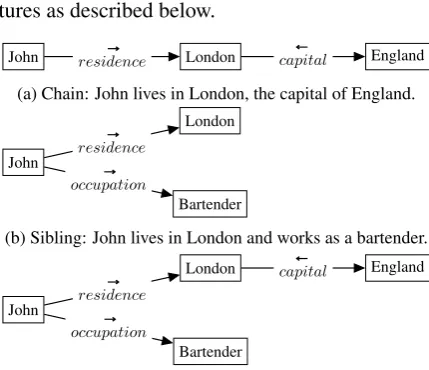
Plan structure Our text plans capture the divi-sion of facts to sentences and the ordering of the sentences. Additionally, for each sentence, the plan captures (1) the ordering of facts within the sentence; (2) The ordering of entities within a fact, which we call thedirectionof the relation. For ex-ample, the{A, location, B}relation can be expressed as either A is located in B or B is the location of A; (3) the structure between facts that share an entity, namely chains and sibling
struc-tures as described below.
John residence
⃗
London capital⃗
England(a) Chain: John lives in London, the capital of England.
John
London
Bartender
⃗
residence⃗
occupation(b) Sibling: John lives in London and works as a bartender.
John
London
Bartender
England
⃗
residence⃗
occupation⃗
capital(c) Combination: John lives in London, the capital of Eng-land, and works as a bartender.
Figure 2: Fact construction structure.
A text plan is modeled as a sequence of sen-tence plans, to be realized in order. Each sensen-tence plan is modeled as an ordered tree, specifying the structure in which the information should be real-ized. Structuring each sentence as a tree enables a clear succession between different facts through shared entities. Our text-plan design assumes that each entity is mentioned only once in a sentence, which holds in the WebNLG corpus. The order-ing of the entities and relations within a sentence is determined by a pre-order traversal of the tree.
[image:3.595.308.523.332.517.2]sen-tence plansis a labeled, ordered tree, with arcs of the form(h, `, m), whereh, m∈V are head and
modifier nodes, each corresponding to an input en-tity, and` = (r, d)is the relation between nodes, wherer∈Ris the RDF relation, andd∈{→,←}
denotes the direction in which the relation is ex-pressed: d =→ if (h, r, m) ∈ G, and d =← if (m, r, h) ∈G. A text planT is said to match an
inputGiff every triplet(s, r, o)inGis expressed inT exactly once, either as an edge(s,(r,→), o)
or as an edge(o,(ri,←), s).
Chains (h, `1, m),(m, `2, x) represent a
suc-cession of facts that share a middle entity (Figure 2a), while siblings — nodes with the same parent —(h, `1, m1),(h, `2, m2)represents a succession
of facts about the same entity (Figure 2b). Sib-ling and chain structures can be combined (Figure 2c). An example of an input we addressed in the WebNLG corpus, and matching text plan is given in Figure1b.
Exhaustive generation For small-ish input graphsG—such as those in the WebNLG task we consider here—it is trivial to generate all possible plans by first considering all the ways of grouping the input into sets, then from each set generating all possible trees by arranging it as an undirected graph and performing several DFS traversals start-ing from each node, where each DFS traversal fol-lows a different order of children.3
3.1 Adding Plans to Training Data
While the input RDFs and references are present in the training dataset, the plans are not. We devise a method to recover the latent plans for most of the input-reference pairs in the training set, construct-ing a new dataset of(G, ref, T)triplets of inputs, reference texts, and corresponding plans.
We define the referenceref, and the text-planT to be consistent with each other iff (a) they exhibit the same splitting into sentences—the facts in ev-ery sentence inref are grouped as a sentence plan inT, and (b) for each corresponding sentence and sentence-plan, the order of the entities is identical. The matching of plans to references is based on the observations that (a) it is relatively easy to identify entities in the reference texts, and a pair of entities in an input is unique to a fact; (b) it is relatively easy to identify sentence splits; (c) a ref-erence text and its matching plan must share the
3
If a graph includes a cycle (0.4% of the graphs in the WebNLG corpus contain cycles) we skip it, as it is guaranteed that a different split will result in cycle-free graphs.
same entities in the same order, and with the same sentence splits.
Sentence split consistency We define a set of triplets to bepotentially consistentwith a sentence iff each triplet contains at least one entity from the sentence (either its subject or object appear in the sentence), and each entity in the sentence is cov-ered by at least one triplet. Given a reference text, we split it into sentences using NLTK (Bird and Loper,2004), and look for divisions ofGinto dis-joint sets such that each set is consistent with a corresponding sentence. For each such division, we consider the exhaustive set of all induced plans. Facts order consistency A natural criterion would be to consider a reference sentence and a sentence-plan originating from the corresponding RDF as matching iff the sets of entities in the sen-tence and the plan are identical, and all entities ap-pear in the same order.4 Based on this, we could represent each sentence and each plan as a se-quence of entities, and verify the sese-quences match. However, using this criterion is complicated by the fact that it is not trivial to map between the entities in the plan (that originate from the RDF triplets) and the entities in the text. In partic-ular, due to language variability, the same plan entity may appear in several forms in the textual sentences. Some of these variations (i.e. “A.F.C Fylde” vs. “AFC Fylde”) can be recognized heuristically, while others require external knowl-edge (“UK conservative party” vs. “the Tories”), and some are ambiguous and require full-fledged co-reference resolution (“them”, “he”, “the for-mer”). Hence, we relax our matching criterion to allow for possible unrecognized entities in the text. Concretely, we represent each sentence plan as a sequence of its entities(pe1, ..., pek), and each
sentence as the sequence of its entities which we managed to recognize and to match with an input entity(se1, ..., sem), m≤k.5
We then consider a sentence and a sentence-plan to beconsistent if the following two
condi-4
An additional constraint is that no two triplets in the RDFs set share the same entities. This is to ensure that if two entities appeared in a structure, only one relation could have been expressed there. This almost always holds in the WebNLG corpus, failing on only 15 out of 6,940 input sets.
5
tions hold: (1) The sentence entities(se1, ..., sem)
are a proper sub-sequence of the plan entities
(pe1, ..., pek); and (2) each of the remaining
enti-ties in the plan already appeared previously in the plan. The second condition accounts for the fact that most un-identified entities are due to pronouns and similar non-lexicalized referring expressions, and that these only appear after a previous occur-rence of the same entity in the text.6
3.2 Test-time Plan Selection
To select the plan to be realized, we propose a mechanism for ranking the possible plans. Our plan scoring method is a product-of-experts model, where each expert is a conditional proba-bility estimate for some property of the plan. The conditional probabilities are MLE estimates based on the plans in the training set constructed in sec-tion 3.1. Estimates involving relation names are smoothed using Lidstone smoothing to account for unseen relations. We use the following experts: Relation directionFor every relationr ∈ R, we
compute its probability to be expressed in the plan in its original order (d =→)or in the reverse
or-der (d =←): pdir(d =→ ∣R). This captures
the tendency of certain relations to be realized in the reversed order to how they are defined in the knowledge base. For example, in the WebNLG corpus the relation “manager” is expressed as a variation of “is managed by” instead of one of “is the manager of” in 68% of its occurrences (pdir(d=←∣manager)=0.68).
Global directionWe find that while the probabil-ity of each relation to be realized in a reversed order is usually below 0.5, still in most plans of longer texts there are one or two relations that ap-pear in the reversed order. We capture this ten-dency using an expert that considers the condi-tional probabilitypgd(nr =n∣ ∣G∣)of observing
nreversed edges in an input with∣G∣triplets. Splitting tendenciesFor each input size, we keep track of the possible ways in which the set of facts can be split to subsets of particular sizes. That is, we keep track of probabilities such as ps(s = [3,2,2] ∣ 7) of realizing an input of 7
RDF triplets as three sentences, each realizing the corresponding number of facts.
Relation transitions We consider each sentence plan as a sequence of the relation types expressed
6
A sensible alternative would be to use a coreference res-olution system at this stage. In our case it turned out to not help, and even performed somewhat worse.
in itr1, . . . , rk followed by an EOS symbol, and
compute the markov transition probabilities over this sequence: ptrans(r1, r2, . . . , rk, EOS) =
∏i=1,kpt(ri+1∣ri). The expert is the product of
the transition probabilities of the individual sen-tence plans in the text plan. This captures the ten-dencies of relations to follow each other and in particular, the tendencies of related relations such as birth-place and birth-date to group, allowing their aggregation in the generated text (John was born in London on Dec 12th, 1980).
Each of the possible plans are then scored based on the product of the above quantities.7
The scores work well for separating good from lousy text plans, and we observe a threshold above which most generated plans result in adequate texts. We demonstrate in Section6that realizing highly-ranked plans manages to obtain good auto-matic realization scores. We note that the plan in Figure1bis the one our ranking algorithm ranked first for the input in Figure1a.
Possible Alternatives In addition to the single plan selection, the explicit planning stage opens up additional possibilities. Instead of choosing and realizing a single plan, we can realizea diverse set of high-scoring plans, or realizing a random high-scoring plan, resulting in a diverse and less templatic set of texts across runs. This relies on the combination of two factors: the ability of the scor-ing component to select plans that correspond to plausible human-authored texts, and the ability of the neural realizer to faithfully realize the plan into fluent text. While it is challenging to directly eval-uate the plans adequacy, we later show an evalu-ation of the plan realizevalu-ation component. Figure3 shows three random plans for the same graph and their realizations. Further examples of the diver-sity of generation are given in the appendix.
The explicit and symbolic planning stage also allows foruser controlover the generated text, ei-ther by supplying constraints on the possible plans (e.g., number of sentences, entities to focus on, the order of entities/relations, or others) or by supply-ing complete plans. We leave these options for future work.
7
(a) Dessert←course [Bionico→country [Mexico]→ingredient [Granola]→region [Jalisco] ]
TheDessert BionicorequiresGranolaas one of its ingredients and originates from theJaliscoregion ofMexico.
(b)
Bionico→country [Mexico]→region [Jalisco] .
Dessert←course [Bionico→ingredient [Granola] ] Bionicois a food found in theMexicoregionJalisco. TheDessert BionicorequiresGranolaas an ingredient.
(c)
Bionico→ingredient [Granola]→course [Dessert] .
Bionico→region [Jalisco]→country [Mexico] Bionico containsGranola and is served as aDessert.
Bionicois a food found in the region ofJalisco,Mexico
Figure 3: Three random linearized plans for the same input graph, and their text realizations. All taken from the top 10% scoring plans. (a) structures the output as a single sentence, while (b) and (c) as two sentences. The second sentence in (b) puts emphasis on Bionico being a dessert, while in (c) the emphasis is on the ingredients.
4 Plan Realization
For plan realization, we use an off-the-shelf vanilla neural machine translation (NMT) system to translate plans to texts. The explicit division to sentences in the text plan allows us to real-ize each sentence plan individually which allows the realizer to follow the plan structure within each (rather short) sentence, reducing the amount of information that the model needs to remem-ber. As a result, we expect a significant reduction in over- and under-generation of facts, which are common when generating longer texts. Currently, this comes at the expense of not modeling dis-course structure (i.e., referring expressions). This deficiency may be handled by integrating the dis-course into the text plan, or as a post-processing step.8. We leave this for future work.
To use text plans as inputs to the NMT, we lin-earize each sentence plan by performing a pre-order traversal of the tree, while indicating the tree structure with brackets (Figure 1c). The di-rected relations(r, d)are expressed as a sequence of two or more tokens, the first indicating the di-rection and the rest expressing the relation.9 En-tities that are identified in the reference text are replaced with single, entity-unique tokens. This allows the NMT system to copy such entities from the input rather than generating them. Figure1d is an example of possible text resulting from such linearization.
Training details We use a standard NMT setup with a copy-attention mechanism (Gulcehre et al., 2016)10 and the pre-trained GloVe.6B word
em-8
Minimally, each entity occurrence can keep track of the number of times it was already mentioned in the plan. Other alternatives include using a full-fledged referring expression generation system such as NeuralREG (Ferreira et al.,2018)
9
We map DBPedia relations to sequences of tokens by splitting on underscores and CamelCase.
10
Concretely, we use the OpenNMT toolkit (Klein et al., 2017) with thecopy attnflag. Exact parameter values are
beddings11 (Pennington et al., 2014). The ptrained embeddings are used to initialize the re-lation tokens in the plans, as well as the tokens in the reference texts.
Generation details We translate each sentence plan individually. Once the text is generated, we replace the entity tokens with the full entity string as it appears in the input graph, and lexicalize all dates asMonth DAY+ordinal, YEAR(i.e.,July 4th, 1776) and for numbers with units (i.e., “5”(min-utes)) we remove the parenthesis and quotation marks (5 minutes).
5 Experimental Setup
The WebNLG challenge (Colin et al.,2016) con-sists of mapping sets of RDF triplets to text in-cluding referring expression generation, aggrega-tion, lexicalizaaggrega-tion, surface realizaaggrega-tion, and sen-tence segmentation. It contains sets with up to 7 triplets each along with one or more reference texts for each set. The test set is split into two parts: seen, containing inputs created for entities and relations belonging to DBpedia categories that were seen in the training data, and unseen, con-taining inputs extracted for entities and relations belonging to 5 unseen categories. While the un-seen category is conceptually appealing, we view the seen category as the more relevant setup: gen-erating fluent, adequate and diverse text for a mix of known relation types is enough of a challenge also without requiring the system to invent verbal-izations for unknown relation types. Any realistic generation system could afford to provide at least a few verbalizations for each relation of interest. We thus focus our attention mostly on the seen case (though our system does also perform well on the unseen case).
Following Section 3.1, we manage to match a
detailed in the appendix. 11
consistent plan for76%of the reference texts and use these plan-text pairs to train the plan real-ization NMT component. Overall, the WebNLG training set contains18,102RDF-text pairs while our plan-enhanced corpus contains 13,828 plan-text pairs.12
Compared Systems We compare to the best submissions in the WebNLG challenge (Gardent et al., 2017): Melbourne, an end-to-end system that scored best on all categories in the automatic evaluation, and UPF-FORGe (Mille et al.,2017), a classic grammar-based NLG system that scored best in the human evaluation.
Additionally, we developed an end-to-end ral baseline which outperforms the WebNLG neu-ral systems. It uses a set encoder, an LSTM (Hochreiter and Schmidhuber,1997) decoder with attention (Bahdanau et al.,2014), a copy-attention mechanism (Gulcehre et al., 2016) and a neural checklist model (Kiddon et al., 2016), as well as applying entity dropout. The entity-dropout and checklist component are the key differentiators from previous systems. We refer to this system asStrongNeural.
6 Experiments and Results
6.1 Automatic Metrics
We begin by comparing our plan-based sys-tem (BestPlan) to the state-of-the-art using the common automatic metrics: BLEU (Papineni et al.,2002), Meteor (Banerjee and Lavie,2005), ROUGEL(Lin,2004) and CIDEr (Vedantam et al., 2015), using the nlg-eval13 tool (Sharma et al., 2017) on the entire test set and on each part sepa-rately (seen and unseen).
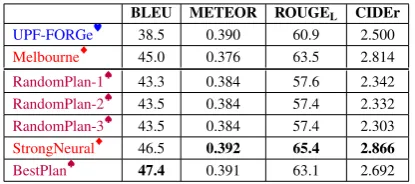
In the original challenge, the best performing system in automatic metric was based on end-to-end NMT (Melbourne). Both the StrongNeu-ral and BestPlan systems outperform all the WebNLG participating systems on all automatic metrics (Table 1). BestPlan is competitive with StrongNeural in all metrics, with small differ-ences either way per metric.14
12
Note that this only affects the training stage. At test time, we do not require gold plans, and evaluate on all sentences.
13
https://github.com/Maluuba/nlg-eval
14
At least part of the stronger results forStrongNeuralcan be attributed to its ability to generate referring expressions, which we currently do not support.
BLEU METEOR ROUGEL CIDEr UPF-FORGe♥ 38.5 0.390 60.9 2.500 Melbourne♦ 45.0 0.376 63.5 2.814
RandomPlan-1♠ 43.3 0.384 57.6 2.342
RandomPlan-2♠ 43.5 0.384 57.4 2.332
[image:7.595.313.521.61.153.2]RandomPlan-3♠ 43.5 0.384 57.4 2.303 StrongNeural♦ 46.5 0.392 65.4 2.866 BestPlan♠ 47.4 0.391 63.1 2.692
Table 1: Results for all categories. Team color indicates the type of system used (NMT♦,Rule-Based♥, Rule-Based + NMT♠).
6.2 Manual Evaluation
Next, we turn to manually evaluate our system’s performance regarding faithfulness to the input on the one hand and fluency on the other. We de-scribe here the main points of the manual evalu-ation setup, with finer details in the appendix.
Faithfulness As explained in Section3, the first benefit we expect of our plan-based architecture is to make the neural systems task simpler, helping it to remain faithful to the semantics expressed in the plan which in turn is guaranteed to be faithful to the original RDF input (by faithfulness, we mean expressing all facts in the graph and only facts from the graph: not dropping, repeating or hal-lucinating facts). We conduct a manual evaluation over the seen portion of the WebNLG human eval-uated test set (139 input sets). We compare Best-Planand StrongNeural.15 For each output text, we manually mark which relations are expressed in it, which are omitted, and which relations ex-ist with the wrong lexicalization. We also count the number of relations the system over generated, either repeating facts or inventing new facts.16
Table2shows the results. BestPlanreduces all error types compared to StrongNeural, by 85%,
56%and90%respectively. While on-par regard-ing automatic metrics,BestPlansubstantially out-performs the new state-of-the-art end-to-end neu-ral system in semantic faithfulness.
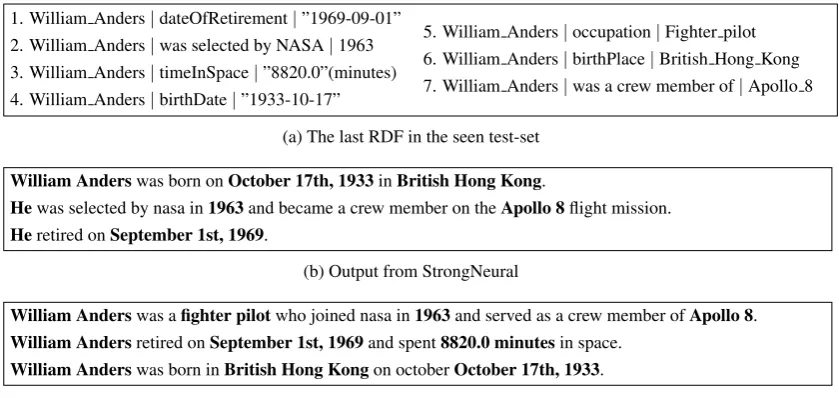
For example, Figure 4 compares the output of
15
We do not evaluate UPF-FORGe as it is a verifiable grammar-based system that is fully faithful by design.
16
1. William Anders|dateOfRetirement|”1969-09-01”
2. William Anders|was selected by NASA|1963 3. William Anders|timeInSpace|”8820.0”(minutes) 4. William Anders|birthDate|”1933-10-17”
5. William Anders|occupation|Fighter pilot
6. William Anders|birthPlace|British Hong Kong 7. William Anders|was a crew member of|Apollo 8
(a) The last RDF in the seen test-set
William Anderswas born onOctober 17th, 1933inBritish Hong Kong.
Hewas selected by nasa in1963and became a crew member on theApollo 8flight mission.
Heretired onSeptember 1st, 1969.
(b) Output from StrongNeural
William Anderswas afighter pilotwho joined nasa in1963and served as a crew member ofApollo 8. William Andersretired onSeptember 1st, 1969and spent8820.0 minutesin space.
William Anderswas born inBritish Hong Kongon octoberOctober 17th, 1933.
[image:8.595.93.513.61.260.2](c) Output from BestPlan
Figure 4: Comparing end-to-end neural generation with our plan based system.
StrongNeural(4b) andBestPlan(4c) on the last input in the seen test set (4b). While both sys-tems chose three sentences split and aggregated details about birth in one sentence and details about the occupation in another, StrongNeural also expressed the information in chronological order. However,StrongNeuralfailed to generate facts 3 and 5.BestPlanmade a lexicalization mis-take in the third sentence by expressing “October” before the actual date, which is probably caused by faulty entity matching for one of the references, and (by design) did not generate any referring ex-pression, which we leave for future work.
BestPlan StrongNeural
Expressed 417 360
Omitted 6 41
[image:8.595.75.288.499.566.2]Wrong-lexicalization 17 39 Over-generation 3 29
Table 2: Semantic faithfulness of each system regard-ing 440 RDF triplets from 139 input sets in the seen part of the manually evaluated test set.
Fluency Next, we assess whether our systems succeed at maintaining the high-quality fluency of the neural systems. We perform pairwise evalu-ation via Amazon Mechanical Turk wherein each task the worker is presented with an RDF set (both in a graph form, and textually), and two texts in random order, one from BestPlan, the other from a competing system. We compare Best-Plan against a strong end-to-end neural system (StrongNeural), a grammar-based system which
StrongNeural Reference UPF-FORGe BestPlan -0.6% -5.4% +5.1%
Table 3: MTurk average worker score for BestPlan
compared to each system. It is a worse than the ref-erence texts, on-par with the neural end-to-end system, and a better than the previous state-of-the-art.
is the state-of-the-art in human evaluation ( UPF-FORGe), and the human-supplied WebNLG ref-erences (Reference). The workers were pre-sented with three possible answers:BestPlantext is better (scored as 1), the other text is better (scored as -1), and both texts are equally fluent (scored as 0). Table 3shows the average worker score given to each pair divided by the number of texts compared. BestPlan performed on-par with StrongNeural, and surpassed the previous state-of-the-artUPF-FORGe. It, however, scored worse than the reference texts, which is expected given that it does not produce referring expres-sions. Our approach manages to keep the same fluency level typical to end-to-end neural systems, thanks to the NMT realization component.
6.3 Plan Realization Consistency
We test the extent to which the realizer generates texts that are consistent with the plans. For several subsets of ranked plans (best plan, top1%, and top
consis-Best Plan Top 1% Plans Top 10% Plans Entities Order Entities Order Entities Order
Seen 98.9% 100% 95.9% 99.9% 93.6% 100% Unseen 66.7% 100% 45.3% 100% 41.3% 100%
Table 4: Surface realizer performance. Entities: Per-cent of sentence plans that were realized with all the requested entities. Order: of the sentences that were realized with all requested entities, percentage of real-izations that followed the requested entity order.
tency we defined above, do all entities appear in the same order in the plan and the realization.
Table4indicates that for decreasingly probable plans our realizer does worse in the first criterion. However, for both parts of the test set, if the real-izer managed to express all of the entities, it ex-pressed them in the requested order, meaning the outputs are consistent with plans. This opens up a potential for user control and diverse outputs, by choosing different plans for realization.
Finally, we verify that the realization of poten-tially diverse plans is not only consistent with each given plan but also preserves output quality. For each input, we realize a random plan from the top
10%. We repeat this process three times with dif-ferent random seeds to generate difdif-ferent outputs, and mark these systems as RandomPlan-1/2/3. Table 1 shows that these random plans maintain decent quality on the automatic metrics, with a limited performance drop, and the automatic score is stable across random seeds.17
7 Related Work
Text planning is a major component in classic NLG. For example, Stent et al. (2004) shows a method of producing coherent sentence plans by exhaustively generating as many as 20 sentence plan trees for each document plan, manually tag-ging them, and learning to rank them using the RankBoost algorithm (Schapire,1999). Our plan-ning approach is similar, but we only have a set of “good” reference plans without internal ranks. While the sentence planning decides on the aggre-gation, one crucial decision left is sentence order. We currently determine order based on a splitting heuristic which relies on the number of facts in ev-ery sentence, not on the content.Lapata(2003) de-vised a probabilistic model for sentence ordering which correlated well with human ordering. Our
17
While the scores for the different sets are very similar, the plans are very different from each other. See for examples the plans in Figure3.
plan selection procedure is admittedly simple, and can be improved by integrating insights from pre-vious text planning works (Barzilay and Lapata, 2006;Konstas and Lapata,2012,2013).
Many generation systems (Gardent et al.,2017; Duˇsek et al.,2018) are based on a black-box NMT component, with various pre-processing transfor-mation of the inputs (such as delexicalization) and outputs to aid the generation process.
Generation from structured data often requires referring to a knowledge base (Mei et al., 2015; Kiddon et al.,2016;Wen et al.,2015). This led to input-coverage tracking neural components such as the checklist model (Kiddon et al., 2016) and copy-mechanism (Gulcehre et al., 2016). Such methods are effective for ensuring coverage and reducing the number of over-generated facts and are in some ways orthogonal to our approach. While our explicit planning stage reduces the amount of over-generation, our realizer may be further improved by using a checklist model.
More complex tasks, like RotoWire (Wiseman et al.,2017) require modeling also document-level planning. Puduppully et al. (2018) explored a method to explicitly model document planning us-ing the attention mechanism.
The neural text generation community has also recently been interested in “controllable” text gen-eration (Hu et al.,2017), where various aspects of the text (often sentiment) are manipulated (Ficler and Goldberg, 2017) or transferred (Shen et al., 2017;Zhao et al., 2017;Li et al.,2018). In con-trast, like in (Wiseman et al., 2018), here we fo-cused on controlling either the content of a gen-eration or the way it is expressed by manipulating the sentence plan used in realizing the generation.
8 Conclusion
[image:9.595.75.291.62.102.2]References
Dzmitry Bahdanau, Kyunghyun Cho, and Yoshua Bengio. 2014. Neural machine translation by jointly learning to align and translate. CoRR, abs/1409.0473.
Satanjeev Banerjee and Alon Lavie. 2005. Meteor: An automatic metric for mt evaluation with improved correlation with human judgments. InProceedings of the acl workshop on intrinsic and extrinsic evalu-ation measures for machine translevalu-ation and/or sum-marization, pages 65–72.
Regina Barzilay and Mirella Lapata. 2006. Aggrega-tion via set partiAggrega-tioning for natural language genera-tion. InProceedings of the main conference on Hu-man Language Technology Conference of the North American Chapter of the Association of Computa-tional Linguistics, pages 359–366. Association for Computational Linguistics.
Steven Bird and Edward Loper. 2004. Nltk: the nat-ural language toolkit. In Proceedings of the ACL 2004 on Interactive poster and demonstration ses-sions, page 31. Association for Computational Lin-guistics.
Emilie Colin, Claire Gardent, Yassine Mrabet, Shashi Narayan, and Laura Perez-Beltrachini. 2016. The webnlg challenge: Generating text from dbpedia data. In Proceedings of the 9th International Nat-ural Language Generation conference, pages 163– 167.
Ondˇrej Duˇsek, Jekaterina Novikova, and Verena Rieser. 2018. Findings of the e2e nlg challenge. arXiv preprint arXiv:1810.01170.
Thiago Castro Ferreira, Diego Moussallem, Akos´ K´ad´ar, Sander Wubben, and Emiel Krahmer. 2018. Neuralreg: An end-to-end approach to referring expression generation. arXiv preprint arXiv:1805.08093.
Jessica Ficler and Yoav Goldberg. 2017. Controlling linguistic style aspects in neural language genera-tion. arXiv preprint arXiv:1707.02633.
Claire Gardent, Anastasia Shimorina, Shashi Narayan, and Laura Perez-Beltrachini. 2017. The webnlg challenge: Generating text from rdf data. In Pro-ceedings of the 10th International Conference on Natural Language Generation, pages 124–133.
Albert Gatt and Emiel Krahmer. 2017. Survey of the state of the art in natural language generation: Core tasks, applications and evaluation. CoRR, abs/1703.09902.
Caglar Gulcehre, Sungjin Ahn, Ramesh Nallap-ati, Bowen Zhou, and Yoshua Bengio. 2016. Pointing the unknown words. arXiv preprint arXiv:1603.08148.
Sepp Hochreiter and J¨urgen Schmidhuber. 1997. Long short-term memory. Neural computation, 9(8):1735–1780.
Zhiting Hu, Zichao Yang, Xiaodan Liang, Ruslan Salakhutdinov, and Eric P Xing. 2017. Toward controlled generation of text. arXiv preprint arXiv:1703.00955.
Chlo´e Kiddon, Luke Zettlemoyer, and Yejin Choi. 2016. Globally coherent text generation with neural checklist models. InProceedings of the 2016 Con-ference on Empirical Methods in Natural Language Processing, pages 329–339.
Guillaume Klein, Yoon Kim, Yuntian Deng, Jean Senellart, and Alexander M Rush. 2017. Opennmt: Open-source toolkit for neural machine translation.
arXiv preprint arXiv:1701.02810.
Ioannis Konstas and Mirella Lapata. 2012. Unsuper-vised concept-to-text generation with hypergraphs. InProceedings of the 2012 Conference of the North American Chapter of the Association for Computa-tional Linguistics: Human Language Technologies, pages 752–761. Association for Computational Lin-guistics.
Ioannis Konstas and Mirella Lapata. 2013. Induc-ing document plans for concept-to-text generation. In Proceedings of the 2013 Conference on Empiri-cal Methods in Natural Language Processing, pages 1503–1514.
Mirella Lapata. 2003. Probabilistic text structuring: Experiments with sentence ordering. In Proceed-ings of the 41st Annual Meeting on Association for Computational Linguistics-Volume 1, pages 545– 552. Association for Computational Linguistics.
Vladimir I Levenshtein. 1966. Binary codes capable of correcting deletions, insertions, and reversals. In
Soviet physics doklady, volume 10, pages 707–710.
Juncen Li, Robin Jia, He He, and Percy Liang. 2018. Delete, retrieve, generate: A simple approach to sentiment and style transfer. arXiv preprint arXiv:1804.06437.
Chin-Yew Lin. 2004. Rouge: A package for auto-matic evaluation of summaries. Text Summarization Branches Out.
Hongyuan Mei, Mohit Bansal, and Matthew R Walter. 2015. What to talk about and how? selective gen-eration using lstms with coarse-to-fine alignment.
arXiv preprint arXiv:1509.00838.
Kishore Papineni, Salim Roukos, Todd Ward, and Wei-Jing Zhu. 2002. Bleu: a method for automatic eval-uation of machine translation. In Proceedings of the 40th annual meeting on association for compu-tational linguistics, pages 311–318. Association for Computational Linguistics.
Jeffrey Pennington, Richard Socher, and Christopher Manning. 2014. Glove: Global vectors for word representation. InProceedings of the 2014 confer-ence on empirical methods in natural language pro-cessing (EMNLP), pages 1532–1543.
Ratish Puduppully, Li Dong, and Mirella Lapata. 2018. Data-to-text generation with content selection and planning. arXiv preprint arXiv:1809.00582.
Yevgeniy Puzikov and Iryna Gurevych. 2018. E2e nlg challenge: Neural models vs. templates. In Proceed-ings of the 11th International Conference on Natural Language Generation, pages 463–471.
Ehud Reiter and Robert Dale. 2000. Building natural language generation systems. Cambridge university press.
Robert E Schapire. 1999. A brief introduction to boost-ing. InIjcai, volume 99, pages 1401–1406.
Shikhar Sharma, Layla El Asri, Hannes Schulz, and Jeremie Zumer. 2017. Relevance of unsupervised metrics in task-oriented dialogue for evaluating nat-ural language generation.CoRR, abs/1706.09799.
Tianxiao Shen, Tao Lei, Regina Barzilay, and Tommi Jaakkola. 2017. Style transfer from non-parallel text by cross-alignment. InAdvances in Neural Informa-tion Processing Systems, pages 6830–6841.
Amanda Stent, Rashmi Prasad, and Marilyn Walker. 2004. Trainable sentence planning for complex in-formation presentation in spoken dialog systems. In
Proceedings of the 42nd annual meeting on associa-tion for computaassocia-tional linguistics, page 79. Associ-ation for ComputAssoci-ational Linguistics.
Ramakrishna Vedantam, C Lawrence Zitnick, and Devi Parikh. 2015. Cider: Consensus-based image de-scription evaluation. In Proceedings of the IEEE conference on computer vision and pattern recog-nition, pages 4566–4575.
Tsung-Hsien Wen, Milica Gasic, Nikola Mrksic, Pei-Hao Su, David Vandyke, and Steve Young. 2015. Semantically conditioned lstm-based natural lan-guage generation for spoken dialogue systems.
arXiv preprint arXiv:1508.01745.
Sam Wiseman, Stuart M Shieber, and Alexander M Rush. 2017. Challenges in data-to-document gen-eration. arXiv preprint arXiv:1707.08052.
Sam Wiseman, Stuart M Shieber, and Alexander M Rush. 2018. Learning neural templates for text gen-eration. arXiv preprint arXiv:1808.10122.