114
Development and Deployment of a Large-Scale Dialog-based Intelligent
Tutoring System
Shazia Afzal1, Tejas Indulal Dhamecha1, Nirmal Mukhi2, Renuka Sindhgatta3∗, Smit Marvaniya1, Matthew Ventura4, Jessica Yarbro4
1IBM Research - India,2IBM Research - Yorktown Heights, NY, USA
3Queensland University of Technology, Brisbane, Australia,4Pearson Education, USA
{shaafzal, tidhamecha, smarvani}@in.ibm.com, [email protected] [email protected],{matthew.ventura, jessica.yarbro}@pearson.com
Abstract
There are significant challenges involved in the design and implementation of a dialog-based tutoring system (DBT) ranging from do-main engineering to natural language classi-fication and eventually instantiating an adap-tive, personalized dialog strategy. These is-sues are magnified when implementing such a system at scale and across domains. In this paper, we describe and reflect on the design, methods, decisions and assessments that led to the successful deployment of our AI driven DBT currently being used by several hundreds of college level students for practice and self-regulated study in diverse subjects like Sociol-ogy, Communications, and American Govern-ment.
1 Introduction
Intelligent Tutoring Systems (ITS) have been one of the ambitions of researchers working in the fields of computer-aided education, learning sci-ences, and, to an extent, computational linguis-tics (Brusilovsky et al., 1996; Graesser et al.,
1999;Evens et al., 1997). A special case of ITS
is Dialog-based Tutoring (DBT) which is based on the Socratic principle of cooperative dialogue meant to stimulate critical thinking and deeper comprehension (Carbonell, 1970;Graesser et al.,
1999,2005).
Dialog-based intelligent tutoring systems (DBT) capture the effectiveness of expert human teacher-learner interactions by using natural lan-guage dialogue. Since articulation of a response in natural language involves recall and reflec-tion of relevant knowledge it facilitates deeper comprehension of content. DBT consists of a sequence of mixed initiative dialogue moves in natural language to steer learners through varying levels of content granularity. A conversation is
∗
[image:1.595.316.517.222.518.2]Work done while at IBM Research - India.
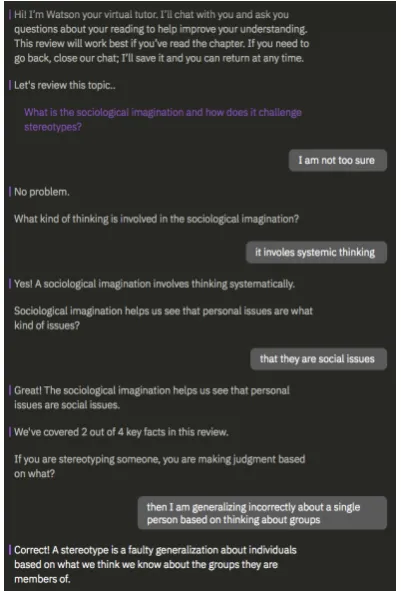
Figure 1: Screenshot of the Watson dialog-based tutor. Notice the transition from a broad question to focused question, intent classification ofI am not too sure as need for help, and answer evaluation.
triggered when the tutor poses a question which typically leads to a series of dialog turns directed towards finer reasoning on relevant concepts. The goal is to scaffold knowledge and provide constructive remediation akin to expert one-one human tutoring. A well known example of DBT is AutoTutor (Graesser et al., 1999, 2005) while other notable systems include Why2 (VanLehn et al.,2002), CIRCSIM-Tutor (Evens et al.,1997), GuruTutor (Olney et al., 2012), DeepTutor (Rus
et al., 2013), and the GIFT framework (Sottilare
Building a DBT is a challenging task as it in-volves balancing of conversational efficiency with the tutoring goal of personalized adaptive mentor-ing and knowledge assessment. In spite of sus-tained research and development efforts there are major challenges that prohibit their vast adoption in educational practice. Some crucial challenges can be identified as:
1.1 Student Response Analysis
Natural language classification is a critical compo-nent of any DBT and is the very basis for driving an effective conversation. Performing a context-based interpretation of a student utterance is even more challenging owing to the diversity of hu-man language, differences in vocabulary and nu-ances. Consequently, current NLP and AI tech-niques have limitations when applied in an open-response scenario like interaction with a DBT. As machine learning techniques rely on good train-ing data to deliver good performance, the consid-erable subjectivity inherent in training-data anno-tation, benchmarking, and reaction to misclassifi-cation errors further impacts the classifimisclassifi-cation ac-curacy.
1.2 Content Design and Creation
Extensive content authoring is required to drive any efficient DBT. The content needs to be struc-tured in a way that drives the tutoring agenda while ensuring that knowledge elements render naturally in a conversational flow. This requires a tremen-dous amount of manual and semi-automated effort from subject matter experts. Content schema is also closely tied to the nature of a domain as dif-ferent subjects would have their respective chal-lenges. For example, creating content for a factual subject like Maths or Physics is substantially dif-ferent to a subject like Psychology.
1.3 Dialog Strategy
Devising a meaningful conversational strategy is a non-trivial aspect as it directly impacts learner en-gagement and therefore learning outcomes. There should be sufficient flexibility and variation in sponses to cater dynamically to the state and re-quirements of individual students. Additionally, there should be scope to implement interventions and scaffolds in order to keep the learner moti-vated. For example, surfacing relevant examples from a textbook when a student struggles or dis-plays lack of knowledge during interaction.
1.4 Evaluation
The overall efficacy of a learning system is pri-marily determined by the learning gains achieved. However, the overall learning experience is signif-icantly impacted by other dimensions such as clas-sification accuracy, response time, style of feed-back, variation in language, robustness and usabil-ity issues. Evaluation should therefore involve a holistic assessment of all factors that eventually lead to improved learning outcomes.
1.5 Scalability and robustness
The underlying algorithm design is impacted by both the domain engineering effort involved in scaling the tutor across titles as well as the abil-ity to handle several concurrent users. Existing architectures are more often monolithic, thereby limiting the scope of improvements and scale.
In the context of the above challenges we now describe the development and refinement of our Watson dialog-based tutoring system that has so far been used by over 2,000 college students in the domains of Sociology, Communications, and American Government. Development of this sys-tem involved creating AI modules for language understanding, designing system architecture for modularity and scalability, and a significant effort to update various designs and algorithms to incor-porate student feedback received at various mile-stones. Our DBT differs from existing systems in terms of domain and load scalability. We approach the issue of scaling across domains using a semi-automated pipeline for authoring, validation and improvisation of content. Scaling to load is en-abled by designing tutor modules as cloud-based REST micro-services.
In the following sections we describe the archi-tecture and iterative refinement of our2 tutor fol-lowed by some qualitative and quantitative evalu-ations from field experiments.
2 Design and Architecture
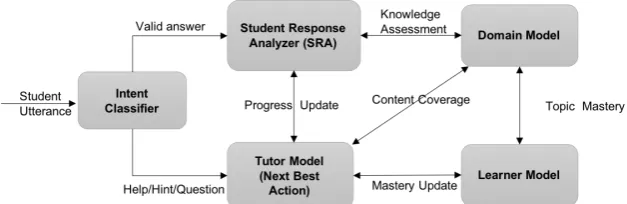
Figure 2: Simplified architecture of the tutor system.
most significant module of the tutor is the Natural Language Response Classifier comprising of two primary sub-components: the Intent Classifier and the Student Response Analyzer (SRA).
The Intent Classifier maps a student utterance to one of about 25 possible intent classes. The two main intent classes are: 1) avalid on-topic
answer and 2) a valid question. Other
intent classes include requests for help, requests for a hint, an expression of boredom, an insult, a greeting, and so on. This level of response clas-sification is crucial to the effective working of the tutor as an error at this stage can have cas-cading effects on the entire dialog flow. This module is designed as a hierarchical classifier, going from broad intents to finer intents. The
valid on-topic answer category requires
domain/subject specific training whereas many meta-cognitive intents can be classified in domain agnostic manner.
Student Response Analysis (SRA) is the task of labeling student answers with categories that can help a dialog system to generate appropriate and effective feedback on errors. It is modeled as a classifier with underlying techniques similar to Textual Entailment (Dzikovska et al.), Seman-tic Textual Similarity (Agirre et al.), and Short Answer Grading (Mohler and Mihalcea, 2009). It takes the valid student answer and evaluates it against the model reference answer into one of 3 categories: correct,partially correct,
and incorrect (Saha et al., 2018; Marvaniya
et al.,2018). The SRA in our DBT thus makes use
of state of art machine learning techniques to per-form classification with macro-average F1 within 7% of that of human agreements; newer models (not reported here) have yielded results within 5% of human agreements. It uses an ensemble of se-mantic and syntactic features obtained from the tu-ple comprising of the question, student answer and the reference answer. This design makes it suitable
for questions and, potentially for unseen-domains too. For a new domain or textbook, if student answers for training are not available, the existing base model can be used inunseen-domain
setting. However, if the training data is available, the classification module can utilize it to improve the grading performance. In addition to response classification, SRA also performs a gap analysis on the student answer against the expected model answer to generate fill-in-the-blank (FITB) style prompts dynamically. The output of the Natural Language Response Classifier is used to drive the tutor strategy by continuous evaluation against the domain model and estimates of mastery from the learner model. The core of the tutoring frame-work is the domain model which is constructed by content experts as a hierarchy of learning objec-tives (LOs). Each LO is further structured into a sequence of assertions along with corresponding Hints and common misconceptions, if any. This formulation of content is designed to elicit knowl-edge gradually and allow fine-grained evaluation. With this domain model design schema, the broad task of evaluating student’s understanding is bro-ken down into set of more focused short answer evaluation.
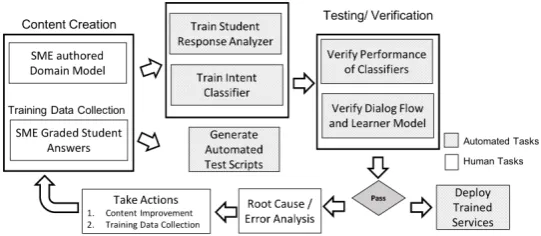
Figure 3: Sequence of tasks carried out to deploy the tutor for a new subject or domain
2008;Hume et al.,1996). The interface model is
the front-end that triggers the UI to enable Tutor-Learner interaction in natural language. As our DBT is conceived to be used as a supplement to digital learning content, it is made strategically available to students for revision and practice.
3 Deployment and Scalability
All modules of the tutor are functionally iso-lated and are manifested as RESTful microservice APIs. This decoupling is important for scalable design. The overarching framework of Orchestra-tion connects all the services. It is implemented in OpenWhisk (Mukhi et al.,2017) which follows a serverless computing based cloud-computing execution model. The front-end communicates with the Orchestration via broadly abstracted tutor APIs only. Depending on the functionality, some modules are domain agnostic (e.g. learner model, next-best-action), whereas others are not. For the domain dependent modules, a set of microservice instances are spawned per domain. In terms of the storage facility, NoSQL IBM CloudantR
, in-memory data structure store Redis, and Cloud Ob-ject Storage SystemTM are employed. Relatively small and structured data (e.g. domain content) is maintained in Cloudant; high frequency update data (e.g. student progress) is cached in Redis; whereas large AI models are stored in Cloud Ob-ject Storage. To cater to computational and traffic load, horizontal (in terms of processor and mem-ory) and vertical (in terms of number of instances) scaling is facilitated by Kubernetes and Nginx API Gateway. Specifically in the context of commer-cial ITS systems, scalability has two aspects: de-velopment & load management.
3.1 Scalable to Develop
This corresponds to the ability to scale the tutor to new subjects/domains. The overall turnaround
time to make the tutor usable for a new subject should be reasonably low. Figure 3 shows key tasks required to have the tutor system support a new subject such as creation of the domain model, retraining/transfer-learning of AI/NLP modules, testing the dialog and AI module performance, configuration tuning, and deploying the system. Some of these, such as domain model creation, evaluating and fine tuning the model are human labor intensive, whereas others have been auto-mated. By design, all of these are distributable across multiple humans and machines which sig-nificantly helps formulate a factory model for preparing the tutor for a new subject. The train-ing and deployment time for a new subject ranges between 6 hours - 72 hours, depending on the amount of refinement needed in the scoring mod-els.
One of the key design elements for develop-ment scalability is re-usability of AI/NLP compo-nents with minimal modifications across various subjects. The SRA module uses a base model that can be used across all subjects. The SRA with only the base model yields a modest accuracy; it is extended with domain specific unstructured (text) and structured (student answers) to transfer it to the subject/domain. This facilitatesbootstrapping
the module and solves the problem of cold start
often encountered in industry AI product develop-ment.
3.2 Scalable to Load
Learning Affordance Items
n=37
Learning Affordance Items
n=37 Dialogue Quality Items
n=37
Response Classification Items
n=37 The tutor recognized when my answers were correct
The tutor helped me learn the material faster than reading alone
[image:5.595.75.289.66.127.2]Strongly Disagree Disagree Neither Agree Nor Disagree Agree Strongly Agree
Figure 4: Response classification related survey ques-tion results illustrating positive impacts of tutor.
Some number crunching heavy modules benefit more from vertical scaling by virtue of inherent parallelization whereas gating/orchestrating mod-ules typically benefit more from horizontal scal-ing. Our tutor can support 600 concurrent users (corresponding to∼300K students using the tutor regularly over a semester) with error rate<0.5%
and response time < 3s on average. The error rates and response times are much better for more typical loads (5 – 50 concurrent students) observed in current deployments.
4 Iterative Improvement of the System: Development Life Cycle
Various micro-experiments were done after ev-ery few internal releases to receive feedback from potential end users (sub-sampled student popula-tion). These micro-experiments helped evaluate the product features and robustness. Following are some of the key improvisations.
4.1 Evolution of the Response Classifier
Originally, the response classification was binary:
correct or incorrect. A misclassification
therefore resulted in either severe penalty or le-niency. To mitigate this risk, the module was retrained to a three-way classifier, with the low-risk third class aspartially correct. Do-ing so, indeed reduced the chance ofcorrect
-to-incorrect and vice-versa misclassification.
However, in later trials we observed that if a stu-dent’s answer is misclassified, it is better to sug-gest a finer follow up activity, than just provid-ing partial grade. For example, by performprovid-ing a gap analysis on the students answer against the expected one we dynamically generate fill-in-the-blank (FITB) style prompts or use encouragement pumps based on mastery.
4.2 Content Revision
During trials, we encountered cases, where stu-dent answers were correct in context of the
text-book, but were wrong as per the authored con-tent. This called for a need to update/enrich the authored content based on the actual student an-swers. As a solution, the students were given the option to rate the tutor’s response using a thumbs up/down sign. These ratings are tracked to draw an SME (subject matter expert)’s attention to im-prove/rectify the content. This semi-automated approach allows for continuous user feedback and incremental training of the underlying modules.
4.3 Improvising the Conversation Tone
Feedback from trials was also leveraged to fine tune the tone of the tutor responses to make it more motivating, less pedantic, personable and more transparent. For example, if a student answer was classified as incorrect, the prompts
That’s incorrect!, That seems to
be a wrong answerandThat does not
match with what I haveconvey the same
message but with different levels of critique and encouragement. Similarly, variation in the feedback language was personalized according to students ability level and punctuation was strategically used to give a sense of enthusiasm and positivity. The overall persona and the personalized behavior were carefully revised and tuned according to situational needs. See (Afzal
et al., 2019) for more details on the design and
evolution of the tutor personality.
4.4 Dialog Flow Refinement
The dialog flow is essentially the entire orches-tration of a tutoring goal, personalized for each student depending on their progress and mastery on specific content. Although, our initial dialog flow included two main activities of student an-swering questions and asking questions, we added additional activities to the dialog to adapt it to stu-dent mastery and improve engagement. These in-cluded recommending question asking based on questions asked by peers, presenting simpler bi-nary true/false questions or presenting a fill-in-the blank question if the computed hint question dif-ficulty is high and student mastery is low for the topic.
5 Evaluation
Human-2
C P I
Human-1
C 57.6 20.2 22.2
P 5.8 27.2 67.0
I 3.1 5.3 91.6
Macro-F1: 60.2%
Tutor
C P I
Human-1
C 64.8 19.5 15.7
P 31.9 23.4 44.7
I 5.7 20.8 73.5
Macro-F1: 53.2%
Tutor
C P I
Human-2
C 69.0 17.4 13.6
P 32.0 34.4 33.6
I 11.4 13.8 74.8
[image:6.595.106.258.61.236.2]Macro-F1: 55.9%
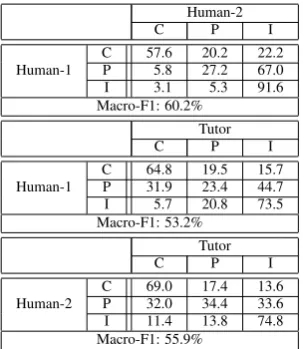
Table 1: Confusion matrices (values in percent-age) of Human-1 vs Human-2 and Humans vs Tutor for response classification during a learning experi-ment. C, P, and I represent correct, partially correct, andincorrectgrade.
et al., 2018). During the fall 2018 semester, the
commercially available titles were used by over 2000 students across more than 200 higher edu-cation institutions (Pearson,2018). The system is expected to be used across a multitude of higher education institutions in the USA and will be pi-loted on five additional titles.
Here, we present our initial results gathered from two controlled learning experiments (LE) conducted 7 months apart. The first LE was con-ducted with 39 students while the second LE had 102 students. The demographic profile was sim-ilar with average GPA of ∼3.5 and 70% female ratio. Here we discuss some relevant results on the following key dimensions:
5.1 Classification
For our two-level classification system - at intent and answer assessment level (SRA), we observed that intent classification of student utterances is 95% accurate, and the SRA system for scoring an-swers is within 7% of human inter-rater reliabil-ity for 3 of the 4 learning objectives tested. Fig-ure4shows the student responses to survey ques-tions that measure the efficacy of the tutor while Table1 illustrates the evaluation of classification through formal metrics. The confusion matrices are reported for 50 transcripts pertaining to to-tal of 1,065 student responses. Note that, I-to-C
misclassification is 2.6-8.3% higher than that of human disagreement; whereas C-to-I misclassi-fication rate is better than human disagreement.
User’s feedback on how well the tutor understood their responses showed a statistically significant across the two LEs.
5.2 Validity
The tutor’s estimate of student mastery scores was found to correlate significantly with the student’s self-perception (r = 0.32, p < 0.05) and ac-tual post–test learning measures (r = 0.53, p < 0.001). This is a strong indicator of the validity of the tutor’s mastery measurement. Note that this validity is crucial as it is the basis for adjusting the dialog strategy to enable true personalization of the tutoring experience.
5.3 Dialog Quality
This was estimated by surveying the SMEs and students who used the system. The SMEs manu-ally scored 236 conversational transcripts and took a survey after each transcript. In these surveys, the tutor was rated as providing an effective tutoring conversation 70% of the time, transitioning effec-tively through the conversation 75% of the time and providing appropriate feedback 66% of the time. Students’ self–report was also fairly posi-tive about the overall experience, feedback, value and usability of the tutor.
5.4 Iterative Improvement
Figure 5 reports the improvements observed across the two LEs on some survey items. These improvements are attributed to content refinement, response and intent classification improvement, and dialog refinement.
Perhaps more gratifying than the generally pos-itive results are the expressions of enthusiasm, in-terest and engagement from students working with the Watson dialog-based tutor. Comments such
as “I wasn’t having to go over reading material
and lecture material over and over to understand it more fully because I grasped it the first time. I could take that time to devote to another subject,
or my family”was evidence of the truly beneficial
societal impact that such a system could have, if applied the right way.
6 Discussion: Human Subjectivity
1 2 3 4 5
The tutor gave additional information that helped me learn the material
The Tutor helped me learn the material faster than just reading The Tutor did a good job guiding me to learning the concept The tutor helped me understand the material more than reading
alone
The tutor helped me think more deeply about the material The tutor understood what I was saying
[image:7.595.326.504.60.288.2]LE1 LE2
Figure 5: Comparison of LE1 & LE2 on survey items scored on 1-5 scale.
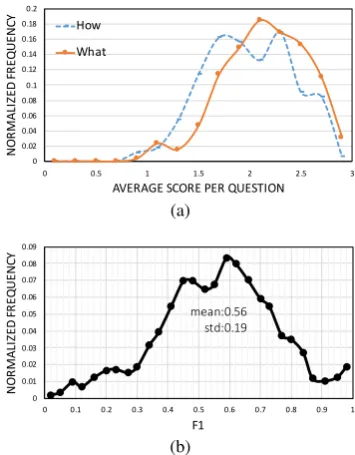
issues pertaining to the granularity of content and the resulting ambiguity expected in responses. For example (See Figure 6a), we observe that recall
type question with WHAT interrogative pronouns are more likely to be answered correctly compared toHOWquestions which may be ambiguous due to relative openness of expected answers. This im-plies that classification accuracy can be improved if a more standardized vocabulary is followed to limit the variation in content creation. However, this is a debatable proposition since it undervalues the richness of domain knowledge and may not be practical for non-factual domains.
Additionally, given a domain authored content like a QA pair, it is hard even for experts to deter-mine the boundaries of correctness in student re-sponses with respect to a reference model answer. This poor inter-rater agreement directly impacts the effectiveness of training the underlying scor-ing modules. To give an estimate, in one of our training data sets, three groundtruth labels were obtained from domain experts for each student swer. There was disagreement on 50% of the an-swers marked as partially correct by experts! Al-though this is a classical problem in ML/NLP, the consequences of scoring a correct answer incor-rectly or vice-versa are more profound in a learn-ing system. Human teachers are more flexible and sometimes abstract in their evaluation of an open-ended answer which is difficult to replicate in an AI system.
Finally, it is the delivery of an overall engag-ing and valuable experience that matters to human end users. Even here, there is remarkable subjec-tivity in users’ perception and tolerance to the type and timing of tutor misclassifications (Afzal et al.,
2018). We cannot measure efficacy solely in terms of absolute and restrictive metrics like accuracy and macro-average F1. Our best proxies, then, are
0 0.02 0.04 0.06 0.08 0.1 0.12 0.14 0.16 0.18 0.2
0 0.5 1 1.5 2 2.5 3
NO
RM
AL
IZ
ED
FR
EQ
U
ENC
Y
AVERAGE SCORE PER QUESTION How
What
(a)
0 0.01 0.02 0.03 0.04 0.05 0.06 0.07 0.08 0.09
0 0.1 0.2 0.3 0.4 0.5 0.6 0.7 0.8 0.9 1
NO
RM
AL
IZ
ED
FR
EQ
U
ENC
Y
F1 mean:0.56
std:0.19
[image:7.595.74.289.64.181.2](b)
Figure 6: Quantifying issues related to human subjec-tivity: (a) ambiguity in answer correctness as function of question type, (b) poor inter-annotator agreement.
qualitative, detailed and timely feedback from the end users to learn and improvise over time.
7 Summary
References
Shazia Afzal, Bryan Dempsey, Cassius D’Helon, Nir-mal Mukhi, Milena Pribic, Aaron Sickler, Peggy Strong, Mira Vanchiswar, and Lorin Wilde. 2019. The personality of ai systems in education: Experi-ences with the watson tutor, a one-on-one virtual tu-toring system.Childhood Education, 95(1):44–52.
Shazia Afzal, Vinay Shashidhar, Renuka Sindhgatta, and Bikram Sengupta. 2018. Impact of tutor errors on student engagement in a dialog based intelligent tutoring system. InITS, pages 267–273. Springer.
Eneko Agirre, Mona Diab, Daniel Cer, and Aitor Gonzalez-Agirre. Semeval-2012 task 6: A pilot on semantic textual similarity. InSemEval-2012, pages 385–393. ACL.
Peter Brusilovsky, Elmar Schwarz, and Gerhard Weber. 1996. ELM-ART: an intelligent tutoring system on world wide web. InITS, pages 261–269.
Jaime R Carbonell. 1970. AI in CAI: An artificial-intelligence approach to computer-assisted instruc-tion. IEEE TMMS, 11(4):190–202.
Myroslava Dzikovska, Rodney Nielsen, Chris Brew, Claudia Leacock, Danilo Giampiccolo, Luisa Ben-tivogli, Peter Clark, Ido Dagan, and Hoa Trang Dang. Semeval-2013 task 7: The joint student re-sponse analysis and 8th recognizing textual entail-ment challenge. InSemEval-2013, volume 2, pages 263–274. ACL.
Martha W Evens, Ru-Charn Chang, Yoon Hee Lee, Leem Seop Shim, Chong Woo Woo, Yuemei Zhang, Joel A Michael, and Allen A Rovick. 1997. Circsim-tutor: An intelligent tutoring system using natural language dialogue. InANLP: Descriptions
of system demonstrations and videos, pages 13–14.
ACL.
Arthur C Graesser, Patrick Chipman, Brian C Haynes, and Andrew Olney. 2005. Autotutor: An intelli-gent tutoring system with mixed-initiative dialogue.
IEEE ToE, 48(4):612–618.
Arthur C Graesser, Katja Wiemer-Hastings, Peter Wiemer-Hastings, Roger Kreuz, Tutoring Research Group, et al. 1999. AutoTutor: a simulation of a hu-man tutor.Cognitive Systems Research, 1(1):35–51.
Gregory Hume, Joel Michael, Allen Rovick, and Martha Evens. 1996. The use of hints by human and computer tutors: the consequences of the tutor-ing protocol. InICLS, pages 135–142.
Smit Marvaniya, Swarnadeep Saha, Tejas I Dhamecha, Peter Foltz, Renuka Sindhgatta, and Bikram Sen-gupta. 2018. Creating scoring rubric from repre-sentative student answers for improved short answer grading. InCIKM, pages 993–1002. ACM.
Michael Mohler and Rada Mihalcea. 2009. Text-to-text semantic similarity for automatic short answer grading. InEACL, pages 567–575. ACL.
Nirmal K Mukhi, Srijith Prabhu, and Bruce Slawson. 2017. Using a serverless framework for implement-ing a cognitive tutor: experiences and issues. In
ACM WoSC, pages 11–15.
Andrew M Olney, Natalie K Person, and Arthur C Graesser. 2012. Guru: designing a conversa-tional expert intelligent tutoring system. In Cross-disciplinary advances in applied natural language
processing: Issues and approaches, pages 156–171.
IGI Global.
Pearson. 2018. Revel with watson. https://www. pearson.com/us/higher-education/ products-services-teaching/ digital-learning-environments/
revel-with-watson.html.
Vasile Rus, Sidney DMello, Xiangen Hu, and Arthur Graesser. 2013. Recent advances in conversational intelligent tutoring systems. AI magazine, 34(3):42– 54.
Swarnadeep Saha, Tejas I Dhamecha, Smit Marvaniya, Renuka Sindhgatta, and Bikram Sengupta. 2018. Sentence level or token level features for automatic short answer grading?: Use both. InAIED, pages 503–517.
Valerie J Shute. 2008. Focus on formative feedback.
Sage RER, 78(1):153–189.
Robert A Sottilare, Keith W Brawner, Benjamin S Goldberg, and Heather K Holden. 2012. The gen-eralized intelligent framework for tutoring (GIFT).
Orlando, FL: US Army Research Laboratory–
Human Research & Engineering Directorate.
Kurt VanLehn, Pamela W Jordan, Carolyn P Ros´e, Du-misizwe Bhembe, Michael B¨ottner, Andy Gaydos, Maxim Makatchev, Umarani Pappuswamy, Michael Ringenberg, Antonio Roque, et al. 2002. The ar-chitecture of Why2-Atlas: A coach for qualitative physics essay writing. InITS, pages 158–167.