3609
Submodular Optimization-based Diverse Paraphrasing and its
Effectiveness in Data Augmentation
Ashutosh Kumar∗1 Satwik Bhattamishra∗2† Manik Bhandari1 Partha Talukdar1
1 Indian Institute of Science, Bangalore, India
2 Birla Institute of Technology and Science, Pilani, India
{ashutosh, ppt}@iisc.ac.in,{satwik55, mbbhandarimanik}@gmail.com
Abstract
Inducing diversity in the task of paraphras-ing is an important problem in NLP with ap-plications in data augmentation and conver-sational agents. Previous paraphrasing ap-proaches have mainly focused on the issue of generating semantically similar paraphrases, while paying little attention towards diversity. In fact, most of the methods rely solely on top-k beam search sequences to obtain a set of paraphrases. The resulting set, however, con-tains many structurally similar sentences. In this work, we focus on the task of obtaining highly diverse paraphrases while not compro-mising on paraphrasing quality. We provide a novel formulation of the problem in terms of monotone submodular function maximization, specifically targeted towards the task of para-phrasing. Additionally, we demonstrate the ef-fectiveness of our method for data augmenta-tion on multiple tasks such as intent classifi-cation and paraphrase recognition. In order to drive further research, we have made the source code available.
1 Introduction
Paraphrasing is the task of rephrasing a given text in multiple ways such that the semantics of the generated sentences remain unaltered. Paraphras-ingQualitycan be attributed to two key character-istics -fidelitywhich measures the semantic sim-ilarity between the input text and generated text, anddiversity, which measures the lexical dissimi-larity between generated sentences.
Many previous works (Prakash et al., 2016; Gupta et al., 2018; Li et al., 2018) address the task of obtaining semantically similar paraphrases. While it is essential to produce paraphrases with high fidelity, it is equally important, and in many
∗
Equal Contribution
†
This research was conducted during the author’s intern-ship at the Indian Institute of Science, Bangalore.
SOURCE – how do i increase body height ? REFERENCE – what do i do to increase my height ?
BEAM
SEARCH
– how do i increase my height ? – how do i increase my body height ? – how do i increase the height ? – how would i increase my body height ?
DIPS (OURS)
– how could i increase my height ? – what should i do to increase my height ? – what are the fastest ways to increase my height ? – is there any proven method to increase height ?
Table 1: Sample paraphrases generated by beam search and DiPS (our method). DiPS offers lexically diverse paraphrases without compromising on fidelity.
cases desirable, to produce lexically diverse ones. Diversity in paraphrase generation finds applica-tions in text simplification (Nisioi et al.,2017;Xu et al., 2015), document summarization (Li et al., 2009; Nema et al., 2017), QA systems (Fader et al.,2013;Bernhard and Gurevych,2008), data augmentation (Zhang et al.,2015;Wang and Yang, 2015), conversational agents (Li et al., 2016) and information retrieval (Anick and Tipirneni,1999).
To obtain a set of multiple paraphrases, most of the current paraphrasing models rely solely on
top-kbeam search sequences. The resulting set, how-ever, contains many structurally similar sentences with only minor, word level changes. There have been some prior works (Li and Jurafsky,2016; El-hamifar et al.,2012) which address the notion of diversity in NLP, including in sequence learning frameworks (Song et al.,2018;Vijayakumar et al., 2018). Although Song et al. (2018) address the issue of diversity in the scenario of neural conver-sation models using determinantal point processes (DPP), it could be naturally used for paraphrasing. On similar lines, subset selection based on Simul-taneous Sparse Recovery (SSR) (Elhamifar et al., 2012) can also be easily adapted for the same task.
re-taining fidelity with respect to the source sen-tence. Addressing the task of diverse paraphrasing through the lens of monotone submodular func-tion maximizafunc-tion (Fujishige, 2005; Krause and Golovin;Bach et al.,2013) alleviates this problem and also provides a few additional benefits. Firstly, the submodular objective offers better flexibility in terms of controlling diversity as well as fidelity. Secondly, there exists a simple greedy algorithm for solving monotone submodular function maxi-mization (Nemhauser et al.,1978), which guaran-tees the diverse solution to be almost as good as the optimal solution. Finally, many submodular programs are fast and scalable to large datasets.
Below, we list the main contributions of our pa-per.
1. We introduce Diverse Paraphraser using
Submodularity (DiPS). DiPS maximizes a novel submodular objective function specif-ically targeted towards paraphrasing.
2. We perform extensive experiments to show the effectiveness of our method in generat-ing structurally diverse paraphrases without compromising on fidelity. We also com-pare against several possible diversity induc-ing schemes.
3. We demonstrate the utility of diverse para-phrases generated via DiPS as data augmen-tation schemes on multiple tasks such as in-tent and question classification.
We have made DiPS’s source code available at https://github.com/malllabiisc/DiPS
2 Related Work
Paraphrasing a given sentence is an important problem and numerous approaches have been proposed to address it. Recently sequence-to-sequence based data-driven deep learning mod-els have been proposed, which try to address the limitations of earlier traditional rule-based (McK-eown, 1983) methods. Prakash et al. (2016) em-ploy residual connections in LSTM to enhance the traditional sequence-to-sequence model. Gupta et al.(2018) provide a VAE (Kingma and Welling, 2013) based framework to improve the quality of generated paraphrases. Li et al. (2018) propose a reinforcement learning based model which uses pointer-generator (See et al., 2017) for generat-ing paraphrases and an evaluator based on (Parikh
et al.,2016) to penalize non-paraphrastic genera-tions. Several other works (Cao et al.,2017;Iyyer et al., 2018) exist for paraphrasing, though they have either been superseded by newer models or are not-directly applicable to our settings. How-ever, most of these methods focus on the issue of generating semantically similar paraphrases, while paying little attention towards diversity.
Diversity in paraphrasing models was first ex-plored by (Gupta et al., 2018) where they pro-pose to generate variations based on different sam-ples from the latent space in a deep generative framework. Although diversity in paraphrasing models has not been explored extensively, meth-ods have been proposed to address diversity in other NLP tasks (Li et al., 2016, 2015; Gimpel et al., 2013). Diverse beam search proposed by (Vijayakumar et al.,2018) generates k-diverse se-quences by dividing the candidate subsese-quences at each time step into several groups and penalizing subsequences which are similar to prior groups. The most relevant to our approach is the method proposed by (Song et al.,2018) for neural conver-sation models where they incorporate diversity by using DPP to select diverse subsequences at each time step. Although their work is addressed in the scenario of neural conversation models, it could be naturally adapted to paraphrasing models and thus we use it as a baseline.
Submodular functions have been applied to a wide variety of problems in machine learning (Iyer and Bilmes, 2013; Jegelka and Bilmes, 2011; Krause and Guestrin, 2011; Kolmogorov and Zabih,2002) and have recently attracted much attention in several NLP tasks including docu-ment summarization (Lin and Bilmes,2011), data selection in machine translation (Kirchhoff and Bilmes, 2014) and goal-oriented chatbot training (Dimovski et al.,2018). However, their applica-tion to sequence generaapplica-tion is largely unexplored.
Algorithm 1: Greedy selection for submodular opti-mization (Cardinality constraint)
Input:Ground Set:V Budget:k
Submodular Function:F
1 S← ∅ 2 N ←V
3 while|S|< kdo
4 x∗←argmaxx∈NF(S∪ {x}) 5 S←S∪ {x∗}
6 N←N\ {x∗} 7 end
8 returnS
approaches try to boost the generalization abili-ties of downstream classification models through word-level substitutions. However, they are in-herently restrictive in terms of the diversity they can offer. Our work offers a data-augmentation scheme via high quality paraphrases.
3 Background: Submodularity
Let V = {v1, . . . , vn} be a set of objects, which
we refer to as the ground set, andF : 2V → R
be a set function which works on subsetsS ofV
to return a real value. The task is to find a subset
S of bounded cardinality say|S| ≤ k that max-imizes the functionF, i.e., argmaxS⊆VF(S). In general, solving this problem is intractable. How-ever, if the functionFis monotone non-decreasing submodular, then although the problem is still NP-complete, there exists a greedy algorithm ( Algo-rithm 1) (Nemhauser et al., 1978) that finds an approximate solution which is guaranteed to be within 0.632 of the optimal solution.
Submodular functions are set functions F : 2V → R, where 2V denotes the power set of ground set V. Submodular functions satisfy the following equivalent properties ofdiminishing re-turns:∀X, Y ⊆V withX⊆Y, and∀s∈V \Y, we have the following.
F(X∪ {s})− F(X)≥ F(Y∪ {s})− F(Y) (1)
In other words, thevalueaddition due to incorpo-ration ofsdecreases as the subset grows from X
toY. Equivalently,∀X, Y ⊆V, we have,
F(X) +F(Y)≥ F(X∪Y) +F(X∩Y)
In case the above inequalities are equalities, the functionF is said to be modular. LetF(s|X) ,
F(X∪ {s})− F(X). Therefore,Fis submodular ifF(s|X)≥ F(s|Y)forX⊆Y.
Algorithm 2:DiPS
Input: Input Sentence:Sin
Max. decoding length:T Submodular objective:F
No. of paraphrases required:k 1 ProcessSinusing the encoder of SEQ2SEQ
2 Start the decoder with input symbolsos
3 t←0;P← ∅ 4 whilet < T do
5 Generate top 3kmost probable subsequences
6 P ←Selectkbased onargmaxX⊆V(t)F(X)
usingAlgorithm1 7 t=t+ 1
8 end
9 returnP
The second criteria which the function needs to satisfy for Algorithm 1 to be applicable is of monotonicity. A set functionFis said to be mono-tone non-decreasing if∀X ⊆Y,F(X)≤ F(Y).
Submodular functions are relevant in a large class of real-world applications, therefore mak-ing them extremely useful in practice. Addition-ally, submodular functions share many common-alities with convex functions, in the sense that they are closed under a number of standard operations like mixtures (non-negative weighted sum of sub-modular functions), truncation and some restricted compositions.
The above properties will be useful when defin-ing the submodular objective for obtaindefin-ing high quality paraphrases.
4 Methodology
Similar to Prakash et al. (2016); Gupta et al. (2018);Li et al.(2018), we formulate the task of paraphrase generation as a sequence-to-sequence learning problem. Previous SEQ2SEQ based ap-proaches depend entirely on the standard cross-entropy loss to produce semantically similar sen-tences and greedy decoding during generation. However, this does not guarantee lexical vari-ety in the generated paraphrases. To incorporate some form of diversity, most prior approaches rely solely on top-k beam search sequences. The k -best list generated by standard beam search are a poor surrogate for the entire search space (Finkel et al., 2006). In fact, most of the sentences in the resulting set are structurally similar, differing only by punctuations or minor morphological vari-ations.
organi-<sos>
Where can I get that movie?
can
Where can I get that film?
I <eos>
How can I get that picture?
: 3k Candidate Subsequences
find film? Where can I that Where can I
Where How
can can I I
that that picture
picture get find
get movie? Where can I
Where can I that
k- sequences Synonym (similar embeddings) Diversity Components Fidelity Components
where , can , film , I , How , find that , that picture ,
.. I get , can I , Where can I
Rewards unique n-grams
Rewards Structural Coverage
Source Sentence
Where
ENCODER DECODER
[image:4.595.128.474.56.306.2]n-gram overlaps
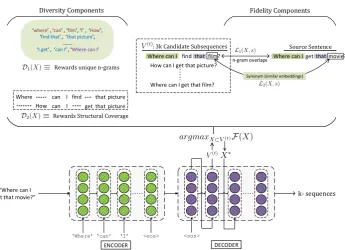
Figure 1: Overview of DiPS during decoding to generatekparaphrases. At each time step, a set ofN sequences (V(t)) is used to determinek < Nsequences (X∗) via submodular maximization . The above figure illustrates the motivation behind each submodular component. Please see Section4for details.
cally combines a sentence encoder with a diversity inducing decoder.
4.1 Overview
Our approach is built upon SEQ2SEQframework.
We first feed the tokenized source sentence to the encoder. The task of the decoder is to take as in-put the encoded representation and produce the respective paraphrase. To achieve this, we train the model using standard cross entropy loss be-tween the generated sequence and the target para-phrase. Upon completion of training, instead of using greedy decoding or standard beam search, we use a modified decoder where we incorporate a submodular objective to obtain high quality para-phrases. Please refer to Figure 1for an overview of the proposed method.
During the generation phase, the encoder takes the source sentence as input and feeds its representa-tion to the decoder to initiate the decoding process. At each time-stept, we consider N most proba-ble subsequences since they are likely to be well-formed. Based on optimization of our submodular objective, a subset of sizek < N are selected and sent as input to the next time step t+ 1for fur-ther generation. The process is repeated until de-sired output lengthT or<eos>token, whichever comes first.
4.2 Monotone Submodular Objectives
We design a parameterized class of submodular functions tailored towards the task of paraphrase generation. LetV(t)be the ground set of possible subsequences at time stept. We aim to determine a setX ⊆V(t) that retains certainfidelityas well asdiversity. Hence, we model our submodular ob-jective function as follows:
X∗ = argmax
X⊆V(t)
F(X) s.t.|X| ≤k (2)
where k is our budget (desired number of para-phrases) andF is defined as:
F(X) =λL(X, s) + (1−λ)D(X) (3)
Heresis the source sentence,L(X, s)andD(X)
measurefidelity anddiversity, respectively. λ ∈ [0,1]is the trade-off coefficient. This formulation clearly brings out the trade-off between the two key characteristics.
Fidelity
class of monotone submodular functions (Stobbe and Krause,2010)
f(X) =X
i∈U
µiφi(mi(X)) (4)
where U is the set of features to be defined later, µi ≥ 0 is the feature weight, mi(X) = P
x∈Xmi(x) is non-negative modular function
andφi is a non-negative non-decreasing concave
function. Based on the analysis of concave func-tions in (Kirchhoff and Bilmes,2014), we use the simple square root function asφ(φ(a) = √a) in both of our fidelity objectives defined below.
We consider two complementary notions of sen-tence similarity namely syntactic and semantic. To capture syntactic information we define the fol-lowing function:
L1(X, s) =µ1 v u u t
X
x∈X N X
n=1
βn|x
n-gram∩sn-gram|
(5) where |xn-gram ∩ sn-gram| represents the number
of overlapping n-grams between the source and the candidate sequence x for different values of
n ∈ {1, . . . , N}(we use N = 3 ). Since longer n-gram overlaps are more valuable, we setβ >1. This function inherently increases the BLEU score between the source and the generated sentences.
We address the semantic aspect of fidelity by devising a function based on the word embeddings of source and generated sentences. We define em-bedding based similarity between two sentences as,
S(x, s) = 1 |x|
X
wi∈x
argmax
wj∈s
ψ(vwi,vwj) (6)
wherevwiis the word embedding for tokenwiand ψ(vwi,vwj) is the gaussian radial basis function
(rbf)1. For each word in the candidate sequencex, we find the best matching word in the source sen-tence using word level similarity. Using the above mentioned measure for embedding similarity we use the following submodular function:
L2(X, s) =µ2 s
X
x∈X
S(x, s) (7)
1We find gaussian rbf to work better than other similarity
metrics such as cosine similarity
This function helps increase the semantic homo-geneity between the source and generated se-quences. The above defined functions (Equation 5,7) are compositions of non-decreasing concave functions and modular functions. Thus, staying in the realm of the class of monotone submodu-lar functions mentioned in Equation4, we define fidelity functionL(X, s) =L1(X, s) +L2(X, s)
Diversity
Ensuring high fidelity often comes at the cost of producing sequences that only slightly differ from each other. To encourage diversity in the gener-ation process it is desirable to reward sequences with higher number of distinct n-grams as com-pared to others in the ground set V(t). Accord-ingly, we propose to use the following function:
D1(X) =µ3 N X
n=1
βn
[
x∈X
xn−gram
(8)
For β = 1, D1(X) denotes the number of
dis-tinct n-grams present in the set X. Since shorter n-grams contribute more towards diversity, we set
β < 1, thereby giving more value to shorter n-grams. It is easy to see that this function is mono-tone nodecreasing as the number of distinct n-grams can only increase with the addition of more sequences. To see thatD1(X)is submodular,
con-sider adding a new sequence to two sets of se-quences, one a subset of the other. Intuitively, the increment in the number of distinct n-grams when adding a new sequence to the smaller set should be larger than the increment when adding it to the larger set, as the distinct n-grams in the new se-quence might have already been covered by the sequences in the larger set.
coverage function is naturally monotone submod-ular and is defined as:
D2(X) =µ4 X
xi∈V(t)
X
xj∈X
R(xi, xj) (9)
whereR(xi, xj) is an alignment based similarity
measure between two sequencesxi andxj given
by:
R(xi, xj) = 1−
EditDistance(xi, xj)
|xi|+|xj|
(10)
Note that R(xi, xj) will always lie in the range
[0,1].
Evidently, this method allows flexibility in terms of controlling diversity and fidelity. Our goal is to strike a balance between these two to obtain high-quality generations.
5 Experiments
5.1 Datasets
In this section we outline the datasets used for evaluating our proposed method. We specify the actual splits in Table2. Based on the task, we cat-egorize them into the following:
1. Intrinsic evaluation: To demonstrate the ef-ficacy of our method on fidelity and diversity, we use the standard Quora question pair2 dataset and the Twitter URL paraphrasing (Lan et al.,2017) dataset.
We train and evaluate the paraphrase gener-ation model on a subset of Quora question pairdataset which we refer to asQuora-Div. This subset comprises only positive examples (pairs which have been annotated as para-phrases).
We additionally perform in-domain data aug-mentation for the task of paraphrase recog-nition. For that, we augment sentences gen-erated through different paraphrasing model as positive samples to theQuora-PRdataset. Quora-PRis a subset ofQuora question pair dataset which contains positive as well as negative examples.
2. Data-augmentation: We exhibit the im-portance of samples generated through our method on the task of Data-augmentation us-ing three primary datasets. SNIPS (Coucke
2https://www.kaggle.com/c/quora-question-pairs
et al.,2018), Yahoo-L313 is used for intent-classification andTREC(Li and Roth,2002) is used for question classification. Each dataset is balanced in terms of the number of samples per classes.
Dataset Task Train Val. Test Classes
Quora-Div Intrinsic 120K 20K 5K N/A Twitter Intrinsic 100K 15K 3K N/A Quora-PR Intrinsic 40K 10K 40K 2
DATA-AUGMENTATION
SNIPS Intent 10k 1k 700 7 Yahoo-L31 Intent 4K 1K 1K 2 TREC Question 1K 200 500 6
Table 2: Dataset Statistics
5.2 Baseline
Several models have sought to increase diversity, albeit with different goals and techniques. How-ever, majority of the prior works in this area have focused on the task of producing diverse responses in dialog systems (Li et al., 2016; Ritter et al., 2011) and not paraphrasing. Given the lack of rel-evant baselines, we compare our model against the following methods:
1. SBS: Decoder which performs standard beam search during generation.
2. DBS: An alternative of beam search to incor-porate diversity. (Vijayakumar et al.,2018)
3. DPP: Decoder based on Determinantal Point Processes (Kulesza et al.,2012)
4. SSR4: Decoder based on Subset Selection us-ing Simultaneous Sparse Recovery (Elhami-far et al.,2016)
We additionally, evaluate against the follow-ing paraphrase generation models:
5. VAE-SVG: VAE based generative frame-work for paraphrase generation. (Gupta et al., 2018)
6. RbM: Deep Reinforcement learning based paraphrase generation model. (Li et al.,2018)
Note that the first four baselines are trained using the same SEQ2SEQnetwork and differ only in the decoding phase.
3
https://webscope.sandbox.yahoo.com/
4Exact formulation of the SSR and DPP can be found in
Quora-Div Twitter
Model BLEU↑ METEOR↑ TERp↓ BLEU↑ METEOR↑ TERp↓
SBS 33.1 28.2 55.6 51.1 23.5 67.9
DBS (Vijayakumar et al.,2018) 30.9 28.3 57.5 47.1 22.1 69.0 VAE-SVG (Gupta et al.,2018) 33.4 25.6 63.2 46.7 25.2 67.1 RbM (Li et al.,2018) 29.4 29.5 62.5 47.7 29.3 68.7
DPP 30.5 27.9 57.3 44.8 21.4 71.4
SSR 28.7 26.8 58.7 41.3 20.0 74.4
[image:7.595.100.265.216.379.2]DiPS (Ours) 35.1 29.7 53.2 55.3 30.1 63.5
Table 3: Results on Quora-Div and Twitter dataset. Higher↑BLEU and METEOR score is better whereas lower↓
TERp score is better. Please see Section6for details.
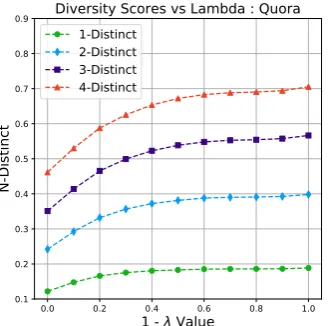
Figure 2: Effect of varying the trade-off coefficientλin DiPS on various diversity metrics on the Quora dataset.
5.3 Intrinsic Evaluation
1. Fidelity: To evaluate our method for fidelity of generated paraphrases, we use three ma-chine translation metrics which have been shown to be suitable for paraphrase evalua-tion task (Wubben et al.,2010): BLEU (Pa-pineni et al., 2002)(upto bigrams), ME-TEOR (Banerjee and Lavie,2005) and TER-Plus (Snover et al.,2009).
2. Diversity: We report degree of diversity by calculating the number of distinct n-grams (n
∈ {1,2,3,4}). The value is scaled by the number of generated tokens to avoid favoring long sequences.
In addition to fidelity and diversity, we evaluate the efficacy of our method by using the generated paraphrases as augmented samples in the task of paraphrase recognition on theQuora-PR dataset. We perform experiments with multiple augmenta-tion settings for the following classifiers:
1. LogReg: Simple Logistic Regression model. We use a set of hand-crafted features, the
de-tails of which can be found in the supplemen-tary.
2. SiameseLSTM: Siamese adaptation of LSTM to measure quality between two sentences (Mueller and Thyagarajan,2016)
We also perform ablation testing to highlight the importance of each submodular component. De-tails can be found in the supplementary section.
5.4 Data-Augmentation
We evaluate the importance of using high qual-ity paraphrases in two downstream classification tasks namely intent-classification and question-classification. Our original generation model is trained onQuora-Divquestion pairs. Since intent-classification and question-intent-classification contain questions, this setting seems like a good fit to per-form transfer learning. We perper-form experiments on the following standard classifier models:
1. LogRegDA: Simple logistic regression model trained using hand-crafted features. For details, please refer to the supplementary section.
2. LSTM: Single layered LSTM classification model.
In addition to SBS and DBS, we use the following data-augmentation baselines for comparison:
1. SynRep: Simple synonym replacement
2. ContAug: Data-augmentation scheme based on replacement of words with similar paradigmatic relations. (Kobayashi,2018)
5.5 Setup
Quora-Div Twitter
Model 1-distinct 2-distinct 3-distinct 4-distinct 1-distinct 2-distinct 3-distinct 4-distinct
SBS 12.8 24.8 35.3 46.6 20.0 30.9 38.1 44.6 VAE-SVG (Gupta et al.,2018) 15.8 22.5 27.6 31.8 19.3 28.2 33.3 37.2 DBS (Vijayakumar et al.,2018) 17.9 33.7 44.8 54.9 25.8 40.7 48.2 53.9 DPP 17.1 34.4 49.1 62.6 25.6 41.4 51.1 59.0 SSR 16.6 32.8 47.1 60.7 26.6 43.7 54.0 62.4 DiPS (Ours) 18.1 37.2 52.3 65.3 28.3 46.6 56.7 64.5
Table 4: Results on Quora-Div and Twitter dataset. Higher distinct scores imply better lexical diversity. Please see Section6for details.
LogRegDA LSTM
Model YahooL31 TREC SNIPS YahooL31 TREC SNIPS
[image:8.595.318.484.230.380.2]NoAug 62.7 82.2 93.4 64.8 94.2 94.7 SBS 63.6 84.6 93.8 65.4 94.4 94.7 DBS 63.3 84.2 94.1 65.6 95.2 96.1 SynRep 63.7 85.2 93.9 65.3 93.6 95.5 ContAug 63.8 86.0 95.3 66.3 95.8 96.4 DiPS(Ours) 64.9 86.6 96.0 66.7 96.4 97.1
Table 5: Accuracy scores of two classification models on various data-augmentation schemes. Please see Sec-tion6for details
the number of generated tokens is nearly half the source sequence length (token level) to avoid pos-sibly erroneous sentences. We then apply submod-ular maximization stochastically with probability
p at each time step. Since each candidate sub-sequence is extended by a single token at every time-step, information added might not necessar-ily be useful as our submodular components work on sentence level. This approach is time efficient and avoids redundant computations.
For each augmentation setting, we randomly se-lect sentences from the training data and generate its paraphrases. We then add them in the training data with the same label as that of the source sen-tence. We evaluate the performance on different classification models in terms of accuracy. Based on the formulation of the objective function, it should be clear that diversity would attain max-imum value at (or around)λ= 0albeit at the cost of fidelity. This is certainly not a desirable prop-erty for paraphrasing systems. To address this, we perform hyperparameter tuning forλvalue by ana-lyzing the trade-off between diversity and fidelity based on varying λvalues. In practice, diversity metric attains saturation at certainλrange (usually 0.2 - 0.5). This behaviour can be seen in Figure2. Corresponding plot for Twitter, the effect ofλon fidelity and additional details about the hyperpa-rameters can be found in the supplementary.
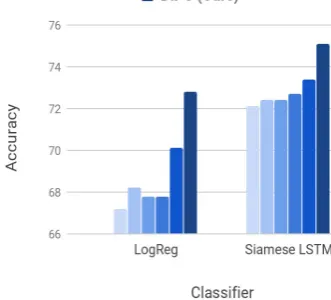
Figure 3: Comparison of accuracy scores of two para-phrase recognition models using different augmenta-tion schemes (Quora-PR). Both LogReg and Siame-seLSTM achieve the highest boost in performance when augmented with samples generated using DiPS
6 Results
Our experiments were geared towards answering the following primary questions:
Q1. Is DiPS able to generate diverse paraphrases without compromising on fidelity? (Section 6.1)
Q2. Are paraphrase generated by DiPS useful in data-augmentation? (Section6.2)
6.1 Intrinsic Evaluation
without compromising on fidelity. Diversity and fidelity scores are reported in Table4and Table3, respectively.
As described in Section 5.3, we evaluate the accuracy of paraphrase recognition models when provided with training data augmented using dif-ferent schemes. It is reasonable to expect that high quality paraphrases would tend to yield better results on in-domain paraphrase recognition task. We observe that using the paraphrases generated by DiPS helps in achieving substantial gains in accuracy over other baseline schemes. Figure 3 showcases the effect of using paraphrases gener-ated by our method as compared to other compet-itive paraphrasing methods.
6.2 Data-augmentation
Data Augmentation results for intent and question classification are shown in Table5. While, SBS does not offer much lexical variability, DBS of-fers high diversity at the cost of fidelity. SynRep and ContAug are augmentation schemes which are limited by the amount of structural variations they can offer. DiPS on the other hand provides gen-eration having high structural variations without compromising on fidelity. The boost in accuracy scores on both the types of classification models is indicative of the importance of using high quality paraphrases for data-augmentation.
7 Conclusion
In this paper, we have proposed DiPS, a model which generates high quality paraphrases by max-imizing a novel submodular objective function de-signed specifically for paraphrasing. In contrast to prior works which focus exclusively either on fidelity or diversity, a submodular function based approach offers a large degree of freedom to con-trol fidelity and diversity. Through extensive ex-periments on multiple standard datasets, we have demonstrated the effectiveness of our approach over numerous baselines. We observe that the di-verse paraphrases generated are not only interest-ing and meaninterest-ing preservinterest-ing, but are also helpful in data augmentation. We showcase that using mul-tiple settings on the task of intent and question classification. We hope that our approach will be useful not only for paraphrase generation and data augmentation, but also for other NLG problems in conversational agents and text summarization.
Acknowledgments
We thank the anonymous reviewers for their con-structive comments. This research is supported in part by the Ministry of Human Research Develop-ment (GovernDevelop-ment of India), Amazon and travel gifts from Microsoft Research (MSR) India and the Tata Trusts.
References
Peter G Anick and Suresh Tipirneni. 1999. The para-phrase search assistant: terminological feedback for iterative information seeking. In Proceedings of the 22nd annual international ACM SIGIR confer-ence on Research and development in information retrieval, pages 153–159. ACM.
Francis Bach et al. 2013. Learning with submodu-lar functions: A convex optimization perspective.
Foundations and TrendsR in Machine Learning, 6(2-3):145–373.
Dzmitry Bahdanau, Kyunghyun Cho, and Yoshua Ben-gio. 2014. Neural machine translation by jointly learning to align and translate. arXiv preprint arXiv:1409.0473.
Satanjeev Banerjee and Alon Lavie. 2005. Meteor: An automatic metric for mt evaluation with improved correlation with human judgments. InProceedings of the acl workshop on intrinsic and extrinsic evalu-ation measures for machine translevalu-ation and/or sum-marization, pages 65–72.
Delphine Bernhard and Iryna Gurevych. 2008. An-swering learners’ questions by retrieving question paraphrases from social q&a sites. InProceedings of the third workshop on innovative use of NLP for building educational applications, pages 44–52. As-sociation for Computational Linguistics.
Ziqiang Cao, Chuwei Luo, Wenjie Li, and Sujian Li. 2017. Joint copying and restricted generation for paraphrase.
Alice Coucke, Alaa Saade, Adrien Ball, Th´eodore Bluche, Alexandre Caulier, David Leroy, Cl´ement Doumouro, Thibault Gisselbrecht, Francesco Calt-agirone, Thibaut Lavril, Ma¨el Primet, and Joseph Dureau. 2018. Snips voice platform: an embedded spoken language understanding system for private-by-design voice interfaces. CoRR, abs/1805.10190.
Ehsan Elhamifar, Guillermo Sapiro, and S Shankar Sastry. 2016. Dissimilarity-based sparse subset se-lection. IEEE transactions on pattern analysis and machine intelligence, 38(11):2182–2197.
Ehsan Elhamifar, Guillermo Sapiro, and Rene Vidal. 2012. Finding exemplars from pairwise dissimilar-ities via simultaneous sparse recovery. InAdvances in Neural Information Processing Systems, pages 19–27.
Anthony Fader, Luke Zettlemoyer, and Oren Etzioni. 2013. Paraphrase-driven learning for open question answering. InProceedings of the 51st Annual Meet-ing of the Association for Computational LMeet-inguistics (Volume 1: Long Papers), volume 1, pages 1608– 1618.
Jenny Rose Finkel, Christopher D Manning, and An-drew Y Ng. 2006. Solving the problem of cascading errors: Approximate bayesian inference for linguis-tic annotation pipelines. InProceedings of the 2006 Conference on Empirical Methods in Natural Lan-guage Processing, pages 618–626. Association for Computational Linguistics.
S Fujishige. 2005. Submodular functions and opti-mization. Annals of Discrete Mathematics, 58.
Kevin Gimpel, Dhruv Batra, Chris Dyer, and Gregory Shakhnarovich. 2013. A systematic exploration of diversity in machine translation. InProceedings of the 2013 Conference on Empirical Methods in Nat-ural Language Processing, pages 1100–1111.
Ankush Gupta, Arvind Agarwal, Prawaan Singh, and Piyush Rai. 2018. A deep generative framework for paraphrase generation. InAAAI Conference on Arti-ficial Intelligence.
Rishabh K Iyer and Jeff A Bilmes. 2013. Submodular optimization with submodular cover and submodu-lar knapsack constraints. InAdvances in Neural In-formation Processing Systems, pages 2436–2444.
Mohit Iyyer, John Wieting, Kevin Gimpel, and Luke Zettlemoyer. 2018. Adversarial example generation with syntactically controlled paraphrase networks. InProceedings of the 2018 Conference of the North American Chapter of the Association for Computa-tional Linguistics: Human Language Technologies, Volume 1 (Long Papers), volume 1, pages 1875– 1885.
Stefanie Jegelka and Jeff Bilmes. 2011. Submodular-ity beyond submodular energies: coupling edges in graph cuts.
Diederik P Kingma and Jimmy Ba. 2014. Adam: A method for stochastic optimization. arXiv preprint arXiv:1412.6980.
Diederik P Kingma and Max Welling. 2013. Auto-encoding variational bayes. arXiv preprint arXiv:1312.6114.
Katrin Kirchhoff and Jeff Bilmes. 2014. Submod-ularity for data selection in machine translation. In Proceedings of the 2014 Conference on Em-pirical Methods in Natural Language Processing (EMNLP), pages 131–141.
Sosuke Kobayashi. 2018. Contextual augmentation: Data augmentation by words with paradigmatic re-lations. In Proceedings of the 2018 Conference of the North American Chapter of the Association for Computational Linguistics: Human Language Tech-nologies, Volume 2 (Short Papers), volume 2, pages 452–457.
Vladimir Kolmogorov and Ramin Zabih. 2002. What energy functions can be minimized via graph cuts? In European conference on computer vision, pages 65–81. Springer.
Andreas Krause and Daniel Golovin. Submodular function maximization.
Andreas Krause and Carlos Guestrin. 2011. Submod-ularity and its applications in optimized information gathering. ACM Transactions on Intelligent Systems and Technology (TIST), 2(4):32.
Alex Krizhevsky, Ilya Sutskever, and Geoffrey E Hin-ton. 2012. Imagenet classification with deep con-volutional neural networks. In Advances in neural information processing systems, pages 1097–1105.
Alex Kulesza, Ben Taskar, et al. 2012. Determinantal point processes for machine learning. Foundations and TrendsR in Machine Learning, 5(2–3):123– 286.
Wuwei Lan, Siyu Qiu, Hua He, and Wei Xu. 2017. A continuously growing dataset of sentential para-phrases. InProceedings of the 2017 Conference on Empirical Methods in Natural Language Process-ing, pages 1224–1234.
Jiwei Li, Michel Galley, Chris Brockett, Jianfeng Gao, and Bill Dolan. 2015. A diversity-promoting objec-tive function for neural conversation models. arXiv preprint arXiv:1510.03055.
Jiwei Li, Michel Galley, Chris Brockett, Jianfeng Gao, and Bill Dolan. 2016. A diversity-promoting objec-tive function for neural conversation models. In Pro-ceedings of the 2016 Conference of the North Amer-ican Chapter of the Association for Computational Linguistics: Human Language Technologies, pages 110–119.
Jiwei Li and Dan Jurafsky. 2016. Mutual information and diverse decoding improve neural machine trans-lation.arXiv preprint arXiv:1601.00372.
Xin Li and Dan Roth. 2002. Learning question clas-sifiers. In Proceedings of the 19th international conference on Computational linguistics-Volume 1, pages 1–7. Association for Computational Linguis-tics.
Zichao Li, Xin Jiang, Lifeng Shang, and Hang Li. 2018. Paraphrase generation with deep reinforce-ment learning. In Proceedings of the 2018 Con-ference on Empirical Methods in Natural Language Processing, pages 3865–3878. Association for Com-putational Linguistics.
Hui Lin and Jeff Bilmes. 2011. A class of submodu-lar functions for document summarization. In Pro-ceedings of the 49th Annual Meeting of the Associ-ation for ComputAssoci-ational Linguistics: Human Lan-guage Technologies-Volume 1, pages 510–520. As-sociation for Computational Linguistics.
Kathleen R McKeown. 1983. Paraphrasing questions using given and new information. Computational Linguistics, 9(1):1–10.
Jonas Mueller and Aditya Thyagarajan. 2016. Siamese recurrent architectures for learning sentence similar-ity.
Preksha Nema, Mitesh M Khapra, Anirban Laha, and Balaraman Ravindran. 2017. Diversity driven atten-tion model for query-based abstractive summariza-tion. InProceedings of the 55th Annual Meeting of the Association for Computational Linguistics (Vol-ume 1: Long Papers), volume 1, pages 1063–1072.
George L Nemhauser, Laurence A Wolsey, and Mar-shall L Fisher. 1978. An analysis of approximations for maximizing submodular set functionsi. Mathe-matical programming, 14(1):265–294.
Sergiu Nisioi, Sanja ˇStajner, Simone Paolo Ponzetto, and Liviu P Dinu. 2017. Exploring neural text sim-plification models. In Proceedings of the 55th An-nual Meeting of the Association for Computational Linguistics (Volume 2: Short Papers), volume 2, pages 85–91.
Kishore Papineni, Salim Roukos, Todd Ward, and Wei-Jing Zhu. 2002. Bleu: a method for automatic eval-uation of machine translation. In Proceedings of the 40th annual meeting on association for compu-tational linguistics, pages 311–318. Association for Computational Linguistics.
Ankur Parikh, Oscar T¨ackstr¨om, Dipanjan Das, and Jakob Uszkoreit. 2016. A decomposable attention model for natural language inference. In Proceed-ings of the 2016 Conference on Empirical Methods in Natural Language Processing, pages 2249–2255.
Aaditya Prakash, Sadid A Hasan, Kathy Lee, Vivek Datla, Ashequl Qadir, Joey Liu, and Oladimeji Farri. 2016. Neural paraphrase generation with stacked residual lstm networks. arXiv preprint arXiv:1610.03098.
Alexander J Ratner, Henry Ehrenberg, Zeshan Hussain, Jared Dunnmon, and Christopher R´e. 2017. Learn-ing to compose domain-specific transformations for data augmentation. InAdvances in Neural Informa-tion Processing Systems, pages 3239–3249.
Alan Ritter, Colin Cherry, and William B Dolan. 2011. Data-driven response generation in social media. In
Proceedings of the 2011 Conference on Empirical Methods in Natural Language Processing, pages 583–593.
Abigail See, Peter J Liu, and Christopher D Manning. 2017. Get to the point: Summarization with pointer-generator networks. InProceedings of the 55th An-nual Meeting of the Association for Computational Linguistics (Volume 1: Long Papers), volume 1, pages 1073–1083.
Matthew Snover, Nitin Madnani, Bonnie J Dorr, and Richard Schwartz. 2009. Fluency, adequacy, or hter?: exploring different human judgments with a tunable mt metric. In Proceedings of the Fourth Workshop on Statistical Machine Translation, pages 259–268. Association for Computational Linguis-tics.
Yiping Song, Rui Yan, Yansong Feng, Yaoyuan Zhang, Dongyan Zhao, and Ming Zhang. 2018. Towards a neural conversation model with diversity net using determinantal point processes. InAAAI.
Peter Stobbe and Andreas Krause. 2010. Efficient min-imization of decomposable submodular functions. InAdvances in Neural Information Processing Sys-tems, pages 2208–2216.
Ashwin Vijayakumar, Michael Cogswell, Ramprasaath Selvaraju, Qing Sun, Stefan Lee, David Crandall, and Dhruv Batra. 2018. Diverse beam search for im-proved description of complex scenes. AAAI Con-ference on Artificial Intelligence.
William Yang Wang and Diyi Yang. 2015. That’s so annoying!!!: A lexical and frame-semantic em-bedding based data augmentation approach to auto-matic categorization of annoying behaviors using# petpeeve tweets. InProceedings of the 2015 Con-ference on Empirical Methods in Natural Language Processing, pages 2557–2563.
Sander Wubben, Antal Van Den Bosch, and Emiel Krahmer. 2010. Paraphrase generation as monolin-gual translation: Data and evaluation. In INLGC, pages 203–207. ACL.
Wei Xu, Chris Callison-Burch, and Courtney Napoles. 2015. Problems in current text simplification re-search: New data can help. Transactions of the Association of Computational Linguistics, 3(1):283– 297.