4086
A Large-Scale Study of the Effects of Word Frequency and Predictability
in Naturalistic Reading
Cory Shain Department of Linguistics The Ohio State University
Abstract
A number of psycholinguistic studies have fac-torially manipulated words’ contextual pre-dictabilities and corpus frequencies and shown separable effects of each on measures of hu-man sentence processing, a pattern which has been used to support distinct mechanisms un-derlying prediction on the one hand and lex-ical retrieval on the other. This paper exam-ines the generalizability of this finding to more realistic conditions of sentence processing by studying effects of frequency and predictabil-ity in three large-scale naturalistic reading cor-pora. Results show significant effects of word frequency and predictability in isolation but no effect of frequency over and above predictabil-ity, and thus do not provide evidence of dis-tinct mechanisms. The non-replication of sep-arable effects in a naturalistic setting raises doubts about the existence of such a distinc-tion in everyday sentence comprehension. In-stead, these results are consistent with previ-ous claims that apparent effects of frequency are underlyingly effects of predictability.
1 Introduction
Are there distinct effects of a word’s frequency versus predictability in human sentence compre-hension? Recent evidence implicates prediction as a major organizing principle in cognition (Bubic et al.,2010;Singer et al.,2018;Keller and Mrsic-Flogel,2018), and psycholinguists have long stud-ied the role of prediction in human sentence pro-cessing and its relation to other comprehension mechanisms (Marslen-Wilson, 1975; Kutas and Hillyard, 1984; MacDonald et al., 1994; Tanen-haus et al.,1995;Hale,2001;Norris,2006;Levy,
2008; Frank and Bod, 2011). Some prominent theories of word recognition claim that ease of lexical access is modulated by the strength of a word’s representation in memory, independently
of contextual factors that guide prediction ( Seiden-berg and McClelland,1989;Coltheart et al.,2001;
Harm and Seidenberg,2004). Other theories hold that apparent effects of frequency are underlyingly effects of predictability (Norris,2006;Levy,2008;
Rasmussen and Schuler,2018).
A number of studies using constructed stim-uli that factorially manipulate word frequency and predictability have found separable additive ef-fects of each, suggesting distinct influences on lexical processing (see Staub, 2015 for a re-view). This paper examines the generalizability of these findings to typical sentence comprehension by searching for separable effects of frequency and n-gram predictability using deconvolutional time series regression (DTSR) models (Shain and Schuler, 2018) fitted to three large naturalistic reading corpora: Natural Stories (Futrell et al.,
2018), Dundee (Kennedy et al.,2003), and UCL (Frank et al.,2013). While results show evidence of both frequency and predictability effects in iso-lation, they show no effect of frequency over pre-dictability and thus do not support the existence of separable effects. They are instead consistent with either (1) an account of apparent frequency effects as epiphenomena of predictive processing (Norris,2006;Levy,2008) or (2) a more circum-scribed role for frequency effects in naturalistic reading than constructed experiments suggest.
2 Background and Related Work
2.1 Frequency and Predictability in Human Sentence Processing
It has long been recognized that low-frequency words are harder to process (Inhoff and Rayner,
(1) a. I have abottle. b. I have akettle.
However, context can dramatically alter these pat-terns by changing words’ predictability (Ehrlich and Rayner,1981):
(2) a. the pot calling thebottleblack
b. the pot calling thekettleblack
Some models of word recognition (Seidenberg and McClelland, 1989; Coltheart et al., 2001;
Harm and Seidenberg, 2004) posit a context-independent lexical retrieval mechanism, distinct from any mechanisms for predictive coding, with processing cost proportional to the strength of a word’s representation in memory (a function of lexical frequency). Such a view predicts separable effects of frequency and predictability in human language comprehension. Other models (Hale,
2001;Norris, 2006;Levy, 2008;Rasmussen and Schuler,2018) posit no such context-independent retrieval mechanism, and instead propose a uni-fied comprehension mechanism that incrementally reallocates resources between possible interpreta-tions of the unfolding sentence, with processing cost proportional to the amount of information (resource reallocation) contributed by each new word. Such a view predicts no separable effects of frequency and predictability because lexical fre-quencies are subsumed into the incremental prob-ability model.
Consistently with the first hypothesis, previous studies have shown separable additive effects of frequency and predictability by factorially manip-ulating corpus frequency and cloze predictability (Rayner et al., 2004;Ashby et al., 2005; Gollan et al., 2011;Staub and Benatar,2013, see Staub, 2015 for a review). However, cloze estimates poorly distinguish degrees of low contextual prob-ability (Smith and Levy, 2013), and constructed stimuli, while affording direct control over lin-guistic variables, may fail to reflect the typical distributional characteristics of the language, lack context, and/or inadvertently trigger suspension of the usual processes of pragmatic inference due to the absence of an overarching discourse (Demberg and Keller,2008;Hasson and Honey,2012;Shain et al.,2018). It is therefore not yet clear whether frequency and predictability effects can be sepa-rated in a more realistic setting.
2.2 The Naturalistic Experimental Paradigm
Concerns about the ecological validity of con-structed stimuli can be addressed by the use of naturalistic stimuli (e.g. stories, newspaper arti-cles, persuasive pieces, etc.). Naturalistic exper-iments are therefore an important complement to constructed experiments in the study of cognitive processes (Hasson and Honey,2012).
However, naturalistic experiments introduce their own challenges. Without the ability to factorially manipulate frequency and predictabil-ity, naturalistic studies must confront the natural collinearity between these two variables in ordi-nary language (Demberg and Keller, 2008). Fur-thermore, because naturalistic stimuli do not de-fine a critical region of the stimulus, responses are generally modeled word-by-word (Demberg and Keller, 2008; Frank and Bod, 2011; Smith and Levy,2013;van Schijndel and Schuler,2015). It is standard psycholinguistic practice to do so through ablative likelihood ratio testing (LRT) of linear mixed effects regression (LMER) models (Bates et al., 2015) fitted to the dependent vari-able of interest (e.g. fixation duration) (Demberg and Keller,2008;Frank and Bod,2011;van Schi-jndel and Schuler,2015;Shain et al.,2016). How-ever, this approach has important disadvantages. First, naturalistic data constitute time series that may violate the independence assumptions of lear regression and therefore confound model in-terpretation and hypothesis testing (Baayen et al.,
2017,2018;Shain and Schuler, 2018). One ma-jor such confound istemporal diffusion(i.e. a lin-gering response to stimuli), which can be brought under statistical control through deconvolutional time series regression (DTSR) models that directly estimate temporal structure in the relationships be-tween predictors and response (Shain and Schuler,
2018). Second, LRT implicitly evaluates on in-sample data, making it challenging to diagnose overfitting and to assess external validity (Vasishth et al.,2018). This can be addressed through out-of-sample non-parametric tests, such as the paired permutation test widely used in machine learning (Demˇsar,2006).
3 Experimental Setup
ad-Effect estimate (log-ms)
[image:3.595.105.496.65.114.2]Corpus SentPos Trial Rate WordLen SaccLen PrevFix Unigram 5-gram Natural Stories 0.0098 -0.0216 -0.3069 — — 0.0158 -0.0018 0.0174 Dundee -0.0085 -0.0052 -0.0277 0.0068 -0.0021 -0.0178 -0.0067 0.0117 UCL 0.0524 -0.1330 0.0023 0.0221 0.0778 0.0005 0.0184
Table 1: Effect estimates in log-ms by corpus, computed as the IRF integral over the longest time offset seen in training. Following psycholinguistic convention, unigrams and 5-grams have opposite sign (log prob vs. surprisal). In UCL,sentence positionandtrialare identical (sentences were shuffled).
Corpus ρ
Natural Stories -0.78 Dundee -0.73 UCL -0.74
Table 2: Pearson’s correlation between 5-gram sur-prisalandunigram log probabilityby corpus.
dress the challenges of Section 2.2. The prob-lem of temporal diffusion is addressed by us-ing DTSR models rather than LMER (see Ap-pendixAfor implementation details). The prob-lem of external validity is addressed by using held-out paired permutation testing rather than LRT, thus basing the hypothesis test directly on gener-alization error. The possibility that cloze probabil-ities are poor estimates of predictability for low-frequency words is addressed by operationalizing predictability as 5-gram surprisal generated by a large-vocabulary statistical language model. The natural collinearity of frequency and predictabil-ity is addressed through the use of large-scale data that should permit subtle differentiation of collinear effects. Taken together, the corpora ex-amined in this study contain over one million fixa-tions generated by 243 human subjects. Although there is a large-magnitude correlation between un-igram log probability(frequency) and5-gram sur-prisal (predictability) in these corpora, as shown in Table2, synthetic experiments show that DTSR can faithfully identify models from much smaller data than that used here, even when all predic-tors are correlated at the 0.75 level (Shain,2018). Given the size of the data, failure to distinguish effects of frequency and predictability would raise doubts about the existence of such a separation in naturalistic reading.
3.1 Statistical Procedure
DTSR models are fitted separately to each of the Natural Stories (Futrell et al.,2018), Dundee (Kennedy et al., 2003), and UCL (Frank et al.,
2013) corpora.1Following previous investigations of this question (Rayner et al.,2004;Ashby et al.,
2005; Gollan et al., 2011, inter alia), frequency is estimated from corpus statistics — in this case, KenLM (Heafield et al., 2013) unigram models trained on the Gigaword 3 corpus (Graff and Cieri,
2003). Unlike previous studies using close esti-mates of predictability (Rayner et al.,2004;Ashby et al., 2005;Gollan et al., 2011, inter alia), pre-dictability is statistically estimated, again using KenLM models (5-gram) trained on Gigaword 3. This is both because (1) cloze norming all words contained in thousands of naturalistic sentences is prohibitive and (2) statistical language mod-els trained on large data can more reliably differ-entiate low probability continuations (Smith and Levy, 2013). Following recent work on predic-tion effects in naturalistic sentence comprehension (Demberg and Keller,2008;Frank and Bod,2011;
Smith and Levy, 2013), predictability estimates are encoded assurprisal by negating the 5-gram log probabilities.
The models assume ShiftedGamma impulse re-sponse functions (Shain and Schuler, 2018, see AppendixA) for each of these variables, as well as for the nuisance variablesword length,saccade length and an indicator variable for whether the previous word was fixated.2 To capture trends in the response at different timescales, the
mod-1
Natural Stories is a self-paced reading corpus containing 848,768 word fixations from 181 subjects reading narrative and informational texts. Dundee is an eye-tracking corpus containing 260,065 word fixations from 10 subjects reading newspaper editorials. UCL is an eye-tracking corpus contain-ing 53,070 fixations from 42 subjects readcontain-ing sentences taken from novels by amateur authors.
Although the sentences in UCL were randomized and pre-sented in isolation — and therefore subject to some of the concerns about constructed stimuli raised in Section2— they are included here because the stimuli are naturally occurring rather than constructed for a particular experimental purpose. The UCL results replicate the overall pattern of significance (Table3), and excluding them has no impact on the overall results.
2The variables
[image:3.595.134.227.178.219.2]Corpus
Comparison Pooled Natural Stories Dundee UCL 5-gram only vs. baseline 0.0001*** 0.0001*** 0.0001*** 0.0001***
Unigram only vs. baseline 0.0001*** 0.0001*** 0.0001*** 0.0001***
5-gram + Unigram vs. Unigram-only 0.0001*** 0.0001*** 0.0626 0.0006***
[image:4.595.123.480.64.125.2]5-gram + Unigram vs. 5-gram-only 0.1515 0.1831 0.0105 0.1491
Table 3: Held-out paired permutation testing results, both pooled (left) and by corpus (right).
els also include linear effects for the word’s in-dex in the sentence (sentence position) and docu-ment (trial). FollowingShain and Schuler(2018), in addition to the intercept, the models contain a convolved intercept (rate) designed to capture ef-fects of stimulus timing. The response used in all corpora is log fixation duration (go-past for eye-tracking).3 Outlier filtering is performed in each corpus following the procedures described in
Shain and Schuler(2018).
Approximately half the data in each corpus is used for training, with the remaining half reserved for held-out evaluation. Models in-clude by-subject random intercepts as well as by-subject random slopes and impulse response parameters for each predictor.4 Held-out hy-pothesis testing uses a “diamond” ablative struc-ture first ablating fixed effects for 5-gram sur-prisal and unigram log probability individually and then ablating both. All random effects are retained in all models. Comparisons use paired permutation tests of the by-item losses on the evaluation set, pooling across all cor-pora.5 Note that the non-parametric permuta-tion test permits this pooling procedure to unify the models from all three corpora into a single test, since (unlike LRT) permutation testing sup-ports out-of-sample comparison. Data processing was performed using the ModelBlocks toolchain (van Schijndel and Schuler, 2013), available
at https://github.com/modelblocks/
modelblocks-release. Model fitting was
performed using the DTSR software library (Shain and Schuler, 2018), available at https://
github.com/coryshain/dtsr. See the
ci-tations above for data access instructions.
3
The overall pattern of significance does not change when first-pass durations are used.
4By-word random intercepts are not included because of their potential to subsume frequency effects.
5To correct for different error variances, errors are rescaled by the joint standard deviation of the errors from the full and ablated models by corpus.
4 Results
Effect estimates6 from the full models are pre-sented in Table 1 and pooled statistical compar-isons are presented in the Pooled column of Ta-ble 3. If predictability and frequency effects are additive, all four comparisons in Table3should be significant. As shown, this is not the case. There is evidence that both frequency (unigram log prob-ability) and predictability (5-gram surprisal) in isolation reliably index processing difficulty, as shown by the significance of both effects over the baseline. However, when the effects are compared to each other, predictability explains significantly more variance than frequency but not vice versa.
This general pattern of results further obtains for each corpus individually, as shown by the Cor-puscolumn breakdown in Table3. One minor ex-ception is that neither predictability nor frequency improves significantly over the other in Dundee.7 The Dundee results are nevertheless consistent with an interpretation in which frequency and pre-dictability do not index distinct processing phe-nomena and inconsistent with an interpretation in which they do. These results thus provide no evi-dence of separable frequency and predictability ef-fects, whether the corpora are considered together or individually.
5 Discussion
As described in Section 4, results show no evi-dence of separable effects of frequency and pre-dictability in naturalistic reading. One possible explanation for this outcome is that 5-gram sur-prisal tracks human prediction effort better than cloze probabilities, in part because cloze proba-bilities are less reliable for infrequent words. Al-though countervailing evidence exists in the liter-ature (e.g. Smith and Levy, 2011 found effects of cloze but notn-gram probabilities in human
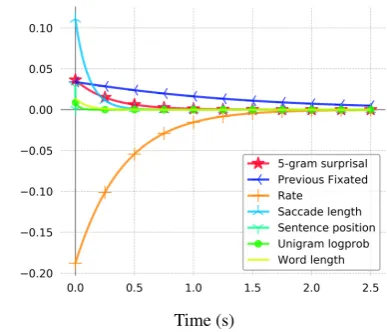
read-6The estimated impulse response functions that underlie these effect sizes are plotted in AppendixB.
ing times), in general this evidence is based on weak statistical competitors to cloze (e.g. Smith and Levy, 2011 used tri-grams). By contrast, re-cent trends in cognitive modeling point toward a correlation between the linguistic and psycholin-guistic performance of language models, such that more powerful models with lower perplexity also tend to correlate more strongly with measures of cognitive effort (Goodkind and Bicknell, 2018;
van Schijndel and Linzen, 2018). This suggests that apparent frequency effects may arise in part from poor estimates of predictability. Note that by using 5-gram surprisal rather than more powerful neural language models (Jozefowicz et al.,2016), the analysis described in this paper is conserva-tive in its attribution of variance to predictabil-ity. The failure of frequency is thus all the more compelling, since replacing 5-gram surprisal with surprisals obtained from more powerful language models would be unlikely to increase the explana-tory power of frequency.
Another potential explanation for the lack of separable effects of frequency and predictability is the use of naturalistic rather than constructed stim-uli. Neuroscientific evidence shows that domain-general executive control regions activate during the processing of some artificially constructed lan-guage stimuli (Kaan and Swaab,2002;Kuperberg et al., 2003; Novick et al., 2005; January et al.,
2009) but fail to activate during the processing of naturalistic stimuli (Blank and Fedorenko,2017). Such results have led some to argue that artifi-cially constructed experimental stimuli may in-crease general cognitive load by coercing compre-hension into problem solving, thereby engaging mechanisms that play little role in everyday sen-tence processing (Campbell and Tyler,2018, We-hbe et al., in prep; Diashek et al., in prep). It is possible that the language comprehension mecha-nisms that implement linguistic prediction (Shain et al., under review) are relatively less engaged while domain general executive control mecha-nisms are relatively more engaged during the pro-cessing of constructed stimuli presented without context, perhaps suppressing the influence of pre-ceding words on participants’ reading behavior. Further investigation is needed in order to explore this hypothesis.
In any case, it is a statistical truism that nega-tive results do not motivate acceptance of the null hypothesis. Thus, it is possible that frequency
ef-fects exist in naturalistic reading but are too small to be detected here. Nevertheless, the failure to find frequency effects in large naturalistic data in-dicates that any such effects are greatly attenuated in the processing of naturalistic texts in compari-son to the processing of constructed stimuli, which circumscribes the importance that any such effects might have in driving comprehension effort during typical reading.
6 Conclusion
This paper explored whether effects of word fre-quency and predictability are distinguishable in naturalistic sentence processing. Despite the size of the combined dataset, results showed no ev-idence of separable effects in naturalistic read-ing, contrary to previous findings of separable ef-fects in studies using constructed stimuli. This investigation thus shows no evidence of a dis-tinct, context-independent lexical retrieval mecha-nism modulated by strength of memory represen-tation (Seidenberg and McClelland, 1989; Colt-heart et al., 2001; Harm and Seidenberg, 2004), and instead favors a view in which sentence pro-cessing effort is driven by a mechanism that in-crementally reallocates resources between com-peting interpretations, subsuming any effects of raw lexical frequency (Norris,2006;Levy,2008;
Rasmussen and Schuler, 2018). The discrep-ancy between constructed and naturalistic exper-imental settings presents a puzzle for our un-derstanding of the mental processes that under-lie human language comprehension, and is per-haps linked to recent evidence that artificially con-structed linguistic stimuli can spuriously engage non-linguistic executive mechanisms by increas-ing general cognitive load as compared to natural-istic settings (Blank and Fedorenko,2017; Camp-bell and Tyler, 2018). Further investigation into the precise sources of the discrepancy may shed new light on the interplay between prediction and memory in human sentence processing.
Acknowledgements
References
Jane Ashby, Keith Rayner, and Charles Clifton. 2005. Eye movements of highly skilled and average read-ers: Differential effects of frequency and pre-dictability. The Quarterly Journal of Experimental Psychology Section A, 58(6):1065–1086.
Harald Baayen, Shravan Vasishth, Reinhold Kliegl, and Douglas Bates. 2017. The cave of shadows: Ad-dressing the human factor with generalized additive mixed models. Journal of Memory and Language, 94(Supplement C):206–234.
R Harald Baayen, Jacolien van Rij, Cecile de Cat, and Simon Wood. 2018. Autocorrelated errors in exper-imental data in the language sciences: Some solu-tions offered by Generalized Additive Mixed Mod-els. In Dirk Speelman, Kris Heylen, and Dirk Geer-aerts, editors, Mixed Effects Regression Models in Linguistics. Springer, Berlin.
Douglas Bates, Martin M¨achler, Ben Bolker, and Steve Walker. 2015. Fitting linear mixed-effects mod-els using lme4. Journal of Statistical Software, 67(1):1–48.
Idan Blank and Evelina Fedorenko. 2017. Domain-general brain regions do not track linguistic input as closely as language-selective regions. Journal of Neuroscience, pages 3616–3642.
Andreja Bubic, D Yves Von Cramon, and Ricarda I Schubotz. 2010. Prediction, cognition and the brain. Frontiers in human neuroscience, 4:25.
Karen L Campbell and Lorraine K Tyler. 2018. Language-related specific and domain-general systems in the human brain. Current opin-ion in behavioral sciences, 21:132–137.
Max Coltheart, Kathleen Rastle, Conrad Perry, Robyn Langdon, and Johannes Ziegler. 2001. DRC: a dual route cascaded model of visual word recognition and reading aloud. Psychological review, 108(1):204.
Vera Demberg and Frank Keller. 2008. Data from eye-tracking corpora as evidence for theories of syntactic processing complexity. Cognition, 109(2):193–210.
Janez Demˇsar. 2006. Statistical comparisons of clas-sifiers over multiple data sets. Journal of Machine Learning Research, 7(Jan):1–30.
Timothy Dozat. 2016. Incorporating Nesterov momen-tum into Adam. InICLR Workshop.
Susan F Ehrlich and Keith Rayner. 1981. Contextual effects on word perception and eye movements dur-ing readdur-ing. Journal of verbal learning and verbal behavior, 20(6):641–655.
Stefan L Frank and Rens Bod. 2011. Insensitivity of the Human Sentence-Processing System to Hierar-chical Structure.Psychological Science, 22(6):829– 834.
Stefan L Frank, Irene Fernandez Monsalve, Robin L Thompson, and Gabriella Vigliocco. 2013. Read-ing time data for evaluatRead-ing broad-coverage models of English sentence processing. Behavior Research Methods, 45(4):1182–1190.
Richard Futrell, Edward Gibson, Harry J . Tily, Idan Blank, Anastasia Vishnevetsky, Steven Piantadosi, and Evelina Fedorenko. 2018. The Natural Stories Corpus. In Proceedings of the Eleventh Interna-tional Conference on Language Resources and Eval-uation (LREC 2018), Paris, France. European Lan-guage Resources Association (ELRA).
Tamar H Gollan, Timothy J Slattery, Diane Golden-berg, Eva Van Assche, Wouter Duyck, and Keith Rayner. 2011. Frequency drives lexical access in reading but not in speaking: The frequency-lag hypothesis. Journal of Experimental Psychology: General, 140(2):186.
Adam Goodkind and Klinton Bicknell. 2018. Predic-tive power of word surprisal for reading times is a linear function of language model quality. In Pro-ceedings of the 8th Workshop on Cognitive Modeling and Computational Linguistics (CMCL 2018), pages 10–18.
David Graff and Christopher Cieri. 2003. English Gi-gaword LDC2003T05.
John Hale. 2001. A probabilistic Earley parser as a psycholinguistic model. InProceedings of the Sec-ond meeting of the North American Chapter of the Association for Computational Linguistics on Lan-guage technologies, pages 1–8.
Michael W Harm and Mark S Seidenberg. 2004. Com-puting the meanings of words in reading: coopera-tive division of labor between visual and phonologi-cal processes. Psychological review, 111(3):662.
Uri Hasson and Christopher J Honey. 2012. Fu-ture trends in Neuroimaging: Neural processes as expressed within real-life contexts. NeuroImage, 62(2):1272–1278.
Kenneth Heafield, Ivan Pouzyrevsky, Jonathan H Clark, and Philipp Koehn. 2013. Scalable modi-fied Kneser-Ney language model estimation. In Pro-ceedings of the 51st Annual Meeting of the Associa-tion for ComputaAssocia-tional Linguistics, pages 690–696, Sofia, Bulgaria.
Albrecht Werner Inhoff and Keith Rayner. 1986. Parafoveal word processing during eye fixations in reading: Effects of word frequency. Perception\& psychophysics, 40(6):431–439.
Rafal Jozefowicz, Oriol Vinyals, Mike Schuster, Noam Shazeer, and Yonghui Wu. 2016. Exploring the limits of language modeling. arXiv preprint arXiv:1602.02410.
Edith Kaan and Tamara Y Swaab. 2002. The brain cir-cuitry of syntactic comprehension. Trends in cogni-tive sciences, 6(8):350–356.
Georg B Keller and Thomas D Mrsic-Flogel. 2018. Predictive Processing: A Canonical Cortical Com-putation.Neuron, 100(2):424–435.
Alan Kennedy, James Pynte, and Robin Hill. 2003. The Dundee corpus. InProceedings of the 12th Eu-ropean conference on eye movement.
Diederik P Kingma and Jimmy Ba. 2014. Adam: A method for stochastic optimization. CoRR, abs/1412.6.
Gina R Kuperberg, Phillip J Holcomb, Tatiana Sit-nikova, Douglas Greve, Anders M Dale, and David Caplan. 2003. Distinct patterns of neural modula-tion during the processing of conceptual and syntac-tic anomalies. Journal of Cognitive Neuroscience, 15(2):272–293.
M Kutas and S A Hillyard. 1984. Brain potentials dur-ing readdur-ing reflect word expectancy and semantic as-sociation.Nature, 307(5947):161–163.
Roger Levy. 2008. Expectation-based syntactic com-prehension. Cognition, 106(3):1126–1177.
Maryellen C MacDonald, Neal J Pearlmutter, and Mark S Seidenberg. 1994. The lexical nature of syn-tactic ambiguity resolution. Psychological Review, 101(4):676–703.
William D Marslen-Wilson. 1975. Sentence Percep-tion as an Interactive Parallel Process. Science, 189(4198):226–228.
Yurii E Nesterov. 1983. A method for solving the convex programming problem with convergence rate O(1/kˆ2). In Dokl. Akad. Nauk SSSR, volume 269, pages 543–547.
Dennis Norris. 2006. The Bayesian Reader: Explain-ing word recognition as an optimal Bayesian deci-sion process. Psychological review, 113(2):327.
Jared M Novick, John C Trueswell, and Sharon L Thompson-Schill. 2005. Cognitive control and pars-ing: Reexamining the role of Brocas area in sen-tence comprehension. Cognitive, Affective,\& Be-havioral Neuroscience, 5(3):263–281.
Nathan E Rasmussen and William Schuler. 2018. Left-Corner Parsing With Distributed Associative Mem-ory Produces Surprisal and Locality Effects. Cogni-tive science, 42:1009–1042.
Keith Rayner, Jane Ashby, Alexander Pollatsek, and Erik D Reichle. 2004. The effects of frequency and predictability on eye fixations in reading: Implica-tions for the EZ Reader model. Journal of Experi-mental Psychology: Human Perception and Perfor-mance, 30(4):720.
Marten van Schijndel and Tal Linzen. 2018. A Neural Model of Adaptation in Reading. InEMNLP 2018, pages 4704–4710.
Marten van Schijndel and William Schuler. 2013. An Analysis of Frequency- and Memory-Based Pro-cessing Costs. InProceedings of Human Language Technologies: The 2013 Annual Conference of the North American Chapter of the ACL.
Marten van Schijndel and William Schuler. 2015. Hier-archic syntax improves reading time prediction. In Proceedings of NAACL-HLT 2015. Association for Computational Linguistics.
Mark S Seidenberg and James L McClelland. 1989. A distributed, developmental model of word recogni-tion and naming. Psychological review, 96(4):523.
Cory Shain. 2018. Deconvolutional time series regres-sion: A technique for modeling temporally diffuse effects. Technical report, The Ohio State University, Columbus.
Cory Shain, Marten van Schijndel, Richard Futrell, Ed-ward Gibson, and William Schuler. 2016. Mem-ory access during incremental sentence processing causes reading time latency. In Proceedings of the Computational Linguistics for Linguistic Complex-ity Workshop, pages 49–58. Association for Compu-tational Linguistics.
Cory Shain, Marten van Schijndel, and William Schuler. 2018. Deep syntactic annotations for broad-coverage psycholinguistic modeling. In Workshop on Linguistic and Neuro-Cognitive Re-sources (LREC 2018).
Cory Shain and William Schuler. 2018. Deconvolu-tional time series regression: A technique for mod-eling temporally diffuse effects. In Proceedings of the 2018 Conference on Empirical Methods in Nat-ural Language Processing.
Yosef Singer, Yayoi Teramoto, Ben D B Willmore, Jan W H Schnupp, Andrew J King, and Nicol S Harper. 2018. Sensory cortex is optimized for prediction of future input. eLife, 7:e31557.
Nathaniel J Smith and Roger Levy. 2011. Cloze but no cigar: The complex relationship between cloze, corpus, and subjective probabilities in language pro-cessing. InProceedings of the 33rd CogSci Confer-ence.
Adrian Staub. 2015. The effect of lexical predictability on eye movements in reading: Critical review and theoretical interpretation. Language and Linguistics Compass, 9(8):311–327.
Adrian Staub and Ashley Benatar. 2013. Individual differences in fixation duration distributions in read-ing. Psychonomic Bulletin & Review, 20(6):1304– 1311.
Michael K Tanenhaus, Michael J Spivey-Knowlton, Kathleen M Eberhard, and Julie C E Sedivy. 1995. Integration of visual and linguistic informa-tion in spoken language comprehension. Science, 268:1632–1634.
Shravan Vasishth, Daniela Mertzen, Lena A J¨ager, and Andrew Gelman. 2018. The statistical significance filter leads to overoptimistic expectations of replica-bility. Journal of Memory and Language, 103:151– 175.
Response
(log-ms)
[image:8.595.314.508.67.233.2]Time (s)
Figure 1: Natural Stories IRFs
Response
(log-ms)
[image:8.595.68.274.345.511.2]Time (s)
Figure 2: Dundee IRFs
Response
(log-ms)
Time (s)
Figure 3: UCL IRFs
A DTSR Implementation
The deconvolutional time series regression (DTSR) models used in this paper were fitted using the code repository released by Shain and Schuler (2018), available at: https:
//github.com/coryshain/dtsr. Models
used variational inference to fit the means and variances of independent normal posterior distri-butions over all model parameters assuming an improper uniform prior. Convolved predictors used the three-parameter ShiftedGamma impulse response function (IRF) kernel:
f(x;α, β, δ) = β
α(x−δ)α−1e−β(x−δ)
Γ(α) (1)
Posterior means for the IRF parameters were ini-tialized atα = 2,β = 5, andδ =−0.2, which de-fines a decreasing IRF with peak centered att= 0 that decays to near-zero within about 1s. Mod-els were fitted using the Adam optimizer (Kingma and Ba, 2014) with Nesterov momentum ( Nes-terov,1983;Dozat,2016), a constant learning rate of 0.01, and minibatches of size 1024. For compu-tational efficiency, histories were truncated at 128 timesteps. Prediction from the network used an exponential moving average of parameter iterates with a decay rate of 0.999, and models were eval-uated using maximum a posteriori estimates ob-tained by setting all parameters to their posterior means.8 Convergence was visually diagnosed.
[image:8.595.68.274.570.740.2]B Impulse response shapes