A Stacking Gated Neural Architecture
for Implicit Discourse Relation Classification
Lianhui Qin1,2, Zhisong Zhang1,2, Hai Zhao1,2,∗
1Department of Computer Science and Engineering,
Shanghai Jiao Tong University, Shanghai, 200240, China
2Key Laboratory of Shanghai Education Commission for Intelligent Interaction
and Cognitive Engineering, Shanghai Jiao Tong University, Shanghai, 200240, China
{qinlianhui, zzs2011}@sjtu.edu.cn,[email protected]
Abstract
Discourse parsing is considered as one of the most challenging natural language processing (NLP) tasks. Implicit discourse relation clas-sification is the bottleneck for discourse pars-ing. Without the guide of explicit discourse connectives, the relation of sentence pairs are very hard to be inferred. This paper proposes a stacking neural network model to solve the classification problem in which a convolu-tional neural network (CNN) is utilized for sentence modeling and a collaborative gated neural network (CGNN) is proposed for fea-ture transformation. Our evaluation and com-parisons show that the proposed model outper-forms previous state-of-the-art systems.
1 Introduction
As a fundamental task in natural language process-ing (NLP), discourse parsprocess-ing entails the discovery of the latent relational structure in multi-sentence level analysis. It is also central to many practical tasks such as question answering (Liakata et al., 2013; Jansen et al., 2014), machine translation (Meyer and Popescu-Belis, 2012; Meyer and Webber, 2013) and automatic summarization (Murray et al., 2006; ∗Corresponding author. This paper was partially supported by Cai Yuanpei Program (CSC No. 201304490199 and No. 201304490171), National Natural Science Foundation of China (No. 61170114, No. 61672343 and No. 61272248), National Basic Research Program of China (No. 2013CB329401), Ma-jor Basic Research Program of Shanghai Science and Tech-nology Committee (No. 15JC1400103), Art and Science In-terdisciplinary Funds of Shanghai Jiao Tong University (No. 14JCRZ04), and Key Project of National Society Science Foun-dation of China (No. 15-ZDA041).
Yoshida et al., 2014). Discourse parsing is also the shared task of CoNLL 2015 and 2016 (Xue et al., 2015; Xue et al., 2016), and many previous works previous on this task (Qin et al., 2016b; Li et al., 2016; Chen et al., 2015; Wang and Lan, 2016). In a discourse parser, implicit relation recognition has been the bottleneck due to lack of explicit connec-tives (like“because”or“and”) that can be strong indicators for the senses between adjacent clauses (Qin et al., 2016b; Pitler et al., 2009; Lin et al., 2014). This work therefore focuses on implicit re-lation recognition that infers the senses of the dis-course relations within adjacent sentence pairs.
Most previous works on PDTB implicit relation recognition only focus on one-versus-others binary classification problems of the top level four classes (Pitler et al., 2009; Zhou et al., 2010; Park and Cardie, 2012; Biran and McKeown, 2013; Ruther-ford and Xue, 2014; Braud and Denis, 2015). Tra-ditional classification methods directly rely on fea-ture engineering, based on bag-of-words, produc-tion rules, and some linguistically-informed fea-tures (Zhou et al., 2010; Rutherford and Xue, 2014). However, discourse relations root in seman-tics, which may be hard to recover from surface level feature, thus these methods did not report sat-isfactory performance. Recently, neural network (NN) models have shown competitive or even bet-ter results than traditional linear models with hand-crafted sparse features (Wang et al., 2016b; Zhang et al., 2016a; Jia and Zhao, 2014). They have been proved to be effective for many tasks (Qin et al., 2016a; Wang et al., 2016a; Zhang et al., 2016b; Wang et al., 2015; Wang et al., 2014; Cai and
Zhao, 2016), also including discourse parsing. Ji and Eisenstein (2015) adopt recursive neural net-work and incorporate with entity-augmented dis-tributed semantics. Zhang et al. (2015) explore a shallow convolutional neural network and achieve competitive performance. Although simple neural network has been shown effective, the result has not been quite satisfactory which suggests that there is still space for improving.
The concerned task could be straightforwardly formalized as a sentence-pair classification problem, which needs inferring senses solely based on the two arguments without cues of connectives. Two prob-lems should be carefully handled in this task: how to model sentences and how to capture the interactions between the two arguments. The former could be addressed by Convolutional Neural Network (CNN) which has been proved effective for sentence mod-eling (Kalchbrenner et al., 2014; Kim, 2014), while the latter is the key problem, which might need deep semantic analysis for the interaction of two argu-ments. To solve the latter problem, we propose collaborative gated neural network (CGNN) which is partially inspired by Highway Network whose gate mechanism achieves success (Srivastava et al., 2015). Our method will be evaluated on the bench-mark dataset against state-of-the-art methods.
The rest of the paper is organized as follows: Sec-tion 2 briefly describes our model, introducing the stacking architecture of CNN and CGNN, Section 3 shows the experiments and analysis, and Section 4 concludes this paper.
2 Method
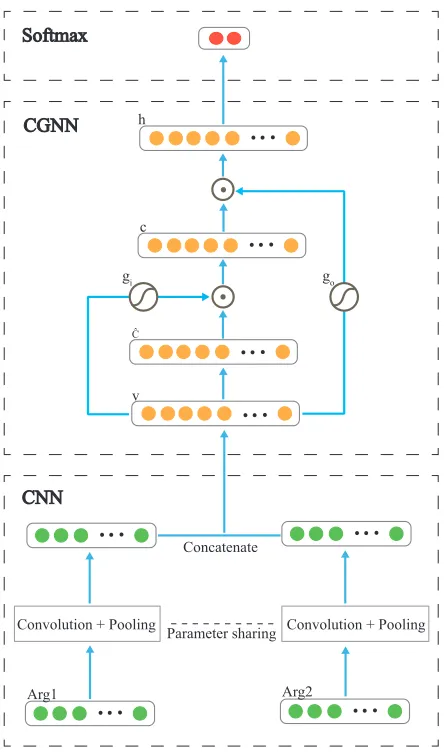
The architecture of the model, as shown in Figure 1, is straightforward. It can be divided into three parts: 1) CNN for modeling arguments; 2) CGNN unit for feature transformation; 3) a conventional softmax layer for the final classification. CNN is used to obtain the vector representations for the sentences, CGNN further captures and transforms the features for the final classification.
2.1 Convolutional Neural Network
As CNN has been broadly adopted for model-ing sentences, we will explain it in brevity. For two arguments, typical sentence modeling process
Softmax
CGNN
CNN
Convolution + Pooling
Concatenate
Convolution + Pooling Parameter sharing
Arg1 Arg2
v c h
gi
Ĉ
[image:2.612.320.542.68.445.2]go
Figure 1:Model Architecture
will be applied: sentence embedding (including embeddings for words and part-of-speech (POS) tags) through projection layer, convolution opera-tions (with multiple groups of filters) through the convolution layer, obtaining the sentence representa-tion through one-max-pooling. The two arguments will get their sentence vectors independently with-out any interfering, and the convolution operation will be the same by sharing parameters. The fi-nal argument-pair representation will be the vector
v which is concatenated from two sentence
COMP. CONT. EXP. TEMP. AVG CNN Only 39.07 54.73 65.94 30.19 47.48 CNN+MLP 37.81 56.30 69.44 32.29 48.96 CNN+LSTM 39.15 53.44 68.85 29.79 47.81 CNN+Highway 37.72 56.35 68.94 30.56 48.39 CNN+CGNN 41.55 57.32 71.50 35.43 51.45
Table 1:F1scores (%) with different models.
2.2 Collaborative Gated Neural Network
For implicit sense classification, the key is how to effectively capture the interactions between the two arguments. The interactions could be word pairs, phrase pairs or even the latent meaning of the two full arguments. Pitler et al. (2009) has shown that word pair features are helpful. To model these in-teractions, we have to make a full use of the sen-tence vectors obtained from CNN. However, com-mon neural hidden layers might be insufficient to deal with the challenge. We need to seek more pow-erful neural models, i.e., gated neural network.
In recent years, gated mechanism has gained pop-ularity in neural models. Although it is first in-troduced in the cells of recurrent neural networks, like Long-Short Term Memory (LSTM) (Hochreiter and Schmidhuber, 1997) and Gated Recurrent Unit (GRU) (Chung et al., 2014), traditional feed-forward neural models such as the Highway Network could also benefit from it (Srivastava et al., 2015). The existing studies show that the gated mechanism in highway network serves not only a means for eas-ier training, but also a tool to route information in a trained network.
Motivated by the idea of highway network, we propose a collaborative gated neural network (CGNN) for this task. The architecture of CGNN is illustrated in Figure 1, and it contains a sequence of transformations. First, the inner-cellˆcis obtained
through linear transformation and non-linear activa-tion on the input v, and this process is exactly the
operation of an ordinary neural layer.
ˆc= tanh(Wc·v+bc)
Meanwhile, the two gates gi andgo are calculated independently because they are only influenced by
the original input through different parameters:
gi =σ(Wi·v+bi)
go=σ(Wo·v+bo)
where theσ denotes sigmoid function which
guar-antees the values in the gates are in [0,1]. Two gated operations are applied sequentially, where a gated operation indicates the element-wise multiplication of an inner-cell and a gate. Between the two gated operations, a non-linear activation operation is ap-plied. The procedure could be formulated as fol-lows:
c=ˆcgi
h= tanh(c)go
where denotes element-wise multiplication, c is
the second inner-cell andhis the output of CGNN
unit.
Although the two gates are generated indepen-dently, they will work collaboratively because they control the information flow of the inner-cells se-quentially which resembles logical AND operation in a probabilistic version. In fact, the transforma-tions afterˆc will concern only element-wise
oper-ations which might give finer controls for each di-mension, and the information can only flow on the dimensions where both gates are “open”. This pro-cedure will help select the most crucial features.
The gates in this model are mainly used for rout-ing information from sentence-pairs vectors. When there is only one gate in our network, the model works similar to the highway network (Srivastava et al., 2015).
2.3 Output and Training
After the transformation of the CGNN unit, the transformed vectorh will be sent to a conventional
The training objectJwill be the cross-entropy er-rorEwithL2regularization:
E(ˆy, y) =−
l
X
j
yj ×log(P r(ˆyj))
J(θ) = 1
m
m
X
k
E(ˆy(k), y(k)) +λ 2kθk
2
whereyjis the gold label andyˆjis the predicted one. We adopt the diagonal variant of AdaGrad (Duchi et al., 2011) for the optimization process.
3 Experiments
3.1 Setting
As for the benchmark dataset, Penn Discourse Tree-bank (PDTB) (Prasad et al., 2008) corpus1 is used
for evaluation. In the PDTB, each discourse relation is annotated between two argument spans.
To be consistent with the setups of prior works, we formulate the implicit relation classification task as four one-versus-other binary classification prob-lems only using the four top level classes: COM -PARISON (COMP.), CONTINGENCY (CONT.), EX -PANSION (EXP.) and TEMPORAL (TEMP.). While different works include different relations of varying specificities, all of them include these four core rela-tions (Pitler et al., 2009). Following dataset splitting convention of the previous works, we use sections 2-20 for training, sections 21-22 for testing and sec-tions 0-1 for development set. The proposed model is possible to be extended for multi-class classifica-tion of discourse parsing, but for the comparisons with most of previous works, we will follow them and focus on the binary classification problems.
For other hyper-parameters of the model and training process, we fix the lengths of both the in-put arguments to be 80, and apply truncating or zero-padding when necessary. The dimensions for word embeddings and POS embeddings are respec-tively 300 and 50, and the embedding layer adopts a dropout of 0.2. The word embeddings are initial-ized with pre-trained word vectors usingword2vec2
(Mikolov et al., 2013) and other parameters are ran-domly initialized including POS embeddings. We
1http://www.seas.upenn.edu/˜pdtb/ 2http://www.code.google.com/p/word2vec
set the starting learning rate to 0.001. For CNN model, we utilize three groups of filters with win-dow widths of (2, 2, 2) and their filter numbers are all set to 1024. The hyper-parameters are the same for all models and we do not tune them individually.
3.2 Model Analysis
For transformation of sentence vectors, a sim-ple Multilayer Perceptron (MLP) layer could be a straightforward choice, while more complex neu-ral modules, such as LSTM and highway network, could also be considered. Our model utilizes a CGNN unit with refined gated mechanism for the transformation. Will the proposed CGNN really bring about further performance improvement? We now answer this question empirically.
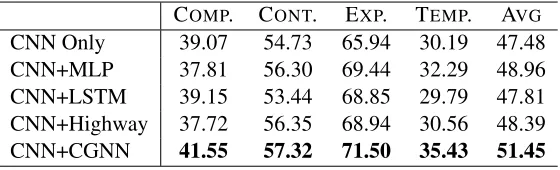
As shown in Table 1, CNN model usually per-forms well on its own. Utilizing an MLP layer or a Highway layer could improve the accuracies on CONTINGENCY, EXPANSION, TEMPORARYexcept for COMPARISON. Though the primary motivation of Highway is to ease gradient-based training of highly deep networks through utilizing gated units, it works merely as an ordinary MLP in the proposed model, which explains the reason that it performs like MLP. Despite one of four classes, COMPAR -ISON, not receiving performance improvement, in-troducing a non-linear transformation layer lets the classification benefit as a whole. “CNN+LSTM” de-notes the method of using LSTM to read the convo-lution sequence (without pooling operation), and it even does not perform better than MLP.
The CGNN achieves the best performance on all classes including COMPARISON. It gains 3.97% imrovement on average F1 score using CNN only model. We assume that CGNN is well-suited to work with CNN, adaptively transforming and com-bining local features detected by the individual fil-ters.
3.3 Results
COMP. CONT. EXP.+ TEMP. AVG.
F1 Acc F1 Acc F1 Acc F1 Acc F1 Acc
Pitler et al. (2009) 21.96 56.59 47.13 67.30 76.42 63.62 16.76 63.49 40.57 62.75 Zhou et al. (2010) 31.79 58.22 47.16 48.96 70.11 54.54 20.30 55.48 40.32 54.30 P&C (2012) 31.32 74.66 49.82 72.09 79.22 69.14 26.57 79.32 46.73 73.80 M&B (2013) 25.40 63.36 46.94 68.09 75.87 62.84 20.23 68.35 42.11 65.66 J& (2015) 35.93 70.27 52.78 76.95 80.02 69.80 27.63 87.11 49.09 76.03 B&D(2015) 36.36 - 55.76 - 61.76 - 29.30 - 45.80 -Chen et al. (2016) 40.17 - 54.76 - 80.62 - 31.32 - 51.72 -Current 41.55 71.22 57.32 73.80 80.96 68.44 35.43 84.32 53.82 74.45
Table 2:Comparisons ofF1scores (%) (symbol+means EXP. withEntrel).
P R F1
COMP.
R&Xue (2014) 27.34 72.41 39.70 Zhang et al.(2015) 22.00 67.76 33.22 Current 29.48 70.39 41.55
CONT. R&Xue (2014)Zhang et al.(2015) 39.80 75.29 52.0444.52 69.96 54.42 Current 50.69 65.95 57.32
EXP.
R&Xue (2014) 59.59 85.50 70.23 Zhang et al.(2015) 56.29 91.11 69.59 Current 60.81 86.76 71.50
TEMP.
R&Xue (2014) 18.52 63.64 28.69 Zhang et al.(2015) 20.22 62.35 30.54 Current 26.63 52.94 35.43
AVG.
[image:5.612.89.524.56.180.2]R&Xue (2014) 37.49 72.88 48.26 Zhang et al.(2015) 34.58 74.13 46.35 Current 41.90 69.01 51.45
Table 3:Comparisons ofF1scores (%) (EXP. withoutEntrel).
We compare with best-performed or competitive models including both traditional linear methods and recent neural methods. For traditional meth-ods: Pitler et al. (2009) use several linguistically in-formed features, including polarity tags, Levin verb classes, length of verb phrases, modality, context, and lexical features; Zhou et al. (2010) improve the performance through predicting connective words as features; Park and Cardie (2012) propose a locally-optimal feature set and further identify factors for feature extraction that can have a major impact per-formance, including stemming and lexicon look-up; Biran and McKeown (2013) collect word pairs from arguments of explicit examples to help the learning; Rutherford and Xue (2014) employ Brown cluster pair and coreference patterns for performance en-hancement. Several neural methods have also been included for comparison: Zhang et al. (2015) pro-pose a simplified neural network which has only
three different pooling operations (max, min, aver-age); Ji and Eisenstein (2015) compute distributed semantics representation by composition up the syn-tactic parse tree through recursive neural network; Braud and Denis (2015) consider shallow lexical features and word embeddings. Chen et al. (2016) replace the original words by word embeddings to overcome the data sparsity problem and they also utilize gated relevance network to capture the se-mantic interaction between word pairs. The gated network is different from ours but also works well.
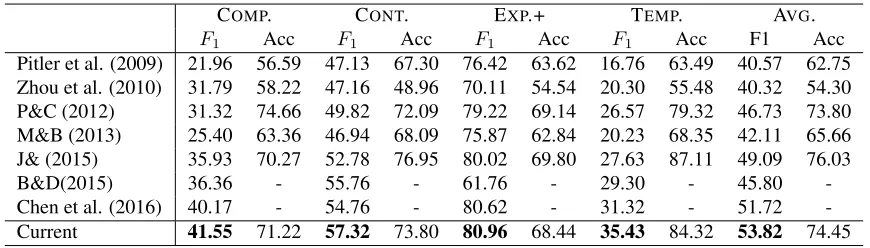
Our model achieves F-measure improvements of 1.85% on COMPARISON, 1.56% on CONTIN -GENCY, 1.27% on EXPANSION, 0.94% on EXPAN -SION+, 4.89% on TEMPORAL, against the state-of-the-art of each class. We improve by 4.73% on av-erage F1 score when not including ENTRELin EX -PANSIONas reported in Table 2 and 3.19% on aver-age F1 score otherwise as reported in Table 3. The results show that our model achieves the best per-formance and especially makes the most remarkable progress on TEMPORAL.
4 Conclusion
References
Or Biran and Kathleen McKeown. 2013. Aggregated word pair features for implicit discourse relation dis-ambiguation. InProceedings of the 51st Annual Meet-ing of the Association for Computational LMeet-inguistics (ACL), pages 69–73, Sofia, Bulgaria, August.
Chlo´e Braud and Pascal Denis. 2015. Comparing word representations for implicit discourse relation clas-sification. In Proceedings of the 2015 Conference on Empirical Methods in Natural Language Process-ing (EMNLP), pages 2201–2211, Lisbon, Portugal, September.
Deng Cai and Hai Zhao. 2016. Neural Word Segmenta-tion Learning for Chinese. InProceedings of the 54th Annual Meeting of the Association for Computational Linguistics (ACL), pages 409–420, Berlin, Germany, August.
Changge Chen, Peilu Wang, and Hai Zhao. 2015. Shal-low discourse parsing using constituent parsing tree. In Proceedings of the CoNLL-15 shared task, pages 37–41, Beijing, China, July.
Jifan Chen, Qi Zhang, Pengfei Liu, Xipeng Qiu, and Xu-anjing Huang. 2016. Implicit discourse relation detec-tion via a deep architecture with gated relevance net-work. InProceedings of the 54th Annual Meeting of the Association for Computational Linguistics (ACL), pages 1726–1735, Berlin, Germany, August.
Junyoung Chung, Caglar Gulcehre, KyungHyun Cho, and Yoshua Bengio. 2014. Empirical evaluation of gated recurrent neural networks on sequence model-ing. arXiv preprint arXiv:1412.3555.
John Duchi, Elad Hazan, and Yoram Singer. 2011. Adaptive subgradient methods for online learning and stochastic optimization. The Journal of Machine Learning Research, 12:2121–2159.
Sepp Hochreiter and J¨urgen Schmidhuber. 1997. Long Short-Term Memory. Neural computation, 9(8):1735– 1780.
Peter Jansen, Mihai Surdeanu, and Peter Clark. 2014. Discourse complements lexical semantics for non-factoid answer reranking. InProceedings of the 52nd Annual Meeting of the Association for Computational Linguistics (ACL), pages 977–986, Baltimore, Mary-land, June.
Yangfeng Ji and Jacob Eisenstein. 2015. One vector is not enough: Entity-augmented distributed seman-tics for discourse relations. Transactions of the Asso-ciation for Computational Linguistics (TACL), 3:329– 344.
Zhongye Jia and Hai Zhao. 2014. A Joint Graph Model for Pinyin-to-Chinese Conversion with Typo Correc-tion. InProceedings of the 52nd Annual Meeting of
the Association for Computational Linguistics (ACL), pages 1512–1523, Baltimore, Maryland, June. Nal Kalchbrenner, Edward Grefenstette, and Phil
Blun-som. 2014. A convolutional neural network for mod-elling sentences. InProceedings of the 52nd Annual Meeting of the Association for Computational Lin-guistics (ACL), pages 655–665, Baltimore, Maryland, June.
Yoon Kim. 2014. Convolutional neural networks for sen-tence classification. InProceedings of the 2014 Con-ference on Empirical Methods in Natural Language Processing (EMNLP), pages 1746–1751, Doha, Qatar, October.
Zhongyi Li, Hai Zhao, Chenxi Pang, Lili Wang, and Huan Wang. 2016. A constituent syntactic parse tree based discourse parser. InProceedings of the CoNLL-16 shared task, pages 60–64, Berlin, Germany, Au-gust.
Maria Liakata, Simon Dobnik, Shyamasree Saha, Colin Batchelor, and Dietrich Rebholz-Schuhmann. 2013. A discourse-driven content model for summarising scientific articles evaluated in a complex question an-swering task. InProceedings of the 2013 Conference on Empirical Methods in Natural Language Process-ing (EMNLP), pages 747–757, Seattle, Washington, USA, October.
Ziheng Lin, Hwee Tou Ng, and Min-Yen Kan. 2014. A pdtb-styled end-to-end discourse parser. Natural Lan-guage Engineering, 20(02):151–184.
Thomas Meyer and Andrei Popescu-Belis. 2012. Us-ing sense-labeled discourse connectives for statisti-cal machine translation. InProceedings of the Joint Workshop on Exploiting Synergies between Informa-tion Retrieval and Machine TranslaInforma-tion (ESIRMT) and Hybrid Approaches to Machine Translation (HyTra), pages 129–138, Avignon, France, April.
Thomas Meyer and Bonnie Webber. 2013. Implicitation of discourse connectives in (machine) translation. In
Proceedings of the Workshop on Discourse in Machine Translation, pages 19–26, Sofia, Bulgaria, August. Tomas Mikolov, Ilya Sutskever, Kai Chen, Greg S
Cor-rado, and Jeff Dean. 2013. Distributed representa-tions of words and phrases and their compositionality. InAdvances in neural information processing systems (NIPS), pages 3111–3119, South Lake Tahoe, Nevada, US, December.
Joonsuk Park and Claire Cardie. 2012. Improving im-plicit discourse relation recognition through feature set optimization. InProceedings of the 13th Annual Meet-ing of the Special Interest Group on Discourse and Di-alogue (SIGDIAL), pages 108–112, Seoul, South Ko-rea, July.
Emily Pitler, Annie Louis, and Ani Nenkova. 2009. Au-tomatic sense prediction for implicit discourse rela-tions in text. InProceedings of the Joint Conference of the 47th Annual Meeting of he Association for Com-putational Linguistics and the 4th International Joint Conference on Natural Language Processing (ACL-IJCNLP), pages 683–691, Suntec, Singapore, August. Rashmi Prasad, Nikhil Dinesh, Alan Lee, Eleni Milt-sakaki, Livio Robaldo, Aravind K Joshi, and Bon-nie L Webber. 2008. The Penn Discourse TreeBank 2.0. InProceedings of the Sixth conference on Inter-national Language Resources and Evaluation (LREC-2008), pages 2961–2968, Marrakech, Morocco, May. Lianhui Qin, Zhisong Zhang, and Hai Zhao. 2016a.
Implicit discourse relation recognition with context-aware character-enhanced embeddings. Inthe 26th In-ternational Conference on Computational Linguistics (COLING), Osaka, Japan, December.
Lianhui Qin, Zhisong Zhang, and Hai Zhao. 2016b. Shallow discourse parsing using convolutional neural network. InProceedings of the CoNLL-16 shared task, pages 70–77, Berlin, Germany, August.
Attapol Rutherford and Nianwen Xue. 2014. Discov-ering implicit discourse relations through brown clus-ter pair representation and coreference patclus-terns. In
Proceedings of the 14th Conference of the European Chapter of the Association for Computational Linguis-tics (EACL), pages 645–654, Gothenburg, Sweden, April.
Rupesh Kumar Srivastava, Klaus Greff, and J¨urgen Schmidhuber. 2015. Highway networks. arXiv preprint arXiv:1505.00387.
Jianxiang Wang and Man Lan. 2016. Two End-to-end Shallow Discourse Parsers for English and Chinese in CoNLL-2016 Shared Task. In Proceedings of the CoNLL-16 shared task, pages 33–40, Berlin, Germany, August.
Rui Wang, Hai Zhao, Bao-Liang Lu, Masao Utiyama, and Eiichiro Sumita. 2014. Neural network based bilin-gual language model growing for statistical machine translation. InProceedings of the 2014 Conference on Empirical Methods in Natural Language Processing (EMNLP), pages 189–195, Doha, Qatar, October. Peilu Wang, Yao Qian, Frank K Soong, Lei He, and Hai
Zhao. 2015. Word embedding for recurrent neural network based TTS synthesis. In 2015 IEEE Inter-national Conference on Acoustics, Speech and
Sig-nal Processing (ICASSP), pages 4879–4883, Brisbane, Australia.
Peilu Wang, Yao Qian, Frank K. Soong, Lei He, and Hai Zhao. 2016a. Learning distributed word represen-tations for bidirectional LSTM recurrent neural net-work. In Proceedings of the 2016 Conference of the North American Chapter of the Association for Com-putational Linguistics: Human Language Technolo-gies (NAACL-HLT), pages 527–533, San Diego, Cal-ifornia, June.
Rui Wang, Masao Utiyama, Isao Goto, Eiichiro Sumita, Hai Zhao, and Bao-Liang Lu. 2016b. Converting continuous-space language models into n-gram lan-guage models with efficient bilingual pruning for sta-tistical machine translation. ACM Transactions on Asian and Low-Resource Language Information Pro-cessing, 15(3):11.
Nianwen Xue, Hwee Tou Ng, Sameer Pradhan, Rashmi Prasad, Christopher Bryant, and Attapol Rutherford. 2015. The CoNLL-2015 Shared Task on Shallow Discourse Parsing. In Proceedings of the CoNLL-15 shared task, pages 1–16, Beijing, China, July.
Nianwen Xue, Hwee Tou Ng, Sameer Pradhan, Attapol Rutherford, Bonnie Webber, Chuan Wang, and Hong-min Wang. 2016. CoNLL 2016 Shared Task on Multi-lingual Shallow Discourse Parsing. InProceedings of the CoNLL-16 shared task, pages 1–19, Berlin, Ger-many, August.
Yasuhisa Yoshida, Jun Suzuki, Tsutomu Hirao, and Masaaki Nagata. 2014. Dependency-based discourse parser for single-document summarization. In Pro-ceedings of the 2014 Conference on Empirical Meth-ods in Natural Language Processing (EMNLP), pages 1834–1839, Doha, Qatar, October.
Biao Zhang, Jinsong Su, Deyi Xiong, Yaojie Lu, Hong Duan, and Junfeng Yao. 2015. Shallow convolu-tional neural network for implicit discourse relation recognition. InProceedings of the 2015 Conference on Empirical Methods in Natural Language Process-ing (EMNLP), pages 2230–2235, Lisbon, Portugal, September.
Jingyi Zhang, Masao Utiyama, Eiichro Sumita, Hai Zhao, Graham Neubig, and Satoshi Nakamura. 2016a. Learning local word reorderings for hierarchical phrase-based statistical machine translation. Machine Translation, pages 1–18.
Zhisong Zhang, Hai Zhao, and Lianhui Qin. 2016b. Probabilistic graph-based dependency parsing with convolutional neural network. In Proceedings of the 54th Annual Meeting of the Association for Compu-tational Linguistics (ACL), pages 1382–1392, Berlin, Germany, August.
con-nectives for implicit discourse relation recognition. In