Rationalizing Neural Predictions
Tao Lei, Regina Barzilay and Tommi Jaakkola Computer Science and Artificial Intelligence Laboratory
Massachusetts Institute of Technology
{taolei, regina, tommi}@csail.mit.edu
Abstract
Prediction without justification has limited ap-plicability. As a remedy, we learn to extract pieces of input text as justifications – ratio-nales – that are tailored to be short and co-herent, yet sufficient for making the same pre-diction. Our approach combines two modu-lar components, generator and encoder, which are trained to operate well together. The gen-erator specifies a distribution over text frag-ments as candidate rationales and these are passed through the encoder for prediction. Ra-tionales are never given during training. In-stead, the model is regularized by desiderata for rationales. We evaluate the approach on multi-aspect sentiment analysis against manu-ally annotated test cases. Our approach out-performs attention-based baseline by a signif-icant margin. We also successfully illustrate the method on the question retrieval task.1
1 Introduction
Many recent advances in NLP problems have come from formulating and training expressive and elabo-rate neural models. This includes models for senti-ment classification, parsing, and machine translation among many others. The gains in accuracy have, however, come at the cost of interpretability since complex neural models offer little transparency con-cerning their inner workings. In many applications, such as medicine, predictions are used to drive criti-cal decisions, including treatment options. It is nec-essary in such cases to be able to verify and
under-1Our code and data are available athttps://github. com/taolei87/rcnn.
the beer was n’t what i expected, and i‘m not sure it’s “true to style“, but i thought it was delicious. a very pleasant ruby red-amber color with a rela9vely brilliant finish, but a limited amount of carbona9on, from the look of it. aroma is what i think an amber ale should be - a nice blend of caramel and happiness bound together.
Review
Ratings
Look: 5 stars Smell: 4 stars
Figure 1: An example of a review with ranking in two cate-gories. The rationale for Look prediction is shown in bold.
stand the underlying basis for the decisions. Ide-ally, complex neural models would not only yield improved performance but would also offer inter-pretable justifications – rationales – for their predic-tions.
In this paper, we propose a novel approach to in-corporating rationale generation as an integral part of the overall learning problem. We limit ourselves to extractive (as opposed to abstractive) rationales. From this perspective, our rationales are simply sub-sets of the words from the input text that satisfy two key properties. First, the selected words represent short and coherent pieces of text (e.g., phrases) and, second, the selected words must alone suffice for prediction as a substitute of the original text. More concretely, consider the task of multi-aspect senti-ment analysis. Figure 1 illustrates a product review along with user rating in terms of two categories or aspects. If the model in this case predicts five star rating for color, it should also identify the phrase”a very pleasant ruby red-amber color”as the rationale underlying this decision.
In most practical applications, rationale
tion must be learned entirely in an unsupervised manner. We therefore assume that our model with rationales is trained on the same data as the origi-nal neural models, without access to additioorigi-nal ra-tionale annotations. In other words, target rara-tionales are never provided during training; the intermedi-ate step of rationale generation is guided only by the two desiderata discussed above. Our model is com-posed of two modular components that we call the generator and the encoder. Our generator specifies a distribution over possible rationales (extracted text) and the encoder maps any such text to task specific target values. They are trained jointly to minimize a cost function that favors short, concise rationales while enforcing that the rationales alone suffice for accurate prediction.
The notion of what counts as a rationale may be ambiguous in some contexts and the task of select-ing rationales may therefore be challengselect-ing to eval-uate. We focus on two domains where ambiguity is minimal (or can be minimized). The first sce-nario concerns with multi-aspect sentiment analysis exemplified by the beer review corpus (McAuley et al., 2012). A smaller test set in this corpus iden-tifies, for each aspect, the sentence(s) that relate to this aspect. We can therefore directly evaluate our predictions on the sentence level with the caveat that our model makes selections on a finer level, in terms of words, not complete sentences. The second sce-nario concerns with the problem of retrieving similar questions. The extracted rationales should capture the main purpose of the questions. We can therefore evaluate the quality of rationales as a compressed proxy for the full text in terms of retrieval perfor-mance. Our model achieves high performance on both tasks. For instance, on the sentiment predic-tion task, our model achieves extracpredic-tion accuracy of 96%, as compared to 38% and 81% obtained by the bigram SVM and a neural attention baseline.
2 Related Work
Developing sparse interpretable models is of con-siderable interest to the broader research commu-nity(Letham et al., 2015; Kim et al., 2015). The need for interpretability is even more pronounced with recent neural models. Efforts in this area include analyzing and visualizing state activation (Hermans
and Schrauwen, 2013; Karpathy et al., 2015; Li et al., 2016), learning sparse interpretable word vec-tors (Faruqui et al., 2015b), and linking word vecvec-tors to semantic lexicons or word properties (Faruqui et al., 2015a; Herbelot and Vecchi, 2015).
Beyond learning to understand or further con-strain the network to be directly interpretable, one can estimate interpretable proxies that approximate the network. Examples include extracting “if-then” rules (Thrun, 1995) and decision trees (Craven and Shavlik, 1996) from trained networks. More recently, Ribeiro et al. (2016) propose a model-agnostic framework where the proxy model is learned only for the target sample (and its neighbor-hood) thus ensuring locally valid approximations. Our work differs from these both in terms of what is meant by an explanation and how they are derived. In our case, an explanation consists of a concise yet sufficient portion of the text where the mechanism of selection is learned jointly with the predictor.
Attention based models offer another means to ex-plicate the inner workings of neural models (Bah-danau et al., 2015; Cheng et al., 2016; Martins and Astudillo, 2016; Chen et al., 2015; Xu and Saenko, 2015; Yang et al., 2015). Such models have been successfully applied to many NLP problems, improving both prediction accuracy as well as vi-sualization and interpretability (Rush et al., 2015; Rockt¨aschel et al., 2016; Hermann et al., 2015). Xu et al. (2015) introduced a stochastic attention mechanism together with a more standard soft at-tention on image captioning task. Our rationale ex-traction can be understood as a type of stochastic attention although architectures and objectives dif-fer. Moreover, we compartmentalize rationale gen-eration from downstream encoding so as to expose knobs to directly control types of rationales that are acceptable, and to facilitate broader modular use in other applications.
3 Extractive Rationale Generation
We formalize here the task of extractive rationale generation and illustrate it in the context of neural models. To this end, consider a typical NLP task where we are provided with a sequence of words as input, namely x = {x1,· · · , xl}, where each
xt ∈ Rd denotes the vector representation of the i-th word. The learning problem is to map i-the input sequencexto a target vector in Rm. For example,
in multi-aspect sentiment analysis each coordinate of the target vector represents the response or rat-ing pertainrat-ing to the associated aspect. In text re-trieval, on the other hand, the target vectors are used to induce similarity assessments between input se-quences. Broadly speaking, we can solve the associ-ated learning problem by estimating a complex pa-rameterized mappingenc(x)from input sequences to target vectors. We call this mapping anencoder. The training signal for these vectors is obtained ei-ther directly (e.g., multi-sentiment analysis) or via similarities (e.g., text retrieval). The challenge is that a complex neural encoder enc(x) reveals lit-tle about its internal workings and thus offers litlit-tle in the way of justification for why a particular pre-diction was made.
In extractive rationale generation, our goal is to select a subset of the input sequence as arationale. In order for the subset to qualify as a rationale it should satisfy two criteria: 1) the selected words should be interpretable and 2) they ought to suffice to reach nearly the same prediction (target vector) as the original input. In other words, a rationale must be short and sufficient. We will assume that a short selection is interpretable and focus on opti-mizing sufficiency under cardinality constraints.
We encapsulate the selection of words as a ratio-nale generatorwhich is another parameterized map-ping gen(x) from input sequences to shorter se-quences of words. Thusgen(x)must include only a few words andenc(gen(x))should result in nearly the same target vector as the original input passed through the encoder orenc(x). We can think of the generator as a tagging model where each word in the input receives a binary tag pertaining to whether it is selected to be included in the rationale. In our case, the generator is probabilistic and specifies a distri-bution over possible selections.
The rationale generation task is entirely unsuper-vised in the sense that we assume no explicit anno-tations about which words should be included in the rationale. Put another way, the rationale is intro-duced as a latent variable, a constraint that guides how to interpret the input sequence. The encoder and generator are trained jointly, in an end-to-end fashion so as to function well together.
4 Encoder and Generator
We use multi-aspect sentiment prediction as a guid-ing example to instantiate the two key components – the encoder and the generator. The framework itself generalizes to other tasks.
Encoderenc(·): Given a training instance(x,y) where x = {xt}lt=1 is the input text sequence of lengthlandy∈[0,1]mis the target m-dimensional sentiment vector, the neural encoder predicts y˜ =
enc(x). If trained on its own, the encoder would aim to minimize the discrepancy between the pre-dicted sentiment vectory˜ and the gold target vector
y. We will use the squared error (i.e. L2 distance) as the sentiment loss function,
L(x,y) =ky˜−yk22=kenc(x)−yk22
The encoder could be realized in many ways such as a recurrent neural network. For example, let
ht =fe(xt,ht−1)denote a parameterized recurrent unit mapping input wordxtand previous stateht−1 to next stateht. The target vector is then generated on the basis of the final state reached by the recur-rent unit after processing all the words in the input sequence. Specifically,
ht=fe(xt,ht−1), t= 1, . . . , l
˜
y=σe(Wehl+be)
Generator gen(·): The rationale generator ex-tracts a subset of text from the original inputx to
function as an interpretable summary. Thus the ra-tionale for a given sequence xcan be equivalently
probability distribution over binary selections, i.e.,
z ∼gen(x) ≡p(z|x)where the length ofzvaries
with the inputx.
In a simple generator, the probability that the tth
word is selected can be assumed to be conditionally independent from other selections given the inputx.
That is, the joint probabilityp(z|x) factors accord-ing to
p(z|x) =
l Y
t=1
p(zt|x) (independent selection)
The component distributions p(zt|x) can be mod-eled using a shared bi-directional recurrent neural network. Specifically, let−→f()and←f−()be the for-ward and backfor-ward recurrent unit, respectively, then
− →
ht=−→f (xt,−−→ht−1) ←−
ht=←f−(xt,←−−ht+1)
p(zt|x) =σz(Wz[−→ht;←h−t] +bz)
Independent but context dependent selection of words is often sufficient. However, the model is un-able to select phrases or refrain from selecting the same word again if already chosen. To this end, we also introduce a dependent selection of words,
p(z|x) =
l Y
t=1
p(zt|x,z1· · ·zt−1)
which can be also expressed as a recurrent neural network. To this end, we introduce another hidden statestwhose role is to couple the selections. For example,
p(zt|x,z1,t−1) =σz(Wz[h−→t;←h−t;st−1] +bz) st=fz([−→ht;←h−t;zt],st−1)
Joint objective: A rationale in our definition cor-responds to the selected words, i.e., {xk|zk = 1}. We will use(z,x)as the shorthand for this rationale and, thus, enc(z,x) refers to the target vector ob-tained by applying the encoder to the rationale as the input. Our goal here is to formalize how the ratio-nale can be made short and meaningful yet function well in conjunction with the encoder. Our generator and encoder are learned jointly to interact well but they are treated as independent units for modularity.
The generator is guided in two ways during learn-ing. First, the rationale that it produces must suffice as a replacement for the input text. In other words, the target vector (sentiment) arising from the ratio-nale should be close to the gold sentiment. The cor-responding loss function is given by
L(z,x,y) =kenc(z,x)−yk22
Note that the loss function depends directly (para-metrically) on the encoder but only indirectly on the generator via the sampled selection.
Second, we must guide the generator to realize short and coherent rationales. It should select only a few words and those selections should form phrases (consecutive words) rather than represent isolated, disconnected words. We therefore introduce an ad-ditional regularizer over the selections
Ω(z) =λ1kzk+λ2 X
t
|zt−zt−1|
where the first term penalizes the number of selec-tions while the second one discourages transiselec-tions (encourages continuity of selections). Note that this regularizer also depends on the generator only indi-rectly via the selected rationale. This is because it is easier to assess the rationale once produced rather than directly guide how it is obtained.
Our final cost function is the combination of the two, cost(z,x,y) = L(z,x,y) + Ω(z). Since the selections are not provided during training, we min-imize the expected cost:
min
θe,θg X
(x,y)∈D
Ez∼gen(x)[cost(z,x,y)]
whereθeandθg denote the set of parameters of the encoder and generator, respectively, and D is the
collection of training instances. Our joint objective encourages the generator to compress the input text into coherent summaries that work well with the as-sociated encoder it is trained with.
Minimizing the expected cost is challenging since it involves summing over all the possible choices of rationales z. This summation could potentially
Doubly stochastic gradient We now derive a sampled approximation to the gradient of the ex-pected cost objective. This sampled approxima-tion is obtained separately for each input textx so
as to work well with an overall stochastic gradient method. Consider therefore a training pair (x,y). For the parameters of the generatorθg,
∂Ez∼gen(x)[cost(z,x,y)] ∂θg
= X
z
cost(z,x,y)·∂p(z|x)
∂θg
= X
z
cost(z,x,y)·∂p(z|x)
∂θg ·
p(z|x)
p(z|x)
Using the fact(logf(θ))0 =f0(θ)/f(θ), we get
X
z
cost(z,x,y)· ∂p∂θ(z|x)
g ·
p(z|x)
p(z|x)
= X
z
cost(z,x,y)·∂log∂θp(z|x)
g ·p(z|x)
= Ez∼gen(x)
cost(z,x,y)∂logp(z|x)
∂θg
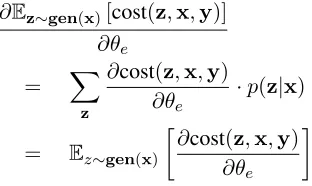
The last term is the expected gradient where the ex-pectation is taken with respect to the generator dis-tribution over rationalesz. Therefore, we can simply
sample a few rationaleszfrom the generatorgen(x) and use the resulting average gradient in an overall stochastic gradient method. A sampled approxima-tion to the gradient with respect to the encoder pa-rametersθecan be derived similarly,
∂Ez∼gen(x)[cost(z,x,y)]
∂θe
= X
z
∂cost(z,x,y)
∂θe ·
p(z|x)
= Ez∼gen(x)
∂cost(z,x,y)
∂θe
Choice of recurrent unit We employ recurrent convolution (RCNN), a refinement of local-ngram based convolution. RCNN attempts to learn n-gram features that are not necessarily consecutive, and average features in a dynamic (recurrent) fashion. Specifically, for bigrams (filter widthn= 2) RCNN computesht=f(xt,ht−1)as follows
Number of reviews 1580k
Avg length of review 144.9
Avg correlation between aspects 63.5%
Max correlation between two aspects 79.1%
[image:5.612.108.264.511.604.2]Number of annotated reviews 994
Table 1:Statistics of the beer review dataset.
λt=σ(Wλxt+Uλht−1+bλ)
c(1)t =λtc(1)t−1+ (1−λt)(W1xt)
c(2)t =λtc(2)t−1+ (1−λt)(c(1)t−1+W2xt)
ht= tanh(c(2)t +b)
RCNN has been shown to work remarkably in clas-sification and retrieval applications (Lei et al., 2015; Lei et al., 2016) compared to other alternatives such CNNs and LSTMs. We use it for all the recurrent units introduced in our model.
5 Experiments
We evaluate the proposed joint model on two NLP applications: (1) multi-aspect sentiment analysis on product reviews and (2) similar text retrieval on AskUbuntu question answering forum.
5.1 Multi-aspect Sentiment Analysis
Dataset We use the BeerAdvocate2review dataset
used in prior work (McAuley et al., 2012).3 This
dataset contains 1.5 million reviews written by the website users. The reviews are naturally multi-aspect – each of them contains multiple sentences describing the overall impression or one particu-lar aspect of a beer, including appearance, smell (aroma),palateand thetaste. In addition to the writ-ten text, the reviewer provides the ratings (on a scale of 0 to 5 stars) for each aspect as well as an overall rating. The ratings can be fractional (e.g. 3.5 stars), so we normalize the scores to[0,1]and use them as the (only) supervision for regression.
McAuley et al. (2012) also provided sentence-level annotations on around 1,000 reviews. Each sentence is annotated with one (or multiple) aspect label, indicating what aspect this sentence covers.
2www.beeradvocate.com
3http://snap.stanford.edu/data/
Method % precision % selectedAppearance % precision % selectedSmell % precision % selectedPalate
SVM 38.3 13 21.6 7 24.9 7
Attention model 80.6 13 88.4 7 65.3 7
Generator (independent) 94.8 13 93.8 7 79.3 7
[image:6.612.79.534.57.130.2]Generator (recurrent) 96.3 14 95.1 7 80.2 7
Table 2:Precision of selected rationales for the first three aspects. The precision is evaluated based on whether the selected words are in the sentences describing the target aspect, based on the sentence-level annotations. Best training epochs are selected based on the objective value on the development set (no sentence annotation is used).
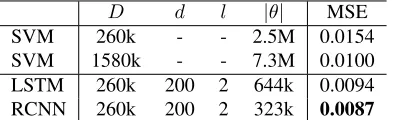
D d l |θ| MSE
SVM 260k - - 2.5M 0.0154
SVM 1580k - - 7.3M 0.0100
LSTM 260k 200 2 644k 0.0094
[image:6.612.325.526.189.282.2]RCNN 260k 200 2 323k 0.0087
Table 3:Comparing neural encoders with bigram SVM model. MSE is the mean squared error on the test set.Dis the amount of data used for training and development.dstands for the hid-den dimension,ldenotes the depth of network and|θ|denotes the number of parameters (number of features for SVM).
We use this set as our test set to evaluate the preci-sion of words in the extracted rationales.
Table 1 shows several statistics of the beer review dataset. The sentiment correlation between any pair of aspects (and the overall score) is quite high, get-ting 63.5% on average and a maximum of 79.1% (between the taste and overall score). If directly training the model on this set, the model can be con-fused due to such strong correlation. We therefore perform a preprocessing step, picking “less corre-lated” examples from the dataset.4 This gives us a
de-correlated subset for each aspect, each contain-ing about 80k to 90k reviews. We use 10k as the development set. We focus on three aspects since the fourth aspect tastestill gets > 50%correlation with the overall sentiment.
Sentiment Prediction Before training the joint model, it is worth assessing the neural encoder sepa-rately to check how accusepa-rately the neural network predicts the sentiment. To this end, we compare neural encoders with bigram SVM model, training medium and large SVM models using 260k and all
4Specifically, for each aspect we train a simple linear regres-sion model to predict the rating of this aspect given the ratings of the other four aspects. We then keep picking reviews with largest prediction error until the sentiment correlation in the se-lected subset increases dramatically.
0.008 0.010 0.012 0.014 0.016
0% 25% 50% 75% 100%
0.015 SVM
0.009 Encoder
Figure 2:Mean squared error of all aspects on the test set (y-axis) when various percentages of text are extracted as ratio-nales (x-axis). 220k training data is used.
1580k reviews respectively. As shown in Table 3, the recurrent neural network models outperform the SVM model for sentiment prediction and also re-quire less training data to achieve the performance. The LSTM and RCNN units obtain similar test er-ror, getting 0.0094 and 0.0087 mean squared error respectively. The RCNN unit performs slightly bet-ter and uses less paramebet-ters. Based on the results, we choose the RCNN encoder network with 2 stack-ing layers and 200 hidden states.
To train the joint model, we also use RCNN unit with 200 states as the forward and backward recur-rent unit for the generator gen(). The dependent generator has one additional recurrent layer. For this layer we use 30 states so the dependent version still has a number of parameters comparable to the inde-pendent version. The two versions of the generator have 358k and 323k parameters respectively.
[image:6.612.89.286.190.250.2]a beer that is not sold in my neck of the woods , but managed to get while on a roadtrip . poured into an imperial pint glass with a generous head that sustained life throughout . nothing out of the ordinary here , but a good brew s9ll . body was kind of heavy , but not thick . the hop smell was excellent and en9cing . very drinkable
very dark beer . pours a nice finger and a half of creamy foam and stays throughout the beer . smells of coffee and roasted malt . has a major coffee-like taste with hints of chocolate . if you like black coffee , you will love this porter . creamy smooth mouthfeel and definitely gets smoother on the palate once it warms . it 's an ok porter but i feel there are much beAer one 's out there .
poured into a sniBer . produces a small coffee head that reduces quickly . black as night . preAy typical imp . roasted malts hit on the nose . a liAle sweet chocolate follows . big toasty character on the taste . in between i 'm geDng plenty of dark chocolate and some biAer espresso . it finishes with hop biAerness . nice smooth mouthfeel with perfect carbona9on for the
style . overall a nice stout i would love to have again , maybe with some age on it .
i really did not like this . it just seemed extremely watery . i dont ' think this had any carbona9on whatsoever . maybe it was flat , who knows ? but even if i got a bad brew i do n't see how this would possibly be something i 'd get 9me and 9me again . i could taste the hops towards the middle , but the beer got preAy nasty towards the boAom . i would never drink this again , unless it was free . i 'm kind of upset i bought this .
[image:7.612.338.517.290.395.2]a : poured a nice dark brown with a tan colored head about half an inch thick , nice red/garnet accents when held to the light . liAle clumps of lacing all around the glass , not too shabby . not terribly impressive though s : smells like a more guinness-y guinness really , there are some roasted malts there , signature guinness smells , less burnt though , a liAle bit of chocolate … … m : rela9vely thick , it is n't an export stout or imperial stout , but s9ll is preAy heBy in the mouth , very smooth , not much carbona9on . not too shabby d : not quite as drinkable as the draught , but s9ll not too bad . i could easily see drinking a few of these .
Figure 3:Examples of extracted rationales indicating the sentiments of various aspects. The extracted texts for appearance, smell and palate are shown in red, blue and green color respectively. The last example is shortened for space.
SVM Attention Gen (independent) Gen (recurrent)
1 73.9 1 89.1 6 97.4 12 96.5
3 55.9 3 88.1 13 94.9 14 96.3
5 48.5 5 86.4 16 92.9 16 91.2
7 44.7 7 84.1
9 42.2 9 82.3
11 41.2 11 79.8
13 38.3 13 77.1
15 36.7 15 74.4
17 35.1 17 71.6
30 48 65 83 100
5 7 9 11 13 15 17 SVM
Attention Gen (independent) Gen (recurrent)
Figure 4: Precision (y-axis) when various percentages of text are extracted as rationales (x-axis) for the appearance aspect.
Rationale Selection To evaluate the supporting rationales for each aspect, we train the joint encoder-generator model on each de-correlated subset. We set the cardinality regularizationλ1between values {2e−4,3e−4,4e−4}so the extracted rationale texts are neither too long nor too short. For simplic-ity, we setλ2 = 2λ1 to encourage local coherency of the extraction.
For comparison we use the bigram SVM model and implement an attention-based neural network model. The SVM model successively extracts un-igram or bun-igram (from the test reviews) with the highest feature. The attention-based model learns a normalized attention vector of the input tokens (us-ing similarly the forward and backward RNNs), then the model averages over the encoder states accord-ingly to the attention, and feed the averaged vector to the output layer. Similar to the SVM model, the attention-based model can selects words based on their attention weights.
0 50 100
0.03 0.04 0.05 0.06
Gen (recurrent) Gen (independent)
0.2 0.4 0.6 0.8 1.0
Figure 5:Learning curves of the optimized cost function on the development set and the precision of rationales on the test set. The smell (aroma) aspect is the target aspect.
Table 2 presents the precision of the extracted ra-tionales calculated based on sentence-level aspect annotations. Theλ1 regularization hyper-parameter is tuned so the two versions of our model extract similar number of words as rationales. The SVM and attention-based model are constrained similarly for comparison. Figure 4 further shows the preci-sion when different amounts of text are extracted. Again, for our model this corresponds to changing theλ1regularization. As shown in the table and the figure, our encoder-generator networks extract text pieces describing the target aspect with high preci-sion, ranging from 80% to 96% across the three as-pects appearance, smell and palate. The SVM base-line performs poorly, achieving around 30% accu-racy. The attention-based model achieves reasonable but worse performance than the rationale generator, suggesting the potential of directly modeling ratio-nales as explicit extraction.
[image:7.612.99.263.292.385.2]Figure 5 shows the learning curves of our model for the smell aspect. In the early training epochs, both the independent and (recurrent) dependent se-lection models fail to produce good rationales, get-ting low precision as a result. After a few epochs of exploration however, the models start to achieve high accuracy. We observe that the dependent sion learns more quickly in general, but both ver-sions obtain close results in the end.
Finally we conduct a qualitative case study on the extracted rationales. Figure 3 presents several reviews, with highlighted rationales predicted by the model. Our rationale generator identifies key phrases or adjectives that indicate the sentiment of a particular aspect.
5.2 Similar Text Retrieval on QA Forum Dataset For our second application, we use the real-world AskUbuntu5 dataset used in recent
work (dos Santos et al., 2015; Lei et al., 2016). This set contains a set of 167k unique questions (each consisting a question title and a body) and 16k user-identified similar question pairs. Following previ-ous work, this data is used to train the neural en-coder that learns the vector representation of the input question, optimizing the cosine distance (i.e. cosine similarity) between similar questions against random non-similar ones. We use the “one-versus-all” hinge loss (i.e. positive versus other negatives) for the encoder, similar to (Lei et al., 2016). Dur-ing development and testDur-ing, the model is used to score 20 candidate questions given each query ques-tion, and a total of400×20query-candidate question pairs are annotated for evaluation6.
Task/Evaluation Setup The question descriptions are often long and fraught with irrelevant details. In this set-up, a fraction of the original question text should be sufficient to represent its content, and be used for retrieving similar questions. Therefore, we will evaluate rationales based on the accuracy of the question retrieval task, assuming that better ratio-nales achieve higher performance. To put this per-formance in context, we also report the accuracy when full body of a question is used, as well as ti-tles alone. The latter constitutes an upper bound on
5askubuntu.com
6https://github.com/taolei87/askubuntu
MAP (dev) MAP (test) %words
Full title 56.5 60.0 10.1
Full body 54.2 53.0 89.9
Independent 55.756.3 53.652.6 19.79.7
[image:8.612.346.499.179.272.2]Dependent 56.156.5 54.655.6 11.632.8
Table 4: Comparison between rationale models (middle and bottom rows) and the baselines using full title or body (top row). Gen (independent) Gen (recurrent)
0.052 47.08 0.063 50.54 0.058 52.36 0.067 49.48 0.059 46.02 0.07 51.96 0.062 49.76 0.078 51.54 0.064 47.94 0.086 52.55 0.068 48.93 0.095 53.59 0.07 49.5 0.108 53.15 0.081 52.18 0.112 51.48 0.081 51.84 0.116 54.62 0.094 51.24 0.121 52.12 0.094 52.21 0.137 53 0.097 53.61 0.163 53.2 0.098 54.11 0.179 54.13 0.122 49.03 0.193 52.11 0.133 54.19 0.262 52.32 0.135 50.21 0.277 50.87 0.136 48.22 0.328 53.21 0.145 50.96 0.328 55.61 0.155 52.91 0.347 51 0.173 52.74 0.378 54.93 0.197 52.6
45.0 47.8 50.5 53.3 56.0
5% 9% 13% 16% 20%
Gen (independent) Gen (recurrent)
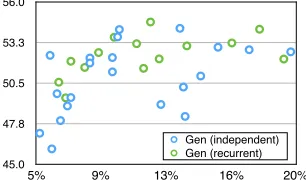
Figure 6:Retrieval MAP on the test set when various percent-ages of the texts are chosen as rationales. Data points corre-spond to models trained with different hyper-parameters.
the model performance as in this dataset titles pro-vide short, informative summaries of the question content. We evaluate the rationales using the mean average precision (MAP) of retrieval.
Results Table 4 presents the results of our ratio-nale model. We explore a range of hyper-parameter values7. We include two runs for each version. The
first one achieves the highest MAP on the develop-ment set, The second run is selected to compare the models when they use roughly 10% of question text (7 words on average). We also show the results of different runs in Figure 6. The rationales achieve the MAP up to 56.5%, getting close to using the titles. The models also outperform the baseline of using the noisy question bodies, indicating the the models’ capacity of extracting short but important fragments. Figure 7 shows the rationales for several questions in the AskUbuntu domain, using the recurrent ver-sion with around 10% extraction. Interestingly, the model does not always select words from the ques-tion title. The reasons are that the quesques-tion body can contain the same or even complementary infor-mation useful for retrieval. Indeed, some rationale fragments shown in the figure are error messages,
7λ
1 ∈ {.008, .01, .012, .015},λ2 ={0, λ1,2λ1}, dropout
∈ {0.1,0.2}
i accidentally removed the ubuntu soBware centre , when i was actually trying to remove my ubuntu one applica9ons . although i do n't remember directly uninstalling the centre , i think dele9ng one of those packages might have triggered it . i can not look at history of applica9on changes , as the soBware centre is missing . please advise on how to install , or rather reinstall , ubuntu soBware centre on my computer . how do i install ubuntu soBware centre applica9on ?
i know this will be an odd ques9on , but i was wondering if anyone knew how to install the ubuntu installer package in an ubuntu installa9on . to clarify , when you boot up to an ubuntu livecd , it 's got the installer program available so that you can install ubuntu to a drive . naturally , this program is not present in the installed ubuntu . is there , though , a way to download and install it like other packages ? invariably , someone will ask what i 'm trying to do , and the answer … install installer package on an installed system ?
what is the easiest way to install all the media codec available for ubuntu ? i am having issues with mul9ple applica9ons promp9ng me to install codecs before they can play my files . how do i install media codecs ?
what should i do when i see <unk> report this <unk> ? an unresolvable problem occurred while ini9alizing the package informa9on . please report this bug against the 'update-manager ' package and include the following error message : e : encountered a sec9on with no package : header e : problem with mergelist <unk> e : the package lists or status file could not be parsed or opened .
please any one give the solu9on for this whenever i try to convert the rpm file to deb file i always get this problem error : <unk> : not an rpm package ( or package manifest ) error execu9ng `` lang=c rpm -qp -- queryformat % { name } <unk> ' '' : at <unk> line 489 thanks conver9ng rpm file to debian fle
how do i mount a hibernated par99on with windows 8 in ubuntu ? i ca n't mount my other par99on with windows 8 , i have ubuntu 12.10 amd64 : error moun9ng /dev/sda1 at <unk> : command-line `mount -t `` n[s '' -o `` uhelper=udisks2 , nodev , nosuid , uid=1000 , gid=1000 , dmask=0077 , fmask=0177 '' `` /dev/sda1 '' `` <unk> '' ' exited with non-zero exit status 14 : windows is hibernated , refused to mount . failed to mount '/dev/sda1 ' : opera9on not permiAed the n[s par99on is hibernated . please resume and shutdown windows properly , or mount the volume read-only with the 'ro ' mount op9on
Figure 7:Examples of extracted rationales of questions in the AskUbuntu domain.
which are typically not in the titles but very useful to identify similar questions.
6 Discussion
We proposed a novel modular neural framework to automatically generate concise yet sufficient text fragments to justify predictions made by neural net-works. We demonstrated that our encoder-generator framework, trained in an end-to-end manner, gives rise to quality rationales in the absence of any ex-plicit rationale annotations. The approach could be modified or extended in various ways to other appli-cations or types of data.
Choices ofenc(·) and gen(·). The encoder and generator can be realized in numerous ways with-out changing the broader algorithm. For instance, we could use a convolutional network (Kim, 2014; Kalchbrenner et al., 2014), deep averaging net-work (Iyyer et al., 2015; Joulin et al., 2016) or a boosting classifier as the encoder. When rationales can be expected to conform to repeated stereotypi-cal patterns in the text, a simpler encoder consistent with this bias can work better. We emphasize that, in this paper, rationales are flexible explanations that may vary substantially from instance to another. On the generator side, many additional constraints could be imposed to further guide acceptable rationales.
Dealing with Search Space. Our training method employs a REINFORCE-style algorithm (Williams, 1992) where the gradient with respect to the param-eters is estimated by sampling possible rationales.
Additional constraints on the generator output can be helpful in alleviating problems of exploring po-tentially a large space of possible rationales in terms of their interaction with the encoder. We could also apply variance reduction techniques to increase sta-bility of stochastic training (cf. (Weaver and Tao, 2001; Mnih et al., 2014; Ba et al., 2015; Xu et al., 2015)).
7 Acknowledgments
We thank Prof. Julian McAuley for sharing the re-view dataset and annotations. We also thank MIT NLP group and the reviewers for their helpful com-ments. The work is supported by the Arabic Lan-guage Technologies (ALT) group at Qatar Com-puting Research Institute (QCRI) within the IYAS project. Any opinions, findings, conclusions, or rec-ommendations expressed in this paper are those of the authors, and do not necessarily reflect the views of the funding organizations.
References
Jimmy Ba, Volodymyr Mnih, and Koray Kavukcuoglu. 2015. Multiple object recognition with visual atten-tion. InProceedings of the International Conference on Learning Representations (ICLR).
Dzmitry Bahdanau, Kyunghyun Cho, and Yoshua Ben-gio. 2015. Neural machine translation by jointly learning to align and translate. InInternational Con-ference on Learning Representations.
Kan Chen, Jiang Wang, Liang-Chieh Chen, Haoyuan
Abc-cnn: An attention based convolutional neural net-work for visual question answering. arXiv preprint arXiv:1511.05960.
Jianpeng Cheng, Li Dong, and Mirella Lapata. 2016. Long short-term memory-networks for machine read-ing. arXiv preprint arXiv:1601.06733.
Mark W Craven and Jude W Shavlik. 1996. Extract-ing tree-structured representations of trained networks. InAdvances in neural information processing systems (NIPS).
Cicero dos Santos, Luciano Barbosa, Dasha Bogdanova, and Bianca Zadrozny. 2015. Learning hybrid rep-resentations to retrieve semantically equivalent ques-tions. In Proceedings of the 53rd Annual Meeting of the Association for Computational Linguistics and the 7th International Joint Conference on Natural Lan-guage Processing (Volume 2: Short Papers), pages 694–699, Beijing, China, July. Association for Com-putational Linguistics.
Manaal Faruqui, Jesse Dodge, Sujay K. Jauhar, Chris Dyer, Eduard Hovy, and Noah A. Smith. 2015a. Retrofitting word vectors to semantic lexicons. In Pro-ceedings of NAACL.
Manaal Faruqui, Yulia Tsvetkov, Dani Yogatama, Chris Dyer, and Noah A. Smith. 2015b. Sparse overcom-plete word vector representations. InProceedings of ACL.
Aur´elie Herbelot and Eva Maria Vecchi. 2015. Build-ing a shared world: mappBuild-ing distributional to model-theoretic semantic spaces. InProceedings of the 2015 Conference on Empirical Methods in Natural Lan-guage Processing. Association for Computational Lin-guistics.
Karl Moritz Hermann, Tomas Kocisky, Edward Grefen-stette, Lasse Espeholt, Will Kay, Mustafa Suleyman, and Phil Blunsom. 2015. Teaching machines to read and comprehend. InAdvances in Neural Information Processing Systems, pages 1684–1692.
Michiel Hermans and Benjamin Schrauwen. 2013.
Training and analysing deep recurrent neural net-works. InAdvances in Neural Information Processing Systems, pages 190–198.
Mohit Iyyer, Varun Manjunatha, Jordan Boyd-Graber, and Hal Daum´e III. 2015. Deep unordered compo-sition rivals syntactic methods for text classification. InProceedings of the 53rd Annual Meeting of the As-sociation for Computational Linguistics and the 7th International Joint Conference on Natural Language Processing (Volume 1: Long Papers).
Armand Joulin, Edouard Grave, Piotr Bojanowski, and Tomas Mikolov. 2016. Bag of tricks for efficient text classification. arXiv preprint arXiv:1607.01759.
Nal Kalchbrenner, Edward Grefenstette, and Phil Blun-som. 2014. A convolutional neural network for mod-elling sentences. In Proceedings of the 52th Annual Meeting of the Association for Computational Linguis-tics.
Andrej Karpathy, Justin Johnson, and Fei-Fei Li. 2015. Visualizing and understanding recurrent networks.
arXiv preprint arXiv:1506.02078.
B Kim, JA Shah, and F Doshi-Velez. 2015. Mind the gap: A generative approach to interpretable feature se-lection and extraction. In Advances in Neural Infor-mation Processing Systems.
Yoon Kim. 2014. Convolutional neural networks for sen-tence classification. InProceedings of the Empiricial Methods in Natural Language Processing (EMNLP 2014).
Tao Lei, Regina Barzilay, and Tommi Jaakkola. 2015. Molding cnns for text: non-linear, non-consecutive convolutions. InProceedings of the 2015 Conference on Empirical Methods in Natural Language Process-ing (EMNLP).
Tao Lei, Hrishikesh Joshi, Regina Barzilay, Tommi Jaakkola, Katerina Tymoshenko, Alessandro Mos-chitti, and Llu´ıs M`arquez. 2016. Semi-supervised question retrieval with gated convolutions. In Pro-ceedings of the 2016 Conference of the North Ameri-can Chapter of the Association for Computational Lin-guistics: Human Language Technologies (NAACL). Benjamin Letham, Cynthia Rudin, Tyler H. McCormick,
and David Madigan. 2015. Interpretable classifiers using rules and bayesian analysis: Building a better stroke prediction model. Annals of Applied Statistics, 9(3):1350–1371.
Jiwei Li, Xinlei Chen, Eduard Hovy, and Dan Jurafsky. 2016. Visualizing and understanding neural models in nlp. InProceedings of NAACL.
Iain J Marshall, Jo¨el Kuiper, and Byron C Wallace. 2015. Robotreviewer: evaluation of a system for automati-cally assessing bias in clinical trials. Journal of the American Medical Informatics Association.
Andr´e F. T. Martins and Ram´on Fernandez Astudillo. 2016. From softmax to sparsemax: A sparse model of attention and multi-label classification. CoRR, abs/1602.02068.
Julian McAuley, Jure Leskovec, and Dan Jurafsky. 2012. Learning attitudes and attributes from multi-aspect re-views. InData Mining (ICDM), 2012 IEEE 12th In-ternational Conference on, pages 1020–1025. IEEE. Volodymyr Mnih, Nicolas Heess, Alex Graves, et al.
2014. Recurrent models of visual attention. In
Marco Tulio Ribeiro, Sameer Singh, and Carlos Guestrin. 2016. ” why should i trust you?”: Explaining the pre-dictions of any classifier. InACM SIGKDD Interna-tional Conference on Knowledge Discovery and Data Mining (KDD).
Tim Rockt¨aschel, Edward Grefenstette, Karl Moritz Her-mann, Tom´aˇs Koˇcisk`y, and Phil Blunsom. 2016. Rea-soning about entailment with neural attention. In In-ternational Conference on Learning Representations. Alexander M Rush, Sumit Chopra, and Jason Weston.
2015. A neural attention model for abstractive sen-tence summarization. InProceedings of the 2015 Con-ference on Empirical Methods in Natural Language Processing.
Sebastian Thrun. 1995. Extracting rules from artifi-cial neural networks with distributed representations. InAdvances in neural information processing systems (NIPS).
Lex Weaver and Nigel Tao. 2001. The optimal reward baseline for gradient-based reinforcement learning. In
Proceedings of the Seventeenth conference on Uncer-tainty in artificial intelligence.
Ronald J Williams. 1992. Simple statistical gradient-following algorithms for connectionist reinforcement learning.Machine learning.
Huijuan Xu and Kate Saenko. 2015. Ask, attend
and answer: Exploring question-guided spatial atten-tion for visual quesatten-tion answering. arXiv preprint arXiv:1511.05234.
Kelvin Xu, Jimmy Ba, Ryan Kiros, Kyunghyun Cho, Aaron Courville, Ruslan Salakhudinov, Rich Zemel, and Yoshua Bengio. 2015. Show, attend and tell: Neu-ral image caption generation with visual attention. In
Proceedings of the 32nd International Conference on Machine Learning (ICML).
Zichao Yang, Xiaodong He, Jianfeng Gao, Li Deng, and Alex Smola. 2015. Stacked attention net-works for image question answering. arXiv preprint arXiv:1511.02274.
Omar Zaidan, Jason Eisner, and Christine D. Piatko. 2007. Using ”annotator rationales” to improve ma-chine learning for text categorization. InProceedings of Human Language Technology Conference of the North American Chapter of the Association of Com-putational Linguistics, pages 260–267.