Active Learning for Post-Editing Based Incrementally Retrained MT
Aswarth Dara Josef van Genabith Qun Liu John Judge Antonio Toral
School of Computing Dublin City University
Dublin, Ireland
{adara,josef,qliu,jjudge,atoral}@computing.dcu.ie
Abstract
Machine translation, in particular statis-tical machine translation (SMT), is mak-ing big inroads into the localisation and translation industry. In typical work-flows (S)MT output is checked and (where required) manually post-edited by hu-man translators. Recently, a significant amount of research has concentrated on capturing human post-editing outputs as early as possible to incrementally up-date/modify SMT models to avoid repeat mistakes. Typically in these approaches, MT and post-edits happen sequentially and chronologically, following the way unseen data (the translation job) is pre-sented. In this paper, we add to the ex-isting literature addressing the question whether and if so, to what extent, this process can be improved upon by Active Learning, where input is not presented chronologically but dynamically selected according to criteria that maximise perfor-mance with respect to (whatever is) the re-maining data. We explore novel (source side-only) selection criteria and show per-formance increases of 0.67-2.65 points TER absolute on average on typical indus-try data sets compared to sequential PE-based incrementally retrained SMT.
1 Introduction and Related Research
Machine Translation (MT) has evolved dramati-cally over the last two decades, especially since the appearance of statistical approaches (Brown et al., 1993). In fact, MT is nowadays succesfully used in the localisation and translation industry, as for many relevant domains such as technical documentation, post-editing (PE) of MT output by human translators (compared to human translation from scratch) results in notable productivity gains, as a number of industry studies have shown con-vincingly, e.g. (Plitt and Masselot, 2010). Fur-thermore, incremental retraining and update tech-niques (Bertoldi et al., 2013; Levenberg et al.,
2010; Mathur et al., 2013; Simard and Foster, 2013) allow these PEs to be fed back into the MT model, resulting in an MT system that is contin-uously updated to perform better on forthcoming sentences, which should lead to a further increase in productivity.
Typically, post-editors are presented with MT output units (sentences) in the order in which input sentences appear one after the other in the trans-lation job. Because of this, incremental MT re-training and update models based on PE outputs also proceed in the same chronological order de-termined by the input data. This may be sub-optimal. In this paper we study the application of Active Learning (AL) to the scenario of PE MT and subsequent PE-based incremental retraining. AL selects data (here translation inputs and their MT outputs for PE) according to criteria that max-imise performance with respect to the remaining data and may diverge from processing data items in chronological order. This may allow incremen-tally PE-based retrained MT to (i) improve more rapidly than chronologically PE-based retrained MT and (ii) result in overall productivity gains.
The main contributions of this paper include:
• Previous work (Haffari et al., 2009; Blood-good and Callison-Burch, 2010) shows that, given a (static) training set, AL can im-prove the quality of MT. By contrast, here we show that AL-based data selection for hu-man PE improves incrementally and dynami-cally retrained MT, reducing overall PE time of translation jobs in the localisation industry application scenarios.
• We propose novel selection criteria for AL-based PE: we adapt cross-entropy difference (Moore and Lewis, 2010; Axelrod et al., 2011), originally used for domain adaptation, and propose an extension to cross entropy difference with a vocabulary saturation filter (Lewis and Eetemadi, 2013).
• While much of previous work concentrates on research datasets (e.g. Europarl, News Commentary), we use industry data
cal manuals). (Bertoldi et al., 2013) shows that the repetition rate of news is consider-ably lower than that of technical documenta-tion, which impacts on the results obtained with incremental retraining.
• Unlike in previous research, our AL-based selection criteria take into account only the source side of the data. This supports se-lection before translation, keeping costs to a minimum, a priority in commercial PE MT applications.
• Our experiments show that AL-based selec-tion works for PE-based incrementally re-trained MT with overall performance gains around 0.67 to 2.65 TER absolute on average.
AL has been successfully applied to many tasks in natural language processing, including pars-ing (Tang et al., 2002), named entity recogni-tion (Miller et al., 2004), to menrecogni-tion just a few. See (Olsson, 2009) for a comprehensie overview of the application of AL to natural language process-ing. (Haffari et al., 2009; Bloodgood and Callison-Burch, 2010) apply AL to MT where the aim is to build an optimal MT model from a given, static dataset. To the best of our knowledge, the most relevant previous research is (Gonz´alez-Rubio et al., 2012), which applies AL to interactive MT. In addition to differences in the AL selection criteria and data sets, our goals are fundamentally differ-ent: while the previous work aimed at reducing human effort in interactive MT, we aim at reduc-ing the overall PE time in PE-based incremental MT update applications in the localisation indus-try.
In our experiments reported in Section 3 below we want to explore a space consisting of a con-siderable number of selection strategies and incre-mental retraining batch sizes. In order to be able to do this, we use the target side of our industry trans-lation memory data to approximate human PE out-put and automatic TER (Snover et al., 2006) scores as a proxy for human PE times (O’Brien, 2011).
2 Methodology
Given a translation job, our goal is to reduce the overall PE time. At each stage, we select sen-tences that are given to the post editor in such a way that uncertain sentences (with respect to the MT system at hand)1are post-edited first. We then
translate thentop-ranked sentences using the MT system and use the human PEs of the MT outputs to retrain the system. Algorithm 1 describes our
1The uncertainty of a sentence with respect to the model
can be measured according to different criteria, e.g. percent-age of unknownn-grams, perplexity etc.
method, wheresandtstand for source and target, respectively.
Algorithm 1Sentence Selection Algorithm
Input:
L←−Initial training data M←−Initial MT model
forC∈(Random,Sequential,Ngram,CED,CEDN)do U←−Translation job
whilesize(U)>0do
U1.s←−SelectTopSentences(C, U.s) U11.t←−Translate(M, U1.s) U1.t←−PostEdit(U11.t) U←−U - U1
L←−L∪U1 M←−TrainModel (L) end while
end for
We use two baselines, i.e. random and sequen-tial. In the random baseline, the batch of sentences at each iteration are selected randomly. In the se-quential baseline, the batches of sentences follow the same order as the data.
Aside from the Random and Sequential base-lines we use the following selection criteria:
• N-gram Overlap. An SMT system will en-counter problems translating sentences con-taining n-grams not seen in the training data. Thus, PEs of sentences with high number of unseen n-grams are considered to be more in-formative for updating the current MT sys-tem. However, for the MT system to trans-late unseenn-grams accurately, they need to
be seen a minimum number V times.2 We
use an n-gram overlap function similar to the one described in (Gonz´alez-Rubio et al., 2012) given in Equation 1 whereN(T(i)) and
N(S(i)) return i-grams in training data and the sentenceS, respectively.
unseen(S) =
n
P
i=1{|N(T
(i))∩N(S(i))|>V}
n
P
i=1N(S
(i))
(1)
• Cross Entropy Difference (CED).This met-ric is originally used in data selection (Moore and Lewis, 2010; Axelrod et al., 2011). Given an in-domain corpus I and a general corpus O, language models are built from both,3 and each sentence in Ois scored
ac-cording to the entropyHdifference (Equation
2Following (Gonz´alez-Rubio et al., 2012) we useV =
10.
3In order to make the LMs comparable they have the same
2). The lower the score given to a sentence, the more useful it is to train a system for the specific domainI.
score(s) =HI(s)−HO(s) (2) In our AL scenario, we have the current train-ing corpusL and an untranslated corpusU. CED is applied to select sentences from U
that are (i) different fromL(as we would like to add sentences that add new information to the model) and (ii) similar to the overall cor-pusU(as we would like to add sentences that are common in the untranslated data). Hence we apply CED and select sentences from U
that have high entropy with respect toLand low entropy with respect toU(Equation 3).
score(s) =HU(s)−HL(s) (3)
• CED +n-gram (CEDN). This is an exten-sion of the CED criterion inspired by the con-cept of the vocabulary saturation filter (Lewis and Eetemadi, 2013). CED may select many very similar sentences, and thus it may be the case that some of them are redundant. By post-processing the selection made by CED with vocabulary saturation we aim to spot and remove redudant sentences. This works in two steps. In the first step, all the sentences fromUare scored using the CED metric. In the second step, we down-rank sentences that are considered redundant. The top sentence is selected, and itsn-grams are stored in local-ngrams. For the remaining sentences, one by one, theirn-grams are matched against local-ngrams. If the intersection between them is lower than a predefined threshold, the current sentence is added andlocalngramsis updated with then-grams from the current sentence. Otherwise the sentence is down-ranked to the bottom. In our experiments, the valuen= 1 produces best results.
3 Experiments and Results
We use technical documentation data taken from Symantec translation memories for the English– French (EN–FR) and English–German (EN–DE) language pairs (both directions) for our experi-ments. The statistics of the data (training and in-cremental splits) are shown in Table 1.
All the systems are trained using the Moses (Koehn et al., 2007) phrase-based sta-tistical MT system, with IRSTLM (Federico et al., 2008) for language modelling (n-grams up to order five) and with the alignment heuristic
grow-diag-final-and.
For the experiments, we considered two settings for each language pair in each direction. In the first setting, the initial MT system is trained using the training set (39,679 and 54,907 sentence pairs for EN–FR and EN–DE, respectively). Then, a batch of 500 source sentences is selected from the incremental dataset according to each of the se-lection criteria, and translations are obtained with the initial MT system. These translations are post-edited and the corrected translations are added to the training data.4 We then train a new MT
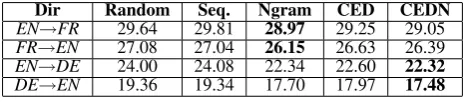
sys-tem using the updated training data (initial training data plus PEs of the first batch of sentences). The updated model will be used to translate the next batch. The same process is repeated until the in-cremental dataset is finished (16 and 20 iterations for English–French and English–German, respec-tively). For each batch we compute the TER score between the MT output and the refererence trans-lations for the sentences of that batch. We then compute the average TER score for all the batches. These average scores, for each selection criterion, are reported in Table 2.
In the second setting, instead of using the whole training data, we used a subset of (randomly se-lected) 5,000 sentence pairs for training the initial MT system and a subset of 20,000 sentences from the remaining data as the incremental dataset. Here we take batches of 1,000 sentences (thus 20 batches). The results are shown in Table 3.
The first setting aims to reflect the situation where a translation job is to be completed for a do-main for which we have a considerable amount of data available. Conversely, the second setting re-flects the situation where a translation job is to be carried out for a domain with little (if any) avail-able data.
[image:3.595.306.538.525.576.2]Dir Random Seq. Ngram CED CEDN EN→FR 29.64 29.81 28.97 29.25 29.05 FR→EN 27.08 27.04 26.15 26.63 26.39 EN→DE 24.00 24.08 22.34 22.60 22.32 DE→EN 19.36 19.34 17.70 17.97 17.48
Table 2: TER average scores for Setting 1
Dir Random Seq. Ngram CED CEDN EN→FR 36.23 36.26 35.20 35.48 35.17 FR→EN 33.26 33.34 32.26 32.69 32.17 EN→DE 32.23 32.19 30.58 31.96 29.98 DE→EN 27.24 27.29 26.10 26.73 24.94
Table 3: TER average scores for Setting 2
For Setting 1 (Table 2), the best result is ob-tained by the CEDN criterion for two out of the four directions. For EN→FR, n-gram overlap
4As this study simulates the post-editing, we use the
[image:3.595.310.537.617.668.2]Type Sentences Avg. EN SL Avg. FR SL Sentences Avg. EN SL Avg. DE SLEN–FR EN–DE
Training 39,679 13.55 15.28 54,907 12.66 12.90
[image:4.595.86.515.60.114.2]Incremental 8,000 13.74 15.50 10,000 12.38 12.61
Table 1: Data Statistics for English–French and English–German Symantec Translation Memory Data. SL stands for sentence length, EN stands for English, FR stands for French and DE stands for German
performs slightly better than CEDN (0.08 points lower) with a decrease of 0.67 and 0.84 points when compared to the baselines (random and se-quential, respectively). For FR→EN, n-gram overlap results in a decrease of 0.93 and 0.89 points compared to the baselines. The decrease in average TER score is higher for the EN→DE and for DE→EN directions, i.e. 1.68 and 1.88 points respectively for CEDN compared to the random baseline.
In the scenario with limited data available be-forehand (Table 3), CEDN is the best performing criterion for all the language directions. For the EN–FR and FR–EN language pairs, CEDN results in a decrease of 1.06 and 1.09 points compared to the random baseline. Again, the decrease is higher for the EN–DE and DE–EN language pairs, i.e. 2.25 and 2.30 absolute points on average.
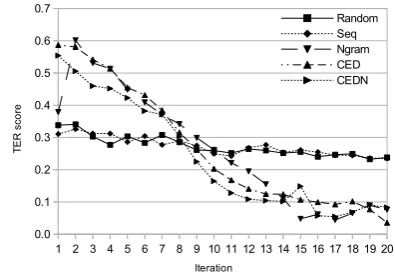
Figure 1 shows the TER scores per iteration for each of the criteria, for the scenario DE→EN Set-ting 2 (the trends are similar for the other scenar-ios). The two baselines exhibit slight improve-ment over the iterations, both starting at around .35 TER points and finishing at around .25 points. Conversely, all the three criteria start at very high scores (in the range [.5,.6]) and then improve con-siderably to arrive at scores below .1 for the last iterations. Compared to Ngram and CED, CEDN reaches better scores earlier on, being the criterion with the lowest score up to iteration 13.
1 2 3 4 5 6 7 8 9 10 11 12 13 14 15 16 17 18 19 20 0.0
0.1 0.2 0.3 0.4 0.5 0.6 0.7
Random Seq Ngram CED CEDN
Iteration
T
E
R
s
co
[image:4.595.82.280.536.673.2]re
Figure 1: Results per iteration, DE→EN Setting 2 Figure 1 together with Tables 2 and 3 show that AL for PE-based incremental MT retrain-ing really works: all AL based methods (Ngram, CED, CEDN) show strong improvements over both baselines after the initial 8-9 iterations (Fig-ure 1) and best performance on the complete
incre-mental data sets, resulting in a noticeable decrease of the overall TER score (Tables 2 and 3). In six out of eight scenarios, our novel metric CEDN ob-tains the best result.
4 Conclusions and Future Work
This paper has presented an application of AL to MT for dynamically selecting automatic transla-tions of sentences for human PE, with the aim of reducing overall PE time in a PE-based incremen-tal MT retraining scenario in a typical industrial localisation workflow that aims to capitalise on human PE as early as possible to avoid repeat mis-takes.
Our approach makes use of source side informa-tion only, uses two novel selecinforma-tion criteria based on cross entropy difference and is tested on indus-trial data for two language pairs. Our best per-forming criteria allow the incrementally retrained MT systems to improve their performance earlier and reduce the overall TER score by around one and two absolute points for English–French and English–German, respectively.
In order to be able to explore a space of selec-tion criteria and batch sizes, our experiments sim-ulate PE, in the sense that we use the target ref-erence (instead of PEs) and approximate PE time with TER. Given that TER correlates well with PE time (O’Brien, 2011), we expect AL-based selec-tion of sentences for human PE to lead to overall reduction of PE time. In the future work, we plan to do the experiments using PEs to retrain the sys-tem and measuring PE time.
In this work, we have taken batches of sentences (size 500 to 1,000) and do full retraining. As fu-ture work, we plan to use fully incremental retrain-ing and perform the selection on a sentence-by-sentence basis (instead of taking batches).
Acknowledgements
This work is supported by Science Foundation Ireland (Grants 12/TIDA/I2438, 07/CE/I1142 and 12/CE/I2267) as part of the Centre for Next Gen-eration Localisation (www.cngl.ie) at Dublin City University. We would like to thank Symantec for the provision of data sets used in our experiments.
References
Amittai Axelrod, Xiaodong He, and Jianfeng Gao. 2011. Domain adaptation via pseudo in-domain data selection. InProceedings of the Conference on Empirical Methods in Natural Language Process-ing, EMNLP ’11, pages 355–362, Stroudsburg, PA, USA. Association for Computational Linguistics. Nicola Bertoldi, Mauro Cettolo, and Marcello
Fed-erico. 2013. Cache-based online adaptation for ma-chine translation enhanced computer assisted trans-lation. InProceedings of the XIV Machine Transla-tion Summit, pages 35–42, Nice, France.
Michael Bloodgood and Chris Callison-Burch. 2010. Bucking the trend: Large-scale cost-focused active learning for statistical machine translation. In Jan Hajic, Sandra Carberry, and Stephen Clark, editors,
ACL, pages 854–864. The Association for Computer Linguistics.
Peter F. Brown, Vincent J. Della Pietra, Stephen A. Della Pietra, and Robert L. Mercer. 1993. The mathematics of statistical machine translation: Pa-rameter estimation. Comput. Linguist., 19(2):263– 311, June.
Marcello Federico, Nicola Bertoldi, and Mauro Cet-tolo. 2008. IRSTLM: an open source toolkit for handling large scale language models. In INTER-SPEECH, pages 1618–1621. ISCA.
Jes´us Gonz´alez-Rubio, Daniel Ortiz-Mart´ınez, and Francisco Casacuberta. 2012. Active learning for interactive machine translation. In Proceedings of the 13th Conference of the European Chapter of the Association for Computational Linguistics, EACL ’12, pages 245–254, Stroudsburg, PA, USA. Asso-ciation for Computational Linguistics.
Gholamreza Haffari, Maxim Roy, and Anoop Sarkar. 2009. Active learning for statistical phrase-based machine translation. In HLT-NAACL, pages 415– 423. The Association for Computational Linguistics. Philipp Koehn, Hieu Hoang, Alexandra Birch, Chris Callison-Burch, Marcello Federico, Nicola Bertoldi, Brooke Cowan, Wade Shen, Christine Moran, Richard Zens, Chris Dyer, Ondˇrej Bojar, Alexandra Constantin, and Evan Herbst. 2007. Moses: open source toolkit for statistical machine translation. In
Proceedings of the 45th Annual Meeting of the ACL on Interactive Poster and Demonstration Sessions, ACL 2007, pages 177–180, Prague, Czech Repub-lic. Association for Computational Linguistics.
Abby Levenberg, Chris Callison-Burch, and Miles Os-borne. 2010. Stream-based translation models for statistical machine translation. InHuman Lan-guage Technologies: The 2010 Annual Conference of the North American Chapter of the Association for Computational Linguistics, HLT ’10, pages 394– 402, Stroudsburg, PA, USA. Association for Com-putational Linguistics.
William Lewis and Sauleh Eetemadi. 2013. Dramati-cally reducing training data size through vocabulary saturation. InProceedings of the Eighth Workshop on Statistical Machine Translation, pages 281–291, Sofia, Bulgaria, August. Association for Computa-tional Linguistics.
Prashant Mathur, Mauro Cettolo, and Marcello Fed-erico. 2013. Online learning approaches in com-puter assisted translation. In Proceedings of the Eighth Workshop on Statistical Machine Transla-tion, ACL, pages 301–308, Sofia, Bulgaria.
Scott Miller, Jethran Guinness, and Alex Zamanian. 2004. Name tagging with word clusters and dis-criminative training. InProceedings of HLT, pages 337–342.
Robert C. Moore and William Lewis. 2010. Intelli-gent selection of language model training data. In
Proceedings of the ACL 2010 Conference Short Pa-pers, ACLShort ’10, pages 220–224, Stroudsburg, PA, USA. Association for Computational Linguis-tics.
Sharon O’Brien. 2011. Towards predicting
post-editing productivity. Machine Translation, 25(3):197–215, September.
Fredrik Olsson. 2009. A literature survey of active machine learning in the context of natural language processing. Technical Report T2009:06.
Mirko Plitt and Franc¸ois Masselot. 2010. A productiv-ity test of statistical machine translation post-editing in a typical localisation context. Prague Bull. Math. Linguistics, 93:7–16.
Michel Simard and George Foster. 2013. Pepr: Post-edit propagation using phrase-based statistical ma-chine translation. In Proceedings of the XIV Ma-chine Translation Summit, pages 191–198, Nice, France.
Matthew Snover, Bonnie Dorr, Richard Schwartz, Lin-nea Micciulla, and John Makhoul. 2006. A study of translation edit rate with targeted human annotation. In Proceedings of Association for Machine Trans-lation in the Americas, pages 223–231, Cambridge, MA.