Proceedings of the 2019 Conference on Empirical Methods in Natural Language Processing 4558
Task-Oriented Conversation Generation Using
Heterogeneous Memory Networks
Zehao Lin1 Xinjing Huang1 Feng Ji2 Haiqing Chen2 Yin Zhang1∗ 1College of Computer Science and Technology, Zhejiang University
2 DAMO Academy, Alibaba Group
{georgelin,huangxinjing,zhangyin98}@zju.edu.cn
{zhongxiu.jf,haiqing.chenhq}@alibaba-inc.com
Abstract
How to incorporate external knowledge into a neural dialogue model is critically important for dialogue systems to behave like real hu-mans. To handle this problem, memory net-works are usually a great choice and a promis-ing way. However, existpromis-ing memory networks do not perform well when leveraging hetero-geneous information from different sources. In this paper, we propose a novel and ver-satile external memory networks called Het-erogeneous Memory Networks (HMNs), to si-multaneously utilize user utterances, dialogue history and background knowledge tuples. In our method, historical sequential dialogues are encoded and stored into the context-aware memory enhanced by gating mechanism while grounding knowledge tuples are encoded and stored into the context-free memory. During decoding, the decoder augmented with HMNs recurrently selects each word in one response utterance from these two memories and a gen-eral vocabulary. Experimental results on mul-tiple real-world datasets show that HMNs sig-nificantly outperform the state-of-the-art data-driven task-oriented dialogue models in most domains.
1 Introduction
Compared with chitchat, task-oriented dialogue systems aim at solving tasks in specific domains with grounding knowledge. Though far from han-dling conversation like a real human, existing task-oriented dialogue systems have shown cheerful prospect in a specific domain, e.g. Siri and Cor-tana are personal assistants, helping people a lot in daily life and business work.
In general, knowledge-grounded task-oriented dialogue system can be divided into three impor-tant components: understanding user utterances, fetching right knowledge from external storage
∗
[image:1.595.309.525.219.346.2]*Corresponding Author
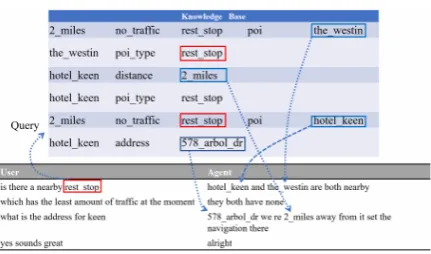
Figure 1: A multi-turn dialogue example. The upper table shows several n-tuples sampled from knowledge base. Lower table shows multi-turn dialogues. Agent needs to retrieve appropriate knowledge tuples to gen-erate the proper response.
and replying right answer. As shown in Fig-ure 1, agent is required to do a point-of-interest navigation. According to dialogue history, agent will fetch related knowledge base information, in our case represented as tuples (e.g. [hotel keen,
poi type, rest stop], which indicates the point-of-i nterests type ofhotel keenisrest stop), as an external knowledge to answer correctly and com-plete task.
Traditional pipeline dialogue systems(Yan et al., 2017; Rojas-Barahona et al., 2017) and some end-to-end dialogue systems rely on the predefined the slot filling labels. Despite the consumption of human efforts, these kinds of systems are difficult to adapt to new domains.
re-sponse (Madotto et al.,2018).
However, existing memory networks equally treat information from multiple sources, e.g. se-quential dialogue history and structure knowledge bases. Therefore two weaknesses arise in such methods: (1) It is difficult to model different types of structured information in only one memory net-work. (2) It is also difficult to model the effective-ness of knowledge from different sources in such a single memory network. To address these issues, we expand the architecture of memory networks used in a seq2seq neural model.
Our contributions are mainly three-fold:
• We propose a novel seq2seq neural conver-sation model augmented with Heterogeneous Memory Networks. We first model sequen-tial dialogue history and grounding exter-nal knowledge with two different kinds of memory networks and then feed the output of context-aware memory to the context-free memory to search the representations of sim-ilar knowledge.
• Our context-aware memory networks is able to learn the context-aware latent representa-tions and stores them into memory slots, by employing a gating mechanism when encod-ing dialogue history and user utterance.
• Experimental results demonstrate that our neural approach significantly outperforms the examined neural methods automatic met-rics, and context-aware memory networks can learn and store more meaningful rep-resentations than the examined memory ap-proaches.
2 Related Works
The end-to-end model uses deep neural net in-stead of several parts in pipeline models to gen-erate responses. (Rojas-Barahona et al., 2017) propose a data-driven goal-oriented neural dia-logue system by adding database operator and pol-icy networks modules to introduce database in-formation and track state which need extra label-ing step that breaks differentiability. (Bordes and Weston, 2016) propose a testbed to break down the strengths and shortcomings of end-to-end di-alog systems in goal-oriented applications. Those methods treated dialogue system as the problem of
learning a mapping policy from dialogue histories to agents’ responses.
The booming internet dialogue data lay the foundation of building data-driven models. (Rit-ter et al., 2011) first applied phrase-based Statis-tical Machine Translation(Setiawan et al., 2005). It treats the conversation system as a translation problem, a user utterance needs to be translated into an agent response.
(Sutskever et al.,2014) propose Sequence to se-quence model (SEQ2SEQ) architecture and apply it to neural machine translation task. SEQ2SEQ has become a general basis of natural language generation tasks, e.g. question answering(Tan et al.,2018) and question generation (Zhou et al., 2017). By applying the RNN based encoder-decoder framework to generate responses, mod-els(Shang et al., 2015; Cho et al., 2014b; Luong et al.,2015b) are able to utilize neural networks to learn the representation of dialogue histories and generate appropriate responses.
To deal with multi-turn information, (Sordoni et al., 2015) propose a model that represents the whole dialogue history (including the current mes-sage) with continuous representations or embed-dings of words and phrases to address the chal-lenge of the context-sensitive response generation. By adding a knowledge base module, recent works (Ghazvininejad et al., 2018;Young et al., 2018) have shown the possibility of training an end-to-end task-oriented dialogue system on the sequence to sequence architecture. Ghazvinine-jad et al. (GhazvinineGhazvinine-jad et al., 2018) general-ize the SEQ2SEQ approach by conditioning re-sponses on both conversation history and external knowledge, aiming at producing more contextual responses without slot filling.
CopyNet (Gu et al.,2016) and Pointer Networks (Vinyals et al., 2015) improve model’s accuracy and ability of handling of out-of-vocabulary words using neural attention. Pointer-Generator net-works (See et al.,2017) apply copy mechanism to the neural generation model. Their work shows copy mechanism can improve quality in text gen-eration. (Dhingra et al.,2017) and (Li et al.,2017) apply reinforcement learning to make it differen-tiable.
Figure 2: An example of Heterogeneous Memory Networks with two-hop attention. Context-aware memory which encodes dialog history to a context vectoroc2while context-free memory loads knowledge base information. The output of context-aware memory will be employed as the query vector to the context-free memory.
et al.,2015) propose end-to-end memory networks with multiple attention hops model over a possi-bly large external memory. (Madotto et al.,2018) propose Mem2Seq that combines the end-to-end memory networks with the idea of pointer net-works. (Chen et al., 2018) add the hierarchical structure and the variational memory network to capture both the high-level abstract variations and long-term memories during the dialogue tracking. To take care of information from different sources, (Fu and Feng,2018) propose an attention mecha-nism to encourage the decoder to actively interact with the memory by taking its heterogeneity into account.
3 Proposed Framework
To generate responses using dialogue history and grounding knowledge, we introduce a novel encoder-decoder neural conversation model aug-mented with Heterogeneous Memory Networks (HMNs). The encoder module adopts a context-aware memory network to better understand the dialogue history and query. The decoder is en-hanced with HMNs, which is able to incorporate external knowledge and dialog history when gen-erating words.
3.1 Encoder
The encoder encodes the dialogue history into a fixed context vector. Here we adopt the context-aware memory as our encoder module. As shown in the left part of Figure2, each word will be ex-tended to the following parts: 1) token itself. 2) A turn tag. 3) An identity tag. For example, in the first turn a user says ”hello” and the response from system is ”may I help you”, it will be concatenated as [(hello, t1, user),(may, t1, sys),(I, t1, sys),(help, t1, sys), (you, t1, sys)],sysmeans the word comes
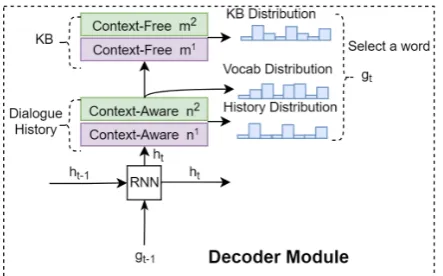
Figure 3: Decoder module with two attention hops
from the dialog system, so doesuser. t1indicates the word is from the first turn. Each word can be transformed into vector by embedding lookup, and we sum up vectors in each tuple to be the input sequence of the context-aware memory. Using a fixed vector to query the memory, a context vector
ccan be obtained.
3.1.1 Context-Aware Memory
To efficiently model the context information of sequential data, we present the context-aware memory. Memory slots nk are structured by concatenating all input vectors as nk =
cat[nk1, nk2, ..., nkl], k stands for the k-th hop in memory, andlmeans the length of the input. nkl
is the sum of each word tag embedding using each hop own randomly initialized embedding matrix
[image:3.595.306.528.235.373.2]in-puts, denoted asnk = [−n→k,n←−k], where−n→kand←n−k
are the forward and backward representation of in-puts, respectively. The forward process can be il-lustrated as equations:
rt=σ(W1vtk+W2 −→
nk(t−1)+b1) (1)
zt=σ(W3vtk+W4 −→
nk(t−1)+b2) (2)
et= tanh(W5vtk+rt(W6 −→
nk(t−1)+b3)) (3)
−→
nkt = (1−zt)et+zt
−→
nk(t−1) (4)
whereW1, W2,W3, W4,W5, W6 andb1, b2, b3 are trainable weights and biases.
Given the query vector qck, attention weights over memory cells nk can be calculated by the equation:
pk=Sof tmax(nk·qck) (5)
the readout vector is the sum of output memory matrixnk+1with corresponding attention weights
pk.
uk=X
i
(pki ·nki+1) (6)
By summing query and readout vector together, we can get the output from the k-th hop.
ock=qck+uk (7)
Noteock is also the query vector of the (k+1)-th hop.
3.2 Decoder
The decoder contains HMNs and an RNN con-troller, as shown in Figure3. The controller con-trols the process of querying HMNs.
In each time step, HMNs will generate: 1) a readout vectoroc1, which is the output of the first hop in history memory, and 2) attention weights of the last hop in two memories, called history word distributionPhisand knowledge tuple distribution
Pkb. The readout vector is concatenated with ht
to predict the vocabulary distributionPvocab.
For-mally,
Pvocab=Sof tmax(W7[ht, oc1]) (8)
whereW7is trainable weight matrix.
We adopt a simple strategy ( Section3.5) to select a word from three distributions Pvocab, Phis and
Pkb.
3.2.1 Heterogeneous Memory Networks
HMNs stacks two types of memory: 1) context-aware memory and 2) context-free memory. Di-alog history is loaded into context-aware mem-ory, and knowledge base triples are loaded into context-free memory. Firstly, HMNs accepts query vector as inputs, then walk through context-aware memories. The final outputuk in the last hop will be employed to query context-free mem-ory. Context-aware memory has been detailed in Section3.1.1.
Context-Free memory itself is end-to-end mem-ory networks (Sukhbaatar et al., 2015). Com-pared with our context-aware memory, it has no gating mechanism. The input to the memory is the summed vectors in each knowledge triple, as depicted in the right part of Figure 2. Each hop owns randomly initialized embedding matrixCk
0
We denote memory slots asmk. It accepts a query vector and then follows the same process 5 to7, the outputuk
0
can be obtained.
3.2.2 Controller
We adopt GRU as our controller. It accepts the output c from encoder as initial hidden state h0. In each time step, it takes the previous generated wordgt−1’s embeddingE(gt−1)and last time hid-den stateht−1as inputs. Formally:
ht=GRU(E(gt−1), ht−1) (9)
thenhtis used to query the HMNs.
3.3 Copy Mechanism
We adopt copy mechanism to copy words from memories. Attention weights in the last hop of the two memories,Pkb andPhiswill be the
probabil-ity of the target word from those memories. If the target word does not appear in inputs, the position index will be the last position in memories, which is a sentinel added in preprocessing stage.
3.4 Joint Learning
To learn the distribution of three vocabularies
Pvocab,PkbandPhisin each time step, the loss in
the t-th time step is the negative log-likelihood of the predict probability of the target word for that time step. Formally:
Loss=−1
T
t=T X
t=0
X
i
(logpti) (10)
Note thatpit means the t-th word’s probability in
Table 1: The statistics of the bAbI-3, 4, 5, DSTC2 and Key-Value Retrieval datasets
Datasets Key-Value Retrieval dataset DSTC 2 bAbI-3 bAbI-4 bAbI-5
Avg. History words 25.5 63.4 49.9 20.5 62.6
Avg. KB pairs 64.7 42.7 23.4 7.0 23.6
Avg. Response Length 8.7 10.2 7.2 5.7 6.5
Vocabulary Size 1554 1066 739 1004 1135
Dialogue Turns 2.8 9.9 10.9 4.5 19.3
3.5 Word Selection Strategy
In our case, if words with the highest probability in Phis andPkb vocabularies are not on sentinel
positions, we directly compare the probability of each word and select the higher one. If one of the vocabularies points to the sentinel position, the model will select the word with the highest prob-ability in the other vocabulary. At last, if both vo-cabularies get to sentinel positions, the word from
Pvocabwill be selected.
4 Experimental Setup
4.1 Datasets
As the proposed approach is quite general, the model can be applied to any task-oriented dia-logue datasets with conversation and knowledge base data. To evaluate and compare the results with the state-of-the-art methods in multiple di-mensions, we choose three popular task conver-sation datasets including DSTC 2, Key-Value Re-trieval dataset and the (6) dialog bAbI tasks. Table 1shows the statistics of datasets.
• Key-Value Retrieval dataset (Eric and Man-ning, 2017). This dataset releases a cor-pus of 3,031 multi-turn dialogues. The di-alogues consist of three different domains: calendar scheduling, weather information re-trieval, and point-of-interest navigation.
• The (6) dialog bAbI tasks (Bordes and We-ston,2016). The (6) dialog bAbI tasks are a set of five subtasks within the goal-oriented context of restaurant reservations. Conversa-tions are grounded with an underlying knowl-edge base of restaurants and their properties (location, type of cuisine, etc.). As task 1 and 2 have been achieved very well, we only test our model on task 3 to 5 and their OOV(out-of-vocabulary), where entities (e.g. restau-rant names) in test sets may not have been able to see during training.
• The Dialog State Tracking Challenge 2 (DSTC 2). DSTC 2 is a research challenge focused on improving the state-of-the-art in tracking the state of spoken dialogue systems. DSTC 2’s training dialogues were gathered using Amazon Mechanical Turk related to restaurant search.
For all datasets, we employ the original conver-sation and knowledge base information only and drop the other labels e.g. slot filling labels. We take several metrics over all datasets to evaluate the performance on multiple dimensions. And to evaluate the context-aware memory networks, we also test the HMNs with only context-free memory on the dialog bAbI tasks.
4.2 Evaluation Method
To compare with the original datasets baselines, we apply evaluation methods on each datasets the same as datasets’ original papers described in4.1.
• Bilingual Evaluation Understudy (BLEU) (Papineni et al., 2002). BLEU has been widely employed in evaluating sequence gen-eration including machine translation, text summarization, and dialogue systems. BLEU calculates the n-gram precision which is the fraction of n-grams in the candidate text which is present in any of the reference texts.
• F1 Score (F-measure): F1 evaluates the model’s ability in terms of precision and re-call, which is more comprehensive than just using precision or recall measure. We adopt F1 to evaluate if a model can extract informa-tion from a knowledge base precisely.
Table 2: Results on Key-Value Retrieval dataset. F1 score, including Entity F1, is micro-average over the entire set, and three subtasks. Human results are reported by Eric et al.(Eric and Manning,2017)
Model name BLEU Ent. F1 Scheduling Ent. F1 Weather Ent. F1 Navigation Ent. F1
Human* 13.5 60.7 64.3 61.6 55.2
SEQ2SEQ 11.07 30.5 30.7 46.4 13.4
SEQ2SEQ+Attn. 11.19 35.6 40.5 44.0 23.0
Mem2Seq 12.06 31.1 51.8 34.3 12.3
[image:6.595.75.523.97.182.2]HMNs 14.46 43.1 61.3 40.3 32.3
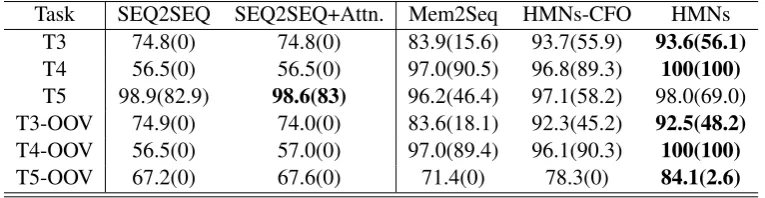
Table 3: Results of Per-response accuracy and Per-dialog accuracy (in brackets) on bAbI dialogues. Per-dialog accuracy presents the accuracy of complete dialogues.
Task SEQ2SEQ SEQ2SEQ+Attn. Mem2Seq HMNs-CFO HMNs T3 74.8(0) 74.8(0) 83.9(15.6) 93.7(55.9) 93.6(56.1) T4 56.5(0) 56.5(0) 97.0(90.5) 96.8(89.3) 100(100) T5 98.9(82.9) 98.6(83) 96.2(46.4) 97.1(58.2) 98.0(69.0) T3-OOV 74.9(0) 74.0(0) 83.6(18.1) 92.3(45.2) 92.5(48.2) T4-OOV 56.5(0) 57.0(0) 97.0(89.4) 96.1(90.3) 100(100)
T5-OOV 67.2(0) 67.6(0) 71.4(0) 78.3(0) 84.1(2.6)
Table 4: The results on the DSTC 2
Model name F1 BLEU
SEQ2SEQ 69.7 55.0
SEQ2SEQ+Attn. 67.1 56.6
SEQ2SEQ+Copy 71.6 55.4
Mem2Seq 75.3 55.3
Our model 77.7 56.4
4.3 Baselines and Training Setup
The hyper-parameter settings are adopted as the best practice settings for each training set follow-ing the Madotto’s (Madotto et al.,2018) and Man-ning’s (Manning and Eric,2017) best experimen-tal results on baselines SEQ2SEQ and Mem2Seq. Detailed models and their settings are as follows:
• Sequence to sequence. For SEQ2SEQ, we adopt one layer LSTMs as encoder and de-coder. For Key-Value Retrieval dataset, hid-den size is placed at 512 and the dropout rate is 0.3. On dataset bAbI, the hidden size and dropout rate are 128 and 0.1 for task 3, 256 and 0.1 for task 4 and 5. Learning rates are set to 0.001 for bAbI and 0.0001 for DSTC 2 and Key-Value Retrieval dataset.
• SEQ2SEQ + Attention. We adopt the atten-tion mechanism (Luong et al., 2015a) com-monly used in neural machine translation. On dataset bAbI, hidden size and the dropout rate are 256 and 0.1 for task 3 and 4, 128 and 0.1
for task 5. For Key-Value Retrieval dataset, hidden size and dropout rate are 512 and 0.3. On the DSTC 2 task, hidden size is set to 353 and word embedding size is 300 (same with original work).
• Mem2Seq. Except 128 in task 3, hidden size in other tasks is 256. The dropout rate is set to 0.2 in task 3, 4 and Key-Value Retrieval dataset, 0.1 in task 5 and DSTC 2 dataset. We adopt three hops in DSTC 2 and Key-Value Retrieval dataset.
• HMNs with context-free only (HMNs-CFO). To test the performance of context-aware memory, we apply other context-free to en-code dialogue history instead of context-aware memory in HMNs. All the other struc-ture and parameter settings are the same as HMNs in this model.
All models are tested with various hyper-parameter settings to get their best performance, e.g. hidden size selected from [64, 128, 256, 512]. Note that settings from datasets are also tested like SEQ2SEQ + Attention’s hidden size is 353 on Key-Value Retrieval dataset.
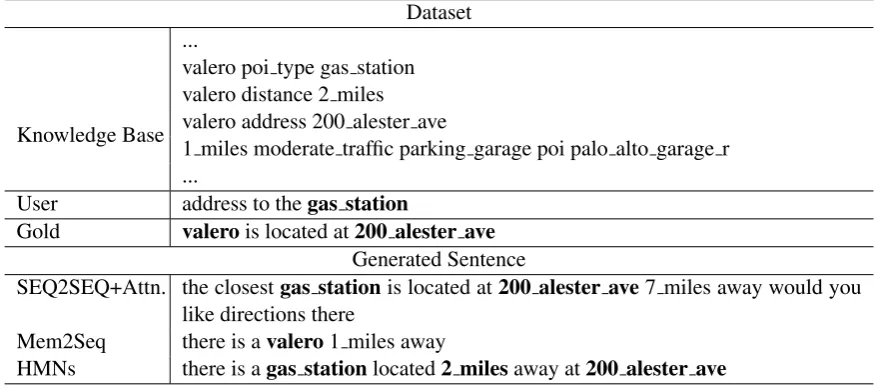
[image:6.595.108.491.224.323.2]Table 5: A generated example from Key-Value Retrieval dataset with correct knowledge entities inbold. Given the knowledge base and user’s request, we list the generated responses of three models and the gold answers. This example is randomly selected from all generated sentences and we only show tuples been used by models.
Dataset
Knowledge Base ...
valero poi type gas station valero distance 2 miles valero address 200 alester ave
1 miles moderate traffic parking garage poi palo alto garage r ...
User address to thegas station
Gold valerois located at200 alester ave Generated Sentence
SEQ2SEQ+Attn. the closestgas stationis located at200 alester ave7 miles away would you like directions there
Mem2Seq there is avalero1 miles away
HMNs there is agas stationlocated2 milesaway at200 alester ave
4.4 HMNs Training Settings
We test the hidden size in [64, 128, 256] and set dropout rate in [0.1, 0.2]. Learning rate is initiated with 0.001 and training batch is set to 64. The metrics results are coming from the best result set-tings for each dataset. We select hidden size and dropout rate at (256, 0.1) on bAbI task 3 and task 5, (256,0.2) on task 4. On the DSTC 2 task, we set hidden size and dropout rate at (128, 0.1). For Key-Value Retrieval dataset, the setting is hidden size 256 and dropout rate 0.1. Except for bAbI tasks’ 1 layer, all HMNs and Mem2Seq tasks em-ploy 3 layer memories.
5 Results and Discussion
5.1 Results and Analysis
The best results of the baselines and HMNs are gathered into tables and figures. Table 2 show the result of models on Key-Value Re-trieval dataset. Except for F1 scores on Calendar Scheduling, HMNs get significantly better results on all benchmarks comparing the state-of-the-art models. HMMs’ BLEU score is even higher than human results which are reported in (Eric and Manning, 2017). Results show our model’s out-standing performance in generating a fluent and accurate response in most tasks.
Examples generated by our approach and base-lines are given in Table 5. These two exam-ples are randomly selected from all generated sen-tences. Comparing the generated sentences by hu-mans, although entities and sentences are different
with gold answer in example one, our approach is able to produce more fluent and accurate sen-tences. However, the result on task weather fore-casting neither HMNs and Mem2Seq can outper-form SEQ2SEQ. We will discuss it in the next sec-tion.
Table4shows our model gets the best F1 score on dataset DSTC 2, while SEQ2SEQ with atten-tion gets the best BLEU result.
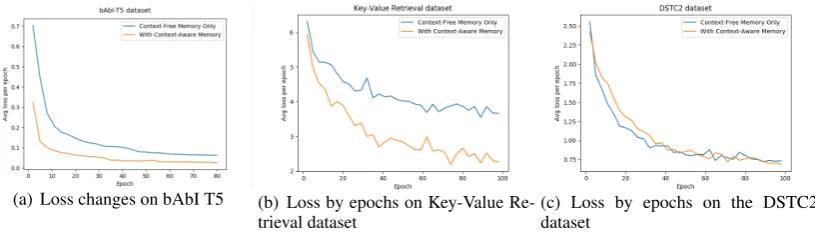
Table3shows results of models on bAbI tasks. HMNs and Mem2Seq adopt one hop attention only and note that all results are the best per-formance of each model in 100 epochs. HMNs achieved the best results on most tasks except T5. HMNs-CFO also outperforms the other mod-els. This demonstrates that both training multiple distributions over heterogeneous information and employment of context-aware memory benefit the end-to-end dialogue system. The improvements in per-dialogue accuracy on out-of-vocabulary tests are even more significant. Figure 4 shows the changes of HMNs and HMNs-CFO’s total loss across time. HMNs learns significantly faster.
sig-(a) Loss changes on bAbI T5 (b) Loss by epochs on Key-Value Re-trieval dataset
[image:8.595.98.506.73.191.2](c) Loss by epochs on the DSTC2 dataset
Figure 4: The total loss by epochs on three different datasets in 100 epochs. One line with context-aware memory and the other with only context-free memory
nificantly improves performance in retrieving cor-rect knowledge entities.
5.2 Discussion
5.2.1 Context-Aware Memory
To show whether context-aware memory bene-fits conversation learning, on bAbI tasks, we also tested HMNs-CFO memory only. From Table3, we observe that HMNs-CFO is significantly bet-ter than original Mem2Seq as well as SEQ2SEQ + attention in several results and only loses slightly on task 4 (89.3 to 90.5). One reason is that one memory is difficult to learn best distribution over different sources. Respectively encoding sequen-tial dialogue history and grounding knowledge can learn two better distributions than one general but not best distribution. This also indicates that using the query vector generated by history memory to retrieve information in knowledge base memory is reasonable.
As the HMNs model get the best results in all tasks except one, in addition the results of train-ing speed of HMNs and HMNs-CFO (Figure 4), the context-aware memory is clearly to learn rep-resentation of the dialogue history much better and faster and also demonstrates that the importance of incorporating context information for dialogue systems. HMNs outperform the HMNs-CFO not only on BLEUs but also entity F1 on most tasks, showing building a good representation of dia-logue history benefits knowledge reasoning, and help to improve the context-free memory by issu-ing a good query vector.
From above all, we can conclude that both stacked memory networks architecture and using context-aware memory to load sequential infor-mation can improve the performance of retrieving knowledge and generating sentences.
5.2.2 Shortcomings
From the results in Table2, we note that HMNs and Mem2Seq failed on weather forecasting task. We analysed the average knowledge pairs of weather forecasting tasks and find it near three times the knowledge pairs of the other two tasks. Then we carried out another experiment that first narrows the KB candidates by perform-ing a matchperform-ing preprocessperform-ing operation, and the Weather Ent. F1 result of our method will climb to more than 48 which is the best. This may indicates that this kind of memory networks may have diffi-culties in handling large scale knowledge base. So perform a matching operation to narrow the can-didate knowledge space is critical in a real-world large scale knowledge base.
And in this paper, we only show sequential data and knowledge triples data. For more types of in-formation to integrate, model needs to add other memory networks, e.g. graph neural networks augmented memory networks (Zhou et al.,2018) for graph structured data.
6 Conclusion
Acknowledgement
We thank the anonymous reviewers for their in-sightful comments on this paper. This work was supported by the NSFC (No.61402403), DAMO Academy (Alibaba Group), Alibaba-Zhejiang University Joint Institute of Frontier Technologies, Chinese Knowledge Center for En-gineering Sciences and Technology, and the Fun-damental Research Funds for the Central Univer-sities.
References
Antoine Bordes and Jason Weston. 2016.
Learn-ing end-to-end goal-oriented dialog. CoRR,
abs/1605.07683.
Hongshen Chen, Zhaochun Ren, Jiliang Tang, Yi-hong Eric Zhao, and Dawei Yin. 2018. Hierarchi-cal variational memory network for dialogue
gener-ation. InProceedings of the 2018 World Wide Web
Conference on World Wide Web, WWW 2018, Lyon, France, April 23-27, 2018, pages 1653–1662.
Kyunghyun Cho, Bart van Merrienboer, Dzmitry Bah-danau, and Yoshua Bengio. 2014a. On the proper-ties of neural machine translation: Encoder-decoder
approaches. In Proceedings of SSST@EMNLP
2014, Eighth Workshop on Syntax, Semantics and Structure in Statistical Translation, Doha, Qatar, 25 October 2014, pages 103–111.
Kyunghyun Cho, Bart van Merrienboer, C¸ aglar G¨ulc¸ehre, Dzmitry Bahdanau, Fethi Bougares, Hol-ger Schwenk, and Yoshua Bengio. 2014b. Learning phrase representations using RNN encoder-decoder for statistical machine translation. InProceedings of the 2014 Conference on Empirical Methods in Nat-ural Language Processing, EMNLP 2014, October 25-29, 2014, Doha, Qatar, A meeting of SIGDAT, a Special Interest Group of the ACL, pages 1724– 1734.
Bhuwan Dhingra, Lihong Li, Xiujun Li, Jianfeng Gao, Yun-Nung Chen, Faisal Ahmed, and Li Deng. 2017.
Towards end-to-end reinforcement learning of
dia-logue agents for information access. In
Proceed-ings of the 55th Annual Meeting of the Association for Computational Linguistics (Volume 1: Long Pa-pers), pages 484–495, Vancouver, Canada. Associa-tion for ComputaAssocia-tional Linguistics.
Mihail Eric and Christopher D Manning. 2017. Key-value retrieval networks for task-oriented dialogue. arXiv preprint arXiv:1705.05414.
Yao Fu and Yansong Feng. 2018. Natural answer
gen-eration with heterogeneous memory. In
Proceed-ings of the 2018 Conference of the North American
Chapter of the Association for Computational Lin-guistics: Human Language Technologies, NAACL-HLT 2018, New Orleans, Louisiana, USA, June 1-6, 2018, Volume 1 (Long Papers), pages 185–195.
Marjan Ghazvininejad, Chris Brockett, Ming-Wei Chang, Bill Dolan, Jianfeng Gao, Wen-tau Yih, and Michel Galley. 2018.A knowledge-grounded neural
conversation model. pages 5110–5117.
Alex Graves, Greg Wayne, and Ivo Danihelka. 2014. Neural turing machines. arXiv preprint arXiv:1410.5401.
Jiatao Gu, Zhengdong Lu, Hang Li, and Victor O. K. Li. 2016. Incorporating copying mechanism in
sequence-to-sequence learning. In Proceedings of
the 54th Annual Meeting of the Association for Computational Linguistics, ACL 2016, August 7-12, 2016, Berlin, Germany, Volume 1: Long Papers.
Mikael Henaff, Jason Weston, Arthur Szlam, Antoine Bordes, and Yann LeCun. 2016. Tracking the
world state with recurrent entity networks. CoRR,
abs/1612.03969.
Xuijun Li, Yun-Nung Chen, Lihong Li, Jianfeng Gao, and Asli Celikyilmaz. 2017. End-to-end task-completion neural dialogue systems. InProceedings of The 8th International Joint Conference on Natu-ral Language Processing.
Thang Luong, Hieu Pham, and Christopher D. Man-ning. 2015a. Effective approaches to attention-based neural machine translation. InProceedings of the 2015 Conference on Empirical Methods in Nat-ural Language Processing, EMNLP 2015, Lisbon, Portugal, September 17-21, 2015, pages 1412–1421.
Thang Luong, Ilya Sutskever, Quoc V. Le, Oriol Vinyals, and Wojciech Zaremba. 2015b. Addressing the rare word problem in neural machine translation. In Proceedings of the 53rd Annual Meeting of the Association for Computational Linguistics and the 7th International Joint Conference on Natural Lan-guage Processing of the Asian Federation of Natural Language Processing, ACL 2015, July 26-31, 2015, Beijing, China, Volume 1: Long Papers, pages 11– 19.
Andrea Madotto, Chien-Sheng Wu, and Pascale Fung. 2018. Mem2seq: Effectively incorporating knowl-edge bases into end-to-end task-oriented dialog sys-tems. InProceedings of the 56th Annual Meeting of the Association for Computational Linguistics, ACL 2018, Melbourne, Australia, July 15-20, 2018, Vol-ume 1: Long Papers, pages 1468–1478.
Christopher D. Manning and Mihail Eric. 2017. A copy-augmented sequence-to-sequence architecture
gives good performance on task-oriented dialogue.
Kishore Papineni, Salim Roukos, Todd Ward, and Wei-Jing Zhu. 2002. Bleu: a method for automatic eval-uation of machine translation. InProceedings of the 40th Annual Meeting of the Association for Compu-tational Linguistics, July 6-12, 2002, Philadelphia, PA, USA., pages 311–318.
Alan Ritter, Colin Cherry, and William B. Dolan. 2011.
Data-driven response generation in social media. In Proceedings of the 2011 Conference on Empirical Methods in Natural Language Processing, EMNLP 2011, 27-31 July 2011, John McIntyre Conference Centre, Edinburgh, UK, A meeting of SIGDAT, a Special Interest Group of the ACL, pages 583–593.
Lina Maria Rojas-Barahona, Milica Gasic, Nikola Mrksic, Pei-Hao Su, Stefan Ultes, Tsung-Hsien Wen, Steve J. Young, and David Vandyke. 2017. A network-based end-to-end trainable task-oriented
di-alogue system. pages 438–449.
Abigail See, Peter J. Liu, and Christopher D. Manning. 2017.Get to the point: Summarization with pointer-generator networks. InProceedings of the 55th An-nual Meeting of the Association for Computational Linguistics, ACL 2017, Vancouver, Canada, July 30 - August 4, Volume 1: Long Papers, pages 1073– 1083.
Hendra Setiawan, Haizhou Li, Min Zhang, and Beng Chin Ooi. 2005. Phrase-based statistical ma-chine translation: A level of detail approach. In Nat-ural Language Processing - IJCNLP 2005, Second International Joint Conference, Jeju Island, Korea, October 11-13, 2005, Proceedings, pages 576–587.
Lifeng Shang, Zhengdong Lu, and Hang Li. 2015.
Neural responding machine for short-text
conver-sation. In Proceedings of the 53rd Annual
Meet-ing of the Association for Computational LMeet-inguistics and the 7th International Joint Conference on Natu-ral Language Processing of the Asian Federation of Natural Language Processing, ACL 2015, July 26-31, 2015, Beijing, China, Volume 1: Long Papers, pages 1577–1586.
Alessandro Sordoni, Michel Galley, Michael Auli, Chris Brockett, Yangfeng Ji, Margaret Mitchell, Jian-Yun Nie, Jianfeng Gao, and Bill Dolan. 2015.
A neural network approach to context-sensitive
gen-eration of conversational responses. InNAACL HLT
2015, The 2015 Conference of the North American Chapter of the Association for Computational Lin-guistics: Human Language Technologies, Denver, Colorado, USA, May 31 - June 5, 2015, pages 196– 205.
Sainbayar Sukhbaatar, Arthur Szlam, Jason Weston, and Rob Fergus. 2015. End-to-end memory
net-works. InAdvances in Neural Information
Process-ing Systems 28: Annual Conference on Neural In-formation Processing Systems 2015, December 7-12, 2015, Montreal, Quebec, Canada, pages 2440– 2448.
Ilya Sutskever, Oriol Vinyals, and Quoc V. Le. 2014.
Sequence to sequence learning with neural
net-works. InAdvances in Neural Information
Process-ing Systems 27: Annual Conference on Neural In-formation Processing Systems 2014, December 8-13 2014, Montreal, Quebec, Canada, pages 3104– 3112.
Chuanqi Tan, Furu Wei, Nan Yang, Bowen Du, Weifeng Lv, and Ming Zhou. 2018. S-net: From answer extraction to answer synthesis for machine
reading comprehension. In Proceedings of the
Thirty-Second AAAI Conference on Artificial Intelli-gence, New Orleans, Louisiana, USA, February 2-7, 2018.
Oriol Vinyals, Meire Fortunato, and Navdeep Jaitly. 2015. Pointer networks. In Advances in Neural Information Processing Systems 28: Annual Con-ference on Neural Information Processing Systems 2015, December 7-12, 2015, Montreal, Quebec, Canada, pages 2692–2700.
Oriol Vinyals and Quoc V. Le. 2015. A neural
conver-sational model.CoRR, abs/1506.05869.
Zhao Yan, Nan Duan, Peng Chen, Ming Zhou, Jianshe Zhou, and Zhoujun Li. 2017. Building task-oriented
dialogue systems for online shopping. In
Proceed-ings of the Thirty-First AAAI Conference on Arti-ficial Intelligence, February 4-9, 2017, San Fran-cisco, California, USA., pages 4618–4626.
Tom Young, Erik Cambria, Iti Chaturvedi, Hao Zhou, Subham Biswas, and Minlie Huang. 2018. Aug-menting end-to-end dialogue systems with common-sense knowledge. In Thirty-Second AAAI Confer-ence on Artificial IntelligConfer-ence.
Hao Zhou, Tom Young, Minlie Huang, Haizhou Zhao, Jingfang Xu, and Xiaoyan Zhu. 2018. Com-monsense knowledge aware conversation generation with graph attention. InProceedings of the Twenty-Seventh International Joint Conference on Artificial Intelligence, IJCAI 2018, July 13-19, 2018, Stock-holm, Sweden., pages 4623–4629.