Distributed Representations for Unsupervised Semantic Role Labeling
Kristian Woodsend and Mirella Lapata
Institute for Language, Cognition and Computation School of Informatics, University of Edinburgh
10 Crichton Street, Edinburgh EH8 9AB
[email protected],[email protected]
Abstract
We present a new approach for unsuper-vised semantic role labeling that lever-ages distributed representations. We in-duce embeddings to represent a predi-cate, its arguments and their complex in-terdependence. Argument embeddings are learned from surrounding contexts involv-ing the predicate and neighborinvolv-ing argu-ments, while predicate embeddings are learned from argument contexts. The in-duced representations are clustered into roles using a linear programming formu-lation of hierarchical clustering, where we can model task-specific knowledge. Experiments show improved performance over previous unsupervised semantic role labeling approaches and other distributed word representation models.
1 Introduction
In recent years, an increasing body of work has been devoted to learning distributed word repre-sentations and their successful usage in numerous tasks and real-world applications. Examples in-clude language modeling (Collobert et al., 2011; Mikolov et al., 2013c; Mnih and Kavukcuoglu, 2013), paraphrase detection (Socher et al., 2011a), sentiment analysis (Socher et al., 2011b; Kalch-brenner et al., 2014), and most notably machine translation (Kalchbrenner and Blunsom, 2013; Cho et al., 2014; Auli et al., 2013). Distributed word representations (also known as word embed-dings) are trained by predicting the contexts in which the words or phrases occur.
In this paper, we present a new approach for unsupervisedsemantic role labeling that leverages distributed representations. The goal of semantic role labeling is to discover the relations that hold between a predicate and its arguments in a given
input sentence (e.g., “who” did “what” to “whom”, “when”, “where”, and “how”).
1. [The burglar]A0[broke]V[the window]A1. 2. [The window]A1[broke]V.
In sentence (1), A0 represents the Agent of the breaking event, A1 represents thePatient(i.e., the physical object affected by the breaking event) and V determines the boundaries of the predicate. The semantic roles in the example are labeled in the style of PropBank (Palmer et al., 2005), a broad-coverage human-annotated corpus of se-mantic roles and their syntactic realizations. In the unsupervised case, the model must induce such la-bels from data without access to a predefined set of semantic roles.
Role induction is commonly treated as a cluster-ing problem (Titov and Klementiev, 2012; Lang and Lapata, 2014). The input to the model are instances of arguments (e.g.,window,the burglar in sentence (1)) and the output is a grouping of these instances into clusters such that each cluster contains arguments corresponding to a specific se-mantic role and each role corresponds to exactly one cluster. In other words, the syntactic repre-sentations of verbal predicates, and argument po-sitions are observable, whereas the associated se-mantic roles are latent and need to be inferred.
The task is challenging due to its unsupervised nature — it is difficult to define a learning objec-tive function whose optimization will yield an ac-curate model — but also because each predicate can allow several alternate mappings or linkings between its semantic roles and their syntactic real-ization. Despite occupying different syntactic po-sitions (subject in sentence (1) and object in sen-tence (2)), the noun phrasethe window expresses the same role in both sentences. To learn such linkings, previous work has made use of syntac-tic and semansyntac-tic features (e.g., whether two argu-ments are in the same position in the parse tree,
whether they have the same POS-tags, whether they are lexically similar). These features are typ-ically defined on argument instances, without tak-ing the predicate into account, and do not interact but instead are sequentially applied.
In this work we propose to learn these features and their complex interactions (e.g., selectional restrictions) automatically from data. Specifi-cally, we induce embeddings to represent a pred-icate and its arguments. Argument embeddings are learned from surrounding contexts involving the predicate and neighboring arguments. Anal-ogously, predicate embeddings are learned from contexts representing their arguments. Our model learns a rich feature space which can serve as input to any clustering algorithm. We use a linear pro-gramming formulation of hierarchical clustering which is advantageous for two reasons. Firstly, ex-pressing clustering as a global optimization prob-lem with an explicit objective function can po-tentially yield higher quality output compared to greedy algorithms (such as agglomerative cluster-ing). Secondly, through the use of constraints, we can model task-specific knowledge (e.g., seman-tic roles are unique within a frame). Experimen-tal results show improved performance over both previous unsupervised semantic role labeling ap-proaches and other distributed word representation models.
2 Related Work
Our model is inspired by recent work in learning distributed representations of words (Bengio et al., 2006; Mnih and Hinton, 2008; Collobert et al., 2011; Turian et al., 2010; Mikolov et al., 2013a). In this framework, a neural network is used to pre-dict a word taking into account its context. Words are represented by vectors which are concatenated or averaged in order to form a representation of the context. We induce vector representations to rep-resent each predicate and its argument. As a learn-ing objective, vectors are required to contribute to a prediction task about the target argument in the sentence, given the predicate and a small win-dow of surrounding arguments. Similarly, predi-cate vectors are learned from the contexts of pre-ceding arguments, and are required to contribute to the prediction of upcoming arguments. Our vectors encode the semantics of arguments, predi-cates, and their interdependence.
Approaches to unsupervised semantic role
la-beling follow two main modeling paradigms. Un-der the the first variant, semantic roles are mod-eled as latent variables in a (directed) graphical model that relates a verb, its semantic roles, and their possible syntactic realizations (Grenager and Manning, 2006; Lang and Lapata, 2010; Garg and Henderson, 2012). Role induction here corre-sponds to inferring the state of the latent variables representing the semantic roles of arguments. The second approach is similarity-driven and based on clustering. For instance, Lang and Lapata (2014) induce semantic roles via graph partition-ing: each vertex in a graph corresponds to an ar-gument instance of a predicate and edges repre-sent features expressing syntactic or semantic sim-ilarity. The graph partitioning problem is solved using task-specific adaptations of label propaga-tion and agglomerative clustering. Titov and Kle-mentiev (2012) propose a Bayesian clustering al-gorithm based on the Chinese Restaurant Pro-cess. Their model encourages similar verbs to have similar linking preferences using a distance-dependent Chinese Restaurant Process prior.
More recently, Titov and Khoddam (2015) pro-pose a reconstruction-error minimization framer-work for unsupervised semantic role induction. Their model consists of two componenets: the encoder (implemented as a log-linear model) predicts roles given syntactic and lexical fea-tures, whereas the reconstruction component (im-plemented as a probabilistic tensor factorization model) recovers argument fillers based on the role predictions, the predicate and other arguments. The two components are estimated jointly to min-imize errors in argument reconstruction.
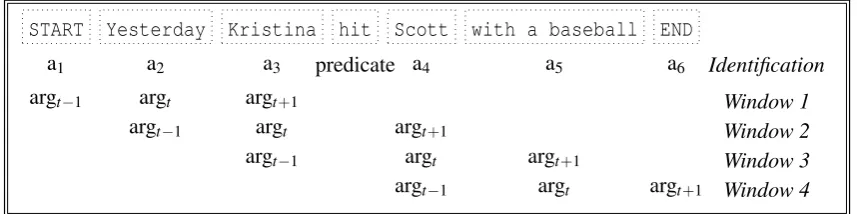
how-START Yesterday Kristina hit Scott with a baseball END
a1 a2 a3 predicate a4 a5 a6 Identification
argt−1 argt argt+1 Window 1
argt−1 argt argt+1 Window 2
argt−1 argt argt+1 Window 3
[image:3.595.85.514.63.170.2]argt−1 argt argt+1 Window 4
Figure 1: Symmetric context window from the list of arguments
ever their application tounsupervised role induc-tion is novel to our knowledge.
3 Model
Unsupervised role induction is commonly mod-eled after supervised semantic role labeling (M`arquez et al., 2008) and follows a two-stage ap-proach. Given a sentence and a designated verb, the goal is to identify the arguments of the verbal predicate (argument identification) and label them with semantic roles (role induction). The model is first given a syntactically analyzed sentence (e.g., in the form of a dependency parse) with the aim of determining all constitutents that fill a se-mantic role. Argument identification is performed heuristically using a small number of rules which take into account syntactic relations encountered when traversing the dependency tree from predi-cate to argument (Lang and Lapata, 2014; Titov and Klementiev, 2012). An alternative which we follow here is to use a supervised classifier trained on a small amount of data using non-lexicalized features.
As mentioned earlier, we treat role induction as a type-level clustering problem: argument in-stances are assigned to clusters such that these rep-resent semantic roles. We induce a separate set of clusters for each verb, and each cluster thus repre-sents a verb-specific role. Clustering algorithms commonly take a matrix of pairwise similarity scores between instances as input and produce a set of output clusters, often satisfying some op-timality criterion. In our case, instances are type-level arguments represented by embeddings whose similarity is quantified using a distance measure such as cosine (see Section 3.1) and clusters are formed using a linear programming formulation of hierarchical clustering (see Section 3.2).
3.1 Predicate and Argument Embeddings
Our approach for learning predicate and argu-ment vectors is inspired by recent methods aimed at learning high-quality vector representations of words from large amounts of unstructured text data (Mikolov et al., 2013a). In this framework, vectors of the surrounding words within a fixed-sized window (thecontext) are summed into a sin-gle vector vc, which is useful in predicting the
output vectorv0representing the current ortarget word. Longer-range context information can also be captured (Le and Mikolov, 2014), specifically words within the current paragraph but outside of the target word context window.
In contrast to previous word-based approaches, our model induces vector representations for each predicate and its semantic arguments. As a learn-ing objective, vectors are required to contribute to a prediction task about the target argument in the sentence, given the predicate and a small win-dow of surrounding arguments. So despite the fact that the argument vectors and weightings are ini-tialized randomly, they can eventually capture se-mantics as an indirect result of the prediction task. Similarly, predicate vectors are learned from the many contexts sampled from sentences involving that predicate, and are required to contribute to the prediction task of the next argument. One way to consider the role of the predicate token is as an-other argument. It acts as a memory (similar to the paragraph memory of Le and Mikolov, 2014) that remembers what is missing from the current context, and so captures something of the core na-ture of the predicate.
the span of each argument. In our model, contexts are symmetric and of fixed length (c=1 in the Figure), sampled from a sliding window over the argument list. To enable the first and last argu-ments within the sentence to be predicted from the context, we augment the argument list withSTART and END arguments. Meanwhile, the predicate is associated with all contexts generated from the sliding window approach.
More formally, given a training set compris-ing a predicate b and a sequence of its semantic arguments a1,a2,a3,...,aT, the objective of the
model is to maximize the average log probability: 1
T
T
∑
t=1logp(at|b,at+j,−c≤ j≤c, j6=0) (1) wherecis the size of the training context around the center argumentat. We define probability
us-ing the softmax function:
p(at|b,acontext)∝exp vTcv0, (2) wherev0 is the target argument vector and vc the
context vector formed from predicate and con-text arguments vectors. Vectors are trained using stochastic gradient descent where the gradient is obtained via back-propagation. After the training converges, predicates and arguments with similar meaning are mapped to a similar position in the vector space.
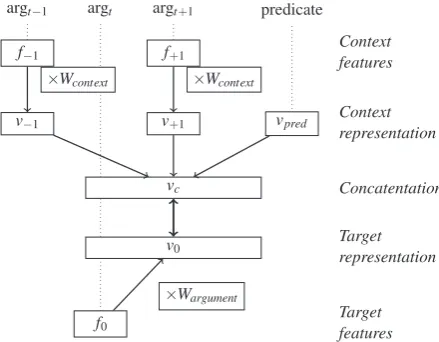
Every predicate is mapped to a unique vec-tor vpred, with the vocabulary of vectors shared across the data set. For the arguments, we generate feature vectors f−1 and f+1 from syntactic infor-mation (dependency relations and POS-tags), con-catenated with a distributional vector to represent the head word token in each argument. The repre-sentation vectorsv−1 andv+1 are calculated from the feature vectors using vj =Wcontextfj, where
the matrixWcontext is also updated as part of the learning process. Wcontext is common for all ar-guments. In a similar manner, the representation vectorv0for the target argument is calculated us-ingv0=Wargumentf0. The predicate and argument vectors are concatenated to predict the middle ar-gument in a context. Other ways of dividing the argument window between context and predicted argument, and of combining context vectors, are possible. As the full list of arguments in a sentence is known, we use a symmetric window. The ad-vantage of concatenating the vectors is that infor-mation on the sequence of arguments is preserved. An illustration of our model is given in Figure 2.
argt−1 argt argt+1 predicate
f−1 f+1
v−1 v+1 vpred ×Wcontext ×Wcontext
vc
v0
f0
×Wargument
Context features
Context representation
Concatentation
Target representation
Target features
Figure 2: Distributional model for learning repre-sentations of predicates and semantic arguments.
Through a context window of arguments rather than neighboring tokens, our model captures a semantic representation of each verbal predicate. Furthermore, the arguments themselves are posi-tioned in vector space as a result of the selectional preferences of the predicates. In the next section, we use the induced semantic space to cluster argu-ments into semantic roles.
3.2 Argument Clustering
Hierarchical clustering is a method of clustering which seeks to build a hierarchy of clusters, often presented in a dendrogram. In such a represen-tation, all possible pairs of clusters are merged at some level. It is typically implemented as a greedy heuristic algorithm with no explicit objective func-tion. Instead, it requires a measure of dissimilar-ity between sets of observations, typically through a measure of distance between pairs of observa-tions. An example is the agglomerative clustering technique used in Lang and Lapata (2014). Their algorithm starts from seed clusters based on shared syntactic information, and then repeatedly merges pairs of clusters “bottom up” to form a hierarchy.
[image:4.595.307.527.75.246.2]al-ternative approximation technique that could be explored; it has recently been used successfully in the context of supervised semantic role labeling (T¨ackstr¨om et al., 2015).
But first, we consider the exact formalization of agglomerative clustering as an ILP. In order to generate a legal dendrogram, it is necessary for the model to enforce the following partition proper-ties:
Reflexivity A seed cluster is always in the same merged cluster as itself.
Symmetry If seed cluster a is merged into the same cluster as seed clusterb, then bis also in the same cluster asa.
Transitivity If a and b are merged at a certain level, andbandcare also merged at the same level, thenais in the same cluster ascat that level.
To model hierarchical clustering as an ILP prob-lem, we consider all pairs of clusters a and b, and introduce variables
Mab
to represent the merge level between clustersaandb. Reflexivity is en-forced by the constraint:Maa
=0, (3)Meanwhile the symmetry requirement is captured by the constraint:
Mab
=Mba
. (4) The transitivity requirement and the objective to find the hierarchy that minimizes pair-wise dis-tances are modeled in the objective of the ILP using auxiliary variables Oabc that represent themerge order of pairs(a,b) and(a,c), and coeffi-cientswabc that are set equal to the difference
be-tween distance metricsDbetween those pairs:
argmax
M,Oa,b,c∈
∑
InstanceswabcOabcsubject to:
Mab
is a merge functionOabc=
(
1 if
Mab
<Mac
0 otherwise wabc=D(a,c)−D(a,b).
Although exact solutions can be found using ILP solvers, for the problems we consider there are
typically over 100 seed clusters. This generates in the order of 106transitivity constraints, and it is this in particular that results in combinatorial com-plexity from off-the-shelf ILP solvers.
An LP relaxation provides approximate solu-tions faster. A maximum merge levelLis first de-fined as a parameter, although as this is not an inte-ger problem and fractional levels are possible, this does not represent the number of levels. Auxiliary variablesZab≥ac capture the merge hierarchy, and
Tabcrewards transitivity by a factorα:
arg max
M,O,Za,b,c∈
∑
InstanceswabcOabc+αTabcsubject to:
0≤T ≤1 0≤O≤1 0≤Z≤1 0≤
M
≤L−L≤
Mac
−Mab
−(L+1)Oabc≤0−L≤
Mab
−Mac
−(L+1)Zab≥ac+1≤0−L≤
Mbc
−Mac
−(L+1)Zbc≥ac+1≤0Zab≥ac+Zbc≥ac≥Tabc
(5)
To capture the linguistic principles involved in semantic role labeling (Lang and Lapata, 2014), our formulation includes additional constraints. These are expressed explicitly through the con-struction of the linear programme:
Role Uniqueness Semantic roles are unique within a particular frame. This principle is cap-tured by constraining the merge level of two seed clustersaandbto be at the top levelL of the hi-erarchy, whereaandbare roles that occur within the same frame, with the constraint:
Mab
=L ∀(a,b)in frame. (6)Syntactic Position Arguments occurring in a specific syntactic position within a specific link-ing all bear the same semantic role. This is han-dled by construction of the problem, where all ar-guments of a particular predicate occurring in a specific syntactic position are collected into a seed cluster at the beginning of the merging problem.
centroid vectors from the instances in each clus-ter. To measure similarity between clustersaand b, we use cosine similarity between centroids:
D(a,b) =kvvTavb
akkvbk (7)
Equations (3)–(7) comprise the LP model.
4 Experimental Setup
In this section we present our experimental setup for assessing the performance of the model pre-sented above. We explain how it was trained and tested, and also briefly introduce the models used for comparison with our approach.
4.1 Training
To obtain distributed representations, we used text from a subset of the English Gigaword corpus (Parker et al., 2011), comprising almost 64 mil-lion tokens (2.7 milmil-lion sentences). The training corpus was pre-processed usingMATE(Bj¨orkelund et al., 2009) to lemmatize the words, provide POS-tags and a dependency parse, identify verbal predicates and the position of arguments.
The neural network model described in Sec-tion 3.1 was trained using Matlab. We restricted the predicate vocabulary to use the 5,000 most fre-quent verbs in the training corpus, and the verbal predicates found in the CoNLL-2008 shared task data set (Surdeanu et al., 2008). Predicates were represented as vectors of size 80, while vectors of length 50 were used for arguments. We used a symmetric context window of size c=1. As the mechanism to prevent all vectors from hav-ing the same value, we used “negative-samplhav-ing” (Mikolov et al., 2013b), where there arek=5 ran-domly sampled negative examples of (context, tar-get) pairs for each data sample. This technique has the advantage that we do not need to provide numerical probabilities for the noise distribution. Model parameters were updated during training using stochastic gradient descent over 5 epochs, decreasing the update step size at each epoch.
4.2 Argument clustering
Following common practice in unsupervised role induction (Titov and Klementiev, 2012; Lang and Lapata, 2014), we evaluated our model on the complete CoNLL-2008 shared task data set. We used the clustering metrics of purity, collocation and their harmonic mean F1. In addition, we used
V-measure (Rosenberg and Hirschberg, 2007), an entropy-based measure which explicitly evaluates how successfully the criteria of homogeneity and completeness have been satisfied.
In previous work on unsupervised role induc-tion, the results for each predicate were weighted in proportion to the number of times the predicate appeared in the CoNLL-2008 test set. In addi-tion to this measure, we evaluate clustering where predicates are uniformly weighted. In a data set where the top 10 predicates account for almost 20% of the samples, these metrics give a view of performance on the other 3,000-plus predicates where less predicate-specific data is available.
4.3 Comparison Models
We compared our model against a baseline that assigns arguments to clusters based on their syn-tactic functions (SYNTF; Lang and Lapata, 2014). Specifically, the baseline forms clusters from the syntactic position of an argument using four cues: the verb’s voice, the argument’s position relative to the predicate, its syntactic relation, and any re-alizing preposition.1
To assess whether our argument-based model has any advantages over other word-based dis-tributed representations we compared the follow-ing variants: (a) thearg2vec model presented in Section 3.1 trained on the subset of Gigaword; (b) the continuous bag-of-words model trained using word2vec on the same Gigaword corpus; and (c) 300–dimensional vectors pre-trained on part of the Google News dataset2 (about 100 billion words), again using word2vec. In all three instances, we performed argument cluster-ing uscluster-ing the LP of Section 3.2. We also com-pare against Agglomerative-cosine (AGGLOM), the best performing model of Lang and Lapata (2014).3 Where applicable, we also refer to the models presented in Titov and Klementiev (2012).
5 Results
Our results on the semantic role induction task are summarized in Tables 1 and 2. Table 1 presents results using the gold standard parses and
argu-1Differences in the results compared to Lang and Lapata
(2014) are due to our re-implementation of the predicate la-beling stage, to be consistent with the preprocessing we used for the other comparison systems.
2http://code.google.com/p/word2vec/
3Differences from published results are again due to
Weighted Unweighted Weighted Unweighted
PU CO F1 PU CO F1 HO CO V1 HO CO V1
SYNTF 81.6 78.1 79.8 90.0 86.8 87.8 71.7 66.2 68.8 85.5 81.7 82.1
AGGLOM 87.4 75.3 80.9 95.1 80.7 86.5 79.2 65.5 71.7 93.1 78.1 84.0
word2vec-GIGAWORD 82.8 77.9 80.3 91.4 86.3 88.2 78.8 63.7 70.4 90.2 81.1 84.4
word2vec-GOOGLENEWS 83.4 76.2 79.7 91.6 85.7 87.9 78.7 63.7 70.4 90.2 80.7 84.1
[image:7.595.76.521.61.134.2]arg2vec-GIGAWORD 87.9 74.7 80.8 94.2 85.4 88.9 86.1 64.6 73.8 94.6 80.9 86.2 Table 1: Purity, collocation and F1 measures (left), and homogeneity, completeness and V1 measures (right) for CoNLL-2008 data set, using gold syntax information.
Weighted Unweighted Weighted Unweighted
PU CO F1 PU CO F1 HO CO V1 HO CO V1
SYNTF 68.3 72.1 70.1 80.6 81.3 80.3 55.2 54.9 55.0 74.4 74.3 73.2 AGGLOM 75.5 69.5 72.4 89.3 77.9 82.4 64.9 55.7 60.0 86.1 74.6 78.8 DEPREL+MATE 81.4 77.7 79.5 88.7 84.8 86.2 71.5 65.7 68.5 83.7 79.2 80.3
word2vec-GIGAWORD 83.3 76.1 79.5 91.3 85.7 87.8 78.4 63.4 70.1 89.9 80.3 83.9
word2vec-GOOGLENEWS 82.9 77.4 80.1 91.3 86.0 88.0 78.3 63.6 70.2 89.9 80.9 84.2
arg2vec-GIGAWORD 87.7 74.6 80.6 93.9 85.3 88.8 85.7 64.4 73.5 94.4 80.8 86.1
Table 2: Purity, collocation and F1 measures, and homogeneity, completeness and V1 measures for CoNLL-2008 data set using automatic parse syntax information.
ments available in the CoNLL 2008 data set. No-tice that our embeddings are still learned using tomatically identified arguments. Table 2 uses au-tomatic parses with auau-tomatically identified argu-ments which is a more realistic evaluation setting. As can be seen in Table 1, when gold standard information is used the syntactic function baseline (SYNTF) is very effective. When considering F1 (weighted by the number of instances), arg2vec performs on the same par with graph-based ag-glomerative clustering (AGGLOM). Interestingly,
word2vec performs worse when trained either on Gigaword or the Google News corpora. Ac-cording to (weighted) V1, arg2vec outperforms all other comparison models. When predicates are weighted uniformly, arg2vecis the best per-forming model using F1 or the more information-centric V-measure. This suggests that our model performs well on the the less-frequent predicates and rarer semantic roles. The results also show that our model captures semantic information use-ful for this task more successuse-fully than the word-based distributional models. Bothword2vec mod-els have similar performance, despite significant differences in the size of their training data.
Table 2 shows similar trends. The poorer per-formance of SYNTF and AGGLOM can partly be ascribed to the heuristics used for argument iden-tification: DEPREL+MATEgives the baseline per-formance of our dependency parser and argu-ment identification. Nevertheless, when compar-ing systems that have access to the same prepro-cessing, our arg2vec model gives the best
per-formance particularly in the information-centric V-measures. Also note, that it seems robust to noise incurred by the automatic parsing and argu-ment identification procedures.
Titov and Klementiev (2012) report a (weighted) F1 of 83.0 on the gold standard CoNLL-2008 dataset, using a coupled model where parameters are shared across verbs and a form of smoothing which replaces argument fillers by lexical cluster ids stemming from Brown et al.’s (1992) algorithm (trained on the RCV1 corpus, about 63 millions words). Our model would presumably benefit from a similar coupling mechanism which we could enforce as a constraint in the ILP. However, we leave this to future work. When tested on automatic parses and gold arguments, their model yields a weighted F1 of 78.8. For comparison, arg2vecobtains an F1 of 80.6 on automatic parses and arguments. Figure 4 shows visualizations of the argument semantic space as captured by the arg2vec -GIGAWORD model, for the predicates eat and
win. Dimensionality reduction was performed by the t-SNE library.4 The visualization suggests that the model learns similarities beyond simple word contexts.
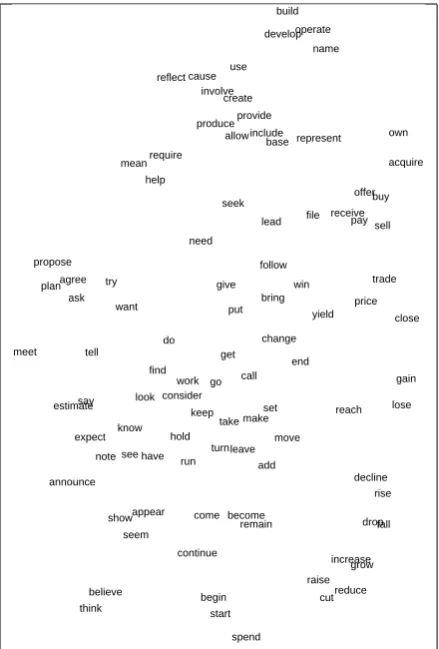
The evaluation presented so far assesses the quality of the argument representations learned by our model. We also wanted to see whether the predicate embeddings capture meaningful se-mantic content. Figure 3 shows a visualization
−800 −600 −400 −200 0 200 400 600 800 −200 −150 −100 −50 0 50 100 150 200 acquire add agree allow announce appear ask base become begin believe bring build buy call cause change close come consider continue create cut decline develop do drop end estimate expect fall file find follow gain get give go grow have help hold include increase involve keep know lead leave look lose make mean meet move name need note offer operate own pay plan price produce propose provide put raise reach receive reduce reflect remain represent require rise run say see seek seem sell set show spend start take tell think trade try turn use want win work yield
Figure 3: 2-D representation of the induced predi-cate space for the 100 most frequent predipredi-cates in CoNLL-2008.
of the predicate semantic space as captured by arg2vec when it is trained on the Gigaword cor-pus. It shows a projection of the 100 most frequent verbs in CoNLL-2008, with dimensionality reduc-tion again performed byt-SNE. The visualization suggests that the model captures non-trivial predi-cate similarities. Verbs relating to buying and sell-ing lie close together (e.g.,offer, buy, receive, pay, sell). Verbs denoting growth or decrease are also grouped together (drop, fall, increase, grow, re-duce, cut). Interestingly, verbs with similar argu-ment structure share regions of the space (e.g.,say, estimate, orbelieve, think orseem, appear). Use-fully, verbs are represented in a continuous space rather than discrete clusters (e.g.,acquire is some-where betweenbuyandown).
In order to quantitatively evaluate the qual-ity of the predicate representations induced by our model, we compared the cosine distances between vectors to the hierarchy of VerbNet (Schuler, 2005). VerbNet is a hierarchical domain-independent broad-coverage verb lexicon for En-glish, organizing verbs into classes. The
evalua-−250 −200 −150 −100 −50 0 50 100 150 200 250 −250 −200 −150 −100 −50 0 50 100 150 200 250 program cash i sandwich you pizza they bowl cheerio sales diabetic sugar pentagon effect people other we bread american apple somebody one
rat the jurisprudence market youth it mushroom things she lunch character debt anyone enterprise $ chunk overtime animal husband ketchup cost profit art
−100 −50 0 50
group it contract back verdict election support business union approval $ fujitsu board them prize candidate % month case official clearance right he account four team series
i party seat they giant pennant order him confirmation endorsement license one battle issue victory share can concession
[image:8.595.72.292.61.386.2]company ibm recently archrival industry race administration confidence plc we majority then finally taylor congress
Figure 4: 2-D representation of the induced argu-ment space for the predicates eat (top) and win (bottom). In both representations, A0 arguments are clustered bottom left, while A1 arguments are found top right.
tion task was, for all pairs of predicates, to predict whether they would be in the same cluster at the top layer of the hierarchy of VerbNet. To form the top layer of VerbNet, we took the first inte-ger of each VerbNet class number. As an exam-ple, the verbsbelieve(VN class conjecture-29.5), think (consider-29.9),expect (conjecture-29.5-1), andadopt (appoint-29.1) would all be in the same class 29. According to this reduction of VerbNet, there are 101 classes. The prediction was based on whether the cosine distance between the pair of vectors was above a threshold value. We mea-sured area under the precision-recall curve (AUC) which captures performance at all thresholds, and F1-score at the best threshold. arg2vecdoes bet-ter in both measures than a baseline of random vectors of the same dimension, scoring 0.637 for AUC compared to a baseline of 0.505, and 29.5 against 22.9 for F1.
6 Conclusion
thus decouple feature learning from clustering in-ference, which results in a conceptually simpler model. Through a formulation of the clustering problem as a linear programme, we are able to per-form clustering efficiently and incorporate task-specific constraints. In the future, we would like to investigate how our approach generalizes across languages and tasks.
Acknowledgements We would like to thank Miguel Forte and members of the ILCC at the School of Informatics for their valuable feed-back. We acknowledge the support of EPSRC (EP/K017845/1) in the framework of the CHIST-ERA READERS project.
References
Michael Auli, Michel Galley, Chris Quirk, and Geof-frey Zweig. 2013. Joint language and translation modeling with recurrent neural networks. In Pro-ceedings of the 2013 Conference on Empirical Meth-ods in Natural Language Processing, pages 1044– 1054, Seattle, Washington.
Yoshua Bengio, Holger Schwenk, Jean-S´ebastien Morin, and Jean-Luc Gauvain, 2006. Neural Proba-bilistic Language Models, pages 137–186. Springer. Anders Bj¨orkelund, Love Hafdell, and Pierre Nugues. 2009. Multilingual Semantic Role Labeling. In Pro-ceedings of the Thirteenth Conference on Computa-tional Natural Language Learning (CoNLL 2009): Shared Task, pages 43–48, Boulder, Colorado, June. Association for Computational Linguistics.
P. F. Brown, V. J. Della Pietra, P. V. deSouza, J. C. Lai, and R. L. Mercer. 1992. Class-based n-gram mod-els of natural language. Computational Linguistics, 18(4):283–298.
Kyunghyun Cho, Bart van Merrienboer, Dzmitry Bah-danau, and Yoshua Bengio. 2014. On the properties of neural machine translation: Encoder–decoder ap-proaches. InProceedings of SSST-8, Eighth Work-shop on Syntax, Semantics and Structure in Statisti-cal Translation, pages 103–111, Doha, Qatar, Octo-ber. Association for Computational Linguistics. Ronan Collobert, Jason Weston, Leon Bottou, Michael
Karlen, Koray Kavukcuoglu, and Pavel Kuksa. 2011. Natural language processing (almost) from scratch. The Journal of Machine Learning Re-search, 12:2493–2537, March.
Nikhil Garg and James Henderson. 2012. Unsuper-vised Semantic Role Induction with Global Role Or-dering. In Proceedings of the 50th Annual Meet-ing of the Association for Computational LMeet-inguis- Linguis-tics (Volume 2: Short Papers), pages 145–149, Jeju Island, Korea.
Sean Gilpin, Siegried Nijssen, and Ian Davidson. 2013. Formalizing Hierarchical Clustering as Integer Lin-ear Programming. In In Proceedings of the 27th AAAI Conference on Artificial Intelligence, pages 372–378, Bellevue, Washington.
Trond Grenager and Christopher D. Manning. 2006. Unsupervised discovery of a statistical verb lexicon. InProceedings of the 2006 Conference on Empirical Methods in Natural Language Processing, pages 1– 8, Sydney, Australia.
Nal Kalchbrenner and Phil Blunsom. 2013. Recurrent continuous translation models. In Proceedings of the 2013 Conference on Empirical Methods in Natu-ral Language Processing, pages 1700–1709, Seattle, Washington.
Nal Kalchbrenner, Edward Grefenstette, and Phil Blun-som. 2014. A Convolutional Neural Network for Modelling Sentences. In Proceedings of the 52nd Annual Meeting of the Association for Computa-tional Linguistics (Volume 1: Long Papers), pages 655–665, Baltimore, Maryland.
Joel Lang and Mirella Lapata. 2010. Unsuper-vised induction of semantic roles. InHuman Lan-guage Technologies: The 2010 Annual Conference of the North American Chapter of the Association for Computational Linguistics, pages 939–947, Los Angeles, California.
Joel Lang and Mirella Lapata. 2014. Similarity-driven semantic role induction via graph partition-ing.Computational Linguistics, 40(3):133–164. Quoc V. Le and Tomas Mikolov. 2014. Distributed
representations of sentences and documents. In Pro-ceedings of the 31th International Conference on Machine Learning, ICML 2014, Beijing, China, 21-26 June 2014, pages 1188–1196.
Llu´ıs M`arquez, Xavier Carreras, Kenneth C. Litkowski, and Suzanne Stevenson. 2008. Semantic Role Labeling: An Introduction to the Special Issue.
Computational Linguistics, 34(2):145–159, June. Tomas Mikolov, Kai Chen, Greg Corrado, and Jeffrey
Dean. 2013a. Efficient Estimation of Word Repre-sentations in Vector Space, January.
Tomas Mikolov, Ilya Sutskever, Kai Chen, Greg S Cor-rado, and Jeffrey Dean. 2013b. Distributed Repre-sentations of Words and Phrases and their Composi-tionality. In C. J. C. Burges, L. Bottou, M. Welling, Z. Ghahramani, and K. Q. Weinberger, editors, Ad-vances in Neural Information Processing Systems 26, pages 3111–3119. Curran Associates, Inc., Oc-tober.
Georgia, June. Association for Computational Lin-guistics.
Andriy Mnih and Geoffrey E. Hinton. 2008. A scal-able hierarchical distributed language model. In Ad-vances in Neural Information Processing Systems, pages 1081–1088.
Andriy Mnih and Koray Kavukcuoglu. 2013. Learning word embeddings efficiently with noise-contrastive estimation. InAdvances in Neural Information Pro-cessing Systems 26, pages 2265–2273.
Martha Palmer, Daniel Gildea, and Paul Kingsbury. 2005. The Proposition Bank: An Annotated Cor-pus of Semantic Roles. Computational Linguistics, 31(1):71–106, March.
Robert Parker, David Graff, Junbo Kong, Ke Chen, and Kazuaki Maeda. 2011. English Gigaword Fifth Edi-tion. LDC2011T07. Linguistic Data Consortium. Vasin Punyakanok, Dan Roth, and Wen-tau Yih. 2008.
The importance of syntactic parsing and inference in semantic role labeling. Computational Linguistics, 34(2):257–287, June.
Andrew Rosenberg and Julia Hirschberg. 2007. V-Measure: A Conditional Entropy-Based External Cluster Evaluation Measure. InProceedings of the 2007 Joint Conference on Empirical Methods in Natural Language Processing and Computational Natural Language Learning (EMNLP-CoNLL). Karin Kipper Schuler. 2005. VerbNet: A
broad-coverage, comprehensive verb lexicon. Ph.D. thesis, University of Pennsylvania.
Richard Socher, Eric H. Huang, Jeffrey Pennin, An-drew Y. Ng, and Christopher D. Manning. 2011a. Dynamic pooling and unfolding recursive autoen-coders for paraphrase detection. In J. Shawe-Taylor, R.S. Zemel, P. Bartlett, F.C.N. Pereira, and K.Q. Weinberger, editors, Advances in Neural Informa-tion Processing Systems 24, pages 801–809. Richard Socher, Jeffrey Pennington, Eric H. Huang,
Andrew Y. Ng, and Christopher D. Manning. 2011b. Semi-Supervised Recursive Autoencoders for Pre-dicting Sentiment Distributions. In Proceedings of the 2011 Conference on Empirical Methods in Nat-ural Language Processing, pages 151–161, Edin-burgh, Scotland, UK.
Mihai Surdeanu, Richard Johansson, Adam Meyers, Llu´ıs M`arquez, and Joakim Nivre. 2008. The CoNLL 2008 Shared Task on Joint Parsing of Syn-tactic and Semantic Dependencies. InCoNLL 2008: Proceedings of the Twelfth Conference on Computa-tional Natural Language Learning, pages 159–177, Manchester, England, August. Coling 2008 Orga-nizing Committee.
Oscar T¨ackstr¨om, Kuzman Ganchev, and Dipanjan Das. 2015. Efficient inference and structured learn-ing for semantic role labellearn-ing. Transactions of the Association for Computational Linguistics, 3:29–41.
Ivan Titov and Ehsan Khoddam. 2015. Unsupervised induction of semantic roles within a reconstruction-error minimization framework. In Proceedings of the 2015 Conference of the North American Chap-ter of the Association for Computational Linguistics: Human Language Technologies, pages 1–10, Den-ver, Colorado.