Improve Statistical Machine Translation with Context-Sensitive
Bilingual Semantic Embedding Model
Haiyang Wu1 Daxiang Dong1 Wei He1 Xiaoguang Hu1 Dianhai Yu1 Hua Wu1 Haifeng Wang1 Ting Liu2
1 Baidu Inc., No. 10, Shangdi 10th Street, Beijing, 100085, China 2 Harbin Institute of Technology, Harbin, China
wuhaiyang,dongdaxiang,hewei,huxiaoguang,yudianhai, wu hua,[email protected]
Abstract
We investigate how to improve bilingual embedding which has been successfully used as a feature in phrase-based sta-tistical machine translation (SMT). De-spite bilingual embedding’s success, the
contextual information, which is of criti-cal importance to translation quality, was ignored in previous work. To employ the contextual information, we propose a simple and memory-efficient model for learning bilingual embedding, taking both the source phrase and context around the phrase into account. Bilingual translation scores generated from our proposed bilin-gual embedding model are used as features in our SMT system. Experimental results show that the proposed method achieves significant improvements on large-scale Chinese-English translation task.
1 Introduction
In Statistical Machine Translation (SMT) sys-tem, it is difficult to determine the translation of some phrases that have ambiguous meanings.For example, the phrase“结果jieguo”can be trans-lated to either “results”, “eventually” or “fruit”, depending on the context around it. There are two reasons for the problem: First, the length of phrase pairs is restricted due to the limitation of model size and training data. Another reason is that SMT systems often fail to use contextual information in source sentence, therefore, phrase sense disam-biguation highly depends on the language model which is trained only on target corpus.
To solve this problem, we present to learn context-sensitive bilingual semantic embedding. Our methodology is to train a supervised model
where labels are automatically generated from phrase-pairs. For each source phrase, the aligned target phrase is marked as the positive label whereas other phrases in our phrase table are treated as negative labels. Different from previ-ous work in bilingual embedding learning(Zou et al., 2013; Gao et al., 2014), our framework is a supervised model that utilizes contextual informa-tion in source sentence as features and make use of phrase pairs as weak labels. Bilingual seman-tic embeddings are trained automaseman-tically from our supervised learning task.
Our learned bilingual semantic embedding model is used to measure the similarity of phrase pairs which is treated as a feature in decoding. We integrate our learned model into a phrase-based translation system and experimental results indi-cate that our system significantly outperform the baseline system. On the NIST08 Chinese-English translation task, we obtained 0.68 BLEU improve-ment. We also test our proposed method on much larger web dataset and obtain 0.49 BLEU im-provement against the baseline.
2 Related Work
Using vectors to represent word meanings is the essence of vector space models (VSM). The representations capture words’ semantic and syn-tactic information which can be used to measure semantic similarities by computing distance be-tween the vectors. Although most VSMs represent one word with only one vector, they fail to cap-ture homonymy and polysemy of word. Huang et al. (2012) introduced global document context and multiple word prototypes which distinguishes and uses both local and global context via a joint training objective. Much of the research focus on the task of inducing representations for sin-gle languages. Recently, a lot of progress has
been made at representation learning for bilin-gual words. Bilinbilin-gual word representations have been presented by Peirsman and Pad´o (2010) and Sumita (2000). Also unsupervised algorithms such as LDA and LSA were used by Boyd-Graber and Resnik (2010), Tam et al. (2007) and Zhao and Xing (2006). Zou et al. (2013) learn bilingual em-beddings utilizes word alignments and monolin-gual embeddings result, Le et al. (2012) and Gao et al. (2014) used continuous vector to represent the source language or target language of each phrase, and then computed translation probability using vector distance. Vuli´c and Moens (2013) learned bilingual vector spaces from non-parallel data in-duced by using a seed lexicon. However, none of these work considered the word sense disam-biguation problem which Carpuat and Wu (2007) proved it is useful for SMT. In this paper, we learn bilingual semantic embeddings for source content and target phrase, and incorporate it into a phrase-based SMT system to improve translation quality.
3 Context-Sensitive Bilingual Semantic Embedding Model
We propose a simple and memory-efficient model which embeds both contextual information of source phrases and aligned phrases in target cor-pus into low dimension. Our assumption is that high frequent words are likely to have multiple word senses; therefore, top frequent words are se-lected in source corpus. We denote our sese-lected words as focused phrase. Our goal is to learn a bilingual embedding model that can capture dis-criminative contextual information for each fo-cused phrase. To learn an effective context sensi-tive bilingual embedding, we extract context fea-tures nearby a focused phrase that will discrimi-nate focused phrase’s target translation from other possible candidates. Our task can be viewed as a classification problem that each target phrase is treated as a class. Since target phrases are usu-ally in very high dimensional space, traditional linear classification model is not suitable for our problem. Therefore, we treat our problem as a ranking problem that can handle large number of classes and optimize the objectives with scalable optimizer stochastic gradient descent.
3.1 Bilingual Word Embedding
We apply a linear embedding model for bilin-gual embedding learning. Cosine similarity
be-tween bilingual embedding representation is con-sidered as score function. The score function should be discriminative between target phrases and other candidate phrases. Our score function is in the form:
f(x,y;W,U) =cos(WTx,UTy) (1)
wherexis contextual feature vector in source sen-tence, andyis the representation of target phrase,
W ∈ R|X|×k,U ∈ R|Y|×k are low rank
ma-trix. In our model, we allowyto be bag-of-words representation. Our embedding model is memory-efficient in that dimensionality ofxandycan be very large in practical setting. We use|X|and|Y|
means dimensionality of random variablexandy, then traditional linear model such as max-entropy model requires memory space ofO(|X||Y|). Our embedding model only requiresO(k(|X|+|Y|)) memory space that can handle large scale vocabu-lary setting. To score a focused phrase and target phrase pair withf(x,y), context features are ex-tracted from nearby window of the focused phrase. Target words are selected from phrase pairs. Given a source sentence, embedding of a focused phrase is estimated fromWTxand target phrase
embed-ding can be obtained throughUTy.
3.2 Context Sensitive Features
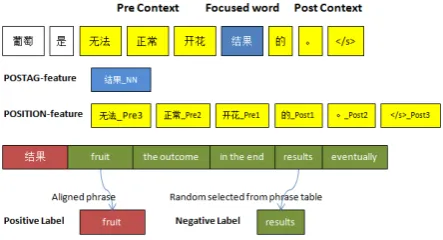
[image:2.595.311.533.610.730.2]Context of a focused phrase is extracted from nearby window, and in our experiment we choose window size of 6 as a focused phrase’s con-text. Features are then extracted from the focused phrase’s context. We demonstrate our feature extraction and label generation process from the Chinese-to-English example in figure 1. Window size in this example is three. Position features and Part-Of-Speech Tagging features are extracted from the focused phrase’s context. The wordfruit
is the aligned phrase of our focused phrase and is treated as positive label. The phrase results is a randomly selected phrase from phrase table results of结果. Note that feature window is not well de-fined near the beginning or the end of a sentence. To conquer this problem, we add special padding word to the beginning and the end of a sentence to augment sentence.
3.3 Parameter Learning
To learn model parameter W and U, we ap-ply a ranking scheme on candidates selected from phrase table results of each focused phrase. In par-ticular, given a focus phrase w, aligned phrase is treated as positive label whereas phrases extracted from other candidates in phrase table are treated as negative label. A max-margin loss is applied in this ranking setting.
I(Θ) = m1
m X
i=1
(δ−f(xi, yi; Θ)−f(xi, y0i; Θ))+
(2) Where f(xi,yi) is previously defined, Θ = {W, U} and + means max-margin hinge loss. In our implementation, a margin ofδ = 0.15is used during training. Objectives are minimized through stochastic gradient descent algorithm. For each randomly selected training example, parameters are updated through the following form:
Θ:=Θ−α∂l∂(ΘΘ) (3)
whereΘ ={W,U}. Given an instance with pos-itive and negative label pair {x,y,y0}, gradients
of parameterWandUare as follows:
∂l(W,U)
∂W =qsx(WTx)T −pqs3x(UTy) (4) ∂l(W,U)
∂U =qsy(UTy)T −pqs3y(WTx) (5)
Where we setp= (WTx)T(UTy),q= 1
||WTx||2
ands= ||UT1y||2. To initialize our model
param-eters with strong semantic and syntactic informa-tion, word vectors are pre-trained independently on source and target corpus through word2vec (Mikolov et al., 2013). And the pre-trained word vectors are treated as initial parameters of our model. The learned scoring functionf(x,y)will be used during decoding phase as a feature in log-linear model which we will describe in detail later.
4 Integrating Bilingual Semantic Embedding into Phrase-Based SMT Architectures
To incorporate the context-sensitive bilingual embedding model into the state-of-the-art Phrase-Based Translation model, we modify the decoding so that context information is available on every source phrase. For every phrase in a source sen-tence, the following tasks are done at every node in our decoder:
• Get the focused phrase as well as its context in the source sentence.
• Extract features from the focused phrase’s context. • Get translation candidate extracted from phrase pairs of
the focused phrase.
• Compute scores for any pair of the focused phrase and a candidate phrase.
We get the target sub-phrase using word align-ment of phrase, and we treat NULL as a common target word if there is no alignment for the focused phrase. Finally we compute the matching score for source content and target word using bilingual se-mantic embedding model. If there are more than one word in the focus phrase, then we add all score together. A penalty value will be given if target is not in translation candidate list. For each phrase in a given SMT input sentence, the Bilingual Seman-tic score can be used as an additional feature in log-linear translation model, in combination with other typical context-independent SMT bilexicon probabilities.
5 Experiment
Our experiments are performed using an in-house phrase-based system with a log-linear framework. Our system includes a phrase trans-lation model, an n-gram language model, a lexi-calized reordering model, a word penalty model and a phrase penalty model, which is similar to Moses (Koehn et al., 2007). The evaluation metric is BLEU (Papineni et al., 2002).
5.1 Data set
Method OpenMT08 WebDataBLEU BLEU Our Baseline 26.24 29.32 LOC 26.78** 29.62* LOC+POS 26.82** 29.81*
Table 1: Results of lowercase BLEU on NIST08 task. LOC is the location feature and POS is the Part-of-Speech feature * or ** equals to sig-nificantly better than our baseline(ρ < 0.05 or
ρ <0.01, respectively)
contains 1.5M sentence pairs after we filter with some simple heuristic rules, such as sentence be-ing too long or containbe-ing messy codes. As mono-lingual corpus, we use the XinHua portion of the English GigaWord. In monolingual corpus we fil-ter sentence if it contain more than 100 words or contain messy codes, Finally, we get mono-lingual corpus containing 369M words. In order to test our approach on a more realistic scenario, we train our models with web data. Sentence pairs obtained from bilingual website and com-parable webpage. Monolingual corpus is gained from some large website such as WiKi. There are 50M sentence pairs and 10B words monolingual corpus.
5.2 Results and Analysis
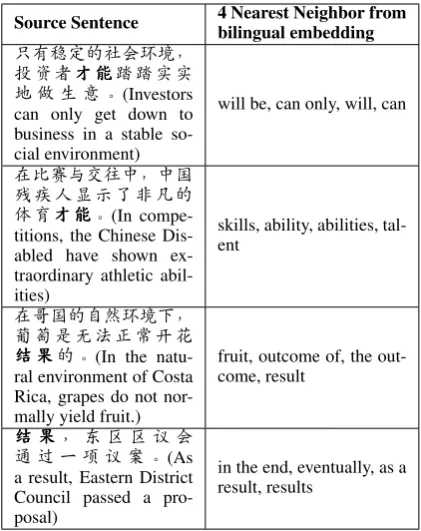
For word alignment, we align all of the train-ing data with GIZA++ (Och and Ney, 2003), us-ing the grow-diag-final heuristic to improve recall. For language model, we train a 5-gram modified Kneser-Ney language model and use Minimum Error Rate Training (Och, 2003) to tune the SMT. For both OpenMT08 task and WebData task, we use NIST06 as the tuning set, and use NIST08 as the testing set. Our baseline system is a standard phrase-based SMT system, and a language model is trained with the target side of bilingual corpus. Results on Chinese-English translation task are re-ported in Table 1. Word position features and part-of-speech tagging features are both useful for our bilingual semantic embedding learning. Based on our trained bilingual embedding model, we can easily compute a translation score between any bilingual phrase pair. We list some cases in table 2 to show that our bilingual embedding is context sensitive.
Contextual features extracted from source sen-tence are strong enough to discriminate different
Source Sentence 4 Nearest Neighbor frombilingual embedding 只有稳定的社会环境,
投资者才才才能能能踏踏实实
地做生意。(Investors can only get down to business in a stable so-cial environment)
will be, can only, will, can
在比赛与交往中,中国 残疾人显示了非凡的 体育才才才能能能。(In
compe-titions, the Chinese Dis-abled have shown ex-traordinary athletic abil-ities)
skills, ability, abilities, tal-ent
在哥国的自然环境下, 葡萄是无法正常开花 结
结结果果果的。(In the natu-ral environment of Costa Rica, grapes do not nor-mally yield fruit.)
fruit, outcome of, the out-come, result
结
结结果果果,东区 区议会 通过一项议案。(As
a result, Eastern District Council passed a pro-posal)
[image:4.595.78.290.62.131.2]in the end, eventually, as a result, results
Table 2: Top ranked focused phrases based on bilingual semantic embedding
word senses. And we also observe from the word “结果jieguo”that Part-Of-Speech Tagging fea-tures are effective in discriminating target phrases.
6 Conlusion
In this paper, we proposed a context-sensitive bilingual semantic embedding model to improve statistical machine translation. Contextual infor-mation is used in our model for bilingual word sense disambiguation. We integrated the bilingual semantic model into the phrase-based SMT sys-tem. Experimental results show that our method achieves significant improvements over the base-line on large scale Chinese-English translation task. Our model is memory-efficient and practical for industrial usage that training can be done on large scale data set with large number of classes. Prediction time is also negligible with regard to SMT decoding phase. In the future, we will ex-plore more features to refine the model and try to utilize contextual information in target sentences.
Acknowledgments
References
Jordan Boyd-Graber and Philip Resnik. 2010. Holis-tic sentiment analysis across languages: Multilin-gual supervised latent dirichlet allocation. In Pro-ceedings of the 2010 Conference on Empirical
Meth-ods in Natural Language Processing, pages 45–55,
Cambridge, MA, October. Association for Compu-tational Linguistics.
Marine Carpuat and Dekai Wu. 2007. Improving sta-tistical machine translation using word sense disam-biguation. In Proceedings of the 2007 Joint Con-ference on Empirical Methods in Natural Language Processing and Computational Natural Language
Learning (EMNLP-CoNLL), pages 61–72, Prague,
Czech Republic, June. Association for Computa-tional Linguistics.
Jianfeng Gao, Xiaodong He, Wen-tau Yih, and Li Deng. 2014. Learning continuous phrase rep-resentations for translation modeling. InProc. ACL. Eric Huang, Richard Socher, Christopher Manning, and Andrew Ng. 2012. Improving word represen-tations via global context and multiple word proto-types. InProceedings of the 50th Annual Meeting of the Association for Computational Linguistics
(Vol-ume 1: Long Papers), pages 873–882, Jeju Island,
Korea, July. Association for Computational Linguis-tics.
Hai-Son Le, Alexandre Allauzen, and Franc¸ois Yvon. 2012. Continuous space translation models with neural networks. In Proceedings of the 2012 Con-ference of the North American Chapter of the As-sociation for Computational Linguistics: Human
Language Technologies, pages 39–48, Montr´eal,
Canada, June. Association for Computational Lin-guistics.
Tomas Mikolov, Ilya Sutskever, Kai Chen, Gregory S. Corrado, and Jeffrey Dean. 2013. Distributed rep-resentations of words and phrases and their compo-sitionality. InNIPS, pages 3111–3119.
Franz Josef Och and Hermann Ney. 2003. A sys-tematic comparison of various statistical alignment models. InComputational Linguistics, Volume 29,
Number 1, March 2003. Computational Linguistics,
March.
Franz Josef Och. 2003. Minimum error rate train-ing in statistical machine translation. In Proceed-ings of the 41st Annual Meeting of the Association for Computational Linguistics, pages 160–167, Sap-poro, Japan, July. Association for Computational Linguistics.
Yves Peirsman and Sebastian Pad´o. 2010. Cross-lingual induction of selectional preferences with bilingual vector spaces. InHuman Language Tech-nologies: The 2010 Annual Conference of the North American Chapter of the Association for
Compu-tational Linguistics, pages 921–929, Los
Ange-les, California, June. Association for Computational Linguistics.
Eiichiro Sumita. 2000. Lexical transfer using a vector-space model. In Proceedings of the 38th Annual Meeting of the Association for Computational Lin-guistics. Association for Computational Linguistics, August.
Yik-Cheung Tam, Ian Lane, and Tanja Schultz. 2007. Bilingual-lsa based lm adaptation for spoken lan-guage translation. In Proceedings of the 45th An-nual Meeting of the Association of Computational
Linguistics, pages 520–527, Prague, Czech
Repub-lic, June. Association for Computational Linguis-tics.
Ivan Vuli´c and Marie-Francine Moens. 2013. Cross-lingual semantic similarity of words as the similarity of their semantic word responses. InProceedings of the 2013 Conference of the North American Chap-ter of the Association for Computational Linguistics:
Human Language Technologies, pages 106–116,
At-lanta, Georgia, June. Association for Computational Linguistics.
Bing Zhao and Eric P. Xing. 2006. Bitam: Bilingual topic admixture models for word alignment. In Pro-ceedings of the COLING/ACL 2006 Main
Confer-ence Poster Sessions, pages 969–976, Sydney,
Aus-tralia, July. Association for Computational Linguis-tics.
Will Y. Zou, Richard Socher, Daniel Cer, and Christo-pher D. Manning. 2013. Bilingual word embed-dings for phrase-based machine translation. In Pro-ceedings of the 2013 Conference on Empirical
Meth-ods in Natural Language Processing, pages 1393–