826
PoMo: Generating Entity-Specific Post-Modifiers in Context
Jun Seok Kang1, Robert L. Logan IV2, Zewei Chu3, Yang Chen3, Dheeru Dua2,Kevin Gimpel4,Sameer Singh2,Niranjan Balasubramanian1
1Stony Brook University, NY, USA
2University of California, Irvine, CA, USA
3University of Chicago, IL, USA
4Toyota Technological Institute at Chicago, IL, USA
{junkang,niranjan}@cs.stonybrook.edu {rlogan,ddua,sameer}@uci.edu {zeweichu,yangc1}@uchicago.edu
{kgimpel}@ttic.edu Abstract
We introduce entity post-modifier generation as an instance of a collaborative writing task. Given a sentence about a target entity, the task is to automatically generate a post-modifier phrase that provides contextually relevant in-formation about the entity. For example, for the sentence, “Barack Obama, , sup-ported the #MeToo movement.”, the phrase “a father of two girls” is a contextually
rel-evant post-modifier. To this end, we build PoMo, a post-modifier dataset created auto-matically from news articles reflecting a jour-nalistic need for incorporating entity informa-tion that is relevant to a particular news event. PoMoconsists of more than 231K sentences with post-modifiers and associated facts ex-tracted from Wikidata for around 57K unique entities. We use crowdsourcing to show that modeling contextual relevance is necessary for accurate post-modifier generation.
We adapt a number of existing generation ap-proaches as baselines for this dataset. Our results show there is large room for improve-ment in terms of both identifying relevant facts to include (knowing which claims are relevant gives a>20%improvement in BLEU score), and generating appropriate post-modifier text for the context (providing relevant claims is not sufficient for accurate generation). We con-duct an error analysis that suggests promising directions for future research.
1 Introduction
The goal of machine-in-the-loop writing systems is to assist human writers by directly augmenting their text. Examples include systems that refine human text for grammar (Rao and Tetreault,2018), collaborate on story plot generation systems (Clark et al.,2018;Yu and Riedl,2012), or modify the content for style (Hu et al.,2017;Shen et al.,2017;
Yang et al., 2018). In this paper, we introduce
Professor Melman ’s arguments appealed to a wide spectrum, attracting unions like the United Automobile Workers and the Machinists Union ...
Noam Chomsky , , said Dr. Melman helped mobilize what once was weak and scattered re-sistance to war and other military operations.
“The country is a lot different than it was 30 to 40 years ago, and he had a big role in that,” Mr. Chomsky said.
Noam Chomsky (Q9049)
spouse Carol Chomsky occupation university teacher political ideology anarchism
employer MIT
notable work “Class Warfare” Input Entity Mention and Context
and Claims from Wikidata
Output “the MIT professor and antiwar activist”
Figure 1: Post-Modifier Generation Task
post-modifier generation as an instance of such an assistive writing task in the news domain. Jour-nalists use post-modifiers to introduce background information about entities discussed in news arti-cles. To write these post-modifiers journalists often need to look up relevant facts about entities. A post-modifier generation system can be seen as a collaborative assistant that automatically finds rel-evant facts and inserts a small text fragment that augments the text produced by the human writer.
his background as an anti-war activist. An effective post-modifier generation system must: (i) select suitable facts about the entity given the text, and (ii) produce text that covers these facts in a way that fits in with the rest of the text.
We introducePoMo, an automatically generated dataset for developing post-modifier generation systems.1 PoMo is a collection of sentences that contain entity post-modifiers, along with a collec-tion of facts about the entities obtained from Wiki-data (Vrandeˇci´c and Kr¨otzsch,2014). We use a small number of dependency patterns to automati-cally identify and extract post-modifiers of entities in sentences. We then link the extracted entities with the entries in Wikidata. The resulting dataset has 231,057 instances covering 57,966 unique en-tities. Our analysis show that the post-modifiers often combine multiple facts and are specific to the sentential context.
We conduct two sets of experiments that high-light the challenges in post-modifier generation. (i) Claim Selection: Given an input sentence, the first step in generating a post-modifier is to fig-ure out which facts to use. We formulate this as a distantly-supervised ranking problem, where we train neural models that learn to identify relevant claims for a given sentence. These claim rank-ing models perform well when predictrank-ing the rele-vance of coarse-grained facts (e.g. occupation), but fare poorly when predicting finer-grained facts (e.g. place of birth). (ii) Generation:We adapt recent sequence-to-sequence generation models for this task. Results show that generation remains a chal-lenge. Even though our automatic claim ranking does not improve generation, further experiments with oracle selected claims demonstrate that when relevant claims are known, the models can generate post-modifiers which humans deem comparable in quality to ones written by professional journalists.
In summary, the main contributions of this work are: 1) a data-to-text problem that introduces new challenges, 2) an automated dataset creation pipeline and a large resulting dataset, 3) a crowd-sourcing study that verifies the contextual relevance of post-modifiers, and 4) a characterization of the difficulty of the task via performance analysis of numerous baselines.
1https://stonybrooknlp.github.io/PoMo/
CNN DM NYT Total
Train 6,557 11,323 202,735 220,615 Valid 162 267 4,771 5,200 Test 181 288 4,773 5,242
[image:2.595.322.512.64.130.2]Total 6,900 11,878 212,279 231,057
Table 1: Dataset distribution by sources.
2 PoMo: Task and Dataset
Post-modifier generation can be formulated as a data-to-text generation problem. The input is text mentioning a target entity and a set of known facts about the entity. The output is a phrase that: (i) fits as a post-modifier of the target entity mentioned in the input text, and (ii) conveys a subset of facts relevant to the context of the input text.
Figure1shows an example for the target entity
Noam Chomsky. The input includes a sentence
mentioning Chomsky’s work on mobilizing anti-war groups along with its surrounding context, and a listing of all facts about Chomsky that are avail-able in Wikidata. Given these inputs, the task is to output a post-modifier phrase that conveys facts about Chomsky that fit within the sentence. In this example the post-modifier conveys both general background information about Chomsky (his oc-cupation), and specific information relevant to the context of the sentence (being an anti-war activist).
This task can be seen as an instance of collabora-tive writing, where the journalist writes text about specific news events involving entities, and the gen-eration system assists the journalist by inserting new text that augments the story. Given a large collection of news articles, we can automatically create training data for such systems by removing the pieces of text that we want the assistant to gen-erate. This requires reliable ways to identify text to remove and sources of information that can be used to generate the text. Here we describe a pipeline for generating such a dataset for our task.
2.1 Dataset
We construct thePoModataset using three different news corpora: NYTimes (Sandhaus,2008), CNN and DailyMail (Hermann et al., 2015). We use Wikidata to collect facts about entities.2
2Wikidata dump from https://www.wikidata.
2.1.1 Post-Modifier and Entity Identification
We use Stanford CoreNLP (Manning et al.,2014) to parse each sentence in the news articles and to identify named entities. We extract post-modifiers by finding noun phrases that share an appos re-lation3 with any recognized named entity in the sentence. In this work, we only consider post-modifiers for people. In the future, we plan to expandPoMoto include more post-modifiers for other targets, such as organizations. We extract only one such pair from a given sentence to reduce the possible noise in the extraction process.
In our running example from Figure 1, Noam
Chomskyis recognized as a person entity. The
word “professor” is an appositive dependency of the word “Chomsky” and therefore, we extract the NP “the Massachusetts Institute of Technology professor and antiwar activist” which includes the word “professor” as a post-modifier for the target entityNoam Chomsky.
2.1.2 Entity Claim Matching
Wikidata provides information about entities in the form of key-value pairs that are calledclaims. To collect the facts about a target entity, we need to link the target to a specific entity in Wikidata. We first search through Wikidata labels and aliases to find candidates with the same name as the target. We sort the candidates based on the number of claims that have a significant word overlap with the extracted post-modifier. We link the entity to the highest ranked candidate whose claims cover at least 30% of the non stop words in the post-modifier. If such a candidate is found we record the claims that overlap with the post-modifier. If no such candidate is found then we discard the entity. We evaluate this simple heuristic by comparing the results to using an off-the-shelf entity linking system AIDA-light (Nguyen et al.,2014) and show the results in Table 2. We find that AIDA-light agrees with our entity linking in 91.2% of the cases. AIDA-light is able to link 94.3% of the entities we found from NYTimes, but for CNN and DailyMail, it links only 87.0% and 86.34% of the entities, re-spectively. This decrease is likely due to the fact that AIDA-light was last updated in 2014 while the CNN/DailyMail datasets contain articles collected until the end of April 2015. On the other hand, NYTimes articles range from 1987 to 2007. Our
3An
appositional modifier of an NP is another NP immedi-ately to the right that defines or modifies the NP.
AIDA Succ. Agreement
Overall 93.66 91.22
Train 93.65 91.16 Valid 94.06 91.13 Test 93.80 93.65
[image:3.595.341.493.62.166.2]CNN 87.03 90.34 DM 86.34 85.66 NYT 94.29 91.53
Table 2: Percent agreement with AIDA-light’s named entity disambiguation results.
heuristic seems to be reasonably reliable as it does not depend on anything else but the data sources: news articles and Wikidata.
2.2 Analysis
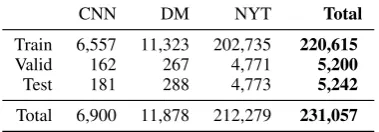
Table1shows the distribution of the data sources over train, validation, and test sets. All splits main-tain the relative distributions of the data sources to prevent stylistic mismatches from influencing generation. We also ensure that there is no entity overlap among the splits. Within the NYTimes data, we verify that the distribution over years between 1987 and 2007 is also similar over the sets.
Distribution of Post-Modifiers and Entities Figure2ashows the distribution of post-modifier lengths in terms of token counts. Most post-modifiers are three to eight words long, and about
17.3%are even longer. Figure2bshows an esti-mate of the number of relevant facts covered by the post-modifiers; this estimate uses the number of claims that overlap with the post-modifier via heuristic matching. More than half of the post-modifiers convey two or more facts. About11.4%
convey five or more facts. These results suggest that generating post-modifiers requires composing together multiple relevant facts.
Table 3 lists the most frequent types of facts used in the post-modifiers in our dataset. Most relate to generic biographical information such as the entity’s occupation, organizations they belong to, place of birth, etc. Here again we see a range of types of information being conveyed which is likely to present a challenge for generation systems.
instance coun
t
0K 20K 40K
number of post-modifier tokens
1 2 3 4 5 6 7 8 9 10+
(a) Histogram of the token counts of the modifiers. Majority of the post-modifiers (171K instances, 74.14%) have 3 to 8 tokens. Average is 5.8 tokens.
0% 20% 40%
number of relevant facts
1 2 3 4 5 6 7 8 9 10+
(b) Number of relevant facts per instance in the dataset. More than a half of the post-modifiers are related to two or more facts.
Other PM True PM
0% 20% 40%
very bad bad neutral good very good
[image:4.595.377.515.64.139.2](c) Histogram of the scores for post-modifiers, averaged over three annota-tions. The distribution of ratings for true and other post-modifiers.
Figure 2:PoMoPost-Modifier Statistics
Fact Type Count
[image:4.595.90.276.223.394.2]position held 151,959 occupation 82,781 educated at 53,067 member of political party 42,416 member of sports team 41,602 employer 36,412 award received 31,618 position played on team / speciality 23,987 country of citizenship 17,444 nominated for 15,139 place of birth 9,185 participant of 8,520 member of 7,565 languages spoken, written or signed 4,827 place of death 4,071
Table 3: Top 15 frequent fact types based on heuristic fact coverage identification.
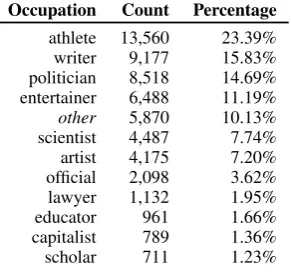
does not belong to the top ten is assigned to a single
othergroup. The resulting distribution is shown in Table4.
Quality of Post-Modifiers We conduct a crowd-sourcing study to understand how often the post-modifiers are specific to the particular context. For each (entity, context, post-modifier) triple in the validation set, we create multiple alternative post-modifiers by randomly choosing up to ten other post-modifiers that are found in some other sen-tences for the same entity. Crowd workers rate the quality of these post-modifiers. Figure3shows a screenshot of a task given to crowd workers. If the true post-modifier, the one that is actually used in the context, is rated the highest compared to the rest, then we assume the post-modifier is indeed specific to the context. On the other hand, if the crowd workers rate multiple other post-modifiers as good fits for the context, then the true post-modifier is not context specific. Figure2cshows the distri-bution of ratings for true and other post-modifiers. The true post-modifiers tend to be ratedvery good
orgoodmore often than the other post-modifiers.
Occupation Count Percentage
athlete 13,560 23.39% writer 9,177 15.83% politician 8,518 14.69% entertainer 6,488 11.19% other 5,870 10.13% scientist 4,487 7.74% artist 4,175 7.20% official 2,098 3.62% lawyer 1,132 1.95% educator 961 1.66% capitalist 789 1.36% scholar 711 1.23%
Table 4: Distribution of the inferred occupations of the target entities. Entities clustered by their occupation.
Figure 3: Screenshot of the crowdsourcing task. We asked crowd to rate the quality of post-modifiers.
This suggests that in many cases post-modifiers are specific to the context and cannot be simply replaced by other post-modifiers.
3 Relevant Claim Selection
[image:4.595.345.491.226.362.2] [image:4.595.306.528.420.548.2]3.1 Methods
We consider three different models: a most-common claim baseline and two neural baselines.
Most-Common Claim This model employs a simple frequency heuristic: rank claims by the fre-quency of their types in the training post-modifiers (e.g. as in the order given in Table3) and deem the topnclaims in this ranking as relevant.
Neural Baselines We use two neural baselines with the following architecture. Word embeddings are used to represent words in the context (e.g. current and previous sentence) and claims. The sequences of embeddings are then fed through 2-layer LSTM’s (Hochreiter and Schmidhuber,1997) to obtain separate representations of the context and claims. These representations are subsequently concatenated together and fed through a fully-connected layer with sigmoid activation, producing a scalar value for each claim representing the prob-ability that it is relevant. We use this model in two ways: as a classifier, and as a ranking model. When used as a classifier, any claim whose score exceeds a threshold τ is predicted to be relevant. When used as a ranking model, the topnhighest-scoring claims are predicted to be relevant.
3.2 Experiments
We train our baselines on thePoModataset, using the claims detected during dataset collection as a (distant) source of supervision. Precision, recall, and F1 score are used to evaluate model
perfor-mance. Model hyperparameters are chosen using (coarse) grid search to maximizeF1score on the
validation set. The neural baselines use a vocabu-lary size of 50,000, 100-dimensional word embed-dings, and 256 hidden units in the LSTM layers. Dropout (Srivastava et al.,2014) is applied between the LSTM layers with a0.5keep probability. The neural classifier uses thresholdτ = 0.37. We find the optimal value ofnis4for the most-common claims model and2for the neural ranker.
Quantitative results are provided in Table 5. Both neural baselines perform considerably better than the most-common claims model. This indi-cates that the provided contexts and claim values contain useful information for claim selection that goes beyond the information captured by global statistics of the dataset alone. We additionally ob-serve that the ranking-based approach outperforms the classification-based approach in terms of both
Prec. Recall F1
[image:5.595.326.505.170.344.2]Most-Common Claim (n=4) 39.9 51.6 45.0 Neural Classifier (τ=0.37) 52.0 63.8 57.4 Neural Ranker (n=2) 66.5 62.7 64.5
Table 5: Baseline model performance on the claim se-lection task.
Fact Type F1
employer 76.95
position played on team / speciality 76.65 position held 63.10
occupation 50.02
member of political party 48.71
member of 45.60
member of sports team 38.53 award received 37.53 nominated for 30.87 educated at 29.56 participant of 29.04 country of citizenship 16.28 place of death 14.72 place of birth 6.80 languages spoken, written or signed 0.00
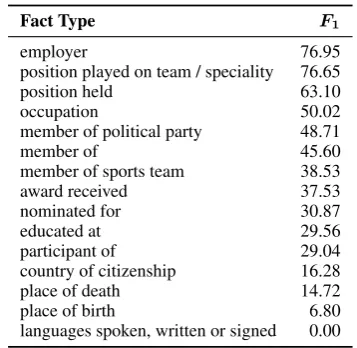
Table 6: F1score of neural ranker (n = 2) on top 15
fact types.
precision andF1 score, while having only slightly
worse recall.
To better understand the cases where the neural models fail and succeed, we examine the distribu-tion of F1 scores over the top 15 fact types (see
Table6). Interestingly, when ranked byF1 score
we observe that fact types fall naturally into topi-cally related groups:
1. position / occupation-related facts: position played, position held, occupation
2. membership-related facts:member of political party, member of, member of sports team
3. achievement-related facts: award received, nominated for
4. location-related facts:country of citizenship, place of death, place of birth
4 Post-Modifier Generation
We move our focus to the main task of post-modifier generation.
4.1 Methods
At its core, post-modifier generation involves pro-ducing a variable-length sequence output condi-tioned on two variable-length inputs: the words in the current and previous sentence (e.g. the con-text), and the collection of claims about the entity. Accordingly, the sequence-to-sequence (seq2seq) framework (Sutskever et al.,2014) is a natural fit for the task — we use it as the foundation for all of our baseline models. Since research has shown that attention (Bahdanau et al., 2015) and copy mechanisms (Gu et al.,2016) consistently improve seq2seq model performance, we use these in our baselines as well.
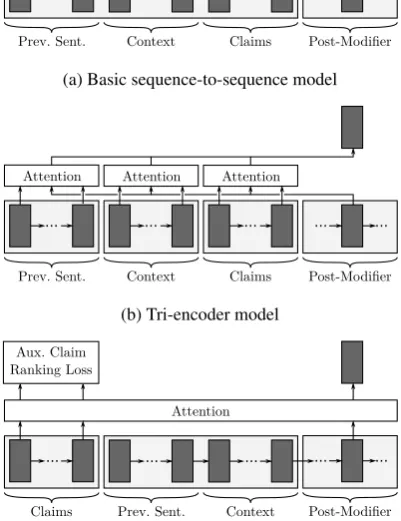
One choice that must be made when using this framework is how to combine the different inputs. The default approach we use is to concatenate the claim and context into a linear sequence of tokens during preprocessing (shown in Figure 4a). We also experiment with encoding the claims and each of the context sentences separately, then concate-nating their vector representations before decoding. We refer to this as thetri-encoderapproach (shown in Figure4b).
As discussed earlier, selecting relevant claims is crucial to generating good post-modifiers. One way to incorporate claim selection is to use our baseline models from Section3to cut out irrele-vant claims from the input before feeding them to the encoder (e.g. performing hard claim selection). This pipelined approach is not differentiable, and can suffer from cascading errors. An alternative way is to use the model’s attention mechanism as a form of soft claim selection that attends only to the relevant claims. The drawback of this approach is that it does not make use of the available claim annotations, which are an important source of su-pervision.
Building on these observations, we propose an
end-to-end claim selectionmodel which incorpo-rates an additional term to the loss function that encourages the claim-level attention probabilities to be higher for the identified relevant claims as shown in Figure 4c. The process for computing this loss term works as follows. We begin by sum-ming together attention scores for tokens within claims to obtain a claim-level score. These scores
Prev. Sent. Context Claims Post-Modifier
...
Attention
...
... ... ...
(a) Basic sequence-to-sequence model
Prev. Sent. Context Claims Post-Modifier
...
Attention
... ... ...
Attention Attention
...
(b) Tri-encoder model
Post-Modifier
...
Attention
Prev. Sent. Context Claims
...
... ... ...
Aux. Claim Ranking Loss
[image:6.595.316.517.134.395.2](c) End-to-end claim selection model
Figure 4: PoMo Models for post-modifier genera-tion. Grey boxes at the bottom represent individual en-coder/decoder modules. (a) For baseline BiLSTM and transformer models all inputs are concatenated into one sequence. (b) The tri-encoder model has a separate en-coder and attention for each type of input. The outputs of attention layers are concatenated together before generation. (c) The end-to-end claim selection model attends to only the claim embeddings and uses an aux-iliary loss term to encourage high attention scores for relevant claims.
are then fed through a sigmoid activation function to obtain a soft claim selection probability. For each claim, we measure the binary cross entropy between the predicted selection probability and a binary variable indicating whether or not the claim was identified as relevant. The final loss term is the average of these binary cross entropies. Note that we do not use a copy mechanism in this model to avoid double-counting (since relevant claims were identified using word overlap).
4.2 Experiments
transform-ers (Vaswani et al.,2017). We use a vocabulary of size 50K, truncate the maximum input sequence length to 500, and use a batch size of 32 in all experiments. To help models distinguish between claims and context we demarcate claim fields with special<claim>,<key>, and<value>tokens. We train all the models for 150k steps, and evaluate on the validation dataset every 10k steps. Evalua-tion is performed using the BLEU (Papineni et al.,
2002) and METEOR (Banerjee and Lavie,2005) translation metrics, and Precision, Recall andF1
score of the predicted bag-of-words (omitting stop-words). The model with the highestF1 score on
the validation set is used during test time.
For the bidirectional LSTM, we use 2 hidden lay-ers with 512 hidden units, 500-dimensional word embeddings, and apply dropout between layers with a keep probability of 0.7. Models are trained using stochastic gradient descent with a learning rate of 1.0. For the transformer model, we use 4 attention heads, 4 layers of transformer blocks with 64 hidden units for the encoder and the decoder, a penultimate hidden layer with 256 units, and 64-dimensional word embeddings. Transformer models are trained using Adam (Kingma and Ba,
2015) with an initial learning rate of 2.0, and a la-bel smoothing (Szegedy et al.,2016) factor of 0.1 when calculating loss.
We perform a variety of experiments, the results of which are displayed in Table 7. In this table,
TransformerandBiLSTMrefer to models trained using the default approach to combining context and claims, whileTri-encoderrefers to a BiLSTM model trained using the approach described in4.1
(we do not train a transformer version since its performance is lackluster). Here are detailed de-scriptions of the experiments performed in each section:
• All Claims: Results for vanilla seq2seq models.
• Oracle: Hard claim selection is performed using the oracle relevant claims.
• Neural Ranker (n= 10): Hard claim selection is performed using the top-10 claims returned by the neural ranker baseline.
• End-to-End Claim Selection: Results for the end-to-end claim selection model.
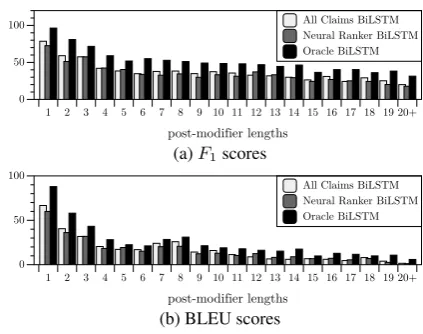
In order to understand the relative contribution of the different inputs, we also include results for the BiLSTM model trained using either only the claims, or only the context sentences. In Figure5
and6, we show the performances by post-modifier
and sentence lengths to examine the impact of the such variables.
Discussion of Quantitative Results Our results contain a few key findings. The first is that know-ing the relevant claims is critical to obtainknow-ing state-of-the-art performance; even knowing only oracle claims is sufficient to perform better than all of the other baselines, although there is a still a large im-provement when context is additionally provided. However, model-based approaches for claim selec-tion do not seem to help: hard claim selecselec-tion using the neural ranker performs just as well as the vanilla models, and our proposed approach for end-to-end claim selection has a negative impact. This moti-vates the need for more effective methods of claim selection. The decreasing performances of the BiLSTM seq2seq models by the increasing target post-modifier and sentence lengths show the dif-ficulty of generating long texts and handling long input data. Finally, we observe that the transformer-based seq2seq models are not particularly well-suited to this task. In all cases their performance is inferior to the BiLSTM-based approaches. Large-scale, pre-trained transformer-based language mod-els, such as GPT-2 (Radford et al., 2019) and BERT (Devlin et al.,2018), might be an interest-ing addition to the baselines, by framinterest-ing the task as filling in the blanks for post-modifiers. How-ever, when restricted to approaches that only use our dataset for training, we expect those based on language models to struggle due to the separation of entities among train, validation, and test.
Prec. Rec. F1 BLEU MET.
All Claims
Transformer 41.9 22.2 29.0 7.0 12.1 Tri-Encoder 53.9 32.4 40.5 17.0 17.6 BiLSTM 51.1 34.7 41.4 19.4 18.8
Oracle
Transformer 69.4 38.6 49.6 15.7 20.0 Tri-Encoder 68.8 47.3 56.1 24.0 24.5 BiLSTM 66.4 48.8 56.2 25.1 25.3
Neural Ranker (n= 10)
Transformer 41.5 22.4 29.1 6.9 12.1 Tri-Encoder 53.5 34.1 41.6 17.6 18.3 BiLSTM 49.0 34.2 40.3 18.5 18.5
End-to-End Claim Selection
BiLSTM 47.5 27.9 35.2 13.7 15.3
Context Only
BiLSTM 13.3 8.5 10.3 3.4 6.2
Claims Only
BiLSTM 47.3 28.5 35.6 13.5 15.0
Oracle Claims Only
BiLSTM 63.8 44.7 52.5 21.3 22.7
Table 7: Post modifier generation model performances with seq2seq models. Precision, recall and F1 scores
are computed ignoring stopwords.
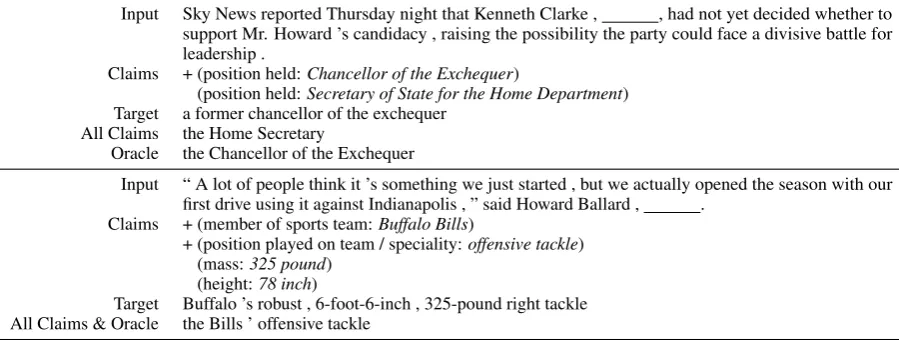
observe that our quantitative evaluation metrics can be too strict. Take for example the second instance in Table8. Here the content of the target and gen-erated post-modifiers is almost exactly the same, however our metrics would give very low scores due to low overlap.
Human Evaluation We additionally evaluate the generated post-modifiers by performing a hu-man evaluation using Amazon Mechanical Turk. We randomly select 500 instances from test set and show crowdworkers the sentence context, along with the true post-modifier and a generated one. For each instance, workers are asked to select the better phrase, or indicate that the two phrases are of equal quality. For the Oracle BiLSTM model, the true post-modifiers are preferred 46% of the time, while generated post-modifiers are preferred 43.2% of the time. For the Neural Ranker (n= 10) BiLSTM model, true post-modifiers are favored much more (57.60%) than the generated ones (20%). Consis-tent with our quantitative results, we see that claim selection is a crucial factor in this task. We also ob-serve a few trends in the results. People tend to pre-fer generated post-modifiers over the ones written by professional journalists when they are shorter and to use more general terms without elaborat-ing too much about the entity. In contrast, longer
All Claims BiLSTM Neural Ranker BiLSTM Oracle BiLSTM
0 50 100
post-modifier lengths
1 2 3 4 5 6 7 8 9 10 11 12 13 14 15 16 17 18 19 20+
(a)F1scores
All Claims BiLSTM Neural Ranker BiLSTM Oracle BiLSTM
0 50 100
post-modifier lengths
1 2 3 4 5 6 7 8 9 10 11 12 13 14 15 16 17 18 19 20+
[image:8.595.306.518.62.229.2](b) BLEU scores
Figure 5: Performances by target post-modifier lengths of BiLSTM model. Post-modifiers with 20 or more to-kens are put into one group,20+.
All Claims BiLSTM Neural Ranker BiLSTM Oracle BiLSTM
0 50 100
sentence lengths
3 4 5 6 7 8 9 10 11 12 13 14 15 16 17 18 19 20+
(a)F1scores
All Claims BiLSTM Neural Ranker BiLSTM Oracle BiLSTM
0 20 40 60
sentence lengths
3 4 5 6 7 8 9 10 11 12 13 14 15 16 17 18 19 20+
[image:8.595.309.519.280.443.2](b) BLEU scores
Figure 6: Performances by input sentence lengths of BiLSTM model. Sentences with 20 or more tokens are put into one group,20+.
and more detailed human written post-modifiers are preferred when they are especially relevant to the rest of the sentence.
5 Related Work
There is a large body of previous work on claim selection (Kukich,1983;Duboue and McKeown,
2003;Reiter and Dale, 1997;Tanaka-Ishii et al.,
1998; Barzilay and Lapata, 2005) and language generation from structured data (Reiter et al.,2005;
Goldberg et al., 1994). Initially, hand-crafted grammars were employed for language generation, which later evolved to statistical machine transla-tion style models (Wong and Mooney, 2007) or PCFG based models (Belz,2008). More recently, the focus has shifted to learning both fact selection and language generation jointly (Liang et al.,2009;
Input Sky News reported Thursday night that Kenneth Clarke , , had not yet decided whether to support Mr. Howard ’s candidacy , raising the possibility the party could face a divisive battle for leadership .
Claims + (position held:Chancellor of the Exchequer)
+(position held:Secretary of State for the Home Department) Target a former chancellor of the exchequer
All Claims the Home Secretary
Oracle the Chancellor of the Exchequer
Input “ A lot of people think it ’s something we just started , but we actually opened the season with our first drive using it against Indianapolis , ” said Howard Ballard , .
Claims + (member of sports team:Buffalo Bills)
+ (position played on team / speciality:offensive tackle)
+(mass:325 pound)
+(height:78 inch)
[image:9.595.73.523.64.234.2]Target Buffalo ’s robust , 6-foot-6-inch , 325-pound right tackle All Claims & Oracle the Bills ’ offensive tackle
Table 8:ChallengingPoMoinstances. Two examples along with outputs of the best All Claims and Oracle models are displayed. Claims deemed relevant during dataset curation are prefaced with a +. In the first example, knowing the relevant claims helps the Oracle model produce an output that closely matches the Target, however lack of temporal information causes the model to miss the wordformer. In the second example, the All Claims and Oracle models produce the same post-modifier. Although it is similar to the Target in meaning, it receives a low score using our evaluation metrics. Futhermore, our data curation method fails to identify relevant claims.
Modern approaches employ neural networks to solve this problem end-to-end.Mei et al.(2016) uti-lize an encoder-decoder framework to map weather conditions to a weather forecast.Ahn et al.(2016) and Yang et al. (2017) introduce a new class of language models which are capable of entity co-reference and copying facts from an external knowl-edge base. Building upon these models,Wiseman et al.(2017) introduce an auxiliary reconstruction loss which use the hidden states of the decoder to recover the facts used to generate the text.Liu et al.
(2018) introduce a hierarchical attention model for fact selection, with the higher level focusing on which records in the table to select and the lower level focusing on which cells in a particular row to pay attention to.
In order to train complex neural models, the quest for larger datasets has become paramount.
Lebret et al.(2016) introduce the WikiBio dataset containing Wikipedia articles of famous people and the corresponding infobox tables. One drawback of this dataset is that it is easily solved using template-based models. To address this issue,Wiseman et al.
(2017) introduce the ROTOWire dataset, which contains summaries of basketball games that are very long and syntactically diverse. A comprehen-sive list of datasets is provided in AppendixB.
6 Conclusions and Future Work
Inspired by recent work on collaborative writing and data-to-text generation, we introduce post-modifier generation, a task that bridges the gap
between these two fields. The task is to generate a factual description of an entity which fits within the context of a human written sentence. In order to promote research on this task we present PoMo, a large dataset of automatically extracted post-modifiers from news articles, aligned to the Wiki-data knowledge graph. We study the performance of numerous strong baseline models on this dataset, with a particular focus on the specific sub-task of claim selection. Our results demonstrate that when relevant claims are known, sequence-to-sequence models are capable of generating post-modifiers which humans deem comparable in quality to ones written by professional journalists. However, ac-cording to both quantitative metrics and human judgment, performance is much lower when mod-els must determine for themselves which claims are relevant. These experiments suggest plausible pathways to achieving human-level performance on this task that are both challenging and interesting problems for future research.
Acknowledgments
References
Sungjin Ahn, Heeyoul Choi, Tanel P¨arnamaa, and Yoshua Bengio. 2016. A neural knowledge language model. arXiv preprint arXiv:1608.00318.
Gabor Angeli, Percy Liang, and Dan Klein. 2010. A simple domain-independent probabilistic approach to generation. InProceedings of the 2010 Confer-ence on Empirical Methods in Natural Language Processing, pages 502–512. Association for Compu-tational Linguistics.
Dzmitry Bahdanau, Kyunghyun Cho, and Yoshua Ben-gio. 2015. Neural machine translation by jointly learning to align and translate. In 3rd Inter-national Conference on Learning Representations, ICLR 2015, San Diego, CA, USA, May 7-9, 2015, Conference Track Proceedings.
Satanjeev Banerjee and Alon Lavie. 2005. Meteor: An automatic metric for mt evaluation with improved correlation with human judgments. InProceedings of the acl workshop on intrinsic and extrinsic evalu-ation measures for machine translevalu-ation and/or sum-marization, pages 65–72.
Regina Barzilay and Mirella Lapata. 2005. Collective content selection for concept-to-text generation. In
Proceedings of the conference on Human Language Technology and Empirical Methods in Natural Lan-guage Processing, pages 331–338. Association for Computational Linguistics.
Anja Belz. 2008. Automatic generation of weather forecast texts using comprehensive probabilistic generation-space models. Natural Language Engi-neering, 14(4):431–455.
Elizabeth Clark, Anne Spencer Ross, Chenhao Tan, Yangfeng Ji, and Noah A Smith. 2018. Creative writing with a machine in the loop: Case studies on slogans and stories. In 23rd International Confer-ence on Intelligent User Interfaces, pages 329–340. ACM.
Jacob Devlin, Ming-Wei Chang, Kenton Lee, and Kristina Toutanova. 2018. Bert: Pre-training of deep bidirectional transformers for language understand-ing. arXiv preprint arXiv:1810.04805.
Pablo A Duboue and Kathleen R McKeown. 2003. Sta-tistical acquisition of content selection rules for nat-ural language generation. In Proceedings of the 2003 conference on Empirical methods in natural language processing, pages 121–128. Association for Computational Linguistics.
Eli Goldberg, Norbert Driedger, and Richard I Kit-tredge. 1994. Using natural-language processing to produce weather forecasts. IEEE Expert, 9(2):45– 53.
Jiatao Gu, Zhengdong Lu, Hang Li, and Victor OK Li. 2016. Incorporating copying mechanism in sequence-to-sequence learning. In Proceedings of
the 54th Annual Meeting of the Association for Com-putational Linguistics (Volume 1: Long Papers), vol-ume 1, pages 1631–1640.
Karl Moritz Hermann, Tomas Kocisky, Edward Grefen-stette, Lasse Espeholt, Will Kay, Mustafa Suleyman, and Phil Blunsom. 2015. Teaching machines to read and comprehend. In Advances in Neural Informa-tion Processing Systems, pages 1693–1701.
Sepp Hochreiter and Jrgen Schmidhuber. 1997. Long short-term memory. InNeural Computation.
Zhiting Hu, Zichao Yang, Xiaodan Liang, Ruslan Salakhutdinov, and Eric P Xing. 2017. Toward controlled generation of text. In Proceedings of the 34th International Conference on Machine Learning-Volume 70, pages 1587–1596. JMLR. org.
Joohyun Kim and Raymond J Mooney. 2010. Gen-erative alignment and semantic parsing for learn-ing from ambiguous supervision. In Proceedings of the 23rd International Conference on Computa-tional Linguistics: Posters, pages 543–551. Associa-tion for ComputaAssocia-tional Linguistics.
Diederik P. Kingma and Jimmy Ba. 2015. Adam: A method for stochastic optimization. In 3rd Inter-national Conference on Learning Representations, ICLR 2015, San Diego, CA, USA, May 7-9, 2015, Conference Track Proceedings.
Ioannis Konstas and Mirella Lapata. 2013. A global model for concept-to-text generation. Journal of Ar-tificial Intelligence Research, 48:305–346.
Karen Kukich. 1983. Design of a knowledge-based re-port generator. In Proceedings of the 21st annual meeting on Association for Computational Linguis-tics, pages 145–150. Association for Computational Linguistics.
R´emi Lebret, David Grangier, and Michael Auli. 2016. Neural text generation from structured data with ap-plication to the biography domain. InProceedings of the 2016 Conference on Empirical Methods in Natural Language Processing, pages 1203–1213.
Percy Liang, Michael I Jordan, and Dan Klein. 2009. Learning semantic correspondences with less super-vision. InProceedings of the Joint Conference of the 47th Annual Meeting of the ACL and the 4th Interna-tional Joint Conference on Natural Language Pro-cessing of the AFNLP: Volume 1-Volume 1, pages 91–99. Association for Computational Linguistics.
Tianyu Liu, Kexiang Wang, Lei Sha, Baobao Chang, and Zhifang Sui. 2018. Table-to-text generation by structure-aware seq2seq learning. InThirty-Second AAAI Conference on Artificial Intelligence.
Christopher D. Manning, Mihai Surdeanu, John Bauer, Jenny Finkel, Steven J. Bethard, and David Mc-Closky. 2014. The Stanford CoreNLP natural lan-guage processing toolkit. InAssociation for Compu-tational Linguistics (ACL) System Demonstrations, pages 55–60.
Hongyuan Mei, Mohit Bansal, and Matthew R. Wal-ter. 2016. What to talk about and how? selective generation using lstms with coarse-to-fine alignment. InProceedings of the 2016 Conference of the North American Chapter of the Association for Computa-tional Linguistics: Human Language Technologies, pages 720–730, San Diego, California. Association for Computational Linguistics.
George A Miller. 1995. Wordnet: a lexical database for english. Communications of the ACM, 38(11):39– 41.
Dat Ba Nguyen, Johannes Hoffart, Martin Theobald, and Gerhard Weikum. 2014. Aida-light: High-throughput named-entity disambiguation. LDOW, 1184.
Kishore Papineni, Salim Roukos, Todd Ward, and Wei-Jing Zhu. 2002. Bleu: a method for automatic eval-uation of machine translation. In Proceedings of the 40th annual meeting on association for compu-tational linguistics, pages 311–318. Association for Computational Linguistics.
Alec Radford, Jeff Wu, Rewon Child, David Luan, Dario Amodei, and Ilya Sutskever. 2019. Language models are unsupervised multitask learners.
Sudha Rao and Joel R. Tetreault. 2018. Dear sir or madam, may i introduce the gyafc dataset: Corpus, benchmarks and metrics for formality style transfer. InNAACL-HLT.
Ehud Reiter and Robert Dale. 1997. Building applied natural language generation systems. Natural Lan-guage Engineering, 3(1):57–87.
Ehud Reiter, Somayajulu Sripada, Jim Hunter, Jin Yu, and Ian Davy. 2005. Choosing words in computer-generated weather forecasts. Artificial Intelligence, 167(1-2):137–169.
Evan Sandhaus. 2008. The new york times annotated corpus. Linguistic Data Consortium, Philadelphia, 6(12):e26752.
Tianxiao Shen, Tao Lei, Regina Barzilay, and Tommi Jaakkola. 2017. Style transfer from non-parallel text by cross-alignment. InAdvances in Neural Informa-tion Processing Systems, pages 6830–6841.
Nitish Srivastava, Geoffrey Hinton, Alex Krizhevsky, Ilya Sutskever, and Ruslan Salakhutdinov. 2014. Dropout: A simple way to prevent neural networks from overfitting. Journal of Machine Learning Re-search, 15:1929–1958.
Ilya Sutskever, Oriol Vinyals, and Quoc V Le. 2014. Sequence to sequence learning with neural networks. In Z. Ghahramani, M. Welling, C. Cortes, N. D. Lawrence, and K. Q. Weinberger, editors,Advances in Neural Information Processing Systems 27, pages 3104–3112. Curran Associates, Inc.
Christian Szegedy, Vincent Vanhoucke, Sergey Ioffe, Jonathon Shlens, and Zbigniew Wojna. 2016. Re-thinking the inception architecture for computer vi-sion. In 2016 IEEE Conference on Computer Vi-sion and Pattern Recognition, CVPR 2016, Las Ve-gas, NV, USA, June 27-30, 2016, pages 2818–2826.
Kumiko Tanaka-Ishii, Kˆoiti Hasida, and Itsuki Noda. 1998. Reactive content selection in the generation of real-time soccer commentary. InProceedings of the 17th international conference on Computational linguistics-Volume 2, pages 1282–1288. Association for Computational Linguistics.
Ashish Vaswani, Noam Shazeer, Niki Parmar, Jakob Uszkoreit, Llion Jones, Aidan N Gomez, Ł ukasz Kaiser, and Illia Polosukhin. 2017. Attention is all you need. In I. Guyon, U. V. Luxburg, S. Bengio, H. Wallach, R. Fergus, S. Vishwanathan, and R. Gar-nett, editors, Advances in Neural Information Pro-cessing Systems 30, pages 5998–6008. Curran Asso-ciates, Inc.
Denny Vrandeˇci´c and Markus Kr¨otzsch. 2014. Wiki-data: a free collaborative knowledgebase. Commu-nications of the ACM, 57(10):78–85.
Sam Wiseman, Stuart Shieber, and Alexander Rush. 2017. Challenges in data-to-document generation. In Proceedings of the 2017 Conference on Empiri-cal Methods in Natural Language Processing, pages 2253–2263, Copenhagen, Denmark. Association for Computational Linguistics.
Yuk Wah Wong and Raymond Mooney. 2007. Genera-tion by inverting a semantic parser that uses statisti-cal machine translation. InHuman Language Tech-nologies 2007: The Conference of the North Amer-ican Chapter of the Association for Computational Linguistics; Proceedings of the Main Conference, pages 172–179.
Zichao Yang, Phil Blunsom, Chris Dyer, and Wang Ling. 2017. Reference-aware language models. In
Proceedings of the 2017 Conference on Empirical Methods in Natural Language Processing, pages 1850–1859, Copenhagen, Denmark. Association for Computational Linguistics.
A Additional Claim Selection Materials
Table9lists the evaluation results of most-common claim baseline forn, the number of claims to pre-dict, from 1 to 5. We obtain highest F1 withn= 4.
n Precision Recall F1
1 57.7 31.8 41.0
2 49.6 38.3 43.2
3 43.4 45.2 44.3
4 39.9 51.6 45.0
5 36.0 56.8 44.0
Table 9: Evaluation metrics for most-common claim baseline for different values ofn.
Neural baseline shows improved performance compared to most-common claim baseline, show-ing its best performance whenn= 2.
n Precision Recall F1
1 75.2 42.4 54.3
2 66.5 62.7 64.5
3 56.0 69.6 62.1
4 48.7 76.2 59.4
Table 10: Evaluation metrics for neural baseline for dif-ferent values ofn.
B Existing Data-to-Text Datasets
Table 11 provides a comprehensive list of data-to-text datasets. PoMo presents a different set of challenges from these datasets. While the target text is shorter and less diverse, the task adds an additional challenge of figuring out which claims to use, a task which our evaluation shows is quite challenging.
Dataset Size Domain of structured data to language
WEATHER.GOV 29.5k Weather conditions to forecast re-port
ALLRECIPES 31k Table of ingredients to recipes ROBOCUP 1.5k Game statistics to summaries ROTOWIRE 4.9k Basketball statistics to game
sum-maries
WIKIBIO 728k Infobox to Wikipedia biography articles
SBNations 10.9K Game statistic to fan written sum-maries
WikiFacts 40k Freebase /film/actor facts to Wiki description of actor
[image:13.595.72.294.590.741.2]