Original Article
Efficacy and safety of Endostar (recombinant human
endostatin hormone) combined with docetaxel as
second-or third-line therapy for patients with
non-small-cell lung cancer
Dongmei Ji
1,2, Jialei Wang
1,2, Hui Yu
1,2, Xianghua Wu
1,2, Huijie Wang
1,2, Wenhua Li
1,2, Si Sun
1,2, Jian Zhang
1,2,
Jianhua Chang
1,21Department of Medical Oncology, Fudan University Shanghai Cancer Center, Shanghai 200032, China; 2Shanghai Medical College, Fudan University, Shanghai 200032, China
Received July 5, 2016; Accepted October 26, 2016; Epub January 15, 2017; Published January 30, 2017
Abstract: This study aimed to evaluate the efficacy and safety of Endostar (recombinant human endostatin hor-mone) in combination with docetaxel as a second-or third-line therapy for NSCLC. From September 2009 to December 2011, 42 patients with metastatic NSCLC were enrolled. Patients received docetaxel 75 mg/m2 IV (day 1) and Endostar 7.5 mg/m2 IV (days 1-14) every three weeks, for up to six cycles. Complete blood count was tested every other day during the first cycle and before the other cycles. Efficacy was evaluated every two cycles. Thirty-nine patients completed treatment with a median follow-up of 19 months. For the primary endpoint, patients under Endostar plus docetaxel had a median overall survival of 10.1 months (95% confidence interval (CI): 5.8-14.4). For the secondary endpoints, the mean disease control rate was 59.0% and median progression-free survival (mPFS) was 3.0 months (95% CI: 1.1-4.8). Multivariate analysis showed that age <55 was associated with mPFS (P=0.031, HR 0.429 95% CI 0.198-0.927). Toxicity was related to bone marrow suppression and transient cardiac toxicity. These results provide favorable evidence to perform large-scale clinical studies using Endostar plus docetaxel as second-or third-line therapy for patients with NSCLC.
Keywords: Carcinoma, non-small-cell lung, chemotherapy, second or third line therapy, endostar protein, docetax-el
Introduction
Among all malignant tumors, lung cancer is
among the ones with the highest incidence in
the world [1]. In China, there are more than
500,000 newly-diagnosed lung cancer cases
annually [2]. Non-small cell lung cancer (NSCLC)
accounts for more than 80% of all lung cancers
[1]. At the time of diagnosis, many lung cancer
patients are already stage IIIB or IV [2], so
treat-ment is unlikely to be curative and generally
aims at prolonging survival and controlling
dis-ease-related symptoms [3]. Platinum-based
two-drug combination chemotherapy is the
standard first-line treatment for stage III and IV
patients [4], but for patients with epidermal
growth factor receptor (EGFR) mutations,
EGFR-tyrosine kinase inhibitor (TKI)-based therapy
may be used as first-line treatment [5, 6].
For patients with progression or relapse of
NSCLC after first-line treatments, an alternative
chemotherapy regimen is recommended to
pro-long survival [7, 8]. Commonly used second-line
treatments for NSCLC include single-agent
docetaxel, pemetrexed, and EGFR-TKI [7-9]. As
a second-line chemotherapy for metastatic
NSCLC, docetaxel has low efficacy (less than
10%), with median progression-free survival
(mPFS) of 2.7-6 months and median overall
sur-vival (mOS) of 5.7-7.9 months [7, 8, 10]. To
increase the efficacy of second-line docetaxel,
many different chemotherapy drugs may be
added [11]. NSCLC patients who fail to respond
to second-line chemotherapy can still benefit
studies have shown that it has good anti-tumor
efficacy in solid tumors with well-tolerated tox
-icity [14]. Endostar has shown some promising
results as first-line treatment for NSCLC.
Endostar plus vinorelbine and cisplatin (NP)
regimen extended patients’ time to tumor
pro-gression (TTP), but the mPFS and mOS were
not significantly improved [14, 15]. Similar
results were found with Endostar in
combina-tion with paclitaxel-carboplatin (TC) with impro-
vements in overall response rates (ORR) but
similar mPFS and mOS [16]. A recent phase II
trial showed that Endostar in combination with
docetaxel and cisplatin chemotherapy for
local-ly advanced NSCLC patients was feasible and
showed promising survival and local control
rates [17]. A meta-analysis of Endostar
combi-nation therapies for NSCLC suggests that
Endostar can improve the response rate
with-out significantly increasing side effects [18],
and may even increase TTP and disease control
rate (DCR) with improvement in patients’
quali-ty of life [19].
Based on the efficacy of combination treat
-ment with Endostar in first-line therapy, we
hypothesized that Endostar in combination
with standard docetaxel second-line therapy
could improve the efficacy of second-and
third-using X-ray, conventional computed
tomogra-phy (CT), or magnetic resonance imaging (MRI),
or ≥10 mm if assessed by spiral CT; 3) failure of
first- or second-line therapy; 4) ECOG perfor
-mance status of 0 or 1; 5) expected survival of
at least 3 months; 6) aged 18-75 years; 7) no
contraindication to chemotherapy; 8) white
blood cells ≥3.5×10
9/L, platelets ≥80×10
9/L,
hemoglobin ≥90 g/L, creatinine ≤2.0× the
upper limit of normal (ULN), transaminases
<1.5× ULN, and bilirubin <1.5× ULN; in the
presence of liver metastases: transaminases
<5× ULN and bilirubin <2.5× ULN; and 9) signed
the informed consent form. Exclusion criteria
were: 1) previously received docetaxel; or 2)
vital organ dysfunction or failure.
The study was approved by the institutional
review board of Shanghai Medical College, Fu-
dan University. Written informed consent was
obtained from all patients. All investigations
were conducted according to the principles of
the Declaration of Helsinki. The study was
reg-istered with ClinicalTrials. gov (NCT01192230).
Data collection
All patients underwent the docetaxel plus
Endostatin treatment and the data were
col-Figure 1. Patients flowchart.line therapy for NSCLC. The
aim of this study was to
inves-tigate the benefits and side
effects of Endostar plus do-
cetaxel as second-or third-line
treatment for patients with
NSCLC.
Materials and methods
Study design and patients
This was a prospective study
of 42 consecutive patients
treated between September
2009 and December 2011 at
the Shanghai Cancer Center,
Fudan University. Inclusion
cri-teria were: 1) definitive diag
-nosis of NSCLC according to
pathological or cytological ex-
amination; 2) stage IIIB or IV
NSCLC confirmed by imaging
with at least one measurable
lesion at baseline; lesion had
[image:2.612.94.375.74.352.2]lected prospectively. The primary endpoint of
the study was OS. As per original study design,
mOS over 10 months was considered
satisfac-tory. The secondary endpoints were TTP and
side effects. Progression was evaluated every
two cycles according to RECIST 1.1 [20, 21].
Adverse effects were classified according to
CTCAE 3.0 [22] in all patients that received at
least one cycle of chemotherapy. DCR was
defined as complete response (CR) + partial
response (PR) + stable disease (SD) based on
the RECIST evaluation of the lesions [20, 21].
Chemotherapy
Patients received docetaxel 75 mg/m
2(day 1),
and Endostar 7.5 mg/m
2(IV, days 1-14) every
three weeks per cycle for up to six cycles. Pro-
phylactic granulocyte colony-stimulating factor
(G-CSF) was not given at the first cycle. The
patients were hospitalized during the first cycle
and complete blood count was tested every
day. If the patient experienced grade 4
neutro-penia or febrile neutroneutro-penia, prophylactic
G-CSF was added for the following cycles.
Electrocardiogram (ECG) was monitored before
each cycle, or if the patients experienced
car-diac symptoms. Blood biochemistry was
exam-ined before each cycle.
Statistical analysis
All data are presented as mean ± standard
deviation. Kaplan-Meier curves were used for
survival analysis, and compared with the
log-rank test. The Cox proportional hazards model
was used for multivariate analysis. Factors with
P
-values <0.10 in univariate analyses were
tested with the multivariate model. A standard
least-squares method was used for multiple
regression analyses. All statistical analyses
were performed with SPSS 16.0 (IBM, Armonk,
NY, USA). Two-sided
P
-values <0.05 were
con-sidered statistically significant.
Results
Characteristics of the patient
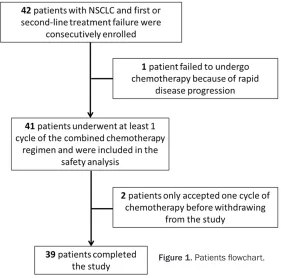
Figure 1
presents the patient flowchart. Among
the 42 participants, one failed to undergo
che-motherapy due to rapid progression of the
dis-ease, and two only accepted one cycle of
che-motherapy before withdrawing from the study;
the remaining 39 patients completed the whole
treatment course with a median follow-up of 19
months.
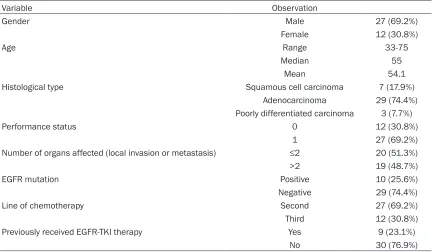
[image:3.612.91.524.84.336.2]The baseline characteristics of the patients are
shown in
Table 1
. There were more males than
Table 1.
Baseline characteristics of the patients enrolled in the study
Variable Observation
Gender Male 27 (69.2%)
Female 12 (30.8%)
Age Range 33-75
Median 55
Mean 54.1
Histological type Squamous cell carcinoma 7 (17.9%)
Adenocarcinoma 29 (74.4%) Poorly differentiated carcinoma 3 (7.7%)
Performance status 0 12 (30.8%)
1 27 (69.2%)
Number of organs affected (local invasion or metastasis) ≤2 20 (51.3%)
>2 19 (48.7%)
EGFR mutation Positive 10 (25.6%)
Negative 29 (74.4%)
Line of chemotherapy Second 27 (69.2%)
Third 12 (30.8%)
Previously received EGFR-TKI therapy Yes 9 (23.1%)
No 30 (76.9%)
females (69.2%), with a mean age of 54.1
years. The most common histological type was
adenocarcinoma (74.4%). The regimen was
second-line for 69.2% of the patients.
Efficacy of the therapy
Among the 39 patients that received the full
docetaxel plus Endostar therapy and that were
included in the efficacy evaluation, 38 received
at least two cycles of chemotherapy. One
patient had PD after the first cycle of chemo
-therapy, and was included in the efficacy evalu
[image:4.612.86.521.86.272.2]-ation. Results of therapy efficacy are shown in
Table 2
.
For the primary endpoint, mOS was 10.1
months (95% confidence interval (CI):
5.8-14.4). For the secondary endpoints, the mean
DCR was 59.0% and mPFS was 3.0 months
(95% CI: 1.1-4.8).
Figure 2
presents the
surviv-al curves and the data is summarized in
Table
3
.
This regimen was particularly effective for
third-line patients with a DCR of 58.3% and the
median progression-free survival (mPFS) of 3.0
months (
Table 3
). Subgroup analysis showed
that younger patients (age <55) (
Figure 3
and
Table 3
) might be more likely to gain benefit
from this regimen (P=0.054 and P=0.074 for
mPFS and mOS, respectively).
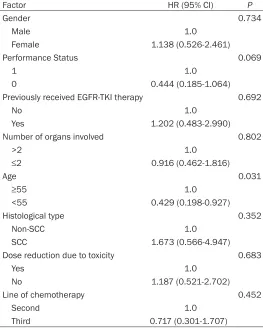
The results of the multivariate analysis are
pre-sented in
Table 4
. The only factor that was
iden-Table 2.
Efficacy of the therapy
Variable Observation
No. of chemotherapy cycles One 1 (2.6%)
Two 17 (43.6%)
Three 2 (5.1%)
Four 15 (38.5%)
Six 4 (10.3%)
Median no. of cycles 3
Efficacy Complete response (CR) 0 (0%)
Partial response (PR) 3 (7.7%) Stable disease (SD) 20 (51.3%) Progressive disease (PD) 16 (41.0%) Disease Control Rate (DCR) 23 (59.0%) Median progression-free survival (mPFS) 3.0 months 95% CI: 1.1-4.8
[image:4.612.91.523.153.455.2]Median overall survival (mOS) 10.1 months 95% CI: 5.8-14.4
tified as being significant for PFS was age <55.
This cut off point was selected because it was
the median age of the patients.
Safety profile
Forty-one patients received at least one cycle
of combined chemotherapy and were included
in the safety evaluation. Thirty-three patients
(80.5%) developed grade 3-4 neutropenia; 21
(51.2%) of them experienced grade 4
neutro-penia. Thirteen (31.8%) patients experienced
febrile neutropenia; 12 of them (29.3%) were
given a reduced dose of docetaxel and one
patient withdrew from the study. They did not
have another episode of febrile neutropenia by
decreasing the dose of docetaxel, without
changing the dose of Endostar.
Two patients had palpitations during the first
cycle of Endostar administration. Four patients
(9.8%) had chest pain at the first cycle treat
-ment, but the symptom did not reappear in the
subsequent cycles. One patient developed
par-oxysmal atrial fibrillation in the first circle; the
[image:5.612.90.523.84.312.2]patient had grade 1 palpitation and the
symp-toms improved after Endostar withdrawal and
amiodarone administration, but the symptoms
Table 3.
Summarized data for the Kaplan-Meier survival analysis
Subgroup MPFS (months) P MOS (months) P
Histological type Non-SCC 3.0 0.103 8.2 0.389
SCC 1.6 10.1
Age <55 3.5 0.054 18.2 0.074
≥55 1.6 8.2
Previously received EGFR-TKI therapy Yes 2.6 0.555 11.5 0.618
No 3.0 8.2
Number of organs involved ≤2 3.3 0.516 11.5 0.817
>2 2.8 8.2
Line of chemotherapy Second 2.8 0.941 10.3 0.919
Third 3.0 8.2
Performance status 0 4.0 0.488 15.6 0.399
1 2.8 8.6
Gender Male 3.0 0.768 8.2 0.567
Female 2.6 15.6
Dose reduction due to toxicity Yes 3.0 0.760 27.4 0.201
No 2.8 8.6
SCC: squamous cell carcinoma.
[image:5.612.95.522.345.503.2]did not reappear in the following cycles of
Endostar. Grade I liver dysfunction was
observed in one patient after the first cycle,
which was managed with glutathione
adminis-tration. Renal malfunction and hypertension
were not observed throughout the study.
Discussion
Single-agent docetaxel is the standard
second-line treatment for NSCLC patients [7, 23]. The
primary endpoint of this study was to evaluate
the efficacy (based on mOS) of docetaxel plus
Endostar in patients with NSCLC for which first-
or second-line chemotherapy had failed. The
results showed that Endostar plus docetaxel
had a DCR of 59.0% and was particularly
effec-tive for third-line patients with a DCR of 58.3%
and mPFS of 3.0 months. Subgroup analysis
showed patients <55 years were more likely to
benefit from the regimen. Toxicity was
manag-eable.
with NSCLC as second-line treatment, with
manageable toxicity [27]. Another trial of doce-
taxel plus nintedanib vs. docetaxel plus
place-bo showed that the combination was an
effec-tive second-line treatment for NSCLC, with a
PFS of 3.4 vs. 2.7 months and manageable
tox-icities [28]. A meta-analysis of 14 trials
sug-gests that a combination of docetaxel with
tar-geted therapy as second-line treatment of
NSCLC increased response rates and PFS, but
without effect on OS and with more toxicities
[29]. The present study did not include a
con-trol group, preventing the evaluation of gained
efficacy. There is no data from randomized con
-trolled trials about the efficacy of the docetaxel
[image:6.612.90.353.99.428.2]plus Endostar combination for the treatment of
NSCLC or of any other type of cancer, but a
meta-analysis showed that the combination of
Endostar with platinum-based chemotherapy
improved DCR in NSCLC [19]. Additional
stud-ies are needed to establish if there is or not a
Table 4.
Multivariate Cox proportional hazards model
analy-ses of various factors affecting PFS
Factor HR (95% CI) P
Gender 0.734
Male 1.0
Female 1.138 (0.526-2.461)
Performance Status 0.069
1 1.0
0 0.444 (0.185-1.064)
Previously received EGFR-TKI therapy 0.692
No 1.0
Yes 1.202 (0.483-2.990)
Number of organs involved 0.802
>2 1.0
≤2 0.916 (0.462-1.816)
Age 0.031
≥55 1.0
<55 0.429 (0.198-0.927)
Histological type 0.352
Non-SCC 1.0
SCC 1.673 (0.566-4.947)
Dose reduction due to toxicity 0.683
Yes 1.0
No 1.187 (0.521-2.702)
Line of chemotherapy 0.452
Second 1.0
Third 0.717 (0.301-1.707)
PFS: progression-free survival; EGFR-TKI: epidermal growth factor-tyrosine kinase inhibitors; SCC: squamous cell carcinoma.
The present study suggested that
the docetaxel plus Endostar
regi-men provided comparable clinical
outcomes to that of second-line
docetaxel monotherapy (75 mg/
m
2), as observed in previous
stud-ies [7, 8, 24-28]. In addition, the
docetaxel and Endostar
combina-tion could improve the clinical
out-come of third-line NSCLC patients
with higher DCR and longer mPFS.
In the present study, mOS was over
10 months, which was higher than
the present 10-month target that
was pre-defined in study design. As
the efficacy of docetaxel alone for
second-line therapy is
disappoint-ing, other combined therapies
have also been investigated and
some have progressed to phase II
clinical trials such as AT-101, which
showed no improvement over
sin-gle agent docetaxel in terms of PFS
[25], or intermittent administration
of erlotinib that also showed no
additional benefit [28]. However,
superiority of docetaxel plus Endostar vs. other
types of chemotherapy for NSCLC.
Nevertheless, combining Endostar with che-
motherapy seems reasonable because of the
possible complementary action mechanisms.
In recent years, immune checkpoint inhibitors
have shown encouraging results in treating
NSCLC [30, 31]. However, the response rate of
this kind of treatment used alone is only about
19-20% [30, 31]. Endostar may play a role in
regulating immune checkpoints, leading to
fur-ther shrinking of the tumor through inhibition of
angiogenesis. It should be noted that the
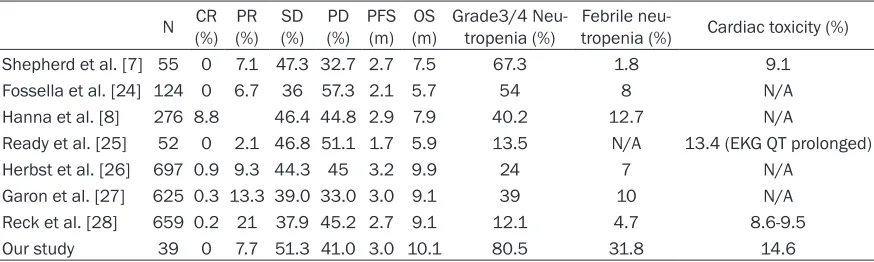
stud-ies listed in
Table 5
evaluated the efficiency of
docetaxel as second-line therapy, but in the
present study, the efficacy of the combined
therapy for second-line or third-line NSCLC
patients was evaluated. The DCR of NSCLC
generally decreases with every treatment line
from the first one and it has been highlighted
that more effective therapies for patients with
NSCLC that have failed second-line treatment
are needed [30]. These results suggest that
Endostar combination therapy could benefit
these patients.
Patients in this study had a relatively high
inci-dence of grade 3-4 bone marrow suppression
and febrile neutropenia. These rates are much
higher than those seen in studies of docetaxel
(
Table 5
), and may be of concern for the further
development of this combination therapy. This
high incidence could be related to docetaxel or
to Endostar administration, but it would be
con-tradictory to other studies using Endostar in
combination with first-line chemotherapy [18,
19]. However, because the patients in this
study were treated because they had relapsed,
they may not have fully recovered from their
previous chemotherapy treatment. Therefore,
in particular for third-line patients, tolerance to
the regimen would be expected to be lower.
Furthermore, because all patients in this study
were hospitalized throughout the first cycle of
chemotherapy, blood tests were closely
moni-tored every other day and bone marrow toxicity
was more likely to be detected than in patients
that had fewer blood tests (e.g., once every
cycle).
Six patients in the present study experienced
symptoms suggesting cardiac toxicity dur-
ing Endostar administration. These symptoms
were, however, transient and disappeared after
appropriate treatments. These rates are
slight-ly higher than in previous studies that provided
data for cardiac symptoms [7, 25, 28], but the
transient symptoms did not prevent the use of
Endostar.
This study has some limitations. The sample
size was small, and all patients received the
combined therapy without any randomized
pla-cebo control. Therefore, the results should be
treated as preliminary and only the first step
[image:7.612.89.526.84.215.2]towards further clinical trials. There were
dis-parities between the general study population
analyses and the age subgroup analyses, which
is probably due to the small sample size and
the general condition of the patients. As the
study was started in 2009, i.e. before the
com-mon use of TKI maintenance medication, nine
cases who had received TKI therapy previously
did not continue to receive TKI despite the fact
that current opinion would consider adding TKI
to the regimen. Mean age was 54 years, which
is comparable to previous Asian and Chinese
Table 5.
Comparable results between this study and other published studies
N CR(%) (%)PR (%)SD (%)PD PFS(m) (m)OS Grade3/4 Neu-tropenia (%) tropenia (%)Febrile neu- Cardiac toxicity (%)
Shepherd et al. [7] 55 0 7.1 47.3 32.7 2.7 7.5 67.3 1.8 9.1
Fossella et al. [24] 124 0 6.7 36 57.3 2.1 5.7 54 8 N/A
Hanna et al. [8] 276 8.8 46.4 44.8 2.9 7.9 40.2 12.7 N/A
Ready et al. [25] 52 0 2.1 46.8 51.1 1.7 5.9 13.5 N/A 13.4 (EKG QT prolonged)
Herbst et al. [26] 697 0.9 9.3 44.3 45 3.2 9.9 24 7 N/A
Garon et al. [27] 625 0.3 13.3 39.0 33.0 3.0 9.1 39 10 N/A
Reck et al. [28] 659 0.2 21 37.9 45.2 2.7 9.1 12.1 4.7 8.6-9.5
Our study 39 0 7.7 51.3 41.0 3.0 10.1 80.5 31.8 14.6
studies [31, 32], but younger to American
popu-lations [33, 34], limiting the generalizability of
the results and comparisons among studies.
Finally, adverse events could not be separated
as docetaxel-induced and Endostar-induced
since there was no control group (docetaxel
only).
Endostar plus docetaxel regimen as second or
third line treatment of NSCLC could have some
benefit on DCR. Patients who received the ther
-apy as third line treatment had a mPFS of 3
months. Adverse events were infrequent and
manageable. These results provide favorable
evidence to perform large-scale clinical studies
using Endostar plus docetaxel as second or
third line therapy for patients with NSCLC.
Acknowledgements
We thank Simcere for kindly providing the drug
Endostar. We would like to give our thanks to
Yanfei Liu and Jie Qiao for their assistance in
patient enrollment.
Disclosure of conflict of interest
None.
Address correspondence to: Jianhua Chang, De- partment of Medical Oncology, Fudan University Shanghai Cancer Center; Shanghai Medical College, Fudan University, Shanghai 200032, China. Tel: +86-21-64175590-83647; Fax: +86-21-64085875; E-mail: [email protected]
References
[1] Jemal A, Bray F, Center MM, Ferlay J, Ward E and Forman D. Global cancer statistics. CA Cancer J Clin 2011; 61: 69-90.
[2] Qin XJ and Shi HZ. Major causes of death dur-ing the past 25 years in China. Chin Med J (Engl) 2007; 120: 2317-2320.
[3] Carnio S, Novello S, Mele T, Levra MG and Scagliotti GV. Extending survival of stage IV non-small cell lung cancer. Semin Oncol 2014; 41: 69-92.
[4] Pujol JL, Barlesi F and Daures JP. Should che-motherapy combinations for advanced non-small cell lung cancer be platinum-based? A meta-analysis of phase III randomized trials. Lung Cancer 2006; 51: 335-345.
[5] Maemondo M, Inoue A, Kobayashi K, Sugawara S, Oizumi S, Isobe H, Gemma A, Harada M, Yoshizawa H, Kinoshita I, Fujita Y, Okinaga S, Hirano H, Yoshimori K, Harada T, Ogura T, Ando
M, Miyazawa H, Tanaka T, Saijo Y, Hagiwara K, Morita S, Nukiwa T; North-East Japan Study Group. Gefitinib or chemotherapy for non-small-cell lung cancer with mutated EGFR. N Engl J Med 2010; 362: 2380-2388.
[6] Mitsudomi T, Morita S, Yatabe Y, Negoro S, Okamoto I, Tsurutani J, Seto T, Satouchi M, Tada H, Hirashima T, Asami K, Katakami N, Takada M, Yoshioka H, Shibata K, Kudoh S, Shimizu E, Saito H, Toyooka S, Nakagawa K, Fukuoka M; West Japan Oncology Group. Gefitinib versus cisplatin plus docetaxel in pa-tients with non-small-cell lung cancer harbour-ing mutations of the epidermal growth factor receptor (WJTOG3405): an open label, ran-domised phase 3 trial. Lancet Oncol 2010; 11: 121-128.
[7] Shepherd FA, Dancey J, Ramlau R, Mattson K, Gralla R, O'Rourke M, Levitan N, Gressot L, Vincent M, Burkes R, Coughlin S, Kim Y and Berille J. Prospective randomized trial of docetaxel versus best supportive care in pa-tients with non-small-cell lung cancer previ-ously treated with platinum-based chemother-apy. J Clin Oncol 2000; 18: 2095-2103. [8] Hanna N, Shepherd FA, Fossella FV, Pereira JR,
De Marinis F, von Pawel J, Gatzemeier U, Tsao TC, Pless M, Muller T, Lim HL, Desch C, Szondy K, Gervais R, Shaharyar, Manegold C, Paul S, Paoletti P, Einhorn L and Bunn PA Jr. Ran- domized phase III trial of pemetrexed versus docetaxel in patients with non-small-cell lung cancer previously treated with chemotherapy. J Clin Oncol 2004; 22: 1589-1597.
[9] Shepherd FA, Rodrigues Pereira J, Ciuleanu T, Tan EH, Hirsh V, Thongprasert S, Campos D, Maoleekoonpiroj S, Smylie M, Martins R, van Kooten M, Dediu M, Findlay B, Tu D, Johnston D, Bezjak A, Clark G, Santabarbara P, Seymour L; National Cancer Institute of Canada Clinical Trials Group. Erlotinib in previously treated non-small-cell lung cancer. N Engl J Med 2005; 353: 123-132.
[10] Kim ES, Hirsh V, Mok T, Socinski MA, Gervais R, Wu YL, Li LY, Watkins CL, Sellers MV, Lowe ES, Sun Y, Liao ML, Osterlind K, Reck M, Armour AA, Shepherd FA, Lippman SM and Douillard JY. Gefitinib versus docetaxel in previ-ously treated non-small-cell lung cancer (IN- TEREST): a randomised phase III trial. Lancet 2008; 372: 1809-1818.
[11] Pirker R. Novel drugs against non-small-cell lung cancer. Curr Opin Oncol 2014; 26: 145-151.
[13] Ling Y, Yang Y, Lu N, You QD, Wang S, Gao Y, Chen Y and Guo QL. Endostar, a novel recombi-nant human endostatin, exerts antiangiogenic effect via blocking VEGF-induced tyrosine phosphorylation of KDR/Flk-1 of endothelial cells. Biochem Biophys Res Commun 2007; 361: 79-84.
[14] Li Y, Huang XE, Yan PW, Jiang Y and Xiang J. Efficacy and safety of endostar combined with chemotherapy in patients with advanced solid tumors. Asian Pac J Cancer Prev 2010; 11: 1119-1123.
[15] Wang J, Sun Y, Liu Y, Yu Q, Zhang Y, Li K, Zhu Y, Zhou Q, Hou M, Guan Z, Li W, Zhuang W, Wang D, Liang H, Qin F, Lu H, Liu X, Sun H, Zhang Y, Wang J, Luo S, Yang R, Tu Y, Wang X, Song S, Zhou J, You L, Wang J and Yao C. [Results of randomized, multicenter, double-blind phase III trial of rh-endostatin (YH-16) in treatment of advanced non-small cell lung cancer patients]. Zhongguo Fei Ai Za Zhi 2005; 8: 283-290. [16] Han B, Xiu Q, Wang H, Shen J, Gu A, Luo Y, Bai
C, Guo S, Liu W, Zhuang Z, Zhang Y, Zhao Y, Jiang L, Zhou J and Jin X. A multicenter, ran-domized, double-blind, placebo-controlled stu- dy to evaluate the efficacy of paclitaxel-carbo-platin alone or with endostar for advanced non-small cell lung cancer. J Thorac Oncol 2011; 6: 1104-1109.
[17] Bao Y, Peng F, Zhou QC, Yu ZH, Li JC, Cheng ZB, Chen L, Hu X, Chen YY, Wang J, Wang Y, Ma HL, Xu ZM, Lu RB, Deng XW and Chen M. Phase II trial of recombinant human endostatin in com-bination with concurrent chemoradiotherapy in patients with stage III non-small-cell lung cancer. Radiother Oncol 2015; 114: 161-166. [18] Ge W, Cao DD, Wang HM, Jie FF, Zheng YF and
Chen Y. Endostar combined with chemothera-py versus chemotherachemothera-py alone for advanced NSCLCs: a meta-analysis. Asian Pac J Cancer Prev 2011; 12: 2705-2711.
[19] Rong B, Yang S, Li W, Zhang W and Ming Z. Systematic review and meta-analysis of Endo- star (rh-endostatin) combined with chemother-apy versus chemotherchemother-apy alone for treating advanced non-small cell lung cancer. World J Surg Oncol 2012; 10: 170.
[20] Nishino M, Jagannathan JP, Ramaiya NH and Van den Abbeele AD. Revised RECIST guideline version 1.1: What oncologists want to know and what radiologists need to know. AJR Am J Roentgenol 2010; 195: 281-289.
[21] Eisenhauer EA, Therasse P, Bogaerts J, Sch- wartz LH, Sargent D, Ford R, Dancey J, Arbuck S, Gwyther S, Mooney M, Rubinstein L, Shankar L, Dodd L, Kaplan R, Lacombe D and Verweij J. New response evaluation criteria in solid tu-mours: revised RECIST guideline (version 1.1). Eur J Cancer 2009; 45: 228-247.
[22] Trotti A, Colevas AD, Setser A, Rusch V, Jaques D, Budach V, Langer C, Murphy B, Cumberlin R, Coleman CN and Rubin P. CTCAE v3.0: devel-opment of a comprehensive grading system for the adverse effects of cancer treatment. Semin Radiat Oncol 2003; 13: 176-181. [23] Dancey J, Shepherd FA, Gralla RJ and Kim YS.
Quality of life assessment of second-line docetaxel versus best supportive care in pa-tients with non-small-cell lung cancer previ-ously treated with platinum-based chemother-apy: results of a prospective, randomized phase III trial. Lung Cancer 2004; 43: 183-194.
[24] Fossella FV, DeVore R, Kerr RN, Crawford J, Natale RR, Dunphy F, Kalman L, Miller V, Lee JS, Moore M, Gandara D, Karp D, Vokes E, Kris M, Kim Y, Gamza F and Hammershaimb L. Randomized phase III trial of docetaxel versus vinorelbine or ifosfamide in patients with ad-vanced non-small-cell lung cancer previously treated with platinum-containing chemothera-py regimens. The TAX 320 Non-Small Cell Lung Cancer Study Group. J Clin Oncol 2000; 18: 2354-2362.
[25] Ready N, Karaseva NA, Orlov SV, Luft AV, Popovych O, Holmlund JT, Wood BA and Leopold L. Double-blind, placebo-controlled, randomized phase 2 study of the proapoptotic agent AT-101 plus docetaxel, in second-line non-small cell lung cancer. J Thorac Oncol 2011; 6: 781-785.
[26] Herbst RS, Sun Y, Eberhardt WE, Germonpre P, Saijo N, Zhou C, Wang J, Li L, Kabbinavar F, Ichinose Y, Qin S, Zhang L, Biesma B, Heymach JV, Langmuir P, Kennedy SJ, Tada H and Johnson BE. Vandetanib plus docetaxel versus docetaxel as second-line treatment for pa-tients with advanced non-small-cell lung can-cer (ZODIAC): a double-blind, randomised, phase 3 trial. Lancet Oncol 2010; 11: 619-626.
[27] Garon EB, Ciuleanu TE, Arrieta O, Prabhash K, Syrigos KN, Goksel T, Park K, Gorbunova V, Kowalyszyn RD, Pikiel J, Czyzewicz G, Orlov SV, Lewanski CR, Thomas M, Bidoli P, Dakhil S, Gans S, Kim JH, Grigorescu A, Karaseva N, Reck M, Cappuzzo F, Alexandris E, Sashegyi A, Yurasov S and Perol M. Ramucirumab plus docetaxel versus placebo plus docetaxel for second-line treatment of stage IV non-small-cell lung cancer after disease progression on platinum-based therapy (REVEL): a multicen-tre, double-blind, randomised phase 3 trial. Lancet 2014; 384: 665-673.
Study Group. Docetaxel plus nintedanib versus docetaxel plus placebo in patients with previ-ously treated non-small-cell lung cancer (LUME-Lung 1): a phase 3, double-blind, ran-domised controlled trial. Lancet Oncol 2014; 15: 143-155.
[29] Li X, Wang H, Lin W and Xu Q. Efficacy of com-bining targeted therapy with pemetrexed or docetaxel as second-line treatment in patients with advanced non-small-cell lung cancer: a meta-analysis of 14 randomized controlled tri-als. Curr Med Res Opin 2014; 30: 2295-2304. [30] Massarelli E, Andre F, Liu DD, Lee JJ, Wolf M,
Fandi A, Ochs J, Le Chevalier T, Fossella F and Herbst RS. A retrospective analysis of the out-come of patients who have received two prior chemotherapy regimens including platinum and docetaxel for recurrent non-small-cell lung cancer. Lung Cancer 2003; 39: 55-61. [31] Mok TS, Wu YL, Thongprasert S, Yang CH, Chu
DT, Saijo N, Sunpaweravong P, Han B, Margono B, Ichinose Y, Nishiwaki Y, Ohe Y, Yang JJ, Chewaskulyong B, Jiang H, Duffield EL, Watkins CL, Armour AA and Fukuoka M. Gefitinib or carboplatin-paclitaxel in pulmonary adenocar-cinoma. N Engl J Med 2009; 361: 947-957. [32] Zhou C, Wu YL, Chen G, Liu X, Zhu Y, Lu S, Feng
J, He J, Han B, Wang J, Jiang G, Hu C, Zhang H, Cheng G, Song X, Lu Y, Pan H, Zheng W and Yin AY. BEYOND: a randomized, double-blind, pla-cebo-controlled, multicenter, phase III study of first-line carboplatin/paclitaxel plus bevaci-zumab or placebo in chinese patients with ad-vanced or recurrent nonsquamous non-small-cell lung cancer. J Clin Oncol 2015; 33: 2197-2204.
[33] Bradley JD, Paulus R, Komaki R, Masters G, Blumenschein G, Schild S, Bogart J, Hu C, Forster K, Magliocco A, Kavadi V, Garces YI, Narayan S, Iyengar P, Robinson C, Wynn RB, Koprowski C, Meng J, Beitler J, Gaur R, Curran W Jr and Choy H. Standard-dose versus high-dose conformal radiotherapy with concurrent and consolidation carboplatin plus paclitaxel with or without cetuximab for patients with stage IIIA or IIIB non-small-cell lung cancer (RTOG 0617): a randomised, two-by-two facto-rial phase 3 study. Lancet Oncol 2015; 16: 187-199.