UdS at the CoNLL 2013 Shared Task
Desmond Darma Putra, Lili Szab´o
Saarland University
Faculty of Computational Linguistics and Phonetics
{
ddputra, lilis
}
@coli.uni-saarland.de
Abstract
This paper describes our submission for the CoNLL 2013 Shared Task, which aims to to improve the detection and correction of the five most common grammatical error types in English text written by non-native speakers. Our system concentrates only on two of them; it employs machine learning classifiers for the
ArtOrDet-, and a fully deterministic rule based
workflow for theSVAerror type.
1
Introduction
Grammatical error correction is not a new task in Natu-ral Language Processing field. Many previous research was done to solve the problem. Most of these works focus on article and preposition correction.
In this paper we present our implementation of our system that participated in the CoNLL 2013 Shared Task for grammatical error correction. Out of the 28 annotated error types in the training data, this year’s task focuses on 5 error types: article or determiner (
Ar-tOrDet), preposition (Prep), noun number (Nn), verb
form (Vform) and subject-verb agreement (SVA). This error proportion can be seen in Table 1.
From these error types we focused onArtOrDetand
Error type Counts
ArtOrDet 6658
Nn 3779
Prep 2404
Vform 1453
[image:1.595.130.233.525.605.2]SVA 1527
Table 1: Error types in NUCLE corpus
SVAmistakes only.
The remaining part of this paper is organized as follows. Chapters refcorp and 3 describe the data and system architecture. Chapter 4.2 explains the
Ar-tOrDetclassification task. Our experimental setup for
ArtOrDeterror is presented in Section 4.3. Chapter 4.4
describes the results from our experiments and some analysis regarding the results. Chapters 5.1 and 5.1.1 describe the task and issues respectively, Chapter 5.2 explains the how the subject-verb pairs are extracted, Chapter 5.3 is about the evaluation of the pairs. Lastly,
Chapter 8 will conclude our work.
2
Corpora and Tools
The training corpus (Dahlmeier, 2013) consists of ap-prox. 1400, 40-sentence long essays (summing up to overall 1161567 tokens), written by non-native speak-ers, and annotated by professional English language in-structors for error tags and corrections.
The tokenized, POS-tagged and dependency and constituency parsed version of the corpus was also provided, along with the tools (tokenization - NLTK, POS-tagging and parsing - Stanford parser (Marie-Catherine de Marneffe, 2011)).
The other NLP-tools used in our implementation (described in the relevant sections) are the LIBLIN-EAR classifier and NodeBox.
For evaluation of the system results the M2 Scorer (Dahlmeier, 2012) was used.
3
System and Pipeline
Our system consists of two independent subsystems, which are combined serially. The parsed version of the input text first goes through the ArtOrDet subsystem whose output is re-parsed, and serves as the input for theSVAsubsystem:
1. Article and determiner correction
2. Re-parsing of the data
3. Subject-verb agreement correction
In the following 2 Chapters we present the workflows for theArtOrDetandSVAmistake types separately.
4
ArtOrDet Correction
4.1 ArtOrDetMistake Type
TheArtOrDeterror type is the most common mistake.
We pose thisArtOrDeterror correction as a multi-class classification task. The output from the classification task will be used to correct the data.
Both sentences’girls like flowers’and’thegirls like
flowers’can be accepted as correct, depending on the
context - whether the noun refers to a specific group or it is a general statement. Another example like ’he ate
the cake’ and ’he atea cake’ are also grammatically correct depending on the context whether the cake has been introduced before or not.
4.2 ArtOrDetClassification
An article or a determiner is followed by an NP. This article often refers to a definite or indefinite element of a class or pointing to something specific or general. There are many examples article/determiner that fol-lows an NP, for example,the, a, some, any, this, these,
that, those,etc. According to (Huddleston, 1984), one
NP can hold up to three determiners e.g. all her many
ideas. Moreover, each NP has a head which is noun type class. This noun consists of three subclasses in-cluding common noun (e.g. book, car, dog), proper noun (e.g. Larry, Sarah, Germany) and pronoun (e.g. you, we, they, them, it). Since we are working with
ArtOrDeterrors, then there is no point of checking NP
which contains pronoun subclass because an article can never be followed by pronoun.
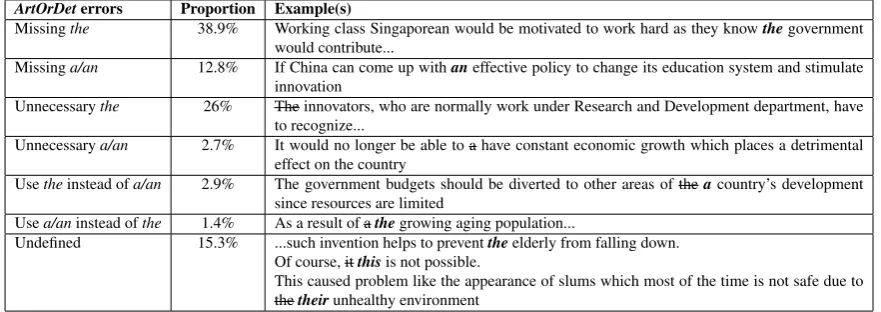
We classify theseArtOrDeterrors into several types which are described in Table 2. The most common er-ror is caused by missingthe(around 39%). Addition-ally, unnecessary use ofthecontributes 26% of error. Furthermore, confusion between usingthe oror a/an
bring 4.3% error. We classified around 15% as unde-fined error due to several reason. First, the error does not appear in front of the NP itself, sometimes it ap-pears in the middle of the NP. Second, the error apap-pears in other type phrase like adjective phrase, this makes the problem is more difficult to trace. For example, a clause ”...such invention helps to prevent elderly from
falling down.” The wordelderlyis recognized as
adjec-tive phrase and the correction happens in front of that word (adding articlethe). Third, the correction involves other articles for examplethis,that, and many more.
Besides the above error, there is another error which we have to handle such as confusion between a or
an. This problem can be solved using a rule-based approach which will be discussed in the next section. To simplify this, we normalize articleaandanintoa. Later on, after the classification is done, we will use this rule-based to return the correct article.
4.3 Experimental setup
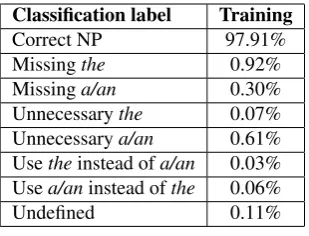
After defining the error types, we split the corpus into training and testing dataset. We select 50 documents from the corpus as a held-out test data and the rest is used for the training data. For the training part, we extract the NP (which is not headed by pronoun) using the information from constituent parse tree and POS tags. Each NP that is extracted represents one training example. Thus, if an NP is incorrect then we label it to one of the label from Table 2. We consider this task as a multi-class classification task, that one NP finds a mappingf :x→ {c1, c2, . . . , c8}that mapsx∈N P s
into one of the 8 labels.
For the first experiment, we select two well known
Classification label Training
[image:2.595.340.495.61.179.2]Correct NP 97.91% Missingthe 0.92% Missinga/an 0.30% Unnecessarythe 0.07% Unnecessarya/an 0.61% Usetheinstead ofa/an 0.03% Usea/aninstead ofthe 0.06% Undefined 0.11%
Table 3: Training data
classification methods such as LIBLINEAR (Fan et al., 2008) and Naive Bayes (McCallum and Nigam, 1998). Both of these methods are trained using the same train-ing data and features which we are gotrain-ing to discuss in Subsection 4.3.5. In the testing part, our classifier will predict a label for each NP. If the classifier predicts that the observed NP is already correct or it needs to add articleathen we apply a rule-based approach to make sure it puts the right article (a/an). This rule-based will utilize CMU pronouncing dictionary from NLTK to do the checking and put conditional constraints such as checking whether this NP is an acronym or not.
The second and third experiments are inspired by (Dahlmeier et al., 2012; Rozovskaya et al., 2012). We realize that the proportion of observed NP without ar-ticle error outnumbers the observed NP with an arar-ticle error (see Table 3). Therefore, this huge proportion of correct NP may affect the classifier accuracy. To justify this claim, we will utilize error inflation method for the second experiment and do re-sampling and undersam-pling NP as the third experiment.
4.3.1 Naive Bayes
Naive Bayes is a famous classification method which applies Bayes theorem’s with naive assumptions. This assumptions believe that all features that are use to de-scribe the data are independent (McCallum and Nigam, 1998). The advantages of this method are fast and easy to implement. This method has shown to be a good classification tool in NLP field (e.g. spam filter-ing, news classification, etc.). To classify an instance D = hf1, f2, . . . , fniaccording to one of the classes
cj ∈C, we calculate the maximum likelihood
estima-tion of a prior probabilitycjtimes the product of every
featuresf1,...,ngiven classcjtimes as described below:
c= arg max cj∈C
P(cj)
Y
i
P(fi|cj) (1)
For this task, we utilize naive bayes package from NLTK. This method is trained using the features which are already described in Table 4.
4.3.2 LIBLINEAR
ArtOrDeterrors Proportion Example(s)
Missingthe 38.9% Working class Singaporean would be motivated to work hard as they knowthegovernment would contribute...
Missinga/an 12.8% If China can come up withaneffective policy to change its education system and stimulate innovation
Unnecessarythe 26% The innovators, who are normally work under Research and Development department, have to recognize...
Unnecessarya/an 2.7% It would no longer be able to a have constant economic growth which places a detrimental effect on the country
Usetheinstead ofa/an 2.9% The government budgets should be diverted to other areas of theacountry’s development since resources are limited
Usea/aninstead ofthe 1.4% As a result of athegrowing aging population...
Undefined 15.3% ...such invention helps to preventtheelderly from falling down. Of course, itthisis not possible.
[image:3.595.80.521.63.219.2]This caused problem like the appearance of slums which most of the time is not safe due to thetheirunhealthy environment
Table 2:ArtOrDeterrors distribution from NUCLE corpus
It supports two binary linear classifiers such as regularized logistic regression (LR), L1-loss and L2-loss linear SVM. Given a pair training set instance
(xi, yi), where i = 1, . . . , l, xi ∈ Rn and y ∈
{+1,−1}l. This data will be considered as
optimiza-tion problem:
min w
1 2w
Tw+C l
X
i=1
ξi
subject toyi(wTφ(xi) +b)≥1−ξi
(2)
whereC >0as a penalty parameter.
LIBLINEAR not only supports binary class prob-lems but also multi-class probprob-lems via one-vs-the-rest strategy. For our purpose, we will use this LIBLINEAR package withC= 0.125. This penalty value is come from the grid search which is provided in the package to find the best parameterC.
Both of these classification methods are evaluated by calculating the number of corrects prediction compare to the annotation label which is defined as:
Accuracy=#of correct predictions #of predictions (3)
4.3.3 Error Inflation Method
Since theArtOrDet errors that we have is sparse and increase the errors proportion in the training data can help the classifier to perform better then we apply this error inflation method (Rozovskaya et al., 2012). We select some positive constant (less than 1.0) to reduce the proportion of the correct example and adding this proportion to the other error types by generating the artificial error. We found that probability among the corrections are still similar.
4.3.4 Re-sampling and Undersampling
Besides error inflation method, we are also interested in re-sampling NP withArtOrDeterror and undersam-pling withoutArtOrDeterror. Some combination will be selected to see whether it can help the classifier in detecting and correcting theArtOrDeterrors. we select
some constant number to re-sample the NP which con-tainsArtOrDeterror and some threshold to undersam-pling the NP which is correct. The results from these two approaches are discussed in the next section.
4.3.5 Feature Extraction
We adopt some features from (Dahlmeier et al., 2012; Rozovskaya et al., 2012) which are described in Ta-ble 4. Most of the features are coming from lexical and POS. If the NP contains an article, then we will sepa-rate it and consider as as additional feature.
wN band wN ain Table 4 represent word at posi-tionNbefore the NP and word at positionNafter the article position. If there is no article in the beginning of NP then first word in the NP is recognize asw1a. pN band pN a describe the POS of wN b andwN a. N C is a noun compound and this compound is gener-ated by the last two words inside the NP which have noun POS. head of the NP is identified withheadWord
feature and it is determined using the information from dependency tree. N P is a noun phrase which is ex-tracted from the constituent parse tree.posXis a POS feature ofX wherex∈ {N C, N P, headW ord}.verb
feature andprepare determined from the POS informa-tion.wordAfterNPis activated if there is another word after the NP.
4.4 Results & Discussion
Feature Type Description Observed article article
Word n-grams w1b, w2b, w3b, w2b w1b, w3b w2b w1b, w1a, w2a, w3a, w1a w2a, w1a w2a w3a, w1b w1a, w2b w1b w1a, w1b w1a w2a, w2b w1b w1a w2a, w3b w2b w1b w1a, w1b w1a w2a w3a
POS features p1b, p2b, p3b, p2b p1b, p3b p2b p1b, p1a, p2a, p3a, p1a p2a, p1a p2a p3a, p1b p1a, p2b p1b p1a, p1b p1a p2a, p2b p1b p1a p2a, p3b p2b p1b p1a, p1b p1a p2a p3a, p1b w1b, p1b w1a, p2b w2b, p2b w2a
NP NC, posNC, headWord, posHeadWord, headWord posHeadWord, w1b posNP posHeadWord, w1b headWord, w1b headWord wordAfterNP
[image:4.595.83.521.63.163.2]Verb verb, verb headWord, verb NC, verb NP, verb posNP headWord, verb posNP NC Preposition prep, prep headWord, prep NC, prep NP, prep posNP headWord, prep posNP NC
Table 4: Features set
1 0.9 0.8 0.7 0.6 0.5
[image:4.595.325.509.197.315.2]acc. 98.64% 98.63% 98.14% 97.12% 95.10% 92.36%
Table 5:ArtOrDetaccuracy using error inflation
Method Accuracy
Baseline 98.5% Naive Bayes 82 % LIBLINEAR 98.67 %
Table 6: Classifier performance on correcting
Ar-tOrDeterrors
we employs.
Our second experiment tests the use of error inflation method on LIBLINEAR classifier. This test is applied to LIBLINEAR classifier with since it has a higher ac-curacy than Naive Bayes. The results from this experi-ment is described in Table 5. The smaller the constant number will result in larger article errors. Nonetheless, if we introduce too many error it will reduce the accu-racy.
The last experiment test the effect of re-sampling NP withArtOrDetseveral error times and reducing the number of observed NP that is already correct can be seen in Table ??. The re-sampling parameter is put on the first column (5, 10, 15, 20 and 25 times) deter-mine how many duplicates are made for each NP. On the row side we use a threshold to reduce the propor-tion of the observed NP which is already correct. So for each correct NP, we generate a random number and if it is higher than the threshold, then it is included in the training dataset. Table??reveals that re-sampling some NP that hasArtOrDeterror does not increase the accuracy. On the other hand, reducing the threshold improve the accuracy.
If we look deeper, we found that increasing the threshold and re-sampling may have a positive corre-lation with correcting the error. However, the number of false positives also increased.
4.5 Further analysis
Inspired by (Gamon et al., 2008) to make two classi-fiers for detecting and correcting article errors. If we consider that our classifier can detect correctly the er-ror, then we only need to train another classifier to make the correction by using the same features as
de-Classification label # Accuracy
Missingthe 45 96% Missinga/an 26 38% Unnecessarythe 47 100% Unnecessarya/an 4 100% Usetheinstead ofa/an 4 0% Usea/aninstead ofthe 1 0%
Undefined 5 0%
TOTAL 132 79%
Table 7: Error Correction distribution
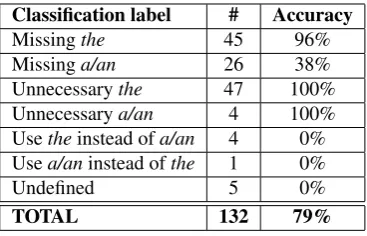
scribed in Table 4. The training for this classifier comes from all NP withArtOrDeterror. Our result proves that 79% of theArtOrDetcan be corrected (see Table 7)
On one hand, our classifier does a good job in a sense of detecting missing article and removing unnecessary article. On the other hand, it is hard to predict either choosing betweena/anorthe. We found that our clas-sifier labels this confusion as unnecessarytheora/an. This means that we have to remove the article for both of these confusions.
This may be caused by lack of training data for par-ticular errors such as confusion between the &a/an. We realize that this mistake occurs often when the ar-ticle would appear in front of an adjective - and in our feature sets there is no explicit adjective feature.
5
SVA Correction
5.1 SVAMistake Type
Subject-verb agreement is the fourth most common mistake type in texts written by English language learners. It is also the highest done by machine translation systems, yet still an unsolved problem. The English verb inflection paradigm is relatively simple, and only the misuse of third person singular and finite form of the verb (the form coinciding with the infinitive form) are of interest for the SVA error correction:
*John and Marygoesto work every day.
*Marygoto work every day.
[image:4.595.124.240.250.300.2]subjects and verbs together. The detection of the dis-agreement is relatively simple, compared to the task of recognizing the number of the subject and verb.
This mistake type is different in nature form the error types (e.g. determiner and preposition) as the scope of the analysis cannot be determined as easily, therefore it has to be the whole sentence. The verb and its corre-sponding subject can be quite distant from one another in the sentence, and by no means have predictable po-sitions.
In English the verbs and their subjects have no fixed positions; in indicative sentences the verb most of the times (not immediately) but follows the subject, al-though not necessarily, e.g. in sentences with exple-tives the subject follows the verb:
However, there/EXPL are/VERB still many prob-lems/SUBJ hampering engineering design process for innovations.
5.1.1 Issues on the Syntactic Level
There are two types of syntactic phenomena that make the recognition and agreement evaluation of subject-verb difficult.
These issues are explained on dependency parsing ex-amples, but can be generalized to any kind of grammar.
5.1.2 Multiple Subjects
When there are multiple subjects in the sentence, only the first one is labeled as asubject, the ones following it get theconjlabel. Even if all of them are in singular form, the verb has to be in its plural form, as multi-ple subjects mean plural number in English. If these type of sentences are not taken care of, that can lead to many missed corrections and to even more faulty ones. Figure 5.1.2 visualizes the problem.
5.1.3 Subject Coreference
If a sentence contains a wh-subordinate clause, the verb in the subordinate clause has to agree with the antecedent of the subject, but the subject is a WH-determiner (that, what, which, who, etc.) that can refer to both singular and plural antecedents.
The referent (ref) of the head of an NP is the rela-tive word introducing the relarela-tive clause modifying the NP is an existing label in dependency parsing, but not available with the parser used here.
There are multiple ways to resolve the coreference, the one simplistic method1applied here is based on the as-sumption that the antecedent of the wh-subject is the closest preceding noun or pronoun to it.
Another competing method is to use the head of the verb in the subordinate clause, which is exactly the an-tecedent of the wh-subject (see in Figure 5.1.3). This relation is labeled asrcmod, the relative clause modi-fier.
When the verb is an auxiliary, its head can be a verb
1In sentences, where the wh-subject is a clausal subject,
likeWhat engineers should do is to invent new machines.are handled separately.
(which have shaped/VBN), an adjective (which is
ef-fective/JJ) or a noun (which is a competitive funding
scheme/NN), whose head is the antecedent of the
rela-tive clause.
The second method, apart from being challenging to implement, yields to significantly worse results than the first one, most probably because of the dependency annotation mistakes in the corpus. The other problem with it is, that it requires the subjects and verbs to be paired before they the pairing is done in the pipeline.
5.2 Subject-Verb Pair Extraction
In order to being able to evaluate their agreement, the first task in finding SVA errors is identifying matching subjects and verbs. This is done in two steps:
1. extracting all predicate verbs and subjects from the sentence,
2. identifying which subject(s) belongs to which verb(s).
For recognizing inflected verb forms in1.the POS-tags are used; all inflected verb forms (VBZ, VBP, VBD, MD) are extracted from the sentence. As for the sub-jects, the dependency labelsnsubj, nsubjpass, csubj are used to recognize them.
This is also the place where the multiple subject identi-fication and coreference resolution is done. Pronoun-and determiner subjects are classified as singular or plural subjects, based on a finite list. Noun subjects are classified based on their POS-tags: NN and NNP as singular, NNS and NNPS as plural.
Once all subjects and verbs were extracted from the sentence, they have to be paired.
In2., depending on how many subjects and verbs were extracted, POS templates were used to pair them.
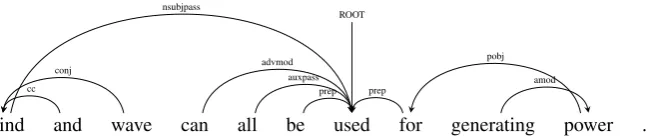
It has to be noted here that in dependency parsing the subjects are not always dependent on the predicate verb itself, but rather on the main verb in the sentence, such as in Figure 5.2, so the head of the subject information couldn’t be used.
There is no straightforward solution in the constituency parse trees either; it is not sufficient to take the head of the NP under the ROOT as the subject, as this solution wouldn’t handle relative clauses properly.
5.2.1 Patterns
Only patterns, which can be almost exhaustively correctly classify subject-verb pairs are used.
Each verb is paired with the subject that is assigned an identical index. The following patterns are used:
Subject1 Verb1
Verb1 Subject1
Subject1/2 Verb1 Verb2 Subject1 Verb1 Subject2
Good environment , efficient technology support and proper use of food *is required . ROOT
nsubjpass
conj
[image:6.595.78.541.89.221.2]conj
Figure 1: Dependency relations in a sentence with conjunct subjects. Only the relevant dependencies are marked. There is an original SVA mistake (made by the author) in the sentence due to the missed identification of the conjunct subjects.
Innovations that are radically different face even greater problems . ROOT
nsubj
[image:6.595.78.458.303.377.2]nsubj cop rcmod
Figure 2: Sentence with subordinate clause. Only relevant dependencies are marked. The subject of the subordinate sentence is headed by the adjective, which is headed by the subject of the main clause.
Wind and wave can all be used for generating power . ROOT
nsubjpass
cc
conj advmod
auxpass prep prep
amod pobj
Figure 3: Sentence with labeled dependency relations. The first subject is not headed by the finite verb of the sentencecan, but rather by the verb in the participial formused.
All other patterns (with 5 and more subjects or verbs in the sentence) were discarded from the evaluation, due to the far too many pairing possibilities. These long sentences generally contain a lot of modifiers, and make up 34% of the development data.
5.3 SV-Agreement Evaluation: Rule-based System
After the pairing is complete, only the pairs which in-clude VBP2/VBZ3tags for the verbs, or verb forms in
the past tense of the copula (was/were) are retained for the agreement evaluation.
If the number of the subject and verb don’t agree, the verb form gets corrected.
2
plural verb form
3third person singular verb form
5.3.1 Correction
The correction is done by using NodeBox, which is a tool that generates the morphologically correct singular or plural form of a given English verb.
5.4 SVA Results
On development set, only SVA-corrections, with other error types not being corrected we get a precision of 0.18.25% and a recall of 22.20%.
5.4.1 System Error Analysis
[image:6.595.87.414.437.507.2]type mistakes, mistake annotation errors and other spe-cific cases.
6
Integrating the Systems
The systems, handling separately the mistake types, are combined in a sequential order.
TheSVAmistake type heavily depends on the correc-tion of the other mistake types, most prominently on the noun number (Nn) mistakes, as the example sen-tence below shows.
*This will , if not already , caused/Vform problems as
there are/SVA very limited spaces/Nn for us .
This will , if not already , cause problems as there is very limited space for us .
Although we don’t deal with Nn-mistakes, the SVA -system is still the last in the row. After each iteration, the test data is re-parsed, to become the input for the next system.
7
Joint Results on Blind Data
Our final results (run on the M2 scorer) are as shown in Table 7.
Precision 0.2769 Recall 0.110
F1 0.0211
Table 8: System results on blind data
8
Conclusion
CorrectingArtOrDeterrors for this task is not an easy job especially the number of NP using correct article is really high (more than 95%). However our LIBLIN-EAR classifier performance is slightly better than the baseline and Naive Bayes. Besides comparing between Naive Bayes and LIBLINEAR classifiers for this task we also adapt two approaches from (Dahlmeier et al., 2012) and (Rozovskaya et al., 2012). Our result ex-plains that neither re-sampling method nor error infla-tion method contribute to the increase of accuracy.
There are several directions that can be pursued to improve the classifier accuracy. Adding language model feature which is mentioned by (Gamon et al., 2008; Dahlmeier et al., 2012) might be useful to filter the result. However using language model like Google N-gram corpus would need some extra treatment since the data is really big and need a lot of computation time to build the language model.
The hardest part of the SVA-correction task is to ex-tract the matching subject-verb pairs; with sufficient amount of data annotated for that purpose (there is one out there, for Swedish), the rule-based approach could be turned into a statistical learning one, which might improve the recall of the system. I have found no pre-vious research pointing to this direction. Long and complex sentences, with more than one subject-verb
pairs, are frequent in corpora specific to life sciences and technology literature, such as the corpus used in this shared task. The system definitely works better on shorter sentences.
References
Dan Roth Alla Rozovskaya. 2010. Training paradigms for correcting errors in grammar and usage. Human Language Technologies: The 2010 Annual
Confer-ence of the North American Chapter of the ACL,
pages 154–162.
Daniel Dahlmeier, Hwee Tou Ng, and Eric Jun Feng Ng. 2012. Nus at the hoo 2012 shared task. In Pro-ceedings of the Seventh Workshop on Building
Ed-ucational Applications Using NLP, pages 216–224,
Stroudsburg, PA, USA. Association for Computa-tional Linguistics.
Ng Hwee Tou Dahlmeier, Daniel. 2012. Better evalu-ation for grammatical error correction. In Proceed-ings of the 2012 Conference of the North American Chapter of the Association for Computational Lin-guistics: Human Language Technologies, (NAACL
2012), pages 568–572, Montreal, Canada.
Ng Hwee Tou Wu Siew Mei Dahlmeier, Daniel. 2013. Building a large annotated corpus of learner english: The nus corpus of learner english. InTo appear in Proceedings of the 8th Workshop on Innovative Use of NLP for Building Educational Applications (BEA
2013), Atlanta, Georgia, USA.
Robert Dale, Ilya Anisimoff, and George Narroway. 2012. Hoo 2012: A report on the preposition and determiner error correction shared task. In Pro-ceedings of the Seventh Workshop on Building
Ed-ucational Applications Using NLP, pages 54–62,
Montr´eal, Canada, June. Association for Computa-tional Linguistics.
Rachele De Felice and Stephen G. Pulman. 2007. Au-tomatically acquiring models of preposition use. In
Proceedings of the Fourth ACL-SIGSEM Workshop
on Prepositions, SigSem ’07, pages 45–50,
Strouds-burg, PA, USA. Association for Computational Lin-guistics.
Rachele De Felice and Stephen G. Pulman. 2008. A classifier-based approach to preposition and deter-miner error correction in l2 english. InProceedings of the 22nd International Conference on
Computa-tional Linguistics - Volume 1, COLING ’08, pages
169–176, Stroudsburg, PA, USA. Association for Computational Linguistics.
Xuelei Miao Yan Song Dongfeng Cai, Yonghua Hu. 2009. Dependency grammar based english subject-verb agreement evaluation. 23rd Pacific Asia
Con-ference on Language, Information and Computation,
Mark Dredze and Koby Crammer. 2008. Confidence-weighted linear classification. InIn ICML ’08: Pro-ceedings of the 25th international conference on
Ma-chine learning, pages 264–271. ACM.
Rong-En Fan, Kai-Wei Chang, Cho-Jui Hsieh, Xiang-Rui Wang, and Chih-Jen Lin. 2008. Liblinear: A library for large linear classification. J. Mach. Learn. Res., 9:1871–1874, June.
Michael Gamon, Jianfeng Gao, Chris Brockett, Alexandre Klementiev, William B. Dolan, Dmitriy Belenko, and Lucy Vanderwende. 2008. Using con-textual speller techniques and language modeling for esl error correction. InIJCNLP, pages 449–456.
Na-Rae Han, Martin Chodorow, and Claudia Leacock. 2006. Detecting errors in english article usage by non-native speakers. Nat. Lang. Eng., 12(2):115– 129, June.
Rodney D. Huddleston. 1984. Introduction to the grammar of English / Rodney Huddle-ston. Cambridge University Press Cambridge [Cam-bridgeshire] ; New York.
Stephanie Seneff John Lee. 2008. Correcting mis-use of verb forms. Proceedings of ACL-08: HLT, 12:174–182.
Dan Klein and Christopher D. Manning. 2003. Accu-rate unlexicalized parsing. InACL, pages 423–430.
Kevin Knight and Ishwar Ch. 1994. Automated poste-diting of documents. InIn Proceedings of AAAI.
Gerard Lynch, Erwan Moreau, and Carl Vogel. 2012. A naive bayes classifier for automatic correction of preposition and determiner errors in esl text. In Pro-ceedings of the Seventh Workshop on Building
Ed-ucational Applications Using NLP, pages 257–262,
Stroudsburg, PA, USA. Association for Computa-tional Linguistics.
Christopher D. Manning Marie-Catherine de Marneffe. 2011. Stanford typed dependencies manual.
Andrew McCallum and Kamal Nigam. 1998. A com-parison of event models for naive bayes text classi-fication. InIN AAAI-98 WORKSHOP ON
LEARN-ING FOR TEXT CATEGORIZATION, pages 41–48.
AAAI Press.
Alla Rozovskaya and Dan Roth. 2010. Training paradigms for correcting errors in grammar and us-age. InHuman Language Technologies: The 2010 Annual Conference of the North American
Chap-ter of the Association for Computational Linguistics,
HLT ’10, pages 154–162, Stroudsburg, PA, USA. Association for Computational Linguistics.
Alla Rozovskaya, Mark Sammons, and Dan Roth. 2012. The ui system in the hoo 2012 shared task on error correction. In Proceedings of the Seventh Workshop on Building Educational Applications
Us-ing NLP, pages 272–280, Stroudsburg, PA, USA.