A Statistical Relational Learning Approach to Identifying
Evidence Based Medicine Categories
Mathias Verbeke♦ Vincent Van Asch♣ Roser Morante♣
Paolo Frasconi♠ Walter Daelemans♣ Luc De Raedt♦
♦
Department of Computer Science, Katholieke Universiteit Leuven, Belgium {mathias.verbeke, luc.deraedt}@cs.kuleuven.be
♣
Department of Linguistics, Universiteit Antwerpen, Belgium
{roser.morante, vincent.vanasch, walter.daelemans}@ua.ac.be ♠
Dipartimento di Sistemi e Informatica, Universit`a degli Studi di Firenze, Italy
Abstract
Evidence-based medicine is an approach whereby clinical decisions are supported by the best available findings gained from scien-tific research. This requires efficient access to such evidence. To this end, abstracts in evidence-based medicine can be labeled using a set of predefined medical categories, the so-calledPICOcriteria. This paper presents an approach to automatically annotate sentences in medical abstracts with these labels. Since both structural and sequential information are important for this classification task, we use kLog, a new language for statistical relational learning with kernels. Our results show a clear improvement with respect to state-of-the-art systems.
1 Introduction
Evidence-based medicine (EBM)orevidence-based practice (EBP)combines clinical expertise, the pref-erences and values of the patient and the best available evidence to make good patient care deci-sions. Clinical research findings are systematically reviewed, appraised and used to improve the patient care, for which efficient access to such evidence is required. In order to facilitate the search process, medical documents are labeled using a set of prede-fined medical categories, thePICO criteria. PICO is an acronym for the mnemonic concepts that are used to construct queries when searching for scientific ev-idence in the EBM process. The need to automatize the annotation process has initiated research into au-tomatic approaches to annotate sentences in medical documents with the PICO labels.
As indicated by Kim et al. (2011), both the struc-tural information of the words in the sentence, and that of the sentences in the document are important features for this task. Furthermore, sequential infor-mation can leverage the dependencies between dif-ferent sentences in the text. Therefore we propose an approach usingkLog(Frasconi et al., 2012) to tackle this problem. kLog is a new language for statistical relational learning with kernels, that is embedded in Prolog, and builds upon and links together concepts from database theory, logic programming and learn-ing from interpretations. Learnlearn-ing from interpreta-tions is a logical and relational learning setting (De Raedt et al., 2008) in which the examples are inter-pretations, that is, sets of tuples that are true in the examples. In a sense, each example can be viewed as a small relational database. kLog is able to trans-form relational into graph-based representations and apply kernel methods to extract an extended high-dimensional feature space.
The choice for kLog was motivated by previous results (Verbeke et al., 2012), where we showed that a statistical relational learning approach using kLog is able to process the contextual aspects of language improving on state-of-the-art results for hedge cue detection. However, the current task adds two levels of complexity. First, next to the relations between the words in the sentence, now also the relations be-tween the sentences in the document become impor-tant. In the proposed approach, we first generate a feature space with kLog that captures the intrasen-tential properties and relations. Hereafter, these fea-tures serve as input for a structured output support vector machine that can handle sequence tagging
(Tsochantaridis et al., 2004), in order to take the intersentential features into account. Second, since there are more than two categories, and each sen-tence can have multiple labels, the problem is now a multiclass multilabel classification task.
The main contribution of this paper is that we show that kLog’s relational nature and its ability to declaratively specify and use background knowl-edge is beneficial for natural language learning prob-lems. This is shown on the NICTA-PIBOSO corpus, for which we present results that indicate a clear im-provement on the state-of-the-art.
The remainder of this paper is organized as fol-lows. In Section 2, we outline earlier work that is related to the research presented here. Section 3 de-scribes the methodology of our method. We present a thorough evaluation of our method in Section 4. The last section draws conclusions and presents some ideas for future work.
2 Related Work
EBM is an approach to clinical problem-solving based on “systematically finding, appraising, and us-ing contemporaneous research findus-ings as the ba-sis for clinical decisions” (Rosenberg and Donald, 1995). The evidence-based process consists of four steps: (1) Formulating a question from a patient’s problem; (2) Searching the literature for relevant clinical articles; (3) Evaluating the evidence; And (4) implementing useful findings in clinical prac-tice. Given the amounts of medical publications available in databases such as PubMed, automating step 2 is crucial to help doctors in their practice. Efforts in this direction from the NLP community have so far focused on corpus annotation (Demner-Fushman and Lin, 2007; Kim et al., 2011), text cate-gorization (Davis-Desmond and Moll´a, 2012), sum-marization (Moll´a and Santiago-Mart´ınez, 2011), and question-anwering (Niuet al., 2003; Demner-Fushman and Lin, 2007).
The existing corpora are usually annotated with the PICO mnemonic (Armstrong, 1999) concepts, that are used to build queries when searching for literature for EBM purposes. The PICO concepts are: primary Problem (P) or population, main Inter-vention (I), main interInter-vention Comparison (C), and
Outcome of intervention (O). PICO helps determin-ing what terms are important in a query and there-fore it helps building the query, which is sent to the search repositories. Once the documents are found, they need to be read by a person who eliminates ir-relevant documents.
The first attempt to classify PICO concepts is pre-sented in Demner-Fushman and Lin (2007), who apply a rule-based approach to identify sentences where PICO concepts occur and a supervised ap-proach to classify sentences that contain an Out-come. The features used by this classifier are n-grams, position, and semantic information from the parser used to process the data. The system is trained on 275 abstracts manually annotated. The accura-cies reported range from 80% forPopulation, 86% forProblem, 80% for Intervention, and, from 64% to 95% forOutcomedepending on the test set of ab-stracts.
Kim et al. (2011) perform a similar classification task in two steps. First a classifier identifies the sen-tences that contain PICO concepts, and then another classifier assigns PICO tags to the sentences found to be relevant by the previous classifier. The sys-tem is based on a CRF algorithm and is trained on the NICTA-PIBOSO corpus. This dataset contains 1,000 medical abstracts manually annotated with an extension of the PICO tagset, for which the defini-tions are listed in Table 1. The annotation is per-formed at sentence level and one sentence may have more than one tag. An example of an annotated abstract from the corpus can be found in the sup-plementary material. The features used by the al-gorithm include features derived from the context, semantic relations, structure and sequencing of the text. The system is evaluated for 5-way and 6-way classification and results are provided apart from structured and unstructured abstracts. The F-scores for structured abstracts is 89.32% for 5-way classifi-cation and 80.88% for 6-way classificlassifi-cation, whereas for unstructured abstracts it is 71.54% for 5-way classification and 64.66% for 6-way classification.
Chung (2009) uses CRF to classify PICO con-cepts by combining them with general categories as-sociated with rhetorical roles: Aim,Method,Results
Background Material that informs and may place the current study in perspective, e.g. work that preceded the current; information about disease prevalence; etc.
Population The group of individual persons, objects or items comprising the study’s sample, or from which the sample was taken for statistical measurement
Intervention The act of interfering with a condition to modify it or with a process to change its course (includes prevention)
Outcome The sentence(s) that best summarizes the consequences of an intervention Study Design The type of study that is described in the abstract
Other Any sentence not falling into one of the other categories and presumed to provide little help with clinical decision making, i.e. non-key or irrelevant sentences
Table 1: Definitions of the semantic tags used as annotation categories (taken from Kim et al. (2011)).
concepts are used. A sentence level classification task is performed, assigning only one rhetorical role per sentence. The F-scores obtained range from 0.93 to 0.98. Then another sentence level classification task is performed to automatically assign the labels
Intervention,ParticipantandOutcome Measuresto sentences in unstructured and structured abstracts without headings. F-scores of up to 0.83 and 0.84 are obtained forInterventionandOutcome Measure
sentences.
Other work aimed at identifying rhetorical zones in biomedical articles. In this case areas of text are classified in terms of the rhetorical categories In-troduction, Methods, Results and Discussion (IM-RAD) (Agarwal and Yu, 2009) or richer categories, such as problem-setting or insight (Mizuta et al., 2006).
There exists a wide range of statistical relational learning systems (Getoor and Taskar, 2007; De Raedt et al., 2008), and many of these systems are in principle useful for natural language process-ing. The most popular formalism today is Markov Logic, which has already been used for natural lan-guage processing tasks such as semantic role label-ing (Riedel and Meza-Ruiz, 2008) and coreference resolution (Poon and Domingos, 2008). With re-spect to Markov Logic, two distinguishing features of kLog are that 1) it employs kernel based meth-ods grounded in statistical learning theory, and 2) it employs a Prolog like language for defining and us-ing background knowledge. As Prolog is a program-ming language, this is more flexible that the formal-ism used by Markov Logic.
3 Methodology
In learning from examples, or interpretations (De Raedt et al., 2008), the instances are sampled iden-tically and independently from some unknown but fixed distribution. They can be represented as pairs
z = (x, y), in which xrepresents the inputs andy
the outputs. An example interpretation can be found in Figure 3, where thehasCategoryrelation repre-sentsyin this case, since it is the target relation we want to predict. The inputsxare formed by all other facts. The task is now to learn a functionh:X→Y
that maps the inputs to the outputs. Sentences may have multiple labels. Hence this is a structured out-put task where the outout-put is a sequence of sets of labels attached to the sentences in a given document. kLog is the new statistical relational language for learning with kernels that we use to tackle the PICO categories classification task. The novelty of kLog is that, based on the regular, linguistic features, it allows to define an extended high-dimensional fea-ture space that is also able to take relational feafea-tures into account in a principled manner. Furthermore, its declarative approach offers a flexible and inter-pretable way to construct features.
de-Database (Fig. 3)
Extensionalized database
Graph (Fig. 4)
Kernel matrix/ feature vectors
Statistical learner Raw data
(sentence)
Feature extraction (lemma, POS,…)
Declarative feature
construction Graphicalization
Feature generation
Graph kernel (NSPDK)
[image:4.612.122.481.58.144.2]kLog
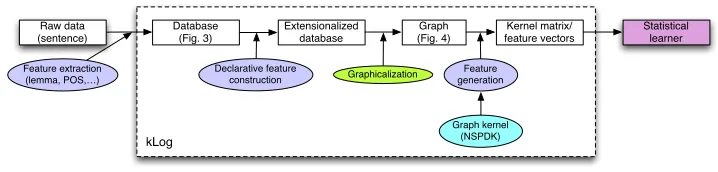
Figure 1: General kLog workflow.
scribed step by step in the following paragraphs.
Preprocessing The sentences have been
prepro-cessed with a named entity tagger and a dependency parser.
Named entity tagging has been performed with the BiogaphTA named entity module, which matches token sequences with entries in the UMLS database1. UMLS integrates over 2 million names for some 900,000 concepts from more than 60 fami-lies of biomedical vocabularies (Bodenreider, 2004). The tagger matches sequences with a length of max-imum 4 tokens. This covers 66.2% of the UMLS entries. By using UMLS, different token sequences referring to the same concept can be mapped to the same concept identifier (CID). The BiographTA named entity tagger has been evaluated on the BioInfer corpus (Pyysalo et al., 2007) obtaining a 72.02 F1 score.
Dependency parsing has been performed with the GENIA dependency parser GDep (Sagae and Tsu-jii, 2007), which uses a best-first probabilistic shift-reduce algorithm based on the LR algorithm (Knuth, 1965) and extended by the pseudo-projective pars-ing technique. This parser is a version of the KSDep dependency parser trained on the GENIA Treebank for parsing biomedical text. KSDep was evaluated in the CoNLL Shared Task 2007 obtaining a La-beled Attachment Score of 89.01% for the English dataset. GDEP outputs the lemmas, chunks, Genia named entities and dependency relations of the to-kens in a sentence.
This information can be represented as an Entity/Relationship (E/R) diagram, a modeling paradigm that is frequently used in database theory (Garcia-Molina et al., 2008). The E/R-model for the
1From UMLS only the MRCONSO.RRF and MRSTY.RRF
files are used.
problem under consideration is shown in Figure 2, which provides an abstract representation of the ex-amples, i.e. medical abstracts in this case. We will show later how this abstract representation can be unrolled for each example, resulting in a graph; cf. also Figure 4 for our example sentence. This rela-tional database representation will serve as the input for kLog.
w
depHead
next
wordID
depRel
lemma
POS-tag
chunktag wordString
NEGenia
NEUMLS sentence hasWord
class sentID
hasCategory
nextS
Figure 2: E/R-diagram modeling the sentence identifica-tion task.
The entities are the words and sentences in the abstract. They are represented by the rectangles in the E/R-model. Each entity can have a number of properties attached to it, depicted by the ovals and has a unique identifier (underlined properties). As in database theory, each entity corresponds with a tuple, orfact, in the database.
Figure 3 shows a part of an example interpretation
z. For example, w(w4 1,‘Surgical’,‘Surgical’,b-np,jj,‘O’,‘O’)specifies a word entity, with w4 1as identifier and the other arguments as properties. As indicated before, as lexical information we take the token string itself, its lemma, the part-of-speech tag and the chunk tag into account. We also include some semantic information, namely two binary val-ues indicating if the word is a (biological) named entity.sentence(s4,4)represents a sentence entity, with its index in the abstract as a property.
[image:4.612.315.538.312.392.2]sentence(s4,4)
hasCategory(s4,‘background’)
w(w4_1,‘Surgical’,‘Surgical’,b-np, jj,‘O’,‘O’) hasWord(s4,w4_1)
dh(w4_1,w4_2,nmod) nextW(w4_2,w4_1)
w(w4_2,‘excision’,‘excision’,i-np, nn,‘O’,‘O’) hasWord(s4,w4_2)
dh(w4_2,w4_5,sub) nextW(w4_3,w4_2)
w(w4_3,‘of’,‘of’,b-pp,in,’O’,’O’) hasWord(s4,w4_3)
dh(w4_3,w4_2,nmod) nextW(w4_4,w4_3)
w(w4_4,‘CNV’,‘CNV’,b-np,nn,
‘B-protein’,‘O’) hasWord(s4,w4_4) dh(w4_4,w4_3,pmod)
nextW(w4_5,w4_4) ...
Figure 3: Part of an example interpretationz, represent-ing the example sentence in Figure 4.
the diamonds. They are linked to the entities that participate in the relationship, or stand alone if they characterize general properties of the interpretation. An example relation isnextW(w4 2,w4 1), which indicates the sequence of the words in the sentence.
dh(w4 1,w4 2,nmod) specifies that wordw4 1is a noun modifier of word w4 2, and thus serves to incorporate the dependency relationships between the words. hasCategory(s4,‘background’) signi-fies that sentences4is a sentence describing back-ground information. This relation is the target re-lation that we want to predict for this task and will not be taken into account as a feature, but is listed in the database and only used during the training of the model.
Since the previously described entities and rela-tionships are listed explicitly in the database, these are calledextensional relations, in contrast to the in-tensional relations, as we will describe next.
Declarative feature construction A strength of
kLog is that it is also capable of constructing fea-tures declaratively, by using intensional relations. This enables one to encode additional background knowledge based on a small set of preprocessed
fea-tures, which renders experimentation very flexible and makes the results more interpretable. It further-more allows one to limit the required features to the core discriminative ones. These intensional features are defined through definite clauses, and is done us-ing an extension of the declarative programmus-ing lan-guage Prolog. The following features were used. We make a distinction between the features used for structured and unstructured abstracts.
For structured abstracts, four intensional relations were defined. The relation lemmaRoot(S,L) is specified as:
lemmaRoot(S,L) ←
hasWord(S, I), w(I,_,L,_,_,_,_), dh(I,_,root).
For each sentence, it only selects the lemmas of the root word in the dependency tree, which markedly limits the number of word features used. The following relations are related to, and try to capture the document structure imposed by the sec-tion headers present in the structured abstracts.
hasHeaderWord(S,X) identifies whether a sen-tence is a header of a section. In order to realize this, it selects the words of a sentence that count more than four characters (to discard short names of bio-logical entities), which all need to be uppercase.
hasHeaderWord(S,X) ←
w(W,X,_,_,_,_,_), hasWord(S,W),
(atom(X) -> name(X,C) ; C = X), length(C,Len),
Len > 4, all_upper(C).
Also the sentences below a certain section header need to be marked as belonging to this sec-tion, which is done by the relation hasSection-Header(S,X).
hasSectionHeader(S,X) ←
nextS(S1,S),
hasHeaderWord(S1,X).
hasSectionHeader(S,X) ←
nextS(S1,S),
For the unstructured abstracts, also the lemma-Rootrelation is used, but next to the lemma, now also the part-of-speech tag of the root word is taken into account. Since the unstructured abstracts lack section headers, other features were needed to dis-tinguish between the different sections, for which the relationprevLemmaRootproved to be very in-formative. It adds the lemma of the root word in the previous sentence as a property to the current sen-tence under consideration.
prevLemmaRoot(S,L) ←
nextS(S1,S),
lemmaRoot(S1,L,_).
The intensional predicates are grounded. This is a proces similar to materialization in databases, that is, the atoms implied by the background knowledge and the facts in the example are all computed using Prolog’s deduction mechanism. This leads to the
extensionalized database, in which both the exten-sional as well as the grounded intenexten-sional predicates are listed.
Graphicalization and feature generation In the
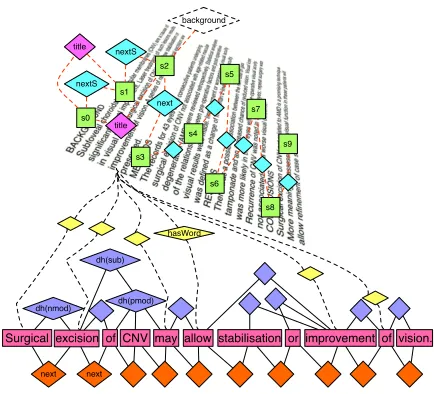
third step, the interpretations aregraphicalized, i.e. transformed into graphs. Since the facts that form the interpretation still conform to the E/R-diagram, this can be interpreted as unfolding the E/R-diagram over the data. An example illustrating this process is given in Figure 4. Each interpretation is converted into a bipartite graph, for which there is a vertex for every ground atom of every E-relation, one for every ground atom of every R-relation, and an undirected edge{e, r}if an entityeparticipates in relationship
r.
The obtained graphs can then be used in the next step forfeature generation. This is done by means of a graph kernel κ, which calculates the similar-ity between two graphicalized interpretations. Any graph kernel that allows fast computations on large graphs and has a flexible bias to enable heteroge-neous features can in theory be applied. In the cur-rent implementation, an extension of the Neighbor-hood Subgraph Pairwise Distance Kernel (NSPDK) (Costa and De Grave, 2010) is used.
NSPDK is a decomposition kernel (Haussler, 1999), in which pairs of subgraphs are compared
s0 s1
s2
s3 nextS
nextS
next
s4 s5
s6 s7
s8 s9 title
title
Surgical excision of CNV may allow stabilisation or improvement of vision.
background
next next dh(nmod)
dh(sub)
dh(pmod)
hasWord
[image:6.612.318.535.62.259.2]
Figure 4: GraphicalizationGzof interpretationz.
to each other in order to calculate the similarity be-tween two graphs. These subgraphs can be seen as circles in the graph, and are defined by three hyper-parameters. First of all, there is the center of the subgraph, thekernel point, which can be any entity or relation in the graph. The entities and relations to be taken into account as kernel points are marked beforehand as a subset of the intensional and exten-sional domain relations. The radius r determines the size of the subgraphs and defines which entities or relations around the kernel point are taken into ac-count. Each entity or relation that is within a number ofredges away from the kernel point is considered to be part of the subgraph. The third hyperparam-eter, thedistanced, determines how far apart from each other the kernel points can be. Each subgraph around a kernel point that is within a distance dor less from the current kernel point will be considered. This is captured by the relationRr,d(Av, Bu, G)
be-tween two rooted subgraphsAv,Bu and a graph G,
which selects all pairs of neighborhood graphs of ra-diusrwhose roots are at distancedin a given graph
G.
The kernelκr,d(G, G0)between graphsGandG0
on the relationRr,dis then defined as:
κr,d(G, G0) =
X
Av, Bu∈R−r,d1(G)
A0v0, B0u0 ∈R
−1
r,d(G 0)
δ(Av, A0v0)δ(Bu, Bu00)
For efficiency reasons, an upper bound is imposed on the radius and distance parameters, which leads to the following kernel definition:
Kr∗,d∗(G, G0) =
r∗ X
r=0 d∗ X
d=0
κr,d(G, G0) (2)
We hereby limit the sum of theκr,dkernels for all
increasing values of the radius and distance parame-ter up to a maximum given value ofr∗, respectively
d∗.
The result of this graphicalization and feature generation process is an extended, high-dimensional feature space, which serves as input for the statisti-cal learner in the next step.
Learning The constructed feature space contains
one feature vector per sentence. This implies that the sequence information of the sentences at the doc-ument level is not taken into account yet. Since the order of the sentences in the abstract is a valuable feature for this prediction problem, a learner that reflects this in the learning process is needed, al-though in principle any statistical learner can be used on the feature space constructed by kLog. There-fore we opted for SVM-HMM2 (Tsochantaridis et al., 2004), which is an implementation of structural support vector machines for sequence tagging. In contrast to a conventional Hidden Markov Model, SVM-HMM is able to take these entire feature vec-tors as observations, and not just atomic tokens.
In our case, the instances to be tagged are formed by the sentences for which feature vectors were cre-ated in the previous step. Theqid is a special fea-ture that is used in the strucfea-tured SVM to restrict the generation of constraints. Since every document needs to be represented as a sequence of sentences, in SVM-HMM, the qid’s are used to obtain the doc-ument structure. The order of the HMM was set to 2, which means that the two previous sentences were considered for collective classification. The cost value was set to 500, and was determined via cross-validation. For epsilon, the default value, 0.5, was kept, since this mainly only influences the run-ning time and memory consumption during trairun-ning.
2http://www.cs.cornell.edu/people/tj/
svm_light/svm_hmm.html
All S U
Nb. Abstracts 1000 376 624
Nb. Sentences 10379 4774 5605
- Background 2557 669 1888
- Intervention 690 313 377
- Outcome 4523 2240 2283
- Population 812 369 443
- Study Design 233 149 84
- Other 1564 1034 530
Table 2: Number of abstracts and sentences for Struc-tured (S) and UnstrucStruc-tured (U) abstract sets, including number of sentences per class (taken from (Kim et al., 2011)).
4 Evaluation
We evaluate the performance of kLog against a base-line system and a memory-based tagger (Daelemans and van den Bosch, 2005). The results are also com-pared against those from Kim et al. (2011), which is the state-of-the-art system for this task.
4.1 Datasets
We perform our experiments on the NICTA-PIBOSO dataset from Kim et al. (2011) (kindly pro-vided by the authors). It contains 1,000 abstracts of which 500 were retrieved from MEDLINE by query-ing for diverse aspects in the traumatic brain injury and spinal cord injury domain. The dataset consists of two types of abstracts. If the abstract contains section headings (e.g. Background, Methodology,
Results, etc.), it is considered to bestructured. This information can be used as a feature in the model. The other abstracts are regardedunstructured.
The definitions of the semantic tags used as an-notations categories are a variation on the PICO tag set, with the addition of two additional categories (see Table 1 in Section 2). Each sentence can be an-notated with multiple classes. This renders the task a multiclass multilabel classification problem. The statistics on this dataset can be found in Table 2.
4.2 Baseline and benchmarks
We compare the kLog system to three other systems: a baseline system, a memory-based system, and the scores reported by Kim et al. (2011).
The memory-based system that we use is based on the memory-based tagger MBT3(Daelemans and van den Bosch, 2005). This machine learner is orig-inally designed for part-of-speech tagging. It pro-cesses data on a sentence basis by carrying out se-quential tagging,viz.the class label or other features from previously tagged tokens can be used when classifying a new token. In our setup, the sentences of an abstract are taken as the processing unit and the collection of all sentences in an abstract is taken as one sequence.
The features that are used to label a sentence are the class labels of four previous sentences, the am-bitags of the following two sentences, the lemma of the dependency root of the sentence, the position of the sentence in the abstract, the lemma of the root of the previous sentence, and section information. For each root lemma, all possible class labels, as ob-served in the training data, are concatenated into one ambitag. These tags are stored in a list. An am-bitag for a sentence is retrieved by looking up the root lemma in this list. The position of the sentence is expressed by a number. Section information is ob-tained by looking for a previous sentence that con-sists of only one token in uppercase. Finally, basic lemmatization is carried out by removing a finalS. All other settings of MBT are the default settings and no feature optimization nor feature selection has been carried out to prevent overfitting.
When a class label contains multiple labels, like e.g. population and study design, these labels are concatenated in an alphabetically sorted manner. This method of working reduces the multilabel prob-lem to a probprob-lem with many different labels, i.e. the label powerset method of Tsoumakas et al. (2010).
The baseline system is exactly the same as the memory-based system except that no machine learner is included. The most frequent class label in the training data, i.e. Outcome, is assigned to each instance. The memory-based system enables us to compare kLog against a basic machine learning ap-proach, using few features. The majority baseline
3http://ilk.uvt.nl/mbt
[16 March 2012]
system enables us to compare the memory-based system and kLog against a baseline in which no in-formation about the observations is used.
4.3 Parametrization
From the kernel definition it might be clear that the kLog hyperparameters, namely the distance d
and radius r, can have a strong influence on the results. This requires a deliberate choice during parametrization. From a linguistic perspective, the use of unigrams and bigrams is justifiable, since most phrases that reveal clues on the structure of the abstract (e.g.evaluation measures,methodolody, fu-ture work) can be expressed with single or pairs of words. This is reflected by a distance and radius both set to 1, which enables to take all possible combina-tions of consecutive words into account and captures the relational information attached to the word in fo-cus, i.e. the current kernel point. This is confirmed by cross-validation on other settings for the hyper-parameters.
Since kLog generates a feature vector, only the sequence information at word level is taken into ac-count by kLog. Since we use a sequence labeling approach as statistical learner, i.e. SVM-HMM, at the level of the abstract this information is however implicitly taken into account during learning. For SVM-HMM, only the cost parameterC, which reg-ulates the trade-off between the slack and the mag-nitude of the weight-vector, and, that specifies the precision to which constraints are required to be sat-isfied by the solution, were optimized by means of cross-validation. For the other parameters, the de-fault values were used.
4.4 Results
label as an extra class in the classification. The re-sults are listed in Table 3.
CV/6-way MBT Kim et al. kLog
Label S U S U S U
Background 71.0 61.3 81.84 68.46 86.19 76.90 Intervention 24.3 6.4 20.25 12.68 26.05 16.14 Outcome 87.9 70.4 92.32 72.94 92.99 77.69 Population 50.6 15.9 56.25 39.80 35.62 21.58 Study Design 45.9 13.10 43.95 4.40 45.5 6.67 Other 86.1 20.9 69.98 24.28 87.98 24.42
Table 3: F-scores per class for structured (S) and unstruc-tured (U) abstracts.
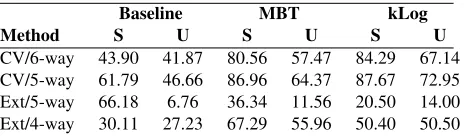
For this setting, kLog is able to outperform both MBT and the system of Kim et al. (2011), for both structured and unstructured abstracts on all classes exceptPopulation. From Table 4, where the micro-average F-scores over all classes and for all settings are listed, it can be observed that kLog performs up to 3.73% better than MBT over structured abstracts, and 9.67% better over unstructured ones.
Although to a lesser extent for the structured ab-stracts, the same pattern can be observed for the
CV/5-waysetting, where we tried to classify the sen-tences only, without considering the irrelevant ones. The per-class results for this setting are shown in Ta-ble 5. Now the scores forPopulationare comparable to the other systems, due to which we assume these sentences are similar in structure to the ones labeled withOther.
For the external corpus, the results are listed in Ta-ble 6. Although kLog performs comparably for the individual classesBackgroundandIntervention, its overall performance is worse on the structured ab-stracts. In case of the unstructured abstracts, kLog performs better on the majority of the individual classes and in overall performance for the 5-way set-ting, and comparable for the 4-way setting.
Baseline MBT kLog
Method S U S U S U
[image:9.612.72.304.594.662.2]CV/6-way 43.90 41.87 80.56 57.47 84.29 67.14 CV/5-way 61.79 46.66 86.96 64.37 87.67 72.95 Ext/5-way 66.18 6.76 36.34 11.56 20.50 14.00 Ext/4-way 30.11 27.23 67.29 55.96 50.40 50.50
Table 4: Micro-averaged F1-score obtained for structured (S) and unstructured (U) abstracts, both for 10-fold cross-validation (CV) and on the external corpus (Ext).
CV/5-way MBT Kim et al. kLog
Label S U S U S U
Background 87.1 64.9 87.92 70.67 91.45 80.06 Intervention 48.0 6.9 48.08 21.39 45.58 22.65 Outcome 95.8 75.9 96.03 80.51 96.21 83.04 Population 70.9 21.4 63.88 43.15 63.96 23.32 Study Design 50.0 7.4 47.44 8.6 48.08 4.50
Table 5: F-scores per class for 5-way classification over structured (S) and unstructured (U) abstracts.
MBT Kim et al. kLog
Label S U S U S U
Ext/5-way
Background 58.9 15.7 56.18 15.67 58.30 29.10 Intervention 21.5 13.8 15.38 28.57 40.00 34.30 Outcome 29.3 17.8 81.34 60.45 27.80 24.10 Population 10.7 17.8 35.62 28.07 5.60 28.60 Other 40.7 3.5 46.32 15.77 11.40 8.50
Ext/4-way
Background 90.4 67.5 77.27 37.5 65 68.6 Intervention 29 23.1 28.17 8.33 28.1 32.3 Outcome 74.1 74.6 90.5 78.77 72.4 72.7 Population 48.7 23.8 42.86 28.57 11.8 15.4
Table 6: F-scores per class for 5-way and 4-way classifi-cation over structured (S) and unstructured (U) abstracts on the external corpus.
As a general observation, it is important to note that there is a high variability between the different labels. Due to kLog’s ability to take the structured input into account, we assume a correlation between the sentence structure of the label and the predic-tion quality. We intend to perform an extensive error analysis, in order to detect patterns which may allow us to incorporate additional declarative background knowledge into our model.
5 Conclusions
lan-guage learning.
In future work, we intend to explore additional ways to incorporate background knowledge in a declarative way, since it renders the language learn-ing problem more intuitive and gives a better under-standing of feature contribution. Furthermore, we also want to investigate the use of SRL approaches for high-relational domains, and make a clear com-parison with related techniques.
6 Acknowledgements
This research is funded by the Research Foundation Flanders (FWO project G.0478.10 - Statistical Re-lational Learning of Natural Language), and made possible through financial support from the KU Leu-ven Research Fund (GOA project 2008/08 Proba-bilistic Logic Learning), the University of Antwerp (GOA project BIOGRAPH) and the Italian Min-istry of Education, University, and Research (PRIN project 2009LNP494 - Statistical Relational Learn-ing: Algorithms and Applications). The authors would like to thank Fabrizio Costa, Kurt De Grave and the anonymous reviewers for their valuable feedback.
References
Shashank Agarwal and Hong Yu. 2009. Automatically Classifying Sentences in Full-text Biomedical Articles into Introduction, Methods, Results and Discussion. Bioinformatics, 25(23):3174–3180.
E. C. Armstrong. 1999. The Well-built Clinical Ques-tion: the Key to Finding the Best Evidence Efficiently. WMJ, 98(2):25–28.
Olivier Bodenreider. 2004. The Unified Medical Language System (UMLS): Integrating Biomed-ical Terminology. Nucleic Acids Research, 32(Suppl.1):D267–D270.
Grace Y Chung. 2009. Sentence Retrieval for Abstracts of Randomized Controlled Trials. BMC Medical In-formatics and Decision Making, 9(10).
Fabrizio Costa and Kurt De Grave. 2010. Fast Neighbor-hood Subgraph Pairwise Distance Kernel. Proceed-ings of the 26th International Conference on Machine Learning, 255–262, Haifa, Israel. Omnipress.
Walter Daelemans and Antal van den Bosch. 2005. Memory-Based Language Processing.. Studies in Natural Language Processing. Cambridge University Press, Cambridge, UK.
P. Davis-Desmond and Diego Moll´a. 2012. Detection of Evidence in Clinical Research Papers. Proceedings of the Australasian Workshop On Health Informatics and Knowledge Management (HIKM 2012), Melbourne, Australia, 129:13–20. Australian Computer Society, Inc.
Dina Demner-Fushman, Barbara Few, Susan E. Hauser, and George Thoma. 2005. Automatically Identifying Health Outcome Information in MEDLINE Records. Journal of the American Medical Informatics Associa-tion (JAMIA), 13:52–60.
Dina Demner-Fushman and Jimmy Lin. 2007. An-swering Clinical Questions with Knowledge Based and Statistical Techniques. Computational Linguis-tics, 33(1):63–103.
Luc De Raedt, Paolo Frasconi, Kristian Kersting, and Stephen Muggleton, editors. 2008. Probabilistic In-ductive Logic Programming. In: Lecture Notes in Computer Science (LNCS), 4911. Springer-Verlag, Heidelberg, Germany.
Paolo Frasconi, Fabrizio Costa, Luc De Raedt, and Kurt De Grave. 2012. kLog - a Language for Logical and Relational Learning with Kernels. arXiv:1205.3981v2.
Hector Garcia-Molina, Jeff Ullman, and Jennifer Widom. 2008. Database Systems: The Complete Book. Pren-tice Hall Press, Englewood Cliffs, NJ, USA.
Lise Getoor and Ben Taskar. 2007. Introduction to Sta-tistical Relational Learning (Adaptive Computation and Machine Learning). The MIT Press, Cambridge, MA, USA.
David Haussler. 1999. Convolution kernels on discrete structures.Technical report (UCSC-CRL-99-10), Uni-versity of California at Santa Cruz.
Su Nam Kim, David Martinez, Lawrence Cavedon, and Lars Yencken. 2011. Automatic Classification of Sen-tences to Support Evidence Based Medicine. BMC Bioinformatics, 12(2):S5.
Donald E. Knuth. 1965. On the Translation of Lan-guages from Left to Right. Information and Control, 8: 607–639.
Y. Mizuta, A. Korhonen, T. Mullen, and N. Collier. 2006. Zone Analysis in Biology Articles as a Basis for Information Extraction. International Journal of Medical Informatics, 75(6):468–487.
Diego Moll´a and Mara Elena Santiago-Mart´ınez. 2011. Development of a Corpus for Evidence Medicine Summarisation. Proceedings of the 2011 Australasian Language Technology Workshop (ALTA 2011), Can-berra, Australia, 86–94. Association for Computa-tional Linguistics.
Questions with Role Identification. Proceedings of the ACL, Workshop on Natural Language Processing in Biomedicine. Sapporo, Japan, 73–80. Association for Computational Linguistics.
Hoifung Poon and Pedro Domingos. 2008. Joint un-supervised coreference resolution with Markov logic. Proceedings of the Conference on Empirical Methods in Natural Language Processing (EMNLP 2008. Hon-olulu, Hawaii, 650–659. Association for Computa-tional Linguistics.
Sampo Pyysalo, Filip Ginter, Juho Heimonen, Jari Bj¨orne, Jorma Boberg, Jouni J¨arvinen, and Tapio Salakoski. 2007. BioInfer: a Corpus for Information Extraction in the Biomedical Domain. BMC Bioinfor-matics, 8:50.
Sebastian Riedel and Ivan Meza-Ruiz. 2008. Collective semantic role labelling with Markov logic. Proceed-ings of the Twelfth Conference on Computational Nat-ural Language Learning (CoNLL 2008. Manchester, United Kingdom, 193–197. Association for Computa-tional Linguistics.
William Rosenberg and Anna Donald. 1995. Evidence Based Medicine: an Approach to Clinical Problem Solving. British Medical Journal, 310(6987):1122– 1126.
Kenji Sagae and Jun’ichi Tsujii. 2007. Dependency Parsing and Domain Adaptation with LR Models and Parser Ensembles. Proceedings of the CoNLL Shared Task Session of EMNLP-CoNLL 2007, Prague, Czech Republic, 1044–1050. Association for Computational Linguistics.
Ioannis Tsochantaridis, Thomas Hofmann, Thorsten Joachims, and Yasemin Altun. 2004. Support Vector Machine Learning for Interdependent and Structured Output Spaces. Proceedings of the twenty-first inter-national conference on Machine learning (ICML), Al-berta, Canada, 104–111. ACM.
Grigorios Tsoumakas and Ioannis Katakis and Ioannis P. Vlahavas. Oded Maimon and Lior Rokach, editors. 2010. Mining Multi-label Data. In: Data Mining and Knowledge Discovery Handbook, 2nd ed., 667–685. Springer-Verlag, Heidelberg, Germany.