A Tree-to-String Phrase-based Model for Statistical Machine Translation
Thai Phuong Nguyen
College of Technology Vietnam National University, Hanoi
Akira Shimazu1, Tu-Bao Ho2, Minh Le Nguyen1, and Vinh Van Nguyen1 1School of Information Science
2School of Knowledge Science
Japan Advanced Institute of Science and Technology
{shimazu,bao,nguyenml,vinhnv}@jaist.ac.jp
Abstract
Though phrase-based SMT has achieved high translation quality, it still lacks of generaliza-tion ability to capture word order differences between languages. In this paper we describe a general method for tree-to-string phrase-based SMT. We study how syntactic trans-formation is incorporated into phrase-based SMT and its effectiveness. We design syntac-tic transformation models using unlexicalized form of synchronous context-free grammars. These models can be learned from source-parsed bitext. Our system can naturally make use of both constituent and non-constituent phrasal translations in the decoding phase. We considered various levels of syntactic analy-sis ranging from chunking to full parsing. Our experimental results of English-Japanese and English-Vietnamese translation showed a significant improvement over two baseline phrase-based SMT systems.
1 Introduction
Based on the kind of linguistic information which is made use of, syntactic SMT can be divided into four types: tree-to-string, string-to-tree, tree-to-tree, and hierarchical phrase-based. The tree-to-string ap-proach (Collins et al., 2005; Nguyen and Shimazu, 2006; Liu et al., 2006 and 2007) supposes that syn-tax of the source language is known. This approach can be applied when a source language parser is available. The string-to-tree approach (Yamada and Knight, 2001; Galley et al., 2006) focuses on syntactic modelling of the target language in cases it has syn-tactic resources such as treebanks and parsers. The tree-to-tree approach models the syntax of both lan-guages, therefore extra cost is required. The fourth approach (Chiang, 2005) constraints phrases under context-free grammar structure without any require-ment of linguistic annotation.
In this paper, we present a tree-to-string phrase-based method which is phrase-based on synchronous CFGs. This method has two important properties: syntactic transformation is used in the decoding phase includ-ing a word-to-phrase tree transformation model and a phrase reordering model; phrases are the basic unit of translation. Since we design syntactic transforma-tion models using un-lexicalized synchronous CFGs, the number of rules is small1. Previous studies on tree-to-string SMT are different from ours. Collins et al. Collins et al. (2005) used hand crafted rules to carry out word reordering in the preprocessing phase but not decoding phase. Nguyen and Shimazu (2006) presented a more general method in which lexicalized syntactic reordering models based on PCFGs can be learned from source-parsed bitext and then applied in the preprocessing phase. Liu et al. (2006) changed the translation unit from phrases to tree-to-string align-ment templates (TATs) while we do not. TATs was represented as xRs rules while we use synchronous CFG rules. In order to overcome the limitation that TATs can not capture non-constituent phrasal transla-tions, Liu et al. (2007) proposed forest-to-string rules while our system can naturally make use of such kind of phrasal translation by word-to-phrase tree transfor-mation.
We carried out experiments with two language pairs English-Japanese and English-Vietnamese. Our system achieved significant improvements over Pharaoh, a state-of-the-art phrase-based SMT system. We also analyzed the dependence of translation qual-ity on the level of syntactic analysis (shallow or deep). Figure 1 shows the architecture of our system. The input of this system is a source-language tree and the output is a target-language string. This system uses all features of conventional phrase-based SMT as in (Koehn et al., 2003). There are two new features in-cluding a word-to-phrase tree transformation model and a phrase reordering model. The decoding
algo-1See Section 6.2.
rithm is a tree-based search algorithm.
Figure 1: A syntax-directed phrase-based SMT archi-tecture.
2 Translation Model
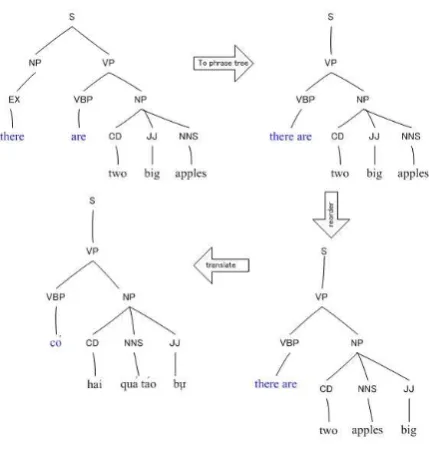
[image:2.595.75.290.378.603.2]We use an example of English-Vietnamese translation to demonstrate the translation process as in Figure 2. Now we describe a tree-to-string SMT model based on synchronous CFGs. The translation process is:
Figure 2: The translation process.
T1→T2→T3→T4 (1)
whereT1is a source tree,T2is a source phrase tree,
T3is a reordered source phrase tree, andT4is a target phrase tree.
Using the first order chain rule, the join probability over variables (trees) in graphical representation 1 is approximately calculated by:
P(T1, T2, T3, T4) =P(T1)×P(T2|T1)×P(T3|T2)×P(T4|T3)
(2)
P(T1)can be omitted since only one syntactic tree is used. P(T2|T1)is a word-to-phrase tree transfor-mation model we describe later. P(T3|T2) is a re-ordering model. P(T4|T3)can be calculated using a phrase translation model and a language model. This is the fundamental equation of our study represented in this paper. In the next section, we will describe how to transform a word-based CFG tree into a phrase-based CFG tree.
3 Word-to-Phrase Tree Transformation
3.1 Penn Treebank’s Tree Structure
According to this formalism, a tree is represented by phrase structure. If we extract a CFG from a tree or set of trees, there will be two possible rule forms:
• A → αwhere αis a sequence of nonterminals (syntactic categories).
• B→γwhereγis a terminal symbol (or a word in this case).
We consider an example of a syntactic tree and a simple CFG extracted from that tree.
Sentence: ”I am a student”
Syntactic tree: (S (NP (NN I)) (VP (VBP am) (NP (DT a) (NN
student))))
Rule set: S→NP VP; VP→VBP NP; NP→NN|DT NN; NN
→I|student; VBP→am; DT→a
However, we are considering phrase-based transla-tion. Therefore the right hand side of the second rule form must be a sequence of terminal symbols (or a phrase) but not a single symbol (a word). Suppose that the phrase table contains a phrase ”am a student” which leads to the following possible tree structure:
Phrase segmentation: ”I|am a student”
Syntactic tree: (S (NP (NN I)) (VP (VBP am a student))) Rule set: S→NP VP; VP→VBP; NP→NN; NN→I; VBP→
am a student
We have to find out some way to transform a CFG tree into a tree with phrases at leaves. In the next sub-section we propose such an algorithm.
3.2 An Algorithm for Word-to-Phrase Tree Transformation
Table 1 represents our algorithm to transform a CFG tree to a phrase CFG tree. When designing this algo-rithm, our criterion is to preserve the original struc-ture as much as possible. This algorithm includes two steps. There are a number of notions concerning this algorithm:
+ Input: A CFG tree, a phrase segmentation + Output: A phrase CFG tree
+ Step 1: Allocate phrases to leaf nodes in a top-down manner: A phrase is allocated to head word of a node if the phrase contains the head word. This head word is then considered as the phrase head.
[image:3.595.317.503.190.372.2]+ Step 2: Transform the syntactic tree by replacing leaf nodes by their allocated phrase and removing all nodes whose span is a substring of phrases.
Table 1: An algorithm to transform a CFG tree to a phrase CFG tree.
• If a node is a pre-terminal node (containing POS tag), its head word is itself. If a node is an in-ner node (containing syntactic constituent tag), its head word is retrieved through the head child.
• Word span of a node is a string of its leaves. For instance, word span of subtree (NP (PRP$ your) (NN class)) is ”your class”.
Now we consider an example depicted in Figure 3 and 4. Head children are tagged with functional label H. There are two phrases: ”is a” and ”in your class”. After the Step 1, the phrase ”is a” is attached to (VBZ is). The phrase ”in your class” is attached to (IN in). In Step 2, the node (V is) is replaced by (V ”is a”) and (DT a) is removed from its father NP. Similarly, (IN in) is replaced by (IN ”in your class”) and the subtree NP on the right is removed.
S
[is]
NP
[Fred]
VP-H
[is]
[image:3.595.84.282.412.629.2]VBZ-H NP
[student]
NNP-H
is NP-H
[student]
DT NN-H
PP
[in]
IN-H NP
[class]
PRP$ NN-H
Fred
a student in
your class
{is a}
{in your class}
Figure 3: Tree transformation - step 1. Solid arrows show the allocation process of ”is a”. Dotted arrows demonstrate the allocation process of ”in your class”
The proposed algorithm has some properties. We state these properties without presenting proof2.
• Uniqueness: Given a CFG tree and a phrase
seg-mentation, by applying Algorithm 1, one and only one phrase tree is generated.
2Proofs are simple.
Figure 4: Tree transformation - step 2.
• Constituent subgraph: A phrase CFG tree is
a connected subgraph of input tree if leaves are ignored.
• Flatness: A phrase CFG tree is flatter than input
tree.
• Outside head: The head of a phrase is always a
word whose head outside the phrase. If there is more than one word satisfying this condition, the word at the highest level is chosen.
• Dependency subgraph: Dependency graph of a
phrase CFG tree is a connected subgraph of in-put tree’s dependency graph if there exist no de-tached nodes.
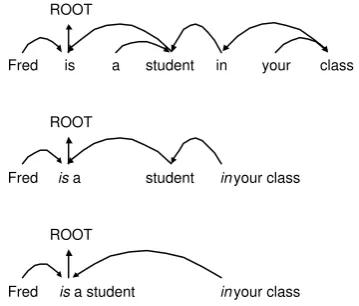
change in dependency direction. We can observe de-pendency trees in Figure 5. The first two trees are source dependency tree and phrase dependency tree of the previous example. The last one corresponds to the case in which a detached node exists.
Fred is
ROOT
student in your class
a
Fred is a ROOT
student in your class
Fred is a student ROOT
[image:4.595.92.272.164.317.2]in your class
Figure 5: Dependency trees. The third tree corre-sponds with phrase segmentation: ”Fred|is a student |in your class”
3.3 Probabilistic Word-to-Phrase Tree Transformation
We have proposed an algorithm to create a phrase CFG tree from a pair of CFG tree and phrase seg-mentation. Two questions naturally arise: ”is there a way to evaluate how good a phrase tree is?” and ”is such an evaluation valuable?” Note that phrase trees are the means to reorder the source sentence repre-sented as phrase segmentations. Therefore a phrase tree is surely not good if no right order can be gen-erated. Now the answer to the second question is clear. We need an evaluation method to prevent our program from generating bad phrase trees. In other words, good phrase trees should be given a higher pri-ority.
We define the phrase tree probability as the product of its rule probability given the original CFG rules:
P(T0) =Y
i
P(LHSi→RHS0i|LHSi→RHSi)
(3) where T0 is a phrase tree whose CFG rules are
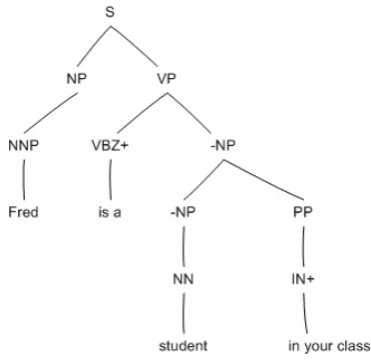
LHSi → RHSi0. LHSi → RHSi are origi-nal CFG rules. RHS0i are subsequences of RHSi. Since phrase tree rules should capture changes made by the transformation from word to phrase, we use ’+’ to represent an expansion and ’-’ to show an overlap. These symbol will be added to a nonter-minal on the side having a change. In the previ-ous example, since a head noun in the word tree
has been expanded on the right, the correspond-ing symbol in phrase tree is NN-H+. A nonter-minal X can become one of the following symbols
X,−X,+X, X−, X+,−X−,−X+,+X−,+X+.
Conditional probabilities are computed in a sepa-rate training phase using a source-parsed and word-aligned bitext. First, all phrase pairs consistent with the word alignment are collected. Then using this phrase segmentation and syntactic trees we can gener-ate phrase trees by word-to-phrase tree transformation and extract rules.
4 Phrase Reordering Model
Reordering rules are represented as SCFG rules which can be un-lexicalized or source-side lexicalized (Nguyen and Shimazu, 2006). In this paper, we used un-lexicalized rules. We used a learning algorithm as in (Nguyen and Shimazu, 2006) to learn weighted SCFGs. The training requirements include a bilingual corpus, a word alignment tool, and a broad coverage parser of the source language. The parser is a con-stituency analyzer which can produce parse tree in Penn Tree-bank’s style. The model is applicable to language pairs in which the target language is poor in resources. We used phrase reorder rules whose ’+’ and ’-’ symbols are removed.
5 Decoding
A source sentence can have many possible phrase seg-mentations. Each segmentation in combination with a source tree corresponds to a phrase tree. A phrase-tree forest is a set of those trees. A naive decoding algo-rithm is that for each segmentation, a phrase tree is generated and then the sentence is translated. This al-gorithm is very slow or even intractable. Based on the constituent-subgraph property of the tree trans-formation algorithm, the forest of phrase trees will be packed into a tree-structure container whose back-bone is the original CFG tree.
5.1 Translation Options
A translation option encodes a possibility to translate a source phrase (at a leaf node of a phrase tree) to another phrase in target language. Since our decoder uses a log-linear translation model, it can exploit var-ious features of translation options. We use the same features as (Koehn et al., 2003). Basic information of a translation option includes:
• source phrase
• target phrase
• lexical translation score (2) • word penalty
Translation options of an input sentence are col-lected before any decoding takes place. This allows a faster lookup than consulting the whole phrase trans-lation table during decoding. Note that the entire phrase translation table may be too big to fit into memory.
5.2 Translation Hypotheses
A translation hypothesis represents a partial or full translation of an input sentence. Initial hypotheses correspond to translation options. Each translation hypothesis is associated with a phrase-tree node. In other words, a phrase-tree node has a collection of translation hypotheses. Now we consider basic infor-mation contained in a translation hypothesis:
• the cost so far
• list of child hypotheses
• left language model state and right language model state
5.3 Decoding Algorithm
First we consider structure of a syntactic tree. A tree node contains fields such as syntactic category, child list, and head child index. A leaf node has an ad-ditional field of word string. In order to extend this structure to store translation hypotheses, a new field of hypothesis collection is appended. A hypothe-sis collection contains translation hypotheses whose word spans are the same. Actually, it corresponds to a phrase-tree node. A hypothesis collection whose word span is [i1, i2] at a node whose tag is X ex-presses that:
• There is a phrase-tree node(X, i1, i2). • There exist a phrase[i1, i2]or
• There exist a subsequence of X’s child list:
(Y1, j0, j1),(Y2, j1+1, j2), ...,(Yn, jn−1+1, jn) wherej0=i1andjn=i2
• Suppose that[i, j]is X’s span, then [i1, i2]is a valid phrase node’s span if and only if:i1 <=i ori < i1<=jand there exist a phrase[i0, i1− 1]overlapping X’s span at[i, i1−1]. A similar condition is required ofj.
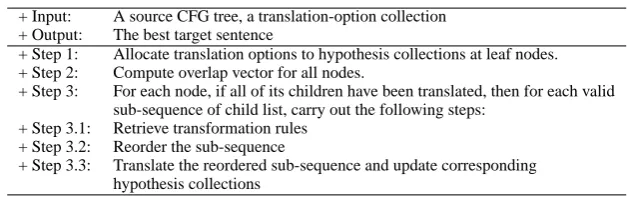
Table 2 shows our decoding algorithm. Step 1 dis-tributes translation options to leaf nodes using a pro-cedure similar to Step 1 of algorithm in Table 1. Step
Corpus Size Training Development Testing Conversation 16,809 15,734 403 672 Reuters 57,778 55,757 1,000 1,021
Table 3: Corpora and data sets.
English Vietnamese Sentences 16,809
Average sent. len. 8.5 8.0 Words 143,373 130,043 Vocabulary 9,314 9,557
English Japanese Sentences 57,778
Average sent. len. 26.7 33.5 Words 1,548,572 1,927,952 Vocabulary 31,702 29,406
Table 4: Corpus statistics of translation tasks.
2 helps check valid subsequences in Step 3 fast. Step 3 is a bottom-up procedure, a node is translated if all of its child nodes have been translated. Step 3.1 calls syntactic transformation models. After reordered in Step 3.2, a subsequence will be translated in Step 3.3 using a simple monotonic decoding procedure result-ing in new translation hypotheses. We used a beam pruning technique to reduce the memory cost and to accelerate the computation.
6 Experimental Results
6.1 Experimental Settings
We used Reuters3, an English-Japanese bilingual cor-pus, and Conversation, an English-Vietnamese corpus (Table 4). These corpora were split into data sets as shown in Table 3. Japanese sentences were analyzed by ChaSen4, a word-segmentation tool.
A number of tools were used in our experiments. Vietnamese sentences were segmented using a word-segmentation program (Nguyen et al., 2003). For learning phrase translations and decoding, we used Pharaoh (Koehn, 2004), a state-of-the-art phrase-based SMT system which is available for research purpose. For word alignment, we used the GIZA++ tool (Och and Ney, 2000). For learning language models, we used SRILM toolkit (Stolcke, 2002). For MT evaluation, we used BLEU measure (Papineni et al., 2001) calculated by the NIST script version 11b. For the parsing task, we used Charniak’s parser (Char-niak, 2000). For experiments with chunking (or shal-low parsing), we used a CRFs-based chunking tool5 to split a source sentence into syntactic chunks. Then a pseudo CFG rule over chunks is built to generate a two-level syntactic tree. This tree can be used in the
+ Input: A source CFG tree, a translation-option collection + Output: The best target sentence
+ Step 1: Allocate translation options to hypothesis collections at leaf nodes. + Step 2: Compute overlap vector for all nodes.
+ Step 3: For each node, if all of its children have been translated, then for each valid sub-sequence of child list, carry out the following steps:
+ Step 3.1: Retrieve transformation rules + Step 3.2: Reorder the sub-sequence
[image:6.595.139.453.87.186.2]+ Step 3.3: Translate the reordered sub-sequence and update corresponding hypothesis collections
Table 2: A bottom-up dynamic-programming decoding algorithm.
Corpus CFG PhraseCFG W2PTT Reorder Conversation 2,784 2,684 8,862 2,999 Reuters 7,668 5,479 13,458 7,855
Table 5: Rule induction statistics.
Corpus Pharaoh PB system SD system SD system (chunking) (full-parsing) Conversation 35.47 35.66 36.85 37.42 Reuters 24.41 24.20 20.60 25.53
Table 6: BLEU score comparison between phrase-based SMT and syntax-directed SMT. PB=phrase-based; SD=syntax-directed
same way as trees produced by Charniak’s parser. We built a SMT system for phrase-based log-linear translation models. This system has two decoders: beam search and syntax-based. We implemented the algorithm in Section 5 for the syntax-based decoder. We also implemented a rule induction module and a module for minimum error rate training. We used the system for our experiments reported later.
6.2 Rule Induction
In Table 5, we report statistics of CFG rules, phrase CFG rules, word-to-phrase tree transformation (W2PTT) rules, and reordering rules. All counted rules were in un-lexicalized form. Those numbers are very small in comparison with the number of phrasal translations (up to hundreds of thousands on our cor-pora). There were a number of ”un-seen” CFG rules which did not have a corresponding reordering rule. A reason is that those rules appeared once or several times in the training corpus; however, their hierarchi-cal alignments did not satisfy the conditions for in-ducing a reordering rule since word alignment is not perfect (Nguyen and Shimazu, 2006). Another reason is that there were CFG rules which required nonlocal reordering. This may be an issue for future research: a Markovization technique for SCFGs.
6.3 BLEU Scores
Table 6 shows a comparison of BLEU scores be-tween Pharaoh, our phrase-based SMT system, and
our syntax-directed (SD) SMT system with chunking and full parsing respectively. On both Conversation corpus and Reuters corpus: The BLEU score of our phrase-based SMT system is comparable to that of Pharaoh; The BLEU score of our SD system with full parsing is higher than that of our phrase-based sys-tem. On Conversation corpus, our SD system with chunking has a higher performance in terms of BLEU score than our phrase-based system. Using sign test (Lehmann, 1986), we verified the improvements are statistically significant. However, on Reuters corpus, performance of the SD system with chunking is much lower than the phrase-based system’s. The reason is that in English-Japanese translation, chunk is a too shallow syntactic structure to capture word order in-formation. For example, a prepositional chunk of-ten includes only preposition and adverb, therefore such information does not help reordering preposi-tional phrases.
6.4 The Effectiveness of the W2PTT Model
Without this feature, BLEU scores decreased around 0.5 on both corpora. We now consider a linguistically motivated example of English-Vietnamese translation to show that phrase segmentation can be evaluated through phrase tree scoring. This example was ex-tracted from Conversation test set.
English sentence: for my wife ’s mother Vietnamese word order: for mother ’s wife my Phrase segmentation 1: for my wife|’s|mother P1=P(PP→IN+ -NP|PP→IN NP)xP(-NP→-NP NN|NP→NP
NN)xP(-NP→POS|NP→PRP$ NN
POS)=log(0.00001)+log(0.14)+log(0.048)=-5-0.85-1.32=-7.17
Phrase segmentation 2: for|my wife ’s|mother P2=P(PP→IN NP|PP→IN NP)xP(NP→NP NN|NP→NP
NN) xP(NP→POS|NP→PRP$ NN POS)
=log(0.32)+log(0.57)+log(0.048)=-0.5-0.24-1.32=-2.06
Figure 6: Two phrase trees.
Corpus Level-1 Level-2 Level-3 Level-4 Full Conversation 36.85 36.91 37.11 37.23 37.42 Reuters 20.60 22.76 24.49 25.12 25.53
Table 7: BLEU score with different syntactic levels. Level-i means syntactic transformation was applied to tree nodes whose level smaller than or equal to i. The level of a pre-terminal node (POS tag) is 0. The level of an inner node is the maximum of its children’s lev-els.
6.5 Levels of Syntactic Analysis
Since in practice, chunking and full parsing are often used, in Table 6, we showed translation quality of the two cases. It is interesting if we can find how syn-tactic analysis can affect BLEU score at more inter-mediate levels (Table 7). On the Conversation corpus, using syntax trees of level-1 is effective in comparison with baseline. The increase of syntactic level makes a steady improvement in translation quality. Note that when we carried out experiments with chunking (con-sidered as level-1 syntax) the translation speed (in-cluding chunking) of our tree-to-string system was much faster than baseline systems’. This is an option for developing applications which require high speed such as web translation.
7 Related Works
7.1 A Comparison of Syntactic SMT Methods
To advance the state of the art, SMT system design-ers have experimented with tree-structured transla-tion models. The underlying computatransla-tional models
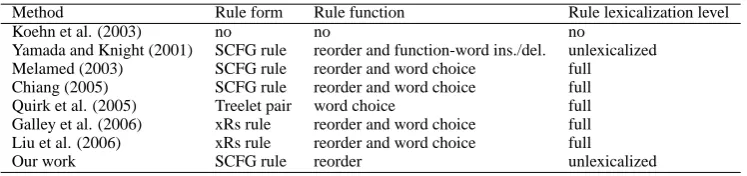
were synchronous context-free grammars and finite-state tree transducers which conceptually have a bet-ter expressive power than finite-state transducers. We create Tables 8 and 9 in order to compare syntac-tic SMT methods including ours. The first row is a baseline phrasal SMT approach. The second column in Table 8 only describes input types because the out-put is often string. Syntactic SMT methods are dif-ferent in many aspects. Methods which make use of phrases (in either explicit or implicit way) can beat the baseline approach (Table 8) in terms of BLEU metric. Two main problems these models aim to deal with are word order and word choice. In order to ac-complish this purpose, the underlying formal gram-mars (including synchronous context-free gramgram-mars and tree transducers) can be fully lexicalized or un-lexicalized (Table 9).
7.2 Non-constituent Phrasal Translations
Liu et al. (2007) proposed forest-to-string rules to capture non-constituent phrasal translation while our system can naturally make use of such kind of phrasal translation by using word-to-phrase tree transforma-tion. Liu et al. (2007) also discussed about how the phenomenon of non-syntactic bilingual phrases is dealt with in other SMT methods. Galley et al. (2006) handled non-constituent phrasal translation by traversing the tree upwards until reaches a node that subsumes the phrase. Marcu et al. (2006) reported that approximately 28% of bilingual phrases are non-syntactic on their English-Chinese corpus. They pro-posed using a pseudo nonterminal symbol that sub-sumes the phrase and corresponding multi-headed syntactic structure. One new xRs rule is required to explain how the new nonterminal symbol can be com-bined with others. This technique brought a signif-icant improvement in performance to their string-to-tree noisy channel SMT system.
8 Conclusions
Method Input Theoretical Decoding style Linguistic Phrase Performance model information usage
[image:8.595.112.486.225.313.2]Koehn et al. (2003) string FSTs beam search no yes baseline Yamada and Knight (2001) string SCFGs parsing target no not better Melamed (2003) string SCFGs parsing both sides no not better Chiang (2005) string SCFGs parsing no yes better Quirk et al. (2005) dep. tree TTs parsing source yes better Galley et al. (2006) string TTs parsing target yes better Liu et al. (2006) tree TTs tree transf. source yes better Our work tree SCFGs tree transf. source yes better
Table 8: A comparison of syntactic SMT methods (part 1). FST=Finite State Transducer; SCFG=Synchronous Context-Free Grammar; TT=Tree Transducer.
Method Rule form Rule function Rule lexicalization level
Koehn et al. (2003) no no no
Yamada and Knight (2001) SCFG rule reorder and function-word ins./del. unlexicalized Melamed (2003) SCFG rule reorder and word choice full Chiang (2005) SCFG rule reorder and word choice full Quirk et al. (2005) Treelet pair word choice full Galley et al. (2006) xRs rule reorder and word choice full Liu et al. (2006) xRs rule reorder and word choice full Our work SCFG rule reorder unlexicalized
Table 9: A comparison of syntactic SMT methods (part 2). xRs is a kind of rule which maps a syntactic pattern to a string, for example VP(AUX(does), RB(not),x0:VB) →ne, x0, pas. In the column Rule lexicalization level: full=lexicalization using vocabularies of both source language and target language.
of non-local reordering phenomena such as adjunct attachment should be handled in the future.
References
Charniak, E. 2000. A maximum entropy inspired parser. In Proceedings of HLT-NAACL.
Galley, M., Jonathan Graehl, Kevin Knight, Daniel Marcu, Steve DeNeefe, Wei Wang, Ignacio Thayer 2006. Scal-able Inference and Training of Context-Rich Syntactic Translation Models. In Proceedings of ACL.
Jos B. Mario, Rafael E. Banchs, Josep M. Crego, Adri de Gispert, Patrik Lambert, Jos A. R. Fonollosa, Marta R. Costa-juss. 2006. N-gram-based Machine Translation. Computational Linguistics, 32(4): 527–549.
Koehn, P. 2004. Pharaoh: a beam search decoder for phrase-based statistical machine translation models. In Proceedings of AMTA.
Koehn, P. and Hieu Hoang. 2007. Factored Translation Models. In Proceedings of EMNLP.
Koehn, P., F. J. Och, and D. Marcu. 2003. Statisti-cal phrase-based translation. In Proceedings of HLT-NAACL.
Lehmann, E. L. 1986. Testing Statistical Hypotheses (Sec-ond Edition). Springer-Verlag.
Liu, Y., Qun Liu, Shouxun Lin. 2006. Tree-to-String Alignment Template for Statistical Machine Transla-tion. In Proceedings of ACL.
Liu, Y., Yun Huang, Qun Liu, and Shouxun Lin 2007. Forest-to-String Statistical Translation Rules. In Pro-ceedings of ACL.
Marcu, D., Wei Wang, Abdessamad Echihabi, and Kevin Knight. 2006. SPMT: Statistical Machine Translation with Syntactified Target Language Phrases. In Proceed-ings of EMNLP.
Melamed, I. D. 2004. Statistical machine translation by parsing. In Proceedings of ACL.
Nguyen, Thai Phuong and Akira Shimazu. 2006. Improv-ing Phrase-Based Statistical Machine Translation with Morphosyntactic Transformation. Machine Translation, 20(3): 147–166.
Nguyen, Thai Phuong, Nguyen Van Vinh and Le Anh Cuong. 2003. Vietnamese Word Segmentation Using Hidden Markov Model. In Proceedings of International Workshop for Computer, Information, and Communica-tion Technologies in Korea and Vietnam.
Och, F. J. and H. Ney. 2000. Improved statistical align-ment models. In Proceedings of ACL.
Papineni, K., S. Roukos, T. Ward, W.-J. Zhu. 2001. BLEU: a method for automatic evaluation of machine translation. Technical Report RC22176 (W0109-022), IBM Research Report.
Quirk, C., A. Menezes, and C. Cherry. 2005. Dependency treelet translation: Syntactically informed phrasal SMT. In Proceedings of ACL.
Stolcke, A. 2002. SRILM - An Extensible Language Mod-eling Toolkit. In Proc. Intl. Conf. Spoken Language Processing.