Computing Optimal Alignments for the IBM-3 Translation Model
Thomas Schoenemann Centre for Mathematical Sciences
Lund University, Sweden
Abstract
Prior work on training the IBM-3 transla-tion model is based on suboptimal meth-ods for computing Viterbi alignments. In this paper, we present the first method guaranteed to produce globally optimal alignments. This not only results in im-proved alignments, it also gives us the op-portunity to evaluate the quality of stan-dard hillclimbing methods. Indeed, hill-climbing works reasonably well in prac-tice but still fails to find the global opti-mum for between 2% and 12% of all sen-tence pairs and the probabilities can be several tens of orders of magnitude away from the Viterbi alignment.
By reformulating the alignment problem as an Integer Linear Program, we can use standard machinery from global opti-mization theory to compute the solutions. We use the well-known branch-and-cut method, but also show how it can be cus-tomized to the specific problem discussed in this paper. In fact, a large number of alignments can be excluded from the start without losing global optimality.
1 Introduction
Brown et al. (1993) proposed to approach the problem of automatic natural language translation from a statistical viewpoint and introduced five probability models, known as IBM 1-5. Their models were single word based, where each source word could produce at most one target word.
State-of-the-art statistical translation systems follow the phrase based approach, e.g. (Och and Ney, 2000; Marcu and Wong, 2002; Koehn, 2004; Chiang, 2007; Hoang et al., 2007), and hence al-low more general alignments. Yet, single word
based models (Brown et al., 1993; Brown et al., 1995; Vogel et al., 1996) are still highly relevant: many phrase based systems extract phrases from the alignments found by training the single word based models, and those that train phrases directly usually underperform these systems (DeNero et al., 2006).
Single word based models can be divided into two classes. On the one hand, models like IBM-1, IBM-2 and the HMM are computationally easy to handle: both marginals and Viterbi alignments can be computed by dynamic programming or even simpler techniques.
On the other hand there are fertility based els, including IBM 3-5 and Model 6. These mod-els have been shown to be of higher practical rel-evance than the members of the first class (Och and Ney, 2003) since they usually produce better alignments. At the same time, computing Viterbi alignments for these methods has been shown to be NP-hard (Udupa and Maji, 2006), and comput-ing marginals is no easier.
The standard way to handle these models – as implemented in GIZA++ (Al-Onaizan et al., 1999; Och and Ney, 2003) – is to use a hillclimbing al-gorithm. Recently Udupa and Maji (2005) pro-posed an interesting approximation based on solv-ing sequences of exponentially large subproblems by means of dynamic programming and also ad-dressed the decoding problem. In both cases there is no way to tell how far away the result is from the Viterbi alignment.
In this paper we solve the problem of find-ing IBM-3 Viterbi alignments by means of Inte-ger Linear Programming (Schrijver, 1986). While there is no polynomial run-time guarantee, in prac-tice the applied branch-and-cut framework is fast enough to find optimal solutions even for the large Canadian Hansards task (restricted to sentences with at most75words), with a training time of6
hours on a2.4GHz Core 2 Duo (single threaded).
Integer Linear Programming in the context of machine translation first appeared in the work of Germann et al. (2004), who addressed the
trans-lation problem (often called decoding) in terms of
a travelings-salesman like formulation. Recently, DeNero and Klein (2008) addressed the training problem for phrase-based models by means of integer linear programming, and proved that the problem is NP-hard. The main difference to our work is that they allow only consecutive words in the phrases. In their formulation, allowing arbi-trary phrases would require an exponential number of variables. In contrast, our approach handles the classical single word based model where any kind of “phrases” in the source sentence are aligned to one-word phrases in the target sentence.
Lacoste-Julien et al. (2006) propose an inte-ger linear program for a symmetrized word-level alignment model. Their approach also allows to take the alignments of neighboring words into ac-count. In contrast to our work, they only have a very crude fertility model and they are consider-ing a substantially different model. It should be noted, however, that a subclass of their problems can be solved in polynomial time - the problem is closely related to bipartite graph matching. Less general approaches based on matching have been proposed in (Matusov et al., 2004) and (Taskar et al., 2005).
Recently Bodrumlu et al. (2009) proposed a very innovative cost function for jointly optimiz-ing dictionary entries and alignments, which they minimize using integer linear programming. They also include a mechanism to derive N-best lists. However, they mention rather long computation times for rather small corpora. It is not clear if the large Hansards tasks could be addressed by their method.
An overview of integer linear programming ap-proaches for natural language processing can be found on http://ilpnlp.wikidot.com/. To facilitate further research in this area, the source code will be made publicly available.
Contribution The key contribution of our work is a method to handle exact fertility models as aris-ing in the IBM-3 model in a global optimization framework. This is done by a linear number of linear consistency constraints. Unlike all previ-ous works on integer linear programming for ma-chine translation, we do not solely use binary co-efficients in the constraint matrix, hence showing
that the full potential of the method has so far not been explored.
At the same time, our method allows us to give a detailed analysis of the quality of hillclimbing ap-proaches. Moreover, we give a more detailed de-scription of how to obtain a fast problem-tailored integer solver than in previous publications, and include a mechanism to a priori exclude some vari-ables without losing optimality.
2 The IBM-3 Translation Model
Given a source sentence fJ
1, the statistical
ap-proach to machine translation is to assign each possible target sentence eI
1 a probability to be an
accurate translation. For convenience in the trans-lation process, this probability is usually rewritten as
P(eI1|f1J) = 1
p(fJ 1)
·p(eI1)·p(f1J|eI1),
and the training problem is to derive suitable pa-rameters for the latter term from a bilingual cor-pus. Here, the probability is expressed by sum-ming over hidden variables called alignments. The common assumption in single word based models is that each source positionjproduces a single tar-get positionaj ∈ {0, . . . , I}, where an artificial
0-position has been introduced to mark words with-out a correspondence in the target sentence. The alignment of a source sentence is then a vectoraJ
1,
and the probability can now be written as
p(f1J|eI1) =
X
aJ 1
p(f1J, aJ1|eI1).
We will focus on training the IBM-3 model which is based on the concept of fertilities: given an alignment aJ
1, the fertility Φi(aJ1) =
P
j:aj=i1
of target word iexpresses the number of source words aligned to it. Omitting the dependence on aJ
1 (and defining p(j|0) = 1), the probability is
expressed as
p(f1J, aJ1|eI1) = p(Φ0|J)· I
Y
i=1
h
Φi!p(Φi|ei)
i
·Y
j
h
p(fj|eaj)·p(j|aj) i
. (1)
For the probability p(Φ0|J)of the fertility of the
translation model, an inverted zero-order align-ment model and a fertility model. We now discuss how to find the optimal alignment for given prob-abilities, i.e. to solve the problem
arg max aJ
1 p(fJ
1, aJ1|eI1) (2)
for each bilingual sentence pair in the training set. This is a desirable step in the approximate EM-algorithm that is commonly used to train the model.
3 Finding IBM-3 Viterbi Alignments via Integer Linear Programming
Instead of solving (2) directly we consider the equivalent task of minimizing the negative loga-rithm of the probability function. A significant part of the arising cost function is already linear in terms of the alignment variables, a first step for the integer linear program (ILP) we will derive.
To model the problem as an ILP, we introduce two sets of variables. Firstly, for any source po-sition j ∈ {1, . . . , J} and any target position i ∈ {0, . . . , I} we introduce an integer variable xij ∈ {0,1} which we want to be 1 exactly if
aj = iand 0otherwise. Since each source
posi-tion must be aligned to exactly one target posiposi-tion, we arrive at the set of linear constraints
X
i
xij = 1 , j = 1, . . . , J . (3)
The negative logarithm of the bottom row of (1) is now easily written as a linear function in terms of the variablesxij:
X
i,j
cxij·xij ,
cxij =−loghp(fj|ei)·p(j|i)
i .
For the part of the cost depending on the fertilities, we introduce another set of integer variablesyif ∈
{0,1}. Herei∈ {0, . . . , I}andfranges from0to some pre-specified limit on the maximal fertility, which we set tomax(15, J/2) in our experiments (fertilities> J need not be considered). We want yif to be 1 if the fertility of i is f, 0 otherwise.
Hence, again these variables must sum to1:
X
f
yif = 1 , i= 0, . . . , I . (4)
The associated part of the cost function is written as
X
i,f
cyif ·yif ,
cyif =−loghf!p(f|ei)
i
, i= 1, . . . , I
cy0f =−log
h
p(Φ0 =f|J)
i .
It remains to ensure that the variablesyif
express-ing the fertilities are consistent with the fertilities induced by the alignment variables xij. This is
done via the following set of linear constraints:
X
j
xij =
X
f
f ·yif , i= 0, . . . , I . (5)
Problem (2) is now reduced to solving the integer linear program
arg min
{xij},{yif} P
i,j
cx
ij xij+P i,f
cyif yif
subject to(3), (4), (5)
xij ∈ {0,1}, yif ∈ {0,1} , (6)
with roughly 2I J variables and roughlyJ + 2I constraints.
4 Solving the Integer Linear Program
To solve the arising integer linear programming problem, we first relax the integrality constraints on the variables to continuous ones:
xij ∈[0,1], yif ∈[0,1] ,
and obtain a lower bound on the problems by solv-ing the arissolv-ing linear programmsolv-ing relaxation via the dual simplex method.
While in practice this can be done in a matter of milli-seconds even for sentences withI, J > 50, the result is frequently a fractional solution. Here the alignment variables are usually integral but the fertility variables are not.
upper bound on the cost function. Such bounds are generally given by feasible integral solutions. We use our own heuristic as a plug-in to the solver. It generates solutions by thresholding the align-ment variables (winner-take-all) and deriving the induced fertility variables. An initial upper bound is furthermore given by the alignment found by hillclimbing.
We suspect that further speed-ups are possible by using so-called follow-up nodes: e.g. if in the branch-and-bound an alignment variablexij is set
to 1, one can conclude that the fertility variable yi0 must be0. Also, sets of binary variables that
must sum to1as in (3) and (4) are known as
spe-cial ordered sets of type I and there are variants
of branch-and-cut that can exploit these proper-ties. However, in our context they did not result in speed-ups.
Our code is currently based on the open source COIN-OR project1 and involves the linear pro-gramming solver CLP, the integer propro-gramming solver CBC, and the cut generator library CGL. We have also tested two commercial solvers. For the problem described in this paper, CBC per-formed best. Tests on other integer programming tasks showed however that the Gurobi solver out-performs CBC on quite a number of problems.
5 Speed-ups by Deriving Bounds
It turns out that, depending on the cost function, some variables may a priori be excluded from the optimization problem without losing global opti-mality. That is, they can be excluded even before the first LP-relaxation is solved.
The affected variables have relatively high cost coefficients and they are identified by considering lower bounds and an upper bound on the cost func-tion. Starting from the lower bounds, one can then identify variables that when included in a solution would raise the cost beyond the upper bound.
An upper boundu on the problem is given by any alignment. We use the one found by hillclimb-ing. If during the branch-and-cut process tighter upper bounds become available, the process could be reapplied (as a so-called column cut generator). For the lower bounds we use different ones to exclude alignment variables and to exclude fertil-ity variables.
1
www.coin-or.org
5.1 Excluding Alignment Variables
To derive a lower bound for the alignment vari-ables, we first observe that the cost cxij for the alignment variables are all positive, whereas the cost cyif for the fertilities are frequently negative, due to the factorial of f. A rather tight lower bound on the fertility cost can be derived by solv-ing the problem
lF,1 = min {Φi}
I
P
i=0
cyiΦi
s.t. P
iΦi=J , (7)
which is easily solved by dynamic programming proceeding along i. A lower bound on the align-ment cost is given by
lA=PjlA,j ,
where lA,j = min i=0,...,Ic
x ij .
The lower bound is then given byl1 = lF,1+lA,
and we can be certain that source wordjwill not be aligned to target wordiif
cxij > lA,j+ (u−l1) .
5.2 Excluding Fertility Variables
Excluding fertility variables is more difficult as cost can be negative and we have used a constraint to derivelF,1above.
At present we are using a two ways to gener-ate a lower bound and apply the exclusion process with each of them sequentially. Both bounds are looser thanl1, but they immensely help to get the
computation times to an acceptable level.
The first bound builds uponl1as derived above,
but using a looser boundlF,2for the fertility cost:
lF,2 =
X
i min
Φi c y iΦi .
This results in a boundl2=lF,2+lA, and fertility
variables can now be excluded in a similar manner as above.
Our second bound is usually much tighter and purely based on the fertility variables:
l3 =
X
i min
Φi
h
cyiΦi + min
J ⊆{1,...,J}:|J=Φi|c x i(J)
i ,
withcxi(J) = X j∈J
and where the cost of the empty set is defined as0. Although this expression looks rather involved, it is actually quite easy to compute by simply sorting the respective cost entries. A fertility variableyif
can now be excluded if the difference betweencyif and the contribution ofitol3exceedsu−l3.
We consider it likely that more variables can be excluded by deriving bounds in the spirit of (7), but with the additional constraint thatΦi =f for
someiandf. We leave this for future work.
6 Experiments
We have tested our method on three different tasks involving a total of three different languages and each in both directions. The first task is the well-known Canadian Hansards2 task (senate debates) for French and English. Because of the large dataset we are currently only considering sentence pairs where both sentences have at most75words. Longer sentences are usually not useful to derive model parameters.
The other two datasets are released by the Eu-ropean Corpus Initiative3. We choose the Union Bank of Switzerland (UBS) corpus for English and German and the Avalanche Bulletins, originally released by SFISAR, for French and German. For the latter task we have annotated alignments for
150 of the training sentences, where one annota-tor specified sure and possible alignments. For de-tails, also on the alignment error rate, see (Och and Ney, 2003).
All corpora have been preprocessed with language-specific rules; their statistics are given in Table 1. We have integrated our method into the standard toolkit GIZA++4and are using the train-ing scheme15
H5 35
45
for all tasks. While we fo-cus on the IBM-3 stage, we also disfo-cuss the quality of the resulting IBM-4 parameters and alignments. Experiments were run on a 2.4 GHz Core 2 Duo with4GB memory. For most sentence pairs, the memory consumption of our method is only marginally more than in standard GIZA++ (600 MB). In the first iteration on the large Hansards task, however, there are a few very difficult sen-tence pairs where the solver needs up to90 min-utes and 1.5GB . We observed this in both trans-lation directions.
2www.isi.edu/natural-language/
download/hansard/
3
The entire CD with many more corpora is available for currently50Euros.
4
available atcode.google.com/p/giza-pp/.
Avalanche Bulletin
French German
# sentences 2989
max. sentence length 88 57 total words 64825 45629 vocabulary size 1707 2113
UBS
English German
# sentences 2689
max. sentence length 92 91 total words 62617 53417 vocabulary size 5785 9127
Canadian Hansards (max. 75)
French English
# sentences 180706
[image:5.595.313.519.61.333.2]max. sentence length 75 75 total words 3730570 3329022 vocabulary size 48065 37633
Table 1: Corpus statistics for all employed (train-ing) corpora, after preprocessing.
6.1 Evaluating Hillclimbing
In our first set of experiments, we compute Viterbi alignments merely to evaluate the quality of the standard training process. That is, the model parameters are updated based on the alignments found by hillclimbing. Table 2 reveals that, as expected, hillclimbing does not always find the global optimum: depending on the task and it-eration number, between 2 and 12 percent of all hillclimbing alignments are suboptimal. For short sentences (i.e. I, J ≤ 20) hillclimbing usually finds the global optimum.
Somewhat more surprisingly, even when a good and hence quite focused initialization of the IBM-3 model parameters is given (by training HMMs first), the probability of the Viterbi alignment can be up to a factor of1037
away from the optimum. This factor occurred on the Hansards task for a sentence pair with46 source and46 target words and the fertility of the empty word changed from
9(for hillclimbing) to5.
6.2 Hillclimbing vs. Viterbi Alignments
Candian Hansards (max 75)
French→English
Iteration # 1 2 3 4 5
# suboptimal alignments in hillclimbing 10.7% 10.7% 10.8% 11.1% 11.4%
Maximal factor to Viterbi alignment 1.9·1037
9.1·1017
7.3·1014
3.3·1012
8.1·1014
English→French
Iteration # 1 2 3 4 5
# suboptimal alignments in hillclimbing 7.3% 7.5% 7.4% 7.4% 7.5%
Maximal factor to Viterbi alignment 5.6·1038
6.6·1020
7.6·1011
4.3·1010
8.3·1011
Avalanche Bulletins
French→German
Iteration # 1 2 3 4 5
# suboptimal alignments in hillclimbing 7.5% 5.6% 4.9% 4.9% 4.4%
Maximal factor to Viterbi alignment 6.1·105
877 368 2.5·104
429
German→French
Iteration # 1 2 3 4 5
# suboptimal alignments in hillclimbing 4.2% 2.7% 2.5% 2.3% 2.1%
Maximal factor to Viterbi alignment 40 302 44 3.3·104
9.2·104
Union Bank of Switzerland (UBS)
English→German
Iteration # 1 2 3 4 5
# suboptimal alignments in hillclimbing 5.0% 4.0% 3.5% 3.3% 3.2%
Maximal factor to Viterbi alignment 677 22 53 40 32
German→English
Iteration # 1 2 3 4 5
# suboptimal alignments in hillclimbing 5.5% 3.3% 2.5% 2.2% 2.3%
Maximal factor to Viterbi alignment 1.4·107
[image:6.595.78.518.92.669.2]808 33 33 1.8·104
une baisse de la temp´erature a en g´en´eral stabilis´e la couverture neigeuse .
ein Temperaturr¨uckgang hat die Schneedecke im allgemeinen stabilisiert .
Standard training (hillclimbing).
une baisse de la temp´erature a en g´en´eral stabilis´e la couverture neigeuse .
ein Temperaturr¨uckgang hat die Schneedecke im allgemeinen stabilisiert .
Proposed training (Viterbi alignments).
Figure 1: Comparison of training schemes. Shown are the alignments of the final IBM-3 iteration.
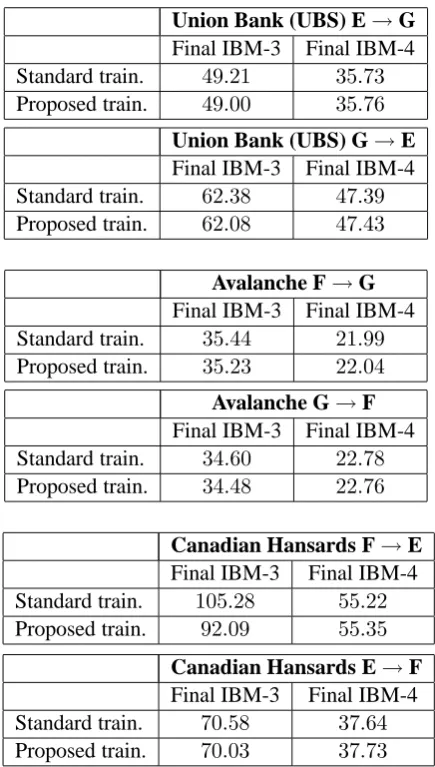
Indeed Table 3 demonstrates that with the new training scheme, the perplexities of the final IBM-3 iteration are consistently lower. Yet, this effect does not carry over to IBM-4 training, where the perplexities are consistently higher. Either this is due to overfitting or it is better to use the same method for alignment computation for both IBM-3 and IBM-4. After all, both start from the HMM Viterbi alignments.
Interestingly, the maximal factor between the hillclimbing alignment and the Viterbi alignment is now consistently higher on all tasks and in all iterations. The extreme cases are a factor of1076
for the Canadian Hansards English→French task and1030
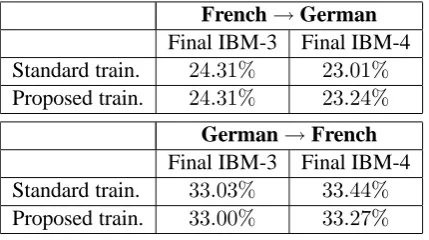
for the Bulletin French→German task. Table 4 demonstrates that the alignment error rates of both schemes are comparable. Indeed, a manual evaluation of the alignments showed that most of the changes affect words like articles or prepositions that are generally hard to translate. In many cases neither the heuristic nor the Viterbi alignment could be considered correct. An inter-esting case where the proposed scheme produced the better alignment is shown in Figure 1.
In summary, our results give a thorough justi-fication for the commonly used heuristics. A test with the original non-deficient empty word model of the IBM-3 furthermore confirmed the impres-sion of (Och and Ney, 2003) that overly many words are aligned to the empty word: the tendency is even stronger in the Viterbi alignments.
6.3 Optimizing Running Time
The possibilities to influence the run-times of the branch-and-cut framework are vast: there are
nu-Union Bank (UBS) E→G
Final IBM-3 Final IBM-4 Standard train. 49.21 35.73
Proposed train. 49.00 35.76
Union Bank (UBS) G→E
Final IBM-3 Final IBM-4 Standard train. 62.38 47.39
Proposed train. 62.08 47.43
Avalanche F→G
Final IBM-3 Final IBM-4 Standard train. 35.44 21.99
Proposed train. 35.23 22.04
Avalanche G→F
Final IBM-3 Final IBM-4 Standard train. 34.60 22.78
Proposed train. 34.48 22.76
Canadian Hansards F→E
Final IBM-3 Final IBM-4 Standard train. 105.28 55.22
Proposed train. 92.09 55.35
Canadian Hansards E→F
Final IBM-3 Final IBM-4 Standard train. 70.58 37.64
[image:7.595.307.525.313.697.2]Proposed train. 70.03 37.73
French→German
Final IBM-3 Final IBM-4 Standard train. 24.31% 23.01%
Proposed train. 24.31% 23.24%
German→French
Final IBM-3 Final IBM-4 Standard train. 33.03% 33.44%
[image:8.595.72.287.62.182.2]Proposed train. 33.00% 33.27%
Table 4: Alignment error rates on the Avalanche bulletin task.
merous ways to generate cuts and several of them can be used simultaneously. The CBC-package also allows to specify how many rounds of cuts to derive at each node. Then there is the question of whether to use the bounds derived in Section 5 to a priori exclude variables. Finally, branch-and-cut need not be done on all variables: since solving LP-relaxations typically results in integral alignments, it suffices to do branch-and-cut on the fertility variables and only add the alignment vari-ables in case non-integral values arise (this never happened in our experiments5).
We could not possibly test all combinations of the listed possibilities, and our primary focus was to achieve acceptable run-times for the large Hansards task. Still, in the end we have a quite uniform picture: the lowest run-times are achieved by using Gomory Cuts only. Moreover, including all variables for branching was between1.5and2
times faster than only including fertility variables. Only by exploiting the bounds derived in Section 5 the run-times for the Hansards task in direction from English to French became acceptable. We believe that further speed-ups are possible by de-riving tighter bounds, and are planning to investi-gate this in the future.
We end up with roughly 6 hours for the Hansards task, roughly 3 minutes for the UBS task, and about2.5minutes for the Avalanche task. In all cases the run-times are much higher than in the standard GIZA++ training. However, we are now getting optimality guarantees where pre-viously one could not even tell how far away one is from the optimum. And the Viterbi alignments of several sentence pairs can of course be computed in parallel.
Lastly, we mention the possibility of setting a
5In fact, when fixing the fertility variables, the problem
reduces to the polynomial time solvable assignment problem.
limit on the branch-and-cut process, either on the running time or on the number of nodes. There is then no longer a guarantee for global optimality, but at least one is getting a bound on the gap to the optimum and one can be certain that the training time will be sufficiently low.
7 Conclusion
We present the first method to compute IBM-3 Viterbi alignments with a guarantee of optimal-ity. In contrast to other works on integer linear programming for machine translation, our formu-lation is able to include a precise and very gen-eral fertility model. The resulting integer linear program can be solved sufficiently fast in prac-tice, and we have given many comments on how problem-specific knowledge can be incorporated into standard solvers.
The proposed method allows for the first time to analyze the quality of hillclimbing approaches for IBM-3 training. It was shown that they can be very far from the optimum. At the same time, this seems to happen mostly for difficult sentences that are not suitable to derive good model parameters.
In future work we want to derive tighter bounds to a priori exclude variables, combine the method with the N-best list generation of (Bodrumlu et al., 2009) and evaluate on a larger set of corpora. Finally we are planning to test other integer pro-gramming solvers.
Acknowledgments We thank Fredrik Kahl for helpful comments and an anonymous reviewer for pointing out freely available software packages. This research was funded by the European Re-search Council (GlobalVision grant no. 209480).
References
Y. Al-Onaizan, J. Curin, M. Jahr, K. Knight, J. Laf-ferty, I. D. Melamed, F. J. Och, D. Purdy, N. A. Smith, and D. Yarowsky. 1999. Statistical ma-chine translation, Final report, JHU workshop.
http://www.clsp.jhu.edu/ws99/.
Tugba Bodrumlu, Kevin Knight, and Sujith Ravi. 2009. A new objective function for word align-ment. In Proceedings of the Workshop on
Inte-ger Linear Programming for Natural Langauge Pro-cessing (ILP), Boulder, Colorado, June.
P.F. Brown, S.A. Della Pietra, V.J. Della Pietra, and R.L. Mercer. 1993. The mathematics of statistical machine translation: Parameter estimation.
P.F. Brown, J. Cocke, S.A. Della Pietra, V.J. Della Pietra, F. Jelinek, J. Lai, and R.L. Mercer. 1995. Method and system for natural language translation. U.S. patent #5.477.451.
David Chiang. 2007. Hierarchical phrase-based trans-lation. Computational Linguistics, 33(2):201–228.
J. DeNero and D. Klein. 2008. The complexity of phrase alignment problems. In Annual
Meet-ing of the Association for Computational LMeet-inguistics (ACL), Columbus, Ohio, June.
John DeNero, Dan Gillick, James Zhang, and Dan Klein. 2006. Why generative phrase models under-perform surface heuristics. In StatMT ’06:
Proceed-ings of the Workshop on Statistical Machine Trans-lation, pages 31–38, Morristown, NJ, USA, June.
U. Germann, M. Jahr, K. Knight, D. Marcu, and K. Ya-mada. 2004. Fast decoding and optimal decod-ing for machine translation. Artificial Intelligence, 154(1–2), April.
H. Hoang, A. Birch, C. Callison-Burch, R. Zens, A. Constantin, M. Federico, N. Bertoldi, C. Dyer, B. Cowan, W. Shen, C. Moran, and O. Bojar. 2007. Moses: Open source toolkit for statistical machine translation. In Annual Meeting of the Association
for Computational Linguistics (ACL), pages 177–
180, Prague, Czech Republic, June.
P. Koehn. 2004. Pharaoh: A beam search decoder for phrase-based statistical machine translation mod-els. In Conference of the Association for Machine
Translation in the Americas (AMTA), pages 115–
124, Washington, D.C., October.
S. Lacoste-Julien, B. Taskar, D. Klein, and M. Jordan. 2006. Word alignment via quadratic assignment. In Human Language Technology Conference of the
North American Chapter of the Association of Com-putational Linguistics, New York, New York, June.
D. Marcu and W. Wong. 2002. A phrase-based, joint probability model for statistical machine trans-lation. In Conference on Empirical Methods in
Nat-ural Language Processing (EMNLP), Philadelphia,
Pennsylvania, July.
E. Matusov, R. Zens, and H. Ney. 2004. Symmetric word alignments for statistical machine translation. In International Conference on Computational
Lin-guistics (COLING), Geneva, Switzerland, August.
Franz Josef Och and Hermann Ney. 2000. Improved statistical alignment models. In Annual Meeting
of the Association for Computational Linguistics (ACL), pages 440–447, Hongkong, China, October.
F.J. Och and H. Ney. 2003. A systematic comparison of various statistical alignment models.
Computa-tional Linguistics, 29(1):19–51.
A. Schrijver. 1986. Theory of Linear and Integer
Pro-gramming. Wiley-Interscience Series in Discrete Mathematics and Optimization. John Wiley & Sons.
B. Taskar, S. Lacoste-Julien, and D. Klein. 2005. A discriminative matching approach to word align-ment. In Conference on Empirical Methods in
Nat-ural Language Processing (EMNLP), Vancouver,
Canada, October.
R. Udupa and H.K. Maji. 2005. Theory of align-ment generators and applications to statistical ma-chine translation. In The International Joint
Con-ferences on Artificial Intelligence, Edinburgh,
Scot-land, August.
R. Udupa and H.K. Maji. 2006. Computational com-plexity of statistical machine translation. In
Con-ference of the European Chapter of the Association for Computational Linguistics (EACL), Trento, Italy,
April.
S. Vogel, H. Ney, and C. Tillmann. 1996. HMM-based word alignment in statistical translation. In
Inter-national Conference on Computational Linguistics (COLING), pages 836–841, Copenhagen, Denmark,
August.