Abstract—This paper presents analysis effects of a lightning rod in a substation with different grounding systems. A lightning stroke is injected to a lightning rod, and then the induced voltage on the ground around the rod is calculated using simulation software. At the end the best grounding system that causes less induced voltage around the rod is suggested.
Index Terms—lightning stroke, Lightning rod, Substation, safety, Step Voltage.
I.INTRODUCTION
Substations are within the most important components of the power system. They are subsidiary station of an electricity generation, transmission and distribution system where voltage is transformed from high to low or the reverse using transformers. There are several vital and expensive elements in substations like protection, switching, control equipments and transformers that should be protected in temporary overvoltages like switching [1] and lightning overvoltages.
Where a substation has a metallic fence, it must be properly grounded [2] to protect people from high voltages that may occur during a fault in the network. Earth faults [3] at a substation can cause a ground [4] potential rise leading to a significantly higher voltage than the ground under a person's feet; this touch potential presents a hazard of electrocution. When a lightning stroke takes place into a substation it should be conducted to ground through some metal rods that are installed over the substation. Usually the ground rods are installed at the sites of surge arresters and at the structures
M. Reza Derakhshanfar([email protected]): He got his B.Sc degree from Azad University south branch in field of Electric power engineering. His bachelor thesis was about wind turbines and its effects on power systems. He is a master student in Chalmers University of Technology in field of Electric power engineering and is doing his master thesis on multilevel inverters for Hybrid electric vehicles. His research interests are high voltage engineering and Power electronics.
Mehdi Javdani([email protected]): He got his B.sc degree from Zanjan University in field of Electric power engineering. His bachelor thesis was about Semnan 600MWTransmission line; Calculations and effect of corona on power loss and Radio waves. He is a master student in Chalmers University of Technology in field of Electric power engineering and is doing his master thesis is on Design, Analysis and Construction of a Bidirectional On-Board Charger for Plug-in Hybrid Electric Vehicle. His research interests are High voltage engineering and power electronics.
carrying masts or shield wires. A typical design consists of a 4 rod system forming a 3 m × 3 m .The lightning stroke injects a very high amount of current about 10 KA[5] in the rod that makes a strong electric field and potential
distribution around it. This electric field is dangerous for both the installations and people around it. So the current should flow in the rod in such a way that induces the least electric field and potential both on the ground and in air. In this project a singular lightning rod in a substation is simulated and its behavior like potential distributions and step voltages in different conditions is investigated. If a current passed through the ground there would be a voltage difference on the ground. The voltage difference for one meter is called voltage step [6]. The magnitude of step voltage directly affects the safety of the man walking on the ground near lightning rod. In this project step voltage is calculated for one meter distance from lightning rod. The models are implemented in the following cases and compare them to find desired condition:
a. Copper rod and wet concrete plate b. Copper rod and dry concrete plate c. Copper rod and wet soil (without plate) d. Copper rod and dry soil (without plate) e. Copper rod with wet copper plate in wet soil f. Copper rod with dry copper plate in dry soil g. Copper rod attached to iron bar with a copper plate
in dry soil
h. Copper rod attached to iron bar in a copper plate located in dry soil and concrete
II. PROBLEM SETUP
To set up the model we need first to know how the standard lightning stroke is schemed. In fig.1 a standard lightning impulse with front time (T1) =1.2 μs and time to half (T2) =50 μs[7] is shown:
Effects of Lightning Rod on a Substation after a
Lightning Stroke
Figure 1. Standard lightning impulse with front time (T1) =1.2 μs and time to half (T2) =50 μs
This plot is driven from the current
Since the amplitude of the lightning stroke is 10 KA, by using MATLAB and entering different values for time constants and , the standard lightning impulse shape was obtained.
[image:2.612.63.267.64.168.2]In fig.2 by choosing = 68 μs, =0.41 μs and = 10377A we obtain the desired lightning impulse shape (1.2/50) and amplitude of 10KA.
Figure 2. Standard lightning impulse with amplitude I0=10 KA First a proper application mode from model navigator menu should be selected. In this model the input current is injected and then the electric potential distribution is calculated. The conductive media DC just deals with current density and voltage, so this model should be used for this model. Lightning stroke acts as a current source which passes through the lightning rod and then the electric potential distribution on the ground should be analyzed. Equation (2) shows the relationship between potential difference , current density (Js), and current source that is run in
conductive media DC mode.
Conductive Media DC mode is selected:
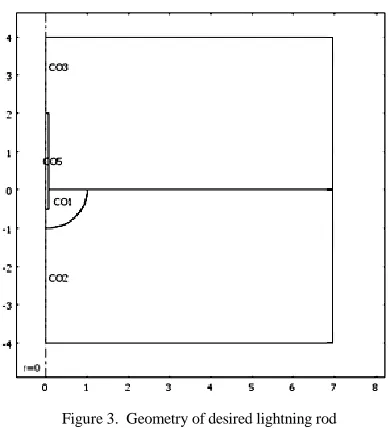
As it is illustrated in fig. 3, the model consists of a rod with height of 2m and width of 0.05m that 0.5m of it is under the ground. Rod is surrounded by air.
Figure 3. Geometry of desired lightning rod
The conductivity of different materials that are used in the model is listed below:
Dry Concrete: σ = 0.011 S/m Wet Concrete: σ = 0.033 S/m Dry Soil: σ = 0.001 S/m Wet Soil: σ = 0.01 S/m Air: σ = 1e-100 S/m
Copper: σ = 5.99e7 S/m
Boundary conditions are set as follow:
The boundary that lightning stroke hits the rod so it acts as a current source can be described by (2):
Jn: Normal current density
Electrical Insulation limits the current by an insulation level that does not permit the current to pass through them which means n.J=0
The boundaries that current pass through them without any disturbance can be described by (3)
In order to have more reliable results, domains should be extended enough especially electrical ground should be chosen carefully. That is the reason electrical ground has 4 meter deep. This makes the potential distribution study on the surface feasible.
III.Analysis
The model is analyzed in 7 different cases:
The first four cases are implemented and compared with each other to find the best case which the maximum voltage and step voltage are the least.
A.Using a copper rod in concrete located in wet soil: In the following plots, electric potential is plotted in 2 different figures:
[image:2.612.52.284.339.514.2]b) Electric Potential versus time in different distances from rod (0.5m, 1m, 1.5m, 2m) (fig.5)
[image:3.612.53.285.75.295.2]Figure 4. Electric Potential versus arc length (distance on the ground from the rod)
Figure 5. Electric Potential versus time in different distances from rod (0.5m, 1m, 1.5m, 2m)
[image:3.612.328.559.251.450.2]B.Using a copper rod in concrete located in dry soil: As it can be seen, there is a huge difference in voltage distribution between case 1 and 2. Due to much higher conductivity of wet soil and concrete (Dry Concrete: σ = 0.011 S/m, Wet Concrete: σ = 0.033 S/m), much lower voltage is expected. A comparison between these two cases reveals that voltage in wet soil and concrete is about 10 times less than dry situation. That suggests there should be a different grounding in dry places with low precipitation or humidity.
Figure 6. Electric Potential versus arc length (distance on the ground from the rod)
Figure 7. Electric Potential versus time in different distances from rod (0.5m, 1m, 1.5m, 2m)
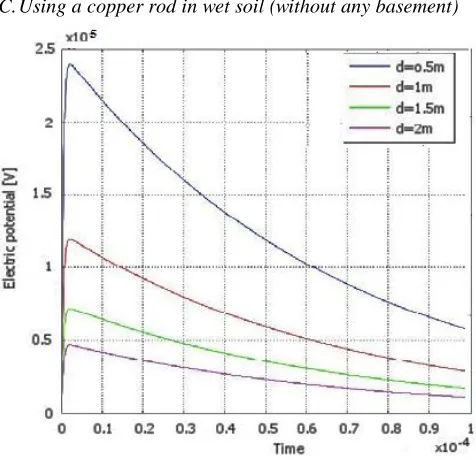
C.Using a copper rod in wet soil (without any basement)
[image:3.612.51.287.334.511.2] [image:3.612.325.563.490.720.2]Here in contrast with previous cases, there is a uniform grounding material (only soil) which is the simplest case.
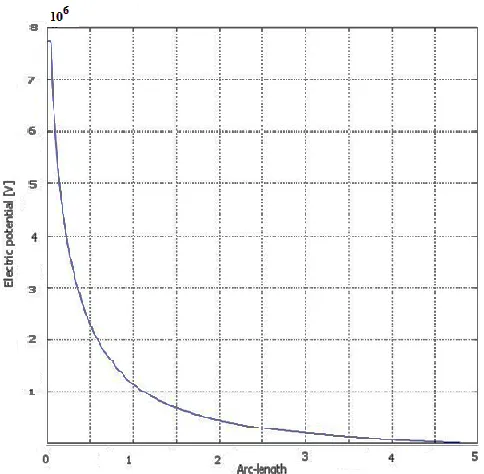
Figure 9. Electric Potential versus arc length (distance on the ground from the rod)
Here, In comparison with our first case (wet soil and concrete), there is a much higher voltage at the rod (7.7e5 for wet soil in comparison with 3.2e5 for wet soil and concrete). This results much faster voltage drop for the first 0.5 meter and this means, step voltage in concrete is much lower (around 2.4 times lower). So using concrete improves the situation and can be an option for step voltage reduction. Obviously the voltage shape outside the concrete is the same for both cases.
[image:4.612.48.288.90.329.2]D.Using a copper rod in dry soil (without any basement)
Figure 10. Electric Potential versus time in different distances from rod (0.5m, 1m, 1.5m, 2m)
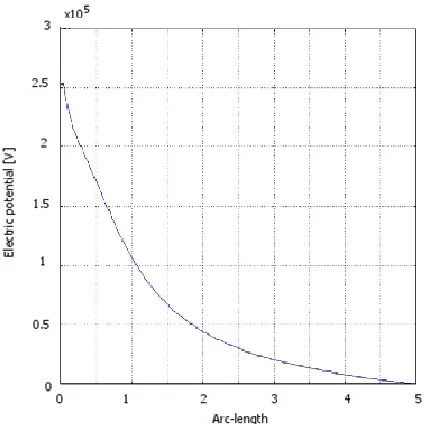
Figure 11. Electric Potential versus arc length (distance on the ground from the rod)
Fig.10 and fig.11 show potential distribution for dry soil is 10 times higher in proportion to wet soil.
[image:4.612.330.559.472.663.2]E.Using a copper rod in a copper plate located in wet soil In this configuration a copper plate is located under the rod. As it can be seen, copper increases the conductivity of ground, so the step voltage will be reduced very well. In fact copper plate is better than concrete for grounding. Especially ground voltage along the copper plate is more linear and not exponential which is a good feature, so there would not be a high step voltage.(table I)
[image:4.612.52.284.505.699.2]Figure 13. Electric Potential versus time in different distances from rod (0.5m, 1m, 1.5m, 2m)
Figure 14. Electric Potential versus arc length (distance on the ground from the rod)
F.Using a copper rod in a copper plate located in dry soil As previous cases, 10 times increase in potential at dry weather can be observed.
[image:5.612.59.274.70.269.2]An interesting point that can be discussed here is that in this case, there is a higher maximum voltage (at rod) in proportion to second case (dry concrete and soil). But based on more linear voltage distribution, there is a less step voltage. For numerical values please see table I.
[image:5.612.60.273.313.525.2]Figure 15. Electric Potential versus time in different distances from rod (0.5m, 1m, 1.5m, 2m)
Figure 16. Electric Potential versus arc length (distance on the ground from the rod)
G.Using a copper rod attached to iron bar in a copper plate located in wet soil and concrete
[image:5.612.344.560.325.519.2]H.Using a copper rod attached to iron bar in a copper plate located in dry soil and concrete
As this case is similar to case 7, it would be adequate to find Max Voltage, and step voltage. Maximum voltage in this case is about 1.82 MV and step voltage is 765 KV.
IV.Conclusion
In this paper a lightning rod that is using in substations to protect electrical elements form lightning strokes is analyzed. The step voltage which is the potential difference in one meter is calculated and compared in different cases with different basement materials and conditions.
According to the results plotted, it can be clearly concluded that while ground is wet, there is a lower maximum voltage and thus lower step voltage.
If the conductivity increases like using concrete as basement of the rod or locating the rod in wet materials, the potential which is the production of resistance and current - which flows from soil through the soil to the grounded boundaries-, reduces. In cases that were analyzed, using concrete is more efficient because it is cheaper and fixes the rod strongly in the soil in addition to small conductivity of it that makes less voltage magnitude in the boundaries of rod and less step voltages. Another good aspect of concrete is that its conductivity doesn’t increase as much as soil in dry conditions, so although in wet conditions concrete is 3.3 times conductive, in dry condition this ratio increases up to 11 times because of higher concrete conductivity.
In reality due to low strength of copper against wind the copper rod is attached to an iron bar. The effect of adding iron bar affects the potential distribution and increases the step voltages a bit.
We need to mention although all these step voltages for dry conditions kill human, still this study is necessary , because it can give a clue on how potential distributes around the rod
and this can suggest copper plate (whether in wet or dry conditions) can have the lowest step voltage and be the most expensive solution.
REFERENCES
[1] T. Keokhoungning, S. Premrudeepreechacharn, K. Ngamsanroaj, “Evaluation of Switching Overvoltage in 500 kV Transmission Line Interconnection Nam Theun 2 Power Plant to Roi Et 2 substation” [2] I. Colominas, J. Aneiros, F. Navarrina, M. Casteleiro, “A boundary
element numerical approach for substation grounding in a two layer earth structure”, Recent Developments in Boundary Element Method, pp.756-761
[3] TillWelfonder, Volker Leitloff, René Feuillet, Sylvain Vitet, ” Location Strategies and Evaluation of Detection Algorithms for Earth Faults in Compensated MV Distribution Systems”, IEEE Transaction on power delivery, Vol.15, No.4, pp.1121-1128
[4] Y.L.Chow, M.M.A. Salma, “A simplified method for calculating the substation grounding grid resistance”, IEEE transaction on power delivery, Vol.9, No.2, April 1994, pp. 734-742
[5] Per Petterson, “A unified probabilistic theory of the incidence of direct and indirect strikes”, IEEE transaction on power delivery, Vol.6, No.3, pp. 1301-1310
[6] Jaroslaw Wiater, “Distribution of step and touch voltages at the typical HV/MV substation during lightning”
[7] “IEEE Recommended Practice for Grounding of Industrial and Commercial Power Systems”,