Ensemble Methods for Automatic Thesaurus Extraction
James R. Curran
Institute for Communicating and Collaborative Systems University of Edinburgh
2 Buccleuch Place, Edinburgh EH8 9LW United Kingdom
Abstract
Ensemble methods are state of the art for many NLP tasks. Recent work by Banko and Brill (2001) suggests that this would not necessarily be true if very large training corpora were available. However, their results are limited by the simplic-ity of their evaluation task and individual classifiers.
Our work explores ensemble efficacy for the more complex task of automatic the-saurus extraction on up to 300 million words. We examine our conflicting results in terms of the constraints on, and com-plexity of, different contextual representa-tions, which contribute to the sparseness-and noise-induced bias behaviour ofNLP systems on very large corpora.
1 Introduction
Ensemble learning is a machine learning technique that combines the output of several different classi-fiers with the goal of improving classification per-formance. The classifiers within the ensemble may differ in several ways, such as the learning algorithm or knowledge representation used, or data they were trained on. Ensemble learning has been successfully applied to numerous NLP tasks, including POS tag-ging (Brill and Wu, 1998; van Halteren et al., 1998), chunking (Tjong Kim Sang, 2000), word sense dis-ambiguation (Pederson, 2000) and statistical pars-ing (Henderson and Brill, 1999). Dietterich (2000) presents a good introduction to ensemble methods.
Ensemble methods ameliorate learner bias by amortising individual classifier bias of over differ-ent systems. For an ensemble to be more effec-tive than its constituents, the individual classifiers must have better than 50%accuracy and must
pro-duce diverse erroneous classifications (Dietterich,
2000). Brill and Wu (1998) call this complementary disagreement complementarity. Although ensem-bles are often effective on problems with small train-ing sets, recent work suggests this may not be true as dataset size increases. Banko and Brill (2001) found that for confusion set disambiguation with corpora larger than 100 million words, the best individual classifiers outperformed ensemble methods.
One limitation of their results is the simplicity of the task and methods used to examine the efficacy of ensemble methods. However, both the task and applied methods are constrained by the ambitious use of one billion words of training material. Dis-ambiguation is relatively simple because confusion sets are rarely larger than four elements. The indi-vidual methods must be inexpensive because of the computational burden of the massive training set, so they must perform limited processing of the training corpus and can only consider a fairly narrow context surrounding each instance.
We explore the value of ensemble methods for the more complex task of automatic thesaurus extrac-tion, training on corpora of up to 300 million words. The increased complexity leads to results contradict-ing Banko and Brill (2001), which we explore uscontradict-ing ensembles of different contextual complexity. This work emphasises the link between contextual com-plexity and the problems of representation sparse-ness and noise as corpus size increases, which in turn impacts on learner bias and ensemble efficacy.
2 Automatic Thesaurus Extraction
The development of large thesauri and semantic re-sources, such as WordNet (Fellbaum, 1998), has al-lowed lexical semantic information to be leveraged to solve NLP tasks, including collocation discov-ery (Pearce, 2001), model estimation (Brown et al., 1992; Clark and Weir, 2001) and text classification (Baker and McCallum, 1998).
Unfortunately, thesauri are expensive and time-consuming to create manually, and tend to suffer from problems of bias, inconsistency, and limited coverage. In addition, thesaurus compilers cannot keep up with constantly evolving language use and cannot afford to build new thesauri for the many sub-domains that NLP techniques are being applied to. There is a clear need for automatic thesaurus extrac-tion methods.
Much of the existing work on thesaurus extrac-tion and word clustering is based on the observa-tions that related terms will appear in similar con-texts. These systems differ primarily in their defi-nition of “context” and the way they calculate simi-larity from the contexts each term appears in. Many systems extract co-occurrence and syntactic infor-mation from the words surrounding the target term, which is then converted into a vector-space repre-sentation of the contexts that each target term ap-pears in (Pereira et al., 1993; Ruge, 1997; Lin, 1998b). Curran and Moens (2002b) evaluate the-saurus extractors based on several different models of context on large corpora. The context models used in our experiments are described in Section 3.
We define a context relation instance as a tuple (w,r,w
0)wherewis a thesaurus term, occurring in a
relation of type r, with another wordw0 in the
sen-tence. We refer to the tuple (r,w
0) as an attribute
of w. The relation type may be grammatical or it may label the position of w0 in a context window:
e.g. the tuple(dog, direct-obj, walk)indicates that the termdog, was the direct object of the verb walk. After the contexts have been extracted from the raw text, they are compiled into attribute vec-tors describing all of the contexts each term appears in. The thesaurus extractor then uses clustering or nearest-neighbour matching to select similar terms based on a vector similarity measure.
Our experiments usek-nearest-neighbour
match-(adjective, good) 2005 (adjective, faintest) 89 (direct-obj, have) 1836 (indirect-obj, toy) 74 (adjective, preconceived) 42 (adjective, foggiest) 15
Figure 1: Example attributes of the nounidea
ing for thesaurus extraction, which calculates the pairwise similarity of the target term with every po-tential synonym. Given n terms and up to m at-tributes for each term, the asymptotic time complex-ity ofk-nearest-neighbour algorithm isO(n2m). We
reduce the number of terms by introducing a mini-mum occurrence filter that eliminates potential syn-onyms with a frequency less than five.
3 Individual Methods
The individual methods in these ensemble experi-ments are based on different extractors of contex-tual information. All the systems use the JACCARD similarity metric and TTESTweighting function that were found to be most effective for thesaurus extrac-tion by Curran and Moens (2002a).
The simplest and fastest contexts to extract are the word(s) surrounding each thesaurus term up to some fixed distance. These window methods are la-belled W(L1R1), whereL1R1indicates that window
extends one word on either side of the target term. Methods marked with an asterisk, e.g. W(L1R1∗), do not record the word’s position in the relation type. The more complex methods extract grammatical relations using shallow statistical tools or a broad coverage parser. We use the grammatical relations extracted from the parse trees of Lin’s broad cov-erage principle-based parser, MINIPAR(Lin, 1998a) and Abney’s cascaded finite-state parser, CASS (Ab-ney, 1996). Finally, we have implemented our own relation extractor, based on Grefenstette’s SEXTANT (Grefenstette, 1994), which we describe below as an example of theNLPsystem used to extract relations from the raw text.
sen-Corpus Sentences Words British National Corpus 6.2M 114M Reuters Corpus Vol 1 8.7M 193M
Table 1: Training Corpora Statistics
tence, associating each noun with the modifiers and verbs from the syntactic contexts they appear in:
1. nouns with pre-modifiers (left to right) 2. nouns with post-modifiers (right to left) 3. verbs with subjects/objects (right to left) 4. verbs with subjects/objects (left to right)
This results in relations representing the contexts:
1. term is the subject of a verb
2. term is the (direct/indirect) object of a verb 3. term is modified by a noun or adjective 4. term is modified by a prepositional phrase
The relation tuple is then converted to root form using the Sussex morphological analyser (Minnen et al., 2000) and the POS tags are stripped. The re-lations for each term are collected together produc-ing a context vector of attributes and their frequen-cies in the corpus. Figure 1 shows the most strongly weighted attributes and their frequencies foridea.
4 Experiments
Our experiments use a large quantity of text which we have grouped into a range of corpus sizes. The approximately 300 million word corpus is a random conflation of the BNC and the Reuters corpus (re-spective sizes in Table 1). We then create corpus subsets down to 1
128th (2.3 million words) of the
original corpus by randomly sentence selection. Ensemble voting methods for this task are quite interesting because the result consists of an ordered set of extracted synonyms rather than a single class label. To test for subtle ranking effects we imple-mented three different methods of combination:
MEAN mean rank of each term over the ensemble;
HARMONIC the harmonic mean rank of each term;
MIXTURE ranking based on the mean score for
each term. The individual extractor scores are not normalised because each extractor uses the same similarity measure and weight function. We assigned a rank of 201 and similarity score of zero to terms that did not appear in the 200 syn-onyms returned by the individual extractors. Finally, we build ensembles from all the available extractor methods (e.g. MEAN(∗)) and the top three perform-ing extractors (e.g. MEAN(3)).
To measure the complementary disagreement be-tween ensemble constituents we calculated both the complementarity C and the Spearman rank-order correlationRs.
C(A,B) = (1−
|errors(A)∩errors(B)|
|errors(A)| )∗100% (1)
Rs(A,B) =
P
i(r(Ai)−r(A))(r(Bi)−r(B))
q P
i(r(Ai)−r(A))2
q P
i(r(Bi)−r(B))2 (2)
wherer(x)is the rank of synonymx. The Spearman rank-order correlation coefficient is the linear corre-lation coefficient between the rankings of elements ofAand B. Rsis a useful non-parametric
compari-son for when the rank order is more relevant than the actual values in the distribution.
5 Evaluation
The evaluation is performed on thesaurus entries ex-tracted for 70 single word noun terms. To avoid sample bias, the words were randomly selected from WordNet such that they covered a range of values for the following word properties:
frequency Penn Treebank andBNCfrequencies;
number of senses WordNet and Macquarie senses;
specificity depth in the WordNet hierarchy;
concreteness distribution across WordNet subtrees. Table 2 shows some of the selected terms with fre-quency and synonym set information. For each term we extracted a thesaurus entry with 200 potential synonyms and their similarity scores.
Word PTBRank PTB# BNC# Reuters # Macquarie # WordNet # Min / Max WordNet subtree roots
company 38 4076 52779 456580 8 9 3 / 6 entity, group, state
interest 138 919 37454 146043 12 12 3 / 8 abs., act, group, poss., state
problem 418 622 56361 63333 4 3 3 / 7 abs., psych., state
change 681 406 35641 55081 8 10 2 / 12 abs., act, entity, event, phenom.
house 896 223 47801 45651 10 12 3 / 6 act, entity, group
idea 1227 134 32754 13527 10 5 3 / 7 entity, psych.
opinion 1947 78 9122 16320 4 6 4 / 8 abs., act, psych.
radio 2278 59 9046 20913 2 3 6 / 8 entity
star 5130 29 8301 6586 11 7 4 / 8 abs., entity
knowledge 5197 19 14580 2813 3 1 1 / 1 psych.
pants 13264 5 429 282 3 2 6 / 9 entity
[image:4.612.82.532.70.205.2]tightness 30817 1 119 2020 5 3 4 / 5 abs., state
Table 2: Examples of the 70 thesaurus evaluation terms
coarse-grained and thesaurus coverage is a problem. To help overcome limited coverage, our evaluation uses a combination of three electronic thesauri: the topic-ordered Macquarie (Bernard, 1990) and Ro-get’s (Roget, 1911) thesauri and the head ordered Moby (Ward, 1996) thesaurus. Since the extracted thesaurus does not separate senses we transform Ro-get’s and Macquarie into head ordered format by collapsing the sense sets containing the term. For the 70 terms we create a gold standard from the union of the synonym lists of the three thesauri, resulting in a total of 23,207 synonyms.
With this gold standard resource in place, it is pos-sible to use precision and recall measures to evaluate the quality of the extracted thesaurus. To help over-come the problems of coarse-grained direct com-parisons we use several measures of system per-formance: direct matches (DIRECT), inverse rank (INVR), and topnsynonyms precision (P(n)).
INVR is the sum of the inverse rank of each matching synonym, e.g. gold standard matches at ranks 3, 5 and 28 give an inverse rank score of
1
3 + 15 + 281 ≈ 0.569. With at most 200 synonyms,
the maximum INVR score is5.878. Topnprecision
is the percentage of matching synonyms in the topn
extracted synonyms. We usen=1,5and 10.
6 Results
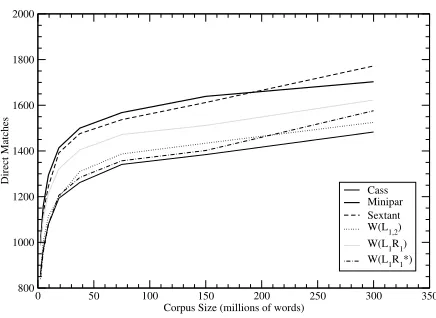
Figure 2 shows the performance trends for the indi-vidual extractors on corpora ranging from 2.3 mil-lion up to 300 milmil-lion words. The best individ-ual context extractors are SEXTANT, MINIPAR and W(L1R1), with SEXTANT outperforming MINIPAR
beyond approximately 200 million words. These
0 50 100 150 200 250 300 350
Corpus Size (millions of words) 800
1000 1200 1400 1600 1800 2000
Direct Matches
Cass Minipar Sextant W(L1,2)
W(L1R1) W(L1R1*)
Figure 2: Single extractor performance to 300MW
three extractors are combined to form the top-three ensemble. CASSand the other window methods per-form significantly worse than SEXTANTand MINI-PAR. Interestingly, W(L1R1∗) performs almost as well as W(L1R1) on larger corpora, suggesting that
position information is not as useful with large cor-pora, perhaps because the left and right set of words for each term becomes relatively disjoint.
[image:4.612.317.535.243.402.2]individ-System DIRECT P(1) P(5) P(10) INVR
CASS 1483 50% 41% 33% 1.58
MINIPAR 1703 59% 48% 40% 1.86
SEXTANT 1772 61% 47% 39% 1.87
W(L1,2) 1525 54% 43% 37% 1.68 W(L1R1) 1623 57% 46% 38% 1.76 W(L1R1∗) 1576 63% 44% 38% 1.78 MEAN(∗) 1850 66% 50% 43% 2.00
MEAN(3) 1802 63% 50% 44% 1.98
HARMONIC(∗) 1821 64% 51% 43% 2.00
HARMONIC(3) 1796 63% 51% 43% 1.96
MIXTURE(∗) 1858 64% 52% 44% 2.03
[image:5.612.78.294.70.205.2]MIXTURE(3) 1794 63% 51% 44% 1.99
Table 3: Extractor performance at 300MW
0 50 100 150 200 250 300 350
Corpus Size (millions of words) 1000
1200 1400 1600 1800 2000
Direct Matches
Minipar Sextant W(L1R1) Mean(*) Harmonic(*) Mixture(*)
Figure 3: Ensemble performance to 300MW
ual methods and the full ensembles. SEXTANT is the only competitive individual method as the corpus size increases. Figure 3 shows that ensemble meth-ods are of more value (at least in percentage terms) for smaller training sets. The trend in the graph sug-gests that the individual extractors will not outper-form the ensemble methods, unless the behaviour changes as corpus size is increased further.
From Table 3 we can also see that full ensembles, combining all the individual extractors, outperform ensembles combining only the top three extractors. This seems rather surprising at first, given that the other individual extractors seem to perform signifi-cantly worse than the top three. It is interesting to see how the weaker methods still contribute to the ensembles performance.
Firstly, for thesaurus extraction, there is no clear concept ofaccuracy greater than 50%since it is not a simple classification task. So, although most of the evaluation results are significantly less than 50%,
Ensemble Rs C
Ensemble(∗) on 2.3M words 0.467 69.2%
Ensemble(3) on 2.3M words 0.470 69.8% Ensemble(∗) on 300M words 0.481 54.1%
[image:5.612.330.520.71.125.2]Ensemble(3) on 300M words 0.466 51.2%
Table 4: Agreement between ensemble members
System CASS MINI SEXT W(L1,2) W(L1R1) W(L1R1∗)
CASS 0% 58% 59% 65% 63% 69%
MINI 57% 0% 47% 57% 54% 60%
SEXT 58% 47% 0% 54% 53% 58%
[image:5.612.328.526.161.235.2]W(L1,2) 65% 58% 55% 0% 40% 43% W(L1R1) 63% 54% 54% 39% 0% 33% W(L1R1∗) 69% 60% 58% 43% 33% 0%
Table 5: Complementarity for extractors
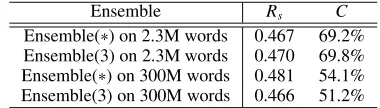
this does not represent a failure of a necessary condi-tion of ensemble improvement. If we constrain the-saurus extraction to selecting a single synonym clas-sification using the P(1) scores, then all of the meth-ods achieve 50% or greater accuracy. Considering the complementarity and rank-order correlation co-efficients for the constituents of the different ensem-bles proves to be more informative. Table 4 shows these values for the smallest and largest corpora and Table 5 shows the pairwise complementarity for the ensemble constituents.
It turns out that the average Spearman rank-order correlation is not sensitive enough to errors for the purposes of comparing favourable disagreement within ensembles. However, the average comple-mentarity clearly shows the convergence of the en-semble constituents, which partially explains the re-duced efficacy of ensemble methods for large cor-pora. Since the top-three ensembles suffer this to a greater degree, they perform significantly worse at 300 million words. Further, the full ensembles can amortise the individual biases better since they aver-age over a larger number of ensemble methods with different biases.
7 Analysis
Understanding ensemble behaviour on very large corpora is important because ensemble classifiers are state of the art for manyNLPtasks. This section explores possible explanations for why our results disagree with Banko and Brill (2001).
[image:5.612.74.297.240.400.2]disam-biguation are quite different tasks. In thesaurus ex-traction, contextual information is collected from the entire corpus into a single description of the environ-ments that each term appears in and classification, as such, involves comparing these collections of data. In confusion set disambiguation on the other hand, each instance must be classified individually with only a limited amount of context. The disambiguator has far less information available to determine each classification. This has implications for representa-tion sparseness and noise that a larger corpus helps to overcome, which in turn, affects the performance of ensemble methods against individual classifiers.
The complexity of the contextual representation and the strength of the correlation between target term and the context also plays a significant role. Curran and Moens (2002b) have demonstrated that more complex and constrained contexts can yield superior performance, since the correlation between context and target term is stronger than simple win-dow methods. Further, structural and grammatical relation methods can encode extra syntactic and se-mantic information in the relation type. Although the contextual representation is less susceptible to noise, it is often sparse because fewer context rela-tions are extracted from each sentence.
The less complex window methods exhibit the op-posite behaviour. Depending on the window param-eters, the context relations can be poorly correlated with the target term, and so we find a very large number of irrelevant relations with low and unstable frequency counts, that is, a noisy contextual repre-sentation. Since confusion set disambiguation uses limited contexts from single occurrences, it is likely to suffer the same problems as the window thesaurus extractors.
To evaluate an ensemble’s ability to reduce the data sparseness and noise problems suffered by dif-ferent context models, we constructed ensembles based on context extractors with different levels of complexity and constraints.
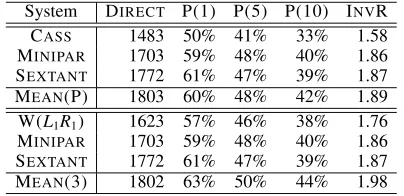
Table 6 shows the performance on the full cor-pus for the three syntactic extractors, the top three performing extractors and their corresponding mean rank ensembles. For these more complex and con-strained context extractors, the ensembles continue to outperform individual learners, since the context representation are still reasonably sparse. The
aver-System DIRECT P(1) P(5) P(10) INVR
CASS 1483 50% 41% 33% 1.58
MINIPAR 1703 59% 48% 40% 1.86
SEXTANT 1772 61% 47% 39% 1.87
MEAN(P) 1803 60% 48% 42% 1.89 W(L1R1) 1623 57% 46% 38% 1.76
MINIPAR 1703 59% 48% 40% 1.86
SEXTANT 1772 61% 47% 39% 1.87
[image:6.612.326.528.71.169.2]MEAN(3) 1802 63% 50% 44% 1.98
Table 6: Complex ensembles better than individuals
System DIRECT P(1) P(5) P(10) INVR W(L1) 1566 59% 42% 35% 1.70 W(L2) 1235 44% 36% 31% 1.38 W(R1) 1198 44% 28% 24% 1.19 W(R2) 1200 49% 30% 24% 1.25 MEAN(D1|2) 1447 54% 46% 37% 1.74 W(L1,2) 1525 54% 43% 37% 1.68 W(L1R1) 1623 57% 46% 38% 1.76 W(R1,2) 1348 53% 32% 29% 1.40 MEAN(D1,2) 1550 63% 46% 39% 1.81 W(L1,2∗) 1500 50% 41% 36% 1.60 W(L1R1∗) 1576 63% 44% 38% 1.78 W(R1,2∗) 1270 46% 29% 27% 1.28 MEAN(D1,2∗) 1499 64% 46% 39% 1.82
Table 7: Simple ensembles worse than individuals
age complementarity is greater than 50%.
Table 7 shows the performance on the full cor-pus for a wide range of window-based extractors and corresponding mean rank ensembles. Most of the individual learners perform poorly because the extracted contexts are only weakly correlated with the target terms. Although the ensemble performs better than most individuals, they fail to outperform the best individual on direct match evaluation. Since the average complementarity for these ensembles is similar to the methods above, we must conclude that it is a result of the individual methods themselves. In this case, the most correlated context extractor, e.g. W(L1R1), extracts a relatively noise free
representa-tion which performs better than amortising the bias of the other noisy ensemble constituents.
Finally, confusion set disambiguation yields a sin-gle classification from a small set of classes, whereas thesaurus extraction yields an ordered set contain-ing every potential synonym. The more flexible set of ranked results allow ensemble methods to exhibit more subtle variations in rank than simply selecting a single class.
syn-onym, P(1), and rank sensitive, INVR, evaluation measures. The results for P(1) do not appear to form any trend, although the results show that ensemble methods do not always improve single class selec-tion. However, if we consider the INVR measure, all of the ensemble methods outperform their con-stituent methods, and we see a significant improve-ment of approximately 10% with the MEAN(3) en-semble.
8 Conclusion
This paper demonstrates the effectiveness of ensem-ble methods for thesaurus extraction and investigates the performance of ensemble extractors on corpora ranging up to 300 million words in size. Contrary to work reported by Banko and Brill (2001), the en-semble methods continue to outperform the best in-dividual systems for very large corpora. The trend in Figure 3 suggests that this may continue for corpora even larger than we have experimented with.
Further, this paper examines the differences be-tween thesaurus extraction and confusion set dis-ambiguation, and links ensemble efficacy to the na-ture of each task and the problems of representation sparseness and noise. This is done by evaluating en-sembles with varying levels of contextual complex-ity and constraints.
The poorly constrained window methods, where contextual correlation is often low, outperformed the ensembles, which parallels results from (Banko and Brill, 2001). This suggests that large train-ing sets ameliorate the predominantly noise-induced bias of the best individual learner better than amor-tising the bias over many similar ensemble con-stituents. Noise is reduced as occurrence counts sta-bilise with larger corpora, improving individual clas-sifier performance, which in turn causes ensemble constituents to converge, reducing complementarity. This reduces the efficacy of classifier combination and contributes to individual classifiers outperform-ing the ensemble methods.
For more complex, constrained methods the same principles apply. Since the correlation between context and target is much stronger, there is less noise in the representation. However, the added constraints reduce the number of contextual rela-tions extracted from each sentence, leading to data
sparseness. These factors combine so that ensemble methods continued to outperform the best individual methods.
Finally, corpus size must be considered with re-spect to the parameters of the contextual representa-tion extracted from the corpus. The value of larger corpora is partly dependent on how much infortion is extracted from each sentence of training ma-terial. We fully expect individual thesaurus extrac-tors to eventually outperform ensemble methods as sparseness and complementarity are reduced, but this is not true for 100 or 300 million words since the best performing representations extract very few contexts per sentence.
We would like to further investigate the relation-ship between contextual complexity, data sparse-ness, noise and learner bias on very large corpora. This includes extending these experiments to an even larger corpus with the hope of establishing the cross over point for thesaurus extraction. Finally, al-though wider machine learning research uses large ensembles, manyNLPensembles use only a handful of classifiers. It would be very interesting to exper-iment with a large number of classifiers using bag-ging and boosting techniques on very large corpora.
Acknowledgements
We would like to thank Miles Osborne for initial dis-cussions which led to this work, and Marc Moens, Steve Finch and Tara Murphy for their feedback on drafts of this paper. This research is supported by a Commonwealth scholarship and a Sydney Univer-sity Travelling scholarship.
References
Steve Abney. 1996. Partial parsing via finite-state cas-cades. Journal of Natural Language Engineering, 2(4):337–344, December.
L. Douglas Baker and Andrew McCallum. 1998. Distri-butional clustering of words for text classification. In Proceedings of the 21st annual international ACM SI-GIR conference on Research and Development in
In-formation Retrieval, pages 96–103, Melbourne,
Aus-tralia, 24–28 August.
Association for Computational Linguistics, pages 26– 33, Toulouse, France, 9–11 July.
John R. L. Bernard, editor. 1990. The Macquarie
Ency-clopedic Thesaurus. The Macquarie Library, Sydney,
Australia.
Eric Brill and Jun Wu. 1998. Classifier combination for improved lexical disambiguation. In Proceedings of the 17th International Conference on Computational Linguistics and of the 36th Annual Meeting of the
As-sociation for Computational Linguistics, pages 191–
195, Montr´eal, Qu´ebec, Canada, 10–14 August.
Peter F. Brown, Vincent J. Della Pietra, Peter V. deSouza, Jennifer C. Lai, and Robert L. Mercer. 1992. Class-based n-gram models of natural language.
Computa-tional Linguistics, 18(4):467–479, December.
Stephen Clark and David Weir. 2001. Class-based prob-ability estimation using a semantic hierarchy. In Pro-ceedings of the Second Meeting of the North American Chapter of the Association for Computational Linguis-tics, pages 95–102, Pittsburgh, PA USA, 2–7 June.
James R. Curran and Marc Moens. 2002a. Improve-ments in automatic thesaurus extraction. In ACL-SIGLEX Workshop on Unsupervised Lexical Acquisi-tion, Philadelphia, PA USA, 12 July.(to appear).
James R. Curran and Marc Moens. 2002b. Scaling con-text space. In Proceedings of the 40th annual
meet-ing of the Association for Computational Lmeet-inguistics,
Philadelphia, PA USA, 7–12 July. (to appear).
Thomas G. Dietterich. 2000. Ensemble methods in machine learning. In Proceedings of the First In-ternational Workshop on Multiple Classifier Systems
(LNCS 1857), pages 1–15. Springer-Verlag, Cagliari,
Sardinia, Italy.
Cristiane Fellbaum, editor. 1998. WordNet: an
elec-tronic lexical database. The MIT Press, Cambridge,
MA USA.
Gregory Grefenstette. 1994. Explorations in Automatic
Thesaurus Discovery. Kluwer Academic Publishers,
Boston, USA.
John C. Henderson and Eric Brill. 1999. Exploiting diversity in natural language processing: Combining parsers. InProceedings of the Fourth Conference on Empirical Methods in Natural Language Processing
(EMNLP-99), pages 187–194, College Park,
Mary-land, USA.
Dekang Lin. 1998a. Dependency-based evaluation of MINIPAR. InWorkshop on the Evaluation of Parsing Systems, Proceedings of the First International
Con-ference on Language Resources and Evaluation, pages
234–241, Granada, Spain, 28–30 May.
Dekang Lin. 1998b. An information-theoretic definition of similarity. InProceedings of the Fifteen
Interna-tional Conference on Machine Learning, pages 296–
304, Madison, WI USA, 24–27 July.
Guido Minnen, John Carroll, and Darren Pearce. 2000. Robust applied morphological generation. InIn Pro-ceedings of the First International Natural Language
Generation Conference, pages 201–208, 12–16 June.
Darren Pearce. 2001. Synonymy in collocation extrac-tion. In Workshop on WordNet and Other Lexical Resources: Applications, Extensions and
Customiza-tions, (NAACL 2001), pages 41–46, Pittsburgh, PA
USA, 2–7 June.
Ted Pederson. 2000. A simple approach to building en-sembles of naive bayesian classifiers for word sense disambiguation. In Proceedings of the 6th Applied Natural Language Processing Conference and the 1st Meeting of the North American Chapter of the
As-sociation of Computational Linguistics, pages 63–69,
Seattle, WA USA, 29 April–4 May.
Fernando Pereira, Naftali Tishby, and Lillian Lee. 1993. Distributional clustering of English words. In Pro-ceedings of the 31st annual meeting of the
Associ-ation for ComputAssoci-ational Linguistics, pages 183–190,
Columbus, Ohio USA, 22–26 June.
Peter Roget. 1911. Thesaurus of English words and
phrases. Longmans, Green and Co., London, UK.
Gerda Ruge. 1997. Automatic detection of thesaurus re-lations for information retrieval applications. In Foundations of Computer Science: Potential Theory
-Cognition, Lecture Notes in Computer Science,
vol-ume LNCS 1337, pages 499–506. Springer Verlag, Berlin, Germany.
Erik F. Tjong Kim Sang. 2000. Noun phrase recog-nition by system combination. In Proceedings of the Language Technology Joint Conference
ANLP-NAACL2000, pages 50–55, Seattle, Washington, USA,
29 April–4 May.
Hans van Halteren, Jakub Zavrel, and Walter Daelemans. 1998. Improving data driven wordclass tagging by system combination. InProceedings of the 17th In-ternational Conference on Computational Linguistics and of the 36th Annual Meeting of the Association for
Computational Linguistics, pages 491–497, Montr´eal,
Qu´ebec, Canada, 10–14 August.