Supervised Learning of Universal Sentence Representations from
Natural Language Inference Data
Alexis Conneau Facebook AI Research [email protected]
Douwe Kiela Facebook AI Research
Holger Schwenk Facebook AI Research
Lo¨ıc Barrault LIUM, Universit´e Le Mans
Antoine Bordes Facebook AI Research
Abstract
Many modern NLP systems rely on word embeddings, previously trained in an un-supervised manner on large corpora, as base features. Efforts to obtain embed-dings for larger chunks of text, such as sentences, have however not been so suc-cessful. Several attempts at learning unsu-pervised representations of sentences have not reached satisfactory enough perfor-mance to be widely adopted. In this paper, we show how universal sentence represen-tations trained using the supervised data of the Stanford Natural Language Inference datasets can consistently outperform unsu-pervised methods like SkipThought vec-tors (Kiros et al., 2015) on a wide range of transfer tasks. Much like how com-puter vision uses ImageNet to obtain fea-tures, which can then be transferred to other tasks, our work tends to indicate the suitability of natural language inference for transfer learning to other NLP tasks. Our encoder is publicly available1.
1 Introduction
Distributed representations of words (or word em-beddings) (Bengio et al., 2003; Collobert et al., 2011; Mikolov et al., 2013; Pennington et al., 2014) have shown to provide useful features for various tasks in natural language processing and computer vision. While there seems to be a con-sensus concerning the usefulness of word embed-dings and how to learn them, this is not yet clear with regard to representations that carry the mean-ing of a full sentence. That is, how to capture the
1https://www.github.com/
facebookresearch/InferSent
relationships among multiple words and phrases in a single vector remains an question to be solved.
In this paper, we study the task of learning uni-versal representations of sentences, i.e., a sentence encoder model that is trained on a large corpus and subsequently transferred to other tasks. Two questions need to be solved in order to build such an encoder, namely: what is the preferable neu-ral network architecture; and how and on what task should such a network be trained. Follow-ing existFollow-ing work on learnFollow-ing word embeddFollow-ings, most current approaches consider learning sen-tence encoders in an unsupervised manner like SkipThought (Kiros et al.,2015) or FastSent (Hill et al., 2016). Here, we investigate whether su-pervised learning can be leveraged instead, tak-ing inspiration from previous results in computer vision, where many models are pretrained on the ImageNet (Deng et al.,2009) before being trans-ferred. We compare sentence embeddings trained on various supervised tasks, and show that sen-tence embeddings generated from models trained on a natural language inference (NLI) task reach the best results in terms of transfer accuracy. We hypothesize that the suitability of NLI as a train-ing task is caused by the fact that it is a high-level understanding task that involves reasoning about the semantic relationships within sentences.
Unlike in computer vision, where convolutional neural networks are predominant, there are mul-tiple ways to encode a sentence using neural net-works. Hence, we investigate the impact of the sentence encoding architecture on representational transferability, and compare convolutional, recur-rent and even simpler word composition schemes. Our experiments show that an encoder based on a bi-directional LSTM architecture with max pool-ing, trained on the Stanford Natural Language In-ference (SNLI) dataset (Bowman et al., 2015), yields state-of-the-art sentence embeddings
pared to all existing alternative unsupervised ap-proaches like SkipThought or FastSent, while be-ing much faster to train. We establish this findbe-ing on a broad and diverse set of transfer tasks that measures the ability of sentence representations to capture general and useful information.
2 Related work
Transfer learning using supervised features has been successful in several computer vision appli-cations (Razavian et al.,2014). Striking examples include face recognition (Taigman et al., 2014) and visual question answering (Antol et al.,2015), where image features trained on ImageNet (Deng et al.,2009) and word embeddings trained on large unsupervised corpora are combined.
In contrast, most approaches for sentence repre-sentation learning are unsupervised, arguably be-cause the NLP community has not yet found the best supervised task for embedding the semantics of a whole sentence. Another reason is that neural networks are very good at capturing the biases of the task on which they are trained, but can easily forget the overall information or semantics of the input data by specializing too much on these bi-ases. Learning models on large unsupervised task makes it harder for the model to specialize. Lit-twin and Wolf(2016) showed that co-adaptation of encoders and classifiers, when trained end-to-end, can negatively impact the generalization power of image features generated by an encoder. They pro-pose a loss that incorporates multiple orthogonal classifiers to counteract this effect.
Recent work on generating sentence embed-dings range from models that compose word em-beddings (Le and Mikolov, 2014; Arora et al., 2017;Wieting et al.,2016b) to more complex neu-ral network architectures. SkipThought vectors (Kiros et al., 2015) propose an objective func-tion that adapts the skip-gram model for words (Mikolov et al.,2013) to the sentence level. By en-coding a sentence to predict the sentences around it, and using the features in a linear model, they were able to demonstrate good performance on 8 transfer tasks. They further obtained better results using layer-norm regularization of their model in (Ba et al., 2016). Hill et al. (2016) showed that the task on which sentence embeddings are trained significantly impacts their quality. In ad-dition to unsupervised methods, they included su-pervised training in their comparison—namely, on
machine translation data (using the WMT’14 En-glish/French and English/German pairs), dictio-nary definitions and image captioning data from the COCO dataset (Lin et al.,2014). These mod-els obtained significantly lower results compared to the unsupervised Skip-Thought approach.
Recent work has explored training sentence en-coders on the SNLI corpus and applying them on the SICK corpus (Marelli et al.,2014), either us-ing multi-task learnus-ing or pretrainus-ing (Mou et al., 2016;Bowman et al.,2015). The results were in-conclusive and did not reach the same level as sim-pler approaches that directly learn a classifier on top of unsupervised sentence embeddings instead (Arora et al.,2017). To our knowledge, this work is the first attempt to fully exploit the SNLI cor-pus for building generic sentence encoders. As we show in our experiments, we are able to consis-tently outperform unsupervised approaches, even if our models are trained on much less (but human-annotated) data.
3 Approach
This work combines two research directions, which we describe in what follows. First, we ex-plain how the NLI task can be used to train univer-sal sentence encoding models using the SNLI task. We subsequently describe the architectures that we investigated for the sentence encoder, which, in our opinion, covers a suitable range of sentence encoders currently in use. Specifically, we exam-ine standard recurrent models such as LSTMs and GRUs, for which we investigate mean and max-pooling over the hidden representations; a self-attentive network that incorporates different views of the sentence; and a hierarchical convolutional network that can be seen as a tree-based method that blends different levels of abstraction.
embeddings in a supervised way. That is, we aim to demonstrate that sentence encoders trained on natural language inference are able to learn sen-tence representations that capture universally use-ful features.
sentence encoder with hypothesis input sentence encoder
with premise input
3-way softmax
u
v
fully-connected layers
[image:3.595.92.269.141.299.2](u, v,|u−v|, u∗v)
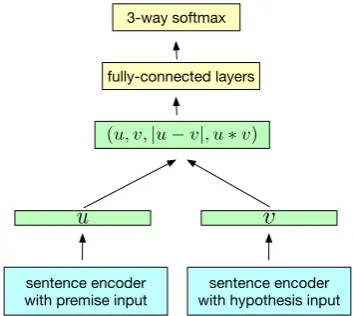
Figure 1:Generic NLI training scheme.
Models can be trained on SNLI in two differ-ent ways: (i) sdiffer-entence encoding-based models that explicitly separate the encoding of the individual sentences and (ii) joint methods that allow to use encoding of both sentences (to use cross-features or attention from one sentence to the other).
Since our goal is to train a generic sentence en-coder, we adopt the first setting. As illustrated in Figure1, a typical architecture of this kind uses a shared sentence encoder that outputs a representa-tion for the premiseuand the hypothesisv. Once the sentence vectors are generated, 3 matching methods are applied to extract relations between
uandv : (i) concatenation of the two representa-tions(u, v); (ii) element-wise productu∗v; and (iii) absolute element-wise difference|u−v|. The resulting vector, which captures information from both the premise and the hypothesis, is fed into a 3-class classifier consisting of multiple fully-connected layers culminating in a softmax layer.
3.2 Sentence encoder architectures
A wide variety of neural networks for encod-ing sentences into fixed-size representations ex-ists, and it is not yet clear which one best cap-tures generically useful information. We com-pare 7 different architectures: standard recurrent encoders with either Long Short-Term Memory (LSTM) or Gated Recurrent Units (GRU), con-catenation of last hidden states of forward and backward GRU, Bi-directional LSTMs (BiLSTM)
with either mean or max pooling, self-attentive network and hierarchical convolutional networks.
3.2.1 LSTM and GRU
Our first, and simplest, encoders apply recurrent neural networks using either LSTM (Hochreiter and Schmidhuber, 1997) or GRU (Cho et al., 2014) modules, as in sequence to sequence en-coders (Sutskever et al., 2014). For a sequence ofT words(w1, . . . , wT), the network computes a set ofT hidden representationsh1, . . . , hT, with
ht = −−−−→LSTM(w1, . . . , wT) (or using GRU units instead). A sentence is represented by the last hid-den vector,hT.
We also consider a model BiGRU-last that con-catenates the last hidden state of a forward GRU, and the last hidden state of a backward GRU to have the same architecture as for SkipThought vectors.
3.2.2 BiLSTM with mean/max pooling For a sequence of T words{wt}t=1,...,T, a bidirec-tional LSTM computes a set of T vectors {ht}t. For t ∈ [1, . . . , T], ht, is the concatenation of a forward LSTM and a backward LSTM that read the sentences in two opposite directions:
− →
ht = −−−−→LSTMt(w1, . . . , wT) ←h−
t = ←−−−−LSTMt(w1, . . . , wT)
ht = [−→ht,←h−t]
We experiment with two ways of combining the varying number of{ht}tto form a fixed-size vec-tor, either by selecting the maximum value over each dimension of the hidden units (max pooling) (Collobert and Weston, 2008) or by considering the average of the representations (mean pooling).
3.2.3 Self-attentive network
The self-attentive sentence encoder (Liu et al., 2016;Lin et al., 2017) uses an attention mecha-nism over the hidden states of a BiLSTM to gen-erate a representationuof an input sentence. The attention mechanism is defined as :
¯
hi = tanh(W hi+bw)
αi = e
¯
hT iuw
P
ie¯hTiuw
u = X
t
The movie was great ←−
h1 ←h−2 ←h−3 ←h−4
− →
h4 −
→
h3 −→
h2 −→
h1
w1 w2 w3 w4
x
x x
x x x x x
max-pooling … …
[image:4.595.115.247.63.235.2]u:
Figure 2:Bi-LSTM max-pooling network.
where{h1, . . . , hT}are the output hidden vec-tors of a BiLSTM. These are fed to an affine trans-formation (W, bw) which outputs a set of keys (¯h1, . . . ,¯hT). The {αi} represent the score of similarity between the keys and a learned con-text query vector uw. These weights are used to produce the final representation u, which is a weighted linear combination of the hidden vectors. Following Lin et al. (2017) we use a self-attentive network with multiple views of the input sentence, so that the model can learn which part of the sentence is important for the given task. Con-cretely, we have 4 context vectorsu1
w, u2w, u3w, u4w which generate 4 representations that are then con-catenated to obtain the sentence representationu. Figure3illustrates this architecture.
The movie was great
uw
←−
h1 ←h−2 ←h−3 ←h−4 − → h4 − → h3 −→ h2 −→ h1
α1 α2 α3 α4
u
w1 w2 w3 w4
Figure 3:Inner Attention network architecture.
3.2.4 Hierarchical ConvNet
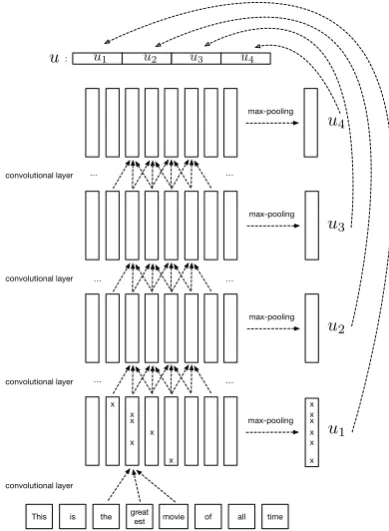
One of the currently best performing models on classification tasks is a convolutional architecture termed AdaSent (Zhao et al., 2015), which con-catenates different representations of the sentences
at different level of abstractions. Inspired by this architecture, we introduce a faster version consist-ing of 4 convolutional layers. At every layer, a representation ui is computed by a max-pooling operation over the feature maps (see Figure4).
… …
… …
… …
This is the greatest movie of all time x
x x x
x
x
max-pooling max-pooling max-pooling max-pooling
x x x
x x x u1
u2
u3
u4
u: u1 u2 u3 u4
convolutional layer
convolutional layer
convolutional layer
[image:4.595.317.512.140.406.2]convolutional layer
Figure 4:Hierarchical ConvNet architecture.
The final representation u = [u1, u2, u3, u4]
concatenates representations at different levels of the input sentence. The model thus captures hi-erarchical abstractions of an input sentence in a fixed-size representation.
3.3 Training details
For all our models trained on SNLI, we use SGD with a learning rate of 0.1 and a weight decay of 0.99. At each epoch, we divide the learning rate by 5 if the dev accuracy decreases. We use mini-batches of size 64 and training is stopped when the learning rate goes under the threshold of10−5. For
the classifier, we use a multi-layer perceptron with 1 hidden-layer of 512 hidden units. We use open-source GloVe vectors trained on Common Crawl 840B2with 300 dimensions as fixed word
embed-dings.
4 Evaluation of sentence representations Our aim is to obtain general-purpose sentence em-beddings that capture generic information that is
2https://nlp.stanford.edu/projects/
[image:4.595.99.267.510.650.2]name N task C examples
MR 11k sentiment (movies) 2 ”Too slow for a younger crowd , too shallow for an older one.” (neg) CR 4k product reviews 2 ”We tried it out christmas night and it worked great .” (pos) SUBJ 10k subjectivity/objectivity 2 ”A movie that doesn’t aim too high , but doesn’t need to.” (subj) MPQA 11k opinion polarity 2 ”don’t want”; ”would like to tell”; (neg, pos)
TREC 6k question-type 6 ”What are the twin cities ?” (LOC:city)
[image:5.595.72.525.64.135.2]SST 70k sentiment (movies) 2 ”Audrey Tautou has a knack for picking roles that magnify her [..]” (pos) Table 1: Classification tasks. C is the number of class and N is the number of samples.
useful for a broad set of tasks. To evaluate the quality of these representations, we use them as features in 12 transfer tasks. We present our sentence-embedding evaluation procedure in this section. We constructed a sentence evaluation tool3 to automate evaluation on all the tasks
men-tioned in this paper. The tool uses Adam (Kingma and Ba,2014) to fit a logistic regression classifier, with batch size 64.
Binary and multi-class classification We use a set of binary classification tasks (see Table 1) that covers various types of sentence classifica-tion, including sentiment analysis (MR, SST), question-type (TREC), product reviews (CR), sub-jectivity/objectivity (SUBJ) and opinion polarity (MPQA). We generate sentence vectors and train a logistic regression on top. A linear classifier re-quires fewer parameters than an MLP and is thus suitable for small datasets, where transfer learning is especially well-suited. We tune the L2 penalty of the logistic regression with grid-search on the validation set.
Entailment and semantic relatedness We also evaluate on the SICK dataset for both entailment (SICK-E) and semantic relatedness (SICK-R). We use the same matching methods as in SNLI and learn a Logistic Regression on top of the joint rep-resentation. For semantic relatedness evaluation, we follow the approach of (Tai et al., 2015) and learn to predict the probability distribution of re-latedness scores. We report Pearson correlation. STS14 - Semantic Textual Similarity While semantic relatedness is supervised in the case of SICK-R, we also evaluate our embeddings on the 6 unsupervised SemEval tasks of STS14 (Agirre et al., 2014). This dataset includes subsets of news articles, forum discussions, image descrip-tions and headlines from news articles contain-ing pairs of sentences (lower-cased), labeled with
3https://www.github.com/
facebookresearch/SentEval
a similarity score between 0 and 5. These tasks evaluate how the cosine distance between two sen-tences correlate with a human-labeled similarity score through Pearson and Spearman correlations.
Paraphrase detection The Microsoft Research Paraphrase Corpus is composed of pairs of sen-tences which have been extracted from news sources on the Web. Sentence pairs have been human-annotated according to whether they cap-ture a paraphrase/semantic equivalence relation-ship. We use the same approach as with SICK-E, except that our classifier has only 2 classes. Caption-Image retrieval The caption-image retrieval task evaluates joint image and language feature models (Hodosh et al., 2013; Lin et al., 2014). The goal is either to rank a large collec-tion of images by their relevance with respect to a given query caption (Image Retrieval), or ranking captions by their relevance for a given query image (Caption Retrieval). We use a pairwise ranking-lossLcir(x, y):
X
y
X
k
max(0, α−s(V y, Ux) +s(V y, Uxk)) +
X
x
X
k0
max(0, α−s(Ux, V y) +s(Ux, V yk0))
where (x, y) consists of an image y with one of its associated captionsx,(yk)k and(yk0)k0 are
negative examples of the ranking loss, α is the margin andscorresponds to the cosine similarity.
name task N premise hypothesis label
SNLI NLI 560k ”Two women are embracing while
holding to go packages.” ”Two woman are holding packages.” entailment SICK-E NLI 10k A man is typing on a machine used
for stenography The man isn’t operating a steno-graph contradiction SICK-R STS 10k ”A man is singing a song and
play-ing the guitar” ”A man is opening a package thatcontains headphones” 1.6 STS14 STS 4.5k ”Liquid ammonia leak kills 15 in
[image:6.595.77.523.60.156.2]Shanghai” ”Liquid ammonia leak kills at least15 in Shanghai” 4.6 Table 2: Natural Language Inference and Semantic Textual Similarity tasks. NLI labels are contra-diction, neutral and entailment. STS labels are scores between 0 and 5.
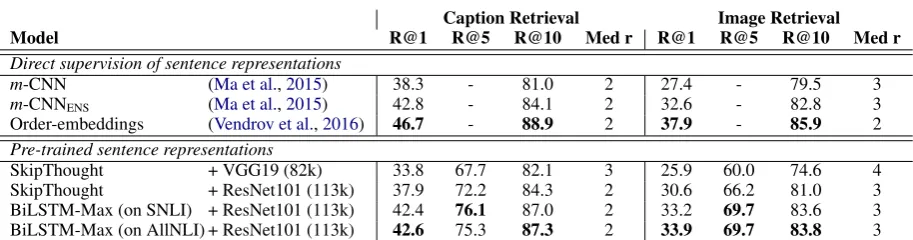
median (Med r) over the 5 splits. For fair compari-son, we also report SkipThought results in our set-ting, using 2048-dimensional pretrained ResNet-101 (He et al.,2016) with 113k training images.
Model dim devNLItest microTransfermacro
LSTM 2048 81.9 80.7 79.5 78.6
GRU 4096 82.4 81.8 81.7 80.9
[image:6.595.72.295.278.371.2]BiGRU-last 4096 81.3 80.9 82.9 81.7 BiLSTM-Mean 4096 79.0 78.2 83.1 81.7 Inner-attention 4096 82.3 82.5 82.1 81.0 HConvNet 4096 83.7 83.4 82.0 80.9 BiLSTM-Max 4096 85.0 84.5 85.2 83.7
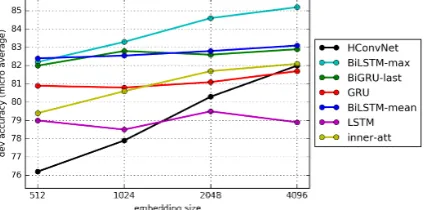
Table 3: Performance of sentence encoder ar-chitectures on SNLI and (aggregated) transfer tasks. Dimensions of embeddings were selected according to best aggregated scores (see Figure5).
Figure 5: Transfer performance w.r.t. embed-ding sizeusing the micro aggregation method.
5 Empirical results
In this section, we refer to ”micro” and ”macro” averages of development set (dev) results on trans-fer tasks whose metrics is accuracy: we compute a ”macro” aggregated score that corresponds to the classical average of dev accuracies, and the ”mi-cro” score that is a sum of the dev accuracies, weighted by the number of dev samples.
5.1 Architecture impact
Model We observe in Table3that different mod-els trained on the same NLI corpus lead to differ-ent transfer tasks results. The BiLSTM-4096 with the max-pooling operation performs best on both SNLI and transfer tasks. Looking at the micro and macro averages, we see that it performs signifi-cantly better than the other models LSTM, GRU, BiGRU-last, BiLSTM-Mean, inner-attention and the hierarchical-ConvNet.
Table 3 also shows that better performance on the training task does not necessarily translate in better results on the transfer tasks like when com-paring inner-attention and BiLSTM-Mean for in-stance.
We hypothesize that some models are likely to over-specialize and adapt too well to the biases of a dataset without capturing general-purpose infor-mation of the input sentence. For example, the inner-attention model has the ability to focus only on certain parts of a sentence that are useful for the SNLI task, but not necessarily for the transfer tasks. On the other hand, BiLSTM-Mean does not make sharp choices on which part of the sentence is more important than others. The difference be-tween the results seems to come from the different abilities of the models to incorporate general in-formation while not focusing too much on specific features useful for the task at hand.
For a given model, the transfer quality is also sensitive to the optimization algorithm: when training with Adam instead of SGD, we observed that the BiLSTM-max converged faster on SNLI (5 epochs instead of 10), but obtained worse re-sults on the transfer tasks, most likely because of the model and classifier’s increased capability to over-specialize on the training task.
[image:6.595.76.289.468.573.2]Model MR CR SUBJ MPQA SST TREC MRPC SICK-R SICK-E STS14 Unsupervised representation training (unordered sentences)
Unigram-TFIDF 73.7 79.2 90.3 82.4 - 85.0 73.6/81.7 - - .58/.57
ParagraphVec (DBOW) 60.2 66.9 76.3 70.7 - 59.4 72.9/81.1 - - .42/.43
SDAE 74.6 78.0 90.8 86.9 - 78.4 73.7/80.7 - - .37/.38
SIF (GloVe + WR) - - - - 82.2 - - - 84.6 .69/
-word2vec BOW† 77.7 79.8 90.9 88.3 79.7 83.6 72.5/81.4 0.803 78.7 .65/.64
fastText BOW† 76.5 78.9 91.6 87.4 78.8 81.8 72.4/81.2 0.800 77.9 .63/.62
GloVe BOW† 78.7 78.5 91.6 87.6 79.8 83.6 72.1/80.9 0.800 78.6 .54/.56
GloVe Positional Encoding† 78.3 77.4 91.1 87.1 80.6 83.3 72.5/81.2 0.799 77.9 .51/.54
BiLSTM-Max (untrained)† 77.5 81.3 89.6 88.7 80.7 85.8 73.2/81.6 0.860 83.4 .39/.48
Unsupervised representation training (ordered sentences)
FastSent 70.8 78.4 88.7 80.6 - 76.8 72.2/80.3 - - .63/.64
FastSent+AE 71.8 76.7 88.8 81.5 - 80.4 71.2/79.1 - - .62/.62
SkipThought 76.5 80.1 93.6 87.1 82.0 92.2 73.0/82.0 0.858 82.3 .29/.35
SkipThought-LN 79.4 83.1 93.7 89.3 82.9 88.4 - 0.858 79.5 .44/.45
Supervised representation training
CaptionRep (bow) 61.9 69.3 77.4 70.8 - 72.2 - - - .46/.42
DictRep (bow) 76.7 78.7 90.7 87.2 - 81.0 68.4/76.8 - - .67/.70
NMT En-to-Fr 64.7 70.1 84.9 81.5 - 82.8 - - .43/.42
Paragram-phrase - - - - 79.7 - - 0.849 83.1 .71/
-BiLSTM-Max (on SST)† (*) 83.7 90.2 89.5 (*) 86.0 72.7/80.9 0.863 83.1 .55/.54
BiLSTM-Max (on SNLI)† 79.9 84.6 92.1 89.8 83.3 88.7 75.1/82.3 0.885 86.3 .68/.65
BiLSTM-Max (on AllNLI)† 81.1 86.3 92.4 90.2 84.6 88.2 76.2/83.1 0.884 86.3 .70/.67
Supervised methods (directly trained for each task – no transfer)
Naive Bayes - SVM 79.4 81.8 93.2 86.3 83.1 - - - -
-AdaSent 83.1 86.3 95.5 93.3 - 92.4 - - -
-TF-KLD - - - 80.4/85.9 - -
-Illinois-LH - - - 84.5
-Dependency Tree-LSTM - - - 0.868 -
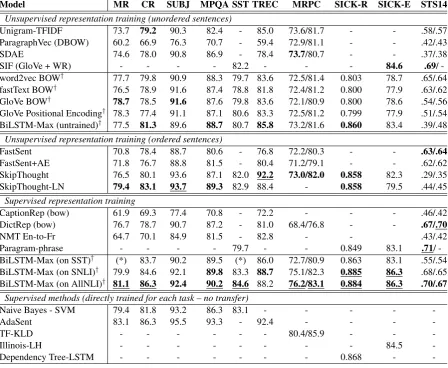
-Table 4: Transfer test results for various architectures trained in different ways. Underlined are best results for transfer learning approaches, in bold are best results among the models trained in the same way. † indicates methods that we trained, other transfer models have been extracted from (Hill
et al., 2016). For best published supervised methods (no transfer), we consider AdaSent (Zhao et al., 2015), TF-KLD (Ji and Eisenstein,2013), Tree-LSTM (Tai et al.,2015) and Illinois-LH system (Lai and Hockenmaier,2014). (*) Our model trained on SST obtained 83.4 for MR and 86.0 for SST (MR and SST come from the same source), which we do not put in the tables for fair comparison with transfer methods.
regard to the embedding size.
Since it is easier to linearly separate in high di-mension, especially with logistic regression, it is not surprising that increased embedding sizes lead to increased performance for almost all models. However, this is particularly true for some mod-els (BiLSTM-Max, HConvNet, inner-att), which demonstrate unequal abilities to incorporate more information as the size grows. We hypothesize that such networks are able to incorporate infor-mation that is not directly relevant to the objective task (results on SNLI are relatively stable with re-gard to embedding size) but that can nevertheless be useful as features for transfer tasks.
5.2 Task transfer
[image:7.595.75.524.64.432.2]unsu-Caption Retrieval Image Retrieval
Model R@1 R@5 R@10 Med r R@1 R@5 R@10 Med r
Direct supervision of sentence representations
m-CNN (Ma et al.,2015) 38.3 - 81.0 2 27.4 - 79.5 3
m-CNNENS (Ma et al.,2015) 42.8 - 84.1 2 32.6 - 82.8 3
Order-embeddings (Vendrov et al.,2016) 46.7 - 88.9 2 37.9 - 85.9 2 Pre-trained sentence representations
SkipThought + VGG19 (82k) 33.8 67.7 82.1 3 25.9 60.0 74.6 4
SkipThought + ResNet101 (113k) 37.9 72.2 84.3 2 30.6 66.2 81.0 3
[image:8.595.73.530.59.179.2]BiLSTM-Max (on SNLI) + ResNet101 (113k) 42.4 76.1 87.0 2 33.2 69.7 83.6 3 BiLSTM-Max (on AllNLI) + ResNet101 (113k) 42.6 75.3 87.3 2 33.9 69.7 83.8 3 Table 5: COCO retrieval results. SkipThought is trained either using 82k training samples with VGG19 features, or with 113k samples and ResNet-101 features (our setting). We report the average results on 5 splits of 1k test images.
pervised ordered sentences such as FastSent and SkipThought (also trained on the Toronto book corpus). We also include the FastSent variant “FastSent+AE” and the SkipThought-LN version that uses layer normalization. We report results from models trained on supervised data in the third group, and also report some results of supervised methods trained directly on each task for compar-ison with transfer learning approaches.
Comparison with SkipThought The best performing sentence encoder to date is the SkipThought-LN model, which was trained on a very large corpora of ordered sentences. With much less data (570k compared to 64M sentences) but with high-quality supervision from the SNLI dataset, we are able to consistently outperform the results obtained by SkipThought vectors. We train our model in less than a day on a single GPU compared to the best SkipThought-LN network trained for a month. Our BiLSTM-max trained on SNLI performs much better than released SkipThought vectors on MR, CR, MPQA, SST, MRPC-accuracy, SICK-R, SICK-E and STS14 (see Table 4). Except for the SUBJ dataset, it also performs better than SkipThought-LN on MR, CR and MPQA. We also observe by looking at the STS14 results that the cosine metrics in our embedding space is much more semantically informative than in SkipThought embedding space (pearson score of 0.68 compared to 0.29 and 0.44 for ST and ST-LN). We hypothesize that this is namely linked to the matching method of SNLI models which incorporates a notion of distance (element-wise product and absolute difference) during training.
NLI as a supervised training set Our findings indicate that our model trained on SNLI obtains much better overall results than models trained on other supervised tasks such as COCO, dictio-nary definitions, NMT, PPDB (Ganitkevitch et al., 2013) and SST. For SST, we tried exactly the same models as for SNLI; it is worth noting that SST is smaller than NLI. Our representations constitute higher-quality features for both classification and similarity tasks. One explanation is that the natu-ral language inference task constrains the model to encode the semantic information of the input sen-tence, and that the information required to perform NLI is generally discriminative and informative.
Domain adaptation on SICK tasks Our trans-fer learning approach obtains better results than previous state-of-the-art on the SICK task - can be seen as an out-domain version of SNLI - for both entailment and relatedness. We obtain a pear-son score of 0.885 on SICK-R while (Tai et al., 2015) obtained 0.868, and we obtain 86.3% test accuracy on SICK-E while previous best hand-engineered models (Lai and Hockenmaier,2014) obtained 84.5%. We also significantly outper-formed previous transfer learning approaches on SICK-E (Bowman et al., 2015) that used the pa-rameters of an LSTM model trained on SNLI to fine-tune on SICK (80.8% accuracy). We hypothe-size that our embeddings already contain the infor-mation learned from the in-domain task, and that learning only the classifier limits the number of parameters learned on the small out-domain task.
ResNet features and 30k more training data, the SkipThought vectors perform significantly better than the original setting, going from 33.8 to 37.9 for caption retrieval R@1, and from 25.9 to 30.6 on image retrieval R@1. Our approach pushes the results even further, from 37.9 to 42.4 on cap-tion retrieval, and 30.6 to 33.2 on image retrieval. These results are comparable to previous approach of (Ma et al.,2015) that did not do transfer but di-rectly learned the sentence encoding on the image-caption retrieval task. This supports the claim that pre-trained representations such as ResNet image features and our sentence embeddings can achieve competitive results compared to features learned directly on the objective task.
MultiGenre NLI The MultiNLI corpus (Williams et al., 2017) was recently released as a multi-genre version of SNLI. With 433K sentence pairs, MultiNLI improves upon SNLI in its coverage: it contains ten distinct genres of written and spoken English, covering most of the complexity of the language. We augment Table 4 with our model trained on both SNLI and MultiNLI (AllNLI). We observe a significant boost in performance overall compared to the model trained only on SLNI. Our model even reaches AdaSent performance on CR, suggesting that having a larger coverage for the training task helps learn even better general representations. On semantic textual similarity STS14, we are also competitive with PPDB based paragram-phrase embeddings with a pearson score of 0.70. Interestingly, on caption-related transfer tasks such as the COCO image caption retrieval task, training our sentence encoder on other genres from MultiNLI does not degrade the performance compared to the model trained only SNLI (which contains mostly captions), which confirms the generalization power of our embeddings.
6 Conclusion
This paper studies the effects of training sentence embeddings with supervised data by testing on 12 different transfer tasks. We showed that els learned on NLI can perform better than mod-els trained in unsupervised conditions or on other supervised tasks. By exploring various architec-tures, we showed that a BiLSTM network with max pooling makes the best current universal sen-tence encoding methods, outperforming existing approaches like SkipThought vectors.
We believe that this work only scratches the sur-face of possible combinations of models and tasks for learning generic sentence embeddings. Larger datasets that rely on natural language understand-ing for sentences could brunderstand-ing sentence embeddunderstand-ing quality to the next level.
References
Eneko Agirre, Carmen Banea, Claire Cardie, Daniel Cer, Mona Diab, Aitor Gonzalez-Agirre, Weiwei Guo, Rada Mihalcea, German Rigau, and Janyce Wiebe. 2014. Semeval-2014 task 10: Multilingual semantic textual similarity. In Proceedings of the 8th International Workshop on Semantic Evaluation (SemEval 2014), pages 81–91, Dublin, Ireland. As-sociation for Computational Linguistics and Dublin City University.
Stanislaw Antol, Aishwarya Agrawal, Jiasen Lu, Mar-garet Mitchell, Dhruv Batra, C Lawrence Zitnick, and Devi Parikh. 2015. Vqa: Visual question an-swering. InProceedings of the IEEE International Conference on Computer Vision, pages 2425–2433.
Sanjeev Arora, Yingyu Liang, and Tengyu Ma. 2017. A simple but tough-to-beat baseline for sentence em-beddings.Proceedings of the 5th International Con-ference on Learning Representations (ICLR).
Jimmy Lei Ba, Jamie Ryan Kiros, and Geoffrey E Hin-ton. 2016. Layer normalization.Advances in neural information processing systems (NIPS).
Yoshua Bengio, Rejean Ducharme, and Pascal Vincent. 2003. A neural probabilistic language model. Jour-nal of Machine Learning Research, 3:1137–1155.
Samuel R. Bowman, Gabor Angeli, Christopher Potts, and Christopher D. Manning. 2015. A large an-notated corpus for learning natural language infer-ence. In Proceedings of the 2015 Conference on Empirical Methods in Natural Language Processing (EMNLP).
Kyunghyun Cho, Bart van Merrienboer, Dzmitry Bah-danau, and Yoshua Bengio. 2014. On the properties of neural machine translation: Encoder-decoder ap-proaches. InEighth Workshop on Syntax, Semantics and Structure in Statistical Translation (SSST-8).
Ronan Collobert and Jason Weston. 2008. A unified architecture for natural language processing: Deep neural networks with multitask learning. In Pro-ceedings of the 25th international conference on Machine learning, pages 160–167. ACM.
Jia Deng, Wei Dong, Richard Socher, Li-Jia Li, Kai Li, and Li Fei-Fei. 2009. Imagenet: A large-scale hi-erarchical image database. InComputer Vision and Pattern Recognition, 2009. CVPR 2009. IEEE Con-ference on, pages 248–255. IEEE.
Juri Ganitkevitch, Benjamin Van Durme, and Chris Callison-Burch. 2013. PPDB: The paraphrase database. In Proceedings of NAACL-HLT, pages 758–764, Atlanta, Georgia. Association for Compu-tational Linguistics.
Kaiming He, Xiangyu Zhang, Shaoqing Ren, and Jian Sun. 2016. Deep residual learning for image recog-nition. InConference on Computer Vision and Pat-tern Recognition (CVPR), page 8. IEEE.
Felix Hill, Kyunghyun Cho, and Anna Korhonen. 2016. Learning distributed representations of sentences from unlabelled data. arXiv preprint arXiv:1602.03483.
Sepp Hochreiter and J¨urgen Schmidhuber. 1997. Long short-term memory. Neural computation, 9(8):1735–1780.
Miach Hodosh, Peter Young, and Julia Hockenmaier. 2013. Framing image description as a ranking task: Data, models and evaluation metrics. Journal of Ar-tificial Intelligence Research, 47:853–899.
Yangfeng Ji and Jacob Eisenstein. 2013. Discrimina-tive improvements to distributional sentence simi-larity. In Proceedings of the 2013 Conference on Empirical Methods in Natural Language Processing (EMNLP).
Andrej Karpathy and Li Fei-Fei. 2015. Deep visual-semantic alignments for generating image descrip-tions. In Proceedings of the IEEE Conference on Computer Vision and Pattern Recognition, pages 3128–3137.
Diederik P. Kingma and Jimmy Ba. 2014. Adam: A method for stochastic optimization. In Proceed-ings of the 3rd International Conference on Learn-ing Representations (ICLR).
Ryan Kiros, Yukun Zhu, Ruslan R Salakhutdinov, Richard Zemel, Raquel Urtasun, Antonio Torralba, and Sanja Fidler. 2015. Skip-thought vectors. In Advances in neural information processing systems (NIPS), pages 3294–3302.
Alice Lai and Julia Hockenmaier. 2014. Illinois-lh: A denotational and distributional approach to seman-tics. Proc. SemEval, 2:5.
Quoc V Le and Tomas Mikolov. 2014. Distributed rep-resentations of sentences and documents. In Pro-ceedings of the 31st International Conference on Machine Learning, volume 14, pages 1188–1196. Tsung-Yi Lin, Michael Maire, Serge Belongie, James
Hays, Pietro Perona, Deva Ramanan, Piotr Doll´ar, and C Lawrence Zitnick. 2014. Microsoft coco:
Common objects in context. In European Confer-ence on Computer Vision, pages 740–755. Springer International Publishing.
Zhouhan Lin, Minwei Feng, Cicero Nogueira dos San-tos, Mo Yu, Bing Xiang, Bowen Zhou, and Yoshua Bengio. 2017. A structured self-attentive sentence embedding. International Conference on Learning Representations (ICLR).
Etai Littwin and Lior Wolf. 2016. The multiverse loss for robust transfer learning. In Proceedings of the IEEE Conference on Computer Vision and Pattern Recognition, pages 3957–3966.
Yang Liu, Chengjie Sun, Lei Lin, and Xiaolong Wang. 2016. Learning natural language inference using bidirectional lstm model and inner-attention. arXiv preprint arXiv:1605.09090.
Lin Ma, Zhengdong Lu, Lifeng Shang, and Hang Li. 2015. Multimodal convolutional neural networks for matching image and sentence. InProceedings of the IEEE International Conference on Computer Vision, pages 2623–2631.
Marco Marelli, Stefano Menini, Marco Baroni, Luisa Bentivogli, Raffaella Bernardi, and Roberto Zam-parelli. 2014. A sick cure for the evaluation of compositional distributional semantic models. In Proceedings of the 9th International Conference on Language Resources and Evaluation (LREC), pages 216–223.
Tomas Mikolov, Ilya Sutskever, Kai Chen, Greg S Cor-rado, and Jeff Dean. 2013. Distributed representa-tions of words and phrases and their compositional-ity. InAdvances in neural information processing systems (NIPS), pages 3111–3119.
Lili Mou, Zhao Meng, Rui Yan, Ge Li, Yan Xu, Lu Zhang, and Zhi Jin. 2016. How transferable are neural networks in nlp applications? Proceedings of the 2016 Conference on Empirical Methods in Nat-ural Language Processing (EMNLP).
Jeffrey Pennington, Richard Socher, and Christopher D Manning. 2014. Glove: Global vectors for word representation. In Proceedings of the 2014 Con-ference on Empirical Methods in Natural Language Processing (EMNLP), volume 14, pages 1532–1543.
Ali Sharif Razavian, Hossein Azizpour, Josephine Sul-livan, and Stefan Carlsson. 2014. Cnn features off-the-shelf: an astounding baseline for recognition. In Proceedings of the IEEE Conference on Computer Vision and Pattern Recognition Workshops, pages 806–813.
Kai Sheng Tai, Richard Socher, and Christopher D Manning. 2015. Improved semantic representations from tree-structured long short-term memory net-works. Proceedings of the 53rd Annual Meeting of the Association for Computational Linguistics (ACL).
Yaniv Taigman, Ming Yang, Marc’Aurelio Ranzato, and Lior Wolf. 2014. Deepface: Closing the gap to human-level performance in face verification. In Conference on Computer Vision and Pattern Recog-nition (CVPR), page 8. IEEE.
Ivan Vendrov, Ryan Kiros, Sanja Fidler, and Raquel Urtasun. 2016. Order-embeddings of images and language. International Conference on Learning Representations (ICLR).
John Wieting, Mohit Bansal, Kevin Gimpel, and Karen Livescu. 2016a. Charagram: Embedding words and sentences via character n-grams. Proceedings of the 2016 Conference on Empirical Methods in Natural Language Processing (EMNLP).
John Wieting, Mohit Bansal, Kevin Gimpel, and Karen Livescu. 2016b. Towards universal paraphrastic sentence embeddings. International Conference on Learning Representations (ICLR).
Adina Williams, Nikita Nangia, and Samuel R Bow-man. 2017. A broad-coverage challenge corpus for sentence understanding through inference. arXiv preprint arXiv:1704.05426.
Han Zhao, Zhengdong Lu, and Pascal Poupart. 2015. Self-adaptive hierarchical sentence model. In Pro-ceedings of the 24th International Conference on Artificial Intelligence, IJCAI’15, pages 4069–4076. AAAI Press.