QUINT: Interpretable Question Answering over Knowledge Bases
Abdalghani Abujabal1, Rishiraj Saha Roy1, Mohamed Yahya2and Gerhard Weikum1
1Max Planck Institute for Informatics, Saarland Informatics Campus, Germany
{abujabal, rishiraj, weikum}@mpi-inf.mpg.de
2Bloomberg L.P., London, United Kingdom
Abstract
We present QUINT, a live system for question answering over knowledge bases. QUINT automatically learns role-aligned utterance-query templates from user ques-tions paired with their answers. When QUINT answers a question, it visualizes the complete derivation sequence from the natural language utterance to the final an-swer. The derivation provides an explana-tion of how the syntactic structure of the question was used to derive the structure of a SPARQL query, and how the phrases in the question were used to instantiate dif-ferent parts of the query. When an an-swer seems unsatisfactory, the derivation provides valuable insights towards refor-mulating the question.
1 Introduction
Motivation.A KB-QA system takes a natural lan-guage utterance as input and produces one or more
crisp answers as output (Bast and Haussmann,
2015;Berant et al.,2013;Reddy et al.,2014;Yih et al.,2015). This is usually done through seman-tic parsing: translating the utterance to a formal query in a language such as SPARQL, and execut-ing this query over a KB like Freebase (Bollacker et al.,2008) or YAGO (Suchanek et al.,2007) to return one or more answer entities.
In addition to answering questions, a KB-QA system should ideally be able to explain how an answer was derived i.e., how the system under-stood the users’ questions. While rapid progress is being made on the KB-QA task, the quality of an-swers obtained from KB-QA systems are far from 2Work done while at the Max Planck Institute for
Infor-matics
perfect. This is due to a combination of factors related to the ambiguity of natural language, the underlying data (e.g., KB incompleteness, gaps in lexicon coverage) and the KB-QA systems them-selves (e.g., errors in named entity recognition and disambiguation, query ranking). Explanations help address this gap in two ways: (i) helping users gain confidence when correct answers are re-turned, and (ii) making sense of the limitations of the system by looking at explanations for wrong answers, possibly providing cues to work around them. For an expert user, explanations also con-tribute totraceability: identifying the exact point of failure in the KB-QA system pipeline, which can be used for subsequent debugging.
In this work, we demonstrate QUINT (Abujabal et al.,2017), a state-of-the-art KB-QA system that gives step-by-step explanations of how it derives answers for questions. Furthermore, when QUINT is unable to link a specific phrase in the question to a KB item, it asks the user to reformulate the phrase. Such reformulations can be used to im-prove various components in the KB-QA pipeline such as underlying lexicons. QUINT takes the first step towards enabling interactive QA in the future, where the system can ask the user about parts of the question that it is unsure about.
Example. Take the question“Where was
Mar-tin Luther raised?”: QUINT returns Eisleben
in Germany as the top answer. A quick
look by the user at the derivation reveals that
(i) ‘Martin Luther’ was mapped to the KB
entity MartinLuther, the theologist, and (ii)
‘raised’ was interpreted as the KB predicate
placeOfBirth. For (i), if the user had intended
the US activistMartinLutherKinginstead, a sim-ple reformulation with“martin luther king”in the input returnsAtlanta, the US city where Luther
King was born. On the other hand, for (ii), if the birthplace was not the specific intent, a quick
rephrasing of the question to “Where did Martin
Luther live?” results inSaxony-Anhalt, which is
derived from the predicateplacesLived.
Motivated by the need for interpretable question answering, QUINT’s approach to KB-QA relies
on role-aligned templates, where each template
consists of anutterance template based on a de-pendency parse pattern and a correspondingquery
template based on the SPARQL query language.
The template (i) specifies how to chunk an utter-ance into phrases, (ii) guides how these phrases map to KB primitives by specifying their seman-tic roles as predicates, entities, or types, and (iii) aligns syntactic structure in the utterance to the se-mantic predicate-argument structure of the query.
Limitations of past work. Prior template-based
approaches rely on a set of manually defined
rules or templates to handle user questions ( Be-rant et al., 2013;Fader et al., 2013, 2014;Unger et al., 2012;Yahya et al., 2013;Yao and Durme,
2014; Zou et al., 2014). The main drawback of these approaches is the limited coverage of templates, making them brittle when it comes to unconventional question formulations. In con-trast, QUINT automatically learns templates from question-answer pairs.
Embedding-based methods (Bordes et al.,2014;
Dong et al., 2015; Yang et al., 2014; Xu et al.,
2016) map questions, KB entities, and subgraphs to a shared space for KB-QA without explic-itly generating a semantic representation. This makes it difficult for such systems to generate fine-grained explanations to users.
Other approaches to KB-QA (Bast and
Hauss-mann, 2015; Yih et al., 2015) over-generate query candidates for a given utterance with no fine-grained alignments to map natural language phrases in a question onto different KB items, making explainability challenging.
Contribution. The key contribution of this demo paper is a live online KB-QA system that visu-alizes the derivation steps for generating an an-swer, and thus takes the first steps towards ex-plainable question-answering. The demo is
avail-able at the following URL: https://gate.
d5.mpi-inf.mpg.de/quint/quint.
2 QUINT
We now give a brief overview of QUINT (
Abu-jabal et al., 2017), the KB-QA system driving our demonstration. QUINT has a training phase
Role-aligned (Utterance dependency parse,
backbone query)
(Utterance, gold answer) (Utterance dependency parse, backbone query)
Training phase Role-aligned (Utterance
template, query template) Template bank
Queries instantiated from paired query templates
Answer Best query Utterance templates matching new utterance
Answering phase Backbone query
generation Alignment with ILP
Token generalization
Formal query execution Learning to rank Template matching
[image:2.595.318.516.64.191.2]and instantiation
Figure 1: Overview of QUINT.
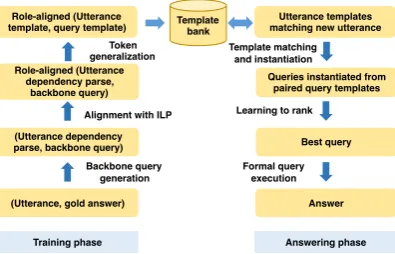
for automatically learning templates and a query ranking function, and an answering phase where templates are used to instantiate queries that are ranked by the learned function. Figure1shows a block diagram for QUINT.
2.1 Training phase
The input to QUINT’s training phase is a set
of natural language utterances u ∈ U and the
corresponding gold answer set Au from a KB
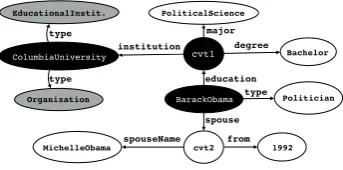
such as the one shown in Figure 2. An
ex-ample of a training utterance is u =“Where
was Obama educated?”, which is paired with
the answer set Au = {ColumbiaUniversity,
HarvardUniversity, PunahouSchool}. First,
entity mentions in each utterance u are detected and disambiguated to Freebase entities using the AIDA system (Hoffart et al.,2011).
Next, QUINT heuristically constructs a query to capture the question, the guiding intuition be-ing that the correct query connects entities in a
question u to an answer entity a ∈ Au. To do
this, QUINT starts by finding, for each answer en-titya∈ Au, the smallest subgraph in the KB that contains all the entities detected inuanda(black
nodes in Fig. 2 for a = ColumbiaUniversity).
This subgraph is then extended by augmenting it
with all type nodes connected to a (gray nodes
OrganizationandEducationalInstitution in Fig.2). This subgraph is transformed into a
back-bone queryqˆby replacing the answer node (a) and
any cvtnodes with distinct variables (cvtnodes are used to representn-ary relations in Freebase). The resultingqˆis shown in Figure3. This is fol-lowed by aligning the components ofqˆand the
de-pendency parse of u. The alignment problem is
cvt1
cvt2
education major institution
from type
spouse degree
spouseName
type type
MichelleObama Organization
ColumbiaUniversity
EducationalInstit. PoliticalScience
Politician Bachelor
1992
BarackObama
education ?VAR ?ANS institution
type
type
BarackObama Organization
[image:3.595.95.267.63.148.2]EducationalInstitution
Figure 2: An example KB fragment.
To connect natural language phrases in a ques-tion to KB items, QUINT uses two kinds of weighted lexicons, a predicate lexicon LP and a type lexicon LC. Entities, as mentioned above, are dealt with using an off-the-shelf named en-tity recognition and disambiguation system. The output of the ILP solver tells us which tokens in u are used to instantiate which KB items in the backbone queryqˆ. Nodes in the dependency parse ofu as well as nodes and edges inqˆthat are not part of the alignmentmare removed from the de-pendency parse of u andqˆ, respectively. In our running example, this results in dropping the node
EducationalInstitution from qˆ(Fig. 3). The
obtained alignment is then generalized by drop-ping concrete values in both u and qˆ, which are referred to as an utterance templateutand a query template qt, respectively. This role-aligned tem-plate pair of(ut, qt)is added to a template repos-itory T. The process is repeated for each train-ing instance (u, Au). However, since several ut-terances are likely to have similar syntactic struc-ture, the number of templates|T| |U|. Figure4
shows the generated template from this instance. Finally, as part of the training phase, QUINT trains a ranking function to rank the queries gener-ated from matching a question against the template repositoryT. A learning-to-rank framework with a random forest classifier (Bast and Haussmann,
2015) is used to model a preference function for a pair of queries, given an input utterance.
2.2 Answering phase
When the trained system receives a new utterance u0 from the user, the dependency parse of u0 is matched against the utterance templates inT. For every match, the paired query template is instanti-ated using the alignment information together with the underlying lexicons. Thus, a set of candidate queries are obtained which are then ranked using the learning-to-rank framework. Finally, the an-swer of the top-ranked query is shown to the user.
cvt1
cvt2
education major institution
from type
spouse degree
spouseName
type type
MichelleObama Organization ColumbiaUniversity
EducationalInstit. PoliticalScience
Politician Bachelor
1992 BarackObama
education ?VAR ?ANS institution
type
type
BarackObama Organization
[image:3.595.332.502.68.149.2]EducationalInstitution
Figure 3: Backbone query qˆgenerated from the
utterance“Where was Obama educated?”and the
answer entityColumbiaUniversity.
PRED/[1,3]
ut W/VERB-1 PRED/[1,3]?VAR qt
W/NOUN-4 nsubjpass
ENT/[4] ?ANS
W/VERB-3
W/WRB-2 TYPE/[2]
[image:3.595.322.512.217.265.2]type advmod auxpass
Figure 4: A pair of (utterance, query) templates. Shared numbers indicate alignment.W is a
place-holder for any word. ENT/P RED/T Y P Eare
the semantic roles of nodes and edges.
3 Demonstration
We now give a walkthrough of our demonstra-tion which shows QUINT’s ability to explain its answers to both normal and technically proficient users through brief and detailed explanations, re-spectively. We use the question“Where was
Mar-tin Luther raised?”to drive this section.
3.1 Question and Answers
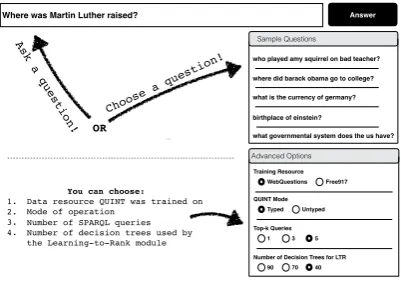
Figure5shows the main window of QUINT where
the starting point for a user is the question box or one of the sample questions provided. An expert user can make several configuration choices (Fig.
5, bottom right):
• Model to load: a model includes a set of
templates learned offline, and a corresponding learned query ranking function. The choices correspond to the training part of the We-bQuestions (Berant et al., 2013) and Free917 (Cai and Yates,2013) datasets.
• Whether to add answer type to queries: most KB-QA systems do not capture fine-grained types, while QUINT does so by design. • The number of top-ranked queries to show
an-swers for.
• The number of decision trees for the learning-to-rank module: this is used for query ranking during the answering phase (Sec.2.2).
QUINT: Interpretable Question Answering Over Knowledge Bases
Where was Martin Luther raised? Answer
Sample Questions
who played amy squirrel on bad teacher?
where did barack obama go to college?
what is the currency of germany?
birthplace of einstein?
what governmental system does the us have?
Advanced Options
Training Resource WebQuestions Free917
QUINT Mode Typed Untyped
Top-k Queries 1 3
Number of Decision Trees for LTR 90 70
5
40 OR
Choose a question! Ask a question!
</div>
You can choose: 1. Data resource QUINT was trained on 2. Mode of operation
3. Number of SPARQL queries 4. Number of decision trees used by
[image:4.595.78.283.69.389.2]the Learning-to-Rank module
Figure 5: User input.
Rank 1 Query Rank 2 Query Rank 3 Query Rank 4 Query Rank 5 Query
Detailed Explanation
Answer(s)
Eisleben
Eisleben is a town in Saxony-Anhalt, Germany. It is famous as the hometown of Martin Luther, hence its official name is Lutherstadt Eisleben. As of 2005, Eisleben had a population of 24,552. It lies on the Halle–Kassel railway.\nEisleben is divided into old and new towns; the latter of which was created for Eisleben's miners in the 14th century.\nEisleben was the capital of the district of Mansfelder Land and is the seat of the Verwaltungsgemeinschaft Lutherstadt Eisleben. Brief Explanation
Figure 6: Retrieved answers from the KB.
in response to a question are given in individual tabs, as shown in Figure6. To give more context to the user, wherever applicable, each answer is accompanied by a picture, a Wikipedia link and a short description from Freebase. For our run-ning example question, the answer is Eisleben, where Martin Luther was born, for the best query. If we explore the rank-2 query, the answer is
Saxony-Anhalt, which is the province in Ger-many where he lived.
3.2 Explanations
Explanations show how the given answers were derived. The ability to generate and display ex-planations is the core contribution of this system demonstration. QUINT generates two types of ex-planations: (i) a brief explanation geared towards non-technical users and (ii) a detailed explanation geared towards more advanced users.
Brief explanations provide an accessible and quick way for users to see how QUINT understood various parts of the question, resulting in the given set of answers. Figure7shows such an explana-tion for our running example. Brief explanaexplana-tions
Brief Explanation
QUINT understood your question as follows:
• The phrase “martin luther” is interpreted as Martin Luther
[image:4.595.81.282.72.226.2]• The words “was, raised” are interpreted as the relation Place of birth
Figure 7: QUINT’s brief explanation.
are particularly useful for normal users who are interested in confirming whether a given answer comes from interpreting the question as they in-tended. Where this is not the case, such an expla-nation guides users in reformulating their question to allow QUINT to better understand it.
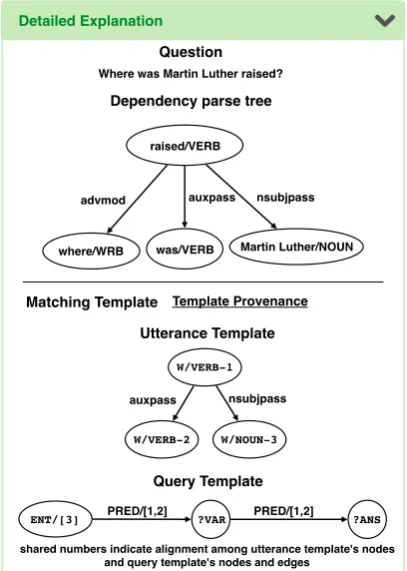
Detailed explanations are geared towards ad-vanced users who are familiar with dependency parses and SPARQL queries. A detailed expla-nation shows the derivation steps which roughly correspond to the right hand side of the diagram in Figure1. First, the dependency parse of the in-put question is shown (Fig. 8). Below that is the
matching templateconsisting of an utterance
tem-plate that fits the utterance, and the correspond-ing query template that will be instantiated to gen-erate a query. Shared numbers between the ut-terance template and the query template indicate alignment, i.e., which tokens in the utterance are used to instantiate which KB items in the query. In this example, we can see that the verb phrase
‘was raised’and the noun phrase‘Martin Luther’
are used to instantiate the KB-predicate and the KB-entity, respectively.
For a user to understand why QUINT maps a certain syntactic structure to a certain semantic form in a template, the user can view some train-ing instances that produced the template. This is
achieved by clicking Template Provenance (Fig.
9). For our example, two such instances are the
questions “Where was Obama educated?” and
“Where are Riddell Helmets manufactured?”.
Finally, the user is shown the SPARQL query that was executed to retrieve the shown answers
(Fig. 10). The node labeled ?ANS is the
tar-get answer node, and nodes marked as ?VAR
are intermediate join variables. Additionally, an alignment table with KB items is shown based on the alignments induced from the template
(lower part of Fig. 10). For KB items, we
find that ‘Martin Luther’ was mapped to the
Detailed Explanation
raised/VERB
where/WRB
nsubjpass
was/VERB Martin Luther/NOUN
advmod auxpass
Question
Where was Martin Luther raised?
Dependency parse tree
Matching Template Template Provenance
?VAR
PRED/[1,2]
?ANS
PRED/[1,2]
W/VERB-1
W/NOUN-3
nsubjpass
Utterance Template
Query Template
ENT/[3]
shared numbers indicate alignment among utterance template's nodes and query template's nodes and edges
W/VERB-2
[image:5.595.79.283.65.351.2]auxpass
Figure 8: Question dependency parse and matched utterance and query template.
and MartinLutherKing), and the lemmatized
phrase‘be raise’was mapped to the KB-predicate
placeOfBirth. Looking at the rank-2 query, we
find that ‘raise’ was interpreted as placesLived
in the KB. This is an alternative intention when the slightly ambiguous phrase‘raised’is used. 4 Use Cases
When QUINT returns the correct answer, expla-nations allow the user to confirm its correctness by seeing how it was derived. When, on the other hand, things go wrong and an answer seems in-correct, explanations can give the user a better un-derstanding of the limitations of the system (e.g., data incompleteness), and insights into overcom-ing these limitations (e.g., question rephrasovercom-ing). We discuss some of these possible scenarios be-low, accompanied by real examples.
Incomplete lexicon.QUINT uses different lex-icons to map the phrases in an utterance onto KB items (Sec. 2). These lexicons are inherently in-complete. For example, QUINT could not cor-rectly answer the utterance “countries of
euro-union” (implying the European Union) since the
phrase ‘euro-union’ does not have an entry in
QUINT’s lexicons. Therefore it shows the
fol-Training Utterance: where was obama educated?
educated/VERB-4
where/WRB-1
nsubjpass
was/VERB-2 obama/NOUN-3 advmod auxpass
obama/[3] education/[2,4] ?VAR institution/[2,4] ?ANS
Training Query
Training Utterance: where are riddell helmets manufactured?
manufactured/VERB-4
where/WRB-1
nsubjpass
are/VERB-2 riddell helmets/NOUN-3 auxpass
riddell helmets/[3] headquarters/[2,4] ?VAR citytown/[2,4] ?ANS
Training Query
[image:5.595.312.519.69.291.2]advmod
Figure 9: Structurally similar training instances to
“Where was Martin Luther raised?”.
en.martin_luther birth ?VAR city ?ANS
Query
Alignment
Lemmatized Phrase Semantic Item Type of Semantic Item
“Martin Luther” “raise be”
en.martin_luther birth, city
Entity Predicate
Figure 10: SPARQL KB-query and KB items.
lowing message urging the user to reformulate the phrase:The phraseeuro-unionin your input ques-tion could not be interpreted. Please reformulate
the phrase.
Incorrect query ranking. QUINT uses a learning-to-rank framework for ranking SPARQL queries. Sometimes, the most appropriate query is not ranked at the top. For example, for the
utterance “What is the former currency of
Ger-many?”, the top answer is Euro, which is
incor-rect. This is because the alignment information in the matching template fails to capture‘former’. However, if the user explores the top-5SPARQL queries, she finds that a query with the correct
predicate currencyFormerlyUsed (as opposed
to the incorrect currencyUsed) is indeed there
and retrieves the desired answersDeutscheMark, GermanRentenmarkandGermanPapiermark.
Incorrect disambiguation to KB items.
[image:5.595.316.518.334.421.2]language group does English belong to?”,
‘En-glish’ gets mapped to the wrong entity England,
resulting in an unexpected answer. When the user sees the brief explanation (Fig. 7), she can immediately observe this incorrect mapping.
Subsequently, she may rephrase it as ‘English
language’which may produce the desired answer.
Missed answer type constraints. Answer typ-ing plays an important role in ensurtyp-ing precise QA. For example, in“Which college did Michelle
Obama go to?”, the user explicitly specifies that
she is looking forcolleges, as opposed to“Where
did Michelle Obama study?”, which, for
exam-ple, could include her high school as well. Here
‘college’ is mapped to the KB type University
and only when this constraint is added to the SPARQL query do we get the desired answer set
HarvardLawSchoolandPrincetonUniversity.
No matching templates. Sometimes an utter-ance is syntactically out of scope for QUINT: it has never seen similar instances during training. For example: “Germany’s capital during the
for-ties?”. In such cases, QUINT raises the message
We could not find any matching templates. Please
reformulate your question.
5 Conclusion
We presented a demonstration of QUINT, a sys-tem that uses automatically learned sys-templates to provide interpretable answers to natural language questions over knowledge bases. When a user gets an answer to her question, our demonstration al-lows her to view the details of how the answer was derived. This improves her confidence in case of correct answers, while giving her a better under-standing of the limitations of the QA system in case of mistakes, and how to work around them.
References
Abdalghani Abujabal, Mohamed Yahya, Mirek Riede-wald, and Gerhard Weikum. 2017. Automated tem-plate generation for question answering over
knowl-edge graphs. InWWW.
Hannah Bast and Elmar Haussmann. 2015. More ac-curate question answering on freebase. InCIKM. Jonathan Berant, Andrew Chou, Roy Frostig, and Percy
Liang. 2013. Semantic parsing on Freebase from
question-answer pairs. InEMNLP.
Kurt Bollacker, Colin Evans, Praveen Paritosh, Tim Sturge, and Jamie Taylor. 2008. Freebase: A
col-laboratively created graph database for structuring
human knowledge. InSIGMOD.
Antoine Bordes, Sumit Chopra, and Jason Weston. 2014. Question answering with subgraph
embed-dings. InEMNLP.
Qingqing Cai and Alexander Yates. 2013. Large-scale semantic parsing via schema matching and lexicon extension. InACL.
Li Dong, Furu Wei, Ming Zhou, and Ke Xu. 2015. Question answering over freebase with
multi-column convolutional neural networks. InACL.
Anthony Fader, Luke Zettlemoyer, and Oren Etzioni. 2013. Paraphrase-driven learning for open question answering. InACL.
Anthony Fader, Luke Zettlemoyer, and Oren Etzioni. 2014. Open Question Answering over Curated and
Extracted Knowledge Bases. InKDD.
Johannes Hoffart, Mohamed Amir Yosef, Ilaria Bor-dino, Hagen F¨urstenau, Manfred Pinkal, Marc Span-iol, Bilyana Taneva, Stefan Thater, and Gerhard Weikum. 2011. Robust disambiguation of named entities in text. InEMNLP.
Siva Reddy, Mirella Lapata, and Mark Steedman. 2014. Large-scale semantic parsing without question-answer pairs. TACL.
Fabian M. Suchanek, Gjergji Kasneci, and Gerhard Weikum. 2007. Yago: A core of semantic
knowl-edge. InWWW.
Christina Unger, Lorenz B¨uhmann, Jens Lehmann, Axel-Cyrille Ngonga Ngomo, Daniel Gerber, and Philipp Cimiano. 2012. Template-based question
answering over RDF data. InWWW.
Kun Xu, Siva Reddy, Yansong Feng, Songfang Huang, and Dongyan Zhao. 2016. Question Answering on Freebase via Relation Extraction and Textual Evi-dence. InACL.
Mohamed Yahya, Klaus Berberich, Shady Elbassuoni, and Gerhard Weikum. 2013. Robust question an-swering over the web of linked data. InCIKM. Min-Chul Yang, Nan Duan, Ming Zhou, and
Hae-Chang Rim. 2014. Joint relational embeddings for
knowledge-based question answering. InEMNLP.
Xuchen Yao and Benjamin Van Durme. 2014. Infor-mation extraction over structured data: Question an-swering with freebase. InACL.
Wen-tau Yih, Ming-Wei Chang, Xiaodong He, and Jianfeng Gao. 2015. Semantic parsing via staged query graph generation: Question answering with
knowledge base. InACL.
Lei Zou, Ruizhe Huang, Haixun Wang, Jeffrey Xu Yu, Wenqiang He, and Dongyan Zhao. 2014. Natural language question answering over RDF: a graph data