Dynamic Entity Representations in Neural Language Models
Yangfeng Ji∗ Chenhao Tan∗ Sebastian Martschat† Yejin Choi∗ Noah A. Smith∗ ∗Paul G. Allen School of Computer Science & Engineering, University of Washington
†Department of Computational Linguistics, Heidelberg University
{yangfeng,chenhao,yejin,nasmith}@cs.washington.edu
Abstract
Understanding a long document requires tracking how entities are introduced and evolve over time. We present a new type of language model, ENTITYNLM, that can
explicitly model entities, dynamically up-date their representations, and contextu-ally generate their mentions. Our model is generative and flexible; it can model an ar-bitrary number of entities in context while generating each entity mention at an arbi-trary length. In addition, it can be used for several different tasks such as language modeling, coreference resolution, and en-tity prediction. Experimental results with all these tasks demonstrate that our model consistently outperforms strong baselines and prior work.
1 Introduction
Understanding a narrative requires keeping track of its participants over a long-term context. As a story unfolds, the information a reader associates with each character in a story increases, and ex-pectations about what will happen next change ac-cordingly. At present, models of natural language do not explicitly track entities; indeed, in today’s language models, entities are no more than the words used to mention them.
In this paper, we endow a generative language model with the ability to build up a dynamic rep-resentation of each entity mentioned in the text. Our language model defines a probability distribu-tion over the whole text, with a distinct generative story for entity mentions. It explicitly groups those mentions that corefer and associates with each en-tity a continuous representation that is updated by every contextualized mention of the entity, and that in turn affects the text that follows.
[John]1 wanted to go to [the coffee shop]2 in [downtown Copenhagen]3. [He]1was told that [it]2sold [the best beans]4.
Figure 1: ENTITYNLM explicitly tracks entities
in a text, including coreferring relationships be-tween entities like [John]1 and [He]1. As a lan-guage model, it is designed to predict that a coref-erent of [the coffee shop]2is likely to follow “told that,” that the referring expression will be “it”, and that “sold the best beans” is likely to come next, by using entity information encoded in the dynamic distributed representation.
Our method builds on recent advances in repre-sentation learning, creating local probability dis-tributions from neural networks. It can be un-derstood as a recurrent neural network language model, augmented with random variables for en-tity mentions that capture coreference, and with dynamic representations of entities. We estimate the model’s parameters from data that is annotated with entity mentions and coreference.
Because our model is generative, it can be queried in different ways. Marginalizing every-thing except the words, it can play the role of a lan-guage model. In§5.1, we find that it outperforms both a strongn-gram language model and a strong recurrent neural network language model on the English test set of the CoNLL 2012 shared task on coreference evaluation (Pradhan et al., 2012). The model can also identify entity mentions and coreference relationships among them. In §5.2, we show that it can easily be used to add a per-formance boost to a strong coreference resolution system, by reranking a list ofk-best candidate out-puts. On the CoNLL 2012 shared task test set, the reranked outputs are significantly better than the original top choices from the same system.
nally, the model can perform entity cloze tasks. As presented in §5.3, it achieves state-of-the-art performance on the InScript corpus (Modi et al.,
2017). 2 Model
A language model defines a distribution over se-quences of word tokens; letXtdenote the random
variable for thetth word in the sequence, xt
de-note the value ofXtandxtthe distributed
repre-sentation (embedding) of this word. Our starting point for language modeling is a recurrent neural network (Mikolov et al.,2010), which defines
p(Xt|history) = softmax (Whht−1+b) (1)
ht−1=LSTM(ht−2,xt−1) (2) where Wh and b are parameters of the model
(along with word embeddings xt), LSTM is the
widely used recurrent function known as “long short-term memory” (Hochreiter and Schmidhu-ber,1997), andhtis aLSTMhidden state encoding
the history of the sequence up to thetth word. Great success has been reported for this model (Zaremba et al., 2015), which posits nothing ex-plicitly about the words appearing in the text se-quence. Its generative story is simple: the value of eachXtis randomly chosen conditioned on the
vectorht−1encoding its history.
2.1 Additional random variables and representations for entities
To introduce our model, we associate with each word an additional set of random variables. At po-sitiont,
• Rt is a binary random variable that
indi-cates whether xt belongs to an entity
men-tion (Rt = 1) or not (Rt = 0). Though not
explored here, this is easily generalized to a categorial variable for the type of the entity (e.g., person, organization, etc.).
• Lt ∈ {1, . . . , `max} is a categorical random variable ifRt = 1, which indicates the
num-ber of remaining words in this mention, in-cluding the current word (i.e., Lt = 1 for
the last word in any mention). `max is a predefined maximum length fixed to be 25, which is an empirical value derived from the training corpora used in the experiments. If
Rt= 0, thenLt= 1. We denote the value of
Ltby`t.
• Et∈ Etis the index of the entity referred to,
ifRt = 1. The setEtconsists of{1, . . . ,1 +
maxt0<tet0}, i.e., the indices of all previously
mentioned entities plus an additional value for a new entity. ThusEt starts as {1} and
grows monotonically witht, allowing for an arbitrary number of entities to be mentioned. We denote the value ofEtbyet. IfRt = 0,
thenEtis fixed to a special valueø.
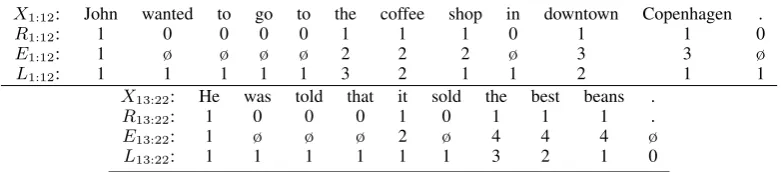
The values of these random variables for our run-ning example are shown inFigure 2.
In addition to using symbolic variables to en-code mentions and coreference relationships, we maintain a vector representation of each entity that evolves over time. For the ith entity, let ei,t be
its representation at time t. These vectors are different from word vectors (xt), in that they are
not parameters of the model. They are similar to history representations (ht), in that they are
de-rived through parameterized functions of the ran-dom variables’ values, which we will describe in the next subsections.
2.2 Generative story
The generative story for the word (and other variables) at timestep t is as follows; forward-referenced equations are in the detailed discussion that follows.
1. If `t−1 = 1 (i.e., xt is not continuing an
already-started entity mention): • Choosert(Equation 3).
• Ifrt= 0, set`t= 1andet= ø; then go
to step 3. Otherwise:
– If there is no embedding for the new candidate entity with index 1 + maxt0<tet0, create one
follow-ing§2.4.
– Select the entityetfrom{1, . . . ,1 +
maxt0<tet0}(Equation 4).
– Set ecurrent = eet,t−1, which is the entity embedding of et before
timestept.
– Select the length of the mention, `t
(Equation 5). 2. Otherwise,
• Set`t=`t−1−1,rt=rt−1,et=et−1. 3. Sample xt from the word distribution given
X1:12: John wanted to go to the coffee shop in downtown Copenhagen .
R1:12: 1 0 0 0 0 1 1 1 0 1 1 0
E1:12: 1 ø ø ø ø 2 2 2 ø 3 3 ø
L1:12: 1 1 1 1 1 3 2 1 1 2 1 1
X13:22: He was told that it sold the best beans .
R13:22: 1 0 0 0 1 0 1 1 1 .
E13:22: 1 ø ø ø 2 ø 4 4 4 ø
[image:3.595.104.495.64.150.2]L13:22: 1 1 1 1 1 1 3 2 1 0
Figure 2: The random variable values in ENTITYNLM for the running example inFigure 1.
(or most recent) entity embedding ecurrent (Equation 6). (If rt = 0, then ecurrent still represents the most recently mentioned en-tity.)
4. Advance the RNN, i.e., feed it the word vec-torxtto computeht(Equation 2).
5. Ifrt = 1, updateeet,t using eet,t−1 andht, then setecurrent =eet,t. Details of the entity updating are given in§2.4.
6. For every entity eι ∈ Et\ {et}, set eι,t =
eι,t−1 (i.e., no changes to other entities’ rep-resentations).
Note that at any given time stept,ecurrent will al-ways contain the most recent vector representation of the most recently mentioned entity.
A generative model with a similar hierarchi-cal structure was used by Haghighi and Klein
(2010) for coreference resolution. Our approach differs in two important ways. First, our model defines a joint distribution over all of the text, not just the entity mentions. Second, we use repre-sentation learning rather than Bayesian nonpara-metrics, allowing natural integration with the lan-guage model.
2.3 Probability distributions
The generative story above referenced several parametric distributions defined based on vector representations of histories and entities. These are defined as follows.
Forr∈ {0,1},
p(Rt=r|ht−1)∝exp(h>t−1Wrr), (3)
where r is the parameterized embedding associ-ated withr, which paves the way for exploring en-tity type representations in future work; Wr is a
parameter matrix for the bilinear score for ht−1 andr.
To give the possibility of predicting a new en-tity, we need an entity embedding beforehand with index(1 + maxt0<tet0), which is randomly
sam-pled from Equation 7. Then, for every e ∈ {1, . . . ,1 + maxt0<tet0}:
p(Et=e|Rt= 1,ht−1)
∝exp(h>t−1Wentityee,t−1+w>distf(e)), (4)
whereee,t−1 is the embedding of entity eat time stept−1andWentityis the weight matrix for pre-dicting entities using their continuous representa-tions. The score above is normalized over values {1, . . . ,1 + maxt0<tet0}. f(e) represents a
vec-tor of distance features associated witheand the mentions of the existing entities. Hence two in-formation sources are used to predict the next en-tity: (i) contextual informationht−1, and (ii) dis-tance featuresf(e)from the current mention to the closest mention from each previously mentioned entity. f(e) = 0 if eis a new entity. This term can also be extended to include other surface-form features for coreference resolution (Martschat and Strube,2015;Clark and Manning,2016b).
For the chosen entity et from Equation 4, the
distribution over its mention length is drawn ac-cording to
p(Lt=`|ht−1,eet,t−1)
∝exp(Wlength> ,`[ht−1;eet,t−1]), (5)
whereeet,t−1is the most recent embedding of the entityet, not updated withht. The intuition is that
eet,t−1 will help contextual information ht−1 to select the residual length of entity et. Wlength
is the weight matrix for length prediction, with
`max = 25rows.
Finally, the probability of a word xas the next token is jointly modeled by ht−1 and the vector representation of the most recently mentioned en-tityecurrent:
p(Xt=x|ht−1,ecurrent)
whereWeis a transformation matrix to adjust the
dimensionality ofecurrent. CFSMis a class factor-ized softmax function (Goodman,2001;Baltescu and Blunsom,2015). It uses a two-step prediction with predefined word classes instead of direct pre-diction on the whole vocabulary, and reduces the time complexity to the log of vocabulary size. 2.4 Dynamic entity representations
Before predicting the entity at stept, we need an embedding for the new candidate entity with index
e0 = 1 + maxt0<tet0 if it does not exist. The new
embedding is generated randomly, according to a normal distribution, then projected onto the unit ball:
u∼ N(r1, σ2I);
ee0,t−1= u
kuk2,
(7)
where σ = 0.01. The time stept−1in ee0,t−1
means the current embedding contains no infor-mation from step t, although it will be updated once we have ht and if Et = e0. r1 is the pa-rameterized embedding forRt= 1, which will be
jointly optimized with other parameters and is ex-pected to encode some generic information about entities. All the initial entity embeddings are cen-tered on the meanr1, which is used inEquation 3 to determine whether the next token belongs to an entity mention. Another choice would be to ini-tialize with a zero vector, although our preliminary experiments showed this did not work as well as random initialization inEquation 7.
AssumeRt = 1andEt =et, which meansxt
is part of a mention of entityet. Then, we need
to updateeet,t−1based on the new information we have fromht. The new embeddingeet,t is a con-vex combination of the old embedding (eet,t−1) and current LSTM hidden state (ht) with the
in-terpolation (δt) determined dynamically based on
a bilinear function:
δt = σ(h>t Wδeet,t−1);
u = δteet,t−1+ (1−δt)ht;
eet,t =
u
kuk2, (8) This updating scheme will be used to updateetin
eachof all the following`tsteps. The projection
in the last step keeps the magnitude of the entity embedding fixed, avoiding numeric overflow. A similar updating scheme has been used byHenaff
et al.(2016) for the “memory blocks” in their re-current entity network models. The difference is that their model updates all memory blocks in each time step. Instead, our updating scheme in Equa-tion 8only applies to the selected entityetat time
stept.
2.5 Training objective
The model is trained to maximize the log of the joint probability ofR,E,L, andX:
`(θ) = logP(R,E,L,X;θ)
=X
t
logP(Rt, Et, Lt, Xt;θ), (9)
where θ is the collection of all the parameters in this model. Based on the formulation in§2.3,
Equation 9can be decomposed as the sum of con-ditional log-probabilities of each random variable at each time step.
This objective requires the training data anno-tated as inFigure 2. We do not assume that these variables are observed at test time.
3 Implementation Details
Our model is implemented with DyNet ( Neu-big et al., 2017) and available at https://
github.com/jiyfeng/entitynlm. We
use AdaGrad (Duchi et al., 2011) with learning rateλ= 0.1and ADAM (Kingma and Ba,2014) with default learning rateλ= 0.001as the candi-date optimizers of our model. For all the parame-ters, we use the initialization tricks recommended byGlorot and Bengio(2010). To avoid overfitting, we also employ dropout (Srivastava et al., 2014) with the candidate rates as{0.2,0.5}.
In addition, there are two tunable hyperpa-rameters of ENTITYNLM: the size of word
em-beddings and the dimension of LSTM hidden states. For both of them, we consider the values {32,48,64,128,256}. We also experiment with the option to either use the pretrained GloVe word embeddings (Pennington et al.,2014) or randomly initialized word embeddings (then updated during training). For all experiments, the best configura-tion of hyperparameters and optimizers is selected based on the objective value on the development data.
4 Evaluation Tasks and Datasets
and (iii) entity prediction. The evaluation on lan-guage modeling shows how the internal entity rep-resentation, when marginalized out, can improve the perplexity of language models. The evaluation on coreference resolution experiment shows how our new language model can improve a compet-itive coreference resolution system. Finally, we employ an entity cloze task to demonstrate the generative performance of our model in predicting the next entity given the previous context.
We use two datasets for the three evaluation tasks. For language modeling and coreference resolution, we use the English benchmark data from the CoNLL 2012 shared task on corefer-ence resolution (Pradhan et al.,2012). We employ the standard training/development/test split, which includes 2,802/343/348 documents with roughly 1M/150K/150K tokens, respectively. We follow the coreference annotation in the CoNLL dataset to extract entities and ignore the singleton men-tions in texts.
For entity prediction, we employ the InScript corpus created byModi et al.(2017). It consists of 10 scenarios, including grocery shopping, taking a flight, etc. It includes 910 crowdsourced simple narrative texts in total and 18 stories were ignored due to labeling problems (Modi et al.,2017). On average, each story has 12.4 sentences, 24.9 en-tities and 217.2 tokens. Each entity mention is labeled with its entity index. We use the same training/development/test split as in (Modi et al.,
2017), which includes 619, 91, 182 texts, respec-tively.
Data preprocessing
For the CoNLL dataset, we lowercase all tokens and remove any token that only contains a punctu-ation symbol unless it is in an entity mention. We also replace numbers in the documents with the special tokenNUMand low-frequency word types
withUNK. The vocabulary size of the CoNLL data
after preprocessing is 10K. For entity mention ex-traction, in the CoNLL dataset, one entity men-tion could be embedded in another. For embed-ded mentions, only the enclosing entity mention is kept. We use the same preprocessed data for both language modeling and coreference resolu-tion evaluaresolu-tion.
For the InScript corpus, we apply similar data preprocessing to lowercase all tokens, and we re-place low-frequency word types with UNK. The
vocabulary size after preprocessing is 1K. 5 Experiments
In this section, we present the experimental results on the three evaluation tasks.
5.1 Language modeling
Task description. The goal of language model-ing is to compute the marginal probability:
P(X) = X
R,E,L
P(X,R,E,L). (10)
However, due to the long-range dependency in recurrent neural networks, the search space of
R,E,L during inference grows exponentially. We thus use importance sampling to approxi-mate the marginal distribution of X. Specifi-cally, with the samples from a proposal distri-butionQ(R,E,L|X), the approximated marginal probability is defined as
P(X) = X
R,E,L
P(X,R,E,L)
= X
R,E,L
Q(R,E,L|X)QP((RX,,ER,,LE|,LX))
≈ 1
N
X
{r(i),e(i),`(i)}∼Q
P(r(i),e(i), `(i),x)
Q(r(i),e(i), `(i)|x) (11) A similar idea of using importance sampling for language modeling evaluation has been used by
Dyer et al.(2016).
For language modeling evaluation, we train our model on the training set from the CoNLL 2012 dataset with coreference annotation. On the test data, we treat coreference structure as latent vari-ables and use importance sampling to approximate the marginal distribution of X. For each docu-ment, the model randomly drawsN = 100 sam-ples from the proposal distribution, discussed next. Proposal distribution. For implementation of
Q, we use a discriminative variant of ENTI -TYNLM by taking the current wordxtfor
predict-ing the entity-related variables in the same time step. Specifically, in the generative story described in §2.2, we delete step 3 (words are not gener-ated, but rather conditioned upon), move step 4 before step 1, and replace ht−1 with ht in the
steps for predicting entity type Rt, entity Et and
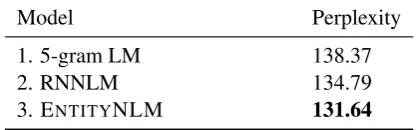
Model Perplexity
1. 5-gram LM 138.37
2. RNNLM 134.79
[image:6.595.75.284.64.129.2]3. ENTITYNLM 131.64
Table 1: Language modeling evaluation on the test sets of the English section in the CoNLL 2012 shared task. As mentioned in§4, the vocabulary size is 10K. ENTITYNLM does not require any
coreference annotation on the test data.
conditional probabilityQ(Rt, Et, Lt|Xt)at each
timestep.
Baselines. We compare the language modeling performance with two competitive baselines: 5-gram language model implemented in KenLM (Heafield et al., 2013) and RNNLM with LSTM units implemented in DyNet (Neubig et al.,2017). For RNNLM, we use the same hyperparameters described in §3 and grid search on the develop-ment data to find the best configuration.
Results. The results of ENTITYNLM and the
baselines on both development and test data are reported inTable 1. For ENTITYNLM, we use the
value of 2−1
TPTt=1logP(Xt,Rt,Et,Lt) on the devel-opment set with coreference annotation to select the best model configuration and report the best number. On the test data, we are able to calcu-late perplexity by marginalizing all other random variables usingEquation 11. To compute the per-plexity numbers on the test data, our model only takes account of log probabilities on word predic-tion. The difference is that coreference informa-tion is only used for training ENTITYNLM and
not for test. All three models reported inTable 1
share the same vocabulary, therefore the numbers on the test data are directly comparable. As shown inTable 1, ENTITYNLM outperforms both the
5-gram language model and the RNNLM on the test data. Better performance of ENTITYNLM on
lan-guage modeling can be expected, if we also use the marginalization method defined inEquation 11on the development data to select the best configura-tion. However, we plan to use the same experi-mental setup for all experiments, instead of cus-tomizing our model for each individual task. 5.2 Coreference reranking
Task description. We show how ENTITYLM,
which allows an efficient computation of the
probability P(R,E,L,X), can be used as a coreference reranker to improve a competitive coreference resolution system due to Martschat and Strube (2015). This task is analogous to the reranking approach used in machine transla-tion (Shen et al.,2004). The specific formulation is as follows:
arg max
{r(i),e(i),l(i)}∈KP(r
(i),e(i),l(i),x) (12)
where K is the k-best list for a given document. In our experiments,k = 100. To the best of our knowledge, the problem of obtainingk-best out-puts of a coreference resolution system has not been studied before.
Approximate k-best decoding. We rerank the output of a system that predicts an antecedent for each mention by relying on pairwise scores for mention pairs. This is the dominant approach for coreference resolution (Martschat and Strube,
2015; Clark and Manning, 2016a). The predic-tions induce an antecedent tree, which represents antecedent decisions for all mentions in the doc-ument. Coreference chains are obtained by tran-sitive closure over the antecedent decisions en-coded in the tree. A mention also can have an empty mention as antecedent, which denotes that the mention is non-anaphoric.
For extending Martschat and Strube’s greedy decoding approach to k-best inference, we can-not simply take the k highest scoring trees ac-cording to the sum of edge scores, because dif-ferent trees may represent the same coreference chain. Instead, we use an heuristic that creates an approximatek-best list on candidate antecedent trees. The idea is to generate trees from the orig-inal system output by considering suboptimal an-tecedent choices that lead to different coreference chains. For each mention pair(mj, mi), we
com-pute the difference of its score to the score of the optimal antecedent choice for mj. We then sort
pairs in ascending order according to this differ-ence and iterate through the list of pairs. For each pair (mj, mi), we create a tree tj,i by replacing
the antecedent ofmjin the original system output
withmi. If this yields a tree that encodes
differ-ent coreference chains from all chains encoded by trees in thek-best list, we addti,jto thek-best list.
Evaluation measures. For coreference resolu-tion evaluaresolu-tion, we employ the CoNLL scorer (Pradhan et al., 2014). It computes three com-monly used evaluation measures MUC (Vilain et al.,1995), B3 (Bagga and Baldwin,1998), and CEAFe (Luo, 2005). We report the F1 score of each evaluation measure and their average as the CoNLL score.
Competing systems. We employed CORT1
(Martschat and Strube, 2015) as our baseline coreference resolution system. Here, we com-pare with the original (one best) outputs of
CORT’s latent ranking model, which is the
best-performing model implemented in CORT. We
consider two rerankers based on ENTITYNLM.
The first reranking method only uses the log probability for ENTITYNLM to sort the candidate
list (Equation 12). The second method uses a linear combination of both log probabilities from ENTITYNLM and the scores from CORT, where
the coefficients were found via grid search with the CoNLL score on the development set.
Results. The reranked results on the CoNLL 2012 test set are reported inTable 2. The numbers of the baseline are higher than the results reported inMartschat and Strube (2015) since the feature set of CORTwas subsequently extended. Lines 2
and 3 inTable 2present the reranked best results. As shown in this table, both reranked results give more than 1% of CoNLL score improvement on the test set overCORT, which are significant based
on an approximate randomization test2.
Additional experiments also found that increas-ingkfrom 100 to 500 had a minor effect. That is because the diversity of eachk-best list is limited by (i) the number of entity mentions in the docu-ment, (ii) the performance of the baseline corefer-ence resolution system, and possibly (iii) the ap-proximate nature of our k-best inference proce-dure. We suspect that a stronger baseline system (such as that ofClark and Manning,2016a) could give greater improvements, if it can be adapted to providek-best lists. Future work might incorpo-rate the techniques embedded in such systems into ENTITYNLM.
[I]1 was about to ride [my]1 [bicycle]2 to the [park]3one day when [I]1noticed that the front [tire]4 was flat . [I]1 realized that [I]1 would have to repair [it]4 . [I]1 went into [my]1 [garage]5 to get some [tools]5. The first thing [I]1did was remove the xxxx
Figure 3: A short story on bicycles from the InScript corpus (Modi et al., 2017). The entity prediction task requires predicting xxxx given the preceding text either by choosing a previously mentioned entity or deciding that this is a “new en-tity”. In this example, the ground-truth prediction is [tire]4. For training, ENTITYNLM attempts to predict every entity. While, for testing, it predicts a maximum of 30 entities after the first three sen-tences, which is consistent with the experimental setup suggested byModi et al.(2017).
5.3 Entity prediction
Task description. Based onModi et al.(2017), we introduce a novel entity prediction task that tries to predict the next entity given the preced-ing text. For a given text as inFigure 3, this task makes a forward prediction based on only the left context. This is different from coreference reso-lution, where both left and right contexts from a given entity mention are used in decoding. It is also different from language modeling, since this task only requires predicting entities. Since EN -TITYNLM is generative, it can be directly applied
to this task. To predict entities in test data,Rtis
always given and ENTITYNLM only needs to
pre-dictEtwhenRt= 1.
Baselines and human prediction. We intro-duce two baselines in this task: (i) thealways-new baseline that always predicts “new entity”; (ii) a linear classification model usingshallow features fromModi et al.(2017), including the recency of an entity’s last mention and the frequency. We also compare with the model proposed byModi et al.
(2017). Their work assumes that the model has prior knowledge of all the participant types, which are specific to each scenario and fine-grained, e.g., rider in the bicycle narrative, and predicts partic-ipant types for new entities. This assumption is unrealistic for pure generative models like ours. 1https://github.com/smartschat/cort, we used version 0.2.4.5.
MUC B3 CEAF e
Model CoNLL P R F1 P R F1 P R F1
[image:8.595.71.527.63.125.2]1. Baseline:CORT’s one best 62.93 77.15 68.67 72.66 66.00 54.92 59.95 60.07 52.76 56.18 2. Rerank: ENTITYNLM 64.00 77.90 69.45 73.44 66.84 56.12 61.01 61.73 53.90 57.55 3. Rerank: ENTITYNLM +CORT 64.04 77.93 69.49 73.47 67.08 55.99 61.04 61.76 53.98 57.61
Table 2: Coreference resolution scores on the CoNLL 2012 test set. CORTis the best-performing model
ofMartschat and Strube(2015) with greedy decoding.
Accuracy (%) 1. Baseline: always-new 31.08 2. Baseline: shallow features 45.34
3.Modi et al.(2017) 62.65
4. ENTITYNLM 74.23
5.Human prediction 77.35
Table 3: Entity prediction accuracy on the test set of the InScript corpus.
Therefore, we remove this assumption and adapt their prediction results to our formulation by map-ping all the predicted entities that have not been mentioned to “new entity”. We also compare to the adapted human prediction used in the In-Script corpus. For each entity slot, Modi et al.
(2017) acquired 20 human predictions, and the majority vote was selected. More details about human predictions are discussed in (Modi et al.,
2017).
Results. Table 3 shows the prediction accura-cies. ENTITYNLM (line 4) significantly
outper-forms both baselines (line 1 and 2) and prior work (line 3) (p 0.01, pairedt-test). The compari-son between line 4 and 5 shows our model is even close to the human prediction performance.
6 Related Work
Rich-context language models. The originally proposed recurrent neural network language mod-els only capture information within sentences. To extend the capacity of RNNLMs, various re-searchers have incorporated information beyond sentence boundaries. Previous work focuses on contextual information from previous sen-tences (Ji et al.,2016a) or discourse relations be-tween adjacent sentences (Ji et al.,2016b), show-ing improvements to language modelshow-ing and re-lated tasks like coherence evaluation and discourse relation prediction. In this work, ENTITYNLM
adds explicit entity information to the language model, which is another way of adding a memory
network for language modeling. Unlike the work by Tran et al. (2016), where memory blocks are used to store general contextual information for language modeling, ENTITYNLM assigns each
memory block specifically to only one entity.
Entity-related models. Two recent approaches to modeling entities in text are closely related to our model. The first is the “reference-aware” lan-guage models proposed by Yang et al. (2016), where the referred entities are from either a pre-defined item list, an external database, or the con-text from the same document. Yang et al.(2016) present three models, one for each case. For mod-eling a document with entities, they use corefer-ence links to recover entity clusters, though they only model entity mentions as containing a single word (an inappropriate assumption, in our view). Their entity updating method takes the latest hid-den state (similar tohtwhenRt= 1in our model)
as the new representation of the current entity; no long-term history of the entity is maintained, just the current local context. In addition, their lan-guage model evaluation assumes that entity infor-mation is provided at test time (Yang, personal communication), which makes a direct compari-son with our model impossible. Our entity updat-ing scheme is similar to the “dynamic memory” method used byHenaff et al.(2016). Our entity representations are dynamically allocated and up-dated only when an entity appears up, while the EntNet fromHenaff et al.(2016) does not model entities and their relationships explicitly. In their model, entity memory blocks are pre-allocated and updated simultaneously in each timestep. So there is no dedicated memory block for every en-tity and no distinction between enen-tity mentions and non-mention words. As a consequence, it is not clear how to use their model for coreference reranking and entity prediction.
Haghighi and Klein (2010). They implemented this idea as a probabillistic graphical model with the distance-dependent Chinese Restaurant Pro-cess (Pitman, 1995) for entity assignment, while our model is built on a recurrent neural network architecture. The reranking method considered in our coreference resolution evaluation could also be extended with samples from additional coref-erence resolution systems, to produce more va-riety (Ng, 2005). The benefit of such a system comes, we believe, from the explicit tracking of each entity throughout the text, providing entity-specific representations. In previous work, such information has been added as features (Luo et al.,
2004; Bj¨orkelund and Kuhn, 2014) or by com-puting distributed entity representations (Wiseman et al.,2016;Clark and Manning,2016b). Our ap-proach complements these previous methods. Entity prediction. The entity prediction task discussed in§5.3is based on work byModi et al.
(2017). The main difference is that we do not as-sume that all entities belong to a previously known set of entity types specified for each narrative sce-nario. This task is also closely related to the “narrative cloze” task of Chambers and Jurafsky
(2008) and the “story cloze test” ofMostafazadeh et al.(2016). Those studies aim to understand re-lationships between events, while our task focuses on predicting upcoming entity mentions.
7 Conclusion
We have presented a neural language model, EN -TITYNLM, that defines a distribution over texts
and the mentioned entities. It provides vector rep-resentations for the entities and updates them dy-namically in context. The dynamic representations are further used to help generate specific entity mentions and the following text. This model out-performs strong baselines and prior work on three tasks: language modeling, coreference resolution, and entity prediction.
Acknowledgments
We thank anonymous reviewers for the helpful feedback on this work. We also thank the members of Noah’s ARK and XLab at University of Wash-ington for their valuable comments, particularly Eunsol Choi for pointing out the InScript corpus. This research was supported in part by a Univer-sity of Washington Innovation Award, Samsung
GRO, NSF grant IIS-1524371, the DARPA CwC program through ARO (W911NF-15-1-0543), and gifts by Google and Facebook.
References
Amit Bagga and Breck Baldwin. 1998. Algorithms for scoring coreference chains. InLREC Workshop on Linguistic Coreference.
Paul Baltescu and Phil Blunsom. 2015. Pragmatic neu-ral language modelling in machine translation. In NAACL.
Anders Bj¨orkelund and Jonas Kuhn. 2014. Learn-ing structured perceptrons for coreference resolution with latent antecedents and non-local features. In ACL.
Nathanael Chambers and Daniel Jurafsky. 2008. Un-supervised Learning of Narrative Event Chains. In ACL.
Kevin Clark and Christopher D. Manning. 2016a. Deep reinforcement learning for mention-ranking coreference models. InEMNLP.
Kevin Clark and Christopher D. Manning. 2016b. Im-proving coreference resolution by learning entity-level distributed representations. InACL.
John Duchi, Elad Hazan, and Yoram Singer. 2011. Adaptive subgradient methods for online learning and stochastic optimization. Journal of Machine Learning Research, 12:2121–2159.
Chris Dyer, Adhiguna Kuncoro, Miguel Ballesteros, and Noah A. Smith. 2016. Recurrent neural network grammars. InEMNLP.
Xavier Glorot and Yoshua Bengio. 2010. Understand-ing the difficulty of trainUnderstand-ing deep feedforward neural networks. InAISTATS, pages 249–256.
Joshua Goodman. 2001. Classes for fast maximum en-tropy training. InICASSP.
Aria Haghighi and Dan Klein. 2010. Coreference res-olution in a modular, entity-centered model. In NAACL.
Kenneth Heafield, Ivan Pouzyrevsky, Jonathan H. Clark, and Philipp Koehn. 2013. Scalable modified Kneser-Ney language model estimation. InACL.
Mikael Henaff, Jason Weston, Arthur Szlam, An-toine Bordes, and Yann LeCun. 2016. Track-ing the world state with recurrent entity networks. arXiv:1612.03969.
Yangfeng Ji, Trevor Cohn, Lingpeng Kong, Chris Dyer, and Jacob Eisenstein. 2016a. Document context lan-guage models. InICLR (workshop track).
Yangfeng Ji, Gholamreza Haffari, and Jacob Eisen-stein. 2016b. A latent variable recurrent neural network for discourse-driven language models. In NAACL-HLT.
Diederik Kingma and Jimmy Ba. 2014. Adam: A method for stochastic optimization. arXiv:1412.6980.
Xiaoqiang Luo. 2005. On coreference resolution per-formance metrics. InHLT-EMNLP.
Xiaoqiang Luo, Abe Ittycheriah, Hongyan Jing, Nanda Kambhatla, and Salim Roukos. 2004. A mention-synchronous coreference resolution algorithm based on the Bell tree. InACL.
Sebastian Martschat and Michael Strube. 2015. La-tent structures for coreference resolution. Transac-tions of the Association for Computational Linguis-tics, 3:405–418.
Tomas Mikolov, Martin Karafi´at, Lukas Burget, Jan Cernock`y, and Sanjeev Khudanpur. 2010. Recur-rent neural network based language model. In
IN-TERSPEECH.
Ashutosh Modi, Ivan Titov, Vera Demberg, Asad Say-eed, and Manfred Pinkal. 2017. Modeling seman-tic expectation: Using script knowledge for referent prediction. Transactions of the Association of Com-putational Linguistics, 5:31–44.
Nasrin Mostafazadeh, Nathanael Chambers, Xiaodong He, Devi Parikh, Dhruv Batra, Lucy Vanderwende, Pushmeet Kohli, and James Allen. 2016. A corpus and evaluation framework for deeper understanding of commonsense stories. InNAACL.
Graham Neubig, Chris Dyer, Yoav Goldberg, Austin Matthews, Waleed Ammar, Antonios Anastasopou-los, Miguel Ballesteros, David Chiang, Daniel Clothiaux, Trevor Cohn, et al. 2017. Dynet: The dynamic neural network toolkit. arXiv:1701.03980.
Vincent Ng. 2005. Machine learning for coreference resolution: From local classification to global rank-ing. InACL.
Jeffrey Pennington, Richard Socher, and Christo-pher D. Manning. 2014. Glove: Global vectors for word representation. InEMNLP.
Jim Pitman. 1995. Exchangeable and partially ex-changeable random partitions. Probability Theory and Related Fields, 102(2):145–158.
Sameer Pradhan, Xiaoqiang Luo, Marta Recasens, Ed-uard Hovy, Vincent Ng, and Michael Strube. 2014. Scoring coreference partitions of predicted men-tions: A reference implementation. InACL.
Sameer Pradhan, Alessandro Moschitti, Nianwen Xue, Olga Uryupina, and Yuchen Zhang. 2012. CoNLL-2012 shared task: Modeling multilingual unre-stricted coreference in OntoNotes. In EMNLP-CoNLL.
Libin Shen, Anoop Sarkar, and Franz Josef Och. 2004. Discriminative reranking for machine translation. In NAACL.
Nitish Srivastava, Geoffrey Hinton, Alex Krizhevsky, Ilya Sutskever, and Ruslan Salakhutdinov. 2014. Dropout: A simple way to prevent neural networks from overfitting. Journal of Machine Learning Re-search, 15(1):1929–1958.
Ke Tran, Arianna Bisazza, and Christof Monz. 2016. Recurrent memory networks for language modeling. InNAACL-HLT.
Marc Vilain, John Burger, John Aberdeen, Dennis Con-nolly, and Lynette Hirschman. 1995. A model-theoretic coreference scoring scheme. InMUC. Sam Wiseman, Alexander M. Rush, and Stuart M.
Shieber. 2016. Learning global features for coref-erence resolution. InNAACL.
Zichao Yang, Phil Blunsom, Chris Dyer, and Wang Ling. 2016. Reference-aware language models. arXiv:1611.01628.