Idiom-Aware Compositional Distributed Semantics
Pengfei Liu Kaiyu Qian Xipeng Qiu∗ Xuanjing Huang
Shanghai Key Laboratory of Intelligent Information Processing, Fudan University School of Computer Science, Fudan University
825 Zhangheng Road, Shanghai, China
{pfliu14,kyqian, xpqiu,xjhuang}@fudan.edu.cn
Abstract
Idioms are peculiar linguistic construc-tions that impose great challenges for rep-resenting the semantics of language, es-pecially in current prevailing end-to-end neural models, which assume that the se-mantics of a phrase or sentence can be literally composed from its constitutive words. In this paper, we propose an idiom-aware distributed semantic model to build representation of sentences on the basis of understanding their contained idioms. Our models are grounded in the literal-first psycholinguistic hypothesis, which can adaptively learn semantic composi-tionality of a phrase literally or idiomat-ically. To better evaluate our models, we also construct an idiom-enriched senti-ment classification dataset with consider-able scale and abundant peculiarities of id-ioms. The qualitative and quantitative ex-perimental analyses demonstrate the effi-cacy of our models. The newly-introduced datasets are publicly available at http: //nlp.fudan.edu.cn/data/
1 Introduction
Currently, neural network models have achieved great success for many natural language process-ing (NLP) tasks , such as text classification (Zhao et al.,2015;Liu et al.,2017), semantic matching (Liu et al.,2016a,b), and machine translation (Cho et al.,2014). The key factor of these neural mod-els is how to compose a phrase or sentence rep-resentation from its constitutive words. Typically, a shared compositional function is used to com-pose word vectors recursively until obtaining the representation of the phrase or sentence. The form
∗
Corresponding author.
of compositional function involves many kinds of neural networks, such as recurrent neural networks (Hochreiter and Schmidhuber,1997;Chung et al.,
2014), convolutional neural networks (Collobert et al., 2011; Kalchbrenner et al., 2014), and re-cursive neural networks (Socher et al., 2013;Tai et al.,2015;Zhu et al.,2015).
However, these methods show an obvious de-fect in representing idiomatic phrases, whose se-mantics are not literal compositions of the individ-ual words. For example, “pulling my leg” is idiomatic, and its meaning cannot be directly derived from a literal combination of its con-tained words. Due to its importance, some pre-vious work focuses on automatic identification of idioms (Katz and Giesbrecht, 2006; Li and Sporleder, 2009; Fazly et al., 2009; Peng et al.,
2014;Salton et al.,2016). However, challenge re-mains to take idioms into account to improve neu-ral based semantic representations of phrases or sentences.
Motivated by the literal-first psycholinguistic hypothesis proposed byBobrow and Bell (1973), in this paper, we propose an end-to-end neural model for idiom-aware distributed semantic rep-resentation, in which we adopt a neural architec-ture of recursive network (Socher et al.,2013;Tai et al.,2015;Zhu et al.,2015) to learn the composi-tional semantics over a constituent tree. More con-cretely, we introduce a neural idiom detector for each phrase in a sentence to adaptively determine their compositionality: literal or idiomatic man-ner. For the literal phrase, we compute its seman-tics from its constituents while for the idiomatic phrase, we design two different ways to learn rep-resentations of idioms grounded in two different linguistic views of idioms (Katz, 1963; Fraser,
1970;Nunberg et al.,1994).
To evaluate our models towards the ability to understand sentences with idioms, we conduct our
experiments on sentiment classification task due to the following reasons: 1) Idioms typically im-ply an affective stance toward something and they are common in reviews and comments (Williams et al., 2015). 2) The error analysis of sentiment classification results reveals that a large number of errors are caused by idioms (Balahur et al.,2013). The contributions of this work are summarized as follows:
• We grow the capacity of recursive neural net-work, enabling it to model idiomatic phrases and handle ubiquitous phenomenon of id-iomatic variations when learning a sentential representation.
• We integrate idioms understanding into a real-world NLP task instead of evaluating id-iom detection as a standalone task.
• We construct a new real-world dataset cover-ing abundant idioms with original and vari-ational forms. The elaborate qualitative and quantitative experimental analyses show the effectiveness of our models.
2 Linguistic Interpretation of Idioms
Recently, idioms have raised eyebrows among lin-guists, psycholinlin-guists, and lexicographers due to their pervasiveness in daily discourse and their fas-cinating properties in linguistics literature ( Villav-icencio et al.,2005;Salton et al.,2014). As pecu-liar linguistic constructions (Villavicencio et al.,
2005;Salton et al.,2014), idioms have three fol-lowing properties:
Invisibility Idioms always disguise themselves as normal multi-words in sentences. It makes end-to-end training hard since we should de-tect idioms first, and then understand them. Idiomaticity Idioms are semantically opaque,
whose meanings cannot be derived from their constituent words. Existing composi-tional distributed approaches fail due to the hypothesis that the meaning of any phrase can be composed of the meanings of its con-stituents.
Flexibility While structurally fixed, idioms allow variations. The words of some idioms can be removed or substituted by other words.
Table 1 shows the three properties of idioms and the resulting challenges for distributed com-positional semantics. To address these challenges,
Property Challenges V1 V2
Invisibility End-to-end training is difficult X X Idiomaticity Difficult to predict meaningsof idioms × X Flexibility Hard to handle variation andgeneralize X ×
Table 1: The main properties of idioms and cor-responding challenges. V1 and V2 represent two different linguistic perspectives towards idiom comprehension: arbitrary and compositional per-spectives.Xindicates the perspective suffers from the corresponding challenge.
two different perspectives have been held for id-iom comprehension.
The first perspective treats idioms as long words whose meanings are stipulated arbitrarily and can not be predict from its constituent (Katz, 1963;
Fraser, 1970). However, a lot of idioms have shown certain degree of flexibility in term of mor-phology and lexeme, so this kind of method han-dles variation badly and fails to generalize.
The second perspective considers idioms as lin-guistic expressions (Nunberg et al.,1994), whose meanings are determined by the meanings of their constituent parts and some compositional rules can be used to combine them. This fully compo-sitional view may handle lexical variations, but it suffers from the idiomaticity problem, for the meanings of idioms are opaque.
3 Proposed Models
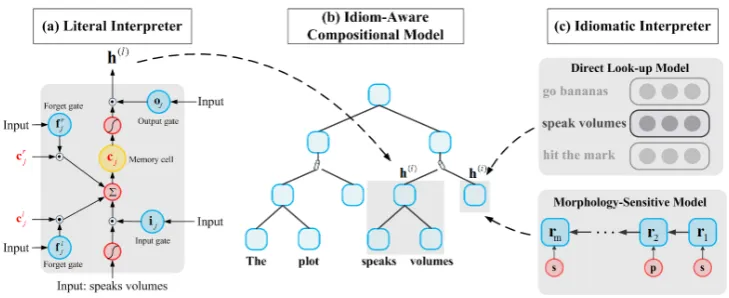
We propose an end-to-end neural model for idiom-aware distributed semantic representation. Specifi-cally, in terms of invisibility, we introduce a neural idiom detector to adaptively distinguish literal and idiomatic meaning of each phrase when learning sentence representations. For the literal phrase, we compute its semantics from its constituents with Tree-structured LSTM (TreeLSTM) (Tai et al.,
Figure 1: Illustration of different modules for our proposed idiom-aware composition network corre-sponding to the sentence “The plot speaks volumes”
3.1 Literal Interpreter
The literal interpreter is basically a composi-tional semantic model, in which the semantics of a phrase is composed by literal meanings of its constituent words. Several existing models could serve as literal interpreter. In this paper, we adopt TreeLSTM (Tai et al., 2015) due to its superior performance.
Formally, given a binary constituency treeT in-duced by a sentence, each non-leaf node corre-sponds to a phrase. We refer to hj andcj as the hidden state and memory cell of each nodej. The transition equations of nodejare as follows:
˜cj
oj
ij
fl j
fr j
=
tanh σ σ σ σ
TA,b
hxjl
j
hr j
, (1)
cj =˜cjij+cljfjl+crjfjr, (2)
hj =ojtanh (cj), (3) wherexj denotes the input vector and is non-zero
if and only if it is a leaf node. The superscript l and r represent the left child and right child re-spectively.σ represents the logistic sigmoid func-tion and denotes element-wise multiplication. TA,bis an affine transformation which depends on
parameters of the network Aandb. Figure 1-(a) gives an illustration of TreeLSTM unit.
3.2 Idiom Detector
Despite the success of TreeLSTM, there is still ex-isting potential weakness of the hypothesis that the meaning of a phrase or a sentence can be com-posed from the meanings of its constituents. Pre-vious neural sentence models are poor at learning
the meanings of idiomatic phrases, not to mention modeling the idiomatic variations.
Therefore, we introduce a parameterized idiom detector, which is used for detecting the boundary between literal and idiomatic meanings. Specifi-cally, if a compositional interpretation is nonsen-sical in the context of a sentence, then the de-tector is supposed to check whether an idiomatic sense should be taken and whether it makes sense. Thisliteral-firstmodel of idiom comprehension is motivated by the psycholinguistic hypothesis pro-posed byBobrow and Bell(1973).
Due to ignoring the context information, TreeLSTM suffers from the problem of disam-biguation. For example, the phrase “in the bag” is compositional in the sentence “The dictionary is in the bag” while it has idiomatic meaning in the sentence “The election is in the bag unless the voters find out about my past”. To address this problem, we explicitly model the context representation and integrate it into the process of sentence composition.
Context Representation More concretely, for each non-leaf nodeiand its corresponding phrase pi, we defineCas a word set which contains words surrounding the phrasepi. Then the context repre-sentationsican be obtained as follow:
si=f(c1, c2, ..., ck;θ) (4)
where f is a function with learnable parameter θ. Here, the function is implemented in two ap-proaches, NBOW and LSTM.
or idiomatic. Formally, for the phrasei(non-leaf nodei) with its context informationsi and literal meaningh(il), we compute the semantic composi-tional scoreαiusing a single layer multilayer per-ceptron.
αi=σ(vTs tanh(Ws[h(il),si])), (5)
where Ws ∈ Rd×2d and vs ∈ Rd are learnable parameters.
3.3 Idiomatic Interpreter
Idiomatic phrases pose a clear challenge to cur-rent compositional models of language compre-hension. However, until recently, there is little in-vestigation of learning idiomatic phrases in a real-world task. Here, based on different views of id-ioms (Katz, 1963; Fraser, 1970; Nunberg et al.,
1994), we propose two idiomatic interpreters to model them.
Direct Look-Up Model Inspired by the direct access theory for idiom comprehension ( Glucks-berg,1993), in this model, once a phrasep is de-tected as an idiom, it will be regarded as a long word like a key, and then their meanings can be directly retrieved from an external memory M, which is a table and stores idiomatic information for each idiom as depicted in the top subfigure in Figure1-(c). Formally, the idiomatic meaning for a phrase can be obtained as:
h(i)=M[k] (6)
where k denotes the index of the corresponding phrasep.
Morphology-Sensitive Model Since most id-ioms enjoy certain flexibility in morphology, lex-icon, syntax, the above model suffers from the problem of idiom variations. To remedy this, in-spired by the compositional view of idioms ( Nun-berg et al.,1994) and recent success of character-based models (Kim et al., 2016; Lample et al.,
2016; Chung et al., 2016), we propose to use CharLSTM to directly encode the meaning of a phrase in an idiomatic space and generate an id-iomatic representation, which is not contaminated by its literal meaning and sensitive to different variations.
Formally, for each non-leaf node iand its cor-responding phrase pi in a constituency tree, we apply charLSTM to phrase pi as depicted in the
bottom subfigure in Figure 1-(c) and utilize the emitted hidden statesrj to represent the idiomatic meaning of the phrase.
rj =Char-LSTM(rj−1,cj−1,xj) (7) where j = 1,2,· · ·, m and m represents the length of the input phrase.
Then, we can obtain the idiomatic representa-tion:
h(i)=r
m (8)
After obtaining the literal or idiomatic mean-ings, we can compute the final representation for phrasepi:
hi =αih(ii)+ (1−αi)h(il) (9) 3.4 Analysis of Two Proposed Idiomatic
Interpreters
Given a phrase, both interpreters can generate a corresponding semantic representation, which is not contaminated by its literal meaning. The dif-ference is that Look-Up Model takes a totally non-compositional view that the meanings of idioms can be directly accessed from an external dictio-nary. This straightforward retrieval mechanism is more efficient and can introduce external prior knowledge by utilizing pre-trained external dictio-nary.
By contrast, Morphology-Sensitive Model holds the idea that idiomatic meanings can still be composed in an idiomatic space, which allows this model to understand idioms better in terms of flexibility. Besides, this kind of model does not require an extra dictionary.
4 iSent: A Benchmark for Idiom-Enriched Sentiment Classification Dataset
Dataset Train Dev. Test Class Lavg |V|
MR 9596 - 1066 2 22 21K
SST-1 8544 1101 2210 5 19 18K
SST-2 6920 872 1821 2 18 15K
[image:5.595.74.294.62.114.2]SUBJ 9000 - 1000 2 21 21K
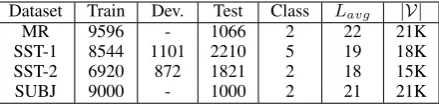
Table 2: Statistics of the four mainstream datasets for sentiment classification. Lavg denotes the av-erage length of documents;|V|denotes the size of vocabulary.
4.1 Mainstream Datasets for Sentiment Classification
We list four kinds of datasets which are most com-monly used for sentiment classification in NLP community. Additionally, we also evaluate our models on these datasets to make a comparison with many recent proposed models. Each dataset is briefly described as follows.
• SST-1 The movie reviews with five classes (negative, somewhat negative, neutral, some-what positive, positive) in the Stanford Senti-ment Treebank1(Socher et al.,2013).
• SST-2 The movie reviews with binary classes. It is also derived from the Stanford Sentiment Treebank.
• MR The movie reviews with two classes
2(Pang and Lee,2005).
• SUBJSubjectivity data set where the goal is to classify each instance (snippet) as being subjective or objective. (Pang and Lee,2004) The detailed statistics about these four datasets are listed in Table2.
4.2 Reasons for a New Dataset
Differing from previous work, which evaluating idiom detection as a standalone task, we want to integrate idiom understanding into sentiment clas-sification task. However, most of existing senti-ment datasets do not cover enough idioms or re-lated linguistic phenomenon. To better evaluate our models on idiom understanding task, we pro-posed an idiom-enriched sentiment classification dataset, in which each sentence contains at least one idiom.
Additionally, considering most idioms have cer-tain flexibility in morphology, lexicon and syn-tax, we enrich our dataset by introducing different types of idiom variations so that we can further
1http://nlp.stanford.edu/sentiment. 2https://www.cs.cornell.edu/people/
pabo/movie-review-data/.
evaluate the ability that the model handle different idiomatic variations. As shown in Table3, we sum up two types of phenomena towards idiom vari-ations and, for each variation, we obtain several corresponding sentences from a large corpora.
4.3 Data collection
We crawl the website rottentomatoes.com to excerpt movie reviews with corresponding scores and collect the idioms from dictionary (Flavell and Flavell, 2006). The idiom dictionary contains lexical variations while has no morphol-ogy variations. To address this problem, we man-ually annotate the morphological variation of each idiom in term of verb(tense), noun(plural or singu-lar).
Then we filter these movie reviews with idioms ensuring that each sentence covers at least one id-iom. After that, we obtain nearly 15K movie re-views covering1K idioms. To further improve the quality of these idiom-enriched sentences, we take some strategies to filter the dataset and finally con-struct13K idiom-enriched sentences.
• If the occurrence of an idiom in all the re-views is less than3, we threw this idiom and corresponding reviews.3
• We find some “idioms” in sentences are movie names rather than expressing id-iomatic meanings and we filtered this kind of noise.
4.4 Statistics
The iSent dataset finally contains 9752 training samples , 1020 development samples and 2003 test samples. Besides, the development and test sets cover different types of idiom variations allow-ing us to test the model’s generalization. Table4
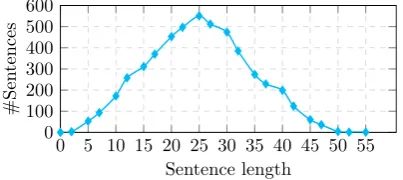
shows the detailed statistics and Figure 2 shows the distribution of the number of reviews over dif-ferent lengths.
5 Experiment
We first evaluate our proposed models on four popular sentiment datasets, so that we can make a comparison with varieties of competitors. And then, we use the newly-introduced dataset to make more detailed experiment analyses.
3The reason is that, for some idioms, we should split their
Variations Examples
Morp. VerbNoun go bananasin a nutshell→→went bananasin nutshells
[image:6.595.73.298.194.238.2]Lexical Add.Sub. in the lurchon the same page→in the big lurch→on different pages
Table 3: Idiom variations at morphological and lexical level. Add. and Sub. refer to lexical addi-tion and substituaddi-tion respectively.
Train O DevM L O TestM L
Idiom 1247 124 21 40 124 21 40
Sent. 9752 720 200 100 1403 400 200
Table 4: Key statistics for the idioms and sen-tences in iSent dataset. O(Original) denotes the idioms in dev/test sets are in original forms and have appeared in training set. M(Morphology) and L(Lexical) represent the morphology and lexical idiom variations respectively and they are unseen in training set.
0 5 10 15 20 25 30 35 40 45 50 55 0
100 200 300 400 500 600
Sentence length
#Sen
tences
Figure 2: The distribution of the number of re-views over different lengths.
5.1 Experimental Settings
Loss Function Given a sentence and its label, the output of neural network is the probabilities of the different classes. The parameters of the net-work are trained to minimise the cross-entropy of the predicted and true label distributions. To mini-mize the objective, we use stochastic gradient de-scent with the diagonal variant of AdaGrad (Duchi et al.,2011).
Initialization and Hyperparameters In all of our experiments, the word embeddings for all of the models are initialized with the GloVe vectors (Pennington et al.,2014). The other parameters are initialized by randomly sampling from uniform distribution in[−0.1,0.1].
For each task, we take the hyperparameters which achieve the best performance on the devel-opment set via a small grid search over
combina-tions of the initial learning rate[0.1,0.01,0.001], l2 regularization [0.0,5E−5,1E−5] The final
hyper-parameters are as follows. The initial learn-ing rate is 0.1. The regularization weight of the parameters is1E−5.
For all the sentences from the five datasets, we parse them with constituency parser (Klein and Manning, 2003) to obtain the trees for our and some competitor models.
5.2 Competitor Models
We give some descriptions about the setting of our models and several baseline models.
• CharLSTM: Character level LSTM.
• TLSTM: Vanilla tree-based LSTM, proposed byTai et al.(2015).
• Cont-TLSTM: Context-dependent tree-based LSTM, introduced byBowman et al.(2016).
• iTLSTM-Lo: Proposed model with Look-Up idiomatic interpreter.
• iTLSTM-Mo: Proposed model with Morphology-Sensitive interpreter.
5.3 Evaluation over Mainstream Datasets The experimental results are shown in Table 5. We can see Cont-TLSTM outperforms TLSTM on all four tasks, showing the importance of context-sensitive composition. Besides, both iTLSTM-Lo and iTLSTM-Mo achieve better results than TL-STM and Cont-LTL-STM, which indicates the ef-fectiveness of our introduced modules (detector and idiomatic interpreter). Additionally, compared with iTLSTM-Lo, iTLSTM-Mo behaves better, suggesting its char-based idiomatic interpreter is more powerful.
Although four mainstream datasets are not rich in idioms, we could also observe substantial im-provement gained from our models. We attribute this success to the power of introduced detector in identifying other non-compositional collocations besides idioms. We will discuss about this later. 5.4 Evaluation over iSent Dataset
Since iSent is a newly-introduced dataset, there is no existing baselines. Nevertheless, we provide several strong baselines implemented by ourselves as shown in Table6, and we can observe that:
[image:6.595.86.288.358.448.2]Model MR SST-1 SST-2 SUBJ
NBOW 77.2 42.4 80.5 91.3
RAE
(Socher et al.,2011) 77.7 43.2 82.4 -MV-RNN
(Socher et al.,2012) 79.0 44.4 82.9 -RNTN
(Socher et al.,2013) - 45.7 85.4 -DCNN
(Kalchbrenner et al.,2014) - 48.5 86.8 -CNN-multichannel
(Kim,2014) 81.5 47.4 88.1 93.2
CharLSTM 75.2 44.0 85.2 90.2
TLSTM 78.7 48.5 86.1 91.0
Cont-TLSTM 79.5 48.9 86.4 91.7
iTLSTM-Lo 81.6 49.9 87.7 93.2
[image:7.595.323.515.62.198.2]iTLSTM-Mo 82.5 51.2 88.2 94.5
Table 5: Accuracies of our models on four datasets against state-of-the-art neural models.
Model Train Dev. Test
NBOW 80.9 77.1 74.5
LSTM 87.5 76.9 75.0
BiLSTM 93.4 76.8 76.3 CharLSTM 92.4 75.1 74.4
TLSTM 88.2 75.3 74.9
Cont-TLSTM 90.8 76.2 75.5 iTLSTM-Lo 88.9 79.6 78.1 iTLSTM-Mo 91.3 81.1 80.0
Table 6: Accuracies of our models on iSent dataset against typical baselines. BiLSTM represents bidi-rectional LSTM.
• Additionally, iTLSTM-Lo performs worse than iTLSTM-Mo while still surpasses baseline models, which also indicates the variation-sensitive model (iTLSTM-Mo) of idioms could further improve the perfor-mance.
5.5 Analysis
In this section, we will provide more detailed quantitative and qualitative analysis in terms of three properties of idioms described in Table 1: flexibility, invisibility and idiomaticity.
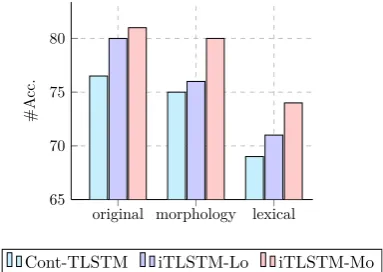
Flexibility Besides the overall accuracies on the test set, we also list the performance achieved by different models over the different parts of test set: original, morphological and lexical, which repre-sents different types of variations and have been described in Table4.
We can see from Figure 3, both idiom-aware models achieve better performance than
Cont-original morphology lexical 65
70 75 80
#A
cc.
[image:7.595.70.295.64.252.2]Cont-TLSTM iTLSTM-Lo iTLSTM-Mo
Figure 3: Performances achieved by different models are subdivided into three parts. Origi-nal, Morphology, Lexical represents accuracies achieved by corresponding part of test data.
TLSTM by a large margin on the original part of test set, which indicates the importance of under-standing idiomatic phrases during sentence mod-elling. Additionally, iTLSTM+Mo outperforms the other two models on the test set, suggesting the effectiveness of morphology-based model for modeling idiom variations.
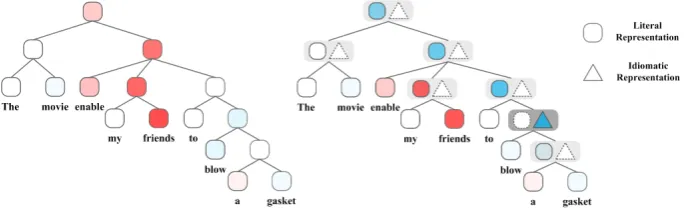
Invisibility and Idiomaticity Previous experi-mental results have shown the effectiveness of our models. Here, we want to know how the intro-duced idiom detector contributes to the improve-ment of performance. Toward this end, we analyze all the 157 samples which our model predicts cor-rectly while baseline model (Cont-TLSTM) fails on iSent, and find more than 120 sentences are given wrong sentiment by Cont-TLSTM due to ig-noring the figurative meanings of idioms. For ex-ample, as shown in Figure 4, we randomly sam-ple a sentence and analyze the changes of the pre-dicted sentiment score at different nodes of the tree.
The sentence “The movie enable my friends to blow a gasket” has negative sentiment. Cont-TLSTM gives a wrong predic-tion due to ignoring the informapredic-tion expressed by the idiomatic phrase “blow a gasket”. By contrast, our model correctly detects this idiom, whose meaning plays a major role in final sentiment prediction.
Non-compositional Phrases Detection Besides idioms, we find the introduced detector can also pick up other types of non-compositional phrases4. We roughly sum up these
[image:7.595.105.257.301.409.2]Figure 4: The change of the predicted sentiment score at different nodes of the tree. The red and blue color represent positive and negative sentiment respectively, where darker indicates higher confidence. Dashed triangle or square box denote not being selected by detector.
PN VP NP AP
Notting Hill let alone short cuts on earth Holly Bolly take cover deja vu at once star wars saga rips off black comedy all in all Barry Skolnick thumb down femme fatale not only Apollo 13 fall apart no problem at times Table 7: PN, VP, NP and AP represent proper noun, noun phrase, verb phrase and adverbial phrase respectively.
compositional phrases picked up by introduced detector from all the five development sets and list them in Table7.
From the table, we can see that most of these phrases either imply an affective stance to-ward something: “thumbs down”, or are criti-cal to the understanding of sentences such as the “Verb Phrases” and “Adverb Phrases”. For exam-ple, the sentence “More often than not, this mixed bag hit its mark” has a positive sentiment. Cont-TLSTM pays much more attention to the word “not” without realizing that it belongs to the collocation “more often than not”, which expresses neutral emotion. In comparison, our model regards this collocation as a whole with neutral sentiment, which is crucial for the final prediction.
6 Related Work
Previous work related to idioms focused on their identification, which falls in two kinds of paradigms: idiom type classification (Gedigian et al., 2006; Shutova et al., 2010) and idiom to-ken classification (Katz and Giesbrecht,2006;Li and Sporleder,2009;Fazly et al.,2009;Peng et al.,
2014; Salton et al., 2016). Different with these work, we integrate idioms understanding into a real-world task and consider different peculiarities
of idioms in an end-to-end trainable framework. Recently, there are some work exploring the compositionality of various types of phrases ( Kart-saklis et al.,2012;Muraoka et al.,2014;Hermann,
2014;Hashimoto and Tsuruoka,2016). Compared with these work, we focus on how to properly model idioms under the context of sentence rep-resentations.
More recently, Zhu et al. (2016) propose a DAG-structured LSTM to incorporate external semantics including non-compositional or holis-tically learned semantics. Its key characteris-tic is that a DAG needs be built in advance, which merges some detected n-grams as the non-compositional phrases based on external knowl-edge. Different from this work, we focus on how to integrate detection and understanding of idioms into a unified end-to-end model, in which an id-iomatic detector is introduced to adaptively con-trol the semantic compositionality. Particularly, in the whole process no extra information is given to tell which phrases should be regarded as non-compositional.
7 Conclusion and Future Work
In this paper, we lay idioms understanding in the context of sentence-level semantic representation based on two linguistic perspectives. To apply our model into the real-world task, we introduce a sizeable idiom-enriched sentiment classification dataset, which covers abundant peculiarities of id-ioms. We make an elaborate experiment design and case analysis to evaluate the effectiveness of our proposed models.
Acknowledgments
We would like to thank the anonymous re-viewers for their valuable comments. This work was partially funded by National Natural Sci-ence Foundation of China (No. 61532011 and 61672162), Shanghai Municipal Science and Technology Commission (No. 16JC1420401), and Young Elite Scientists Sponsorship Program By CAST (2015QNRC001).
References
Alexandra Balahur, Ralf Steinberger, Mijail Kabad-jov, Vanni Zavarella, Erik Van Der Goot, Matina Halkia, Bruno Pouliquen, and Jenya Belyaeva. 2013. Sentiment analysis in the news. arXiv preprint arXiv:1309.6202.
Samuel A Bobrow and Susan M Bell. 1973. On catch-ing on to idiomatic expressions. Memory & Cogni-tion1(3):343–346.
Samuel R Bowman, Jon Gauthier, Abhinav Ras-togi, Raghav Gupta, Christopher D Manning, and Christopher Potts. 2016. A fast unified model for parsing and sentence understanding. arXiv preprint arXiv:1603.06021.
Kyunghyun Cho, Bart van Merrienboer, Caglar Gul-cehre, Fethi Bougares, Holger Schwenk, and Yoshua Bengio. 2014. Learning phrase representations using rnn encoder-decoder for statistical machine translation. InProceedings of EMNLP.
Junyoung Chung, Kyunghyun Cho, and Yoshua Ben-gio. 2016. A character-level decoder without ex-plicit segmentation for neural machine translation.
arXiv preprint arXiv:1603.06147.
Junyoung Chung, Caglar Gulcehre, KyungHyun Cho, and Yoshua Bengio. 2014. Empirical evaluation of gated recurrent neural networks on sequence model-ing. arXiv preprint arXiv:1412.3555.
Ronan Collobert, Jason Weston, L´eon Bottou, Michael Karlen, Koray Kavukcuoglu, and Pavel Kuksa. 2011. Natural language processing (almost) from scratch. The JMLR12:2493–2537.
John Duchi, Elad Hazan, and Yoram Singer. 2011. Adaptive subgradient methods for online learning and stochastic optimization. The JMLR 12:2121– 2159.
Afsaneh Fazly, Paul Cook, and Suzanne Stevenson. 2009. Unsupervised type and token identification of idiomatic expressions. Computational Linguis-tics35(1):61–103.
Linda Flavell and Roger Flavell. 2006. Dictionary of idioms and their origins. Kyle Cathie Limited.
Bruce Fraser. 1970. Idioms within a transformational grammar. Foundations of languagepages 22–42. Matt Gedigian, John Bryant, Srini Narayanan, and
Bra-nimir Ciric. 2006. Catching metaphors. In Pro-ceedings of the Third Workshop on Scalable Natural Language Understanding. Association for Compu-tational Linguistics, pages 41–48.
Sam Glucksberg. 1993. Idiom meanings and allusional content. Idioms: Processing, structure, and inter-pretationpages 3–26.
Kazuma Hashimoto and Yoshimasa Tsuruoka. 2016. Adaptive joint learning of compositional and non-compositional phrase embeddings. arXiv preprint arXiv:1603.06067.
Karl Moritz Hermann. 2014. Distributed representa-tions for compositional semantics. arXiv preprint arXiv:1411.3146.
Sepp Hochreiter and J¨urgen Schmidhuber. 1997. Long short-term memory. Neural computation
9(8):1735–1780.
Nal Kalchbrenner, Edward Grefenstette, and Phil Blun-som. 2014. A convolutional neural network for modelling sentences. InProceedings of ACL. Dimitri Kartsaklis, Mehrnoosh Sadrzadeh, and Stephen
Pulman. 2012. A unified sentence space for categor-ical distributional-compositional semantics: Theory and experiments. In In Proceedings of COLING: Posters. Citeseer.
Graham Katz and Eugenie Giesbrecht. 2006. Au-tomatic identification of non-compositional multi-word expressions using latent semantic analysis. In
Proceedings of the Workshop on Multiword Expres-sions: Identifying and Exploiting Underlying Prop-erties. Association for Computational Linguistics, pages 12–19.
Jerrold J Katz. 1963.Semantic interpretation of idioms and sentences containing them. Research Labora-tory of Electronics, Massachusetts Institute of Tech-nology.
Yoon Kim. 2014. Convolutional neural net-works for sentence classification. arXiv preprint arXiv:1408.5882.
Yoon Kim, Yacine Jernite, David Sontag, and Alexan-der M Rush. 2016. Character-aware neural language models. InThirtieth AAAI Conference on Artificial Intelligence.
Dan Klein and Christopher D Manning. 2003. Accu-rate unlexicalized parsing. In Proceedings of the 41st Annual Meeting on Association for Computa-tional Linguistics-Volume 1. pages 423–430. Guillaume Lample, Miguel Ballesteros, Sandeep
Sub-ramanian, Kazuya Kawakami, and Chris Dyer. 2016. Neural architectures for named entity recognition.
Linlin Li and Caroline Sporleder. 2009. Classifier com-bination for contextual idiom detection without la-belled data. InProceedings of the 2009 Conference on Empirical Methods in Natural Language Pro-cessing: Volume 1-Volume 1. Association for Com-putational Linguistics, pages 315–323.
Pengfe Liu, Xipeng Qiu, Jifan Chen, and Xuanjing Huang. 2016a. Deep fusion LSTMs for text seman-tic matching. InProceedings of ACL.
Pengfei Liu, Xipeng Qiu, and Xuanjing Huang. 2017. Adversarial multi-task learning for text classifica-tion. arXiv preprint arXiv:1704.05742.
Pengfei Liu, Xipeng Qiu, Yaqian Zhou, Jifan Chen, and Xuanjing Huang. 2016b. Modelling interaction of sentence pair with coupled-lstms. InProceedings of the 2016 Conference on EMNLP.
Masayasu Muraoka, Sonse Shimaoka, Kazeto Ya-mamoto, Yotaro Watanabe, Naoaki Okazaki, and Kentaro Inui. 2014. Finding the best model among representative compositional models. In
Proceedings of the 28th Pacific Asia Conference on Language, Information, and Computation (PACLIC 2014). pages 65–74.
Geoffrey Nunberg, Ivan A Sag, and Thomas Wasow. 1994. Idioms. Languagepages 491–538.
Bo Pang and Lillian Lee. 2004. A sentimental educa-tion: Sentiment analysis using subjectivity summa-rization based on minimum cuts. InProceedings of ACL.
Bo Pang and Lillian Lee. 2005. Seeing stars: Exploit-ing class relationships for sentiment categorization with respect to rating scales. In Proceedings of the 43rd annual meeting on association for compu-tational linguistics. Association for Computational Linguistics, pages 115–124.
Jing Peng, Anna Feldman, and Ekaterina Vylomova. 2014. Classifying idiomatic and literal expressions using topic models and intensity of emotions. In
EMNLP. pages 2019–2027.
Jeffrey Pennington, Richard Socher, and Christopher D Manning. 2014. Glove: Global vectors for word rep-resentation. Proceedings of the EMNLP 12:1532– 1543.
Giancarlo Salton, Robert Ross, and John Kelleher. 2014. An empirical study of the impact of idioms on phrase based statistical machine translation of en-glish to brazilian-portuguese .
Giancarlo D Salton, Robert J Ross, and John D Kelle-her. 2016. Idiom token classification using senten-tial distributed semantics. In Proceedings of the 54th Annual Meeting of the Association for Compu-tational Linguistics. pages 194–204.
Ekaterina Shutova, Lin Sun, and Anna Korhonen. 2010. Metaphor identification using verb and noun clustering. InProceedings of the 23rd International Conference on Computational Linguistics. Associ-ation for ComputAssoci-ational Linguistics, pages 1002– 1010.
Richard Socher, Brody Huval, Christopher D Manning, and Andrew Y Ng. 2012. Semantic compositional-ity through recursive matrix-vector spaces. In Pro-ceedings of EMNLP. pages 1201–1211.
Richard Socher, Jeffrey Pennington, Eric H Huang, Andrew Y Ng, and Christopher D Manning. 2011. Semi-supervised recursive autoencoders for predict-ing sentiment distributions. In Proceedings of EMNLP.
Richard Socher, Alex Perelygin, Jean Y Wu, Jason Chuang, Christopher D Manning, Andrew Y Ng, and Christopher Potts. 2013. Recursive deep mod-els for semantic compositionality over a sentiment treebank. InProceedings of EMNLP.
Kai Sheng Tai, Richard Socher, and Christopher D Manning. 2015. Improved semantic representations from tree-structured long short-term memory net-works. arXiv preprint arXiv:1503.00075.
Aline Villavicencio, Francis Bond, Anna Korhonen, and Diana McCarthy. 2005. Introduction to the spe-cial issue on multiword expressions: Having a crack at a hard nut.
Lowri Williams, Christian Bannister, Michael Arribas-Ayllon, Alun Preece, and Irena Spasi´c. 2015. The role of idioms in sentiment analysis. Expert Systems with Applications42(21):7375–7385.
Han Zhao, Zhengdong Lu, and Pascal Poupart. 2015. Self-adaptive hierarchical sentence model. arXiv preprint arXiv:1504.05070.
Xiao-Dan Zhu, Parinaz Sobhani, and Hongyu Guo. 2015. Long short-term memory over recursive structures. InICML. pages 1604–1612.