133
CytonMT: an Efficient Neural Machine Translation
Open-source Toolkit Implemented in C++
Xiaolin Wang Masao Utiyama Eiichiro Sumita
Advanced Translation Research and Development Promotion Center National Institute of Information and Communications Technology, Japan
{xiaolin.wang,mutiyama,eiichiro.sumita}@nict.go.jp
Abstract
This paper presents an open-source neural ma-chine translation toolkit named CytonMT1. The toolkit is built from scratch only using C++ and NVIDIA’s GPU-accelerated libraries. The toolkit features training efficiency, code simplicity and translation quality. Benchmarks show that CytonMT accelerates the training speed by 64.5% to 110.8% on neural net-works of various sizes, and achieves compet-itive translation quality.
1 Introduction
Neural Machine Translation (NMT) has made remarkable progress over the past few years (Sutskever et al., 2014;
Bahdanau et al., 2014; Wu et al., 2016). Just like Moses (Koehn et al., 2007) does for statistic machine translation (SMT), open-source NMT toolkits contribute greatly to this progress, including but not limited to,
• RNNsearch-LV (Jean et al.,2015)2
• Luong-NMT (Luong et al.,2015a)3
• DL4MT by Kyunghyun Cho et al.4
• BPE-char (Chung et al.,2016)5
• Nematus (Sennrich et al.,2017)6
• OpenNMT (Klein et al.,2017)7
• Seq2seq (Britz et al.,2017)8
1
https://github.com/arthurxlw/cytonMt
2https://github.com/sebastien-j/LV groundhog
3https://github.com/lmthang/nmt.hybrid
4
https://github.com/nyu-dl/dl4mt-tutorial
5
https://github.com/nyu-dl/dl4mt-cdec
6
https://github.com/EdinburghNLP/nematus
7https://github.com/OpenNMT/OpenNMT-py
8https://github.com/google/seq2seq
• ByteNet (Kalchbrenner et al.,2016)9
• ConvS2S (Gehring et al.,2017)10
• Tensor2Tensor (Vaswani et al.,2017)11
• Marian (Junczys-Dowmunt et al.,2018)12 These open-source NMT toolkits are undoubt-edly excellent software. However, there is a com-mon issue – they are all written in script languages with dependencies on third-party GPU platforms (see Table 1) except Marian, which is developed simultaneously with our toolkit.
Using script languages and third-party GPU platforms is a two-edged sword. On one hand, it greatly reduces the workload of coding neural networks. On the other hand, it also causes two problems as follows,
• The running efficiency drops, and profiling and optimization also become difficult, as the direct access to GPUs is blocked by the lan-guage interpreters or the platforms. NMT systems typically require days or weeks to train, so training efficiency is a paramount concern. Slightly faster training can make the difference between plausible and impossible experiments (Klein et al.,2017).
• The researchers using these toolkits may be constrained by the platforms. Unex-plored computations or operations may be-come disallowed or unnecessarily inefficient on a third-party platform, which lowers the chances of developing novel neural network techniques.
9
https://github.com/paarthneekhara/byteNet-tensorflow (unofficial) and others.
10
https://github.com/facebookresearch/fairseq
11https://github.com/tensorflow/tensor2tensor
Toolkit Language Platform
RNNsearch-LV Python Theano,GroundHog
Luong-NMT Matlab Matlab
DL4MT Python Theano
BPE-char Python Theano
Nematus Python Theano
OpenNMT Lua Torch
Seq2seq Python Tensorflow
ByteNet Python Tensorflow
ConvS2S Lua Torch
Tensor2Tensor Python Tensorflow
Marian C++ –
[image:2.595.308.529.60.260.2]CytonMT C++ –
Table 1: Languages and Platforms of Open-source NMT toolkits.
CytonMT is developed to address this issue, in hopes of providing the community an attractive alternative. The toolkit is written in C++ which is the genuine official language of NVIDIA – the manufacturer of the most widely-used GPU hard-ware. This gives the toolkit an advantage on effi-ciency when compared with other toolkits.
Implementing in C++ also gives CytonMT great flexibility and freedom on coding. The researchers who are interested in the real calculations inside neural networks can trace source codes down to kernel functions, matrix operations or NVIDIA’s APIs, and then modify them freely to test their novel ideas.
The code simplicity of CytonMT is compara-ble to those NMT toolkits implemented in script languages. This owes to an open-source general-purpose neural network library in C++, named Cy-tonLib, which is shipped as part of the source code. The library defines a simple and friendly pattern for users to build arbitrary network archi-tectures in the cost of two lines of genuine C++ code per layer.
CytonMT achieves competitive translation quality, which is the main purpose of NMT toolkits. It implements the popular framework of attention-based RNN encoder-decoder. Among the reported systems of the same architecture, it ranks at top positions on the benchmarks of both WMT14 and WMT17 English-to-German tasks.
The following of this paper presented the details of CytonMT from the aspects of method, imple-mentation, benchmark, and future works.
2 Method
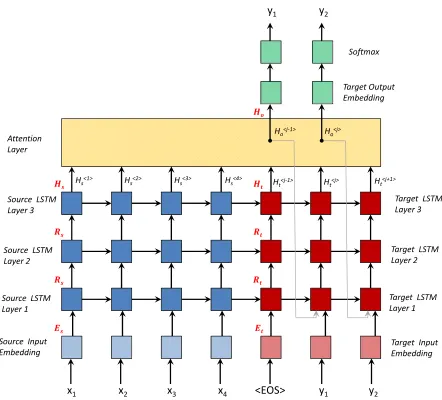
The toolkit approaches to the problem of ma-chine translation using the attention-based RNN encoder-decoder proposed by Bahdanau et al.
(2014) and Luong et al.(2015a). Figure1
! "
# " $"
"
[image:2.595.80.284.61.194.2]$" $" $%" ! " "
Figure 1: Architecture of CytonMT.
trates the architecture. The conditional probability of a translation given a source sentence is formu-lated as,
log p(y|x) =
m X
j=1
log(p(yj|Hohji)
=
m X
j=1
log(softmaxyj(tanh(WoH
hji
o +Bo))) (1)
Hohji=Fatt(Hs, Hh ji
t ), (2)
wherexis a source sentence; y=(y1, . . . , ym)is
a translation;Hsis a source-side top-layer hidden state;Hthji is a target-side top-layer hidden state;
Hohji is a state generated by an attention model
Fatt; Wo and Bo are the weight and bias of an
output embedding.
The toolkit adopts the multiplicative attention model proposed byLuong et al.(2015a), because it is slightly more efficient than the additive variant proposed byBahdanau et al.(2014). This issue is addressed inBritz et al.(2017) andVaswani et al.
(2017). Figure2illustrates the model, formulated as ,
ahstiji= softmax(Fa(Hshii, H hji t ))
= e
Fa(H
hii
s ,Hthji)
Pn i=1eF
a(H
hii
s ,Hthji)
, (3)
Fa(Hshii, H hji t ) =H
hii s
⊤
WaHthji, (4)
Cshji= n X
i=1
ahstijiH hii
s , (5)
Csthji= [Cs;H hji
t ], (6) Hohji= tanh(WcCsthji), (7)
whereFais a scoring function for alignment;Wa
Figure 2: Architecure of Attention Model.
states into a space comparable to the source-side;
ahstijiis an alignment coefficient;Cshjiis a
source-side context; Csthji is a context derived from both sides.
3 Implementation
The toolkit consists of a general purpose neural network library, and a neural machine translation system built upon the library. The neural network library defines a class named Network to facili-tate the construction of arbitrary neural networks. Users only need to inherit the class, declare com-ponents as data members, and write down two lines of codes per component in an initialization function. For example, the complete code of the attention network formulated by the equations 3
to7 is presented in Figure3. This piece of code fulfills the task of building a neural network as fol-lows,
• The class of Variable stores numeric values and gradients. Through passing the pointers of Variable around, component are connected together.
• The data member of layers collects all the components. The base class of Network will call the functions forward, backward and
cal-culateGradient of each component to
per-form the actual computation.
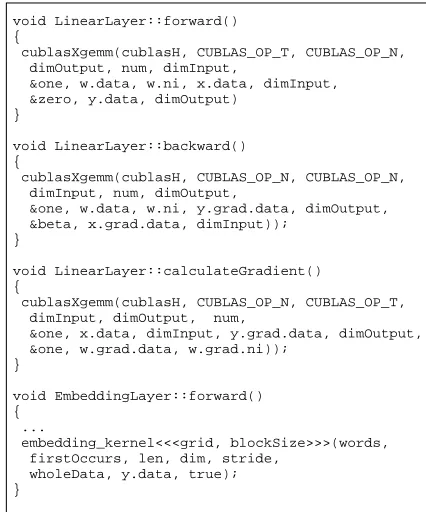
The codes of actual computation are organized in the functions forward, backward and
calculate-Gradient for each type of component. Figure 4
presents some examples. Note that these codes have been slightly simplified for illustration.
class Attention: public Network {
DuplicateLayer dupHt; // declare components LinearLayer linearHt;
MultiplyHsHt multiplyHsHt; SoftmaxLayer softmax; WeightedHs weightedHs; Concatenate concateCsHt; LinearLayer linearCst; ActivationLayer actCst;
Variable* init(LinearLayer* linHt, LinearLayer* linCst, Variable* hs, Variable* ht)
{
Variable* tx;
tx=dupHt.init(ht); // make two copies
layers.push_back(&dupHt);
tx=linearHt.init(linHt, tx); // WaHt
layers.push_back(&linearHt);
tx=multiplyHsHt.init(hs, tx); // Fa
layers.push_back(&multiplyHsHt);
tx=softmax.init(tx); // ast
layers.push_back(&softmax);
tx=weightedHs.init(hs, tx); // Cs
layers.push_back(&weightedHs);
tx=concateCsHt.init(tx, &dupHt.y1); // Cst layers.push_back(&concateCsHt);
tx=linearCst.init(linCst, tx); // WcCst layers.push_back(&linearCst);
tx=actCst.init(tx, CUDNN_ACTIVATION_TANH);// Ho layers.push_back(&actCst);
return tx; //pointer to result }
[image:3.595.73.295.84.201.2]};
Figure 3: Complete Code of Attention Model For-mulated by Equations3to7
void LinearLayer::forward() {
cublasXgemm(cublasH, CUBLAS_OP_T, CUBLAS_OP_N, dimOutput, num, dimInput,
&one, w.data, w.ni, x.data, dimInput, &zero, y.data, dimOutput)
}
void LinearLayer::backward() {
cublasXgemm(cublasH, CUBLAS_OP_N, CUBLAS_OP_N, dimInput, num, dimOutput,
&one, w.data, w.ni, y.grad.data, dimOutput, &beta, x.grad.data, dimInput));
}
void LinearLayer::calculateGradient() {
cublasXgemm(cublasH, CUBLAS_OP_N, CUBLAS_OP_T, dimInput, dimOutput, num,
&one, x.data, dimInput, y.grad.data, dimOutput, &one, w.grad.data, w.grad.ni));
}
void EmbeddingLayer::forward() {
...
embedding_kernel<<<grid, blockSize>>>(words, firstOccurs, len, dim, stride,
wholeData, y.data, true); }
[image:3.595.308.521.460.716.2]4 Benchmarks
4.1 Settings
CytonMT is tested on the widely-used bench-marks of the WMT14 and WMT17 English-to-German tasks (Bojar et al., 2017) (Ta-ble 2). Both datasets are processed and con-verted using byte-pair encoding(Gage, 1994;
Schuster and Nakajima, 2012) with a shared source-target vocabulary of about 37000 to-kens. The WMT14 corpora are processed by the scripts from Vaswani et al. (2017)13. The WMT17 corpora are processed by the scripts from Junczys-Dowmunt et al. (2018)14, which includes 10 million back-translated sentence pairs for training.
The benchmarks were run on an Intel Xeon CPU E5-2630 @ 2.4Ghz and a GPU Quadro M4000 (Maxwell) that had 1664 CUDA cores @ 773 MHz, 2,573 GFLOPS . The software is CentOS 6.8, CUDA 9.1 (driver 387.26), CUDNN 7.0.5, Theano 1.0.1, Tensorflow 1.5.0. Netmaus, Torch and OpenNMT are the latest version in De-cember 2017. Marian is the last version in May 2018.
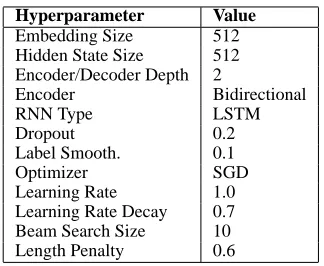
CytonMT is run with the hyperparameters set-tings presented by Table3unless stated otherwise. The settings provide both fast training and com-petitive translate quality according to our experi-ments on a variety of translation tasks. Dropout is applied to the hidden states between non-top re-current layersRs,Rtand outputHoaccording to
(Wang et al., 2017). Label smoothing estimates the marginalized effect of label-dropout during training, which makes models learn to be more un-sure (Szegedy et al.,2016). This improved BLEU scores (Vaswani et al., 2017). Length penalty is applied using the formula in (Wu et al.,2016).
4.2 Comparison on Training Speed
Four baseline toolkits and CytonMT train mod-els using the settings of hyperparameters in Ta-ble3. The number of layers and the size of embed-dings and hidden states varies, as large networks are often used in real-world applications to achieve higher accuracy at the cost of more running time.
Table 4 presents the training speed of differ-ent toolkits measured in source tokens per sec-ond. The results show that the training speed of CytonMT is much higher than the baselines.
13
https://github.com/tensorflow/tensor2tensor
14
https://github.com/marian-nmt/marian-examples/tree/master/wmt2017-uedin
Data Set # Sent. # Words
Source Target
WMT14
Train.(standard) 4,500,966 113,548,249 107,259,529
Dev. (tst2013) 3,000 64,807 63,412
Test (tst2014) 3,003 67,617 63,078
WMT17
Train.(standard) 4,590,101 118,768,285 112,009,072
Train.(back trans.) 10,000,000 190,611,668 149,198,444
Dev. (tst2016) 2,999 64,513 62,362
[image:4.595.307.552.62.172.2]Test (tst2017) 3,004 64,776 60,963
Table 2: WMT English-to-German corpora.
Hyperparameter Value
Embedding Size 512
Hidden State Size 512
Encoder/Decoder Depth 2
Encoder Bidirectional
RNN Type LSTM
Dropout 0.2
Label Smooth. 0.1
Optimizer SGD
Learning Rate 1.0
Learning Rate Decay 0.7
Beam Search Size 10
[image:4.595.336.498.212.345.2]Length Penalty 0.6
Table 3: Hyperparameter Settings.
OpenNMT is the fastest baseline, while CytonMT achieves a speed up versus it by 64.5% to 110.8%. Moreover, CytonMT shows a consistent tendency to speed up more on larger networks.
4.3 Comparison on Translation Quality
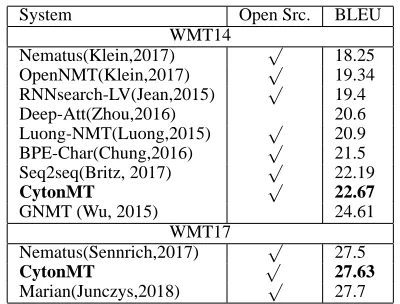
Table 5 compares the BLEU of CytonMT with the reported results from the systems of the same architecture (attention-based RNN encoder-decoder). BLEU is calculated on cased, to-kenized text to be comparable to previous work (Sutskever et al.,2014;Luong et al.,2015b;
Wu et al.,2016;Zhou et al.,2016).
The settings of CytonMT on WMT14 follows Table 3, while the settings on WMT17 adopt a depth of 3 and a hidden state size of 1024 as the training set is three times larger. The cross
Embed./State Size 512 512 1024 1024
Enc./ Dec. Layers 2 4 2 4
Nematus 1875 1190 952 604
OpenNMT 2872 2038 1356 904
Seq2Seq 1618 1227 854 599
Marian 2630 1832 1120 688
CytonMT 4725 3751 2571 1906
[image:4.595.306.531.639.720.2]speedup> 64.5% 84.1% 89.6% 110.8%
System Open Src. BLEU WMT14
Nematus(Klein,2017) √ 18.25
OpenNMT(Klein,2017) √ 19.34
RNNsearch-LV(Jean,2015) √ 19.4
Deep-Att(Zhou,2016) 20.6
Luong-NMT(Luong,2015) √ 20.9
BPE-Char(Chung,2016) √ 21.5
Seq2seq(Britz, 2017) √ 22.19
CytonMT √ 22.67
GNMT (Wu, 2015) 24.61
WMT17
Nematus(Sennrich,2017) √ 27.5
CytonMT √ 27.63
[image:5.595.81.281.60.212.2]Marian(Junczys,2018) √ 27.7
Table 5: Comparing BLEU with Public Records.
entropy of the development set is monitored ev-ery 121 epoch on WMT14 and every
1
36 epoch on
WMT17, approximately 400K sentence pairs. If the entropy has not decreased by max(0.01 ×
learning rate,0.001) in 12 times, learning rate decays by 0.7 and the training restarts from the previous best model. The whole training proce-dure terminates when no improvement is made during two neighboring decays of learning rate. The actual training took 28 epochs on WMT14 and 12 epochs on WMT17.
Table5shows that CytonMT achieves the com-petitive BLEU points on both benchmarks. On WMT14, it is only outperformed by Google’s pro-duction system (Wu et al., 2016), which is very much larger in scale and much more demanding on hardware. On WMT17, it achieves the same level of performance with Marian, which is high among the entries of WMT17 for a single sys-tem. Note that the start-of-the-art scores on these benchmarks have been recently pushed forward by novel network architectures such asGehring et al.
(2017), Vaswani et al. (2017) and Shazeer et al.
(2017)
5 Conclusion
This paper introduces CytonMT – an open-source NMT toolkit – built from scratch only using C++ and NVIDIA’s GPU-accelerated li-braries. CytonMT speeds up training by more than 64.5%, and achieves competitive BLEU points on WMT14 and WMT17 corpora. The source code of CytonMT is simple because of CytonLib – an open-source general purpose neural network li-brary – contained in the toolkit. Therefore, Cy-tonMT is an attractive alternative for the research community. We open-source this toolkit in hopes
of benefiting the community and promoting the field. We look forward to hearing feedback from the community.
The future work of CytonMT will be contin-ued in two directions. One direction is to fur-ther optimize the code for GPUs, such support-ing multi-GPU. The problem we used to have is that GPUs proceed very fast in the last few years. For example, the microarchitectures of NVIDIA GPUs evolve twice during the development of Cy-tonMT, from Maxwell to Pascale, and then to Volta. Therefore, we have not explored cutting-edge GPU techniques as the coding effort may be outdated quickly. Multi-GPU machines are com-mon now, so we plan to support them.
The other direction is to support latest NMT ar-chitectures such ConvS2S (Gehring et al., 2017) and Transformer (Vaswani et al.,2017). In these architectures, recurrent structures are replaced by convolution or attention structures. Their high per-formance indicates that the new structures suit the translation task better, so we also plan to support them in the future.
References
Dzmitry Bahdanau, Kyunghyun Cho, and Yoshua Ben-gio. 2014. Neural machine translation by jointly learning to align and translate. Proceedings of the
3rd International Conference on Learning Repre-sentations., pages 1–15.
Ondˇrej Bojar, Rajen Chatterjee, Christian Federmann, Yvette Graham, Barry Haddow, Shujian Huang, Matthias Huck, Philipp Koehn, Qun Liu, Varvara Logacheva, Christof Monz, Matteo Negri, Matt Post, Raphael Rubino, Lucia Specia, and Marco Turchi. 2017. Findings of the 2017 conference on machine translation (wmt17). In Proceedings
of the Second Conference on Machine Translation, Volume 2: Shared Task Papers, pages 169–214,
Copenhagen, Denmark. Association for Computa-tional Linguistics.
Denny Britz, Anna Goldie, Minh-Thang Luong, and Quoc Le. 2017. Massive exploration of neural machine translation architectures. In Proceedings
of the 2017 Conference on Empirical Methods in Natural Language Processing, pages 1442–1451,
Copenhagen, Denmark. Association for Computa-tional Linguistics.
Junyoung Chung, Kyunghyun Cho, and Yoshua Ben-gio. 2016. A character-level decoder without ex-plicit segmentation for neural machine translation. In Proceedings of the 54th Annual Meeting of the
As-sociation for Computational Linguistics (Volume 1: Long Papers), pages 1693–1703, Berlin, Germany.
Philip Gage. 1994. A new algorithm for data compres-sion. The C Users Journal, 12(2):23–38.
Jonas Gehring, Michael Auli, David Grangier, Denis Yarats, and Yann N Dauphin. 2017. Convolutional Sequence to Sequence Learning. ArXiv e-prints.
S´ebastien Jean, Kyunghyun Cho, Roland Memisevic, and Yoshua Bengio. 2015. On using very large target vocabulary for neural machine translation. In Proceedings of the 53rd Annual Meeting of the
Association for Computational Linguistics and the 7th International Joint Conference on Natural Lan-guage Processing (Volume 1: Long Papers), pages
1–10, Beijing, China. Association for Computa-tional Linguistics.
Marcin Junczys-Dowmunt, Roman Grundkiewicz, Tomasz Dwojak, Hieu Hoang, Kenneth Heafield, Tom Neckermann, Frank Seide, Ulrich Germann, Alham Fikri Aji, Nikolay Bogoychev, Andr F. T. Martins, and Alexandra Birch. 2018. Marian: Fast neural machine translation in c++. arXiv preprint
arXiv:1804.00344.
Nal Kalchbrenner, Lasse Espeholt, Karen Simonyan, A¨aron van den Oord, Alex Graves, and Koray Kavukcuoglu. 2016. Neural machine translation in linear time. CoRR, abs/1610.10099.
Guillaume Klein, Yoon Kim, Yuntian Deng, Jean Senellart, and Alexander Rush. 2017. Opennmt: Open-source toolkit for neural machine translation. In Proceedings of ACL, System Demonstrations, pages 67–72, Vancouver, Canada. Association for Computational Linguistics.
Philipp Koehn, Hieu Hoang, Alexandra Birch, Chris Callison-Burch, Marcello Federico, Nicola Bertoldi, Brooke Cowan, Wade Shen, Christine Moran, Richard Zens, et al. 2007. Moses: Open source toolkit for statistical machine translation. In
Pro-ceedings of ACL, Interactive Poster and Demonstra-tion Sessions, pages 177–180. AssociaDemonstra-tion for
Com-putational Linguistics.
Thang Luong, Hieu Pham, and Christopher D. Man-ning. 2015a. Effective approaches to attention-based neural machine translation. In Proceedings of
the 2015 Conference on Empirical Methods in Nat-ural Language Processing, pages 1412–1421,
Lis-bon, Portugal. Association for Computational Lin-guistics.
Thang Luong, Ilya Sutskever, Quoc Le, Oriol Vinyals, and Wojciech Zaremba. 2015b. Addressing the rare word problem in neural machine translation. In
Pro-ceedings of the 53rd Annual Meeting of the Associ-ation for ComputAssoci-ational Linguistics and the 7th In-ternational Joint Conference on Natural Language Processing (Volume 1: Long Papers), pages 11–19,
Beijing, China. Association for Computational Lin-guistics.
Mike Schuster and Kaisuke Nakajima. 2012. Japanese and korean voice search. In Acoustics, Speech and
Signal Processing (ICASSP), 2012 IEEE Interna-tional Conference on, pages 5149–5152. IEEE.
Rico Sennrich, Orhan Firat, Kyunghyun Cho, Alexan-dra Birch, Barry Haddow, Julian Hitschler, Marcin Junczys-Dowmunt, Samuel L”aubli, Antonio Vale-rio Miceli Barone, Jozef Mokry, and Maria Nadejde. 2017. Nematus: a toolkit for neural machine trans-lation. In Proceedings of the Software
Demonstra-tions of the 15th Conference of the European Chap-ter of the Association for Computational Linguistics,
pages 65–68, Valencia, Spain. Association for Com-putational Linguistics.
Noam Shazeer, Azalia Mirhoseini, Krzysztof Maziarz, Andy Davis, Quoc V. Le, Geoffrey E. Hinton, and Jeff Dean. 2017. Outrageously large neural net-works: The sparsely-gated mixture-of-experts layer.
CoRR, abs/1701.06538.
Ilya Sutskever, Oriol Vinyals, and Quoc V Le. 2014. Sequence to sequence learning with neural net-works. In Advances in neural information
process-ing systems, pages 3104–3112.
Christian Szegedy, Vincent Vanhoucke, Sergey Ioffe, Jonathon Shlens, and Zbigniew Wojna. 2016. Re-thinking the inception architecture for computer vi-sion. Proceedings of the Conference on Computer
Vision and Pattern Recognition, pages 2818–2826.
Ashish Vaswani, Noam Shazeer, Niki Parmar, Jakob Uszkoreit, Llion Jones, Aidan N Gomez, Ł ukasz Kaiser, and Illia Polosukhin. 2017. Attention is all you need. In I. Guyon, U. V. Luxburg, S. Bengio, H. Wallach, R. Fergus, S. Vishwanathan, and R. Gar-nett, editors, Advances in Neural Information
Pro-cessing Systems 30, pages 6000–6010. Curran
As-sociates, Inc.
Xiaolin Wang, Masao Utiyama, and Eiichiro Sumita. 2017. Empirical study of dropout scheme for neu-ral machine translation. In Proceedings of the 16th
Machine Translation Summit, pages 1–15.
Yonghui Wu, Mike Schuster, Zhifeng Chen, Quoc V Le, Mohammad Norouzi, Wolfgang Macherey, Maxim Krikun, Yuan Cao, Qin Gao, Klaus Macherey, et al. 2016. Google’s neural ma-chine translation system: Bridging the gap between human and machine translation. arXiv preprint arXiv:1609.08144.
Jie Zhou, Ying Cao, Xuguang Wang, Peng Li, and Wei Xu. 2016. Deep recurrent models with fast-forward connections for neural machine translation.