Learning to Encode Text as Human-Readable Summaries using
Generative Adversarial Networks
Yau-Shian Wang National Taiwan University
Hung-Yi Lee
National Taiwan University [email protected]
Abstract
Auto-encoders compress input data into a latent-space representation and reconstruct the original data from the representation. This la-tent representation is not easily interpreted by humans. In this paper, we propose training an auto-encoder that encodes input text into human-readable sentences, and unpaired ab-stractive summarization is thereby achieved. The auto-encoder is composed of a generator and a reconstructor. The generator encodes the input text into a shorter word sequence, and the reconstructor recovers the generator input from the generator output. To make the gen-erator output human-readable, a discriminator restricts the output of the generator to resem-ble human-written sentences. By taking the generator output as the summary of the in-put text, abstractive summarization is achieved without document-summary pairs as training data. Promising results are shown on both En-glish and Chinese corpora.
1 Introduction
When it comes to learning data representations, a popular approach involves the auto-encoder ar-chitecture, which compresses the data into a la-tent representation without supervision. In this paper we focus on learning text representations. Because text is a sequence of words, to encode a sequence, a sequence-to-sequence (seq2seq) auto-encoder (Li et al.,2015;Kiros et al.,2015) is usu-ally used, in which a RNN is used to encode the input sequence into afixed-length representation, after which another RNN is used to decode the original input sequence given this representation.
Although the latent representation learned by the seq2seq auto-encoder can be used in down-stream applications, it is usually not human-readable. A human-readable representation should comply the rule of human grammar and can be comprehended by human. Therefore, in this work,
we use comprehensible natural language as a la-tent representation of the input source text in an auto-encoder architecture. This human-readable latent representation is shorter than the source text; in order to reconstruct the source text, it must
re-flect the core idea of the source text. Intuitively, the latent representation can be considered a sum-mary of the text, so unpaired abstractive summa-rization is thereby achieved.
The idea that using human comprehensible lan-guage as a latent representation has been ex-plored on text summarization, but only in a semi-supervised scenario. Previous work (Miao and Blunsom, 2016) uses a prior distribution from a pre-trained language model to constrain the gen-erated sequence to natural language. However, to teach the compressor network to generate text summaries, the model is trained using labeled data. In contrast, in this work we need no labeled data to learn the representation.
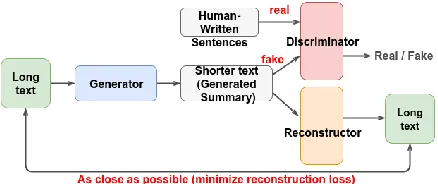
As shown in Fig.1, the proposed model is com-posed of three components: a generator, a discrim-inator, and a reconstructor. Together, the generator and reconstructor form a text auto-encoder. The generator acts as an encoder in generating the la-tent representation from the input text. Instead of using a vector as latent representation, however, the generator generates a word sequence much shorter than the input text. From the shorter text, the reconstructor reconstructs the original input of the generator. By minimizing the reconstruc-tion loss, the generator learns to generate short text segments that contain the main information in the original input. We use the seq2seq model in modeling the generator and reconstructor because both have input and output sequences with differ-ent lengths.
not readable by humans. Here, instead of reg-ularizing the generator output with a pre-trained language model (Miao and Blunsom, 2016), we borrow from adversarial auto-encoders (Makhzani et al., 2015) and cycle GAN (Zhu et al., 2017) and introduce a third component – the discrimina-tor – to regularize the generadiscrimina-tor’s output word se-quence. The discriminator and the generator form a generative adversarial network (GAN) ( Good-fellow et al., 2014). The discriminator discrim-inates between the generator output and human-written sentences, and the generator produces out-put as similar as possible to human-written sen-tences to confuse the discriminator. With the GAN framework, the discriminator teaches the genera-tor how to create human-like summary sentences as a latent representation. However, due to the non-differential property of discrete distributions, generating discrete distributions by GAN is chal-lenging. To tackle this problem, in this work, we proposed a new kind of method on language gen-eration by GAN.
By achieving unpaired abstractive text summa-rization, machine is able to unsupervisedly extract the core idea of the documents. This approach has many potential applications. For example, the output of the generator can be used for the down-stream tasks like document classification and sen-timent classification. In this study, we evaluate the results on an abstractive text summarization task. The output word sequence of the generator is re-garded as the summaries of the input text. The model is learned from a set of documents with-out summaries. As most documents are not paired with summaries, for example the movie reviews or lecture recordings, this technique makes it possi-ble to learn summarizer to generate summaries for these documents. The results show that the gener-ator generates summaries with reasonable quality on both English and Chinese corpora.
2 Related Work
Abstractive Text Summarization
Recent model architectures for abstractive text summarization basically use the sequence-to-sequence (Sutskever et al., 2014) framework in combination with various novel mechanisms. One popular mechanism is attention (Bahdanau et al.,
2015), which has been shown helpful for summa-rization (Nallapati et al.,2016;Rush et al.,2015;
[image:2.595.307.526.65.157.2]Chopra et al.,2016). It is also possible to directly optimize evaluation metrics such as ROUGE (Lin,
Figure 1: Proposed model. Given long text, the generator produces a shorter text as a summary. The generator is learned by minimizing the recon-struction loss together with the reconstructor and making discriminator regard its output as human-written text.
2004) with reinforcement learning (Ranzato et al.,
2016;Paulus et al.,2017;Bahdanau et al.,2016). The hybrid pointer-generator network (See et al.,
2017) selects words from the original text with a pointer (Vinyals et al., 2015) or from the whole vocabulary with a trained weight. In order to elim-inate repetition, a coverage vector (Tu et al.,2016) can be used to keep track of attended words, and coverage loss (See et al., 2017) can be used to encourage model focus on diverse words. While most papers focus on supervised learning with novel mechanisms, in this paper, we explore un-supervised training models.
GAN for Language Generation
In this paper, we borrow the idea of GAN to make the generator output human-readable. The major challenge in applying GAN to sentence genera-tion is the discrete nature of natural language. To generate a word sequence, the generator usually has non-differential parts such asargmaxor other sample functions which cause the original GAN to fail.
step, but this method suffers from high time com-plexity. Following this idea, (Li et al.,2017) pro-poses partial evaluation approach to evaluate the expected reward at each time step. In this pa-per, we propose the self-critical adversarial RE-INFORCE algorithm as another way to evaluate the expected reward at each time step. The per-formance between original WGAN and proposed adversarial REINFORCE is compared in experi-ment.
3 Proposed Method
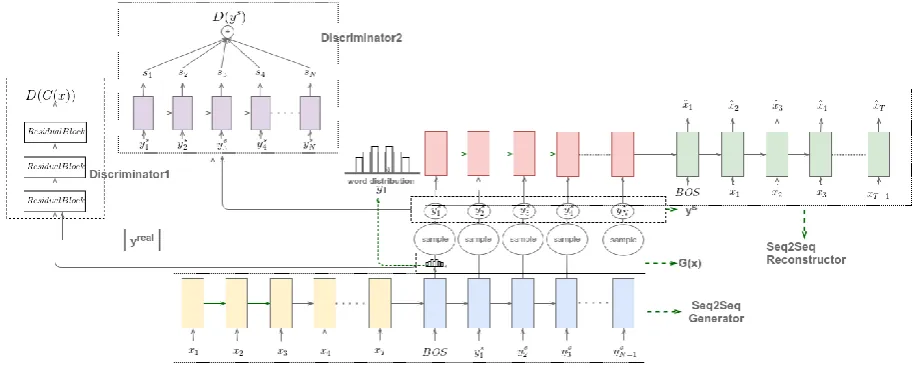
The overview of the proposed model is shown in Fig. 2. The model is composed of three com-ponents: generator G, discriminator D, and re-constructor R. Both G and R are seq2seq hy-brid pointer-generator networks (See et al.,2017) which can decide to copy words from encoder in-put text via pointing or generate from vocabulary. They both take a word sequence as input and out-put a sequence of word distributions. Discrimina-torD, on the other hand, takes a sequence as input and outputs a scalar. The model is learned from a set of documentsx and human-written sentences yreal.
To train the model, a training document x = {x1, x2, ..., xt, ..., xT}, where xt rep-resents a word, is fed to G, which outputs a sequence of word distributions G(x) = {y1, y2, ..., yn, ..., yN}, whereyn is a distribution over all words in the lexicon. Then we randomly sample a wordyns from each distributionyn, and a word sequenceys={y1s, y2s, ..., ysN}is obtained according toG(x). We feed the sampled word se-quence ys to reconstructor R, which outputs an-other sequence of word distributions x. The re-ˆ constructorRreconstructs the original textxfrom ys. That is, we seek an output of reconstructor ˆ
xthat is as close to the original textxas possible; hence the loss for training the reconstructor,Rloss, is defined as
Rloss= K �
k=1
ls(x,xˆ), (1)
where the reconstruction lossls(x,xˆ)is the cross-entropy loss computed between the reconstructor output sequence xˆ and the source text x, or the negative conditional log-likelihood of source text x given word sequence ys sampled from G(x). The reconstructor output sequence xˆ is teacher-forced by source textx. The subscriptsinls(x,xˆ)
indicates thatxˆis reconstructed fromys. Kis the number of training documents, and (1) is the sum-mation of the cross-entropy loss over all the train-ing documentsx.
In the proposed model, the generatorGand re-constructorRform an auto-encoder. However, the reconstructorRdoes not directly take the genera-tor output distributionG(x)as input1. Instead, the
reconstructor takes a sampled discrete sequenceys as input. Due to the non-differentiable property of discrete sequences, we apply the REINFORCE al-gorithm, which is described in Section4.
In addition to reconstruction, we need the dis-criminatorDto discriminate between the real se-quenceyrealand the generated sequenceysto reg-ularize the generated sequence satisfying the sum-mary distribution. D learns to give yreal higher scores while givingyslower scores. The loss for training the discriminatorD is denoted as Dloss; this is further described in Section5.
G learns to minimize the reconstruction loss Rloss, while maximizing the loss of the discrimi-natorDby generating a summary sequenceysthat cannot be differentiated byDfrom the real thing. The loss for the generatorGlossis
Gloss=αRloss−Dloss� (2)
where D�loss is highly related to Dloss – but not necessary the same2– andαis a hyper-parameter.
After obtaining the optimal generator by minimiz-ing (2), we use it to generate summaries.
GeneratorGand discriminatorDtogether form a GAN. We use two different adversarial training methods to train D and G; as shown in Fig. 2, these two methods have their own discriminators 1 and 2. Discriminator 1 takes the generator out-put layerG(x) as input, whereas discriminator 2 takes the sampled discrete word sequence ys as input. The two methods are described respectively in Sections5.1and5.2.
4 Minimizing Reconstruction Loss
Because discrete sequences are non-differentiable, we use the REINFORCE algorithm. The gener-ator is seen as an agent whose reward given the source text x is −ls(x,xˆ). Maximizing the re-ward is equivalent to minimizing the reconstruc-tion lossRlossin (1). However, the reconstruction
1We found that if the reconstructorRdirectly takesG(x) as input, the generatorGlearns to put the information about the input text in the distribution ofG(x), making it difficult to sample meaningful sentences fromG(x).
2D�
losshas different formulations in different approaches.
Figure 2: Architecture of proposed model. The generator network and reconstructor network are a seq2seq hybrid pointer-generator network, but for simplicity, we omit the pointer and the attention parts. loss varies widely from sample to sample, and thus
the rewards to the generator are not stable either. Hence we add a baseline to reduce their difference. We apply self-critical sequence training (Rennie et al., 2017); the modified reward rR(x,xˆ) from reconstructor R with the baseline for the genera-tor is
rR(x,xˆ) =−ls(x,xˆ)−(−la(x,xˆ)−b) (3)
where −la(x,xˆ) − b is the baseline. la(x,xˆ) is also the same cross-entropy reconstruction loss as ls(x,xˆ), except that xˆ is obtained from ya instead of ys. ya is a word sequence {ya
1, ya2, ..., yan, ..., yaN}, whereyanis selected using the argmax function from the output distribution of generator yn. As in the early training stage, the sequence ys barely yields higher reward than sequence ya, to encourage exploration we intro-duce the second baseline score b, which gradu-ally decreases to zero. Then, the generator is up-dated using the REINFORCE algorithm with re-wardrR(x,xˆ)to minimizeRloss.
5 GAN Training
With adversarial training, the generator learns to produce sentences as similar to the human-written sentences as possible. Here, we conduct experi-ments on two kinds of methods of language gen-eration with GAN. In Section 5.1 we directly feed the generator output probability distributions to the discriminator and use a Wasserstein GAN (WGAN) with a gradient penalty. In Section5.2, we explore adversarial REINFORCE, which feeds sampled discrete word sequences to the discrim-inator and evaluates the quality of the sequence
from the discriminator for use as a reward signal to the generator.
5.1 Method 1: Wasserstein GAN
In the lower left of Fig.2, the discriminator model of this method is shown as discriminator1 D1. D1 is a deep CNN with residual blocks, which takes a sequence of word distributions as input and outputs a score. The discriminator lossDlossis
Dloss= 1 K
K �
k=1
D1(G(x(k)))− 1 K
K �
k=1
D1(yreal(k))
+β1 1 K
K �
k=1
(Δyi(k)D1(yi(k))−1)2,
where K denotes the number of training exam-ples in a batch, and k denotes the k-th exam-ple. The last term is the gradient penalty ( Gul-rajani et al., 2017). We interpolate the genera-tor output layer G(x) and the real sample yreal, and apply the gradient penalty to the interpolated sequence yi. β1 determines the gradient penalty scale. In Equation (2), for WGAN, the generator maximizesDloss� :
Dloss� = 1 K
K �
k=1
D1(G(x(k))). (4)
5.2 Method 2: Self-Critic Adversarial REINFORCE
{ys
1, ys2, ..., yis}at each time stepi. The generator knows that compared to the last time step, as the generated sentence either improves or worsens, it can easilyfind the problematic generation step in a long sequence, and thusfix the problem easily.
5.2.1 Discriminator 2
[image:5.595.83.282.269.339.2]As shown in Fig. 2, the discriminator2 D2 is a unidirectional LSTM network which takes a dis-crete word sequence as input. At time step i, given input wordyisit predicts the current scoresi based on the sequence{y1, y2, ..., yi}. The score is viewed as the quality of the current sequence. An example of discriminator regularized by weight clipping(Arjovsky et al.,2017) is shown in Fig.3.
Figure 3: When the secondarrestedappears, as the sentence becomes ungrammatical, the discrimina-tor determines that this example comes from the generator. Hence, after this time-step, it outputs low scores.
In order to compute the discriminator loss Dloss, we sum the scores {s1, s2, ..., sN} of the whole sequenceysto yield
D2(ys) = 1 N
N �
n=1 sn.
where N denotes the generated sequence length. Then, the loss of discriminator is
Dloss= 1 K
K �
k=1
D2(ys(k))− 1 K
K �
k=1
D2(yreal(k))
+β2 1 K
K �
k=1
(Δyi(k)D2(yi(k))−1)2,
Similar to previous section, the last term is gra-dient penalty term. With the loss mentioned above, the discriminator attempts to quickly deter-mine whether the current sequence is real or fake. The earlier the timestep discriminator determines whether the current sequence is real or fake, the lower its loss.
5.2.2 Self-Critical Generator
Since we feed a discrete sequence ys to the dis-criminator, the gradient from the discriminator cannot directly back-propagate to the generator. Here, we use the policy gradient method. At
timestep i, we use thei−1 timestep scoresi−1 from the discriminator as its self-critical baseline. The rewardriDevaluates whether the quality of se-quence in timestepiis better or worse than that in timestepi−1. The generator rewardrDi fromD2 is
riD = �
si if i = 1 si−si−1 otherwise.
However, some sentences may be judged as bad sentences at the previous timestep, but at later timesteps judged as good sentences, and vice versa. Hence we use the discounted expected re-warddwith discount factorγ to calculate the dis-counted rewarddiat time stepias
di = N �
j=i
γj−irDj .
To maximize the expected discounted reward di, the loss of generator is:
G�loss=−Eys
i∼pG(ysi|y1s,...,yi−s 1,x)[di]. (5) We use the likelihood ratio trick to approximate the gradient to minimize (5).
6 Experiment
Our model was evaluated on the English/Chinese Gigaword datasets and CNN/Daily Mail dataset. In Section 6.1,6.2 and6.4, the experiments were conducted on English Gigaword, while the experi-ments were conducted on CNN/Daily Mail dataset and Chinese Gigaword dataset respectively in Sec-tions 6.3and6.6. We used ROUGE(Lin,2004) as our evaluation metric.3 During testing, when
us-ing the generator to generate summaries, we used beam search with beam size=5, and we eliminated repetition. We provide the details of the imple-mentation and corpus re-processing respectively in AppendixAandB.
Before jointly training the whole model, we pre-trained the three major components – gener-ator, discrimingener-ator, and reconstructor – separately. First, we pre-trained the generator in an unsuper-vised manner so that the generator would be able to somewhat grasp the semantic meaning of the source text. The details of the pre-training are in Appendix C. We pre-trained the discriminator and reconstructor respectively with the pre-trained generator’s output to ensure that these two critic networks provide good feedback to the generator.
Task Labeled Methods R-1 R-2 R-L
(A)Supervised 3.8M
(A-1)Supervised training on generator 33.19 14.21 30.50 (A-2) (Rush et al.,2015)✝ 29.76 11.88 26.96 (A-3) (Chopra et al.,2016)✝ 33.78 15.97 31.15 (A-4) (Zhou et al.,2017)✝ 36.15 17.54 33.63
(B) Trivial baseline 0 (B-1) Lead-8 21.86 7.66 20.45
(C) Unpaired 0
(C-1) Pre-trained generator 21.26 5.60 18.89 (C-2) WGAN 28.09 9.88 25.06 (C-3)Adversarial REINFORCE 28.11 9.97 25.41
(D) Semi-supervised
10K (D-2)Adversarial REINFORCE(D-1) WGAN 2930.01 11.57 27.61.17 10.54 26.72
500K (D-3)(Miao and Blunsom,2016)
✝ 30.14 12.05 27.99
(D-4) WGAN 32.50 13.65 29.67 (D-5)Adversarial REINFORCE 33.33 14.18 30.48
1M (D-6)(Miao and Blunsom,2016)
✝ 31.09 12.79 28.97
(D-7) WGAN 33.18 14.19 30.69 (D-8)Adversarial REINFORCE 34.21 15.16 31.64
0 (E-1) Pre-trained generator
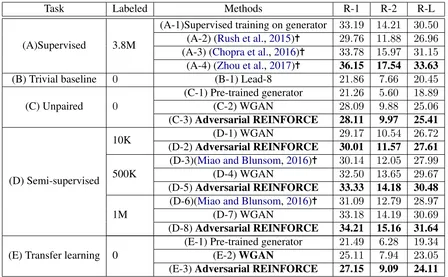
[image:6.595.74.522.61.338.2]21.49 6.28 19.34 (E) Transfer learning (E-2)WGAN 25.11 7.94 23.05 (E-3)Adversarial REINFORCE 27.15 9.09 24.11 Table 1: Average F1 ROUGE scores on English Gigaword. R-1, R-2 and R-L refers to ROUGE 1, ROUGE 2 and ROUGE L respectively. Results marked with✝are obtained from corresponding papers. In part (A), the model was trained supervisedly. In row (B-1), we select the article’sfirst eight words as its summary. Part (C) are the results obtained without paired data. In part (D), we trained our model with few labeled data. In part (E), we pre-trained generator on CNN/Diary and used the summaries from CNN/Diary as real data for the discriminator.
6.1 English Gigaword
The English Gigaword is a sentence summariza-tion dataset which contains the first sentence of each article and its corresponding headlines. The preprocessed corpus contains 3.8M training pairs and 400K validation pairs. We trained our model on part of or fully unparalleled data on 3.8M train-ing set. To have fair comparison with previous works, the following experiments were evaluated on the 2K testing set same as (Rush et al.,2015;
Miao and Blunsom,2016). We used the sentences in article headlines as real data for discriminator4.
As shown in the following experiments, the head-lines can even come from another set of docu-ments not related to the training docudocu-ments.
The results on English Gigaword are shown in Table 1. WGAN and adversarial REINFORCE refer to the adversarial training methods men-tioned in Sections 5.1 and 5.2 respectively. Re-sults trained by full labeled data are in part (A). In row (A-1), We trained our generator by
su-4Instead of using general sentences as real data for dis-criminator, we chose sentences from headlines because they have their own unique distribution.
pervised training. Compared with the previous work (Zhou et al.,2017), we used simpler model and smaller vocabulary size. We did not try to achieve the state-of-the-art results because the fo-cus of this work is unsupervised learning, and the proposed approach is independent to the summa-rization models used. In row (B-1), we simply took thefirst eight words in a document as its sum-mary.
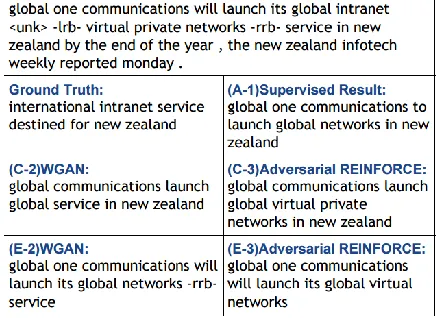
The results for the pre-trained generator with method mentioned in Appendix.Cis shown in row (C-1). In part (C), we directly took the sentences in the summaries of Gigaword as the training data of discriminator. Compared with the pre-trained generator and the trivial baseline , the proposed approach (rows (C-2) and (C-3)) showed good im-provement. In Fig.4, we provide a real example. More examples can be found in the Appendix.D.
6.2 Semi-Supervised Learning
la-beled data, the teacher-forcing was conducted ev-ery 25, 5 and 3 updates without paired data, re-spectively. In teacher-forcing, given source text as input, the generator was teacher-forced to pre-dict the human-written summary of source text. Teacher-forcing can be regarded as regularization of unpaired training that prevents generator from producing unreasonable summaries of source text. We found that if we teacher-forced generator too frequently, generator would overfit on training data since we only used very few labeled data on semi-supervised training.
[image:7.595.71.290.407.566.2]The performance of semi-supervised model in English Gigaword regarding available labeled data is shown in Table 1 part (D). We compared our results with (Miao and Blunsom, 2016) which was the previous state-of-the-art method on semi-supervised summarization task under the same amount of labeled data. With both 500K and 1M labeled data, our method performed better. Fur-thermore, with only 1M labeled data, using ad-versarial REINFORCE even outperformed super-vised training in Table 1 (A-1) with the whole 3.8M labeled data.
Figure 4: Real examples with methods referred in Table 1. The proposed methods generated sum-maries that grasped the core idea of the articles.
6.3 CNN/Daily Mail dataset
The CNN/Daily Mail dataset is a long text sum-marization dataset which is composed of news ar-ticles paired with summaries. We evaluated our model on this dataset because it’s a popular bench-mark dataset, and we want to know whether the proposed model works on long input and long output sequences. The details of corpus pre-processing can be found in Appendix.B . In un-paired training, to prevent the model from directly
matching the input articles to its corresponding summaries, we split the training pairs into two equal sets, one set only supplied articles and the other set only supplied summaries.
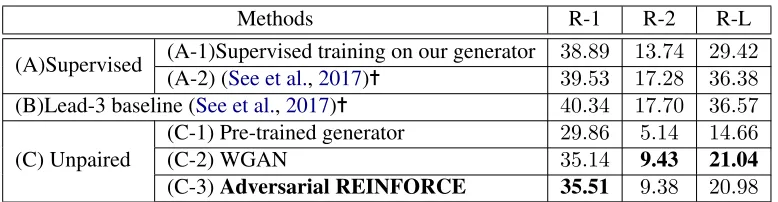
The results are shown in Table 2. For super-vised approaches in part (A), although our seq2seq model was similar to (See et al., 2017), due to the smaller vocabulary size (we didn’t tackle out-of-vocabulary words), simpler model architecture, shorter output length of generated summaries, there was a performance gap between our model and the scores reported in (See et al.,2017). Com-pared to the lead-3 baseline in part (B) which took thefirst three sentences of articles as summaries, the seq2seq models fell behind. That was be-cause news writers often put the most important information in the first few sentences, and thus even the best abstractive summarization model only slightly beat the lead-3 baseline on ROUGE scores. However, during pre-training or training we didn’t make assumption that the most impor-tant sentences are infirst few sentences.
We observed that our unpaired model yielded decent ROUGE-1 score, but it yielded lower ROUGE-2 and ROUGE-L score. That was proba-bly because the length of our generated sequence was shorter than ground truth, and our vocabu-lary size was small. Another reason was that the generator was good at selecting the most impor-tant words from the articles, but sometimes failed to combine them into reasonable sentences be-cause it’s still difficult for GAN to generate long sequence. In addition, since the reconstructor only evaluated the reconstruction loss of whole se-quence, as the generated sequence became long, the reconstruction reward for generator became extremely sparse. However, compared to pre-trained generator (rows (C-2), (C-3) v.s. (C-1)), our model still enhanced the ROUGE score. An real example of generated summary can be found at Appendix.DFig.11.
6.4 Transfer Learning
The experiments conducted up to this point re-quired headlines unpaired to the documents but in the same domain to train discriminator. In this subsection, we generated the summaries from English Gigaword (target domain), but the sum-maries for discriminator were from CNN/Daily Mail dataset (source domain).
pre-Methods R-1 R-2 R-L
(A)Supervised (A-1)Supervised training on our generator(A-2) (See et al.,2017)✝ 38.89 13.74 29.42 39.53 17.28 36.38 (B)Lead-3 baseline (See et al.,2017)✝ 40.34 17.70 36.57
(C) Unpaired
(C-1) Pre-trained generator 29.86 5.14 14.66
(C-2) WGAN 35.14 9.43 21.04
[image:8.595.104.493.60.161.2](C-3)Adversarial REINFORCE 35.51 9.38 20.98
Table 2: F1 ROUGE scores on CNN/Diary Mail dataset. In row (B), thefirst three sentences were taken as summaries. Part (C) are the results obtained without paired data. The results with symbol✝are directly
obtained from corresponding papers.
Methods R-1 R-2 R-L
(A) Training with paired data (supervised) 49.62 34.10 46.42 (B)Lead-15 baseline 30.08 18.24 27.74
(C) Unpaired (C-1) Pre-trained generator
[image:8.595.124.471.212.299.2]28.36 16.73 26.48 (C-2) WGAN 38.15 24.60 35.27 (C-3)Adversarial REINFORCE 41.25 26.54 37.76
Table 3: F1 ROUGE scores on Chinese Gigaword. In row (B), we selected the article’sfirstfifteen words as its summary. Part (C) are the results obtained without paired data.
trained generator and the poor pre-training result indicates that the data distributions of two datasets are quite different. We find that using sentences from another dataset yields lower ROUGE scores on the target testing set (parts (E) v.s. (C)) due to the mismatch word distributions between the sum-maries of the source and target domains. How-ever, the discriminator still regularizes the gener-ated word sequence. After unpaired training, the model enhanced the ROUGE scores of the pre-trained model (rows (E-2), (E-3) v.s. (E-1)) and it also surpassed the trivial baselines in part (B).
6.5 GAN Training
In this section, we discuss the performance of two GAN training methods. As shown in the Table 1, in English Gigaword, our proposed ad-versarial REINFORCE method performed better than WGAN. However, in Table2, our proposed method slightly outperformed by WGAN. In addi-tion, wefind that when training with WGAN, con-vergence is faster. Because WGAN directly eval-uates the distance between the continuous distri-bution from generator and the discrete distridistri-bution from real data, the distribution was sharpened at an early stage in training. This caused generator to converge to a relatively poor place. On the other hand, when training with REINFORCE, genera-tor keeps seeking the network parameters that can better fool discriminator. We believe that training GAN on language generation with this method is
worth exploring.
6.6 Chinese Gigaword
The Chinese Gigaword is a long text summariza-tion dataset composed of paired headlines and news. Unlike the input news in English Gigaword, the news in Chinese Gigaword consists of sev-eral sentences. The results are shown in Table3. Row (A) lists the results using 1.1M document-summary pairs to directly train the generator with-out the reconstructor and discriminator: this is the upper bound of the proposed approach. In row (B), we simply took thefirst fifteen words in a docu-ment as its summary. The number of words was chosen to optimize the evaluation metrics. Part (C) are the results obtained in the scenario with-out paired data. The discriminator took the sum-maries in the training set as real data. We show the results of the pre-trained generator in row (C-1); rows (C-2) and (C-3) are the results for the two GAN training methods respectively. Wefind that despite the performance gap between the un-paired and supervised methods (rows 2), (C-3) v.s. (A)), the proposed method yielded much better performance than the trivial baselines (rows (C-2), (C-3) v.s. (B)).
7 Conclusion and Future Work
References
Martin Arjovsky, Soumith Chintala, and Lon Bot-tou. 2017. Wasserstein gan. arXiv preprint arXiv:1701.07875.
Dzmitry Bahdanau, Philemon Brakel, Kelvin Xu, Anirudh Goyal, Ryan Lowe, Joelle Pineau, Aaron Courville, and Yoshua Bengio. 2016. An actor-critic algorithm for sequence prediction. arXiv preprint arXiv:1607.07086.
Dzmitry Bahdanau, Kyunghyun Cho, and Yoshua Ben-gio. 2015. Neural machine translation by jointly learning to align and translate. ICLR.
Sumit Chopra, Michael Auli, and Alexander M. Rush. 2016. Abstractive sentence summarization with at-tentive recurrent neural networks. HLT-NAAC. Ian J. Goodfellow, Jean Pouget-Abadie, Mehdi Mirza,
Bing Xu, David Warde-Farley, Sherjil Ozair, Aaron Courville, and Yoshua Bengio. 2014. Generative ad-versarial networks.arXiv preprint arXiv:1406.2661. Ishaan Gulrajani, Faruk Ahmed, Martin Arjovsky, Vin-cent Dumoulin, and Aaron Courville. 2017. Im-proved training of wasserstein gans. arXiv preprint arXiv:1704.00028.
Ryan Kiros, Yukun Zhu, Ruslan Salakhutdinov, Richard S. Zemel, Antonio Torralba, Raquel Urta-sun, and Sanja Fidler. 2015. Skip-thought vectors. NIPS.
Jiwei Li, Minh-Thang Luong, and Dan Jurafsky. 2015. A hierarchical neural autoencoder for paragraphs and documents. ACL.
Jiwei Li, Will Monroe, Tianlin Shi, Sbastien Jean, Alan Ritter, and Dan Jurafsky. 2017. Adversarial learn-ing for neural dialogue generation. arXiv preprint arXiv:1701.06547.
Chin-Yew Lin. 2004. Rouge: A package for auto-matic evaluation of summaries. In Text summariza-tion branches out: ACL workshop.
Alireza Makhzani, Jonathon Shlens, Navdeep Jaitly, Ian Goodfellow, and Brendan Frey. 2015. Adversar-ial autoencoders. arXiv preprint arXiv:1511.05644. Yishu Miao and Phil Blunsom. 2016. Language as a latent variable: Discrete generative models for sen-tence compression.EMNLP.
Ramesh Nallapati, Bowen Zhou, Cicero Nogueira dos santos, Caglar Gulcehre, and Bing Xiang. 2016. Abstractive text summarization using sequence-to-sequence rnns and beyond. EMNLP.
Romain Paulus, Caiming Xiong, and Richard Socher. 2017. A deep reinforced model for abstractive sum-marization.arXiv preprint arXiv:1705.04304. Marc’Aurelio Ranzato, Sumit Chopra, Michael Auli,
and Wojciech Zaremba. 2016. Sequence level train-ing with recurrent neural networks. ICLR.
Steven J. Rennie, Etienne Marcheret, Youssef Mroueh, Jarret Ross, and Vaibhava Goel. 2017. Self-critical sequence training for image captioning. CVPR.
Alexander M. Rush, Sumit Chopra, and Jason Weston. 2015. A neural attention model for abstractive sen-tence summarization.EMNLP.
Abigail See, Peter J. Liu, and Christopher D. Manning. 2017. Get to the point: Summarization with pointer-generator networks.ACL.
Ilya Sutskever, Oriol Vinyals, and Quoc V. Le. 2014. Sequence to sequence learning with neural net-works. NIPS.
Zhaopeng Tu, Zhengdong Lu, Yang Liu, Xiaohua Liu, and Hang Li. 2016. Modeling coverage for neural machine translation. ACL.
Oriol Vinyals, Meire Fortunato, and Navdeep Jaitly. 2015. Pointer networks. NIPS.
Lantao Yu, Weinan Zhang, Jun Wang, and Yong Yu. 2017. Seqgan: Sequence generative adversarial nets with policy gradient. AAAI.
Qingyu Zhou, Nan Yang, Furu Wei, and Ming Zhou. 2017. Selective encoding for abstractive sentence summarization.ACL.