Proceedings of the 2018 EMNLP Workshop BlackboxNLP: Analyzing and Interpreting Neural Networks for NLP, pages 175–186 175
An Operation Sequence Model for Explainable Neural Machine
Translation
Felix Stahlberg and Danielle Saunders and Bill Byrne
Department of Engineering University of Cambridge, UK
{fs439,ds636,wjb31}@cam.ac.uk
Abstract
We propose to achieve explainable neural ma-chine translation (NMT) by changing the out-put representation to explain itself. We present a novel approach to NMT which generates the target sentence by monotonically walking through the source sentence. Word reorder-ing is modeled by operations which allow set-ting markers in the target sentence and move a target-side write head between those mark-ers. In contrast to many modern neural mod-els, our system emits explicit word alignment information which is often crucial to practi-cal machine translation as it improves explain-ability. Our technique can outperform a plain text system in terms of BLEU score under the recent Transformer architecture on Japanese-English and Portuguese-Japanese-English, and is within 0.5 BLEU difference on Spanish-English.
1 Introduction
Neural machine translation (NMT) mod-els (Sutskever et al., 2014; Bahdanau et al., 2015;Gehring et al., 2017;Vaswani et al.,2017) are remarkably effective in modelling the distri-bution over target sentences conditioned on the source sentence, and yield superior translation performance compared to traditional statistical machine translation (SMT) on many language pairs. However, it is often difficult to extract a comprehensible explanation for the predictions of these models as information in the network is represented by real-valued vectors or matri-ces (Ding et al.,2017). In contrast, the translation process in SMT is ‘transparent’ as it can identify the source word which caused a target word through word alignment. Most NMT models do not use the concept of word alignment. It is tempting to interpret encoder-decoder attention matrices (Bahdanau et al.,2015) in neural models as (soft) alignments, but previous work has found
that the attention weights in NMT are often erratic (Cheng et al.,2016) and differ significantly from traditional word alignments (Koehn and Knowles, 2017; Ghader and Monz, 2017). We will discuss the difference between attention and alignment in detail in Sec. 4. The goal of this paper is explainable NMT by developing a trans-parent translation process for neural models. Our approach does not change the neural architecture, but represents the translation together with its alignment as a linear sequence of operations. The neural model predicts this operation sequence, and thus simultaneously generates a translation and an explanation for it in terms of alignments from the target words to the source words that generate them. The operation sequence is “self-explanatory”; it does not explain an underlying NMT system but is rather a single representation produced by the NMT system that can be used to generate translations along with an accompanying explanatory alignment to the source sentence. We report competitive results of our method on Spanish-English, Portuguese-English, and Japanese-English, with the benefit of producing hard alignments for better interpretability. We discuss the theoretical connection between our approach and hierarchical SMT (Chiang, 2005) by showing that an operation sequence can be seen as a derivation in a formal grammar.
2 A Neural Operation Sequence Model
2015;Vaswani et al.,2017;Gehring et al.,2017) could be used. In this paper, we use the recent Transformer model architecture (Vaswani et al., 2017) in all experiments.
In OSNMT, the neural seq2seq model learns to produce a sequence of operations. An OS-NMT operation sequence describes a translation (the ‘compiled’ target sentence) and explains each target token with a hard link into the source sen-tence. OSNMT keeps track of the positions of a source-side read head and a target-side write head. The read head monotonically walks through the source sentence, whereas the position of the write head can be moved from marker to marker in the target sentence. OSNMT defines the following op-erations to control head positions and produce out-put words.
• POP SRC: Move the read head right by one token.
• SET MARKER: Insert a marker symbol into the target sentence at the position of the write head.
• JMP FWD: Move the write head to the nearest marker right of the current head position in the target sentence.
• JMP BWD: Move the write head to the nearest marker left of the current head position in the target sentence.
• INSERT(t): Insert a target token t into the target sentence at the position of the write head.
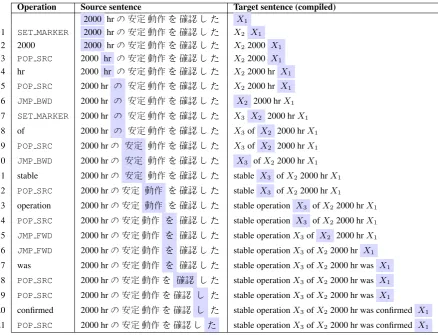
Tab.1 illustrates the generation of a Japanese-English translation in detail. The neural seq2seq model is trained to produce the sequence of opera-tions in the first column of Tab.1. The initial state of the target sentence is a single marker symbol
X1. Generative operations likeSET MARKER or
INSERT(t) insert a single symbol left of the cur-rent marker (highlighted). The model begins with a SET MARKER operation, which indicates that the translation of the first word in the source sen-tence is not at the beginning of the target sensen-tence. Indeed, after “translating” the identities ‘2000’ and ‘hr’, in time step 6 the model jumps back to the marker X2 and continues writing left of
‘2000’. The translation process terminates when the read head is at the end of the source sentence. The final translation in plain text can be obtained
by removing all markers from the (compiled) tar-get sentence.
2.1 OSNMT Represents Alignments
The word alignment can be derived from the operation sequence by looking up the position of the read head for each generated target to-ken. The alignment for the example in Tab. 1is shown in Fig. 1. Note that similarly to the IBM models (Brown et al., 1993) and the OSM for SMT (Durrani et al.,2011), our OSNMT can only represent 1:nalignments. Thus, each target token is aligned to exactly one source token, but a source token can generate any number of (possibly non-consecutive) target tokens.
2.2 OSNMT Represents Hierarchical Structure
We can also derive a tree structure from the op-eration sequence in Tab.1(Fig. 2) in which each marker is represented by a nonterminal node with outgoing arcs to symbols inserted at that marker. The target sentence can be read off the tree by depth-first search traversal (post-order).
More formally, synchronous context-free gram-mars (SCFGs) generate pairs of strings by pairing two context-free grammars. Phrase-based hierar-chical SMT (Chiang,2005) uses SCFGs to model the relation between the source sentence and the target sentence. Multitext grammars (MTGs) are a generalization of SCFGs to more than two output streams (Melamed,2003;Melamed et al., 2004). We find that an OSNMT sequence can be inter-preted as sequence of rules of a tertiary MTG G
which generates 1.) the source sentence, 2.) the target sentence, and 3.) the position of the target side write head. The start symbol ofGis
[(S),(X1),(P1)]T (1)
which initializes the source sentence stream with a single nonterminal S, the target sentence with the initial markerX1and the position of the write
head with 1 (P1). FollowingMelamed et al.(2004)
we denote rules inGas
[(α1),(α2),(α3)]T→[(β1),(β2),(β3)]T (2)
where α1, α2, α3 are single nonterminals or
empty,β1, β2, β3are strings of terminals and
non-terminals, andαi → βi for alli ∈ {1,2,3}with
Operation Source sentence Target sentence (compiled)
2000 hrの安定動作を確認し た X1
1 SET MARKER 2000 hrの安定動作を確認し た X2 X1
2 2000 2000 hrの安定動作を確認し た X22000 X1
3 POP SRC 2000 hr の安定動作を確認し た X22000 X1
4 hr 2000 hr の安定動作を確認し た X22000 hr X1
5 POP SRC 2000 hr の 安定動作を確認し た X22000 hr X1
6 JMP BWD 2000 hr の 安定動作を確認し た X2 2000 hrX1
7 SET MARKER 2000 hr の 安定動作を確認し た X3 X2 2000 hrX1
8 of 2000 hr の 安定動作を確認し た X3of X2 2000 hrX1
9 POP SRC 2000 hrの 安定 動作を確認し た X3of X2 2000 hrX1
10 JMP BWD 2000 hrの 安定 動作を確認し た X3 ofX22000 hrX1
11 stable 2000 hrの 安定 動作を確認し た stable X3 ofX22000 hrX1
12 POP SRC 2000 hrの安定 動作 を確認し た stable X3 ofX22000 hrX1
13 operation 2000 hrの安定 動作 を確認し た stable operation X3 ofX22000 hrX1
14 POP SRC 2000 hrの安定動作 を 確認し た stable operation X3 ofX22000 hrX1
15 JMP FWD 2000 hrの安定動作 を 確認し た stable operationX3of X2 2000 hrX1
16 JMP FWD 2000 hrの安定動作 を 確認し た stable operationX3ofX22000 hr X1
17 was 2000 hrの安定動作 を 確認し た stable operationX3ofX22000 hr was X1
18 POP SRC 2000 hrの安定動作を 確認 し た stable operationX3ofX22000 hr was X1
19 POP SRC 2000 hrの安定動作を確認 し た stable operationX3ofX22000 hr was X1
20 confirmed 2000 hrの安定動作を確認 し た stable operationX3ofX22000 hr was confirmed X1
[image:3.595.84.523.60.395.2]21 POP SRC 2000 hrの安定動作を確認し た stable operationX3ofX22000 hr was confirmed X1
[image:3.595.320.506.495.596.2]Table 1: Generation of the target sentence “stable operation of 2000 hr was confirmed” from the source sentence “2000 hr の 安定 動作 を 確認 し た”. The neural model produces the linear sequence of operations in the first column. The positions of the source-side read head and the target-side write head are highlighted. The marker in the target sentence produced by thei-thSET MARKERoperation is denoted with ‘Xi+1’;X1is the initial marker. We denoteINSERT(t) operations astto simplify notation.
Figure 1: The translation and the alignment derived from the operation sequence in Tab.1.
the three individual components which need to be applied simultaneously. POP SRCextends the source sentence prefix in the first stream by one token.
POP SRC:∀s∈ Vsrc :
(S) () ()
→
(sS) () ()
(3)
whereVsrc is the source language vocabulary. A
jump from markerXi toXj is realized by
replac-Figure 2: Target-side tree representation of the op-eration sequence in Tab.1.
ingPi withPj in the third grammar component:
JMP:∀i, j∈ N : [(),(), Pi]T→[(),(),(iPj)]T
(4) where N = {k ∈ N|k ≤ n} is the set of
the firstnnatural numbers for a sufficiently large
[image:3.595.91.271.499.548.2]Derivation OSNMT
[(S),(X1), P1]T Eq.3
→ [(2000S),(X1), P1]T SET MARKER Eq.5
→ [(2000S),(X2X1),(P1)]T 2000 Eq.6
→ [(2000S),(X22000X1),(P1)]T POP SRC
Eq.3
→
(2000 hrS) (X22000X1)
(P1) hr Eq.6 →
(2000 hrS) (X22000 hrX1)
(P1)
POP SRC
Eq.3
→
(2000 hrのS) (X22000 hrX1)
(P1)
JMP BWD
Eq.4
→
(2000 hrのS) (X22000 hrX1)
(1P2)
SET MARKER
Eq.5
→
(2000 hrのS) (X3X22000 hrX1)
(1P2) of Eq.6 →
(2000 hrのS) (X3ofX22000 hrX1)
(1P2)
...
[image:4.595.77.287.57.327.2]...
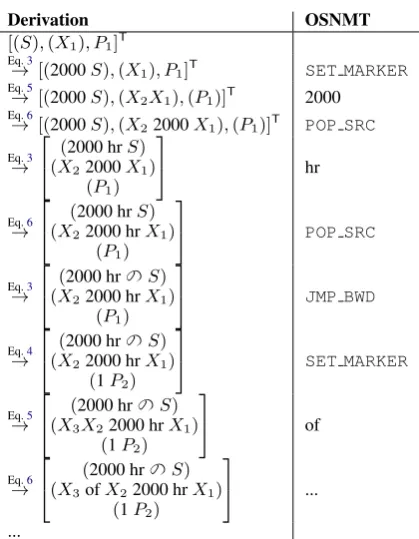
Table 2: Derivation inGfor the example of Tab.1.
INSERT(t)) insert symbols into the second com-ponent.
SET MARKER:∀i∈ N :
() (Xi)
(Pi)
→
() (Xi+1Xi)
(Pi)
(5)
INSERT:∀i∈ N, t∈ Vtrg:
() (Xi)
(Pi)
→
() (tXi)
(Pi)
(6)
whereVtrg is the target language vocabulary. The identity mappingPi →Piin the third component
enforces that the write head is at markerXi. We
note that G is not only context-free but also reg-ular in the first and third components (but not in the second component due to Eq. 5). Rules of the form in Eq.6are directly related to alignment links (cf. Fig.1) as they represent the fact that tar-get tokentis aligned to the last terminal symbol in the first stream. We formalize removing mark-ers/nonterminals at the end by introducing a spe-cial nonterminalT which is eventually mapped to the end-of-sentence symbol EOS:
[(S),(),()]T→[(T),(),()]T (7)
[(T),(),()]T→[(EOS),(),()]T (8)
∀i∈ N : [(T),(Xi),()]T→[(T),(),()]T (9)
∀i∈ N : [(T),(),(Pi)]T→[(T),(),()]T (10)
Tab. 2illustrates that there is a 1:1 correspon-dence between a derivation inG and an OSNMT operation sequence. The target-side derivation (the second component inG) is structurally sim-ilar to a binarized version of the tree in Fig. 2. However, we assign scores to the structure via the corresponding OSNMT sequence which does not need to obey the usual conditional independence assumptions in hierarchical SMT. Therefore, even thoughGis context-free in the second component, our scoring model forGis more powerful as it con-ditions on the OSNMT history which potentially contains context information. Note that OSNMT is deficient (Brown et al.,1993) as it assigns non-zero probability mass to any operation sequence, not only those with derivation inG.
We further note that subword-based OSNMT can potentially represent any alignment to any tar-get sentence as long as the alignment does not violate the 1:n restriction. This is in contrast to phrase-based SMT where reference translations often do not have a derivation in the SMT system due to coverage problems (Auli et al.,2009).
2.3 Comparison to the OSM for SMT
Our OSNMT set of operations (POP SRC,
SET MARKER, JMP FWD, JMP BWD, and
Algorithm 1Align2OSNMT(a,x,y)
1: holes← {(0,∞)}
2: ops← hi {Initialize with empty list}
3: head←0
4: fori←1to|x|do
5: for allj∈ {j|aj =i}do
6: hole idx←holes.find(j) 7: d←hole idx−head 8: ifd <0then
9: ops.extend(JMP BWD.repeat(−d))
10: end if
11: ifd >0then
12: ops.extend(JMP FWD.repeat(d))
13: end if
14: head←hole idx
15: (s, t)←holes[head]
16: ifs6=jthen
17: holes.append((s, j−1))
18: head←head+ 1
19: ops.append(SET MARKER)
20: end if
21: ops.append(yj)
22: holes[head]←(j+ 1, t) 23: end for
24: ops.append(SRC POP) 25: end for
26: return ops
3 Training
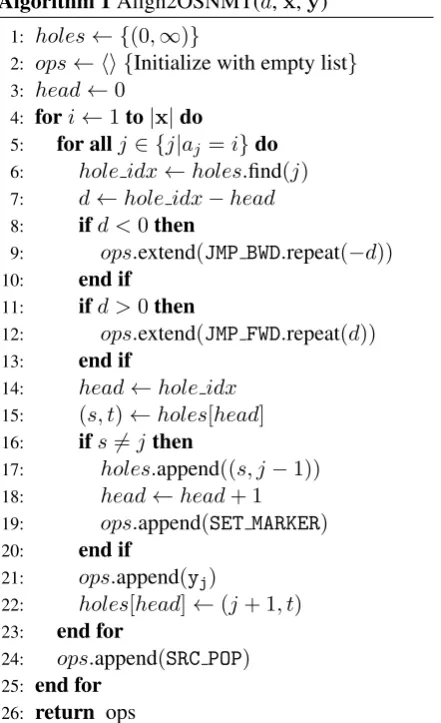
We train our Transformer model as usual by minimising the negative log-likelihood of the tar-get sequence. However, in contrast to plain text NMT, the target sequence is not a plain sequence of subword or word tokens but a sequence of op-erations. Consequently, we need to map the target sentences in the training corpus to OSNMT repre-sentations. We first run a statistical word aligner like Giza++ (Och and Ney, 2003) to obtain an aligned training corpus. We delete all alignment links which violate the 1:nrestriction of OSNMT (cf. Sec.2). The alignments together with the tar-get sentences are then used to generate the refer-ence operation sequrefer-ences for training. The algo-rithm for this conversion is shown in Alg.1.1 Note that an operation sequence represents one specific alignment, which means that the only way for an OSNMT sequence to be generated correctly is if
1A Python implementation is available at https:
//github.com/fstahlberg/ucam-scripts/ blob/master/t2t/align2osm.py.
Corpus Language pair # Sentences
Scielo Spanish-English 587K
Scielo Portuguese-English 513K
[image:5.595.73.294.69.431.2]WAT Japanese-English 1M
Table 3: Training set sizes.
both the word alignment and the target sentence are also correct. Thereby, the neural model learns to align and translate at the same time. However, there is spurious ambiguity as one alignment can be represented by different OSNMT sequences. For instance, simply adding a SET MARKER op-eration at the end of an OSNMT sequence does not change the alignment represented by it.
4 Results
We evaluate on three language pairs: Japanese-English (ja-en), Spanish-Japanese-English (es-en), and Portuguese-English (pt-en). We use the ASPEC corpus (Nakazawa et al., 2016) for ja-en and the health science portion of the Scielo corpus (Neves and N´ev´eol, 2016) for es-en and pt-en. Train-ing set sizes are summarized in Tab. 3. We use byte pair encoding (Sennrich et al., 2016) with 32K merge operations for all systems (joint encoding models for es-en and pt-en and sepa-rate source/target models for ja-en). We trained Transformer models (Vaswani et al., 2017)2 un-til convergence (250K steps for plain text, 350K steps for OSNMT) on a single GPU using Ten-sor2Tensor (Vaswani et al.,2018) after removing sentences with more than 250 tokens. Batches contain around 4K source and 4K target tokens. Transformer training is very sensitive to the batch size and the number of GPUs (Popel and Bojar, 2018). Therefore, we delay SGD updates ( Saun-ders et al., 2018) to every 8 steps to simulate 8 GPU training as recommended byVaswani et al. (2017). Based on the performance on the ja-en dev set we decode the plain text systems with a beam size of 4 and OSNMT with a beam size of 8 using our SGNMT decoder (Stahlberg et al.,2017). We use length normalization for ja-en but not for es-en or pt-es-en. We report cased multi-bleu.pl
BLEU scores on the tokenized text to be compara-ble with the WAT evaluation campaign on ja-en.3.
2We follow thetransformer baseconfiguration and
use 6 layers, 512 hidden units, and 8 attention heads in both the encoder and decoder.
3http://lotus.kuee.kyoto-u.ac.jp/WAT/
BLEU Method es-en pt-en
Align on subword level 36.7 38.1
[image:6.595.321.517.60.114.2]Convert word level alignments 37.1 38.4
Table 4: Generating training alignments on the subword level.
Type Frequency
Valid 92.49%
Not enoughSRC POP 7.28%
Too manySRC POP 0.22%
Write head out of range 0.06%
Table 5: Frequency of invalid OSNMT sequences produced by an unconstrained decoder on the ja-en test set.
Generating training alignments As outlined in Sec.3we use Giza++ (Och and Ney,2003) to gen-erate alignments for training OSNMT. We experi-mented with two different methods to obtain align-ments on the subword level. First, Giza++ can di-rectly align the source-side subword sequences to target-side subword sequences. Alternatively, we can run Giza++ on the word level, and convert the word alignments to subword alignments in a post-processing step by linking subwords if the words they belong to are aligned with each other. Tab.4 compares both methods and shows that converting word alignments is marginally better. Thus, we use this method in all other experiments.
Constrained beam search Unconstrained neu-ral decoding can yield invalid OSNMT sequences. For example, theJMP FWDandJMP BWD opera-tions are undefined if the write head is currently at the position of the last or first marker, respec-tively. The number ofSRC POPoperations must be equal to the number of source tokens in or-der for the read head to scan the entire source sentence. Therefore, we constrain these opera-tions during decoding. We have implemented the constraints in our publicly available SGNMT de-coding platform (Stahlberg et al., 2017). How-ever, these constraints are only needed for a small fraction of the sentences. Tab.5 shows that even unconstrained decoding yields valid OSNMT se-quences in 92.49% of the cases.
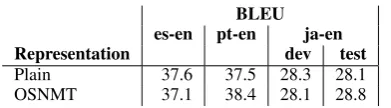
Comparison with plain text NMT Tab.6 com-pares our OSNMT systems with standard plain text models on all three language pairs. OSNMT performs better on the pt-en and ja-en test sets, but
BLEU es-en pt-en ja-en Representation dev test
Plain 37.6 37.5 28.3 28.1
[image:6.595.91.278.61.104.2]OSNMT 37.1 38.4 28.1 28.8
Table 6: Comparison between plain text and OSNMT on Spanish-English (es-en), Portuguese-English (pt-en), and Japanese-Portuguese-English (ja-en).
slightly worse on es-en. We think that more engi-neering work such as optimizing the set of oper-ations or improving the training alignments could lead to more consistent gains from using OSNMT. However, we leave this to future work since the main motivation for this paper is explainable NMT and not primarily improving translation quality.
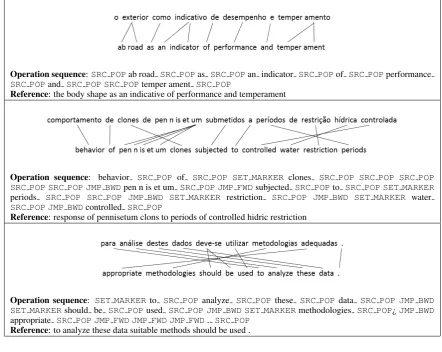
Alignment quality Tab. 7 contains example translations and subword-alignments generated from our Portuguese-English OSNMT model. Alignment links from source words consisting of multiple subwords are mapped to the final sub-word, visible for the words ‘temperamento’ in the first example and ‘pennisetum’ in the second one. The length of the operation sequences in-creases with alignment complexity as operation sequences for monotone alignments consist only ofINSERT(t) andSRC POPoperations (example 1). However, even complex mappings are cap-tured very well by OSNMT as demonstrated by the third example. Note that OSNMT can represent long-range reorderings very efficiently: the move-ment from ‘para’ in the first position to ‘to’ in the tenth position is simply achieved by starting the operation sequence with ‘SET MARKERto’ and a
JMP BWDoperation later. The first example in par-ticular demonstrates the usefulness of such align-ments as the wrong lexical choice (‘abroad’ rather than ‘body shape’) can be traced back to the source word ‘exterior‘.
For a qualitative assessment of the alignments produced by OSNMT we ran Giza++ to align the generated translations to the source sentences, en-forced the 1:n restriction of OSNMT, and used the resulting alignments as reference for comput-ing the alignment error rate (Och and Ney,2003, AER). Fig.3shows that as training proceeds, OS-NMT learns to both produce high quality transla-tions (increasing BLEU score) and accurate align-ments (decreasing AER).
atten-Operation sequence:SRC POPab road SRC POPas SRC POPan indicator SRC POPof SRC POPperformance
SRC POPand SRC POP SRC POPtemper ament SRC POP
Reference: the body shape as an indicative of performance and temperament
Operation sequence: behavior SRC POP of SRC POP SET MARKER clones SRC POP SRC POP SRC POP SRC POP SRC POP JMP BWDpen n is et um SRC POP JMP FWDsubjected SRC POPto SRC POP SET MARKER
periods SRC POP SRC POP JMP BWD SET MARKER restriction SRC POP JMP BWD SET MARKER water
SRC POP JMP BWDcontrolled SRC POP
Reference: response of pennisetum clons to periods of controlled hidric restriction
Operation sequence: SET MARKER to SRC POP analyze SRC POPthese SRC POPdata SRC POP JMP BWD SET MARKERshould be SRC POPused SRC POP JMP BWD SET MARKERmethodologies SRC POP¿JMP BWD
appropriate SRC POP JMP FWD JMP FWD JMP FWD. SRC POP
[image:7.595.76.519.66.418.2]Reference: to analyze these data suitable methods should be used .
Table 7: Examples of Portuguese-English translations together with their (subword-)alignments induced by the operation sequence. Alignment links from source words consisting of multiple subwords were mapped to the final subword in the training data, visible for ‘temperamento’ and ‘pennisetum’.
AER (in %) Representation Alignment extraction dev test
Plain LSTM forced decoding 63.9 63.7
Plain LSTM forced decoding with supervised attention (Liu et al.,2016,Cross Entropyloss) 54.9 54.7
[image:7.595.74.284.584.702.2]OSNMT OSNMT 24.2 21.5
Table 8: Comparison between OSNMT and using the attention matrix from forced decoding with a recurrent model.
0 5 10 15 20 25 30
50K 100K 150K 200K 250K 20% 30% 40% 50% 60% 70% 80% 90% 100%
Dev set BLEU
Alignment Error Rate
Training iterations BLEU
AER
Figure 3: AER and BLEU training curves for OS-NMT on the Japanese-English dev set.
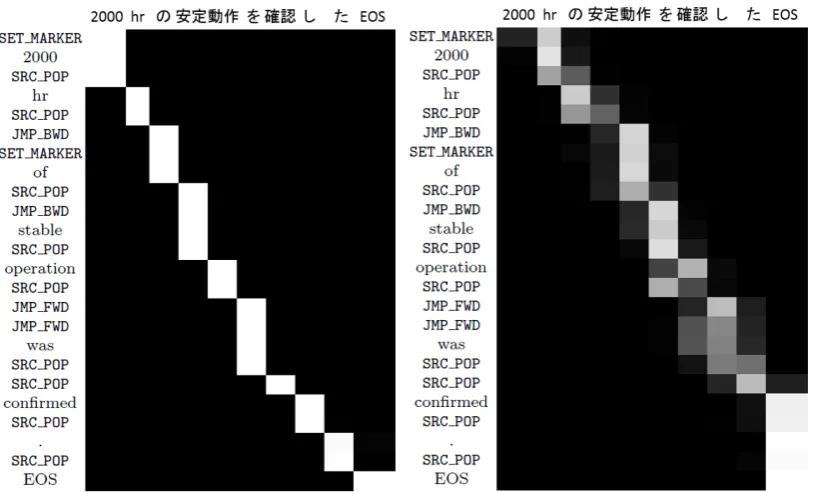
like-(a) Layer 4, head 1; attending to the source side read head.
[image:8.595.96.505.64.310.2](b) Layer 2, head 3; attending to the right trigram context of the read head.
Figure 4: Encoder-decoder attention weights.
lihood of the training set, and a second one with supervised attention following Liu et al. (2016). Tab. 8 shows that the supervised attention loss of Liu et al. (2016) improves the AER of the LSTM model. However, OSNMT is able to pro-duce much better alignments since it generates the alignment along with the translation in a single de-coding run.
OSNMT sequences contain target words in source sentence order An OSNMT sequence can be seen as a sequence of target words in source sentence order, interspersed with instruc-tions on how to put them together to form a flu-ent target sflu-entence. For example, if we strip out all SRC POP, SET MARKER, JMP FWD, and
JMP BWDoperations in the OSNMT sequence in the second example of Tab.7we get:
behavior of clones pennisetum sub-jected to periods restriction water con-trolled
The word-by-word translation back to Por-tugese is:
comportamento de clones pennisetum submetidos a per´ıodos restric¸˜ao h´ıdrica controlada
This restores the original source sentence (cf. Tab. 7) up to unaligned source words. There-fore, we can view the operations for control-ling the write head (SET MARKER,JMP FWD, and
JMP BWD) as reordering instructions for the target words which appear in source sentence word order within the OSNMT sequence.
one to the next source token. Other attention heads have learned to take other responsibilities. For in-stance, head 3 in layer 2 (Fig.4b) attends to the trigram right of the source head.
5 Related Work
Explainable and interpretable machine learning is attracting more and more attention in the research community (Ribeiro et al.,2016;Doshi-Velez and Kim, 2017), particularly in the context of natu-ral language processing (Karpathy et al.,2015;Li et al., 2016; Alvarez-Melis and Jaakkola, 2017; Ding et al., 2017; Feng et al., 2018). These ap-proaches aim to explain (the predictions of) an ex-isting model. In contrast, we change the target representation such that the generated sequences themselves convey important information about the translation process such as the word align-ments.
Despite considerable consensus about the im-portance of word alignments in practice (Koehn and Knowles, 2017), e.g. to enforce constraints on the output (Hasler et al.,2018) or to preserve text formatting, introducing explicit alignment in-formation to NMT is still an open research prob-lem. Word alignments have been used as supervi-sion signal for the NMT attention model (Mi et al., 2016;Chen et al.,2016;Liu et al.,2016;Alkhouli and Ney,2017).Cohn et al.(2016) showed how to reintroduce concepts known from traditional sta-tistical alignment models (Brown et al.,1993) like fertility and agreement over translation direction to NMT. Some approaches to simultaneous trans-lation explicitly control for reading source tokens and writing target tokens and thereby generate monotonic alignments on the segment level (Yu et al.,2016,2017;Gu et al.,2017).Alkhouli et al. (2016) used separate alignment and lexical models and thus were able to hypothesize explicit align-ment links during decoding. While our motivation is very similar to Alkhouli et al. (2016), our ap-proach is very different as we represent the align-ment as operation sequence, and we do not use separate models for reordering and lexical trans-lation.
The operation sequence model for SMT ( Dur-rani et al.,2011,2015) has been used in a number of MT evaluation systems (Durrani et al., 2014; Peter et al., 2016; Durrani et al., 2016) and for post-editing (Pal et al., 2016), often in combina-tion with a phrase-based model. The main
differ-ence to our OSNMT is that we have adapted the set of operations for neural models and are able to use it as stand-alone system, and not on top of a phrase-based system.
Our operation sequence model has some simi-larities with transition-based models used in other areas of NLP (Stenetorp,2013;Dyer et al.,2015; Aharoni and Goldberg, 2017). In particular, our
POP SRCoperation is very similar to thestep ac-tion of the hard alignment model ofAharoni and Goldberg (2017). However, Aharoni and Gold-berg(2017) investigated monotonic alignments for morphological inflections whereas we use a larger operation/action set to model complex word re-orderings in machine translation.
6 Conclusion
We have presented a way to use standard seq2seq models to generate a translation together with an alignment as linear sequence of operations. This greatly improves the interpretability of the model output as it establishes explicit alignment links between source and target tokens. However, the neural architecture we used in this paper is representation-agnostic, i.e. we did not explicitly incorporate the alignments induced by an opera-tion sequence into the neural model. For future work we are planning to adapt the Transformer model, for example by using positional embed-dings of the source read head and the target write head in the Transformer attention layers.
Acknowledgments
This work was supported in part by the U.K. En-gineering and Physical Sciences Research Council (EPSRC grant EP/L027623/1). We thank Joanna Stadnik who produced the recurrent translation and alignment models during her 4th year project.
References
Roee Aharoni and Yoav Goldberg. 2017. Morphologi-cal inflection generation with hard monotonic atten-tion. InProceedings of the 55th Annual Meeting of the Association for Computational Linguistics (Vol-ume 1: Long Papers), pages 2004–2015, Vancouver, Canada. Association for Computational Linguistics.
Tamer Alkhouli and Hermann Ney. 2017. Biasing attention-based recurrent neural networks using ex-ternal alignment information. InProceedings of the Second Conference on Machine Translation, pages 108–117, Copenhagen, Denmark. Association for Computational Linguistics.
David Alvarez-Melis and Tommi Jaakkola. 2017. A causal framework for explaining the predictions of black-box sequence-to-sequence models. In Pro-ceedings of the 2017 Conference on Empirical Meth-ods in Natural Language Processing, pages 412– 421. Association for Computational Linguistics.
Michael Auli, Adam Lopez, Hieu Hoang, and Philipp Koehn. 2009. A systematic analysis of translation model search spaces. In Proceedings of the Fourth Workshop on Statistical Machine Translation, pages 224–232. Association for Computational Linguis-tics.
Dzmitry Bahdanau, Kyunghyun Cho, and Yoshua Ben-gio. 2015. Neural machine translation by jointly learning to align and translate. In ICLR, Toulon, France.
Peter E. Brown, Stephen A. Della Pietra, Vincent J. Della Pietra, and Robert L. Mercer. 1993. The mathematics of statistical machine translation: Pa-rameter estimation. Computational Linguistics, 19(2).
Wenhu Chen, Evgeny Matusov, Shahram Khadivi, and Jan-Thorsten Peter. 2016. Guided alignment training for topic-aware neural machine translation. arXiv preprint arXiv:1607.01628.
Yong Cheng, Shiqi Shen, Zhongjun He, Wei He, Hua Wu, Maosong Sun, and Yang Liu. 2016. Agreement-based joint training for bidirectional attention-based neural machine translation. In Pro-ceedings of the Twenty-Fifth International Joint Conference on Artificial Intelligence, IJCAI’16, pages 2761–2767. AAAI Press.
David Chiang. 2005. A hierarchical phrase-based model for statistical machine translation. In Pro-ceedings of the 43rd Annual Meeting of the As-sociation for Computational Linguistics (ACL’05), pages 263–270, Ann Arbor, Michigan. Association for Computational Linguistics.
Trevor Cohn, Cong Duy Vu Hoang, Ekaterina Vy-molova, Kaisheng Yao, Chris Dyer, and Gholamreza Haffari. 2016. Incorporating structural alignment biases into an attentional neural translation model. InProceedings of the 2016 Conference of the North American Chapter of the Association for Computa-tional Linguistics: Human Language Technologies, pages 876–885, San Diego, California. Association for Computational Linguistics.
Yanzhuo Ding, Yang Liu, Huanbo Luan, and Maosong Sun. 2017. Visualizing and understanding neural machine translation. InProceedings of the 55th An-nual Meeting of the Association for Computational
Linguistics (Volume 1: Long Papers), pages 1150– 1159. Association for Computational Linguistics.
Finale Doshi-Velez and Been Kim. 2017. Towards a rigorous science of interpretable machine learning.
Nadir Durrani, Fahim Dalvi, Hassan Sajjad, and Stephan Vogel. 2016. QCRI machine translation systems for IWSLT 16. InInternational Workshop on Spoken Language Translation. Seattle, WA, USA.
Nadir Durrani, Barry Haddow, Philipp Koehn, and Kenneth Heafield. 2014. Edinburgh’s phrase-based machine translation systems for WMT-14. In Pro-ceedings of the Ninth Workshop on Statistical Ma-chine Translation, pages 97–104, Baltimore, Mary-land, USA. Association for Computational Linguis-tics.
Nadir Durrani, Helmut Schmid, and Alexander Fraser. 2011. A joint sequence translation model with in-tegrated reordering. InProceedings of the 49th An-nual Meeting of the Association for Computational Linguistics: Human Language Technologies, pages 1045–1054, Portland, Oregon, USA. Association for Computational Linguistics.
Nadir Durrani, Helmut Schmid, Alexander Fraser, Philipp Koehn, and Hinrich Sch¨utze. 2015. The op-eration sequence model—combining n-gram-based and phrase-based statistical machine translation. Computational Linguistics, 41(2):157–186.
Chris Dyer, Miguel Ballesteros, Wang Ling, Austin Matthews, and Noah A. Smith. 2015. Transition-based dependency parsing with stack long short-term memory. In Proceedings of the 53rd Annual Meeting of the Association for Computational Lin-guistics and the 7th International Joint Conference on Natural Language Processing (Volume 1: Long Papers), pages 334–343, Beijing, China. Associa-tion for ComputaAssocia-tional Linguistics.
Shi Feng, Eric Wallace, Alvin Grissom II, Mohit Iyyer, Pedro Rodriguez, and Jordan Boyd-Graber. 2018. Pathologies of neural models make interpretations difficult. InProceedings of the 2018 Conference on Empirical Methods in Natural Language Process-ing. Association for Computational Linguistics.
Jonas Gehring, Michael Auli, David Grangier, Denis Yarats, and Yann N Dauphin. 2017. Convolutional sequence to sequence learning. ArXiv e-prints.
Hamidreza Ghader and Christof Monz. 2017. What does attention in neural machine translation pay at-tention to? InProceedings of the Eighth Interna-tional Joint Conference on Natural Language Pro-cessing (Volume 1: Long Papers), pages 30–39. Asian Federation of Natural Language Processing.
1, Long Papers, pages 1053–1062. Association for Computational Linguistics.
Eva Hasler, Adri`a de Gispert, Gonzalo Iglesias, and Bill Byrne. 2018. Neural machine translation de-coding with terminology constraints. In Proceed-ings of the 2018 Conference of the North American Chapter of the Association for Computational Lin-guistics: Human Language Technologies. Associa-tion for ComputaAssocia-tional Linguistics.
Andrej Karpathy, Justin Johnson, and Li Fei-Fei. 2015. Visualizing and understanding recurrent networks. arXiv preprint arXiv:1506.02078.
Philipp Koehn and Rebecca Knowles. 2017. Six chal-lenges for neural machine translation. In Pro-ceedings of the First Workshop on Neural Machine Translation, pages 28–39. Association for Compu-tational Linguistics.
Jiwei Li, Xinlei Chen, Eduard Hovy, and Dan Jurafsky. 2016. Visualizing and understanding neural models in NLP. InProceedings of the 2016 Conference of the North American Chapter of the Association for Computational Linguistics: Human Language Tech-nologies, pages 681–691. Association for Computa-tional Linguistics.
Lemao Liu, Masao Utiyama, Andrew Finch, and Ei-ichiro Sumita. 2016. Neural machine translation with supervised attention. InProceedings of COL-ING 2016, the 26th International Conference on Computational Linguistics: Technical Papers, pages 3093–3102, Osaka, Japan. The COLING 2016 Or-ganizing Committee.
I. Dan Melamed. 2003. Multitext grammars and syn-chronous parsers. In Proceedings of the 2003 Hu-man Language Technology Conference of the North American Chapter of the Association for Computa-tional Linguistics.
I. Dan Melamed, Giorgio Satta, and Benjamin Welling-ton. 2004. Generalized multitext grammars. In Pro-ceedings of the 42nd Annual Meeting of the Associ-ation for ComputAssoci-ational Linguistics (ACL-04).
Haitao Mi, Zhiguo Wang, and Abe Ittycheriah. 2016. Supervised attentions for neural machine translation. In Proceedings of the 2016 Conference on Empiri-cal Methods in Natural Language Processing, pages 2283–2288, Austin, Texas. Association for Compu-tational Linguistics.
Toshiaki Nakazawa, Manabu Yaguchi, Kiyotaka Uchi-moto, Masao Utiyama, Eiichiro Sumita, Sadao Kurohashi, and Hitoshi Isahara. 2016. ASPEC: Asian scientific paper excerpt corpus. In LREC, pages 2204–2208, Portoroz, Slovenia.
Mariana L Neves and Aur´elie N´ev´eol. 2016. The Sci-elo corpus: a parallel corpus of scientific publica-tions for biomedicine. InLREC, pages 2942–2948, Portoroz, Slovenia.
Franz Josef Och and Hermann Ney. 2003. A systematic comparison of various statistical alignment models. Computational Linguistics, 29(1):19–51.
Santanu Pal, Marcos Zampieri, and Josef van Genabith. 2016. USAAR: An operation sequential model for automatic statistical post-editing. InProceedings of the First Conference on Machine Translation, pages 759–763, Berlin, Germany. Association for Compu-tational Linguistics.
Jan-Thorsten Peter, Andreas Guta, Nick Rossenbach, Miguel Grac¸a, and Hermann Ney. 2016. The RWTH Aachen machine translation system for IWSLT 2016. In International Workshop on Spoken Lan-guage Translation. Seattle, WA, USA.
Martin Popel and Ondˇrej Bojar. 2018. Training tips for the transformer model. arXiv preprint arXiv:1804.00247.
Marco Ribeiro, Sameer Singh, and Carlos Guestrin. 2016. “Why should I trust you?”: Explaining the predictions of any classifier. In Proceedings of the 2016 Conference of the North American Chap-ter of the Association for Computational Linguis-tics: Demonstrations, pages 97–101. Association for Computational Linguistics.
Danielle Saunders, Felix Stahlberg, Adri`a de Gispert, and Bill Byrne. 2018. Multi-representation en-sembles and delayed SGD updates improve syntax-based NMT. In Proceedings of the 56th Annual Meeting of the Association for Computational Lin-guistics. Association for Computational LinLin-guistics.
Rico Sennrich, Barry Haddow, and Alexandra Birch. 2016. Neural machine translation of rare words with subword units. InProceedings of the 54th An-nual Meeting of the Association for Computational Linguistics (Volume 1: Long Papers), pages 1715– 1725. Association for Computational Linguistics.
Felix Stahlberg, Eva Hasler, Danielle Saunders, and Bill Byrne. 2017. SGNMT – A flexible NMT de-coding platform for quick prototyping of new mod-els and search strategies. In Proceedings of the 2017 Conference on Empirical Methods in Natu-ral Language Processing: System Demonstrations, pages 25–30. Association for Computational Lin-guistics. Full documentation available at http:
//ucam-smt.github.io/sgnmt/html/.
Pontus Stenetorp. 2013. Transition-based dependency parsing using recursive neural networks. In NIPS Workshop on Deep Learning. Citeseer.
Zhaopeng Tu, Zhengdong Lu, Yang Liu, Xiaohua Liu, and Hang Li. 2016. Modeling coverage for neural machine translation. InProceedings of the 54th An-nual Meeting of the Association for Computational Linguistics (Volume 1: Long Papers), pages 76–85. Association for Computational Linguistics.
Ashish Vaswani, Samy Bengio, Eugene Brevdo, Fran-cois Chollet, Aidan N Gomez, Stephan Gouws, Llion Jones, Łukasz Kaiser, Nal Kalchbrenner, Niki Parmar, et al. 2018. Tensor2tensor for neural ma-chine translation. arXiv preprint arXiv:1803.07416.
Ashish Vaswani, Noam Shazeer, Niki Parmar, Jakob Uszkoreit, Llion Jones, Aidan N Gomez, Ł ukasz Kaiser, and Illia Polosukhin. 2017. Attention is all you need. InAdvances in Neural Information Pro-cessing Systems 30, pages 6000–6010. Curran Asso-ciates, Inc.
L Yu, P Blunsom, C Dyer, E Grefenstette, and T Ko-cisky. 2017. The neural noisy channel. In Proceed-ings of the 5th International Conference on Learning Representations (ICLR), Toulon, France. Computa-tional and Biological Learning Society.