Heuristic Search for Non-Bottom-Up Tree Structure Prediction
Andrea Gesmundo Department of Computer Science
University of Geneva
James Henderson
Department of Computer Science University of Geneva
Abstract
State of the art Tree Structures Prediction techniques rely on bottom-up decoding. These approaches allow the use of context-free fea-tures and bottom-up feafea-tures. We discuss the limitations of mainstream techniques in solving common Natural Language Process-ing tasks. Then we devise a new framework that goes beyond Bottom-up Decoding, and that allows a better integration of contextual features. Furthermore we design a system that addresses these issues and we test it on Hierar-chical Machine Translation, a well known tree structure prediction problem. The structure of the proposed system allows the incorpora-tion of non-bottom-up features and relies on a more sophisticated decoding approach. We show that the proposed approach can find bet-ter translations using a smaller portion of the search space.
1 Introduction
Tree Structure Prediction (TSP) techniques have become relevant in many Natural Language Pro-cessing (NLP) applications, such as Syntactic Pars-ing, Semantic Role Labeling and Hierarchical Ma-chine Translation (HMT) (Chiang, 2007). HMT approaches have a higher complexity than Phrase-Based Machine Translation techniques, but exploit a more sophisticated reordering model, and can produce translations with higher Syntactic-Semantic quality.
TSP requires as inputs: a weighted grammar,G, and a sequence of symbols or a set of sequences en-coded as a Lattice (Chappelier et al., 1999). The
input sequence is often a sentence for NLP applica-tions. Tree structures generating the input sequence can be composed using rules,r, from the weighted grammar,G. TSP techniques return as output a tree structure or a set of trees (forest) that generate the input string or lattice. The output forest can be rep-resented compactly as a weighted hypergraph (Klein and Manning, 2001). TSP tasks require finding the tree, t, with the highest score, or the best-k such trees. Mainstream TSP relies on Bottom-up Decod-ing (BD) techniques.
With this paper we propose a new framework as a generalization of the CKY-like Bottom-up ap-proach. We also design and test an instantiation of this framework, empirically showing that wider con-textual information leads to higher accuracy for TSP tasks that rely on non-local features, like HMT.
2 Beyond Bottom-up Decoding
TSP decoding requires scoring candidate trees, cost(t). Some TSP tasks require only local features. For these cases cost(t) depends only on the local score of the rules that composet:
cost(t) =X
ri∈t
cost(ri) (1)
This is the case for Context Free Grammars. More complex tasks need non-local features. Those fea-tures can be represented by a non-local factor, nonLocal(t), into the overalltscore:
cost(t) =X
ri∈t
cost(ri) +nonLocal(t) (2)
For example, in HMT the Language Model (LM) is a non-local fundamental feature that approximates the adequacy of the translation with the sum of log-probabilities of composingn-grams.
CKY-like BD approaches build candidate trees in a bottom-up fashion, allowing the use of Dynamic Programming techniques to simplify the search space by mering sub-trees with the same state, and also easing application of pruning techniques (such as Cube Pruning, e.g. Chiang (2007), Gesmundo (2010)). For clarity of presentation and follow-ing HMT practice, we will henceforth restrict our focus to binary grammars. Standard CKY works by building objects known as items (Hopkins and Langmead, 2009). Each item, ι, corresponds to a candidate sub-tree. Items are built linking a rule instantiation, r, to two sub-items that represents left context, ι1, and right context, ι2; formally: ι ≡ h ι1 ⋗ r ⋖ ι2 i. An item is a triple that
contains aspan, apostconditionand acarry. The span contains the indexes of the starting and end-ing input words delimitend-ing the continuous sequence covered by the sub-tree represented by the item. The postcondition is a string that representsr’s head non-terminal label, telling us which rules may be applied. The carry, κ, stores extra information required to correctly score the non-local interactions of the item when it will be linked in a broader context (for HMT with LM the carry consists of boundary words that will form newn-grams).
Items,ι≡ hι1 ⋗r⋖ι2i, are scored according to
the following formula:
cost(ι) = cost(r) +cost(ι1) +cost(ι2) (3)
+ interaction(r, κ1, κ2)
Where:cost(r)is the cost associated to the weighted ruler;cost(ι1)andcost(ι2)are the costs of the two
sub-items computed recursively using formula (3); interaction(r, κ1, κ2)is the interaction cost between
the rule instantiation and the two sub-items. In HMT the interaction cost includes the LM score of newn -grams generated by connecting the childrens’ sub-spans with terminals ofr. Notice that formula (3) is equal to formula (2) for items that cover the whole input sequence.
In many TSP applications, the search space is too large to allow an exhaustive search and
there-fore pruning techniques must be used. Pruning deci-sions are based on the score of partial derivations. It is not always possible to compute exactly non-local features while computing the score of partial derivations, since partial derivations miss part of the context. Formula (3) accounts for the interaction be-tweenr and sub-itemsι1 and ι2, but it does not
in-tegrate the cost relative to the interaction between the item and the surrounding context. Therefore the item score computed in a bottom-up fashion is an approximation of the score the item has in a broader context. For example, in HMT the LM score forn -grams that partially overlap the item’s span cannot be computed exactly since the surrounding words are not known.
Basing pruning decisions on approximated scores can introduce search errors. It is possible to reduce search errors using heuristics based on future cost estimation. In general the estimation of the interac-tion betweenιand the surrounding context is func-tion of the carry,κ. In HMT it is possible to estimate the cost of n-grams that partially overlap ι’s span considering the boundary words. We can obtain the heuristic cost for an item, ι, adding to formula (3) the factor, est(κ), for the estimation of interaction with missing context:
heuristicCost(ι) =cost(ι) +est(κ) (4)
And useheuristicCost(ι) to guide BD pruning de-cisions. Anyway, even if a good interaction estima-tion is available, in practice it is not possible to avoid search errors while pruning.
More sophisticated parsing models allow the use of non-bottom-up features within a BD framework. Caraballo and Charniak (1998) present best-first parsing with Figures of Merit that allows condition-ing of the heuristic function on statistics of the input string. Corazza et al. (1994), and Klein and Man-ning (2003) propose an A* parsing algorithm that estimates the upper bound of the parse completion scores using contextual summary features. These models achieve time efficiency and state-of-the-art accuracy for PCFG parsing, but still use a BD frame-work that doesn’t allow the application of a broader class of non-bottom-up contextual features.
a simple example consider the translation of the fre-quent English word “get” into Chinese. The choice of the correct set of ideograms to translate “get” of-ten requires being aware of the presence of particles that can be at any distance within the sentence. In a common English to Chinese dictionary we found 93 different sets of ideograms that could be translations of “get”. Sentence-wide context is also important in the choice of word re-ordering: as an example consider the following translations from English to German:
1. EN : I go home.
DE : Ich gehe nach Hause.
2. EN : I say, that I go home.
DE : Ich sage, dass ich nach Hause gehe.
3. EN : On Sunday I go home.
DE : Am Sonntag gehe ich nach Hause.
The English phrase “I go home” is translated in Ger-man using the same set of words but with different orderings. It is not possible to choose the correct ordering of the phrase without being aware of the context. Thus a bottom-up decoder without context needs to build all translations for “I go home”, intro-ducing the possibility of pruning errors.
Having shown the importance of contextual fea-tures, we define a framework that overcomes the limitations of bottom-up feature approximation.
3 Undirected-CKY Framework
Our aim is to propose a new Framework that over-comes BD limitations allowing a better integration of contextual features. The presented framework can be regarded as a generalization of CKY.
To introduce the new framework let us focus on a detail of CKY BD. The items are created and scored in topological order. The ordering constraint can be formally stated as: an item covering the span[i, j]
must be processed after items covering sub spans
[h, k]|h ≥ i, k ≤ j. This ordering constraint im-plies that full yield information is available when an item is processed, but information about ances-tors and siblings is missing. Therefore non-bottom-up context cannot be used because of the ordering constraint. Now let us investigate how the decoding
algorithm could change if we remove the ordering constraint.
Removing the ordering constraint would lead to the occurrence of cases in which an item is pro-cessed before all child items have been propro-cessed. For example, we could imagine to create and score an item,ι, with postconditionXand span[i, j], link-ing the rule instantiation r : X→AB with only the left sub-item,ιA, while information for the right
sub-item, ιB is still missing. In this case, we can
rely on local and partial contextual features to score
ι. Afterwards, it is possible to processιB using the
parent item, ι, as a source of additional informa-tion about the parent context and sibling ιA yield.
This approach can avoid search errors in cases where pruning at the parent level can be correctly done us-ing only local and partial yield context, while prun-ing at the child level needs extra non-bottom-up con-text to make a better pruning decision. For exam-ple, consider the translation of the English sentence “I run” into French using the following synchronous grammar:
r1 :S→ X1 X2 |X1 X2 r2 :X→I |Je
r3 :X→run|course r4 :X→run|courir r5 :X→run|cours r6 :X→run|courons
.. .
Where: r1 is a Gluerule and boxed indexes
de-scribe the alignment; r2 translates “I” in the
cor-responding French pronoun; r3 translates “run” as
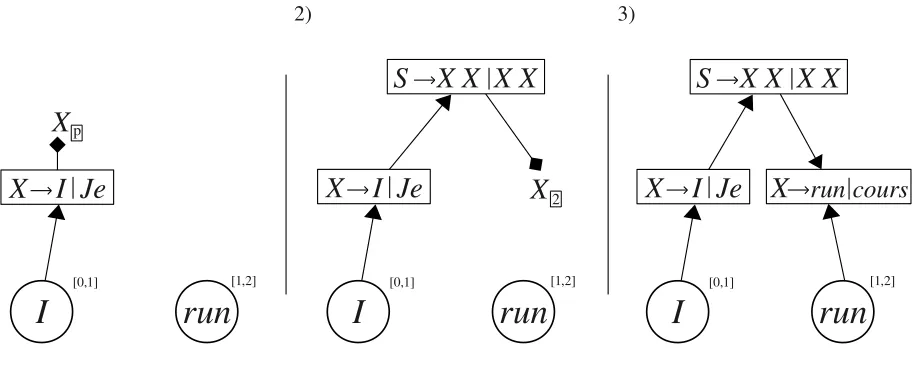
a noun; remaining rules translate “run” as one of the possible conjugations of the verb “courir”. Us-ing only bottom-up features it is not possible to re-solve the ambiguity of the word “run”. If the beam is not big enough the correct translation could be pruned. Anyway a CKY decoder would give the highest score to the most frequent translation. In-stead, if we follow a non bottom-up approach, as described in Figure 1, we can: 1) first translate “I”; 2) Then create an item usingr1 with missing right
child; 3) finally choose the correct translation for “run” using r1 to access a wider context. Notice
Figure 1: Example of undirected decoding for HMT. The arrows point to the direction in which information is propa-gated. Notice that the parent link at step 3 is fundamental to correctly disambiguate the translation for “run”.
1 and the LM feature.
To formalize Undirected-CKY, we define a gen-eralized item calledundirected-item. Undirected-items,˚ι, are built linking rule instantiations with elements in L ≡ {left child, right child, parent}; for example: ˚ι ≡ h˚ι1 ⋗ r ∨˙ ˚ιpi, is built linking r with left child,˚ι1, and parent,˚ιp. We denote
with L˚+ι the set of links for which the
undirected-item, ˚ι, has a connection, and with L˚−ι the set of missing links. An undirected-item is a triple that contains a span, a carry and an undirected
-postcondition. The undirected-postcondition is a set of strings, one string for each of˚ι’s missing links,
l∈ L˚−ι. Each string represents the non-terminal
re-lated to one of the missing links available for expan-sion. Bottom-up items can be considered specific cases of undirected-items havingL+ ={left child,
right child}and L− ={parent}. We can formally describe the steps of the example depicted in Figure 1 with:
1) r2 :X→I|Je , terminal: [0,1] ˚ι1 : [0,1,{Xp}, κ1]
2) r1 :S→X1X2|X1X2 , ˚ι1 : [0,1,{Xp}, κ1] ˚ι2 : [0,1,{X2}, κ2)]
3)r5:X→run|cours,˚ι2: [· · ·], terminal: [1,2] ˚ι3 : [0,2,{}, κ3]
The scoring function for undirected-items can be ob-tained generalizing formula (3):
cost(˚ι) = cost(r)
+ X
l∈L+
cost(˚ιl) (5)
+ interaction(r,L+)
In CKY, each span is processed separately in topological order, and the best-kitems for each span are selected in sequence according to scoring func-tion (4). In the proposed framework, the selec-tion of undirected-items can be done in any order, for example: in a first step selecting an undirected-item for spans1, then selecting an undirected-item
for span s2, and in a third step selecting a second
undirected-item for s1, and so on. As in agenda
based parsing (Klein and Manning, 2001), all candi-date undirected-items can be handled with an unique queue. Allowing the system to decide decoding or-der based on the candidates’ scores, so that candi-dates with higher confidence can be selected earlier and used as context for candidates with lower confi-dence.
the unique queue contains candidates relative to dif-ferent nodes and with difdif-ferent context scope. To ensure comparability, we can associate to candidate undirected-items a heuristic score of the full deriva-tion:
heuristicCost(˚ι) =cost(˚ι) +est(˚ι) (6)
Where est(˚ι) estimates the cost of the missing branches of the derivation as a function of˚ι′s par-tial structure and carry.
In this framework, the queue can be initialized with a candidate for each rule instantiation. These initializing candidates have no context information and can be scored using only local features. A generic decoding algorithm can loop selecting the candidate undirected-item with the highest score,˚ι, and then propagating its information to neighboring candidates, which can update using˚ιas context. In this general framework the link to the parent node is not treated differently from links to children. While in CKY the information is always passed from chil-dren to parent, in Undirected-CKY the information can be propagated in any direction, and any decod-ing order is allowed.
We can summarize the steps done to generalize CKY into the proposed framework: 1) remove the node ordering constraint; 2) define the scoring of candidates with missing children or parent; 3) use a single candidate queue; 4) handle comparability of candidates from different nodes and/or with differ-ent context scope; 5) allow information propagation in any direction.
4 Undirected Decoding
In this section we propose Undirected Decod-ing (UD), an instantiation of the Undirected-CKY framework presented above. The generic framework introduces many new degrees of freedom that could lead to a higher complexity of the decoder. In our actual instantiation we apply constraints on the ini-tialization step, on the propagation policy, and fix a search beam ofk. These constraints allow the sys-tem to converge to a solution in practical time, al-low the use of dynamic programming techniques to merge items with equivalent states, and gives us the possibility of using non-bottom-up features and test-ing their relevance.
Algorithm 1 Undirected Decoding
1: function decoder (k) : out-forest
2: Q←LeafRules();
3: while|Q|>0do
4: ˚ι←PopBest (Q);
5: if CanPop(˚ι) then
6: out-forest.Add(˚ι);
7: if˚ι.HasChildrenLinks() then
8: for allr ∈HeadRules(˚ι) do
9: Cˆ ←NewUndirectedItems(r,˚ι);
10: for allˆc∈Cˆ do
11: if CanPop(ˆc) then
12: Q.Insert(ˆc);
13: end if
14: end for
15: end for
16: end if
17: end if
18: end while
Algorithm 1 summarizes the UD approach. The beam size,k, is given as input. Atline2the queue of undirected-item candidates,Q, is initialized with only leafs rules. Atline 3 the loop starts, it will terminate when Q is empty. At line 4 the candi-date with highest score,˚ι, is popped fromQ.line5
checks if˚ιis within the beam width: if˚ιhas a span for whichkcandidates were already popped, then˚ι is dropped and a new iteration is begun. Otherwise
˚ιis added to the out-forest atline 6. Fromline 7
toline10the algorithm deals with the generation of new candidate undirected-items. line 7checks if˚ι has both children links, if not a new decoding iter-ation is begun. line8loops over the rule instantia-tions,r, that can use˚ιas child. Atline9, the set of new candidates,Cˆ, is built linkingrwith˚ιand any context already available in the out-forest. Finally, betweenline 10and line 12, each elementˆcinCˆ
is inserted inQ after checking thatˆc is within the beam width: ifˆchas a span for whichkcandidates were already popped it doesn’t make sense to insert it inQsince it will be surely discarded atline5.
In more detail, the function
doesn’t have a missing child and matches missing span coverage; 3) and using as parent context the best undirected-item with missing child link that has been incorporated in the out-forest and can expand the missing child link usingr. In our current method, only the best possible parent context is used because it only provides context for ranking candidates, as discussed at the end of this section. In contrast, a different candidate is generated for each possible other child in 2), as well as for the case where no other child is included in the undirected-item.
We can make some general observations on the Undirected Decoding Algorithm. Notice that, the
if statement at line7and the way new undirected-items are created at line 9, enforce that each undirected-item covers a contiguous span. An undirected-item that is missing a child link cannot be used as child context but can be used as parent context since it is added to the out-forest atline 6
before theif statement atline7. Furthermore, the
if statements at line 5 and line 11 check that no more than kcandidates are selected for each span, but the algorithm does not require the the selection of exactlykcandidates per span as in CKY.
The queue of candidates,Q, is ordered according to the heuristic cost of formula (6). The score of the candidate partial structure is accounted for with fac-torcost(˚ι)computed according to formula (5). The factorest(˚ι)accounts for the estimation of the miss-ing part of the derivation. We compute this factor with the following formula:
est(˚ι) = X l∈L˚−ι
localCost(˚ι, l) +contextEst(˚ι, l)
(7) For each missing link,l∈ L˚−ι, we estimate the cost
of the corresponding derivation branch with two fac-tors: localCost(˚ι, l) that computes the context-free score of the branch with highest score that could be attached tol; andcontextEst(˚ι, l) that estimates the contextual score of the branch and its interac-tion with˚ι. Because our model is implemented in the Forest Rescoring framework (e.g. Huang and Chiang (2007), Dyer et al. (2010), Li et al. (2009)), localCost(˚ι, l)can be efficiently computed exactly. In HMT it is possible to exhaustively represent and search the context-free-forest (ignoring the LM),
which is done in the Forest Rescoring framework be-fore our task of decoding with the LM. We exploit this context-free-forest to compute localCost(˚ι, l): for missing child links the localCost(·) is the In-side score computed using the (max, +) semiring (also known as the Viterbi score), and for missing parent links the localCost(·) is the corresponding Outside score. The factor contextEst(·) estimates the LM score of the words generated by the missing branch and their interaction with the span covered by˚ι. To compute the expected interaction cost we use the boundary words information contained in˚ι’s carry as done in BD. To estimate the LM cost of the missing branch we use an estimation function, con-ditioned on the missing span length, whose parame-ters are tuned on held-out data with gradient descent, using the search score as objective function.
To show that UD leads to better results than BD, the two algorithms are compared in the same search space. Therefore we ensure that candidates em-bedded in the UD out-forest would have the same score if they were scored from BD. We don’t need to worry about differences derived from the missing context estimation factor,est(·), since this factor is only considered while sorting the queue,Q, accord-ing to theheuristicCost(·). Also, we don’t have to worry about candidates that are scored with no miss-ing child and no parent link, because in that case scoring function (3) for BD is equivalent to scoring function (5) for UD. Instead, for candidates that are scored with parent link, we remove the parent link factor from thecost(·) function when inserting the candidate into the out forest. And for the candi-dates that are scored with a missing child, we ad-just the score once the link to the missing child is created in the out-forest. In this way UD and BD score the same derivation with the same score and can be regarded as two ways to explore the same search space.
5 Experiments
In this section we test the algorithm presented, and empirically show that it produces better translations searching a smaller portion of the search space.
0 100 200 300 400 500 600 700 800 900
2 4 6 8 10 12 14 16
Test Set
Beam Size
[image:7.612.223.533.49.217.2]UD best score BD best score
Figure 2: Comparison of the quality of the translations.
periments are executed on the NIST MT03 Chinese-English parallel corpus. The training corpus con-tains 239k sentence pairs with 6.9M Chinese words and 8.9M English words. We use a hierarchical phrase-based translation grammar extracted using a suffix array rule extractor (Lopez, 2007). The NIST-03 test set is used for decoding, it has 919 sentence pairs. The experiments can be reproduced on an average desktop computer. Since we compare two different decoding strategies that rely on the same training technique, the evaluation is primarily based on search errors rather than on BLEU. We compare the two systems on a variety of beam sizes between 1 and 16.
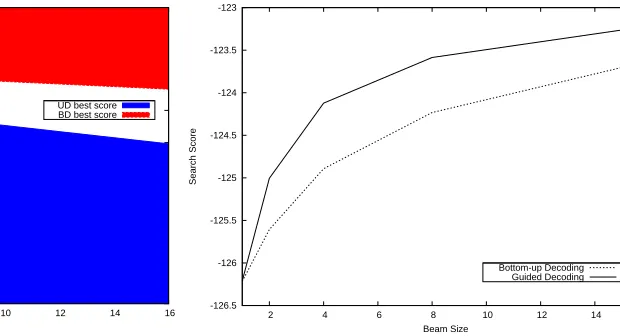
Figure 2 reports a comparison of the translation quality for the two systems in relation to the beam size. The blue area represents the portion of sen-tences for which UD found a better translation. The white area represents the portion of sentences for which the two systems found a translation with the same search score. With beam 1 the two systems ob-viously have a similar behavior, since both the sys-tems stop investigating the candidates for a node af-ter having selected the best candidate immediately available. For beams 2-4, UD has a clear advan-tage. In this range UD finds a better translation for two thirds of the sentences. With beam 4, we ob-serve that UD is able to find a better translation for 63.76% of the sentences, instead BD is able to find a better translation for only 21.54% of the sentences. For searches that employ a beam bigger than 8, we notice that the UD advantage slightly decreases, and
-126.5 -126 -125.5 -125 -124.5 -124 -123.5 -123
2 4 6 8 10 12 14 16
Search Score
Beam Size
[image:7.612.88.433.50.217.2]Bottom-up Decoding Guided Decoding
Figure 3: Search score evolution for BD and UD.
the number of sentences with equivalent translation slowly increases. We can understand this behavior considering that as the beam increases the two sys-tems get closer to exhaustive search. Anyway with this experiment UD shows a consistent accuracy ad-vantage over BD.
Figure 3 plots the search score variation for dif-ferent beam sizes. We can see that UD search leads to an average search score that is consistently bet-ter than the one computed for BD. Undirected De-coding improves the average search score by0.411
for beam 16. The search score is the logarithm of a probability. This variation corresponds to a rel-ative gain of 50.83% in terms of probability. For beams greater than 8 we see that the two curves keep a monotonic ascendant behavior while converging to exhaustive search.
Figure 4 shows the BLEU score variation. Again we can see the consistent improvement of UD over BD. In the graph we report also the performance ob-tained using BD with beam 32. BD reaches BLEU score of 32.07 with beam 32 while UD reaches
32.38 with beam 16: UD reaches a clearly higher BLEU score using half the beam size. The differ-ence is even more impressive if we consider that UD reaches a BLEU of32.19with beam 4.
31.2 31.4 31.6 31.8 32 32.2 32.4
2 4 6 8 10 12 14 16
BLEU Score
Beam Size
[image:8.612.81.314.49.216.2]Bottom-up Decoding Undirected Decoding BD beam 30
Figure 4: BLEU score evolution for BD and UD.
5 10 15 20 25 30 35 40
2 4 6 8 10 12 14 16
Reduction (%)
Beam Size
Nodes Reduction Edges Reduction
Figure 5: Percentage of reduction of the size of the hy-pergraph produced by UD.
selectkcandidates perf-node. As we can see from Algorithm 1, the decoding loop terminates when the queue of candidates is empty, and the statements at
line5andline11ensure that no more than k can-didates are selected perf-node, but nothing requires the selection ofkelements, and some bad candidates may not be generated due to the sophisticated prop-agation strategy. The number of derivations that a hypergraph represents is exponential in the number of nodes and edges composing the structure. With beam 16, the hypergraphs produced by UD contain on average 4.6k fewer translations. Therefore UD is able to find better translations even if exploring a smaller portion of the search space.
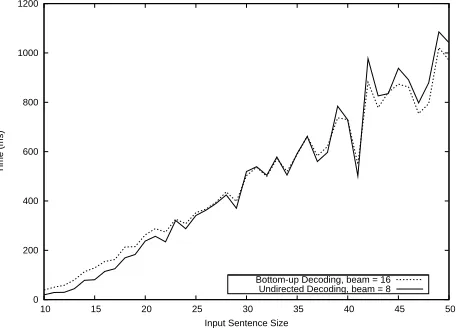
Figure 6 reports the time comparison between BD and UD with respect to sentence length. The
0 200 400 600 800 1000 1200
10 15 20 25 30 35 40 45 50
Time (ms)
Input Sentence Size
[image:8.612.324.552.51.215.2]Bottom-up Decoding, beam = 16 Undirected Decoding, beam = 8
Figure 6: Time comparison between BD and UD.
sentence length is measured with the number of ideogram groups appearing in the source Chinese sentences. We compare BD with beam of 16 and UD with beam of 8, so that we compare two sys-tems with comparable search score. We can notice that for short sentences UD is faster, while for longer sentences UD becomes slower. To understand this result consider that for simple sentences UD can rely on the advantage of exploring a smaller search space. While, for longer sentences, the amount of candidates considered during decoding grows ex-ponentially with the size of the sentence, and UD needs to maintain an unique queue whose size is not bounded by the beam sizek, as for the queues used in BD’s Cube Pruning. It may be possible to address this issue with more efficient handling of the queue. In conclusion we can assert that, even if explor-ing a smaller portion of the search space, UD finds often a translation that is better than the one found with standard BD. UD’s higher accuracy is due to its sophisticated search strategy that allows a more efficient integration of contextual features. This set of experiments show the validity of the UD approach and empirically confirm our intuition about the BD’s inadequacy in solving tasks that rely on fundamental contextual features.
6 Future Work
[image:8.612.77.310.254.424.2]Hypergraph can be regarded as a non-directed graph. In this setting we could imagine applying mes-sage passing algorithms from graphical model the-ory (Koller and Friedman, 2010).
Furthermore, considering that the proposed framework lets the system decide the decoding or-der, we could design a system that explicitly learns to infer the decoding order at training time. Sim-ilar ideas have been successfully tried: Shen et al. (2010) and Gesmundo (2011) investigate the Guided Learning framework, that dynamically incorporates the tasks of learning the order of inference and train-ing the local classifier.
7 Conclusion
With this paper we investigate the limitations of Bottom-up parsing techniques, widely used in Tree Structures Prediction, focusing on Hierarchical Ma-chine Translation. We devise a framework that al-lows a better integration of non-bottom-up features. Compared to a state of the art HMT decoder the pre-sented system produces higher quality translations searching a smaller portion of the search space, em-pirically showing that the bottom-up approximation of contextual features is a limitation for NLP tasks like HMT.
Acknowledgments
This work was partly funded by Swiss NSF grant CRSI22 127510 and European Community FP7 grant 216594 (CLASSiC, www.classic-project.org).
References
Sharon A. Caraballo and Eugene Charniak. 1998. New figures of merit for best-first probabilistic chart pars-ing, Computational Linguistics, 24:275-298.
J. C. Chappelier and M. Rajman and R. Arages and A. Rozenknop. 1999. Lattice Parsing for Speech Recog-nition. In Proceedings of TALN 1999, Cargse, France. David Chiang. 2007. Hierarchical phrase-based trans-lation. Computational Linguistics, 33(2):201-228, 2007.
Anna Corazza, Renato De Mori, Roberto Gretter and Giorgio Satta. 1994. Optimal Probabilistic Evalu-ation Functions for Search Controlled by Stochastic Context-Free Grammars. IEEE Transactions on Pat-tern Analysis and Machine Intelligence, 16(10):1018-1027.
Chris Dyer, Adam Lopez, Juri Ganitkevitch, Johnathan Weese, Ferhan Ture, Phil Blunsom, Hendra Setiawan, Vladimir Eidelman, and Philip Resnik. 2010. cdec: A Decoder, Alignment, and Learning framework for finite-state and context-free translation models. In Proceedings of the Conference of the Association of Computational Linguistics 2010, Uppsala, Sweden. Andrea Gesmundo and James Henderson 2010. Faster
Cube Pruning. Proceedings of the seventh Inter-national Workshop on Spoken Language Translation (IWSLT), Paris, France.
Andrea Gesmundo 2011. Bidirectional Sequence Classi-fication for Tagging Tasks with Guided Learning. Pro-ceedings of TALN 2011, Montpellier, France. Mark Hopkins and Greg Langmead 2009. Cube
prun-ing as heuristic search. Proceedprun-ings of the Conference on Empirical Methods in Natural Language Processing 2009, Singapore.
Liang Huang and David Chiang. 2007. Forest rescoring: Faster decoding with integrated language models. In Proceedings of the Conference of the Association of Computational Linguistics 2007, Prague, Czech Re-public.
Dan Klein and Christopher D. Manning. 2001 Pars-ing and Hypergraphs, In ProceedPars-ings of the Interna-tional Workshop on Parsing Technologies 2001, Bei-jing, China.
Dan Klein and Christopher D. Manning. 2003 A* Pars-ing: Fast Exact Viterbi Parse Selection, In Proceed-ings of the Conference of the North American Associ-ation for ComputAssoci-ational Linguistics 2003, Edmonton, Canada.
Daphne Koller and Nir Friedman. 2010. Probabilistic Graphical Models: Principles and Techniques. The MIT Press, Cambridge, Massachusetts.
Shankar Kumar, Wolfgang Macherey, Chris Dyer, and Franz Och. 2009. Efficient Minimum Error Rate Training and Minimum Bayes-Risk decoding for translation hypergraphs and lattices, In Proceedings of the Joint Conference of the 47th Annual Meeting of the ACL and the 4th International Joint Conference on Natural Language Processing of the AFNLP, Suntec, Singapore.
Zhifei Li, Chris Callison-Burch, Chris Dyer, Juri Ganitkevitch, Sanjeev Khudanpur, Lane Schwartz, Wren N. G. Thornton, Jonathan Weese, and Omar F. Zaidan. 2009. Joshua: An Open Source Toolkit for Parsing-based Machine Translation. In Proceedings of the Workshop on Statistical Machine Translation 2009, Athens, Greece.
Haitao Mi, Liang Huang and Qun Liu. 2008. Forest-Based Translation. In Proceedings of the Conference of the Association of Computational Linguistics 2008, Columbus, OH.
Libin Shen, Giorgio Satta and Aravind Joshi. 2007. Guided Learning for Bidirectional Sequence Classifi-cation. In Proceedings of the Conference of the As-sociation of Computational Linguistics 2007, Prague, Czech Republic.
Andreas Stolcke. 2002. SRILM - An extensible lan-guage modeling toolkit. In Proceedings of the Inter-national Conference on Spoken Language Processing 2002, Denver, CO.