Proceedings of the 2011 Conference on Empirical Methods in Natural Language Processing, pages 313–321,
Simple Effective Decipherment via Combinatorial Optimization
Taylor Berg-Kirkpatrick and Dan Klein Computer Science Division
University of California at Berkeley
{tberg, klein}@cs.berkeley.edu
Abstract
We present a simple objective function that when optimized yields accurate solutions to both decipherment and cognate pair identifica-tion problems. The objective simultaneously scores a matching between two alphabets and a matching between two lexicons, each in a different language. We introduce a simple coordinate descent procedure that efficiently finds effective solutions to the resulting com-binatorial optimization problem. Our system requires only a list of words in both languages as input, yet it competes with and surpasses several state-of-the-art systems that are both substantially more complex and make use of more information.
1 Introduction
Decipherment induces a correspondence between the words in an unknown language and the words in a known language. We focus on the setting where a close correspondence between the alphabets of the two languages exists, but is unknown. Given only two lists of words, the lexicons of both languages, we attempt to induce the correspondence between alphabets and identify the cognates pairs present in the lexicons. The system we propose accomplishes this by defining a simple combinatorial optimiza-tion problem that is a funcoptimiza-tion of both the alphabet and cognate matchings, and then induces correspon-dences by optimizing the objective using a block co-ordinate descent procedure.
There is a range of past work that has var-iously investigated cognate detection (Kondrak, 2001; Bouchard-Cˆot´e et al., 2007; Bouchard-Cˆot´e et al., 2009; Hall and Klein, 2010), character-level decipherment (Knight and Yamada, 1999; Knight et al., 2006; Snyder et al., 2010; Ravi and Knight,
2011), and bilingual lexicon induction (Koehn and Knight, 2002; Haghighi et al., 2008). We consider a common element, which is a model wherein there are character-level correspondences and word-level correspondences, with the word matching parame-terized by the character one. This approach sub-sumes a range of past tasks, though of course past work has specialized in interesting ways.
Past work has emphasized the modeling as-pect, where here we use a parametrically simplistic model, but instead emphasize inference.
2 Decipherment as Two-Level Optimization
Our method represents two matchings, one at the al-phabet level and one at the lexicon level. A vector of variablesxspecifies a matching between alphabets.
For each characteriin the source alphabet and each characterj in the target alphabet we define an
indi-cator variablexij that is on if and only if characteri
is mapped to characterj. Similarly, a vectory rep-resents a matching between lexicons. For worduin
the source lexicon and wordvin the target lexicon,
the indicator variableyuvdenotes thatu maps tov.
Note that the matchings need not be one-to-one. We define an objective function on the matching variables as follows. Let EDITDIST(u, v;x)denote the edit distance between source worduand target
word v given alphabet matching x. Let the length
of word u be lu and the length of word w be lw.
This edit distance depends on x in the following
way. Insertions and deletions always cost a constant
.1 Substitutions also cost unless the characters
are matched in x, in which case the substitution is
1In practice we set = 1
lu+lv. lu+lv is the maximum
number of edit operations between wordsuandv. This nor-malization insures that edit distances are between 0 and 1 for all pairs of words.
free. Now, the objective that we will minimize can be stated simply: PuPv yuv·EDITDIST(u, v;x),
the sum of the edit distances between the matched words, where the edit distance function is parame-terized by the alphabet matching.
Without restrictions on the matchings x and y
this objective can always be driven to zero by either mapping all characters to all characters, or matching none of the words. It is thus necessary to restrict the matchings in some way. Let I be the size of
the source alphabet andJ be the size of the target
alphabet. We allow the alphabet matching x to
be many-to-many but require that each character participate in no more than two mappings and that the total number of mappings be max(I, J), a
constraint we refer to as restricted-many-to-many. The requirements can be encoded with the following linear constraints onx:
∀i
X
j
xij≤2
∀j
X
i
xij≤2
X
i
X
j
xij= max(I, J)
The lexicon matchingy is required to beτ
-one-to-one. By this we mean thatyis an at-most-one-to-one
matching that covers proportionτ of the smaller of
the two lexicons. Let U be the size of the source
lexicon and V be this size of the target lexicon. This requirement can be encoded with the following linear constraints:
∀u
X
v
yuv≤1
∀v
X
u
yuv≤1
X
u
X
v
yuv=τmin(U, V)
Now we are ready to define the full optimization problem. The first formulation is called theImplicit Matching Objective since includes an implicit minimization over edit alignments inside the com-putation of EDITDIST.
(1)Implicit Matching Objective:
min
x,y
X
u
X
v
yuv·EDITDIST(u, v;x)
s.t. xis restricted-many-to-many yisτ-one-to-one
In order to get a better handle on the shape of the objective and to develop an efficient optimization procedure we decompose each edit distance compu-tation and re-formulate the optimization problem in Section 2.2.
2.1 Example
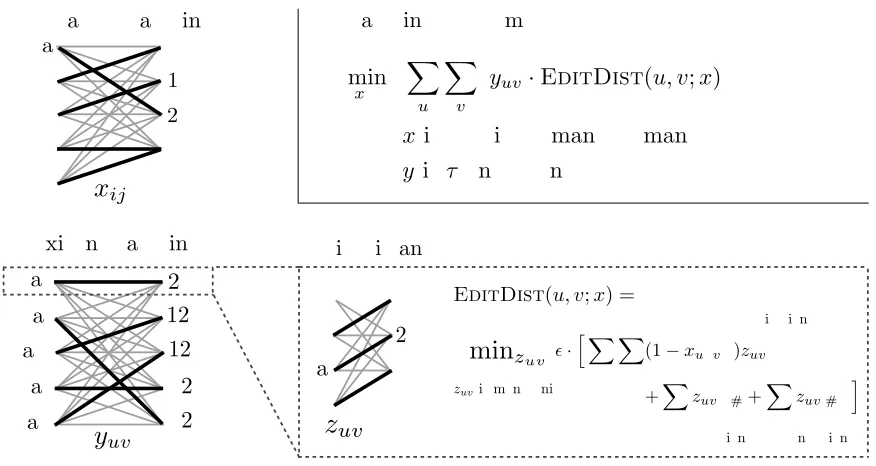
Figure 1 presents both an example matching prob-lem and a diagram of the variables and objective. Here, the source lexicon consists of the English words (cat, bat, cart, rat, cab), and the source alphabet consists of the characters (a, b, c, r, t). The target alphabet is (0, 1, 2, 3). We have used digits as symbols in the target alphabet to make it clear that we treat the alphabets as disjoint. We have no prior knowledge about any correspondence between alphabets, or between lexi-cons.
The target lexicon consists of the words (23, 1233, 120, 323, 023). The bipartite graphs show a specific setting of the matching variables. The bold edges correspond to the xij andyuv that
are one. The matchings shown achieve an edit dis-tance of zero between all matched word pairs ex-cept for the pair(cat, 23). The best edit align-ment for this pair is also diagrammed. Here, ‘a’ is aligned to ‘2’, ‘t’ is aligned to ‘3’, and ‘c’ is deleted and therefore aligned to the null position ‘#’. Only the initial deletion has a non-zero cost since all other alignments correspond to substitutions be-tween characters that are matched inx.
2.2 Explicit Objective
Computing EDITDIST(u, v;x) requires running a dynamic program because of the unknown edit alignments; here we define those alignmentsz
ex-plicitly, which makes the EDITDIST(u, v;x)easy to write explicitly at the cost of more variables. How-ever, by writing the objective in an explicit form that refers to these edit variables, we are able to describe a efficient block coordinate descent procedure that can be used for optimization.
EDITDIST(u, v;x) is computed by minimizing over the set of monotonic alignments between the characters of the source wordu and the characters
a
b
c r t
0 1 2 3 Alphabet Matching
Lexicon Matching
x
ijcat bat
rat cart
cab
1233 120 323 023 23
y
uvEdit Distance
c a
t
2 3
# # EditDist(u, v;x) =
min x,y
�
u
�
v
yuv·EditDist(u, v;x)
s.t. x is restricted-many-to-many
y isτ-one-to-one Matching Problem
Insertion
�
�
�
Substitution
Deletion �·� �
n
�
m
(1−xunvm)zuv,nm
+�
n
zuv,n#+ �
m
zuv,#m
� s.t.
min
zuvzuvis monotonic
[image:3.612.92.530.78.311.2]z
uv,nmFigure 1: An example problem displaying source and target lexicons and alphabets, along with specific matchings. The variables involved in the optimization problem are diagrammed. xare the alphabet matching indicator variables, yare the lexicon matching indicator variables, andzare the edit alignment indicator variables. The indexurefers to
a word in the source lexicon,vrefers to word in the target lexicon,irefers to a character in the source alphabet, and jrefers to a character in the target alphabet. nandmrefer to positions in source and target words respectively. The
matching objective function is also shown.
vm. Let zuv be the vector of alignment variables
for the edit distance computation between source word u and target word v, where entry zuv,nm
indicates whether the character at position n of
source worduis aligned to the character at position m of target wordv. Additionally, define variables zuv,n# and zuv,#m denoting null alignments, which
will be used to keep track of insertions and deletions.
EDITDIST(u, v;x) = min
zuv
·SUB(zuv, x) +DEL(zuv) +INS(zuv)
s.t.zuvis monotonic
We define SUB(zuv, x) to be the number of
sub-stitutions between characters that are not matched inx, DEL(zuv) to be the number of deletions, and
INS(zuv)to be the number of insertions.
SUB(zuv, x) =
X
n,m
(1−xunvm)zuv,nm
DEL(zuv) =
X
n zuv,n#
INS(zuv) =
X
m
zuv,#m
Notice that the variablezuv,nm being turned on
in-dicates the substitute operation, while a zuv,n# or zuv,#m being turned on indicates an insert or delete
operation. These variables are digrammed in Fig-ure 1. The requirement that zuv be a monotonic
alignment can be expressed using linear constraints, but in our optimization procedure (described in Sec-tion 3) these constraints need not be explicitly rep-resented.
Noticing that the mins and sums commute, we arrive at the explicit form of the matching optimization problem.
(2)Explicit Matching Objective:
min
x,y,z
h X
u,v
yuv·· SUB(zuv, x) +DEL(zuv) +INS(zuv)i
s.t. xis restricted-many-to-many yisτ-one-to-one
∀uvzuvis monotonic
The implicit and explicit optimizations are the same, apart from the fact that the explicit optimization now explicitly represents the edit alignment variablesz.
Let the explicit matching objective (2) be denoted asJ(x, y, z). The relaxation of the explicit problem
with 0-1 constraints removed has integer solutions,2
however the objectiveJ(x, y, z)is non-convex. We thus turn to a block coordinate descent method in the next section in order to find local optima.
3 Optimization Method
We now state a block coordinate descent procedure to find local optima of J(x, y, z) under the con-straints on x, y, and z. This procedure alternates
between updatingyandzto their exact joint optima
whenxis held fixed, and updatingxto its exact
op-timum whenyandzare held fixed.
The psuedocode for the procedure is given in Al-gorithm 1. Note that the function EDITDISTreturns
both the min edit distance euv and the argmin edit
alignmentszuv. Also note thatcij is as defined in
Section 3.2.
3.1 Lexicon Matching Update
Letx, the alphabet matching variable, be fixed. We
consider the problem of optimizing J(x, y, z) over the lexicon matching variable y and and the edit alignments z under the constraint that y is τ
-one-to-one and eachzuvis monotonic.
2This can be shown by observing that optimizingxwheny
andzare held fixed yields integer solutions (shown in Section 3.2), and similarly for the optimization ofyandz whenxis fixed (shown in Section 3.1). Thus, every local optimum with respect to these block coordinate updates has integer solutions. The global optimum must be one of these local optima.
Algorithm 1Block Coordinate Descent Randomly initialize alphabet matchingx.
repeat
for allu, vdo
(euv, zuv)←EDITDIST(u, v;x) end for
[Hungarian]
y←argminy τ-one-to-oneh Pu,vyuveuv
i
[Solve LP]
x←argmaxxrestr.-many-to-manyh Pi,jxijcij
i
untilconvergence
Notice thatysimply picks out which edit distance
problems affect the objective. The zuv in each of
these edit distance problems can be optimized in-dependently. zuv that do not have yuv active have
no effect on the objective, and zuv with yuv active
can be optimized using the standard edit distance dy-namic program. Thus, in a first step we compute the
U ·V edit distanceseuv and best monotonic
align-ment variableszuv between all pairs of source and
target words usingU·V calls to the standard edit
dis-tance dynamic program. Altogether, this takes time
O (Pulu)·(Pvlv).
Now, in a second step we compute the least weighted τ-one-to-one matching y under the
weights euv. This can be accomplished in time O(max(U, V)3) using the Hungarian algorithm (Kuhn, 1955). These two steps produceyandzthat
exactly achieve the optimum value ofJ(x, y, z)for the given value ofx.
3.2 Alphabet Matching Update
Lety andz, the lexicon matching variables and the
edit alignments, be fixed. Now, we find the optimal alphabet matching variables x subject to the
con-straint thatxis restricted-many-to-many.
It makes sense that to optimizeJ(x, y, z)with re-spect to x we should prioritize mappings xij that
would mitigate the largest substitution costs in the active edit distance problems. Indeed, with a little algebra it can be shown that solving a maximum weighted matching problem with weights cij that
count potential substitution costs gives the correct update for x. In particular, cij is the total cost of
prob-lems that would result if source characteriwere not
mapped to target characterj in the alphabet match-ingx. This can be written as:
cij =
X
u,v
X
n,ms.t.un=i,vm=j
·yuv·zuv,nm
If x were constrained to be one-to-one, we
could again apply the Hungarian algorithm, this time to find a maximum weighted matching under the weights cij. Since we have instead allowed
restricted-many-to-many alphabet matchings we turn to linear programming for optimizing x. We
can state the update problem as the following linear program (LP), which is guaranteed to have integer solutions:
min x
X
ij
xijcij
s.t. ∀i
X
j
xij≤2, ∀j
X
i
xij ≤2
X
i
X
j
xij = max(I, J)
In experiments we used the GNU Linear Program-ming Toolkit (GLPK) to solve the LP and update the alphabet matchingx. This update yields
match-ing variables x that achieve the optimum value of J(x, y, z)for fixedyandz.
3.3 Random Restarts
In practice we found that the block coordinate de-scent procedure can get stuck at poor local optima. To find better optima, we run the coordinate descent procedure multiple times, initialized each time with a random alphabet matching. We choose the local optimum with the best objective value across all ini-tializations. This approach yielded substantial im-provements in achieved objective value.
4 Experiments
We compare our system to three different state-of-the-art systems on three different data sets. We set up experiments that allow for as direct a comparison as possible. In some cases it must be pointed out that the past system’s goals are different from our own, and we will be comparing in a different way than the respective work was intended. The three systems make use of additional, or slightly different, sources of information.
4.1 Phonetic Cognate Lexicons
The first data set we evaluate on consists of 583 triples of phonetic transcriptions of cognates in Spanish, Portuguese, and Italian. The data set was introduced by Bouchard-Cˆot´e et al. (2007). For a given pair of languages the task is to determine the mapping between lexicons that correctly maps each source word to its cognate in the target lexicon. We refer to this task and data set as ROMANCE.
Hall and Klein (2010) presented a state-of-the-art system for the task of cognate identification and evaluated on this data set. Their model explicitly represents parameters for phonetic change between languages and their parents in a phylogenetic tree. They estimate parameters and infer the pairs of cog-nates present in all three languages jointly, while we consider each pair of languages in turn.
Their model has similarities with our own in that it learns correspondences between the alphabets of pairs of languages. However, their correspondences are probabilistic and implicit while ours are hard and explicit. Their model also differs from our own in a key way. Notice that the phonetic alphabets for the three languages are actually the same. Since phonetic change occurs gradually across languages a helpful prior on the correspondence is to favor the identity. Their model makes use of such a prior. Our model, on the other hand, is unaware of any prior correspondence between alphabets and does not make use of this additional information about phonetic change.
Hall and Klein (2010) also evaluate their model on lexicons that do not have a perfect cognate map-ping. This scenario, where not every word in one language has a cognate in another, is more realistic. They produced a data set with this property by prun-ing words from the ROMANCE data set until only
about 75% of the words in each source lexicon have cognates in each target lexicon. We refer to this task and data set as PARTIALROMANCE.
4.2 Lexicons Extracted from Corpora
cor-pus (Koehn, 2005). To make this set up more real-istic (though fairly comparable), we insured that the corpora were non-parallel by using the first 50K tences on the English side and the second 50K sen-tences on the Spanish side. To generate a gold cog-nate matching we used the intersected HMM align-ment model of Liang et al. (2008) to align the full parallel corpus. From this alignment we extracted a translation lexicon by adding an entry for each word pair with the property that the English word was aligned to the Spanish in over 10% of the alignments involving the English word. To reduce this transla-tion lexicon down to a cognate matching we went through the translation lexicon by hand and removed any pair of words that we judged to not be cognates. The resulting gold matching contains cognate map-pings in the English lexicon for 1,026 of the words in the Spanish lexicon. This means that only about 50% of the words in English lexicon have cognates in the Spanish lexicon. We evaluate on this data set by computing precision and recall for the number of English words that are mapped to a correct cognate. We refer to this task and data set as EUROPARL.
On this data set, we compare against the state-of-the-art orthographic system presented in Haghighi et al. (2008). Haghighi et al. (2008) presents sev-eral systems that are designed to extract transla-tion lexicons for non-parallel corpora by learning a correspondence between their monolingual lexi-cons. Since our system specializes in matching cog-nates and does not take into account additional infor-mation from corpus statistics, we compare against the version of their system that only takes into ac-count orthographic features and is thus is best suited for cognate detection. Their system requires a small seed of correct cognate pairs. From this seed the sys-tem learns a projection using canonical correlation analysis (CCA) into a canonical feature space that allows feature vectors from source words and target words to be compared. Once in this canonical space, similarity metrics can be computed and words can be matched using a bipartite matching algorithm. The process is iterative, adding cognate pairs to the seed lexicon gradually and each time computing a re-fined projection. Our system makes no use of a seed lexicon whatsoever.
Both our system and the system of Haghighi et al. (2008) must solve bipartite matching problems
between the two lexicons. For this data set, the lexi-cons are large enough that finding the exact solution can be slow. Thus, in all experiments on this data set, we instead use a greedy competitive linking al-gorithm that runs in timeO(U2V2log(U V)).
Again, for this dataset it is reasonable to expect that many characters will map to themselves in the best alphabet matching. The alphabets are not iden-tical, but are far from disjoint. Neither our system, nor that of Haghighi et al. (2008) make use of this expectation. As far as both systems are concerned, the alphabets are disjoint.
4.3 Decipherment
Finally, we evaluate our model on a data set where a main goal is to decipher an unknown correspon-dence between alphabets. We attempt to learn a mapping from the alphabet of the ancient Semitic language Ugaritic to the alphabet of Hebrew, and at the same time learn a matching between Hebrew words in a Hebrew lexicon and their cognates in a Ugaritic lexicon. This task is related to the task at-tempted by Snyder et al. (2010). The data set con-sists of a Ugaritic lexicon of 2,214 words, each of which has a Hebrew cognate, the lexicon of their 2,214 Hebrew cognates, and a gold cognate dictio-nary for evaluation. We refer to this task and data set as UGARITIC.
The non-parameteric Bayesian system of Snyder et al. (2010) assumes that the morphology of He-brew is known, making use of an inventory of suf-fixes, presuf-fixes, and stems derived from the words in the Hebrew bible. It attempts to learn a corre-spondence between the morphology of Ugaritic and that of Hebrew while reconstructing cognates for Ugaritic words. This is a slightly different goal than that of our system, which learns a correspondence between lexicons. Snyder et al. (2010) run their system on a set 7,386 Ugaritic words, the same set that we extracted our 2,214 Ugaritic words with He-brew cognates from. We evaluate the accuracy of the lexicon matching produced by our system on these 2,214 Ugaritic words, and so do they, measuring the number of correctly reconstructed cognates.
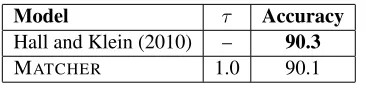
Model τ Accuracy Hall and Klein (2010) – 90.3
[image:7.612.96.279.70.113.2]MATCHER 1.0 90.1
Table 1: Results on ROMANCE data set. Our system is labeled MATCHER. We compare against the phylogenetic cognate detection system of Hall and Klein (2010). We show the pairwise cognate accuracy across all pairs of languages from the following set: Spanish, Portuguese, and Italian.
comparable: only a small proportion of the words in the Ugaritic lexicon have cognates in the lexicon composed of the most frequent Hebrew words.
Here, the alphabets really are disjoint. The sym-bols in both languages look nothing alike. There is no obvious prior expectation about how the alpha-bets will be matched. We evaluate against a well-established correspondence between the alphabets of Ugaritic and Hebrew. The Ugaritic alphabet con-tains 30 characters, the Hebrew alphabet concon-tains 22 characters, and the gold matching contains 33 en-tries. We evaluate the learned alphabet matching by counting the number of recovered entries from the gold matching.
Due to the size of the source and target lexicons, we again use the greedy competitive linking algo-rithm in place of the exact Hungarian algoalgo-rithm in experiments on this data set.
5 Results
We present results on all four datasets ROMANCE,
PARTIALROMANCE, EUROPARL, and UGARITIC.
On the ROMANCEand PARTIALROMANCEdata sets
we compare against the numbers published by Hall and Klein (2010). We ran an implementation of the orthographic system presented by Haghighi et al. (2008) on our EUROPARL data set. We
com-pare against the numbers published by Snyder et al. (2010) on the UGARITIC data set. We refer to our
system as MATCHERin result tables and discussion.
5.1 ROMANCE
The results of running our system, MATCHER, on
the ROMANCE data set are shown in Table 1. We
recover 88.9% of the correct cognate mappings on the pair Spanish and Italian, 85.7% on Italian and Portuguese, and 95.6% on Spanish and Portuguese.
Model τ Precision Recall F1
[image:7.612.318.543.73.133.2]Hall and Klein (2010) – 66.9 82.0 73.6 MATCHER 0.25 99.7 34.0 50.7 0.50 93.8 60.2 73.3 0.75 81.1 78.0 79.5
Table 2: Results on PARTIALROMANCE data set. Our system is labeled MATCHER. We compare against the phylogenetic cognate detection system of Hall and Klein (2010). We show the pairwise cognate precision, recall, and F1 across all pairs of languages from the following set: Spanish, Portuguese, and Italian. Note that approx-imately 75% of the source words in each of the source lexicons have cognates in each of the target lexicons.
Our average accuracy across all pairs of languages is 90.1%. The phylogenetic system of Hall and Klein (2010) achieves an average accuracy of 90.3% across all pairs of languages. Our system achieves accuracy comparable to that of the phylogenetic sys-tem, despite the fact that the phylogenetic system is substantially more complex and makes use of an in-formed prior on alphabet correspondences.
The alphabet matching learned by our system is interesting to analyze. For the pairing of Span-ish and Portuguese it recovers phonetic correspon-dences that are well known. Our system learns the correct cognate pairing of Spanish /bino/ to Por-tuguese /vinu/. This pair exemplifies two com-mon phonetic correspondences for Spanish and Por-tuguese: the Spanish /o/ often transforms to a /u/ in Portuguese, and Spanish /b/ often transforms to /v/ in Portuguese. Our system, which allows many-to-many alphabet correspondences, correctly identifies the mappings /o/→/u/ and /b/→/v/ as well as the identity mappings /o/→/o/ and /b/→/b/ which are also common.
5.2 PARTIALROMANCE
In Table 2 we present the results of running our sys-tem on the PARTIALROMANCEdata set. In this data
set, only approximately 75% of the source words in each of the source lexicons have cognates in each of the target lexicons. The parameterτ trades off
pre-cision and recall. We show results for three different settings ofτ: 0.25, 0.5, and 0.75.
Span-Model Seed τ Precision Recall F1
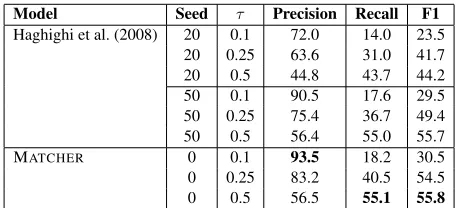
Haghighi et al. (2008) 20 0.1 72.0 14.0 23.5 20 0.25 63.6 31.0 41.7 20 0.5 44.8 43.7 44.2 50 0.1 90.5 17.6 29.5 50 0.25 75.4 36.7 49.4 50 0.5 56.4 55.0 55.7
MATCHER 0 0.1 93.5 18.2 30.5
0 0.25 83.2 40.5 54.5 0 0.5 56.5 55.1 55.8
Table 3: Results on EUROPARL data set. Our system is labeled MATCHER. We compare against the bilingual lexicon induction system of Haghighi et al. (2008). We show the cognate precision, recall, and F1 for the pair of languages English and Spanish using lexicons extracted from corpora. Note that approximately 50% of the words in the English lexicon have cognates in the Spanish lexi-con.
ish – Portuguese, our system achieves prefect preci-sion at recalls of 32.2% and 38.1% respectively. The best average F1 achieved by our system is 79.5%, which surpasses the average F1 of 73.6 achieved by the phylogenetic system of Hall and Klein (2010).
The phylogenetic system observes the phyloge-netic tree of ancestry for the three languages and explicitly models cognate evolution and survival in a ‘survival’ tree. One might expect the phyloge-netic system to achieve better results on this data set where part of the task is identifying which words do not have cognates. It is surprising that our model does so well given its simplicity.
[image:8.612.72.300.71.175.2]5.3 EUROPARL
Table 3 presents results for our system on the EU -ROPARLdata set across three different settings ofτ:
0.1, 0.25, and 0.5. We compare against the ortho-graphic system presented by Haghighi et al. (2008), across the same three settings ofτ, and with two
dif-ferent sizes of seed lexicon: 20 and 50. In this data set, only approximately 50% of the source words have cognates in the target lexicon.
Our system achieves a precision of 93.5% at a re-call of 18.2%, and a best F1 of 55.0%. Using a seed matching of 50 word pairs, the orthographic sys-tem of Haghighi et al. (2008) achieves a best F1 of 55.7%. Using a seed matching of 20 word pairs, it achieves a best F1 of 44.2%. Our system out-performs the orthographic system even though the orthographic system makes use of important
addi-Model τ Lexicon Acc. Alphabet Acc.
Snyder et al. (2010) – 60.4* 29/33* MATCHER 1.0 90.4 28/33
Table 4: Results on UGARITICdata set. Our system is la-beled MATCHER. We compare against the decipherment system of Snyder et al. (2010). *Note that results for this system are on a somewhat different task. In particular, the MATCHERsystem assumes the inventories of cognates in both Hebrew and Ugaritic are known, while the system of Snyder et al. (2010)reconstructs cognates assuming only that the morphology of Hebrew is known, which is a harder task. We show cognate pair identification accuracy and alphabet matching accuracy for Ugaritic and Hebrew.
tional information: a seed matching of correct cog-nate pairs. The results show that as the size of this seed is decreased, the performance of the ortho-graphic system degrades.
5.4 UGARITIC
In Table 4 we present results on the UGARITICdata
set. We evaluate both accuracy of the lexicon match-ing learned by our system, and the accuracy of the alphabet matching. Our system achieves a lexicon accuracy of 90.4% while correctly identifying 28 out the 33 gold character mappings.
We also present the results for the decipherment model of Snyder et al. (2010) in Table 4. Note that while the evaluation data sets for our two models are the same, the tasks are very different. In par-ticular, our system assumes the inventories of cog-nates in both Hebrew and Ugaritic are known, while the system of Snyder et al. (2010) reconstructs cog-nates assuming only that the morphology of Hebrew is known, which is a harder task. Even so, the re-sults show that our system is effective at decipher-ment when semantically similar lexicons are avail-able.
6 Conclusion
[image:8.612.316.536.71.108.2]References
A. Bouchard-Cˆot´e, P. Liang, T.L. Griffiths, and D. Klein. 2007. A probabilistic approach to diachronic phonol-ogy. InProc. of EMNLP.
A. Bouchard-Cˆot´e, T.L. Griffiths, and D. Klein. 2009. Improved reconstruction of protolanguage word forms. InProc. of NAACL.
A. Haghighi, P. Liang, T. Berg-Kirkpatrick, and D. Klein. 2008. Learning bilingual lexicons from monolingual corpora. Proceedings of ACL.
D. Hall and D. Klein. 2010. Finding cognate groups using phylogenies. InProc. of ACL.
K. Knight and K. Yamada. 1999. A computational ap-proach to deciphering unknown scripts. In Proc. of ACL Workshop on Unsupervised Learning in Natural Language Processing.
K. Knight, A. Nair, N. Rathod, and K. Yamada. 2006. Unsupervised analysis for decipherment problems. In
Proc. of COLING/ACL.
P. Koehn and K. Knight. 2002. Learning a translation lexicon from monolingual corpora. In Proc. of ACL workshop on Unsupervised lexical acquisition. P. Koehn. 2005. Europarl: A Parallel Corpus for
Statis-tical Machine Translation. InProc. of Machine Trans-lation Summit.
G. Kondrak. 2001. Identifying Cognates by Phonetic and Semantic Similarity. InNAACL.
H.W. Kuhn. 1955. The Hungarian method for the assign-ment problem. Naval research logistics quarterly. P. Liang, D. Klein, and M.I. Jordan. 2008.
Agreement-based learning. Proc. of NIPS.
S. Ravi and K. Knight. 2011. Bayesian inference for Zo-diac and other homophonic ciphers. InProc. of ACL. B. Snyder, R. Barzilay, and K. Knight. 2010. A