Soft-Supervised Learning for Text Classification
Amarnag Subramanya & Jeff Bilmes Dept. of Electrical Engineering,
University of Washington, Seattle, WA 98195, USA.
{asubram,bilmes}@ee.washington.edu
Abstract
We propose a new graph-based
semi-supervised learning (SSL) algorithm and demonstrate its application to document categorization. Each document is represented by a vertex within a weighted undirected graph and our proposed framework minimizes the weighted Kullback-Leibler divergence between distributions that encode the class membership probabilities of each vertex. The proposed objective is convex with guaranteed convergence using an alternating
minimiza-tion procedure. Further, it generalizes in
a straightforward manner to multi-class
problems. We present results on two
stan-dard tasks, namely Reuters-21578 and
WebKB, showing that the proposed algorithm significantly outperforms the state-of-the-art.
1 Introduction
Semi-supervised learning (SSL) employs small amounts of labeled data with relatively large amounts of unlabeled data to train classifiers. In many problems, such as speech recognition, doc-ument classification, and sentiment recognition, annotating training data is both time-consuming and tedious, while unlabeled data are easily ob-tained thus making these problems useful appli-cations of SSL. Classic examples of SSL algo-rithms include self-training (Yarowsky, 1995) and co-training (Blum and Mitchell, 1998). Graph-based SSL algorithms are an important class of SSL techniques that have attracted much of attention of late (Blum and Chawla, 2001; Zhu et al., 2003).
Here one assumes that the data (both labeled and unlabeled) is embedded within a low-dimensional manifold expressed by a graph. In other words, each data sample is represented by a vertex within a weighted graph with the weights providing a mea-sure of similarity between vertices.
Most graph-based SSL algorithms fall under one of two categories – those that use the graph structure to spread labels from labeled to unlabeled samples (Szummer and Jaakkola, 2001; Zhu and Ghahra-mani, 2002) and those that optimize a loss function based on smoothness constraints derived from the graph (Blum and Chawla, 2001; Zhu et al., 2003; Joachims, 2003; Belkin et al., 2005). Sometimes the two categories are similar in that they can be shown to optimize the same underlying objective (Zhu and Ghahramani, 2002; Zhu et al., 2003). In general graph-based SSL algorithms are non-parametric and transductive.1 A learning algorithm is said to be transductive if it is expected to work only on a closed data set, where a test set is revealed at the time of training. In practice, however, transductive learners can be modified to handle unseen data (Zhu, 2005a; Sindhwani et al., 2005). A common drawback of many graph-based SSL algorithms (e.g. (Blum and Chawla, 2001; Joachims, 2003; Belkin et al., 2005)) is that they assume binary classification tasks and thus require the use of sub-optimal (and often com-putationally expensive) approaches such as one vs. rest to solve multi-class problems, let alone struc-tured domains such as strings and trees. There are also issues related to degenerate solutions (all un-labeled samples classified as belonging to a single
1
Excluding Manifold Regularization (Belkin et al., 2005).
class) (Blum and Chawla, 2001; Joachims, 2003; Zhu and Ghahramani, 2002). For more background on graph-based and general SSL and their applica-tions, see (Zhu, 2005a; Chapelle et al., 2007; Blitzer and Zhu, 2008).
In this paper we propose a new algorithm for graph-based SSL and use the task of text classifica-tion to demonstrate its benefits over the current state-of-the-art. Text classification involves automatically assigning a given document to a fixed number of se-mantic categories. Each document may belong to one, many, or none of the categories. In general, text classification is a multi-class problem (more than 2 categories). Training fully-supervised text classifiers requires large amounts of labeled data whose annotation can be expensive (Dumais et al., 1998). As a result there has been interest is us-ing SSL techniques for text classification (Joachims, 1999; Joachims, 2003). However past work in semi-supervised text classification has relied primarily on one vs. rest approaches to overcome the inherent multi-class nature of this problem. We believe such an approach may be sub-optimal because, disregard-ing data overlap, the different classifiers have train-ing procedures that are independent of one other. In order to address the above drawback we pro-pose a new framework based on optimizing a loss function composed of Kullback-Leibler divergence (KL-divergence) (Cover and Thomas, 1991) terms between probability distributions defined for each graph vertex. The use of probability distributions, rather than fixed integer labels, not only leads to a straightforward multi-class generalization, but also allows us to exploit other well-defined functions of distributions, such as entropy, to improve system performance and to allow for the measure of uncer-tainty. For example, with a single integer, at most all we know is its assignment. With a distribution, we can continuously move from knowing an assignment with certainty (i.e., an entropy of zero) to expres-sions of doubt or multiple valid possibilities (i.e., an entropy greater than zero). This is particularly use-ful for document classification as we will see. We also show how one can use the alternating minimiza-tion (Csiszar and Tusnady, 1984) algorithm to op-timize our objective leading to a relatively simple, fast, easy-to-implement, guaranteed to converge, it-erative, and closed form update for each iteration.
2 Proposed Graph-Based Learning Framework
We consider the transductive learning problem, i.e., given a training setD={Dl,Du}, whereDlandDu are the sets of labeled and unlabeled samples respec-tively, the task is to infer the labels for the samples in Du. In other words, Du is the “test-set.” Here Dl = {(xi, yi)}li=1,Du = {xi}il+=ul+1,xi ∈ X (the
input space of the classifier, and corresponds to vec-tors of features) andyi ∈ Y (the space of classifier
outputs, and for our case is the space of non-negative integers). Thus |Y| = 2 yields binary classifica-tion while |Y| > 2 yields multi-class. We define n=l+u, the total number of samples in the train-ing set. GivenD, most graph-based SSL algorithms utilize an undirected weighted graph G = (V, E)
where V = {1, . . . , n} are the data points in D and E = V ×V are the set of undirected edges between vertices. We use wij ∈ W to denote the
weight of the edge between verticesiandj. W is referred to as the weight (or affinity) matrix of G. As will be seen shortly, the input featuresxi effect
the final classification results viaW, i.e., the graph. Thus graph construction is crucial to the success of any graph-based SSL algorithm. Graph construction “is more of an art, than science” (Zhu, 2005b) and is an active research area (Alexandrescu and Kirch-hoff, 2007). In general the weights are formed as wij =sim(xi,xj)δ(j∈ K(i)). HereK(i)is the set
ofi’s k-nearest-neighbors (KNN), sim(xi,xj) is a
given measure of similarity betweenxi andxj, and
δ(c)returns a1ifcis true and0otherwise. Getting the similarity measure right is crucial for the success of any SSL algorithm as that is what determines the graph. Note that setting K(i) = |V| = n results in a fully-connected graph. Some popular similarity measures include
sim(xi,xj) =e−
kxi−xjk22
σ2 or
sim(xi,xj) = cos(xi,xj) =
hxi,xji
kxi k22kxj k22
where k xi k2 is the L2 norm, and hxi,xji is the
inner product ofxiandxj. The first similarity
We next introduce our proposed approach. For everyi ∈V, we define a probability distributionpi
over the elements ofY. In addition letrj,j= 1. . . l
be another set of probability distributions again over the elements ofY (recall, Y is the space of classi-fier outputs). Here{rj}j represents the labels of the
supervised portion of the training data. If the label for a given labeled data point consists only of a sin-gle integer, then the entropy of the correspondingrj
is zero (the probability of that integer will be unity, with the remaining probabilities being zero). If, on the other hand, the “label” for a given labeled data point consists of a set of integers (e.g., if the object is a member of multiple classes), thenrj is able to
represent this property accordingly (see below). We emphasize again that bothpi andrj are probability
distributions, withrjfixed throughout training. The
goal of learning in this paper is to find the best set of distributionspi,∀ithat attempt to: 1) agree with
the labeled datarj wherever it is available; 2) agree
with each other (when they are close according to a graph); and 3) be smooth in some way. These cri-teria are captured in the followingnew multi-class SSL optimization procedure:
min
p C1(p), whereC1(p) =
" l X
i=1
DKL ri||pi
+µ
n X
i X
j
wijDKL pi||pj
−ν
n X
i=1
H(pi)
,
(1)
and where p , (p1, . . . , pn) denotes the
en-tire set of distributions to be learned, H(pi) =
−P
ypi(y) logpi(y) is the standard Shannon
en-tropy function of pi, DKL(pi||qj) is the
KL-divergence betweenpi andqj, andµandν are
hy-perparameters whose selection we discuss in section 5. The distributionsriare derived fromDl(as
men-tioned above) and this can be done in one of the fol-lowing ways: (a) ifyˆi is the single supervised label
for inputxi thenri(y) = δ(y = ˆyi), which means
thatrigives unity probability foryequaling the
la-belyˆi; (b) ifyˆi ={yˆi(1), . . . ,yˆ
(k)
i },k≤ |Y|is aset
of possible outputs for inputxi, meaning an object
validly falls into all of the corresponding categories, we setri(y) = (1/k)δ(y ∈ yˆi) meaning thatri is
uniform over only the possible categories and zero
otherwise; (c) if the labels are somehow provided in the form of a set of non-negative scores, or even a probability distribution itself, we just setri to be
equal to those scores (possibly) normalized to be-come a valid probability distribution. Among these three cases, case (b) is particularly relevant to text classification as a given document many belong to (and in practice may be labeled as) many classes. The final classification results, i.e., the final labels forDu, are then given byyˆ= argmax
y∈Y pi (y).
We next provide further intuition on our objective function. SSL on a graph consists of finding a la-belingDuthat is consistent with both the labels
pro-vided in Dl and the geometry of the data induced by the graph. The first term of C1 will penalize the solution pi i ∈ {1, . . . , l}, when it is far away
from the labeled training dataDl, but it does not in-sist thatpi = ri, as allowing for deviations fromri
can help especially with noisy labels (Bengio et al., 2007) or when the graph is extremely dense in cer-tain regions. As explained above, our framework al-lows for the case where supervised training is uncer-tain or ambiguous. We consider it reasonable to call our approachsoft-supervisedlearning, generalizing the notion of semi-supervised learning, since there is even more of a continuum here between fully su-pervised and fully unsusu-pervised learning than what typically exists with SSL. Soft-supervised learning allows uncertainty to be expressed (via a probability distribution) about any of the labels individually.
The second term of C1 penalizes a lack of con-sistency with the geometry of the data and can be seen as a graph regularizer. Ifwij is large, we prefer
a solution in whichpi andpj are close in the
KL-divergence sense. While KL-KL-divergence is asym-metric, given thatGis undirected impliesWis sym-metric (wij = wji) and as a result the second term
is inherently symmetric.
The last term encourages each pi to be close to
en-sures that the nodes in this disconnected region are encouraged to yield a uniform distribution, validly expressing the fact that we do not know the labels of these nodes based on the nature of the graph. More generally, we conjecture that by maximizing the en-tropy of eachpi, the classifier has a better chance of
producing high entropy results in graph regions of low confidence (e.g. close to the decision boundary and/or low density regions). This overcomes a com-mon drawback of a large number of state-of-the-art classifiers that tend to be confident even in regions close to the decision boundary.
We conclude this section by summarizing some of the features of our proposed framework. It should be clear that C1 uses the “manifold assumption” for SSL (see chapter 2 in (Chapelle et al., 2007)) — it assumes that the input data can be embed-ded within a low-dimensional manifold (the graph). As the objective is defined in terms of probability distributions over integers rather than just integers (or to real-valued relaxations of integers (Joachims, 2003; Zhu et al., 2003)), the framework general-izes in a straightforward manner to multi-class prob-lems. Further, all the parameters are estimated jointly (compare to one vs. rest approaches which involve solving |Y| independent problems). Fur-thermore, the objective is capable of handling label training data uncertainty (Pearl, 1990). Of course, this objective would be useless if it wasn’t possible to efficiently and easily optimize it on large data sets. We next describe a method that can do this.
3 Learning with Alternating Minimization As long as µ, ν ≥ 0, the objective C1(p) is con-vex. This follows since DKL(pi||pj) is convex in
the pair (pi, pj) (Cover and Thomas, 1991),
nega-tive entropy is convex, and a posinega-tive-weighted lin-ear combination of a set of convex functions is con-vex. Thus, the problem of minimizingC1 over the space of collections of probability distributions (a convex set) constitutes a convex programming prob-lem (Bertsekas, 2004). This property is extremely
beneficial since there is a unique global optimum and there are a variety of methods that can be used to yield that global optimum. One possible method might take the derivative of the objective along with Lagrange multipliers to ensure that we stay within
the space of probability distributions. This method can sometimes yield a closed form single-step an-alytical expression for the globally optimum solu-tion. Unfortunately, however, our problem does not admit such a closed form solution because the gra-dient ofC1(p)with respect topi(y) is of the form,
k1pi(y) logpi(y) +k2pi(y) +k3(wherek1, k2, k3
are fixed constants). Sometimes, optimizing the dual of the objective can also produce a solution, but un-fortunately again the dual of our objective also does not yield a closed form solution. The typical next step, then, is to resort to iterative techniques such as gradient descent along with modifications to en-sure that the solution stays within the set of proba-bility distributions (the gradient ofC1alone will not necessarily point in the direction where p is still a valid distribution) - one such modification is called the method of multipliers (MOM). Another solu-tion would be to use computasolu-tionally complex (and complicated) algorithms like interior point methods (IPM). While all of the above methods (described in detail in (Bertsekas, 2004)) are feasible ways to solve our problem, they each have their own draw-backs. Using MOM, for example, requires the care-ful tuning of a number of additional parameters such as learning rates, growth factors, and so on. IPM in-volves inverting a matrix of the order of the number of variables and constraints during each iteration.
We instead adopt a different strategy based on al-ternating minimization (Csiszar and Tusnady, 1984). This approach has a single additional optimization parameter (contrasted with MOM), admits a closed form solution for each iteration not involving any matrix inversion (contrasted with IPM), and yields guaranteed convergence to the global optimum. In order to render our approach amenable to AM, how-ever, we relax our objective C1 by defining a new (third) set of distributions for all training samplesqi,
i= 1, . . . , ndenoted collectively like the above us-ing the notationq, (q1, . . . , qn). We define a new
objective to be optimized as follows:
min
p,q C2(p,q), whereC2(p,q) = " l
X
i=1
DKL ri||qi
+µ
n X
i=1 X
j∈N(i)
w0
ijDKL pi||qj
−ν
n X
i=1
H(pi)
Before going further, the reader may be wondering at this juncture how might it be desirable for us to have apparently complicated the objective function in an attempt to yield a more computationally and methodologically superior machine learning proce-dure. This is indeed the case as will be spelled out below. First, in C2 we have defined a new weight matrix[W0]ij =w0ij of the same size as the original
whereW0 =W +αIn, whereInis then×n
iden-tity matrix, and whereα≥0is a non-negative con-stant (this is the optimization related parameter men-tioned above). This has the effect that w0ii ≥ wii. In the original objective C1, wii is irrelevant since
DKL(p||p) = 0for allp, but since there are now two
distributions for each training point, there should be encouragement for the two to approach each other. Like C1, the first term of C2 ensures that the la-beled training data is respected and the last term is a smoothness regularizer, but these are done via dif-ferent sets of distributions,qandprespectively — this choice is what makes possible the relatively sim-ple analytical update equations given below. Next, we see that the two objective functions in fact have identical solutions when the optimization enforces the constraint thatpandqare equal:
min
(p,q):p=qC2(p,q) = minp C1(p).
Indeed, asαgets large, the solutions considered vi-able are those only wherep = q. We thus have that:
lim
α→∞minp,q C2(p,q) = minp C1(p).
Therefore, the two objectives should yield the same solution as long asα≥wij for alli, j. A key
advan-tage of this relaxed objective is that it is amenable to alternating minimization, a method to produce a se-quence of sets of distributions(pn,qn)as follows:
pn= argmin
p C2(p,q
n−1), qn= argmin
q C2(p
n,q).
It can be shown (we omit the rather lengthy proof due to space constraints) that the sequence gener-ated using the above minimizations converges to the minimum ofC2(p,q), i.e.,
lim
n→∞C2(p
(n),q(n)) = inf
p,qC2(p,q),
provided we start with a distribution that is initial-ized properly q(0)(y) > 0 ∀ y ∈ Y. The update equations forp(n)andq(n)are given by
p(n) i (y) =
1
Zi
exp
β(in−1)(y)
γi ,
q(n) i (y) =
ri(y)δ(i≤l) +µPjw
0
jip( n) j (y)
δ(i≤l) +µP jw
0
ji
,
where
γi =ν+µ X
j
w0
ij,
β(n−1)
i (y) =−ν+µ X
j
wij0 (logq( n−1)
j (y)−1)
and whereZiis a normalizing constant to ensurepi
is a valid probability distribution. Note that each it-eration of the proposed framework has a closed form solution and is relatively simple to implement, even for very large graphs. Henceforth we refer to the proposed objective optimized using alternating min-imization asAM.
4 Connections to Other Approaches
Label propagation (LP) (Zhu and Ghahramani, 2002) is a graph-based SSL algorithms that per-forms Markov random walks on the graph and has a straightforward extension to multi-class problems. The update equations for LP (which also we use for our LP implementations) may be written as
p(n)
i (y) =
ri(y)δ(i≤l) +δ(i > l)Pjwijp
(n−1)
j (y)
δ(i≤l) +δ(i > l)P
jwij
Note the similarity to the update equation forqi(n)in our AM case. It has been shown that the squared-loss based SSL algorithm (Zhu et al., 2003) and LP have similar updates (Bengio et al., 2007).
to the following: 1) squared loss is appropriate un-der a Gaussian loss model which may not be opti-mal under many circumstances (e.g. classification); 2) KL-divergenceDKL(p||q) is based on a relative
(relative to p) rather than an absolute error; and 3) under certain natural assumptions, KL-divergence is asymptotically consistent with respect to the under-lying probability distributions.
AM is also similar to the spectral graph trans-ducer (Joachims, 2003) in that they both attempt to find labellings over the unlabeled data that re-spect the smoothness constraints of the graph. While spectral graph transduction is anapproximate solu-tion to a discrete optimizasolu-tion problem (which is NP hard), AM is anexactsolution obtained by optimiz-ing a convex function over a continuous space. Fur-ther, while spectral graph transduction assumes bi-nary classification problems, AM naturally extends to multi-class situations without loss of convexity.
Entropy Minimization (EnM) (Grandvalet and Bengio, 2004) uses the entropy of the unlabeled data as a regularizer while optimizing a parametric loss function defined over the labeled data. While the objectives in the case of both AM and EnM make use of the entropy of the unlabeled data, there are several important differences: (a) EnM isnot graph-based, (b) EnM is parametric whereas our proposed approach is non-parametric, and most importantly, (c) EnM attempts tominimizeentropy while the pro-posed approach aims to maximize entropy. While this may seem a triviality, it has catastrophic conse-quences in terms of both the mathematics and mean-ing. The objective in case of EnM is not convex, whereas in our case we have a convex formulation with simple update equations and convergence guar-antees.
(Wang et al., 2008) is a graph-based SSL al-gorithm that also employs alternating minimiza-tion style optimizaminimiza-tion. However, it is inherently squared-loss based which our proposed approach out-performs (see section 5). Further, they do not provide or state convergence guarantees and one side of their update approximates an NP-complete optimization procedure.
The information regularization (IR) (Corduneanu and Jaakkola, 2003) algorithm also makes use of a KL-divergence based loss for SSL. Here the in-put space is divided into regions{Ri}which might
or might not overlap. For a given point xi ∈ Ri,
IR attempts to minimize the KL-divergence between pi(yi|xi)andpˆRi(y), the agglomerative distribution
for regionRi. Given a graph, one can define a
re-gion to be a vertex and its neighbor thus making IR amenable to graph-based SSL. In (Corduneanu and Jaakkola, 2003), the agglomeration is performed by a simple averaging (arithmetic mean). While IR sug-gests (without proof of convergence) the use of al-ternating minimization for optimization, one of the steps of the optimization does not admit a closed-form solution. This is a serious practical drawback especially in the case of large data sets. (Tsuda, 2005) (hereafter referred to as PD) is an extension of the IR algorithm to hypergraphs where the agglom-eration is performed using the geometric mean. This leads to closed form solutions in both steps of the al-ternating minimization. There are several important differences between IR and PD on one side and our proposed approach: (a) neither IR nor PD use an entropy regularizer, and (b) the update equation for one of the steps of the optimization in the case of PD (equation 13 in (Tsuda, 2005)) is actually a spe-cial case of our update equation forpi(y) and may
be obtained by settingwij = 1/2. Further, our work
here may be easily extended to hypergraphs.
5 Results
We compare our algorithm (AM) with other state-of-the-art SSL-based text categorization al-gorithms, namely, (a) SVM (Joachims, 1999), (b) Transductive-SVM (TSVM) (Joachims, 1999), (c) Spectral Graph Transduction (SGT) (Joachims, 2003), and (d) Label Propagation (LP) (Zhu and Ghahramani, 2002). Note that only SGT and LP are graph-based algorithms, while SVM is fully-supervised (i.e., it does not make use of any of the unlabeled data). We implemented SVM and TSVM usingSVM Light(Joachims, b) and SGT usingSGT Light(Joachims, a). In the case of SVM, TSVM and SGT we trained|Y|classifiers (one for each class) in a one vs. rest manner precisely following (Joachims, 2003).
5.1 Reuters-21578
1987 (Lewis et al., 1987). The corpus has 9,603 training (not to be confused withD) and 3,299 test documents (which representsDu). Of the 135
poten-tial topic categories only the 10 most frequent cate-gories are used (Joachims, 1999). Catecate-gories outside the 10 most frequent were collapsed into one class and assigned a label “other”. For each document i in the training and test sets, we extract featuresxiin
the following manner: stop-words are removed fol-lowed by the removal of case and information about inflection (i.e., stemming) (Porter, 1980). We then compute TFIDF features for each document (Salton and Buckley, 1987). All graphs were constructed us-ing cosine similarity with TFIDF features.
For this task Y = { earn, acq, money, grain,
crude, trade, interest, ship, wheat, corn, average}. For LP and AM, we use the output spaceY0 = Y∪ {
other}. For documents inDl that are labeled with
multiple categories, we initialize ri to have equal
non-zero probability for each such category. For example, if document i is annotated as belonging to classes { acq, grain, wheat}, then ri(acq) =
ri(grain) =ri(wheat) = 1/3.
We created 21 transduction sets by randomly sam-plingldocuments from the training set with the con-straint that each of 11 categories (top 10 categories and the classother) are represented at least once in each set. These samples constitute Dl. All algo-rithms used the same transduction sets. In the case of SGT, LP and AM, the first transduction set was used to tune the hyperparameters which we then held fixed for all the remaining 20 transduction sets. For all the graph-based approaches, we ran a search over K ∈ {2, 10, 50, 100, 250, 500, 1000, 2000,n}(note K=nrepresents a fully connected graph). In addi-tion, in the case of AM, we setα = 2for all exper-iments, and we ran a search overµ∈ {1e–8, 1e–4, 0.01, 0.1, 1, 10, 100} andν ∈ {1e–8, 1e–6, 1e–4, 0.01, 0.1}, for SGT the search was overc∈ {3000, 3200, 3400, 3800, 5000, 100000} (see (Joachims, 2003)).
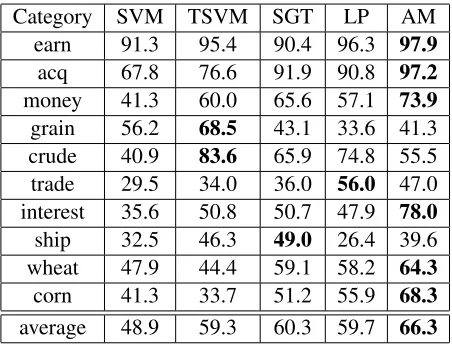
We report precision-recall break even point (PRBEP) results on the 3,299 test documents in Ta-ble 1. PRBEP has been a popular measure in infor-mation retrieval (see e.g. (Raghavan et al., 1989)). It is defined as that value for which precision and recall are equal. Results for each category in Ta-ble 1 were obtained by averaging the PRBEP over
Category SVM TSVM SGT LP AM earn 91.3 95.4 90.4 96.3 97.9
acq 67.8 76.6 91.9 90.8 97.2
money 41.3 60.0 65.6 57.1 73.9
grain 56.2 68.5 43.1 33.6 41.3 crude 40.9 83.6 65.9 74.8 55.5 trade 29.5 34.0 36.0 56.0 47.0 interest 35.6 50.8 50.7 47.9 78.0
ship 32.5 46.3 49.0 26.4 39.6 wheat 47.9 44.4 59.1 58.2 64.3
corn 41.3 33.7 51.2 55.9 68.3
average 48.9 59.3 60.3 59.7 66.3
Table 1: P/R Break Even Points (PRBEP) for the top
10 categories in the Reuters data set withl = 20and
u = 3299. All results are averages over 20 randomly
generated transduction sets. The last row is the macro-average over all the categories. Note AM is the proposed approach.
the 20 transduction sets. The final row “average” was obtained by macro-averaging (average of av-erages). The optimal value of the hyperparame-ters in case of LP was K = 100; in case of AM,
K = 2000, µ = 1e–4, ν = 1e–2; and in the case
of SGT, K = 100, c = 3400. The results show that AM outperforms the state-of-the-art on 6 out of 10 categories and is competitive in 3 of the remain-ing 4 categories. Further it significantly outperforms all other approaches in case of the macro-averages. AM is significant over its best competitor SGT at the 0.0001 level according to the difference of pro-portions significance test.
Figure 1 shows the variation of “average” PRBEP against the number of labeled documents (l). For each value ofl, we tuned the hyperparameters over the first transduction set and used these values for all the other 20 sets. Figure 1 also shows error-bars (±standard deviation) all the experiments. As expected, the performance of all the approaches improves with increasing number of labeled docu-ments. Once again in this case, AM, outperforms the other approaches for all values ofl.
5.2 WebKB Collection
[image:7.612.314.540.56.229.2]0 50 100 150 200 250 300 350 400 450 500 45
50 55 60 65 70 75 80 85
Number of Labeled Documents
Average PRBEP
[image:8.612.87.254.61.190.2]AM SGT LP TSVM SVM
Figure 1: Average PRBEP over all classes vs.
number of labeled documents (l) for Reuters data
set
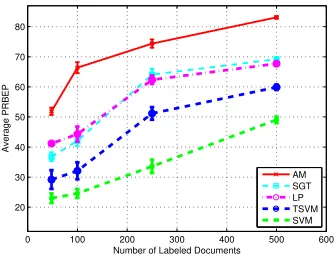
0 100 200 300 400 500 600
20 30 40 50 60 70 80
Number of Labeled Documents
Average PRBEP
[image:8.612.334.502.62.190.2]AM SGT LP TSVM SVM
Figure 2: Average PRBEP over all classes vs.
number of labeled documents (l) for WebKB
col-lection.
domains. The web pages in the WebKB set are la-beled using two different polychotomies. The first is according to topic and the second is according to web domain. In our experiments we only consid-ered the first polychotomy, which consists of 7 cat-egories: course, department, faculty, project, staff,
student, and other. Following (Nigam et al., 1998) we only use documents from categoriescourse, de-partment, faculty, projectwhich gives 4199 docu-ments for the four categories. Each of the docudocu-ments is in HTML format containing text as well as other information such as HTML tags, links, etc. We used both textual and non-textual information to construct the feature vectors. In this case we did not use ei-ther stop-word removal or stemming as this has been found to hurt performance on this task (Nigam et al., 1998). As in the the case of the Reuters data set we extracted TFIDF features for each document and constructed the graph using cosine similarity.
As in (Bekkerman et al., 2003), we created four roughly-equal random partitions of the data set. In order to obtainDl, we first randomly choose a split and then sample l documents from that split. The other three splits constitute Du. We believe this is
more realistic than sampling the labeled web-pages from a single university and testing web-pages from the other universities (Joachims, 1999). This method of creating transduction sets allows us to better eval-uate the generalization performance of the various algorithms. Once again we create 21 transduction sets and the first set was used to tune the hyperpa-rameters. Further, we ran a search over the same grid as used in the case of Reuters. We report
precision-Class SVM TSVM SGT LP AM course 46.5 43.9 29.9 45.0 67.6
faculty 14.5 31.2 42.9 40.3 42.5 project 15.8 17.2 17.5 27.8 42.3
student 15.0 24.5 56.6 51.8 55.0
average 23.0 29.2 36.8 41.2 51.9
Table 2: P/R Break Even Points (PRBEP) for the WebKB
data set withl = 48andu= 3148. All results are
aver-ages over 20 randomly generated transduction sets. The last row is the macro-average over all the classes. AM is the proposed approach.
recall break even point (PRBEP) results on the 3,148 test documents in Table 2. For this task, we found that the optimal value of the hyperparameter were: in the case of LP, K = 1000; in case of AM,
K = 1000, µ = 1e–2, ν = 1e–4; and in case of
SGT,K = 100, c = 3200. Once again, AM is
sig-nificant at the 0.0001 level over its closest competi-tor LP. Figure 2 shows the variation of PRBEP with number of labeled documents (l) and was generated in a similar fashion as in the case of the Reuters data set.
6 Discussion
We note that LP may be cast into an AM-like frame-work by using the following sequence of updates,
p(n)
i (y) =δ(i≤l)ri(y) +δ(i > l)q
(n−1)
i ,
q(n) i (y) =
P
jwijp(in)(y) P
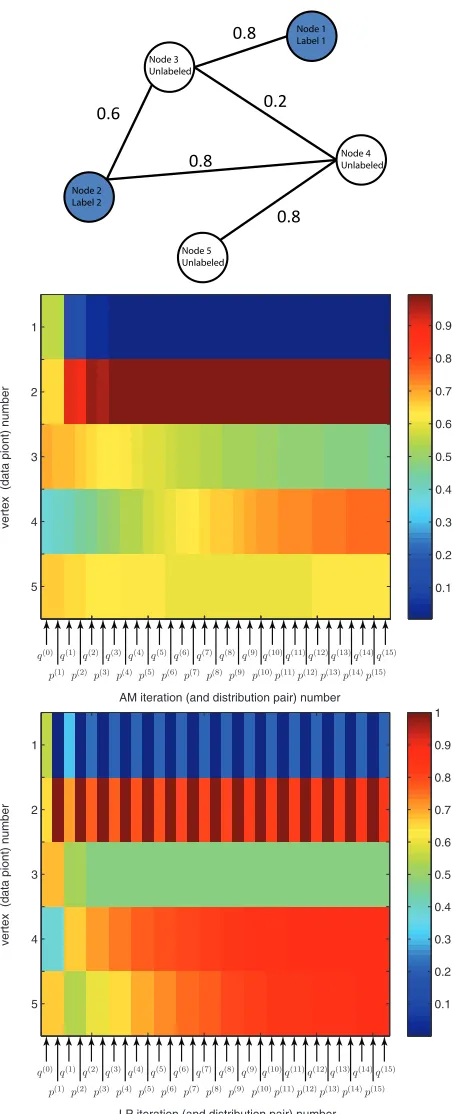
[image:8.612.317.537.255.345.2]To compare the behavior of AM and LP, we ap-plied this form of LP along with AM on a simple 5-node binary-classification SSL graph where two nodes are labeled (node 1 and 2) and the remaining nodes are unlabeled (see Figure 3, top). Since this is binary classification (|Y| = 2), each distributionpi
orqi can be depicted using only a single real
num-ber between 0 and 1 corresponding to the probability that each vertex is class 2 (yes two). We show how both LP and AM evolve starting from exactly the same random starting point q0 (Figure 3, bottom). For each algorithm, the figure shows that both algo-rithms clearly converge. Each alternate iteration of LP is such that the labeled vertices oscillate due to its clamping back to the labeled distribution, but that is not the case for AM. We see, moreover, qualitative differences in the solutions as well – e.g., AM’s so-lution for the pendant node 5 is less confident than is LP’s solution. More empirical comparative analysis between the two algorithms of this sort will appear in future work.
We have proposed a new algorithm for semi-supervised text categorization. Empirical results show that the proposed approach significantly out-performs the state-of-the-art. In addition the pro-posed approach is relatively simple to implement and has guaranteed convergence properties. While in this work, we use relatively simple features to construct the graph, use of more sophisticated fea-tures and/or similarity measures could lead to further improved results.
Acknowledgments
This work was supported by ONR MURI grant N000140510388, by NSF grant IIS-0093430, by the Companions project (IST programme under EC grant IST-FP6-034434), and by a Microsoft Re-search Fellowship.
References
Alexandrescu, A. and Kirchhoff, K. (2007). Data-driven graph construction for semi-supervised graph-based
learnning in nlp. In Proc. of the Human Language
Technologies Conference (HLT-NAACL).
Bekkerman, R., El-Yaniv, R., Tishby, N., and Winter, Y. (2003). Distributional word clusters vs. words for text
categorization. J. Mach. Learn. Res., 3:1183–1208.
0.8
0.6 0.2
0.8
0.8
Node 1 Label 1
Node 2 Label 2
Node 3 Unlabeled
Node 4 Unlabeled
Node 5 Unlabeled
1
2
3
4
5 0.1
0.2 0.3 0.4 0.5 0.6 0.7 0.8 0.9
AM iteration (and distribution pair) number
vertex (data piont) number
q(0)
p(1)
q(1)
p(2)
q(2)
p(3)
q(3)
p(4)
q(4)
p(5)
q(5)
p(6)
q(6)
p(7)
q(7)
p(8)
q(8)
p(9)
q(9)
p(15)
q(15)
p(14)
q(14)
p(13)
q(13)
p(12)
q(12)
p(11)
q(11)
p(10)
q(10)
LP iteration (and distribution pair) number
vertex (data piont) number
1
2
3
4
5 0.1
0.2 0.3 0.4 0.5 0.6 0.7 0.8 0.9 1
q(0)
p(1)
q(1)
p(2)
q(2)
p(3)
q(3)
p(4)
q(4)
p(5)
q(5)
p(6)
q(6)
p(7)
q(7)
p(8)
q(8)
p(9)
q(9)
p(15)
q(15)
p(14)
q(14)
p(13)
q(13)
p(12)
q(12)
p(11)
q(11)
p(10)
[image:9.612.314.541.83.640.2]q(10)
Figure 3: Graph (top), and alternating values ofpn,qn
Belkin, M., Niyogi, P., and Sindhwani, V. (2005). On
manifold regularization. InProc. of the Conference on
Artificial Intelligence and Statistics (AISTATS).
Bengio, Y., Delalleau, O., and Roux, N. L. (2007).
Semi-Supervised Learning, chapter Label Propogation and Quadratic Criterion. MIT Press.
Bertsekas, D. (2004). Nonlinear Programming. Athena
Scientific Publishing.
Blitzer, J. and Zhu, J. (2008). ACL 2008 tutorial on
Semi-Supervised learning. http://ssl-acl08.
wikidot.com/.
Blum, A. and Chawla, S. (2001). Learning from labeled
and unlabeled data using graph mincuts. InProc. 18th
International Conf. on Machine Learning, pages 19– 26. Morgan Kaufmann, San Francisco, CA.
Blum, A. and Mitchell, T. (1998). Combining labeled
and unlabeled data with co-training. In COLT:
Pro-ceedings of the Workshop on Computational Learning Theory.
Chapelle, O., Scholkopf, B., and Zien, A. (2007).
Semi-Supervised Learning. MIT Press.
Corduneanu, A. and Jaakkola, T. (2003). On
informa-tion regularizainforma-tion. InUncertainty in Artificial
Intelli-gence.
Cover, T. M. and Thomas, J. A. (1991). Elements of
In-formation Theory. Wiley Series in Telecommunica-tions. Wiley, New York.
Csiszar, I. and Tusnady, G. (1984). Information
Geome-try and Alternating Minimization Procedures.
Statis-tics and Decisions.
Dumais, S., Platt, J., Heckerman, D., and Sahami, M. (1998). Inductive learning algorithms and
represen-tations for text categorization. InCIKM ’98:
Proceed-ings of the seventh international conference on Infor-mation and knowledge management, New York, NY, USA.
Grandvalet, Y. and Bengio, Y. (2004). Semi-supervised
learning by entropy minimization. In Advances in
Neural Information Processing Systems (NIPS).
Joachims, T. SGT Light. http://sgt.joachims.
org.
Joachims, T. SVM Light. http://svmlight.
joachims.org.
Joachims, T. (1999). Transductive inference for text
clas-sification using support vector machines. In Proc. of
the International Conference on Machine Learning (ICML).
Joachims, T. (2003). Transductive learning via spectral
graph partitioning. InProc. of the International
Con-ference on Machine Learning (ICML).
Lewis, D. et al. (1987). Reuters-21578. http:
//www.daviddlewis.com/resources/
testcollections/reuters21578.
Nigam, K., McCallum, A., Thrun, S., and Mitchell, T. (1998). Learning to classify text from labeled and
un-labeled documents. InAAAI ’98/IAAI ’98:
Proceed-ings of the fifteenth national/tenth conference on Arti-ficial intelligence/Innovative applications of artiArti-ficial intelligence, pages 792–799.
Pearl, J. (1990). Jeffrey’s Rule, Passage of Experience
and Neo-Bayesianism in Knowledge Representation and Defeasible Reasoning. Kluwer Academic Pub-lishers.
Porter, M. (1980). An algorithm for suffix stripping.
Pro-gram, 14(3):130–137.
Raghavan, V., Bollmann, P., and Jung, G. S. (1989). A critical investigation of recall and precision as
mea-sures of retrieval system performance. ACM Trans.
Inf. Syst., 7(3):205–229.
Salton, G. and Buckley, C. (1987). Term weighting ap-proaches in automatic text retrieval. Technical report, Ithaca, NY, USA.
Sindhwani, V., Niyogi, P., and Belkin, M. (2005). Be-yond the point cloud: from transductive to
semi-supervised learning. InProc. of the International
Con-ference on Machine Learning (ICML).
Szummer, M. and Jaakkola, T. (2001). Partially
la-beled classification with Markov random walks. In
Advances in Neural Information Processing Systems, volume 14.
Tsuda, K. (2005). Propagating distributions on a
hyper-graph by dual information regularization. In
Proceed-ings of the 22nd International Conference on Machine Learning.
Wang, J., Jebara, T., and Chang, S.-F. (2008). Graph
transduction via alternating minimization. InProc. of
the International Conference on Machine Learning (ICML).
Yarowsky, D. (1995). Unsupervised word sense
disam-biguation rivaling supervised methods. In
Proceed-ings of the 33rd Annual Meeting of the Association for Computational Linguistics.
Zhu, X. (2005a). Semi-supervised learning literature sur-vey. Technical Report 1530, Computer Sciences, Uni-versity of Wisconsin-Madison.
Zhu, X. (2005b). Semi-Supervised Learning with
Graphs. PhD thesis, Carnegie Mellon University.
Zhu, X. and Ghahramani, Z. (2002). Learning from
labeled and unlabeled data with label propagation. Technical report, Carnegie Mellon University. Zhu, X., Ghahramani, Z., and Lafferty, J. (2003).
Semi-supervised learning using gaussian fields and
har-monic functions. InProc. of the International