Complexity of finding the BLEU-optimal hypothesis in a confusion network
Gregor Leusch and Evgeny Matusov and Hermann Ney RWTH Aachen University, Germany
{leusch,matusov,ney}@cs.rwth-aachen.de
Abstract
Confusion networks are a simple representa-tion of multiple speech recognirepresenta-tion or transla-tion hypotheses in a machine translatransla-tion sys-tem. A typical operation on a confusion net-work is to find the path which minimizes or maximizes a certain evaluation metric. In this article, we show that this problem is gener-ally NP-hard for the popular BLEU metric, as well as for smaller variants of BLEU. This also holds for more complex representations like generic word graphs. In addition, we give an efficient polynomial-time algorithm to cal-culate unigram BLEU on confusion networks, but show that even small generalizations of this data structure render the problem to be NP-hard again.
Since finding the optimal solution is thus not always feasible, we introduce an approximat-ing algorithm based on a multi-stack decoder, which finds a (not necessarily optimal) solu-tion forn-gram BLEU in polynomial time.
1 Introduction
In machine translation (MT), confusion networks (CNs) are commonly used to represent alternative versions of sentences. Typical applications include translation of different speech recognition hypothe-ses (Bertoldi et al., 2007) or system combination (Fiscus, 1997; Matusov et al., 2006).
A typical operation on a given CN is to find the path which minimizes or maximizes a certain eval-uation metric. This operation can be used in ap-plications like Minimum Error Rate Training (Och, 2003), or optimizing system combination as de-scribed by Hillard et al. (2007). Whereas this is easily achievable for simple metrics like the Word Error Rate(WER) as described by Mohri and Riley
(2002), current research in MT uses more sophisti-cated measures, like the BLEU score (Papineni et al., 2001). Zens and Ney (2005) first described this task on general word graphs, and sketched a com-plete algorithm for calculating the maximum BLEU score in a word graph. While they do not give an estimate on the complexity of their algorithm, they note that already a simpler algorithm for calculating the Position independent Error Rate (PER) has an exponential worst-case complexity. The same can be expected for their BLEU algorithm. Dreyer et al (2007) examined a special class of word graphs, namely those that denote constrained reorderings of single sentences. These word graphs have some properties which simplify the calculation; for exam-ple, no edge is labeled with the empty word, and all paths have the same length and end in the same node. Even then, their decoder does not optimize the true BLEU score, but an approximate version which uses a language-model-like unmodified pre-cision. We give a very short introduction to CNs and the BLEU score in Section 2.
In Section 3 we show that finding the best BLEU score is an NP-hard problem, even for a simplified variant of BLEU which only scores unigrams and bigrams. The main reason for this problem to be-come NP-hard is that by looking at bigrams, we al-low for one decision to also influence the folal-lowing decision, which itself can influence the decisions af-ter that. We also show that this also holds for uni-gram BLEU and theposition independent error rate (PER) on a slightly augmented variant of CNs which allows for edges to carry multiple symbols. The con-catenation of symbols corresponds to the interde-pendency of decisions in the case of bigram matches above.
NP-hard problems are quite common in machine
translation; for example, Knight (1999) has shown that even for a simple form of statistical MT mod-els, the decoding problem is NP-complete. More recently, DeNero and Klein (2008) have proven the NP-completeness of the phrase alignment problem.
But even a simple, common procedure as BLEU scoring, which can be performed in linear time on single sentences, becomes a potentially intractable problem as soon as it has to be performed on a slightly more powerful representation, such as con-fusion networks. This rather surprising result is the motivation of this paper.
The problem of finding the best unigram BLEU score in an unaugmented variant of CNs is not NP-complete, as we show in Section 4. We present an algorithm that finds such a unigram BLEU-best path in polynomial time.
An important corollary of this work is that calcu-lating the BLEU-best path on general word graphs is also NP-complete, as CNs are a true subclass of word graphs. It is still desirable to calculate a “good” path in terms of the BLEU score in a CN, even if calculating the best path is infeasible. In Sec-tion 5, we present an algorithm which can calculate “good” solutions for CNs in polynomial time. This algorithm can easily be extended to handle arbitrary word graphs. We assess the algorithm experimen-tally on real-world MT data in Section 6, and draw some conclusions from the results in this article in Section 7.
2 Confusion networks
A confusion network (CN) is a word graph where each edge is labeled with exactly zero or one sym-bol, and each path from the start node to the end node visits each node of the graph in canonical or-der. Usually, we represent unlabeled edges by label-ing them with theempty wordε.
Within this paper, we represent a CN by a list of lists of words{wi,j}, where each wi,j corresponds to a symbol on an edge between nodesiandi+ 1. Apathin this CN can be written as a string of inte-gers,an
1 = a1, . . . , an, such that the path is labeled w1,a1w2,a2. . . wn,an. Note that there can be a differ-ent number of possible words,j, for different posi-tionsi.
2.1 BLEU and variants
The BLEU score, as defined by Papineni et al. (2001), is the modified n-gram precision of a
hy-pothesis, with1 ≤n ≤N, given a set of reference translations R. “Modified precision” here means that for each n-gram, its maximum number of oc-currences within the reference sentences is counted, and only up to that many occurrences in the hypothe-sis are considered to be correct. The geometric mean over the precisions for allnis calculated, and mul-tiplied by abrevity penaltybp. This brevity penalty is1.0if the hypothesis sentence is at least as long as the reference sentence (special cases occur if multi-ple reference sentences with different length exists), and less than1.0otherwise. The exact formulation can be found in the cited paper; for the proofs in our paper it is enough to note that the BLEU score is 1.0 exactly if all n-grams in the hypothesis oc-cur at least that many times in a reference sentence, and if there is a reference sentence which is as long as or shorter than the hypothesis. Assuming that we can always provide a dummy reference sentence shorter than this length, we do not need to regard the brevity penalty in these proofs. Within the fol-lowing proofs of NP-hardness, we will only require confusion networks (and word graphs) which do not contain empty words, and where all paths from the start node to the end node have the same length.
Usually, in the definition of the BLEU score,N is set to4; within this article we denote this metric as 4BLEU. We can also restrict the calculations to un-igrams only, which would be 1BLEU, or to bun-igrams and unigrams, which we denote as 2BLEU.
Similar to the 1BLEU metric is the Position in-dependent Error Rate PER (Tillmann et al., 1997), which counts the number of substitutions, insertions, and deletions that have to be performed on the uni-gram counts to have the hypothesis counts match the reference counts. Unlike 1BLEU, for PER to be op-timal (here, 0.0), the reference counts must match the candidate counts exactly.
Given a CN {wi,j} and a set of reference sen-tencesR, we define the optimization problem
Definition 1 (CN-2BLEU-OPTIMIZE) Among all pathsaI1 through the CN, what is the path with the highest 2BLEU score?
Related to this is the decision problem
Definition 2 (CN-2BLEU-DECIDE) Among all paths aI1 through the CN, is there a path with a 2BLEU score of1.0?
3 CN-2BLEU-DECIDE is NP-complete
We now show that CN-2BLEU-DECIDE is NP-complete. It is obvious that the problem is in NP: Given a pathaI
1, which is polynomial in size to the
problem, we can decide in polynomial time whether
aI1 is a solution to the problem – namely by calcu-lating the BLEU score. We now show that there is a problem known to be NP-complete which can be polynomially reduced to CN-2BLEU-DECIDE. For our proof, we choose 3SAT.
3.1 3SAT
Consider the following problem:
Definition 3 (3SAT) Let X = {x1, . . . , xn}
be a set of Boolean variables, let F =
Vk
i=1(Li,1∨Li,2∨Li,3) be a Boolean formula,
where each literalLi,j is either a variablex or its negate x. Is there a assignment β : X → {0,1} such that β |= F? In other words, if we replace eachxinFbyβ(x), and eachxby1−β(x), does Fbecome true?
It has been shown by Karp (1972) that 3SAT is NP-complete. Consequently, if for another problem in NP there is polynomial-size and -time reduction of an arbitrary instance of 3SAT to an instance of this new problem, this new problem is also NP-complete.
3.2 Reduction of 3SAT to CN-2BLEU-DECIDE
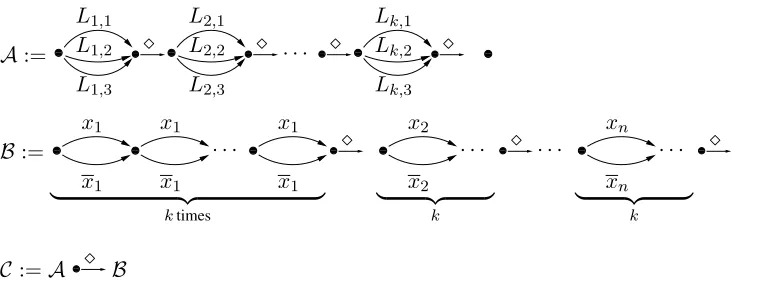
LetF be a Boolean formula in 3CNF, and let kbe its size, as in Definition 3. We will now reduce it to a corresponding CN-2BLEU-DECIDE problem. This means that we create an alphabetΣ, a confusion net-workC, and a set of reference sentencesR, such that there is a path throughCwith a BLEU score of1.0
exactly ifF is solvable:
Create an alphabet Σ based on F as Σ :=
{x1, . . . , xn} ∪ {x1, . . . , xn} ∪ {}. Here, thexi andxi symbols will correspond to the variable with the same name or their negate, respectively, whereas will serve as an “isolator symbol”, to avoid un-wanted bigram matches or mismatches between sep-arate parts of the constructed CN or sentences.
Consider the CNCfrom Figure 1.
Consider the following set of reference sentences:
R:={ (x1)k(x2)k. . .(xn)k (x1)k(x2)k. . .(xn)k,
(x1)k(x1)k. . .(xn)k(xn)k()k+n}
where(x)kdenotesksubsequent occurrences ofx. Clearly, both C and R are of polynomial size in n
andk, and can be constructed in polynomial time. Then,
There is an assignmentβsuch thatβ|=F ⇔
There is a pathaI1throughCsuch that
BLEU(aI1, R) = 1.0.
Proof: “⇒”
Letβ be an assignment under whichF becomes true. Create a path aI1 as follows: Within A, for each set of edgesLi,1, Li,2, Li,3, choose the path
through an x where β(x) = 1, or through an x
whereβ(x) = 0. Note that there must be such an
x, because otherwise the clause Li,1 ∨Li,2 ∨Li,3
would not be true underβ. WithinB, select the path always throughxi ifβ(xi) = 0, and throughxi if β(xi) = 1.
Then,aI
1 consists of, for eachi,
• At mostkoccurrences of bothxiandxi
• At mostk occurrences of each of the bigrams
xi,xi,xi,xi,xixi, andxixi
• No other bigram than those listed above.
For all of these unigram and bigram counts, there is a reference sentence inRwhich contains at least as many of those unigrams/bigrams as the path. Thus, the unigram and bigram precision ofaI1 is1.0. In ad-dition, there is always a reference sentence whose length is shorter than that ofaI1, such that the brevity penalty is also 1.0. As a result, BLEU(aI
1, R) =
1.0.
“⇐”
Let aI1 be a path through C such that
BLEU(aI1, R) = 1.0. Because there is no bi-gramxixiorxixiinR, we can assume that for each xi, either only xi edges, or only xi edges appear in the B part of aI1, each at most k times. As no unigramxi andxi appears more thanktimes inR, we can assume that, if the xi edges are passed in B, then only thexiedges are passed inA, and vice versa. Now, create an assignmentβas follows:
β:=
(
0 ifxiedges are passed inB
1 otherwise
A:=000000000 000 111 111 111 111
L1,1 L1,2 L1,3
000 000 000 000 111 111 111 111 000 000 000 000 111 111 111 111
L2,1 L2,2 L2,3
000 000 000 000 111 111 111 111 · · ·
000 000 000 000 111 111 111 111 000 000 000 000 111 111 111 111
Lk,1 Lk,2 Lk,3
000 000 000 000 111 111 111 111 000 000 000 000 111 111 111 111
B:=000000000 000 111 111 111 111 x1 x1 000 000 000 000 111 111 111 111 x1 x1
· · ·000000000 000 111 111 111 111 x1 x1
| {z }
ktimes 000 000 000 000 111 111 111 111 000 000 000 000 111 111 111 111 x2 x2 · · ·
| {z }
k 000 000 000 000 111 111 111 111 · · ·
000 000 000 000 111 111 111 111 xn xn · · ·
| {z }
k 000 000 000 000 111 111 111 111
[image:4.612.72.453.54.197.2]C:=A000000000 000 111 111 111 111 B
Figure 1: CN constructed from a 3SAT formulaF. Cis the concatenation of the left partA, and the right pathB, separated by an isolating.
0. At least one of the edgesLi,j associated with the literals of this clause must have been passed byaK1
inA. This literal, though, can not have been passed in B. As a consequence, β(Li,j) = 1. But this means that Li,1 ∨Li,2 ∨Li,3 = 1 ;
contra-diction.
Because CN-2BLEU-DECIDE is in NP, and we can reduce an NP-complete problem (3SAT) in poly-nomial time to a CN-2BLEU-DECIDE problem, this means that CN-2BLEU-DECIDE is NP-complete.
3.3 CN-4BLEU-DECIDE
It is straightforward to modify the construction above to create an equivalent CN-4BLEU-DECIDE problem instead: Replace each occurrence of the isolating symbol inA,B,C, R by three consecu-tive isolating symbols . Then, everything said about unigrams still holds, and bi-, tri- and four-grams are handled equivalently: Previous unigram matches on correspond to uni-, bi-, and trigram matches on,,. Bigram matches onx corre-spond to bi-, tri-, and fourgram matches onx,x,
x, and similar holds for bigram matchesx,x, x. Unigram matches x, x, and bigram matches
xxetc. stay the same. Consequently, CN-4BLEU-DECIDE is also an NP-complete problem.
3.4 CN*-1BLEU-DECIDE
Is it possible to get rid of the necessity for bi-gram counts in this proof? One possibility might be to look at slightly more powerful graph structures, CN*. In these graphs, each edge can be labeled by arbitrarily many symbols (instead of just zero or
one). Then, consider a CN* graphC0 := A 000 000 000 000 111 111 111 111
B0,
B0 :=000000 000 000 111 111 111 111
(x1)k
(x1)k 000 000 000 000 111 111 111 111 000 000 000 000 111 111 111 111 x1 x1 ε
| {z }
ktimes
· · ·000000 000 000 111 111 111 111
(xn)k
(xn)k
000 000 000 000 111 111 111 111 · · ·
Figure 2: Right part of a CN* constructed from a 3SAT formulaF.
withB0 as in Figure 2. With
R0 :={(x1)k(x1)k. . .(xn)k(xn)k()k} we can again assume that either xi or xi ap-pears k times in the B0-part of a path aK
1 with
1BLEU(aK
1 , R0) = 1.0, and that for every solution βtoF there is a corresponding pathaK1 throughC0 and vice versa. In this construction, we also have exact matches of the counts, so we can also use PER in the decision problem.
While CN* are generally not word graphs by themselves due to the multiple symbols on edges, it is straightforward to create an equivalent word graph from a given CN*, as demonstrated in Fig-ure 3. Consequently, deciding unigram BLEU and unigram PER are NP-complete problems for general word graphs as well.
4 Solving CN-1BLEU-DECIDE in polynomial time
[image:4.612.316.535.262.320.2]CN*: · · ·000000 000 000 111 111 111 111
(x1)k
(x1)k 000 000 000 000 111 111 111 111 · · ·
;
WG: · · · 000000000 111 111 111
x1 x1
00 00 00 11 11 11
00 00 00 00 11 11 11 11
x1 x1
· · · 000000111111 00 00 00 00 11 11 11 11
x1 x1
| {z }
ktimes
000 000 000 000 111 111 111 111 · · ·
Figure 3: Construction of a word graph from a CN* as in
B0.
matter at all, can be decided in polynomial time using the following algorithm, which disregards a brevity penalty for the sake of simplicity:
Given a vocabularyX, a CN{wi,j}, and a set of reference sentences R together with their unigram BLEU countsc(x) :X →NandC:=P
x∈Xc(x),
1. Remove all parts fromwwhere there is an edge labeled with the empty wordε. This step will always increase unigram precision, and can not hurt any highern-gram precision here, because
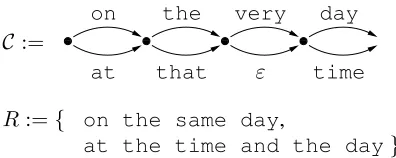
n = 1. In the example in Figure 4, the edges labeledveryandεrespectively are affected in this step.
2. Create nodes A0 := {1, . . . , n}, one for each
node with edges in the CN. In the example in Figure 5, the three leftmost column heads cor-respond to these nodes.
3. Create nodesB :={x.j|x∈X,1≤j≤c(x)}. In other words, create a unique node for each “running” word in R – e.g. if the first and second reference sentence containxonce each, and the third reference containsxtwice, create exactlyx.1andx.2. In Figure 5, those are the row heads to the right.
4. Fill A with empty nodes to match the total length:A:=A0 ∪ {ε.j|1≤j≤C−n}.
Ifn > C, the BLEU precision can not be1.0. The five rightmost columns in Figure 5 corre-spond to those.
5. Create edges
E:={(i, wi,j.k)|1≤i≤n, allj,1≤c(wi,j)} ∪ {(i, ε.j)|1≤i≤n,allj}. These edges are denoted as◦or•in Figure 5.
C:= 000000 000 000 111 111 111 111
on
at 000 000 000 000 111 111 111 111
the
that 000 000 000 000 111 111 111 111
very
ε 000 000 000 000 111 111 111 111
day
time
R:={ on the same day,
[image:5.612.312.510.55.134.2]at the time and the day}
Figure 4: Example for CN-1BLEU-DECIDE.
1 2 3 ε.1 ε.2 ε.3 ε.4 ε.5
• ◦ ◦ ◦ ◦ ◦ on
• ◦ ◦ ◦ ◦ ◦ the.1
◦ • ◦ ◦ ◦ ◦ the.2
◦ • ◦ ◦ ◦ same
• ◦ ◦ ◦ ◦ ◦ day
◦ ◦ ◦ • ◦ ◦ at
◦ ◦ ◦ ◦ • ◦ time
[image:5.612.73.302.69.187.2]◦ ◦ ◦ ◦ • and
Figure 5: Bipartite graph constructed to find the optimal 1BLEU path in Figure 4. One possible maximum bipar-tite matching is marked with•.
6. Find the maximum bipartite matching M be-tweenAandB givenE. Figure 5 shows such a matching with•.
7. If all nodes in A and B are covered by M, then 1BLEU({wi,j}, R) = 1.0. The words that are matched toA0 then form the solution path
through{wi,j}.
Figure 4 gives an example of a CN and a set of ref-erences R, for which the best 1BLEU path can be constructed by the algorithm above. The bipartite graph constructed in Step 1 to Step 4 for this exam-ple, given in matrix form, can be found in Figure 5.
Such a solution to Step 6, if found, corresponds exactly to a path through the confusion network with 1BLEU=1.0, and vice versa: for each position1≤
i≤n, the matched word corresponds to the word that is selected for the position of the path; “surplus” counts are matched withεs.
Step 6 can be performed in polynomial time (Hopcroft and Karp, 1973)O((C+n)5/2); all other
steps in linear timeO(C+n). Consequently, CN-1BLEU can be decided in polynomial timeO((C+
[image:5.612.327.526.206.325.2]can be calculated inO((C+n)5/2).
It should be noted that the only alterations in the hypothesis length, and as a result the only alterations in the brevity penalty, will come from Step 1. Con-sequently, the brevity penalty can be taken into ac-count as follows: Consider that there areM nodes with an empty edge in {wi,j}. Instead of remov-ing them in Step 1, keep them in, but for each
1 ≤ m ≤ M, run through steps 2 to 6, but add
mnodesε.1, . . . , ε.mtoBin Step 3, and add corre-sponding edges to these nodes toEin Step 5. After each iteration (which leads to a constant hypothesis length), calculate precision and brevity penalty. Se-lect the best product of precision and brevity penalty in the end. The overall time complexity now is in
M·O((C+n)5/2).
A PER score can be calculated in a similar fash-ion.
5 Finding approximating solutions for CN-4BLEU in polynomial time
Knowing that the problem of finding the BLEU-best path is an NP-complete problem is an unsatisfactory answer in practice – in many cases, having a good, but not necessarily optimum path is preferable to having no good path at all.
A simple approach would be to walk the CN from the start node to the end node, keeping track ofn -grams visited so far, and choosing the word next which maximizes the n-gram precision up to this word. Track is kept by keeping n-gram count vec-tors for the hypothesis path and the reference sen-tences, and update those in each step.
The main problem with this approach is that of-ten the local optimum is suboptimal on the global scale, for example if a word occurs on a later posi-tion again.
Zens and Ney (2005) on the other hand propose to keep all n-gram count vectors instead, and only recombine path hypotheses with identical count vec-tors. As they suspect, the search space can become exponentially large.
In this paper, we suggest a compromise between these two extremes, namely keeping active a suffi-ciently large number of “path hypotheses” in terms of n-gram precision, instead of only the first best, or of all. But even then, edges with empty words pose a problem, as stepping along an empty edge will never decrease the precision of the local path. In certain cases, steps along empty edges may affect
then-gram precision for higher n-grams. But this will only take effect after the next non-empty step, it does not influence the local decision in a node. Step-ping along a non-empty edge will often decrease the local precision, though. As a consequence, a simple algorithm will prefer paths with shorter hypotheses, which leads to a suboptimal total BLEU score, be-cause of the brevity penalty. One can counter this problem for example by using a brevity penalty al-ready during the search. But this is problematic as well, because it is difficult to define a proper partial reference length in this case.
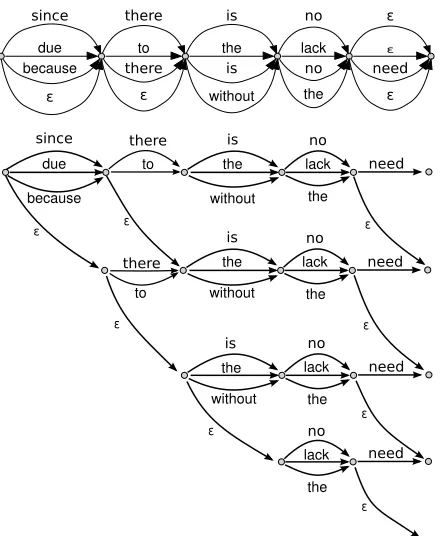
The approach we propose is to compare only par-tial path hypotheses with the same number of empty edges, and ending in the same position in the confu-sion network. This idea is illustrated in Figure 6: We compare only the partial precision of path hypothe-ses ending in the same node. Due to the simple na-ture of this search graph, it can easily be traversed in a left-to-right, top-to-bottom manner. With regard to a node currently being expanded, only the next node in the same row, and the corresponding columns in the next row need to be kept active. When imple-menting this algorithm, Hypotheses should be com-pared on the modified BLEUS precision by Lin and Och (2004) because the original BLEU precision equals zero as long as there are no higher n-gram matches in the partial hypotheses, which renders meaningful comparison hard or impossible.
In the rightmost column, all path hypotheses within a node have the same hypothesis length. Con-sequently, we can select the hypothesis with the best (brevity-penalized) BLEU score by multiplying the appropriate brevity penalty to the precision of the best path ending in each of these nodes. If we al-ways expand all possible path hypotheses within the nodes, and basically run a full search, we will al-ways find the BLEU-best path this way. From the proof above, it follows that the number of path hy-pothesis we would have to keep can become expo-nentially large. Fortunately, if a “good” solution is good enough, we do not have to keep all possible path hypotheses, but only theSbest ones for a given constantS, or those with a precision not worse than
c times the precision of the best hypothesis within the node. Assuming that adding and removing an element to/from a size-limited stack of sizeS takes timeO(logS), that we allow at mostEempty edges in a solution, and that there arejedges in each of the
Figure 6: Principle of the multi-stack decoder used to find a path with a good BLEU score. The first row shows the original confusion network, the following rows show the search graph. Duplicate edges were removed, but no word was considered “unknown”.
O(E·n·j·SlogS).
To reduce redundant duplicated path hypotheses, and by this to speed up the algorithm and reduce the risk that good path hypotheses are pruned, the confu-sion network should besimplifiedbefore the search, as shown in Figure 6:
1. Remove all words in the CN which do not ap-pear in any reference sentence, if there at least one “known” non-empty word at the same po-sition. If there is no such “known” word, re-place them all by a single token denoting the “unknown word”.
2. Remove all duplicate edges in a position, that is, if there are two or more edges carrying the same label in one position, remove all but one for them.
[image:7.612.76.298.53.321.2]These two steps will keep at least one of the BLEU-best paths intact. But they can remove the average branching factor (j) of the CN significantly, which leads to a significantly lower number of duplicate path hypotheses during the search.
Table 1: Statistics of the (Chinese–)English MT corpora used for the experiments
NIST NIST
2003 2006
number of systems 4 4
number of ref. 4 4 per sent.
sentences 919 249
system length 28.4 33.2 words∗
ref. length 27.5 34.2 words∗
best path 24.4 33.9 words∗
CN length 40.7 39.5 nodes∗
best single system 29.3 52.5 BLEU
30.5 51.6 BLEUS∗
∗
average per sentence
Our algorithm can easily be extended to handle ar-bitrary word graphs instead of confusion networks. In this case, each “row” in Figure 6 will reflect the structure of the word graph instead of the “linear” structure of the CN.
While this algorithm searches for the best path for a single sentence only, a common task is to find the best BLEU score over a whole test set – which can mean suboptimal BLEU scores for in-dividual sentences. This adds an additional com-binatorial problem over the sentences to the actual decoding process. Both Zens and Ney (2005) and Dreyer et al (2007) use a greedy approach here; the latter estimated the impact of this to be insignifi-cant in random sampling experiments. In our exper-iments, we used the per-sentence BLEUS score as (greedy) decision criterion, as this is also the prun-ing criterion. One possibility to adapt this approach to Zens’s/Dreyer’s greedy approach for system-level BLEU scores might be to initializen-gram counts and hypothesis length not to zero at the beginning of each sentence, but to those of the corpus so far. But as this diverts from our goal to optimize the sentence-level scores, we have not implemented it so far.
6 Experimental assessment of the algorithm
● ●
● ● ● ●● ● ● ● ● ● ● ● ●
5 10 15 20
0.32
0.34
0.36
0.38
0.40
# path hyps
BLEU, BLEUS
●
[image:8.612.327.518.74.272.2]sys−BLEU avg. seg−BLEUS avg. seg−BLEU
Figure 7: Average of the sentence-wise BLEU and BLEUS score and the system-wide BLEU score versus the number of path hypotheses kept per node during the search. NIST MT03 corpus.
the NIST 2003 and 2006 Chinese–English evalu-ation campaigns, as available from the Linguistic Data Consortium (LDC). The hypotheses of the best single system served as skeleton, those of the three remaining systems were reordered and aligned to the skeleton hypothesis. This corpus is described in Ta-ble 1. Figures 7 and 8 show the measured BLEU scores in three different definitions, versus the max-imum number of path hypotheses that are kept in each node of the search graph. Shown are the av-erage sentence-wise BLEUS score, which is what the algorithm actually optimizes, for comparison the average sentence-wise BLEU score, and the total document-wise BLEU score.
All scores increase with increasing number of re-tained hypotheses, but stabilize around a total of 15 hypotheses per node. The difference over a greedy approach, which corresponds to a maximum of one hypothesis per node if we leave out the separation by path length, is quite significant. No further improve-ments can be expected for a higher number of hy-potheses, as experiments up to 100 hypotheses show.
7 Conclusions
In this paper, we showed that deciding whether a given CN contains a path with a BLEU score of 1.0 is an NP-complete problem forn-gram lengths≥2.
● ●
● ● ● ● ● ● ● ● ● ● ● ● ● ●
5 10 15 20 25
0.65
0.67
0.69
0.71
# path hyps
BLEU, BLEUS
●
sys−BLEU avg. seg−BLEUS avg. seg−BLEU
Figure 8: Average of the sentence-wise BLEU and BLEUS score and the system-wide BLEU score versus the number of path hypotheses kept per node during the search. NIST MT06 corpus.
The problem is also NP-complete if we only look at unigram BLEU, but allow for CNs where edges may contain multiple symbols, or for arbitrary word graphs. As a corollary, any proposed algorithm to find the path with an optimal BLEU score in a CN, even more in an arbitrary word graph, which runs in worst case polynomial time can only deliver an approximation1.
We gave an efficient polynomial time algorithm for the simplest variant, namely deciding on a uni-gram BLEU score for a CN. This algorithm can eas-ily be modified to decide on the PER score as well, or to calculate an actual unigram BLEU score for the hypothesis CN.
Comparing these results, we conclude that the ability to take bi- or higher n-grams into account, be it in the scoring (as in 2BLEU), or in the graph structure (as in CN*), is the key to render the prob-lem NP-hard. Doing so creates long-range depen-dencies, which oppose local decisions.
We also gave an efficient approximating algo-rithm for higher-order BLEU scores. This algoalgo-rithm is based on a multi-stack decoder, taking into ac-count the empty arcs within a path. Experimental results on real-world data show that our method is indeed able to find paths with a significantly better
1
[image:8.612.85.279.75.271.2]BLEU score than that of a greedy search. The re-sulting BLEUS score stabilizes already on a quite restricted search space, showing that despite the proven NP-hardness of the exact problem, our al-gorithm can give useful approximations in reason-able time. It is yet an open problem in how far the problems of finding the best paths regarding a sentence-level BLEU score, and regarding a system-level BLEU score correlate. Our experiments here suggest a good correspondence.
8 Acknowledgments
This paper is based upon work supported by the Defense Advanced Research Projects Agency (DARPA) under Contract No. HR0011-06-C-0023. The proofs and algorithms in this paper emerged while the first author was visiting researcher at the Interactive Language Technologies Group of the National Research Council (NRC) of Canada, Gatineau. The author wishes to thank NRC and Aachen University for the opportunity to jointly work on this project.
References
Nicola Bertoldi, Richard Zens, and Marcello Federico. 2007. Speech translation by confusion network de-coding. InIEEE International Conference on Acous-tics, Speech, and Signal Processing, pages 1297–1300, Honululu, HI, USA, April.
John DeNero and Dan Klein. 2008. The complexity of phrase alignment problems. InHuman Language Technologies 2008: The Conference of the Association for Computational Linguistics, Short Papers, pages 25–28, Columbus, Ohio, June. Association for Com-putational Linguistics.
Markus Dreyer, Keith Hall, and Sanjeev Khudanpur. 2007. Comparing Reordering Constraints for SMT Using Efficient BLEU Oracle Computation. InAMTA Workshop on Syntax and Structure in Statistical Trans-lation (SSST) at the Annual Conference of the North American Chapter of the Association for Compu-tational Linguistics (NAACL-HLT), pages 103–110, Rochester, NY, USA, April.
Jonathan G. Fiscus. 1997. A post-processing system to yield reduced word error rates: Recogniser output vot-ing error reduction (ROVER). In Proceedings 1997 IEEE Workshop on Automatic Speech Recognition and Understanding, pages 347–352, Santa Barbara, CA.
Dustin Hillard, Bj¨orn Hoffmeister, Mari Ostendorf, Ralf Schl¨uter, and Hermann Ney. 2007. iROVER:
Improv-ing system combination with classification. InHuman Language Technologies 2007: The Conference of the North American Chapter of the Association for Com-putational Linguistics; Companion Volume, Short Pa-pers, pages 65–68, Rochester, New York, April.
John E. Hopcroft and Richard M. Karp. 1973. An n5/2 algorithm for maximum matchings in bipartite graphs. SIAM Journal on Computing, 2(4):225–231.
Richard M. Karp. 1972. Reducibility among combina-torial problems. In R. E. Miller and J. W. Thatcher, editors,Complexity of Computer Computations, pages 85–103. Plenum Press.
Kevin Knight. 1999. Decoding complexity in word-replacement translation models. Computational Lin-guistics, 25(4):607–615, December.
Chin-Yew Lin and Franz Josef Och. 2004. Orange: a method for evaluation automatic evaluation metrics for machine translation. InProc. COLING 2004, pages 501–507, Geneva, Switzerland, August.
Evgeny Matusov, Nicola Ueffing, and Hermann Ney. 2006. Computing consensus translation from multiple machine translation systems using enhanced hypothe-ses alignment. InConference of the European Chap-ter of the Association for Computational Linguistics, pages 33–40, Trento, Italy, April.
Mehryar Mohri and Michael Riley. 2002. An efficient algorithm for the n-best-strings problem. InProc. of the 7th Int. Conf. on Spoken Language Processing (IC-SLP’02), pages 1313–1316, Denver, CO, September.
Franz Josef Och. 2003. Minimum error rate training in statistical machine translation. InProc. of the 41th Annual Meeting of the Association for Computational Linguistics (ACL), pages 160–167, Sapporo, Japan, July.
Kishore A. Papineni, Salim Roukos, Todd Ward, and Wei-Jing Zhu. 2001. Bleu: a method for auto-matic evaluation of machine translation. Technical Re-port RC22176 (W0109-022), IBM Research Division, Thomas J. Watson Research Center, September.
Christoph Tillmann, Stephan Vogel, Hermann Ney, Alex Zubiaga, and Hassan Sawaf. 1997. Accelerated DP based search for statistical translation. In Euro-pean Conf. on Speech Communication and Technol-ogy, pages 2667–2670, Rhodes, Greece, September.