Sentiment Retrieval using Generative Models
Koji Eguchi
National Institute of Informatics Tokyo 101-8430, Japan
Victor Lavrenko
Department of Computer Science University of Massachusetts
Amherst, MA 01003, USA
Abstract
Ranking documents or sentences accord-ing to both topic and sentiment relevance should serve a critical function in helping users when topics and sentiment polari-ties of the targeted text are not explicitly given, as is often the case on the web. In this paper, we propose several sentiment information retrieval models in the frame-work of probabilistic language models, as-suming that a user both inputs query terms expressing a certain topic and also speci-fies a sentiment polarity of interest in some manner. We combine sentiment relevance models and topic relevance models with model parameters estimated from training data, considering the topic dependence of the sentiment. Our experiments prove that our models are effective.
1 Introduction
The recent rapid expansion of access to informa-tion has significantly increased the demands on re-trieval or classification of sentiment information from a large amount of textual data. The field of sentiment classification has recently received con-siderable attention, where the polarities of senti-ment, such as positive or negative, were identified from unstructured text (Shanahan et al., 2005). A number of studies have investigated sentiment classification at document level, e.g., (Pang et al., 2002; Dave et al., 2003), and at sentence level, e.g., (Hu and Liu, 2004; Kim and Hovy, 2004; Nigam and Hurst, 2005); however, the accuracy is still less than desirable. Therefore, ranking ac-cording to the likelihood of containing sentiment information is expected to serve a crucial func-tion in helping users. We believe that our work
is the first attempt at sentiment retrieval that aims at finding sentences containing information with a specific sentiment polarity on a certain topic.
Intuitively, the expression of sentiment in text is dependent on the topic. For example, a nega-tive view for some voting event may be expressed using ‘flaw’, while a negative view for some politi-cian may be expressed using ‘reckless’. Moreover, sentiment polarities are also dependent on topics or domains. For example, the adjective ‘unpre-dictable’ may have a negative orientation in an au-tomotive review, in a phrase such as ‘unpredictable steering’, but it could have a positive orientation in a movie review, in a phrase such as ‘unpredictable plot’, as mentioned in (Turney, 2002) in the con-text of his sentiment word detection.
We propose sentiment retrieval models in the framework of generative language modeling, not only assuming query terms expressing a certain topic, but also assuming that the polarity of sen-timent interest is specified by the user in some manner, where the topic dependence of the sen-timent is considered. To the best of our knowl-edge, there have been no other studies on a re-trieval model unifying both topic and sentiment, and further, there have been no other studies on sentiment retrieval. The sentiment information of-ten appears as local in a document, and therefore focusing on finer levels, i.e., sentence or passage levels rather than document level, is crucial. We thus experiment on sentiment retrieval at the sen-tence level in this paper.
The rest of this paper is structured as follows. Section 2 introduces the work related to this study. Section 3 describes a generative model of sen-timent, which is proposed here as a theoretical framework for our work. Section 4 describes the task definition and our sentiment retrieval model.
Section 5 explains the data we used for our experi-ments, and gives our experimental results. Section
6 concludes the paper.
2 Related Work
Some efforts for the TREC Novelty Track were related to our work. Although some of the topics used in the Novelty Track in 2003 and 2004 (Sobo-roff and Harman, 2003; Sobo(Sobo-roff, 2004) were re-lated to opinions, most of the efforts were fo-cused on topic, such as studies using term dis-tribution within each sentence, e.g., (Allan et al., 2003; Losada, 2005; Murdock and Croft, 2005). Amongst the participants in the TREC Novelty Track, only (Kim et al., 2004) proposed a method specialized to opinion-bearing sentence retrieval, by making use of lists of words with positive or negative polarities. They aimed to find opinions on a given topic but did not distinguish or did not care about sentiment polarities that should be rep-resented in some sentences (hereafter, opinion re-trieval). We focus on finding positive views or negative views according to a given topic and sen-timent of interest (hereafter, sensen-timent retrieval). Our work is the first work on sentiment retrieval, to the best of our knowledge.
In the context of sentiment classification, some researchers have conducted studies on the topic dependence of sentiment polarities. (Nasukawa and Yi, 2003) and (Yi et al., 2003) extracted pos-itive or negative expressions on a given product name using handmade lexicons. (Engstr¨om, 2004) studied how the topic dependence influences the accuracy of sentiment classification and attempted to reduce the influence to improve the accuracy. (Wilson et al., 2005) investigated how context in-fluences sentiment polarity at the phrase level in a corpus, beginning with a predefined list of words with polarities. Their focus on the phenomena of topic dependence of sentiment can be shared with our work; however, their work is not directly re-lated to ours, because we focus on a different task, sentiment retrieval, where different approaches are required.
3 A Generative Model of Sentiment
In this section we will provide a formal underpin-ning for our approach to sentiment retrieval. The approach is based on the generative paradigm: we describe a statistical process that could be viewed, hypothetically, as a source of every statement of
interest to our system. We stress that this genera-tive process is to be treated as purely hypothetical; the process is only intended to reflect those aspects of human discourse that are pertinent to the prob-lem of retrieving affectively appropriate and topic-relevant texts in response to a query posed by our user.
Before giving a formal specification of our model, we will provide a high-level overview of the main ideas. We are trying to model a col-lection of natural-language statements, some of which are relevant to a user’s query. In our ex-periments, these statements are individual sen-tences, but the model can be applied to textual chunks of any length. We assume that the con-tent of an individual statement can be modeled independently of all other statements in the col-lection. Each statement consists of some topic-bearing and some sentiment-topic-bearing words. We assume that the topic-bearing words represent ex-changeable samples from some underlying topic language model. Exchangeability means that the relative order of the words is irrelevant, but the words are not independent of each other—the idea often stated as a bag-of-words assumption. Sim-ilarly, sentiment-bearing words are viewed as an order-invariant ‘bag’, sampled from the underly-ing sentiment language model. We will explicitly model dependency between the topic and senti-ment language models, and will demonstrate that treating them independently leads to sub-optimal retrieval performance. When a sentiment polarity value is observed for a given statement, we will treat it as a ternary variable influencing the topic and sentiment language models.
We represent a user’s query as just another state-ment, consisting of topic and sentiment parts, sub-ject to all the independence assumptions stated above. We will use the query to estimate the topic and sentiment language models that are represen-tative of the user’s interests. Following (Lavrenko and Croft, 2001), we will use the term relevance models to describe these models, and will use them to rank statements in order of their relevance to the query.
3.1 Definitions
We start by providing a set of definitions that will be used in the remainder of this section. The task of our model is to generate a collection of state-ments w
1
::: wn. A statement w
wordsw i1
:::w
ini, drawn from a common vocabu-laryV. We introduce a binary variableb
ij
2fS;Tg as an indicator of whether the word in thejth po-sition of theith statement will be a topic word or a sentiment word. For our purposes, b
ij is either provided by a human annotator (manual annota-tion), or determined heuristically (automatic an-notation).
The sentiment polarityx
i for a given statement is a discrete random variable with three outcomes:
f 1;0;+1g, representing negative, neutral and positive polarity values, respectively. As a matter of convenience we will often denote a statement as a triplefw
s i ;w t i ;x i
g, wherew s
i contains the sen-timent words andw
t i
contains the topic words. As we mentioned above, the user’s query is treated as just another statement. It will be denoted as a triple fq
s ;q
t ;q
x
g, corresponding to sentiment words, topic keywords, and the desired polarity value. We will use p to denote a unigram lan-guage model, i.e., a function that assigns a number
p(v)2[0;1℄to every wordvin our vocabularyV, such that
v
p(v)=1. The set of all possible un-igram language models is the probability simplex
IP. Similarly, p
x will denote a distribution over the three possible polarity values, and IP
x is the corresponding ternary probability simplex. We de-fine :IPIPIP
x
![0;1℄to be a measure func-tion that assigns a probability (p
1 ;p
2 ;p
x ) to a pair of language modelsp
1and p
2together with a polarity modelpx.
3.2 Generative model
Using the definitions presented above, and assum-ing that ()is given, we hypothesize that a new statement w
i containing words w
i1 ::: w
im with sentiment polarityx
i can be generated according to the following mechanism.
1. Drawp t ;p sand p xfrom (;;). 2. Samplex
ifrom a polarity distribution p
x (). 3. For each positionj=1::: m:
(a) ifb ij
=T: draww ij from
p t
(); (b) ifb
ij
=S: draww ij from
p s
().
The probability of observing the new statement
w i1
::: w
imunder this mechanism is given by:
X pt;ps;px (p t ;p s ;p x )p x (x i ) m Y j=1 ( p t (w ij
) ifb ij =T p s (w ij ) otherwise (1) The summation in equation (1) goes over all pos-sible pairs of language modelsp
t
;ps, but we can
avoid integration by specifying a mass function
() that assigns nonzero probabilities to a finite subset of points in IPIPIPx. We accomplish this by using a nonparametric estimate for(), the details of which are provided below.
3.2.1 A nonparametric generative mass function
We use a nonparametric estimate for (;;), which makes our generative model similar to kernel-based density estimators or Parzen-window classifiers (Silverman, 1986). The primary dif-ference is that our model operates over discrete events (strings of words), and accordingly the mass function is defined over the space of distribu-tions, rather than directly over the data points. Our estimate relies on a collection of paired observa-tionsC=fw
t i ;w s i ;x i
:i=1::ng, which represent statements for which we know which words are topic words(w
t i
), and which are sentiment words (w
s i
). Each of these observations corresponds to a unique pointp
ti ;p
si ;p
xiin the space of paired distributions IPIPIPx, defined by the follow-ing coordinates: p ti (v) = t #(v;w t i )=#(w t i
)+(1 t ) tv p si (v) = s #(v;w s i )=#(w s i
)+(1 s ) sv p xi (x) = x 1 x=x i +(1 x ): (2)
Here,#(v;w t i
)represents the number of times the wordvwas observed in the topic part of statement
i, the length of which is denoted by#(w t i
). tv stands for the relative frequency ofv in the topic part of the collection. The same definitions ap-ply to the sentiment parameters#(v;w
s i
),#(w s i ) andsv. The Boolean indicator function1
yreturns one when the predicatey is true and zero other-wise. Metaparameters
t,
s and
x specify the amount of Dirichlet smoothing (Zhai and Lafferty, 2001) applied to the topic, sentiment and polarity estimates respectively; values for these parameters are determined empirically.
We define (p t
;p s
;p x
) to have mass 1 n
when its argument p
t ;p
s ;p
x corresponds to some ob-servationp
ti ;p
si
;pxi, and zero otherwise:
(p t ;p s ;p x )= 1 n n X i=1 1 p t =p ti 1 p s =p si 1 p x =p xi : (3) Equation (3) maintains empirical dependencies between the topic language modelp
prob-ability mass only to pairs of models that actually co-occur in our observations.
3.2.2 Limitations of the model
Our model represents each statement w i as a bag of words, or more formally an order-invariant sequence. This representation is often confused with word independence, which is a much stronger assumption. The generative model defined by equation (1) ignores the relative ordering of the words, but it does allow arbitrarily strong un-ordered dependencies among them. To illustrate, consider the probability of observing the words ‘unpredictable’ and ‘plot’ in the same statement. Suppose we set
t ;
s
=1 in equation (2), reduc-ing the effects of smoothreduc-ing. It should be evi-dent that P(unpredictable,plot) will be non-zero only when the two words actually co-occur in the training data. By carefully selecting the smoothing parameters, the model can preserve dependencies between topic and sentiment words, and is quite capable of distinguishing the positive sentiment of ‘unpredictable plot’ from the negative sentiment of ‘unpredictable steering’. On the other hand, the model does ignore the ordering of the words, so it will not be able to differentiate the negative phrase ‘gone from good to bad’ from its exact opposite. Furthermore, our model is not well suited for mod-eling adjacency effects: the phrase ‘unpredictable plot’ is treated in the same way as two separate words, ‘unpredictable’ and ‘plot’, co-occurring in the same sentence.
3.3 Using the model for retrieval
The generative model presented above can be ap-plied to sentiment retrieval in the following fash-ion. We start with a collection of statementsCand a queryfq
s ;q
t ;q
x
gsupplied by the user. We use the machinery outlined in Section 3.2 to estimate the topic and sentiment relevance models corre-sponding to the user’s information need, and then determine which statements in our collection most closely correspond to these models of relevance. The topic relevance modelR
tand sentiment rele-vance modelR
s are estimated as follows. We as-sume that our queryq
s ;q
t ;q
x
is a random sample from a distribution defined by equation (1), and then for each word v we estimate the likelihood thatvwould be observed if we sampled one more
topic or sentiment word:
R t
(v)= P(q
s ;q
t Æv;q
x )
P(q s
;q t
;q x
) ;R
s (v)=
P(q s
Æv;q t
;q x
)
P(q s
;q t
;q x
) : (4) Both the numerator and denominator are com-puted according to equation (1), with the mass function()given by equations (3) and (2). We use the notationqÆvto denote appending wordv to the stringq. Estimation is done over the train-ing corpus, which may or may not include numeric values of sentiment polarity.1 Once we have esti-mates for the topic and sentiment relevance mod-els, we can rank testing statementswby their sim-ilarity to R
t and R
s. We rank statements using a variation of cross-entropy, which was proposed by (Zhai, 2002):
X
v R
t
(v)logp t
(v)+(1 ) X
v R
s
(v)logp s
(v): (5) Here the summations extend over all words v in the vocabulary, R
t and R
s are given by equa-tion (4), whilep
tand p
sare computed according to equation (2). A weighting parameterallows us to change the balance of topic and sentiment in the final ranking formula; its value is selected empirically.
4 Sentiment Retrieval Task
4.1 Task definition
We define two variations of the sentiment retrieval task. In one, the user supplies us with a numeric value for the desired polarity q
x
. In the other, the user supplies a set of seed wordsq
s
, reflect-ing the desired sentiment. The first task requires us to have polarity observationsx
i in our training data, while the second does not.
Task with training data:
Input: (1) a set of topic keywordsq t
and (2) a sentiment specificationq
x
2f 1;1g. In this case we assume q
s
to be the empty string.
Output: a ranked list of topic-relevant and sentiment-relevant sentences from the test data.
Task with seed words:
Input: (1) a set of topic keywordsq t
and (2) a set of sentiment seed wordsq
s
. In this case our model ignoresq
x andx
i.
1When the training corpus does not contain numeric po-larity valuesx
i, we assume (p
t ;p
s ;p
x )=(p
t ;p
s ) and
forcep x
(x i
Output: a ranked list of topic-relevant and sentiment-relevant sentences from the test data.
In the first task, we split our corpus into three parts: (i) the training set, which was used for es-timating the relevance modelsR
s and
Rt; (ii) the development set, which was used for tuning the model parameters
t,
sand
; and (iii) the testing set, from which we retrieved sentences in response to the query. In the second task, we split the corpus into two parts: (i) the training set, which was used for tuning the model parameters; and (ii) the test-ing set, which was used for constructtest-ing R
s and R
t and from which we retrieved sentences in re-sponse to queries.2 The testing set was identical in both tasks. Note that the sentiment relevance modelR
scan be constructed in a topic-dependent fashion for both tasks.
4.2 Variations of the retrieval model
slm: the retrieval model as described in
Sec-tion 3.3.
lmt: the standard language modeling
ap-proach (Ponte and Croft, 1998; Song and Croft, 1999) on the topic keywordsq
t for the topic part of the textw
t .
lms: the standard language modeling approach
on the sentiment keywords q s
for the senti-ment part of the textw
s .
base: the weighted linear combination of lmt
and lms.
rmt: only the topic relevance model was used
for ranking usingq t
and forw t
.3
rms: only the sentiment relevance model was
used for ranking usingq s
and forw s
.
rmt-base: the slm model with=1, ignoring the sentiment relevance model.
rms-base: the slm model with=0, ignoring the topic relevance model.
2
Because the training set was used for tuning the model parameters, no development set was required for this task.
3
When we use the automatic annotation that is described in Section 5.2.2, we use the whole text instead of the topic part of the text, for the reasons given in that section. This treatment is applied to the base, rmt-base, rms-base, rmt-rms,
rmt-slm and slm models that are described in this section for
using the automatic annotation. However, we distinguish the
lmt and rmt models using the topic part of the text and the lmtf and rmtf models, as baselines, using the whole text,
re-spectively, even in the experiments using the automatic anno-tation.
rmt-rms: the rmt and rms models are treated
independently.
rmt-slm: the rmt and rms-base models are
combined.
lmtf: the standard language modeling
ap-proach usingq t
for the nonsplit text, as base-line.
rmtf: the conventional relevance model was
used for ranking usingq t
for the nonsplit text, as baseline.
lmtsf: the standard language modeling
ap-proach using both q t
and q s
for the nonsplit text, for reference.
rmtsf: the conventional relevance model was
used for ranking using bothq t
andq s
for the nonsplit text, for reference.
Note that the relevance models are constructed using training data for the training-based task, but are constructed using test data for the seed-based task, as mentioned in Section 4.1. Therefore, the base model is only used for the training data, not for the test data, in the training-based task, while it can be performed for the test data in the case of the seed-based task. Moreover, the lms, lmtsf and rmtsf models are based on the premise of using seed words to specify sentiments, and so they are only applicable to the seed-based task.
In the models described in this subsec-tion,
t and
s in equation (2) were set to Dirichlet estimates (Zhai and Lafferty, 2001),
#(w t i
)=(#(w t i
)+ t
)and#(w s i
)=(#(w s i
)+ s
) for the relevance modelsR
t and R
s, respectively, in equation (4), and were fixed at 0.9 for ranking as in equation (5) for our experiments in Section 5. Here,
tand
swere selected empirically accord-ing to the tasks described in Section 4.1. The model parameter in equation (5) was also se-lected empirically in the same manner. The num-ber of ranked documents used in the relevance models R
t and
Rs, in equation (4), was selected empirically in the same manner as above; how-ever, we fixed the number of terms used in the rel-evance models as 1000.
5 Experiments
5.1 Data set and evaluation measure
re-trieval models. We summarize this data set as fol-lows.
This corpus contains news articles collected from 187 different foreign and U.S. news sources from June 2001 to May 2002. The cor-pus contains 535 documents, a total of 11,114 sentences.
The majority of the articles are on 10 differ-ent topics, which are labeled at documdiffer-ent level, but, in addition to these, a number of additional articles were randomly selected from a larger corpus of 270,000 documents.
Each article was manually annotated using an annotation scheme for opinions and other pri-vate states at phrase level. We only used the annotations for sentiments that included some attributes such as polarity and strength.
In this data set, the topic relevance for the 10 topics is known at the document level, but un-known at the sentence level. We assumed that all the sentences in a relevant document could be con-sidered relevant to the topic.4
This data set was annotated with sentiment po-larities at the phrase level, but not explicitly an-notated at the sentence level. Therefore, we pro-vided sentiment polarities at the sentence level to prepare training data and data for evaluation. We set the sentence-level sentiment polarity equal to the polarity with the highest strength in each sen-tence.5
Queries were expressed using the title of one of the 10 topics and specified as positive or negative. Thus, we had 20 types of queries for our experi-ments. Because the supposed relevance judgments in this setting are imperfect at sentence level, we used bpref (Buckley and Voorhees, 2004), in both the training and testing phases, as it is known to be tolerant of imperfect judgments. Bpref uses bi-nary relevance judgments to define the preference relation (i.e., any relevant document is preferred over any nonrelevant document for a given topic), while other measures, such as mean average pre-cision, depend only on the ranks of the relevant documents.
4This is a strong assumption to make and may not be true in all cases. A larger, more complete data set is required to perform a more detailed analysis, which is left as future work.
5
We disregarded ‘neutral’ and ‘both’ if other polarities ap-peared. We can also set the sentence-level sentiment polarity according to the presence of polarity in each sentence, but we did not consider this setting here.
5.2 Extracting sentiment expressions 5.2.1 Using manual annotation
Because the MPQA corpus was annotated with phrase-level sentiments, we can use these anno-tations to split a sentence into a topic part w
t and a sentiment part w
s
. The Krovetz stem-mer (Krovetz, 1993) was applied to the topic part, the sentiment part and to the query terms6and, for the retrieval experiments in Sections 5.3 and 5.4, a total of 418 stopwords from a standard stopword list were removed when they appeared.
5.2.2 Using automatic annotation
In automatic extraction of sentiment expres-sions in this study, we detected sentiment-bearing words using lists of words with established polar-ities. At this stage, topic dependence was not con-sidered; however, at the stage of sentiment model-ing, the topic dependence can be reflected, as de-scribed in Sections 3 and 4.
We first prepared a list of words indicating sen-timents. We used Hatzivassiloglou and McKe-own’s sentiment word list (Hatzivassiloglou and McKeown, 1997), which consists of 657 positive and 679 negative adjectives, and The General In-quirer (Stone et al., 1966), which contains 1621 positive and 1989 negative words.7 By merging these lists, we obtained 1947 positive and 2348 negative words. After stemming these words in the same manner as in Section 5.2.1, we were left with 1667 positive and 2129 negative words, which we will use hereafter in this paper.
The sentiment polarities are sometimes sensi-tive to the structural information, for instance, a negation expression reverses the following sentiment polarity. To handle negation, ev-ery sentiment-bearing word was rewritten with a ‘NEG’ suffix, such as ‘good NEG’, if an odd num-ber of negation expressions was found within the five preceding words in the sentence. To detect negation expressions, we used a predefined nega-tion expression list. This neganega-tion handling is sim-ilar to that used in (Das and Chen, 2001; Pang et al., 2002). We extracted sentiment-bearing expres-sions using the list of words with established
po-6We used the topic labels attached to the MPQA corpus as the topic query termsq
t
in all the experiments in Sections 5.3 and 5.4.
7
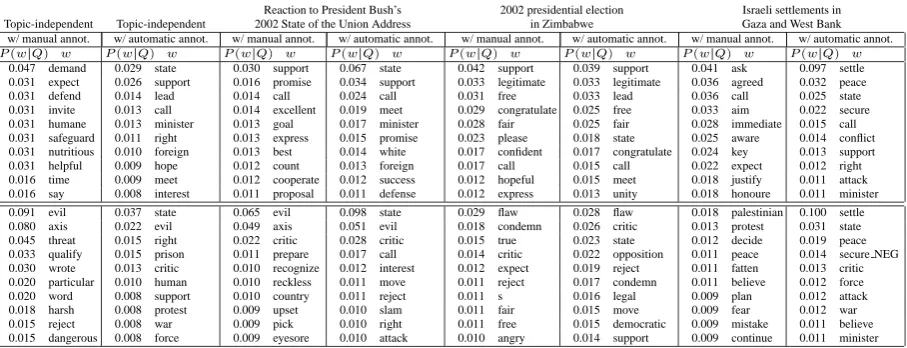
Table 1: Sample probabilities from the sentiment relevance models
Reaction to President Bush’s 2002 presidential election Israeli settlements in Topic-independent Topic-independent 2002 State of the Union Address in Zimbabwe Gaza and West Bank
w/ manual annot. w/ automatic annot. w/ manual annot. w/ automatic annot. w/ manual annot. w/ automatic annot. w/ manual annot. w/ automatic annot.
P(wjQ) w P(wjQ) w P(wjQ) w P(wjQ) w P(wjQ) w P(wjQ) w P(wjQ) w P(wjQ) w
0.047 demand 0.029 state 0.030 support 0.067 state 0.042 support 0.039 support 0.041 ask 0.097 settle 0.031 expect 0.026 support 0.016 promise 0.034 support 0.033 legitimate 0.033 legitimate 0.036 agreed 0.032 peace 0.031 defend 0.014 lead 0.014 call 0.024 call 0.031 free 0.033 lead 0.036 call 0.025 state 0.031 invite 0.013 call 0.014 excellent 0.019 meet 0.029 congratulate 0.025 free 0.033 aim 0.022 secure 0.031 humane 0.013 minister 0.013 goal 0.017 minister 0.028 fair 0.025 fair 0.028 immediate 0.015 call 0.031 safeguard 0.011 right 0.013 express 0.015 promise 0.023 please 0.018 state 0.025 aware 0.014 conflict 0.031 nutritious 0.010 foreign 0.013 best 0.014 white 0.017 confident 0.017 congratulate 0.024 key 0.013 support 0.031 helpful 0.009 hope 0.012 count 0.013 foreign 0.017 call 0.015 call 0.022 expect 0.012 right 0.016 time 0.009 meet 0.012 cooperate 0.012 success 0.012 hopeful 0.015 meet 0.018 justify 0.011 attack 0.016 say 0.008 interest 0.011 proposal 0.011 defense 0.012 express 0.013 unity 0.018 honoure 0.011 minister 0.091 evil 0.037 state 0.065 evil 0.098 state 0.029 flaw 0.028 flaw 0.018 palestinian 0.100 settle 0.080 axis 0.022 evil 0.049 axis 0.051 evil 0.018 condemn 0.026 critic 0.013 protest 0.031 state 0.045 threat 0.015 right 0.022 critic 0.028 critic 0.015 true 0.023 state 0.012 decide 0.019 peace 0.033 qualify 0.015 prison 0.011 prepare 0.017 call 0.014 critic 0.022 opposition 0.011 peace 0.014 secure NEG 0.030 wrote 0.013 critic 0.010 recognize 0.012 interest 0.012 expect 0.019 reject 0.011 fatten 0.013 critic 0.020 particular 0.010 human 0.010 reckless 0.011 move 0.011 reject 0.017 condemn 0.011 believe 0.012 force 0.020 word 0.008 support 0.010 country 0.011 reject 0.011 s 0.016 legal 0.009 plan 0.012 attack 0.018 harsh 0.008 protest 0.009 upset 0.010 slam 0.011 fair 0.015 move 0.009 fear 0.012 war 0.015 reject 0.008 war 0.009 pick 0.010 right 0.011 free 0.015 democratic 0.009 mistake 0.011 believe 0.015 dangerous 0.008 force 0.009 eyesore 0.010 attack 0.010 angry 0.014 support 0.009 continue 0.011 minister
The upper and lower tables correspond to positive and negative sentiments, respectively. The topic-independent sentiment relevance models (in the left two columns) correspond to rms, and the topic-dependent models (in the rest of the columns) correspond to rms-base, which is used for slm.
larities, considering negation, as described above. Note that we used the list of words with sentiments to extract sentiment expressions, but we did not use the predefined sentiments to model sentiment relevance.
Some expressions are sometimes used to ex-press a certain topic, such as settlements in “Is-raeli settlements in Gaza and West Bank”; but at other times are used to express a certain sentiment, such as the same word in “All parties signed court-mediated compromise settlements”. Therefore, we will use whole sentences to model topic relevance, while we will use the automatically extracted sen-timent expressions to model sensen-timent relevance, in Sections 5.3 and 5.4.
5.3 Experiments on training-based task
We conducted experiments on the training-based task described in Section 4.1, using either man-ual annotation as described in Section 5.2.1 or au-tomatic annotation as described in Section 5.2.2.
Table 1 contrasts sample probabilities from
topic-independent sentiment relevance models and those from topic-dependent sentiment relevance models. In the left two columns of this table, two sets of sample probabilities using the topic-independent model are presented. One was computed from the manual annotation and the other was computed from the automatic annotation. In the remain-ing columns, samples usremain-ing the topic-dependent model are shown according to the three topics: (1) “reaction to President Bush’s 2002 State of the Union Address”, (2) “2002 presidential
elec-tion in Zimbabwe”, and (3) “Israeli settlements in Gaza and West Bank”. A number of posi-tive expressions appeared topic dependent, such as ‘promise’ (stemmed from ‘promising’ or not) and ‘support’ for Topic (1), ‘legitimate’ and ‘con-gratulate’ for Topic (2) and ‘justify’ and ‘se-cure’ for Topic (3); while negative expressions ap-peared topic-dependent, such as ‘critic’ (stemmed from ‘criticism’) and ‘eyesore’ for Topic (1), ‘flaw’ and ‘condemn’ for Topic (2) and ‘mistake’ and ‘secure NEG’ (i.e., ‘secure’ was negated) for Topic (3).
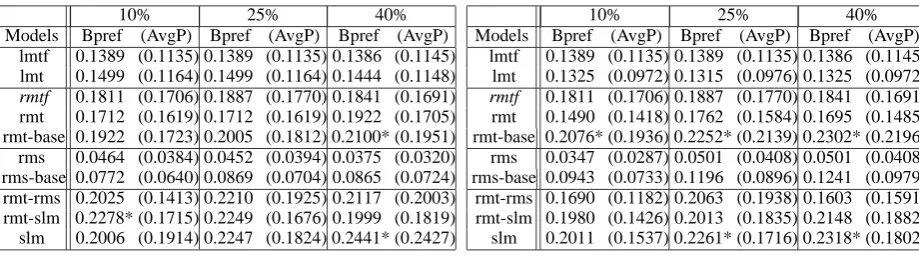
Table 2: Experimental results of training-based task using manually annotated data
10% 25% 40%
Models Bpref (AvgP) Bpref (AvgP) Bpref (AvgP) lmtf 0.1389 (0.1135) 0.1389 (0.1135) 0.1386 (0.1145) lmt 0.1499 (0.1164) 0.1499 (0.1164) 0.1444 (0.1148)
rmtf 0.1811 (0.1706) 0.1887 (0.1770) 0.1841 (0.1691) rmt 0.1712 (0.1619) 0.1712 (0.1619) 0.1922 (0.1705) rmt-base 0.1922 (0.1723) 0.2005 (0.1812) 0.2100* (0.1951) rms 0.0464 (0.0384) 0.0452 (0.0394) 0.0375 (0.0320) rms-base 0.0772 (0.0640) 0.0869 (0.0704) 0.0865 (0.0724) rmt-rms 0.2025 (0.1413) 0.2210 (0.1925) 0.2117 (0.2003) rmt-slm 0.2278* (0.1715) 0.2249 (0.1676) 0.1999 (0.1819) slm 0.2006 (0.1914) 0.2247 (0.1824) 0.2441* (0.2427)
‘*’ indicates statistically significant improve-ment over rmtf wherep < 0:05with the
two-sided Wilcoxon signed-rank test.
We performed retrieval experiments in the steps described in Section 4.1. For this purpose, we split the data into three parts: (i) x% as the training data, (ii) (50 x)% as the evaluation data, and (iii)50% as the test data.
The test results of training-based task using manually annotated data and automatically anno-tated data are shown in Tables 2 and 3, respec-tively. The scores were computed according to the bpref evaluation measure (Buckley and Voorhees, 2004), as mentioned in Section 5.1. In addition to the bpref, mean average precision values are presented as ‘AvgP’ in the tables, for reference.8 In these tables, the top row indicates the percent-ages of the training data x. It turned out that in all our experiments the appropriate fraction of training data was 40%. In this setting, our slm model worked 76.1% better than the query like-lihood model and 32.6% better than the conven-tional relevance model, when using manual anno-tation, and both improvements were statistically significant according to the Wilcoxon signed-rank test.9 When using automatic annotation, the slm model worked 67.2% better than the query like-lihood model and 25.9% better than the conven-tional relevance model, where both improvements were statistically significant. The rmt-base model also worked well with automatic annotation.
5.4 Experiments on seed-based task
For experiments on the seed-based task that was described in Section 4.1, we used three groups of
8As mentioned in Section 5.1, the bpref is more appro-priate for the evaluation of our experiments than the mean average precision.
9Significance tests involved only 20 queries, which makes it difficult to achieve statistical significance.
Table 3: Experimental results of training-based task using automatically annotated data
10% 25% 40%
Models Bpref (AvgP) Bpref (AvgP) Bpref (AvgP) lmtf 0.1389 (0.1135) 0.1389 (0.1135) 0.1386 (0.1145)
lmt 0.1325 (0.0972) 0.1315 (0.0976) 0.1325 (0.0972)
rmtf 0.1811 (0.1706) 0.1887 (0.1770) 0.1841 (0.1691) rmt 0.1490 (0.1418) 0.1762 (0.1584) 0.1695 (0.1485) rmt-base 0.2076* (0.1936) 0.2252* (0.2139) 0.2302* (0.2196) rms 0.0347 (0.0287) 0.0501 (0.0408) 0.0501 (0.0408) rms-base 0.0943 (0.0733) 0.1196 (0.0896) 0.1241 (0.0979) rmt-rms 0.1690 (0.1182) 0.2063 (0.1938) 0.1603 (0.1591) rmt-slm 0.1980 (0.1426) 0.2013 (0.1835) 0.2148 (0.1882) slm 0.2011 (0.1537) 0.2261* (0.1716) 0.2318* (0.1802)
‘*’ indicates statistically significant improve-ment over rmtf wherep < 0:05with the
two-sided Wilcoxon signed-rank test.
seed words:KAM,TURandOR G. Each group consists of a positive word setq
s (+)
and a negative word setq
s (
), as follows:
KAM: q s (+)
=fgoodg, andq s ( )
=fbadg.
TUR: q s (+)
=fgood, nice, excellent, positive, fortunate, correct, superiorg, andq
s ( )
=fbad, nasty, poor, negative, unfortunate, wrong, infe-riorg.
OR G: q s (+)
= fsupport, demand, promise, want, hopeg, andq
s ( )
=frefuse, accuse, crit-icism, fear, rejectg.
KAM and TUR were used in (Kamps and Marx, 2002) and (Turney and Littman, 2003), respectively. We constructed OR G considering sentiment-bearing words that may frequently ap-pear in newspaper articles.
We experimented with the seed-based task, making use of each of these seed word groups, in the steps described in Section 4.1. For this pur-pose, we split the data into two parts: (i) 50% as the estimation data and (ii) 50% as the test data.
The test results using manually annotated data and automatically annotated data are shown in
Ta-bles 4 and 5, respectively, where the scores were
computed according to the bpref evaluation mea-sure. Mean average precision values are also pre-sented as ‘AvgP’ in the tables, for reference.
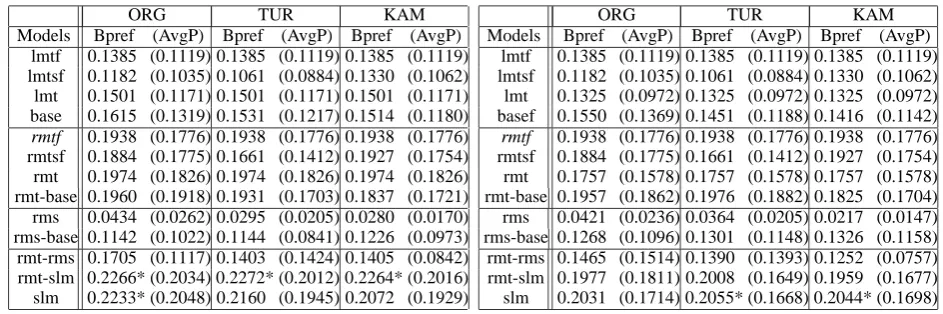
Table 4: Experimental results of seed-based task using manually annotated data
ORG TUR KAM
Models Bpref (AvgP) Bpref (AvgP) Bpref (AvgP) lmtf 0.1385 (0.1119) 0.1385 (0.1119) 0.1385 (0.1119) lmtsf 0.1182 (0.1035) 0.1061 (0.0884) 0.1330 (0.1062) lmt 0.1501 (0.1171) 0.1501 (0.1171) 0.1501 (0.1171) base 0.1615 (0.1319) 0.1531 (0.1217) 0.1514 (0.1180)
rmtf 0.1938 (0.1776) 0.1938 (0.1776) 0.1938 (0.1776) rmtsf 0.1884 (0.1775) 0.1661 (0.1412) 0.1927 (0.1754) rmt 0.1974 (0.1826) 0.1974 (0.1826) 0.1974 (0.1826) rmt-base 0.1960 (0.1918) 0.1931 (0.1703) 0.1837 (0.1721) rms 0.0434 (0.0262) 0.0295 (0.0205) 0.0280 (0.0170) rms-base 0.1142 (0.1022) 0.1144 (0.0841) 0.1226 (0.0973) rmt-rms 0.1705 (0.1117) 0.1403 (0.1424) 0.1405 (0.0842) rmt-slm 0.2266* (0.2034) 0.2272* (0.2012) 0.2264* (0.2016) slm 0.2233* (0.2048) 0.2160 (0.1945) 0.2072 (0.1929)
‘*’ indicates statistically significant improve-ment over rmtf wherep < 0:05with the
two-sided Wilcoxon signed-rank test.
using the other seed word groups, the slm model worked 49–56% better than the query likelihood model and 6–12% better than the conventional relevance model; however, the latter improve-ment was not statistically significant. The rmt-slm model also worked well with manual annotation.
When using automatic annotation, the slm model worked 46–48% better than the query like-lihood model and 4–6% better than the conven-tional relevance model, as shown in Table 5. The improvements over the conventional relevance model were statistically significant only when us-ingTURorKAM; however, the score when us-ingOR Gis almost comparable with the others.
6 Conclusion
We propose sentiment retrieval models in the framework of probabilistic generative models, not only assuming that a user inputs query terms ex-pressing a certain topic, but also assuming that the user specifies a sentiment polarity of interest ei-ther as a sentiment specificationq
x
2f 1;1gor as a set of sentiment seed wordsq
s
. For this pur-pose, we combine sentiment relevance models and topic relevance models, considering the topic de-pendence of the sentiment. In our experiments, our model worked significantly better than stan-dard language modeling approaches, both when usingq
x andq
s
, and with both manual and auto-matic annotation of the fragments expressing sen-timents in text. With q
s
and automatic annota-tion, our model still worked significantly better than the standard approaches; however, the
per-Table 5: Experimental results of seed-based task using automatically annotated data
ORG TUR KAM
Models Bpref (AvgP) Bpref (AvgP) Bpref (AvgP) lmtf 0.1385 (0.1119) 0.1385 (0.1119) 0.1385 (0.1119) lmtsf 0.1182 (0.1035) 0.1061 (0.0884) 0.1330 (0.1062) lmt 0.1325 (0.0972) 0.1325 (0.0972) 0.1325 (0.0972) basef 0.1550 (0.1369) 0.1451 (0.1188) 0.1416 (0.1142)
rmtf 0.1938 (0.1776) 0.1938 (0.1776) 0.1938 (0.1776) rmtsf 0.1884 (0.1775) 0.1661 (0.1412) 0.1927 (0.1754) rmt 0.1757 (0.1578) 0.1757 (0.1578) 0.1757 (0.1578) rmt-base 0.1957 (0.1862) 0.1976 (0.1882) 0.1825 (0.1704) rms 0.0421 (0.0236) 0.0364 (0.0205) 0.0217 (0.0147) rms-base 0.1268 (0.1096) 0.1301 (0.1148) 0.1326 (0.1158) rmt-rms 0.1465 (0.1514) 0.1390 (0.1393) 0.1252 (0.0757) rmt-slm 0.1977 (0.1811) 0.2008 (0.1649) 0.1959 (0.1677) slm 0.2031 (0.1714) 0.2055* (0.1668) 0.2044* (0.1698)
‘*’ indicates statistically significant improve-ment over rmtf wherep < 0:05with the
two-sided Wilcoxon signed-rank test.
formance did not reach that achieved with other settings. We believe the performance can be im-proved with larger-scale data.
We experimented to find sentences that were relevant to a given topic and were appropriate to a given sentiment; however, our models can also be applied to textual chunks of any length, such as at document level or passage level. Our model can be easily extended to opinion retrieval, if the opin-ion retrieval is defined as retrieving sentences or documents that contain either positive or negative sentiments. This issue is worth pursuing in future work. Approaches considering polarity strength or continuous values for the polarity specification, rather than usingf 1;1g, can also be considered in future work.
Acknowledgments
We thank James Allan, W. Bruce Croft and the anony-mous reviewers for valuable discussions and comments. This work was supported in part by the Overseas Research Schol-ars Program and the Grant-in-Aid for Scientific Research (#17680011) from the Ministry of Education, Culture, Sports, Science and Technology, Japan, in part by the Telecommu-nications Advancement Foundation, Japan, in part by the Center for Intelligent Information Retrieval, and in part by the Defense Advanced Research Projects Agency (DARPA), USA under contract number HR0011-06-C-0023. Any opin-ions, findings and conclusions or recommendations expressed in this material are those of the author(s) and do not necessar-ily reflect those of the sponsor.
References
James Allan, Courtney Wade, and Alvaro Bolivar. 2003. Re-trieval and novelty detection at the sentence level. In Proc.
of the 26th Annual International ACM SIGIR Conference,
Chris Buckley and Ellen M. Voorhees. 2004. Retrieval eval-uation with incomplete information. In Proc. of the 27th
Annual International ACM SIGIR Conference, pages 25–
32, Sheffield, United Kingdom.
Sanjiv R. Das and Mike Y. Chen. 2001. Yahoo! for Ama-zon: Sentiment parsing from small talk on the Web. In
Proc. of the 2001 European Finance Association Annual Conference, Barcelona, Spain.
Kushal Dave, Steve Lawrence, and David M. Pennock. 2003. Mining the peanut gallery: Opinion extraction and seman-tic classification of product reviews. In Proc. of the 12th
International Conference on the World Wide Web, pages
519–528, Budapest, Hungary.
Charlotta Engstr¨om. 2004. Topic dependence in sentiment classification. Master’s thesis, University of Cambridge. Vasileios Hatzivassiloglou and Kathleen R. McKeown. 1997.
Predicting the semantic orientation of adjectives. In Proc.
of the 35th Annual Meeting of the Association for Compu-tational Linguistics, pages 174–181, Madrid, Spain.
Minqing Hu and Bing Liu. 2004. Mining and summariz-ing customer reviews. In Proc. of the 10th ACM SIGKDD
International Conference on Knowledge Discovery and Data Mining, pages 168–177, Seattle, USA.
Jaap Kamps and Maarten Marx. 2002. Words with attitude. In Proc. of the 1st International Conference on Global
WordNet, pages 332–341, Mysore, India.
Soo-Min Kim and Eduard Hovy. 2004. Determining the sen-timent of opinions. In Proc. of the 20th International
Con-ference on Computational Linguistics, Geneva, Czech
Re-public.
Soo-Min Kim, Deepak Ravichandran, and Eduard Hovy. 2004. ISI Novelty Track system for TREC 2004. In Proc.
of the 13th Text Retrieval Conference. NIST Special
Pub-lication 500-261.
Robert Krovetz. 1993. Viewing morphology as an inference process. In Proc. of the 16th Annual International ACM
SIGIR Conference, pages 191–202, Pittsburgh,
Pennsylva-nia, USA.
Victor Lavrenko and W. Bruce Croft. 2001. Relevance-based language models. In Proc. of the 24th Annual
Interna-tional ACM-SIGIR Conference, pages 120–127, New
Or-leans, Louisiana, USA.
David E. Losada. 2005. Language modeling for sentence retrieval: A comparison between multiple-Bernoulli and multinomial models. In Information Retrieval and Theory
Workshop, Glasgow, United Kingdom.
Vanessa Murdock and W. Bruce Croft. 2005. A translation model for sentence retrieval. In Proc. of HLT/EMNLP
2005, pages 684–691, Vancouver, Canada.
Tetsuya Nasukawa and Jeonghee Yi. 2003. Sentiment anal-ysis: Capturing favorability using natural language pro-cessing. In Proc. of the 2nd International Conference on
Knowledge Capture, pages 70–77, Sanibel Island, Florida,
USA.
Kamal Nigam and Matthew Hurst, 2005. Computing
Atti-tude and Affect in Text: Theory and Applications, chapter
Towards a Robust Metric of Opinion. Springer.
Bo Pang, Lillian Lee, and Shivakumar Vaithyanathan. 2002. Thumbs up? Sentiment classification using machine learning techniques. In Proc. of the 2002 Conference
on Empirical Methods in Natural Language Processing,
pages 79–86, Philadelphia, Pennsylvania, USA.
Jay M. Ponte and W. Bruce Croft. 1998. A language mod-eling approach to information retrieval. In Proc. of the
21st Annual International ACM-SIGIR Conference, pages
275–281, Melbourne, Australia.
James Shanahan, Yan Qu, and Janyce Wiebe, editors. 2005.
Computing attitude and affect in text. Springer.
B. W. Silverman, 1986. Density Estimation for Statistics and
Data Analysis, pages 75–94. CRC Press.
Ian Soboroff and Donna Harman. 2003. Overview of the TREC 2003 Novelty Track. In Proc. of the 12th Text
Re-trieval Conference, pages 38–53. NIST Special
Publica-tion 500-255.
Ian Soboroff. 2004. Overview of the TREC 2004 Novelty Track. In Proc. of the 13th Text Retrieval Conference. NIST Special Publication 500-261.
Fei Song and W. Bruce Croft. 1999. A general language model for information retrieval. In Proc. of the 8th
Inter-national Conference on Information and Knowledge Man-agement, pages 316–321, Kansas City, Missouri, USA.
Philip J. Stone, Dexter C. Dunphy, Marshall S. Smith, and Daniel M. Ogilvie. 1966. The General Inquirer: A
Com-puter Approach to Content Analysis. MIT Press.
Peter D. Turney and Michael L. Littman. 2003. Measur-ing praise and criticism: Inference of semantic orientation from association. ACM Transactions on Information
Sys-tems, 21(4):315–346.
Peter D. Turney. 2002. Thumbs up or thumbs down? Se-mantic orientation applied to unsupervised classification of reviews. In Proc. of the 40th Annual Meeting of the
As-sociation for Computational Linguistics, pages 417–424,
Philadelphia, Pennsylvania, USA.
Janyce Wiebe, Theresa Wilson, and Claire Cardie. 2005. Annotating expressions of opinions and emotions in lan-guage. Language Resources and Evaluation, 1(2):0–0. Theresa Wilson, Janyce Wiebe, and Paul Hoffmann. 2005.
Recognizing contextual polarity in phrase-level sentiment analysis. In Proc. of HLT/EMNLP 2005, Vancouver, Canada.
Jeonghee Yi, Tetsuya Nasukawa, Razvan Bunescu, and Wayne Niblack. 2003. Sentiment analyzer: Extracting sentiments about a given topic using natural language pro-cessing techniques. In Proc. of the 3rd IEEE International
Conference on Data Mining, pages 427– 434, Melbourne,
Florida, USA.
Chengxiang Zhai and John Lafferty. 2001. A study of smoothing methods for language models applied to ad hoc information retrieval. In Proc. of the 24th Annual
Interna-tional ACM-SIGIR Conference, pages 334–342, New
Or-leans, Louisiana, USA.
Chengxiang Zhai. 2002. Risk Minimization and Language
Modeling in Text Retrieval. PhD dissertation, Carnegie