Studying the History of Ideas Using Topic Models
David Hall
Symbolic Systems Stanford University Stanford, CA 94305, USA
Daniel Jurafsky
Linguistics Stanford University Stanford, CA 94305, USA
Christopher D. Manning
Computer Science Stanford University Stanford, CA 94305, USA
Abstract
How can the development of ideas in a sci-entific field be studied over time? We ap-ply unsupervised topic modeling to the ACL Anthology to analyze historical trends in the field of Computational Linguistics from 1978 to 2006. We induce topic clusters using Latent Dirichlet Allocation, and examine the strength of each topic over time. Our methods find trends in the field including the rise of prob-abilistic methods starting in 1988, a steady in-crease in applications, and a sharp decline of research in semantics and understanding be-tween 1978 and 2001, possibly rising again after 2001. We also introduce a model of the diversity of ideas, topic entropy, using it to show that COLING is a more diverse confer-ence than ACL, but that both conferconfer-ences as well as EMNLP are becoming broader over time. Finally, we apply Jensen-Shannon di-vergence of topic distributions to show that all three conferences are converging in the topics they cover.
1 Introduction
How can we identify and study the exploration of ideas in a scientific field over time, noting periods of gradual development, major ruptures, and the wax-ing and wanwax-ing of both topic areas and connections with applied topics and nearby fields? One im-portant method is to make use of citation graphs (Garfield, 1955). This enables the use of graph-based algorithms like PageRank for determining re-searcher or paper centrality, and examining whether their influence grows or diminishes over time.
However, because we are particularly interested in the change ofideasin a field over time, we have chosen a different method, following Kuhn (1962). In Kuhn’s model of scientific change, science pro-ceeds by shifting from one paradigm to another. Because researchers’ ideas and vocabulary are con-strained by their paradigm, successive incommensu-rate paradigms will naturally have different vocabu-lary and framing.
Kuhn’s model is intended to apply only to very large shifts in scientific thought rather than at the micro level of trends in research foci. Nonetheless, we propose to apply Kuhn’s insight that vocabulary and vocabulary shift is a crucial indicator of ideas and shifts in ideas. Our operationalization of this in-sight is based on the unsupervised topic model La-tent Dirichlet Allocation (LDA; Blei et al. (2003)).
For many fields, doing this kind of historical study would be very difficult. Computational linguistics has an advantage, however: the ACL Anthology, a public repository of all papers in theComputational Linguistics journal and the conferences and work-shops associated with the ACL, COLING, EMNLP, and so on. The ACL Anthology (Bird, 2008), and comprises over 14,000 documents from conferences and the journal, beginning as early as 1965 through 2008, indexed by conference and year. This re-source has already been the basis of citation anal-ysis work, for example, in the ACL Anthology Net-work of Joseph and Radev (2007). We apply LDA to the text of the papers in the ACL Anthology to induce topics, and use the trends in these topics over time and over conference venues to address ques-tions about the development of the field.
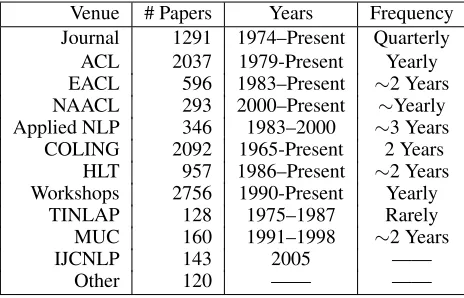
Venue # Papers Years Frequency Journal 1291 1974–Present Quarterly
ACL 2037 1979-Present Yearly EACL 596 1983–Present ∼2 Years NAACL 293 2000–Present ∼Yearly Applied NLP 346 1983–2000 ∼3 Years
COLING 2092 1965-Present 2 Years HLT 957 1986–Present ∼2 Years Workshops 2756 1990-Present Yearly
TINLAP 128 1975–1987 Rarely
MUC 160 1991–1998 ∼2 Years
IJCNLP 143 2005 ——
[image:2.612.72.304.57.206.2]Other 120 —— ——
Table 1: Data in the ACL Anthology
Despite the relative youth of our field, computa-tional linguistics has witnessed a number of research trends and shifts in focus. While some trends are obvious (such as the rise in machine learning meth-ods), others may be more subtle. Has the field got-ten more theoretical over the years or has there been an increase in applications? What topics have de-clined over the years, and which ones have remained roughly constant? How have fields like Dialogue or Machine Translation changed over the years? Are there differences among the conferences, for exam-ple between COLING and ACL, in their interests and breadth of focus? As our field matures, it is im-portant to go beyond anecdotal description to give grounded answers to these questions. Such answers could also help give formal metrics to model the dif-ferences between the many condif-ferences and venues in our field, which could influence how we think about reviewing, about choosing conference topics, and about long range planning in our field.
2 Methodology
2.1 Data
The analyses in this paper are based on a text-only version of the Anthology that comprises some 12,500 papers. The distribution of the Anthology data is shown in Table 1.
2.2 Topic Modeling
Our experiments employ Latent Dirichlet Allocation (LDA; Blei et al. (2003)), a generative latent variable model that treats documents as bags of words gener-ated by one or more topics. Each document is
char-acterized by a multinomial distribution over topics, and each topic is in turn characterized by a multino-mial distribution over words. We perform parame-ter estimation using collapsed Gibbs sampling (Grif-fiths and Steyvers, 2004).
Possible extensions to this model would be to in-tegrate topic modelling with citations (e.g., Dietz et al. (2007), Mann et al. (2006), and Jo et al. (2007)). Another option is the use of more fine-grained or hi-erarchical model (e.g., Blei et al. (2004), and Li and McCallum (2006)).
All our studies measure change in various as-pects of the ACL Anthology over time. LDA, how-ever, does not explicitly model temporal relation-ships. One way to model temporal relationships is to employ an extension to LDA. The Dynamic Topic Model (Blei and Lafferty, 2006), for example, rep-resents each year’s documents as generated from a normal distribution centroid over topics, with the following year’s centroid generated from the pre-ceding year’s. The Topics over Time Model (Wang and McCallum, 2006) assumes that each document chooses its own time stamp based on a topic-specific beta distribution.
Both of these models, however, impose con-straints on the time periods. The Dynamic Topic Model penalizes large changes from year to year while the beta distributions in Topics over Time are relatively inflexible. We chose instead to perform
post hoccalculations based on the observed proba-bility of each topic given the current year. We define
ˆ
p(z|y)as the empirical probability that an arbitrary paperdwritten in yearywas about topicz:
ˆ
p(z|y) = X
d:td=y ˆ
p(z|d)ˆp(d|y)
= 1
C
X
d:td=y ˆ
p(z|d)
= 1
C
X
d:td=y
X
z0i∈d
I(zi0 =z)
(1)
whereIis the indicator function,tdis the date
docu-mentdwas written,pˆ(d|y)is set to a constant1/C.
3 Summary of Topics
0 0.05 0.1 0.15 0.2
1980 1985 1990 1995 2000 2005 Classification
[image:3.612.76.292.56.220.2]Probabilistic Models Stat. Parsing Stat. MT Lex. Sem
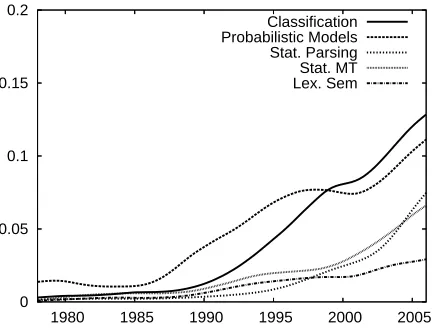
Figure 1: Topics in the ACL Anthology that show a strong recent increase in strength.
words for 10 more topics to improve coverage of the field. These 46 topics were then used as priors to a new 100-topic run. The top ten most frequent words for 43 of the topics along with hand-assigned labels are listed in Table 2. Topics deriving from manual seeds are marked with an asterisk.
4 Historical Trends in Computational Linguistics
Given the space of possible topics defined in the pre-vious section, we now examine the history of these in the entire ACL Anthology from 1978 until 2006. To visualize some trends, we show the probability mass associated with various topics over time, plot-ted as (a smoothed version of)pˆ(z|y).
4.1 Topics Becoming More Prominent
Figure 1 shows topics that have become more promi-nent more recently.
Of these new topics, the rise inprobabilistic mod-elsandclassification/taggingis unsurprising. In or-der to distinguish these two topics, we show 20 of the strongly weighted words:
Probabilistic Models: model word probability set data number algorithm language corpus method figure proba-bilities table test statistical distribution function al values performance
Classification/Tagging:features data corpus set feature table word tag al test accuracy pos classification perfor-mance tags tagging text task information class
Some of the papers with the highest weights for theprobabilistic modelsclass include:
N04-1039 Goodman, Joshua. Exponential Priors For Maximum Entropy Models (HLT-NAACL, 2004)
W97-0309 Saul, Lawrence, Pereira, Fernando C. N. Aggregate And Mixed-Order Markov Models For Statistical Language Processing (EMNLP, 1997)
P96-1041 Chen, Stanley F., Goodman, Joshua. An Empirical Study Of Smoothing Techniques For Language Model-ing (ACL, 1996)
H89-2013 Church, Kenneth Ward, Gale, William A. Enhanced Good-Turing And CatCal: Two New Methods For Esti-mating Probabilities Of English Bigrams (Workshop On Speech And Natural Language, 1989)
P02-1023 Gao, Jianfeng, Zhang, Min Improving Language Model Size Reduction Using Better Pruning Criteria (ACL, 2002)
P94-1038 Dagan, Ido, Pereira, Fernando C. N. Similarity-Based Estimation Of Word Cooccurrence Probabilities (ACL, 1994)
Some of the papers with the highest weights for theclassification/taggingclass include:
W00-0713 Van Den Bosch, Antal Using Induced Rules As Com-plex Features In Memory-Based Language Learning (CoNLL, 2000)
W01-0709 Estabrooks, Andrew, Japkowicz, Nathalie A Mixture-Of-Experts Framework For Text Classification (Workshop On Computational Natural Language Learning CoNLL, 2001)
A00-2035 Mikheev, Andrei. Tagging Sentence Boundaries (ANLP-NAACL, 2000)
H92-1022 Brill, Eric. A Simple Rule-Based Part Of Speech Tagger (Workshop On Speech And Natural Language, 1992)
As Figure 1 shows, probabilistic modelsseem to have arrived significantly before classifiers. The probabilistic model topic increases around 1988, which seems to have been an important year for probabilistic models, including high-impact papers like A88-1019 and C88-1016 below. The ten papers from 1988 with the highest weights for the proba-bilistic modelandclassifiertopics were the follow-ing:
C88-1071 Kuhn, Roland. Speech Recognition and the Frequency of Recently Used Words (COLING)
J88-1003 DeRose, Steven. Grammatical Category Disambiguation by Statistical Optimization. (CL Journal)
C88-2133 Su, Keh-Yi, and Chang, Jing-Shin. Semantic and Syn-tactic Aspects of Score Function. (COLING)
A88-1019 Church, Kenneth Ward. A Stochastic Parts Program and Noun Phrase Parser for Unrestricted Text. (ANLP) C88-2134 Sukhotin, B.V. Optimization Algorithms of Deciphering
as the Elements of a Linguistic Theory. (COLING) P88-1013 Haigh, Robin, Sampson, Geoffrey, and Atwell, Eric.
Project APRIL: a progress report. (ACL)
A88-1005 Boggess, Lois. Two Simple Prediction Algorithms to Fa-cilitate Text Production. (ANLP)
C88-1016 Peter F. Brown, et al. A Statistical Approach to Machine Translation. (COLING)
A88-1028 Oshika, Beatrice, et al.. Computational Techniques for Improved Name Search. (ANLP)
C88-1020 Campbell, W.N. Speech-rate Variation and the Prediction of Duration. (COLING)
Anaphora Resolution resolution anaphora pronoun discourse antecedent pronouns coreference reference definite algorithm Automata string state set finite context rule algorithm strings language symbol
Biomedical medical protein gene biomedical wkh abstracts medline patient clinical biological Call Routing call caller routing calls destination vietnamese routed router destinations gorin Categorial Grammar proof formula graph logic calculus axioms axiom theorem proofs lambek
Centering* centering cb discourse cf utterance center utterances theory coherence entities local Classical MT japanese method case sentence analysis english dictionary figure japan word Classification/Tagging features data corpus set feature table word tag al test
Comp. Phonology vowel phonological syllable phoneme stress phonetic phonology pronunciation vowels phonemes Comp. Semantics* semantic logical semantics john sentence interpretation scope logic form set
Dialogue Systems user dialogue system speech information task spoken human utterance language Discourse Relations discourse text structure relations rhetorical relation units coherence texts rst
Discourse Segment. segment segmentation segments chain chains boundaries boundary seg cohesion lexical Events/Temporal event temporal time events tense state aspect reference relations relation
French Function de le des les en une est du par pour
Generation generation text system language information knowledge natural figure domain input Genre Detection genre stylistic style genres fiction humor register biber authorship registers Info. Extraction system text information muc extraction template names patterns pattern domain Information Retrieval document documents query retrieval question information answer term text web Lexical Semantics semantic relations domain noun corpus relation nouns lexical ontology patterns MUC Terrorism slot incident tgt target id hum phys type fills perp
Metaphor metaphor literal metonymy metaphors metaphorical essay metonymic essays qualia analogy Morphology word morphological lexicon form dictionary analysis morphology lexical stem arabic Named Entities* entity named entities ne names ner recognition ace nes mentions mention
Paraphrase/RTE paraphrases paraphrase entailment paraphrasing textual para rte pascal entailed dagan Parsing parsing grammar parser parse rule sentence input left grammars np
Plan-Based Dialogue plan discourse speaker action model goal act utterance user information Probabilistic Models model word probability set data number algorithm language corpus method Prosody prosodic speech pitch boundary prosody phrase boundaries accent repairs intonation Semantic Roles* semantic verb frame argument verbs role roles predicate arguments
Yale School Semantics knowledge system semantic language concept representation information network concepts base Sentiment subjective opinion sentiment negative polarity positive wiebe reviews sentence opinions Speech Recognition speech recognition word system language data speaker error test spoken
Spell Correction errors error correction spelling ocr correct corrections checker basque corrected detection Statistical MT english word alignment language source target sentence machine bilingual mt
Statistical Parsing dependency parsing treebank parser tree parse head model al np
Summarization sentence text evaluation document topic summary summarization human summaries score Syntactic Structure verb noun syntactic sentence phrase np subject structure case clause
TAG Grammars* tree node trees nodes derivation tag root figure adjoining grammar
Unification feature structure grammar lexical constraints unification constraint type structures rule WSD* word senses wordnet disambiguation lexical semantic context similarity dictionary Word Segmentation chinese word character segmentation corpus dictionary korean language table system WordNet* synset wordnet synsets hypernym ili wordnets hypernyms eurowordnet hyponym ewn wn
0 0.05 0.1 0.15 0.2
1980 1985 1990 1995 2000 2005 Computational Semantics
[image:5.612.78.293.56.220.2]Conceptual Semantics Plan-Based Dialogue and Discourse
Figure 2: Topics in the ACL Anthology that show a strong decline from 1978 to 2006.
probabilistic models and classifiers entered the field? First, not surprisingly, we note that the vast majority (9 of 10) of the papers appeared in ference proceedings rather than the journal, con-firming that in general new ideas appear in confer-ences. Second, of the 9 conference papers, most of them appeared in the COLING conference (5) or the ANLP workshop (3) compared to only 1 in the ACL conference. This suggests that COLING may have been more receptive than ACL to new ideas at the time, a point we return to in Section 6. Fi-nally, we examined the background of the authors of these papers. Six of the 10 papers either focus on speech (C88-1010, A88-1028, C88-1071) or were written by authors who had previously published on speech recognition topics, including the influential IBM (Brownet al.) and AT&T (Church) labs (C88-1016, A88-1005, A88-1019). Speech recognition is historically an electrical engineering field which made quite early use of probabilistic and statistical methodologies. This suggests that researchers work-ing on spoken language processwork-ing were an impor-tant conduit for the borrowing of statistical method-ologies into computational linguistics.
4.2 Topics That Have Declined
Figure 2 shows several topics that were more promi-nent at the beginning of the ACL but which have shown the most precipitous decline. Papers strongly associated with the plan-based dialogue topic in-clude:
J99-1001 Carberry, Sandra, Lambert, Lynn. A Process Model For Recognizing Communicative Acts And Modeling Nego-tiation Subdialogues (CL, 1999)
J95-4001 McRoy, Susan W., Hirst, Graeme. The Repair Of Speech Act Misunderstandings By Abductive Inference (CL, 1995)
P93-1039 Chu, Jennifer. Responding To User Queries In A Collab-orative Environment (ACL, 1993)
P86-1032 Pollack, Martha E. A Model Of Plan Inference That Distinguishes Between The Beliefs Of Actors And Ob-servers (ACL, 1986)
T78-1017 Perrault, Raymond C., Allen, James F. Speech Acts As A Basis For Understanding Dialogue Coherence (Theo-retical Issues In Natural Language Processing, 1978) P84-1063 Litman, Diane J., Allen, James F. A Plan Recognition
Model For Clarification Subdialogues (COLING-ACL, 1984)
Papers strongly associated with thecomputational semanticstopic include:
J90-4002 Haas, Andrew R. Sentential Semantics For Propositional Attitudes (CL, 1990)
P83-1009 Hobbs, Jerry R. An Improper Treatment Of Quantifica-tion In Ordinary English (ACL, 1983)
J87-1005 Hobbs, Jerry R., Shieber, Stuart M. An Algorithm For Generating Quantifier Scopings (CL, 1987)
C90-1003 Johnson, Mark, Kay, Martin. Semantic Abstraction And Anaphora (COLING, 1990)
P89-1004 Alshawi, Hiyan, Van Eijck, Jan. Logical Forms In The Core Language Engine (ACL, 1989)
Papers strongly associated with theconceptual se-mantics/story understandingtopic include:
C80-1022 Ogawa, Hitoshi, Nishi, Junichiro, Tanaka, Kokichi. The Knowledge Representation For A Story Understanding And Simulation System (COLING, 1980)
A83-1012 Pazzani, Michael J., Engelman, Carl. Knowledge Based Question Answering (ANLP, 1983)
P82-1029 McCoy, Kathleen F. Augmenting A Database Knowl-edge Representation For Natural Language Generation (ACL, 1982)
H86-1010 Ksiezyk, Tomasz, Grishman, Ralph An Equipment Model And Its Role In The Interpretation Of Nominal Compounds (Workshop On Strategic Computing - Natu-ral Language, 1986)
P80-1030 Wilensky, Robert, Arens, Yigal. PHRAN - A Knowledge-Based Natural Language Understander (ACL, 1980)
A83-1013 Boguraev, Branimir K., Sparck Jones, Karen. How To Drive A Database Front End Using General Semantic In-formation (ANLP, 1983)
P79-1003 Small, Steven L. Word Expert Parsing (ACL, 1979)
The declines in both computational semantics and
0 0.05 0.1 0.15 0.2 0.25
[image:6.612.76.294.56.224.2]1980 1985 1990 1995 2000 2005 Semantics
Figure 3: Semantics over time
understanding, computational semantics, WordNet, word sense disambiguation, semantic role labeling, RTE and paraphrase, MUC information extraction,
andevents/temporal. We then plotted pˆ(z ∈ S|y), the sum of the proportions per year for these top-ics, as shown in Figure 3. The steep decrease in se-mantics is readily apparent. The last few years has shown a levelling off of the decline, and possibly a revival of this topic; this possibility will need to be confirmed as we add data from 2007 and 2008.
We next chose two fields, Dialogue and Machine Translation, in which it seemed to us that the topics discovered by LDA suggested a shift in paradigms in these fields. Figure 4 shows the shift in translation, while Figure 5 shows the change in dialogue.
The shift toward statistical machine translation is well known, at least anecdotally. The shift in di-alogue seems to be a move toward more applied, speech-oriented, or commercial dialogue systems and away from more theoretical models.
Finally, Figure 6 shows the history of several top-ics that peaked at intermediate points throughout the history of the field. We can see the peak of unifica-tionaround 1990, ofsyntactic structurearound 1985 ofautomatain 1985 and again in 1997, and ofword sense disambiguationaround 1998.
5 Is Computational Linguistics Becoming More Applied?
We don’t know whether our field is becoming more applied, or whether perhaps there is a trend to-wards new but unapplied theories. We therefore
0 0.05 0.1 0.15 0.2
1980 1985 1990 1995 2000 2005 Statistical MT
[image:6.612.314.534.65.237.2]Classical MT
Figure 4: Translation over time
0 0.05 0.1 0.15 0.2
1980 1985 1990 1995 2000 2005 Dialogue Systems
Plan-Based Dialogue and Discourse
Figure 5: Dialogue over time
0 0.05 0.1 0.15 0.2
1980 1985 1990 1995 2000 2005 TAG
Generation Automata Unification Syntactic Structure Events WSD
[image:6.612.315.533.286.460.2] [image:6.612.314.534.420.663.2]0 0.05 0.1 0.15 0.2 0.25
[image:7.612.74.288.64.426.2]1980 1985 1990 1995 2000 2005 Applications
Figure 7: Applications over time
0 0.05 0.1 0.15 0.2
1980 1985 1990 1995 2000 2005 Statistical MT
Dialogue Systems Spelling Correction Call Routing Speech Recognition Biomedical
Figure 8: Six applied topics over time
looked at trends over time for the following appli-cations: Machine Translation, Spelling Correction,
Dialogue Systems,Information Retrieval,Call Rout-ing, Speech Recognition, and Biomedical applica-tions.
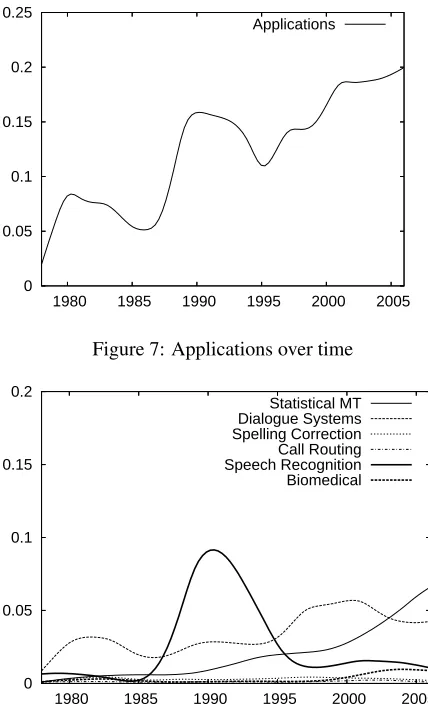
Figure 7 shows a clear trend toward an increase in applications over time. The figure also shows an interesting bump near 1990. Why was there such a sharp temporary increase in applications at that time? Figure 8 shows details for each application, making it clear that the bump is caused by a tempo-rary spike in theSpeech Recognitiontopic.
In order to understand why we see this temporary spike, Figure 9 shows the unsmoothed values of the
Speech Recognitiontopic prominence over time. Figure 9 clearly shows a huge spike for the years 1989–1994. These years correspond exactly to the DARPA Speech and Natural Language Workshop,
0 0.05 0.1 0.15 0.2
1980 1985 1990 1995 2000 2005
Figure 9: Speech recognition over time
held at different locations from 1989–1994. That workshop contained a significant amount of speech until its last year (1994), and then it was revived in 2001 as the Human Language Technology work-shop with a much smaller emphasis on speech pro-cessing. It is clear from Figure 9 that there is still some speech research appearing in the Anthology after 1995, certainly more than the period before 1989, but it’s equally clear that speech recognition is not an application that the ACL community has been successful at attracting.
6 Differences and Similarities Among COLING, ACL, and EMNLP
The computational linguistics community has two distinct conferences, COLING and ACL, with dif-ferent histories, organizing bodies, and philoso-phies. Traditionally, COLING was larger, with par-allel sessions and presumably a wide variety of top-ics, while ACL had single sessions and a more nar-row scope. In recent years, however, ACL has moved to parallel sessions, and the conferences are of similar size. Has the distinction in breadth of top-ics also been blurred? What are the differences and similarities in topics and trends between these two conferences?
[image:7.612.310.527.65.229.2]conference but more recently, while still smaller than both COLING and ACL, it has grown large enough to be considered with them. How does the breadth of its topics compare with the others?
Our hypothesis, based on our intuitions as con-ference attendees, is that ACL is still more narrow in scope than COLING, but has broadened consid-erably. Similarly, our hypothesis is that EMNLP has begun to broaden considerably as well, although not to the extent of the other two.
In addition, we’re interested in whether the topics of these conferences are converging or not. Are the probabilistic and machine learning trends that are dominant in ACL becoming dominant in COLING as well? Is EMNLP adopting some of the topics that are popular at COLING?
To investigate both of these questions, we need a model of the topic distribution for each conference. We define the empirical distribution of a topiczat a conferencec, denoted bypˆ(z|c)by:
ˆ
p(z|c) = X
d:cd=c ˆ
p(z|d)ˆp(d|c)
= 1
C
X
d:cd=c ˆ
p(z|d)
= 1
C
X
d:cd=c
X
z0i∈d
I(z0i=z)
(2)
We also condition on the year for each conference, giving uspˆ(z|y, c).
We propose to measure the breadth of a confer-ence by using what we calltopic entropy: the condi-tional entropy of this conference topic distribution. Entropy measures the average amount of informa-tion expressed by each assignment to a random vari-able. If a conference has higher topic entropy, then it more evenly divides its probability mass across the generated topics. If it has lower, it has a far more narrow focus on just a couple of topics. We there-fore measuredtopic entropy:
H(z|c, y) =−
K
X
i=1 ˆ
p(zi|c, y) log ˆp(zi|c, y) (3)
Figure 10 shows the conditional topic entropy of each conference over time. We removed from the ACL and COLING lines the years when ACL
3.6 3.8 4 4.2 4.4 4.6 4.8 5 5.2 5.4 5.6
1980 1985 1990 1995 2000 2005 ACL Conference
[image:8.612.314.519.66.219.2]COLING EMNLP Joint COLING/ACL
Figure 10: Entropy of the three major conferences per year
and COLING are colocated (1984, 1998, 2006), and marked those colocated years as points separate from either plot. As expected, COLING has been historically the broadest of the three conferences, though perhaps slightly less so in recent years. ACL started with a fairly narrow focus, but became nearly as broad as COLING during the 1990’s. However, in the past 8 years it has become more narrow again, with a steeper decline in breadth than COLING. EMNLP, true to its status as a “Special Interest” con-ference, began as a very narrowly focused confer-ence, but now it seems to be catching up to at least ACL in terms of the breadth of its focus.
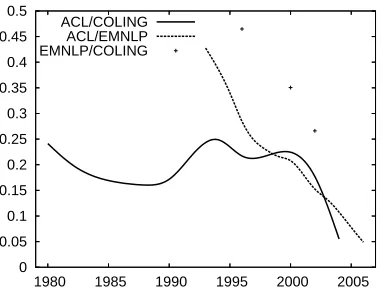
Since the three major conferences seem to be con-verging in terms of breadth, we investigated whether or not the topic distributions of the conferences were also converging. To do this, we plotted the Jensen-Shannon (JS) divergence between each pair of con-ferences. The Jensen-Shannon divergence is a sym-metric measure of the similarity of two pairs of tributions. The measure is 0 only for identical dis-tributions and approaches infinity as the two differ more and more. Formally, it is defined as the aver-age of the KL divergence of each distribution to the average of the two distributions:
DJS(P||Q) = 1
2DKL(P||R) + 1
2DKL(Q||R)
R= 1
2(P+Q)
(4)
0 0.05 0.1 0.15 0.2 0.25 0.3 0.35 0.4 0.45 0.5
1980 1985 1990 1995 2000 2005 ACL/COLING
[image:9.612.103.294.76.225.2]ACL/EMNLP EMNLP/COLING
Figure 11: JS Divergence between the three major con-ferences
and COLING have historically met very infre-quently in the same year, so those similarity scores are plotted as points and not smoothed. The trend across all three conferences is clear: each confer-ence is not only increasing in breadth, but also in similarity. In particular, EMNLP and ACL’s differ-ences, once significant, are nearly erased.
7 Conclusion
Our method discovers a number of trends in the field, such as the general increase in applications, the steady decline in semantics, and its possible re-versal. We also showed a convergence over time in topic coverage of ACL, COLING, and EMNLP as well an expansion of topic diversity. This growth and convergence of the three conferences, perhaps influenced by the need to increase recall (Church, 2005) seems to be leading toward a tripartite real-ization of a single new “latent” conference.
Acknowledgments
Many thanks to Bryan Gibson and Dragomir Radev for providing us with the data behind the ACL An-thology Network. Also to Sharon Goldwater and the other members of the Stanford NLP Group as well as project Mimir for helpful advice. Finally, many thanks to the Office of the President, Stanford Uni-versity, for partial funding.
References
Steven Bird. 2008. Association of Computational Lin-guists Anthology. http://www.aclweb.org/anthology-index/.
David Blei and John D. Lafferty. 2006. Dynamic topic models.ICML.
David Blei, Andrew Ng, , and Michael Jordan. 2003. La-tent Dirichlet allocation. Journal of Machine Learning Research, 3:993–1022.
D. Blei, T. Gri, M. Jordan, and J. Tenenbaum. 2004. Hi-erarchical topic models and the nested Chinese restau-rant process.
Kenneth Church. 2005. Reviewing the reviewers. Com-put. Linguist., 31(4):575–578.
Laura Dietz, Steffen Bickel, and Tobias Scheffer. 2007. Unsupervised prediction of citation influences. In
ICML, pages 233–240. ACM.
Eugene Garfield. 1955. Citation indexes to science: A new dimension in documentation through association of ideas.Science, 122:108–111.
Tom L. Griffiths and Mark Steyvers. 2004. Finding sci-entific topics.PNAS, 101 Suppl 1:5228–5235, April. Yookyung Jo, Carl Lagoze, and C. Lee Giles. 2007.
Detecting research topics via the correlation between graphs and texts. InKDD, pages 370–379, New York, NY, USA. ACM.
Mark T. Joseph and Dragomir R. Radev. 2007. Citation analysis, centrality, and the ACL anthology. Techni-cal Report CSE-TR-535-07, University of Michigan. Department of Electrical Engineering and Computer Science.
Thomas S. Kuhn. 1962. The Structure of Scientific Rev-olutions. University Of Chicago Press.
Wei Li and Andrew McCallum. 2006. Pachinko alloca-tion: DAG-structured mixture models of topic correla-tions. InICML, pages 577–584, New York, NY, USA. ACM.
Gideon S. Mann, David Mimno, and Andrew McCal-lum. 2006. Bibliometric impact measures leveraging topic analysis. In JCDL ’06: Proceedings of the 6th ACM/IEEE-CS joint conference on Digital libraries, pages 65–74, New York, NY, USA. ACM.