[ 3 9 ]
AN INVESTIGATION OF THE 'CHRONOMETER'
FACTOR IN BIRD NAVIGATION
BY G. V. T. MATTHEWS
Department of Zoology, University of Cambridge
(Received 29 March 1954)
INTRODUCTION
In previous papers (Matthews, 1951a, b, 1952, 1953a, b, c) the existence of a true, bico-ordinate navigational ability was demonstrated in three very different species of birds, Homing Pigeons, Lesser Blackbacked Gulls and Manx Shearwaters. In each case the sun was shown to play an essential part in such navigation, which broke down with overcast conditions. A theory of complete sun navigation pro-posed was found to be theoretically plausible. Experimental evidence was obtained that pigeons were detecting latitude displacement from differences in the noon altitude of the sun at home and at the release point. A start was made with the investigation of the second part of the hypothesis, that longitude displacement was detected by comparing home time (provided by an internal 'chronometer') with local time at release (estimated from the sun's position on its arc with reference to the highest point of that arc). Exposure of pigeons to irregular light/dark sequences, such as might disrupt the working of such a ' chronometer', resulted in a breakdown of orientation. An attempt to obtain reorientation in longitude with shearwaters by exposure to regular, out of phase, light/dark sequences gave suggestive results. The present paper describes further experiments on these lines.
Manx Shearwaters (Procellaria puffinus puffinus, Brunn.) were taken from the colony on Skokholm Bird Observatory, Pembrokeshire. The technique of obtaining and handling these birds has been described before (Matthews, 1953 c). Pigeons were reared at the Ornithological Field Station, Madingley.
I. ATTEMPTS TO IMPOSE A DIRECT SHIFT ON THE 'CHRONOMETER' Method
birds might 'consider' that the transfer to the new day conditions was brought about by their having been displaced in longitude, and remember this when released. This might occur independently of, or together with, the effects on the ' chronometers'. Thus for birds subjected to an advanced day and then released say 60 miles east of home we have the possibilities shown in Table 1.
In case A, when the treatment has been wholly ineffectual, the experimental birds will show no difference from the untreated controls. Not much difference could be expected in case B, although the reinforced westward tendency might be apparent. In case D the effects might cancel out, giving no orientation in longitude, or one or other of the indications might be 'preferred'. Only in case C could we expect a radically different initial orientation between experimentals and controls. It is thus clearly most important that the change in the light/dark sequence should not be interpreted as being due to displacement in longitude. This could best be done by carrying out the treatment in familiar surroundings at home, or in
Table 1
Artificial day has effect of
A B C
D
Advancing 'chronometer'
No No Yes Yes
Being interpreted as shift to east
No) Yesf Noi Yesf
Sun at release in relation to ' chronometer'
time
Slightly in advance Far behind
Expected flight direction
West West East
Indeterminate
conditions that closely simulate these. Further, while the change in ' chronometer' time must be sufficient to offset the actual displacement to the release point (other-wise birds in case C will still fly west), it should not be so large that there is a possibility of the orientation mechanism breaking down in such ' impossible' condi-tions. Even if longitude displacement could not then be detected it is possible that latitude displacement could still be detected, since the sun's noon altitude could, theoretically, be estimated without a chronometer, from the observed sun arc. Then if the release point differed in latitude from home, orientation north or south as appropriate would be expected (this applies in case D also).
It was not possible to treat shearwaters on Skokholm owing to the lack of a soundproof room which would be needed to exclude the noise of the other shear-waters returning at night. The birds selected for the experiment had not been used in tests before, so the disturbance of removing them to the mainland would have no meaning in terms of displacement. Any elaborate kinaesthetic sense recording spatial displacement has been disproved (Matthews, 19516). The journey to Cam-bridge, once started, might therefore reasonably be completed. To try and create a ' homelike' atmosphere in the room there, the birds were provided with:
(1) a confined space, similar to the nesting chamber, (2) nesting material,
Investigation of ' chronometer' factor in bird navigation 41
(4) a recording of the nocturnal uproar made when the birds are returning to their burrows. As suggested previously this nightly noise may be an important pace-maker for the birds' ' chronometers' in addition to the light/dark rhythm.
The alternation between artificial day and night was arranged by raising or lowering the illumination (two 100 W. bulbs in an 8 ft. cube) by four stages over half an hour. The length of the night was that appropriate to the season, and at the appropriate time the record of calling was played, the natural sequence being reproduced by increasing the amount and loudness of calling to a crescendo, and then making it die away more slowly, the whole process taking 2 hr.
With these precautions it was hoped that if the shearwaters responded at all to the artificial day it would be by an adjustment of their ' chronometers' to the new time. The time shift imposed was arbitrarily taken at 3 hr., and was the same for all experiments described in this paper. This was quite sufficient to mask the time shift due to the actual change in longitude (about 20 min.), but not, it was hoped, so large as to disrupt the 'chronometer' mechanism. The artificial day was in advance of normal. A similar number of shearwaters were kept in their boxes (without an egg) in a separate wing of the building as controls. Normal daylight coming through frosted windows facing north was the only illumination provided in this case. The period for which the treatment could be continued was limited to that for which the birds could be restrained without being weakened. They would not take food, but would swallow water jetted on to their beaks. Although they can remain continuously on the nest for up to 16 days (Matthews, 1954), the average incubation shift is about 5 days. In view of this, and of previous experience, a limit of 4 days and nights in the boxes was imposed. This was very short for the purpose of the experiment and also meant that the birds had to be released at the end of this time whatever the weather conditions might be.
There was no such urgent time limit with pigeons since they could be kept under fairly normal conditions, with room to exercise. Again the experimental birds could not be kept at the loft site owing to the lack of sufficiently spacious sound-proof accommodation. They were therefore transported the short distance to the laboratory (3J miles) in uncovered baskets, along a road with which they might well have become familiar in previous moves to Cambridge prior to long journeys. They were kept in the same lightproof room previously used for the shearwaters, of about 500 cu.ft. capacity, equipped with a sufficient number of the usual box perches on the walls. The artificial day was again 3 hr. in advance of normal. Temperature was not controlled, but the previous experience in this room (Matthews, 1953 a) had shown that the heat of the bulbs was sufficient to ensure that it rose to a maximum during the artificial daytime. Ventilation was ensured by a masked fan system. The control birds were kept in the loft with a similar space at their disposal, but with full view of the sun and sky. Both groups were fed twice a day at constant times, those for the controls being normal, those for the experimentals being advanced accordingly.
samples to be equally matched if there were any variations in homing ability. The experiment with pigeons (T. 38) was carried out with thirty-eight birds that had been bred and used experimentally in previous years and retained for breeding purposes. Their experience is indicated in Fig. 2. Nine birds reared and used in 1951 and seventeen reared and used in 1952 had received their training from the west of the loft, followed by a single critical release to the south. Nine reared in 1950 had been trained from the north and given critical releases to the west and south. Three from 1952 had not been trained. Sixteen of the 1951-2 birds had had the experience of being shut off from sun and sky in the altitude/latitude experiments (Matthews, 1953 a), but no attempt had been made to upset their ' chronometers' on that occasion. The birds had been mated up on their field performance, like with like, and alternate pairs in order of merit were allotted to the experimental and control groups. With a few adjustments each group contained like numbers of north-trained birds, of birds with experimental experience, of untrained birds and of males and females. These birds had been allowed to rear two pairs of young in 1953, the process being complete by the end of May. They were then allowed to remain mated and in possession of their nesting boxes, to keep them in breeding condition and delay the onset of the moult. In the week before the experiment began they were given a short 'refresher' course of short-distance releases at 5, 10 and 25 miles south.
The shearwaters were taken to the release point in their (covered) boxes by day, that is, after it was light both inside and outside the experimental room. The pigeons were placed in covered baskets and loaded into the lightproofed van when it was dark both inside and outside the room, around 23.00 hr. The journey to the release point was thus made through the night. The interior of the van was dimly lit at local sunrise to emphasize the time lag behind the conditions in the experimental room. Thus no bird had experience of the outside conditions from the beginning of the experimental treatment until immediately before its release.
Investigation of ' chronometer' factor in bird navigation 43
The co-ordinates of the theoretical release point in relation to home, as they would appear to a bird using sun navigation and taken in completely by the experimental treatment, are:Latitude: the actual shift in latitude to the real release point, plus or minus the equivalent in latitude of the change in the sun's declination in the period for which the birds were out of sight of sun and sky.
Longitude: the equivalent of 3 hr. time shift in the appropriate latitude, less the actual shift in longitude to the real release point.
The initial direction (A) in which the birds should then start was calculated from the formulae
hav p = hav P x sin a x sin b + hav (a ~ b) hav A = {hav a — hav (b ~p)} cosec b x cosec p, where a = colat of home,
i = colat of 'release point',
P = difference in longitude between 'release point' and home.
The initial scatter diagrams can be examined by ' / ' or x2 tests. It was shown (Matthews, 1953 a) that the former is useful for comparing well-balanced scatters about a single bearing. But its usefulness breaks down when a distribution is heavily skew about the home bearing, or, more particularly, when the distribution may be a compound one, with two opposed bearings about which the birds may be scattering. In these circumstances, which obtain throughout this paper, resort must be made to the x2 test, the division of the diagram adopted being such that a substantial number of points could be expected in the sectors. A simple bisection has been used throughout. To reduce the occurrence of statistical insertions it may be assumed that a given result does not reach the P= 0-05 level of significance if no statistical evidence to the contrary is offered.
Results
In the first experiment with shearwaters (Cambridge J, 28 May 1953) fourteen experimental birds and eleven controls were released between 05.36 and 07.23 hr.
44
In view of the disturbing effect of the wind in this experiment, it was repeated in the hope of obtaining better weather conditions. On the next occasion (Cambridge K, 24 June 1953) sixteen birds of each group were released after the same treatment
Table 2
Experimentals Controls
Returned on nights
1-4 | 5-10
6 7 3 3
Later
1
3
Missing
2
Total
14
1 1
(b) (c)
Fig. 1. Initial orientation of shearwaters after attempts to impose a direct 'chronometer' shift, (a) Cambridge J, (6) Cambridge K, (c) Cambridge L. Experimental birds in black, controls in white.
General note on orientation diagrams:
Vanishing points grouped in 10° sectors. Solid arrow, true home bearing; half-blocked arrow, predicted false bearing; open arrow head, true north.
Investigation of' chronometer' factor in bird navigation 45
and controls as regards orientation or time in sight (2-5 v. 2-6 min.). Again in line with previous results the returns were slower than in the earlier sunny release, but with no difference between the groups (Table 3).
One further attempt was made (Cambridge L, 8 July 1953) with ten experimentals and thirteen controls released between 04.50 and 06.59 hr. Sun conditions were good, only high thin cloud 2-5/ioth, but once more the wind was strong (force 4-5) and, worse, blowing from due west. Experimentals and controls alike were driven downwind (Fig. 1 c) and lost from sight in times that do not differ significantly, 3-2 and 2-2 min. No check for returns was made, as the season for homing work with this bird on Skokholm had come to an end.
[image:7.451.46.408.315.384.2]Including the 1952 tests Cambridge F and I, five experimental releases had now been made to test the 'chronometer' factor in shearwaters, involving 123 birds. Not once had wholly suitable weather conditions been encountered and the results must remain inconclusive. But as far as they go, particularly in Cambridge J, they do indicate that four nights of the treatment were quite ineffectual at upsetting longitude orientation. A parallel experiment, but with longer treatment, was now carried out with the homing pigeons.
Table 3
Experimentals Controls
Returned on nights
i - 4
1
4
5-10
12 II
Later
—
Missing
3
1
Total
16 16
The treatment of the experimentals, aimed at advancing the 'chronometer' by 3 hr., was continued for ten complete days. By the third and fourth days it looked, from casual observation, as if the birds had settled down to the artificial day. For instance, they appeared to be roosting well in advance of the normal time. But too much stress should not be laid on this, since in normal circumstances some birds will be sleeping while others are active. In particular, such activity changes cannot be taken as evidence that the 'chronometer' has been changed. Stein (1951) has shown that long after activity rhythms of passerines had broken down under con-tinuous lighting, the birds were still indicating the time at which they had been trained to expect food. On 11 August 1953 the birds were released between 06.00 and 09.39 hr- m ideal weather conditions, cloudless sky and a slight breeze, east-south-east, force 0-1 (T.38). At the release point (see Fig. 2) home was 56 miles away on a bearing of 2520, the false bearing being 0790. This was the most easterly point available which would still be a good distance (20 miles) from the coast. Other releases (T.3, 4, 9, 13, 14, 21, 36, 41, 42) have been made rather closer to a coast without the orientation being biased. The centre of a deserted airfield provided an ideal release site in otherwise rather unsuitable country.
4 G. V. T. MATTHEWS
Fig. 2. Release points of adult pigeons. Solid lines and open circles, training releases; dotted lines and solid circles, test releases. 1952, T. 29-36; 1951, T. 22-28; 1950 not shown for clarity, training line approximating to that of T.46 with test releases west-south-west and south, T. 10-21. All releases at T. 37 in 1953. Only releases at 25 miles or further from home are shown.
T.38
Experimental! Controls
[image:8.451.93.358.460.603.2]Investigation of ' chronometer' factor in bird navigation 47
[image:9.451.44.408.193.256.2]P being respectively 4-26, 0-04 and 5-55, 002 when the scatter is bisected at right angles to the home bearing). If anything, the experimental show a higher propor-tion of birds closer to the home bearing (13 v. 7 within 6o°). The birds were in sight for similar times, averaging 3-7 and 4-0 min. Once again the time-shifting treatment had failed to affect initial orientation, confirming the tentative con-clusions reached with the shearwaters. The experimental pigeons also homed rather faster (Table 4).
Table 4
Experimentals Controls
1
7 2
Returned on days
2
1 7
3 and 4
6 4
Later
:
Missing
1 2
Total
19 19
The results thus far might mean that 'chronometers' are not concerned in longitude navigation, but a great deal of negative evidence would be necessary for this conclusion to be accepted. It was also possible that the experimental treatment was insufficient to upset the 'chronometers', and more drastic treatment was therefore decided upon. There is the additional possibility that the shift in the artificial day was being interpreted as due to a shift in longitude, a long way to the east (case B, p. 40). Both shearwaters and pigeons released in sunny conditions gave rather faster returns by the experimentals. This would be expected if on release they had a stronger conviction than the controls (with only a small time shift to estimate and interpret) that they must fly west. The somewhat better orientation of the experimental pigeons also lends support for this view. More definite evidence could be obtained by releasing birds treated in this manner, in a different direction, say to the south. They should then still fly west while controls should go north. This would be strong indirect proof that longitude determination had a chronometer basis of the kind proposed, but it would be less satisfactory than the type of re-orientation which would be expected from an alteration in the ' chrono-meters' themselves.
II. ATTEMPTS TO DISRUPT AND THEN IMPOSE A SHIFT ON THE 'CHRONOMETER'
Method
brought to the laboratory in open baskets, but left in them on the flat roof, with a view towards the home surroundings, for 4 hr. on a sunny afternoon. They were then taken straight down to the experimental room. The control birds were given a similar exposure in the afternoon before transport to the release point. In other respects the technical arrangements were as before.
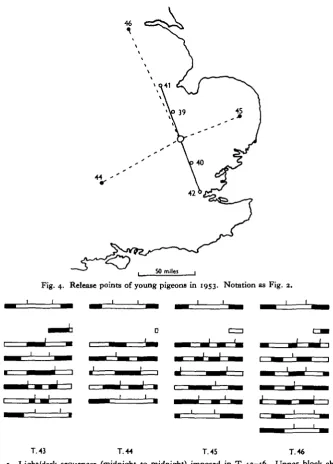
Four experiments were made, T. 43-46, and as similar results were obtained, they will be considered together. In T. 43 the 34 old birds that had then returned from T. 38 were used as a try-out of the new method. Since the experimentals had given the better performances in that test, any effect would have to be manifest in them to be convincing, so they were again used as experimentals and the former controls again as controls. In T. 44 young birds were used that had been hatched between 16 March and 16 May in the present (1953) season. Their training was rather different from that given in previous years. It had been shown (Matthews, 19536) that training did not greatly improve initial orientation from a novel direction. But it did considerably increase the proportion of birds returning, presumably by increasing the 'area' of known country as well as the confidence of the birds. Some training was therefore needed if sufficient birds were to get back and be available for further experiments and if only competent homers were actually to be used in the tests. On the other hand, if the training was unduly prolonged there would be wastage from incidental causes. A compromise restricted training flights but increased the ground actually covered, by releasing birds up to 50 miles alternately in opposite directions. This also served to prevent the im-position of a rigid training direction, with a tendency to fly always in that direction, as has been found to be the case if such training is continued for too long. Training took place between 23 July 1953 and 23 August 1953. After releases at 1, 2 and 3 miles east, west and north, alternate releases north and south followed at each of the following distances: 6, 10, 15, 25 and 50 miles (see Fig. 4). The birds were released in groups of five up to 15 miles north, in groups of three at 15 miles south, in pairs at the 25-mile points, and singly at the 50-mile points. On days not occupied by training the birds could freely enter and leave the loft. Seventy-five birds had been reduced to fifty by the end of the training, a measure of the selection involved. These were divided into two equal lots by designating alternate ring numbers to be experimentals and controls. Consecutive numbers are given to sibs and the series run through as the squabs become ready for ringing. An equal division on the basis of heredity and age was thus ensured. Two birds returning after the division had been made were put into the control group.
Investigation of ' chronometer' factor in bird navigation 49
The birds were given five complete days (four in T.44) °f irregular light/dark alternation as indicated in Fig. 5. Their 'chronometers' having by then, it was hoped, been thoroughly upset, the birds were kept for a number of days with a regular light/dark alternation out of phase with the normal day. For the easterly
i 50 mile; i
Fig. 4. Release points of young pigeons in 1953. Notation as Fig. 2.
[image:11.451.59.393.130.594.2]T.43 T.44 T.45 T.46
Fig. 5. Light/dark sequences (midnight to midnight) imposed in T.43-46. Upper block shows normal sequence experienced by control birds, short vertical lines indicate feeding times. Subsequent blocks show the irregular sequences and feeding times used with experimentals, with (l°west block) the first day of their regular, shifted sequence and feeding times.
releases (T. 45) the artificial day was 3 hr. in advance, as in T. 38. For the westerly (T. 43 and T. 44) and northerly (T. 46) releases it was 3 hr. behind normal, so that, according to the theory, a westerly bias should be imposed. The sun at release would be in advance of the new 'chronometer' time, as would have resulted from a move far to the east. It is worth emphasizing here that to obtain statistically convincing results in field tests of this nature, it is essential to arrange for a wide divergence between true and false bearings. Even with well-orientated birds the mean devia-tion from the home bearing will be around 400, with a standard deviation of about 300 (Matthews, 19536). Scatters after experimental treatment which might not affect all birds in precisely the same way would be expected to be wider than this. Further, many cases are known where initial scatters have been markedly skew, even when there should be no conflict of bearings as might result from training or experiment—see, for example, Matthews (1953 a, Figs. 2 and 4) and Kramer (1953, Fig. 5). The release points were chosen with this in mind, and were all more than 50 miles from any previous point at which the birds concerned had previously been released (Figs. 2 and 4). That for T.45 had been used in T.38 and that for T.44 in several earlier releases, T.8, 20, 35, so comparison with scatters on those occasions can be made.
The regular light/dark alternation was continued for a minimum of five days, and from then on until suitable weather conditions were forecast by the Air Ministry meteorological officers at London or Mildenhall. It is notoriously difficult to forecast if and when early fog will lift, and whether it will give clear or clouded skies. This is especially so when the information is required some twelve hours in advance so that the birds can be transported through the night (p. 42). As a result some excellent release conditions were missed, and T.43, 44 and 45 a were all delayed in starting, because cloud or fog cleared more slowly than forecast. In T. 45 a a completely unpredicted return of heavy cloud and rain made it necessary to suspend releases when only a third complete. If the birds were kept at the release site in the van overnight, in the hope of better weather the next day, it seemed quite probable that they would pick up sufficient clues (sounds, temperature etc.) to confuse, if not to reset their' chronometers'. It was decided to return to Cambridge, and the experimental birds were replaced in the lightproof room, under cover of darkness and, of course, in covered baskets. Since they had already been immured for 17 days, a complete repetition of the treatment could not be made. The regular lighting treatment alone was therefore resumed for another eight days. The results (T. 45 b) were so similar to the previous partial release that the two are considered together as T.45.
Results
Investigation of ' chronometer' factor in bird navigation 51
of birds flying towards or away from home compared with the 1:1 ratio expected on chance (Table 6). In each test the distribution is strongly non-random and orientated in the homeward direction. There is no significant heterogeneity, i.e. the results of the tests are similar to one another and can justifiably be added together in assessing the results of the whole series.
Experimental! Controls
[image:13.451.90.361.153.480.2]Experimentals Controls
Fig. 6. Initial orientation of pigeons after treatment to disrupt and then reset 'chronometers', (a) T.43, adults; (b) T.44, young birds.
Secondly, we can find whether the experimental distributions differ from the control distributions, by dividing both along the line bisecting the angle between home and false bearings, and comparing the numbers of birds falling into these sectors, that is, approximating more closely to one or the other bearing (Table 7). There is no question but that the experimentals were consistently giving very different scatters from those of the control birds.
Thirdly, we wish to know whether the experimental scatters differ, not only from the control, but from those which would have been expected if the birds had flown at random, as if only the first (irregular) part of the treatment had been
Table 5 Exptls No. of birds 17 I 80
1
1230 27901
27. viii. 12.05-15.47 27 80 064O 280" 6. u 10.45-14.58 61
561
252"1
6 ~7.k:I
I0.3pI 1.5 r Home Table 6-1
Eg
1
Date1
TheI
ControlsI
~istancel Bearing Heterogeneity 2.66 Table 7-
Sun and cloud conditions - - - - - - - - Full sun, 4/10 Cu. Full sun, no cloud Sun lightly veiled by high, thin stratus Full sun, no cloud Full sun, no cloud N.E. 1-2 W.N.W. Experimentals ControlsTest T.
Investigation of ' chronometer' factor in bird navigation 53
effective. To do this the experimental scatters are bisected at right angles to the false bearing, and the distribution of the birds compared with the i : i ratio (Table 8).
We may conclude that the experimental scatters form a homogeneous series distinctly different from random and orientated in the false direction, though less
Experimental* Controls
Experlmentali Concroli
Fig. 7. Initial orientation of pigeons after treatment to disrupt and then reset 'chronometer', (a) T.45, young birds; T.4sa in white, T.456 in black, (b) T.46, adults and young birds; expcrimentals with previous experience of experimental treatment in white, eipcrimentals without such experience in black.
Table 8
Test
1 T T4 3
T.44 T.45 T.46
All
<oo°
12 17 IS 19
63
>9O°
4 6 5
zo
X1
4'oo 5-27 S-oo 8-i7
22-43 22-3O
Heterogeneity 0-13
P
i
0-05 1 O-O2 1 0-03 1 0-007<OOOOI
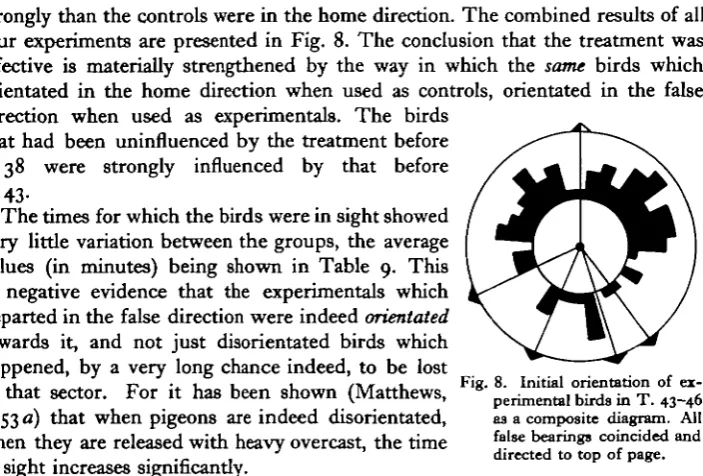
strongly than the controls were in the home direction. The combined results of all four experiments are presented in Fig. 8. The conclusion that the treatment was effective is materially strengthened by the way in which the same birds which orientated in the home direction when used as controls, orientated in the false direction when used as experimentals. The birds
that had been uninfluenced by the treatment before T. 38 were strongly influenced by that before
T.43-The times for which the birds were in sight showed very little variation between the groups, the average values (in minutes) being shown in Table 9. This is negative evidence that the experimentals which departed in the false direction were indeed orientated towards it, and not just disorientated birds which happened, by a very long chance indeed, to be lost
.1 . . T-, . 1 1 1 ,» » _ , Fig. 8. Initial orientation of
ex-in that sector. For it has been shown (Matthews, * p e r i m e n t a, b i r d 8 ^ T. 4 3-46
1953 a) that when pigeons are indeed disorientated, as a composite diagram. All when they are released with heavy overcast, the time [alse bearing comcided and
. . . . directed to top of page. in sight increases significantly.
It is possible that those experimentals which approximated to the home direction did not merely represent the edge of the general scatter, but were birds whose 'chronometers' had not been altered. Their homeward tendency might then be further reinforced by their interpreting the artificial day as being due to a shift in longitude (p. 40). Inspection of Figs. 6 and 7 shows that these birds were not scattered evenly through the sector opposed to the false direction, but were clustered around the bearing of true home. In fact they give a tight 'fan' whose mean deviation, 32°, is less than that for control birds approximating to the home direction, 420. There is also a suggestion they are above the average in orientation ability in normal circumstances. When used in other tests as controls their average deviation was still only 350, as compared with 480 for those birds which had been falsely orientated as experimentals.
[image:16.451.55.407.80.318.2]Investigation of ' chronometer' factor in bird navigation 55
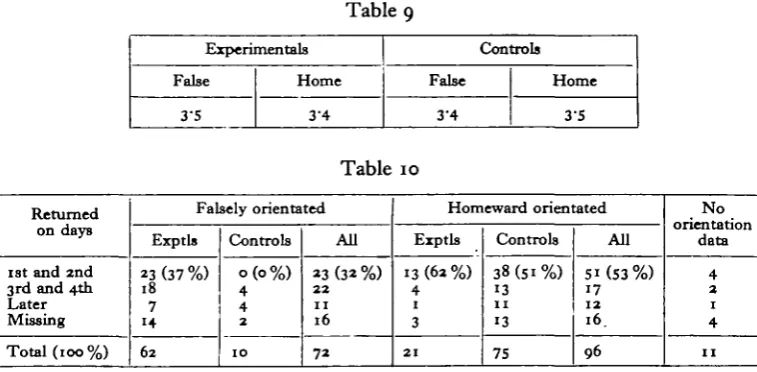
much random wandering (Wilkinson, 1952). In a narrow island like England, birds flying east or west must fairly soon reach and be diverted by a coast. If they simply continue to follow the coastline they will sooner or later reach known country— particularly, for example, in T.45. Attention should therefore be concentrated on those birds returning on the first and second days after release. The overall picture is summarized in Table 10.
[image:17.451.36.415.258.444.2]Only five birds returned on the first day, four being controls and the fifth an experimental orientated homewards. Taking first and second day returns together, the table shows that the performance of those control birds which, despite their advantages, were orientated in the false direction, was the poorest of all. Then come the experimentals orientated in the false direction, followed by the homeward orientated controls. Best of all were the experimentals whose 'chronometers' were apparently unaffected and which orientated towards home. The overall
Table 9 Experimentals False 3-5 Home 3-4 Controls False 3'4 Home 3-S Table 10 Returned on dayB
1st and 2nd 3rd and 4th Later Missing Total (100%) Falsely orientated Exptls 23(37%) 18 7 14 62 Controls 0(0%) 4 4 2 1 0 All 23(32%) 22 n 16 72 Homeward orientated Exptls 13(62%) 4 1 3 2 1 Controls 38(51%) 13 1 1 13 75 All 5i(53%) 17 12 16. 96 N o orientation data 4 2 1 4 1 1
difference between birds orientated falsely and those orientated towards home is significant (x2 = 7"49> ^ = 0-008), as is that between the two divisions of the experi-mental birds (x2 = 3'93. P=°'°5)- This confirms that we are indeed dealing with a real qualitative distinction, already suggested by the scatter diagrams.
majority in the false direction from being statistically distinguished from random. The use of abnormal reactions in an unstable part of the population in the investiga-tion of a normal reacinvestiga-tion is quite respectable—human psychology would be sadly handicapped without madmen and neurotics. Nevertheless this state of affairs is not wholly satisfactory, since it can lead to conflicting results between workers using different stocks of pigeons. Nor can the birds be sorted out beforehand other than by tests involving the same treatment as that employed in the main experiment. The necessity for laboratory tests in a form of solarium, in which the sun's appearance and movement can be accurately simulated is more than ever apparent.
The returns on the third and fourth days practically levelled out the differences between the falsely orientated and homeward orientated birds. This suggests that the effects of the treatment do not last very long, that the artificially induced alterations in the ' chronometers' may be overridden fairly easily when the birds are exposed to normal day conditions.
DISCUSSION AND CONCLUSIONS
The attempts to impose a direct shift on the 'chronometer' of shearwaters and pigeons were unsuccessful, though the possibility of an interpretation of the condi-tions as being due to a shift in longitude cannot be excluded. Since the present experiments were completed, Hoffmann (1953) has reported that he has altered the ' chronometers' of two starlings by keeping them for 12-18 days in an artificial day retarded by 6 hr. The new 'chronometer' setting was maintained during 28 days of constant illumination, and then returned to normal after 12-16 days in an out-side aviary. The starlings were only exhibiting the simplest form of orientation, moving to food in one direction fixed by training. The change in orientation, through 900, was that expected if the sun was simply being used as a compass. The ' chronometers' of these two birds would appear to be more easily adjustable than those of the pigeons in T.38, though a few more days' treatment of the latter might have had some effect. It now seems unlikely that successful results with the simple shift technique will be possible using wild birds taken from the nest, because of the short time available for treatment. The requirement is for a species with good homing ability, showing overt orientation at release and capable of withstanding much longer periods of captivity, either fasting or feeding readily, without diminu-tion of the homing urge. In four days, it may be possible to produce a random scattering in shearwaters by irregular light/dark treatment to parallel the results with pigeons in T.35 (Matthews, 1953 a).*
Investigation of' chronometer' factor in bird navigation 57
on time differences. And there does not appear to be any way in which local time could be determined except with reference to the sun arc, whose highest point is reached at local noon. This is always due south and so would provide a constant reference point when all others were lacking in completely unknown country. To this we must add the experimental evidence, also statistically satisfactory, obtained by Matthews (1953 a) that the majority of pigeons showed a false orientation in latitude when prevented from observing the seasonal change in the sun's altitude. Against the background of a complete breakdown of orientation when the sun is hidden by overcast, these accumulated experimental data speak very strongly in favour of a form of complete sun navigation. The particular hypothesis put forward by Matthews (1951a) with its basic requirement of extrapolation from a short observed arc still appears to be the most plausible. Kramer's (1953) experiment would appear to have disposed of the unsatisfactory conception of sun navigation which overlooked the necessity of some reference point from which to measure the sun's co-ordinates in the instantaneous 'fix' it proposed.SUMMARY
1. An investigation was made of that part of the sun navigation hypothesis which proposes that birds detect longitude displacement by comparing home time (provided by an internal 'chronometer') with local time (estimated from the highest point of the sun arc).
2. Shearwaters were exposed for 4 days, and pigeons for ten days, to an artificial day 3 hr. in advance of normal. This did not result in any confusion of their orientation when released to the east.
3. More drastic treatment was then used, pigeons being subjected to 4-5 days of irregular light/dark sequences, followed by 5-11 days of regular sequences, advanced or retarded with respect to normal.
4. In tests from the west (2), east and north after this treatment, the ' chrono-meters ' had apparantly been affected and the birds showed a definite tendency to fly in the predicted false direction—east after an advanced day, west after a retarded one.
5. Variations in the time-in-sight, and in the proportion of the more rapid returns supported the conclusions drawn from the orientation data. In a minority (25 %) of the birds, the evidence suggests that the ' chronometers' were not affected.
6. It is concluded that these new results, taken with those produced previously, strongly support the suggestion that a form of complete, bico-ordinate sun naviga-tion is used by birds.
were made possible by the co-operation of the Council for the Promotion of Field Studies, their Wardens, J. H. Barrett and P. J. Conder, and their staffs and visitors. The recording of shearwater flight calls, made by Dr Ludwig Koch, was donated by the B.B.C.
The work was carried out while I was in receipt of a grant from the Department of Scientific and Industrial Research, and experimental expenses were met by another grant from the Royal Society. To both these bodies I would express my gratitude.
REFERENCES
HOFFMANN, K. (1953). Experimentelle Anderung des Richtungsfindens beim Star durch Beein-flussung der 'inneren Uhr'. Naturwisienscturften, 40, 608-9.
KRAMER, G. (1953). Wird die SonnenhOhe bei der Heimfindeorientierung verwertet? J. Orn., Lpz., 94, 201-19.
MATTHEWS, G. V. T. (1951a). The sensory basis of bird navigation. J. Inst. Navig. 4, 260-^75. MATTHEWS, G. V. T. (19516). The experimental investigation of navigation in homing pigeons.
J. Exp. Biol. a8, 508-36.
MATTHEWS, G. V. T. (1952). An investigation of homing ability in two species of gulls. Ibis, 94,
243-O4-MATTHEWS, G. V. T. (1953 a). Sun navigation in homing pigeons. J. Exp. Biol. 30, 243-67. MATTHEWB, G. V. T. (19536). The orientation of untrained pigeons; a dichotomy in the homing
process. J. Exp. Biol. 30, 268-76.
MATTHEWS, G. V. T. (1953c). Navigation in the Manx Shearwater. J. Exp. Biol. 30, 370-96. MATTHEWS, G. V. T. (1954). Some aspects of incubation in the Manx Shearwater, Procellaria
puffinus, with particular reference to chilling resistance in the embryo. Ibis, 96, 432-440.