©IJRASET: All Rights are Reserved
619
Automatic Irrigation System using Solar Power
Karan Gupta1, Himani Mahajan2, Kanav Singh Chandel3, Ankita Kasav4, Maneesh Kundal5, Shubham kumar Azad6, Rakesh Kumar7
1
Associate Professor, 3, 4,5, 6, 7Research Scholar, GCET, Jammu
2
Assistant Professor, Departmentof Electrical Engineering, GCET, Jammu
Abstract: India’s population is raised to beyond 1.2 billion and population rate is increasing day by day and then after some years there will be serious problem of food, so development of agriculture is necessary. Indian agriculture depends on the monsoon which is not a reliable source of water. Therefore, there is a need for an irrigation system in the country which can provide water according to their soil types .The main aim of this paper is to provide information about automatic irrigation to the plants which helps in saving money and water. We are more concern with the use of solar energy in our project .The system is using a programmed Micro Controllerwhich takes signals from the sensors i.e. Moisture, light and temperature sensor and this will give signal to motor to sprinkle the water when it is required.
Keywords: Light Sensor ,Micro Controller, Temperature Sensor.
I. INTRODUCTION
In a country like India, the agriculture plays the important role in the economy and development of country. At present farmers have been using irrigation techniques in India through the manual control in which farmers irrigate the land at the regular intervals. In this farmers have to check when to on or off the system .This process consumes more water or sometimes the water reaches late due to which crops get dried. So there is a need for the automation in the system [1]. This paper tells us about the automation using different sensors with the help of micro controller. Solar power is absolutely perfect for use with irrigation systems for gardens, allotments & greenhouses .When the sun is shining you need more water and so the solar power is there for the pump. By adding a marine battery power can be made available 24 hours per day enabling watering in the evening the best time to water plants in the summer so that water has a chance to soak into the ground. We will also install some lights which will be automatically ON during night and OFF during day time using Light Dependent Resistor (LDR)[2]. And for the automation in the sprinkling system we will use moisture sensors and temperature sensors. The available traditional irrigation techniques are: ditch irrigation; terraced irrigation; drip irrigation and sprinkler system.
India receives annual average rainfall of about 1190 mm, which is highly variable temporally and spatially[3].It has been as sensed that there is potential it of bring in ground 45 million hectares land under micro irrigation in India. Out of which 30 million hectares are suitable for sprinkler irrigation for crops like cereals , pulses, fodder ,oil seeds etc .Around 12 million hectares are suitable for drip irrigation for crops like cotton, sugarcane, fruits, vegetables ,spices ,condiments ,pulses etc . Apart from this two, around 2.8 million hectares are suitable for mini sprinkler crops like potato ,onion ,garlic ,ground nut ,short stature vegetable crops like cabbage, cauliflower etc.
Drip irrigation is a form of irrigation that saves water and fertilizer by allowing water to drip slowly to the roots of many different plants , either on to the soil surface or directly onto the root zone, through a network of valves, pipes, tubing and emitters[10].It is done through narrow tubes that deliver water directly to the base of the plant. Solar powered automated drip irrigation system can be used for efficient drip irrigation.
II. LITERATURESURVEY
Solar powered irrigation technique is the future for the farmers and a solution for the energy crisis .According to the survey conducted by the Bureau of Electrical Energy in India in 2015, there are around 18 million agriculture pump sets and around 0.5 million new connections per year is installed with average capacity of 5 hp .Total annual consumption in agriculture sector is 131.96 billion kWh.
Almost 70% of India’s population depends on agriculture either directly or indirectly. While 44% of the 140
620
©IJRASET: All Rights are Reserved
provided at very low tariffs - in most cases, flat rates are charged based on the ratings of the pump. This is largely due to logistical difficulties faced with metering and charge collection. But this practice of providing electricity to farmers at highly subsidized rates has led to increasingly high consumption patterns and widespread use of inefficient pumps across the nation. Also, pumps of lower ratings are used to power applications requiring higher power. These factors, among others, have led to an invidious irrigation-energy nexus. Apart from this, limited and unreliable supply of grid electricity has led to farmers’ extensive dependence on diesel for water pumping. In addressing this challenge, the efforts of the Gujarat government are noteworthy. They introduced the Jyoti gram Yojana, a programme that seeks to provide a reliable supply of power for agricultural and domestic purposes in rural areas[5].
According to the survey conducted by the Bureau of Electrical Energy in India in 2011 there are around 18 million agricultural pump sets and around 0.5 million new connections per year is installed with average capacity 5HP. Total annual consumption in agriculture sector is 131.96 billion KWh (19% of total electricity consumption). Solar powered smart irrigation technique is the future for the farmers and a solution for energy crisis[6]. Sine PWM technique has been used for inverter operation for minimum harmonics which further increases the efficiency of the system. The rating of the system was calculated corresponding to the pump specifications[7].
III. AUTOMATICIRRIGATIONSYSTEMUSINGSOLARPOWER
In this proposed system, we utilize the solar energy from solar panels to automatically pump water from bore well directly into a ground level storage tank depending on the intensity of sunlight.
On the input side we will use three sensors .Soil moisture sensor will check the moisture of the soil as per the crop which is to be cultivated .When the moisture level of the soil goes above or below the set value, it will direct the micro controller whether it should pump the water or not. Temperature sensor will check the temperature of the surroundings. If the temperature goes above or below the set value which is needed for a crop to grow, the micro controller will direct the shedding to shed the entire field thereby maintaining the temperature needed by the crop for its healthy growth. The light sensor will automatically turn ON during night and OFF during day.LCD display is used to notify what actions are being taken by the micro controller.
Fig 1:- Block Diagram of the Automatic Irrigation System using Solar Power
The specifications of automatic irrigation system components such as pump, batteries , solar panel ,soil moisture sensor ,are described below:
1) Solar Panel: The solar panel with RatedPower:10W±5%, Rated Voltage: 12V and Rated Current Capacity: 7Ah is used in the system.
2) Voltage Regulator (LM 7805): Voltage regulator IC converts fluctuating ac voltage in to constant dc voltage .This has rated voltage of 5V taking voltage in the range of 7–35V.7805 IC provides +5 volts regulated power supply[16].
3) Filters: Filter circuit includes one 1000micro Farad capacitor and one 470 micro Farad capacitor. Filter circuit provides pure dc voltage for the system.
4) Microcontroller (AT89S52): This system has supply voltage of range 4.5 -12.5V and supply of max. current of 10A.There are 40 pins include input ,output , supply and control ports[17].This will help to take inputs from the sensors and produce output in output ports. The supply provided to microcontroller is 5V.
621
©IJRASET: All Rights are Reserved
6) Transistor BC547: Range of collector rating from 100-200mA and have power dissipation rating of 500MW.It will help to regulate the output voltage to 12V.
7) Light Emitting Diode (LED): LED with voltage rating of 3.5V and Current Rating of 30mA is used.
8) Light Dependent (LDR): LDR is also called a photo resistor or photo conductor. It basically a photocell that works on the principle of photoconductivity. The passive element is basically a resistor whose resistance decreases when the intensity of light decreases. It will switch OFF the device when light falls on it. With this device we can make the automatic lightning system.Voltage rating of 100V, Power Rating of 100mW and resistance @Lux is 100 kΩ and Operating Temp. min. of -30C.
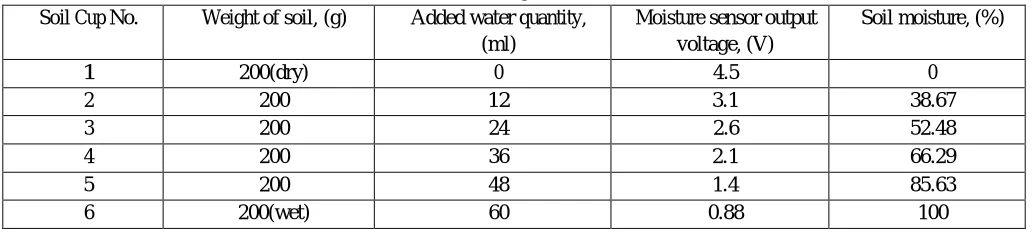
9) Soil Moisture Sensor: Soil is non conductive by nature but presence of water in soil increases its conductivity due to the presence of conduction ions in water . Soil resistivity is a measure of a soil's ability to retard the conduction of an electric current .Normally, the soil resistivity varies from 0 to 5 kilo-ohms. The soil moisture sensor has probes to be inserted into soil. Specifications of Soil Moisture Sensor with Operating Voltage:3.3V-5V,Dual output, 4 wire interface ,Panel PCB dim.: 3cm x1.5cm,Soil Probe dim.: 6cm x 3cm ,Cable length : 21cm,Digitaloutput(DO)and Analog output(AO)interface are used .Voltage will be developed between the PIN AO and GND , the development of voltage is depends upon the moisture condition of the soil and the sensor length kept in side the soil.Thesensorwillproducehighvoltagesay4.5to5Vwhenthe soil is completely dry[12]. Voltage level will decrease w.r.t. increase in moisture content .When the soil is completely wet ,the output voltage will be 0.88to1.0V.
[image:3.612.49.565.385.501.2]In fruit trees, moisture sensor should be placed on the sunny side of the treat 30-45cm from the emitter .In vegetable crops, moisture sensor should be placedat10-15 cm depth. For trees, thumbruleistoirrigate60%ofthe shaded area. To understand the functional behavior of soil moisture sensors, batteries charging voltage, batteries discharging voltage while running the pump by drawing the power from battery alone (i.e., keeping solar panel disconnected from the circuit) and batteries discharging voltage while running the pump drawing power from batteries and simultaneously it is also kept in charged condition from SPV, the following Table I illustrates the voltage developed by the moisture sensor w.r.t. addition of water[13].
Table I:-Moisture sensor voltage w.r.t. water content in the soil Soil Cup No. Weight of soil, (g) Added water quantity,
(ml)
Moisture sensor output voltage, (V)
Soil moisture, (%)
1 200(dry) 0 4.5 0
2 200 12 3.1 38.67
3 200 24 2.6 52.48
4 200 36 2.1 66.29
5 200 48 1.4 85.63
6 200(wet) 60 0.88 100
10) Temperature Sensor: LM35 gives the voltage in the range of -55 -150amp.The LM35 is an integrated circuit sensor that can be used to measure temperature with an electrical output proportional to the temperature (in °C).It can measure temperature more accurately than a using a thermistor [14].Temperature is a important factor for the change of the moisture level in the environment. Another important characteristic of the LM35DZ is that it draws only 60 micro amps from its supply and possesses a low self-heating capability. The sensor self- heating causes less than 0.1oC temperature rise in still air. The LM35 generates a higher output voltage than thermocouples and may not require that the output voltage be amplified.
622
©IJRASET: All Rights are Reserved
Fig.3 Setup Of Solar Powered Automatic Irrigation System
Fig.4Soil moisture and temperature sensors
A. Working
623
©IJRASET: All Rights are Reserved
IV. COSTANALYSIS
Table2 . Cost Analysis of proposed Automatic irrigation system using solar panel
S.No. Components Unit
Cost in Rs/-
Quantity Total Cost(Rs)
1 Solar Panel 1050 1 1050
2 Battery 1700 1 1700
3 1000μFCapacitor 7 1 7
4 470μF Capacitor 3 1 3
5 7805 Voltage
Regulator
15 1 15
6 1kΩ resistor 7.5 2 15
7 Reset Switch 60 1 60
8 AT89S52
Microcontroller
130 1 130
9 LDR 10 1 10
10 Soil Moisture Sensor
65 1 65
11 Temperature
Sensor
250 1 250
12 Analog to Digita –l Converter
140 1 140
13 LCD Display 150 1 150
14 Relay Circuit 200 3 600
15 Pump 100 1 100
16 Fan 250 1 250
17 LED 10 4 40
18 Lamp 100 1 100
TOTAL
COST(Rs) Rs.4685
V. CONCLUSION
By implementing the proposed system there are various benefits to both the government and the farmers. This can be a solution for the government in the present state of energy crisis. By using the automatic irrigation system one can optimizes the usage of water by reducing wastage and reduces the human intervention [15]. The excess energy produced using solar panels can also be given to the grid with small modifications in the circuit, which can be a source of the revenue of the farmer, thus encouraging farming in India and same time giving a solution for energy crisis. Proposed system is easy to implement and environment friendly solution for irrigating fields. The system was found to be successful when implemented for bore holes as they pump over the whole day. Solar pumps also offer clean solutions with no danger of borehole contamination. The system requires minimal maintenance and attention as they are self-starting. Even though there is high capital investment required for this system to be implemented, the overall benefits are high and in long run this system is economical.
REFERENCES
[1] G.L. Barbosa, F. D. A. Gadelha, N. Kublik, R. U. Halden, “Comparison of Land, Water, and Energy Requirements of Lettuce Grown Using Bydroponic vs. Conventional Agricultural Methods”, International Journal of Environmental Research and Public Health, 2015.
[2] Deweshvree Rane, P.R. Indurkar, D.M. Khatri, “Review Paper Based On Automatic Irrigation System Based On RF Module”, IJAICT Volume 1, Issue 9, January 2015
[3] Archana P, Priya R, “DESIGN AND IMPLEMENTATION OF AUTOMATIC PLANT WATERING SYSTEM”, International Journal of Advanced Engineering and Global Technology Vol-04, Issue-01 , January 2016, ISSN No: 2309-4893
624
©IJRASET: All Rights are Reserved
[5] https://en.wikipedia.org/wiki/Electricity_sector_in_India#cite_ref-GES_3-13(accessed on 16-01-2019).
[6] Ministry of Power, Central Electricity Authority, “Growth of electricity sector in India from 1947-2016”, May 2016.
[7] S. Darshna, T.Sangavi , Sheena Mohan, A.Soundharya, Sukanya Desikan , “Smart Irrigation System”, IOSR Journal of Electronics and Communication Engineering Volume 10, Issue 3, Ver. II (May - Jun.2015).
[8] Karan Kansara, Vishal Zaveri, Shreyans Shah, Sandip Delwadkar, Kaushal Jani, “Sensor based Automated Irrigation System with IOT: A Technical Review”, Karan Kansara et al, / (IJCSIT) International Journal of Computer Science and Information Technologies, Vol. 6 (6), 2015, 5331-5333
[9] Abhinav Rajpal, Sumit Jain, Nistha Khare and Anil Kumar Shukla, “Microcontroller based Automatic Irrigation System with Moisture Sensors”, Proceedings of the International Conference on Science and Engineering, 2011, pp. 94-96
[10] Venkata Naga RohitGunturi, “MicroController Based Automatic Plant Irrigation System”, International Journal of Advancements in Research & Technology, Volume 2, Issue4, April-2013
[11] Dr.S. Raman, “Micro Irrigation status and Technology Adoption in India”, National Congress on New Challenges and Advances in Sustainable Micro Irrigation, March, 2017, Pages-21-35.
[12] Sabe, A.y., Venaagmoothy, G.K.”Efficient Utilization of renewable energy sources by Gridable Vehicles in Cyber-Physical energy System Journal,IEEE-sept 2010n cycle control.
[13] Garg, H.P. 1987. Advances in solar energy technology, Volume 3. Reidel Publishing, Boston,MA.
[14] Halcrow, S.W. and Partners. 1981. Small-scale solar powered irrigation pumping systems: technical and economic review. UNDP Project GLO/78/004.Intermediate Technology Power, London, UK. A. Harmim et al., “Mathematical modeling of a box-type solar cooker employing an asymmetric compound parabolic concentrator,” Solar Energy, vol.86, pp. 1673–1682,2012.
[15] K. K. Tse, M. T. Ho, H. S.-H. Chung, and S. Y. Hui, “A novel maximum power point tracker for PV panels using switching frequency modulation,” IEEE Trans. Power Electron., vol. 17, no. 6, pp. 980–989,Nov.2002.
[16] Haley, M, and M. D. Dukes. 2007. Evaluation of sensor-based residential irrigation water application. ASABE 2007 Annual International Meeting, Minneapolis, Minnesota, 2007. ASABE Paper No.072251.
[17] Prakash Persada, Nadine Sangsterb, Edward Cumberbatch, Aneil Ram khalawand and AatmaMaharajh, "Investigating the Feasibility of Solar Powered Irrigation for Food Crop Production: A Caroni Case," ISSN 1000 7924 The Journal of the Association of Professional Engineers of Trinidad and Tobago, Vol.40, No.2, pp.61-65, October/November2011.
[18] L. Prisilla, P.S.V. Rooban and L. Arockiam, “A novel method for water irrigation system for paddy fields using ANN,” InternationalJournal of Computer Science and Network, Vol.1, No. 2, April2012.