The DCU Discourse Parser for Connective, Argument Identification and
Explicit Sense Classification
Longyue Wang, Chris Hokamp, Tsuyoshi Okita, Xiaojun Zhang, Qun Liu ADAPT Centre
School of Computing, Dublin City University Glasnevin, Dublin 9, Ireland
{lwang, chokamp, tokita, xzhang, qliu}@computing.dcu.ie
Abstract
This paper describes our submission to the CoNLL-2015 shared task on discourse parsing. We factor the pipeline into sub-components which are then used to form the final sequential architecture. Focusing on achieving good performance when in-ferring explicit discourse relations, we ap-ply maximum entropy and recurrent neu-ral networks to different sub-tasks such as connective identification, argument ex-traction, and sense classification. The our final system achieves 16.51%, 12.73% and 11.15% overall F1 scores on the dev, WSJ and blind test sets, respectively.
1 Introduction
The task of discourse parsing is generally con-ceived as a pipeline of steps, corresponding to: i) locating explicit discourse connectives, ii) identi-fying the spans of text that serve as the two argu-ments for each discourse connective, and iii) pdicting the sense for both explicit and implicit re-lations. Understanding such discourse information is clearly an important component of natural lan-guage understanding that impacts a wide range of downstream natural language applications.
Since Penn Discourse Treebank was released, a number of data driven approaches have been proposed to deal with different challenging sub-tasks of discourse parsing. As explicit arguments may be intra-sentential or inter-sentential, Lin et al. (2012), Xu et al. (2012), Stepanov and Ric-cardi (2012) propose to employ argument posi-tion classificaposi-tion as heuristic and then apply sepa-rated models for argument extraction. Ghosh et al. (2011) regarded argument extraction as a token-level sequence labeling task, applying conditional random fields (CRFs) to label each token in a sen-tence. Following on this work, Ghosh et al. (2012)
designed many global features to help distinguish Argument1 and Argument2 within the same sen-tence. Lin et al. (2014) formulated the task as finding the nodes in the constituent parse that are Argument1 or Argument2. However, the perfor-mance of this approach is heavily dependent upon the quality of the input parse trees. The different characteristic of implicit and explicit discourse re-lations are another important consideration. Lin et al. (2009) apply three feature classes: the con-stituent parse, the dependency parse and word-pair features for implicit relation classification. Rutherford and Xue (2014) exploit Brown cluster pairs to represent discourse relations in naturally occurring text. Considering the whole task, Lin et al. (2014) introduce a pipeline framework in-cluding several sub-tasks (connective classifier, ar-gument labeler, explicit classifier and non-explicit classifier) to handle both explicit and non-explicit relations based on the PDTB corpus using maxi-mum entropy.
In our work, we design the framework of our system based on Lin et al. (2014). The task is split the into seven components: connective clas-sifier, argument positions clasclas-sifier, three argu-ment extractors, explicit sense classifier and im-plicit sense classifier. We approach argument ex-traction as a sequence labelling task, employing recurrent neural network (RNN) to classify each candidate token. We use distributional representa-tions via word embeddings to decrease the out-of-vocabulary words (OOVs) problem which result from the scarcity of training data. After a post-precessing step which resolves label conflicts, we extract the spans of arguments. For other com-ponents, we use a classification via maximum en-tropy, and explore diverse features. In this sys-tem, we mainly focus on explicit relations, thus we only apply a simple majority function for the non-explicit component.
The remainder of this paper is organized as
lows: Section 2 describes the framework and each component of our proposed system. Then we dis-cuss the results, including the official results and post-task results, in Section 3. Finally, we sum-marize our conclusions in Section 4.
2 Proposed System
The framework of our system is shown in Figure 1. In the first step, the connective classifier is used to identify connectives according to the occurrences of the predefined connectives. Once a candidate is labelled as a connective, an explicit relation is created. The next step is then to find the argument positions (arg1 and arg2) for each explicit rela-tion. Here we use a classifier to label two cases: 1, arg1 and arg2 are in the same sentence (SS), or 2, arg1 andarg2 are not in the same sentence (OT). Then we train and apply different argument extraction models for these two cases. After la-belling the argument span, we use a sense classi-fication component to classify them to predefined sense types.
After processing the explicit relations, the non-explicit part extracts all the adjacent sentence pairs which are not explicit relations and then infers im-plicit relations. As we mainly focus on exim-plicit relations, in this part, we only apply a simple ma-jority function to give all candidate pairs the same results.
2.1 Connective Classifier
As words which can be discourse connectives do not always function as discourse connectives, we need to identify if an instance of a connective candidate is a functional connective each time it occurs. Pilter and Nenkova (2009) showed that syntactic features extracted from constituent parse trees are very useful in disambiguating discourse connectives from other functions. Lin et al. (2014) tackled this problem by first using the connec-tive list to identify the candidates and then us-ing a combination of simple POS-based features and tree-based features, an approach which also achieved good performance. To model the syntac-tic relation, they also propose a path feature, which is the combined tags of sub-tree nodes from con-nective to the root. Compressed path means the adjacent identical tags are combined (e.g., -NP-NP- is combined into --NP-NP-).
Based on above work, we extract the 99 types of connectives defined in the PDTB training corpus.
As shown in Table 1, we use three feature classes: lexical, syntactic and others. Especially, we em-ploy the position of connection as a new feature (i.e., beginning or not), because we observe that the candidates occurring at the beginning are al-ways the connectives. Then a ME model is applied to classify each connective candidate as a connec-tive or not. After exploring 14 features and com-binations, we finally found that the feature set{ 2-10,13, 14}which yields the best performance on dev set. The final score is shown in Section 3.
2.2 Argument Position Classification
arg2is the argument with which the connective is syntactically associated, and its position is fixed once we have located the connective from the pre-vious component (Section 2.1). Thus, the chal-lenging step for this task is to identify the location ofarg1.
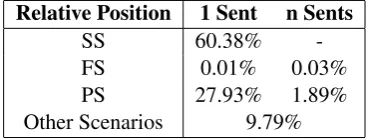
Prasad et al. (2008) show thatarg1may be lo-cated in various positions to the connective, such as within the same sentence (SS), before (PS), or after (FS) the sentence containing the connec-tive. Furthermore,arg1 may be adjacent or non-adjacent with connective sentence. arg1may also contain one or more sentences. Table 2 shows the statistics of each of above scenarios.
Relative Position 1 Sent n Sents
SS 60.38%
-FS 0.01% 0.03%
PS 27.93% 1.89%
[image:2.595.324.509.439.509.2]Other Scenarios 9.79%
Table 2: Statistics of arg1’s Positions. (Percent-age (%) is computed as the number of the scenario divided by the total relations; n>1)
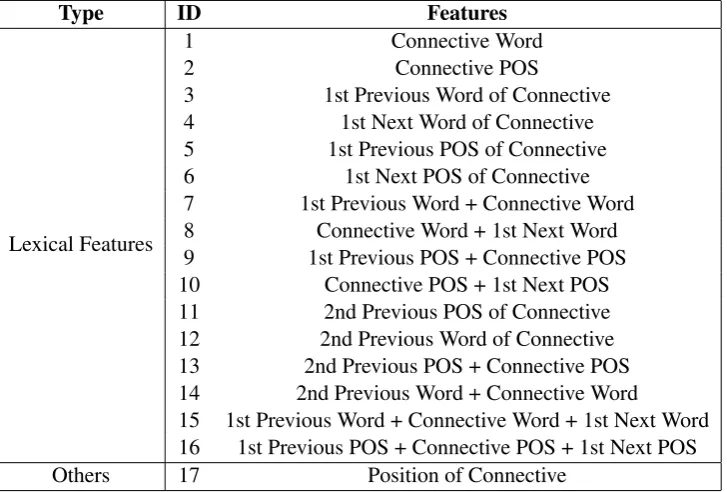
As SS and PS constitute 90.20% of all explicit relations, our system mainly focus on these two cases. Therefore, we use a argument position clas-sifier to classify a relation as SS or PS. In our ex-periment, we compared 17 features and their com-binations, which are shown in Table 3. Finally, we use the feature set{1-3, 5, 7, 9, 11-14, 17}since it achieves the highest accuracy (97.78%) on dev set.
2.3 Argument Extraction
Figure 1: Framework of Our System
Type ID Features
Lexical Features
1 Connective Word
2 Connective POS
3 1st Previous Word of Connective 4 1st Next Word of Connective 5 1st Previous Word + Connective Word 6 Connective Word + 1st Next Word 7 1st Previous POS + Connective POS 8 Connective POS + 1st Next POS
9 1st Previous Word + Connective Word + 1st Next Word 10 1st Previous POS + Connective POS + 1st Next POS
[image:3.595.113.490.239.446.2]Syntactic Features 1112 Path of Connective’s Parent to the RootPath of Connective to the Root 13 Compressed Path of Connective’s Parent to the Root Others 14 Low-Cased Connective Word
Table 1: Features for Connective Classification
Type ID Features
Lexical Features
1 Connective Word
2 Connective POS
3 1st Previous Word of Connective 4 1st Next Word of Connective 5 1st Previous POS of Connective 6 1st Next POS of Connective 7 1st Previous Word + Connective Word 8 Connective Word + 1st Next Word 9 1st Previous POS + Connective POS 10 Connective POS + 1st Next POS 11 2nd Previous POS of Connective 12 2nd Previous Word of Connective 13 2nd Previous POS + Connective POS 14 2nd Previous Word + Connective Word
15 1st Previous Word + Connective Word + 1st Next Word 16 1st Previous POS + Connective POS + 1st Next POS Others 17 Position of Connective
[image:3.595.119.483.487.733.2]of applying deep neural network technologies in natural language processing, we carried out an in-vestigation of the use of recurrent neural network (RNN) for this difficult task (Mesnil et al., 2013; Raymond and Riccardi, 2007).
After determining the likely position of arg1, we split the explicit relations into two sets: SS and OT. We apply token-level sequence labeling approach with the separate models for arguments of intra-sentential and inter-sentential explicit dis-course relations (Ghosh et al. 2011; Stepanov and Riccardi, 2012). As shown in Figure 1, we apply two components to deal with these two cases. Be-sides, in OT, we also train separated models to deal with Arg1 and Arg2 extraction.
Since for sequence labeling we use IOBE (In-side, Out, Begin, End) notation as the labels for both Arg1 and Arg2. For example, the set of classes for the SS case is {B, I, arg1-E, arg2-B, arg2-I, arg2-E and None}. The sets of classes for OT are{arg1-B, arg1-I, arg1-E and None}and{arg2-B, arg2-I, arg2-E and None}.
As input features, we use the word embeddings for Arg1 and Arg2 in order to infer the argument labels. We use RNNs to learn a word embedding on the part of training data. As the official scorer will give points only when the whole argument span is right, we employ this scorer to calculate the performance in each iteration of training. Further-more, we compare the performance with different parameters: number of context windows, hidden layers, iterations and word embeddings. Finally, we set number of context windows as 5, hidden layers as 300, iterations as 10 and word embed-dings as 100 to achieve the highest performance.
Besides, we only extract the relations in the corresponding scenario as the training data, thus OOVs may harm the models. We use distri-butional representations via word embeddings to alleviate the problem, which results from the scarcity of training data.
2.4 Explicit Sense Classification
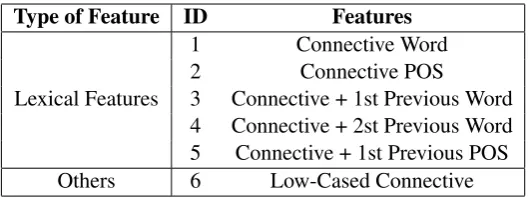
One method that has previously been employed to resolve the ambiguity in discourse connectives is to build a classifier with some very simple features. They are the connective (one or more words), the connectives POS, and the connective + its previous word (Lin et al., 2014). This approach achieves an F1 score of 86.77, which is quite im-pressive compared the human agreement score of
84%.
Therefore, for this component, we still employ the similar feature set, which is shown in Table 4. Finally, we apply the feature set{1-3, 5-6} to obtain the best scores on dev set.
2.5 Non-Explicit Relations
The non-explicit relation includes Implicit , Al-tLex, EntRel and NoRel relations.
The non-explicit relations are annotated for all adjacent sentence pairs within paragraphs. If there is already an explicit relation from the previous step between two adjacent sentences, they are ex-empt from this step. In our system, we just apply a majority classifier, labeling all non-explicit rela-tion candidates as EntRel.
3 Experiments and Results 3.1 System Setup
All available training data, development set, test sets from CoNLL 2015 (LDC2015E21)1 are used
in this study. Besides, we use the Skip-gram Neu-ral Word Embeddings2 for RNNs. All the used
syntactic information are automatically predicted by the Berkeley Parser3.
We use Maxent toolkit4 for the ME method.
And we apply Theano5 (Bastien et al., 2012;
Bergstra et al., 2010) for the RNNs. We use the Python programming language to develop all the compontents and divided each component into two parts: one is training which is processed in our CPU and GPU servers and the other is decoding which is run on TIRA server6.
3.2 Official Results
The official results are shown in Table 5. The per-formance of connective classifier is around 80%, which is not good enough. There are two reasons: 1, we skip some separated connectives such as ei-ther or, neiei-ther nor etc. and 2, the current fea-ture set missed some syntactic information. For argument extraction, the reasonable scores show our proposed method can really work for this part. However, it does not work well for OT case, be-cause the span is always located the whole sen-tence. It may be helpful by adding structure
fea-1Available at https://www.ldc.upenn.edu
2Available at https://code.google.com/p/word2vec
3Description at http://www.cs.brandeis.edu/ clp/conll15st/rules.html 4Available at https://github.com/lzhang10/maxent
Type of Feature ID Features
Lexical Features
1 Connective Word 2 Connective POS
[image:5.595.167.432.61.160.2]3 Connective + 1st Previous Word 4 Connective + 2st Previous Word 5 Connective + 1st Previous POS Others 6 Low-Cased Connective Table 4: Features for Explicit Sense Classification.
tures into RNNs. The sense classifier is the worst component, which only obtained about 8% F1 scores. It is because 1, the errors from previous components are propagated, which is also the lim-itation of the pipeline architecture; 2, we apply a simple non-explicit component and miss a lot implicit relations, which result in the low recall. On the whole, our system can still be improved in many ways.
4 Conclusions and Further Work
This paper describes the discourse parsing sys-tem we implemented for the CoNLL-2015 shared task. We build a pipeline system which focuses on achieving good performance when inferring ex-plicit discourse relations. We apply maximum en-tropy and recurrent neural networks to different sub-tasks.
This is our ongoing work, and we will keep on improving the system by employing novel neural network methods.
Acknowledgments
This work is supported by the Science Founda-tion of Ireland (SFI) CNGL project (Grant No.: 12/CE/I2267), and partly supported by the DCU-Huawei Joint Project (Grant No.:201504032) and the Open Projects Program of National Laboratory of Patter Recognition (Grant No.: 201407353), and also by the European Commission FP7 EX-PERT project.
References
Ziheng Lin, Hwee Tou Ng and Min-Yen Kan. 2014.
A PDTB-styled End-to-End Discourse Parser, vol-ume 1-34. Natural Language Engineering.
Sucheta Ghosh, Richard Johansson and Sara Tonelli. 2011. Shallow Discourse Parsing with Conditional Random Fields. In Proceedings of the 5th Interna-tional Joint Conference on Natural Language Pro-cessing.
Sucheta Ghosh, Giuseppe Riccardi and Richard Jo-hansson. 2012. Global Features for Shallow Dis-course Parsing, 150-159. In Proceedings of the 13th Annual Meeting of the Special Interest Group on Discourse and Dialogue. Association for Computa-tional Linguistics
Emily Pitler and Ani Nenkova. 2009. Global Fea-tures for Shallow Discourse Parsing, 150-159. In Proceedings of the ACL-IJCNLP 2009 Conference Short Papers. Association for Computational Lin-guistics.
Attapol T. Rutherford and Nianwen Xue. 2014.
Discovering Implicit Discourse Relations Through Brown Cluster Pair Representation and Coreference Patterns, 645. In Proceedings of EACL 2014. Rashmi Prasad, Nikhil Dinesh, Alan Lee, Eleni
Milt-sakaki, Livio Robaldo, Aravind Joshi, Bonnie Web-ber. 2008. The Penn Discourse TreeBank 2.0. In Proceedings of the LREC.
Grgoire Mesnil, Xiaodong He, Li Deng and Yoshua Bengio. 2013. Investigation of Recurrent-Neural-Network Architectures and Learning Methods for Spoken Language Understanding. In Proceedings of the Interspeech 2013.
Christian Raymond and Giuseppe Riccardi. 2007.
Generative and discriminative algorithms for spo-ken language understanding. In Proceedings of the Interspeech 2007.
Frdric Bastien, Pascal Lamblin, Razvan Pascanu, James Bergstra, Ian Goodfellow, Arnaud Bergeron, Nicolas Bouchard, David Warde-Farley, Yoshua Bengio. 2012. Theano: new features and speed im-provements. In Proceedings of the Python for Scien-tific Computing Conference (SciPy).
James Bergstra, Olivier Breuleux, Frdric Bastien, Pas-cal Lamblin, Razvan Pascanu, Guillaume Des-jardins, Joseph Turian, David Warde-Farley, Yoshua Bengio. 2010. Theano: a CPU and GPU math ex-pression compiler. In Proceedings of the Python for Scientific Computing Conference (SciPy).
Evgeny A. Stepanov and Giuseppe Riccardi. 2013.
Dev Set Test Set Blind Set
Components Precision Recall F1 Precision Recall F1 Precision Recall F1 Connectives 0.9010 0.8162 0.8565 0.9040 0.8570 0.8799 0.8487 0.7464 0.7943
Arg1 0.3437 0.4770 0.3995 0.3100 0.4384 0.3632 0.2794 0.3755 0.3204 Arg2 0.3778 0.5244 0.4392 0.3559 0.5034 0.4170 0.3489 0.4690 0.4001 Arg1 & Arg2 0.2559 0.3552 0.2975 0.2174 0.3074 0.2546 0.1926 0.2589 0.2209 Sense 0.3194 0.1080 0.0938 0.2257 0.1124 0.0849 0.0905 0.0701 0.0481 Overall 0.1420 0.1971 0.1651 0.1087 0.1537 0.1273 0.0972 0.1307 0.1115
Table 5: Official Results.