Top-Rank Enhanced Listwise Optimization
for Statistical Machine Translation
Huadong Chen,†Shujian Huang,†∗ David Chiang,‡Xinyu Dai,†Jiajun Chen† †State Key Laboratory for Novel Software Technology, Nanjing University
{chenhd,huangsj,daixinyu,chenjj}@nlp.nju.edu.cn
‡Department of Computer Science and Engineering, University of Notre Dame
Abstract
Pairwise ranking methods are the basis of many widely used discriminative train-ing approaches for structure prediction problems in natural language processing (NLP). Decomposing the problem of rank-ing hypotheses into pairwise comparisons enables simple and efficient solutions. However, neglecting the global ordering of the hypothesis list may hinder learning. We propose a listwise learning framework for structure prediction problems such as machine translation. Our framework di-rectly models the entire translation list’s ordering to learn parameters which may better fit the given listwise samples. Fur-thermore, we proposetop-rank enhanced
loss functions, which are more sensitive to ranking errors at higher positions. Exper-iments on a large-scale Chinese-English translation task show that both our list-wise learning framework and top-rank en-hanced listwise losses lead to significant improvements in translation quality. 1 Introduction
Discriminative training methods for structured prediction in natural language processing (NLP) aim to estimate the parameters of a model that as-signs a score to each hypothesis in the (possibly very large) search space. For example, in statisti-cal machine translation (SMT), the model assigns a score to each possible translation, and in syn-tactic parsing, the function assigns a score to each possible syntactic tree. Ideally, the model should assign scores that rank hypotheses according to their true quality. In this paper, we consider the problem of discriminative training for SMT.
∗Corresponding author.
Traditional SMT systems use log-linear models with only about a dozen features, such as trans-lation probabilities and language model probabil-ities (Yamada and Knight, 2001; Koehn et al.,
2003;Chiang,2005;Liu et al.,2006). These mod-els can be tuned by minimum error rate training (MERT) (Och, 2003), which directly optimizes BLEU using coordinate ascent combined with a global line search.
To enable training of modern SMT systems, which can have thousands of features or more, many research efforts have been made towards scalable discriminative training methods (Chiang et al.,2008;Hopkins and May,2011;Bazrafshan et al., 2012). Most of these methods either de-fine loss functions that push the model to correctly compare pairs of hypotheses, or use approximate optimization methods that effectively do the same. For practical reasons, only a subset of the pairs are considered; these pairs are selected by either sam-pling (Hopkins and May,2011) or heuristic meth-ods (Watanabe et al.,2007;Chiang et al.,2008).
But this pairwise approach neglects the global ordering of the list of hypotheses, which may lead to problems trying to learn good parameter values. Inspired by research in information re-trieval (IR) (Cao et al., 2007; Xia et al., 2008), we propose to directly model the ordering of the whole translation list, instead of decomposing it into translation pairs.
Previous research has tried to integrate listwise methods into SMT, but almost all of them focus on the reranking task, which aims to rescore the fixed translation lists generated by a baseline sys-tem. They try to either use listwise approaches to training the reranking model (Li et al., 2013;
Niehues et al., 2015) or replace the pointwise ranking function, i.e. the log-linear model, with a listwise ranking function by introducing listwise features (Zhang et al., 2016). In this paper, we
focus on listwise approaches that can learn bet-ter discriminative models for SMT. We present a listwise learning framework for tuning translation systems that uses two listwise ranking objectives originally developed for IR, ListNet (Cao et al.,
2007) and ListMLE (Xia et al., 2008). But un-like standard IR problems, structured prediction problems usually have a huge search space, and at each training iteration, the list of search results can vary. The usual strategy is to form the union of all lists of search results, but this can lead to a “patchy” list that doesn’t represent the full search space well. The listwise approaches always based on the permutation probability distribution over the list. Modeling the distribution over a “patchy” list, whose elements were generated by different parameters will affect listwise approaches’ per-formance. To address this issue, we design an
instance-aggregating method: Instead of treating the data as a fixed-size set of lists that each grow over time as new translations are added at each it-eration, we treat the data as a growing set of lists; each time a sentence is translated, thek-best list of translations is added as a new list.
We also extend standard listwise training by considering the importance of different instances in the list. Based on the intuition that instances at the top may be more important for ranking, we proposetop-rank enhancedloss functions, which incorporate a position-dependent cost that penal-izes errors occurring at the top of the list more strongly.
We conduct large-scale Chinese-to-English translation experiments showing that our top-rank enhanced listwise learning methods significantly outperform other tuning methods with high di-mensional feature sets. Additionally, even with a small basic feature set, our methods still obtain better results than MERT.
2 Background
2.1 Log-linear models
In this paper, we assume a log-linear model, which defines a scoring function on target translation hy-pothesese, given a source sentencef:
P r(e|f) = Pexps(e,f)
e0exps(e0,f) (1) s(e,f) =w·h(e|f) (2) whereh(e | f) is the feature vector andwis the feature weight vector.
𝑓𝑖 𝑓𝑖+1 𝑓𝑖+2 𝑓𝑖+3
𝑒𝑗 𝑒𝑗 +1 𝑒𝑗 +2 𝑒𝑗 +3 𝑒𝑗 +4
Figure 1: An example of word-phrase features for a phrase translation. Thefi andejrepresent thei
-th in -the source phrase andj-th word in the target phrase, respectively.
The process of training a SMT system includes both learning the sub-models, which are included in the feature vector h, and learning the weight vectorw.
Then the decoding of SMT systems can be for-mulated as a search for the translationˆewith the highest model score:
ˆe= arg max
e∈E s(e,f) (3)
whereEis the set of all reachable hypotheses.
2.2 SMT Features
In this paper, we use a hierarchical phrase based translation system (Chiang,2005). For convenient comparison, we divide features of SMT into the following three sets.
Basic Features: The basic features are those commonly used in hierarchical phrase based trans-lation systems, including a language model, four translation model features, word, phrase and rule penalties, and penalties for unknown words, the glue rule and null translations.
Extended Features: Inspired by Chen et al.
(2013), we manually group the parallel training data into 15 sets, according to their genre and ori-gin. The translation models trained on each set are used as separate features. We also add an indica-tor feature for each individual training set to mark where the translation rule comes from. The ex-tended features provide additional 60 translation model features and 16 indicator features, which is too many to be tuned with MERT.
Sparse Features: We use word-phrase pair features as our sparse features, which reflect the word-phrase correspondence in a hierarchical phrase (Watanabe et al.,2007). Figure1illustrates an example of word-phrase pair features for a phrase translation pairfi, ..., fi+3andej, ..., ej+4.
Word-phrase pair features (fi, ej+1), (fi+1, ej),
(fi+2, ej+2ej+3),(fi+3, ej+4)will be fired for the
practice, these feature only fire when all the source and target words in the feature are both in the top 100 most frequent words.
2.3 Tuning via Pairwise Ranking
The beam search strategy for SMT decoding pro-cess makes it convenient to get a k-best transla-tion list for each source sentence. Given a set of source sentences and their corresponding transla-tion lists, the tuning problem could be regarded as a ranking task. Many recently proposed SMT tuning methods are based on the pairwise rank-ing framework (Chiang et al.,2008;Hopkins and May,2011;Bazrafshan et al.,2012).
Pairwise ranking optimization (PRO) (Hopkins and May, 2011) is a commonly used tuning method. The idea of PRO is to sample pairs(e,e0)
from thek-best list, and train a linear binary clas-sifier to predict whether eval(e) > eval(e0) or eval(e) < eval(e0), where eval(·) is an extrinsic
metric like BLEU. In this paper, we use sentence-level BLEU with add-one smoothing (Lin and Och,2004).
The method gets a comparable BLEU score to MERT and MIRA (Chiang et al.,2008), and scales well on large feature sets. Other pairwise ranking methods employ similar procedures.
3 Listwise Learning Framework
Although ranking methods have shown their effec-tiveness in tuning for SMT systems (Hopkins and May, 2011; Watanabe, 2012; Dreyer and Dong,
2015), most proposed ranking approaches view tuning as pairwise ranking. These approaches de-compose the ranking of the hypothesis list into pairs, which might limit the training method’s ability to learn better parameters. To preserve the ranking information, we first formulate training as an instance of the listwise ranking problem. Then we propose a learning method based on the iter-ative learning framework of SMT tuning and fur-ther investigate the top-rank enhanced losses.
3.1 Training Objectives
3.1.1 The Permutation Probability Model
In order to directly model the translation list, we first introduce a probabilistic model proposed byGuiver and Snelson(2009). A ranking of a list ofktranslations can be thought of as a functionπ from[1, k]to translations, where each π(t)is the t-th translation candidate in the ranking. A scoring
functionz(which could be either the model score, s, or the BLEU score,eval) induces a probability distribution over rankings:
Pz(π) = k
Y
j=1
expz(π(j))
Pk
t=jexpz(π(t))
. (4)
3.1.2 Loss Functions
Based on the probabilistic model above, the loss function can be defined as the difference between the distribution over the ranking according to eval(·) ands(·). Thus, we introduce the follow-ing two standard listwise losses.
ListNet: The ListNet loss is the cross entropy between the distributions calculated fromeval(·)
ands(·), respectively, over all permutations. Due to the exponential number of permutations,
Cao et al. (2007) propose a top-one loss instead. Given the function eval(·) ands(·), the top-one loss is defined as:
LNet-T=−
k
X
j=1
P0
eval(ej) logPs0(ej)
P0
z(ej) = Pkexpz(ej) i=1expz(ei)
where ej is the j-th element in the k-best list,
andP0
z(ej)is the probability that translationej is
ranked at the top by the functionz.
ListMLE: The ListMLE loss is the negative log-likelihood of the permutation probability of the correct ranking πeval, calculated according
tos(·)(Xia et al.,2008):
LMLE =−logPs(πeval)
=−Xk
j=1
logPkexps(πeval(j))
t=jexps(πeval(t)).
(5)
The training objective, which we want to min-imize, is simply the total loss over all the lists in the tuning set.
3.2 Training with Instance Aggregating
Algorithm 1MERT-like tuning algorithm
Require: Training sentences {f}, maximum number of iterations I, randomly initialized model parametersw0.
1: fori= 0toI do
2: forsource sentencesf do
3: Decodef:Efi =KbestDecoder(f,wi) 4: T ←T∪ {Ei
f}
5: end for
6: Training: wi+1=Optimization(T,wi) 7: end for
Many previous tuning methods address this problem by merging the k-best list at the current iteration with thek-best lists at all previous itera-tions into a single list (Hopkins and May,2011). We call thisk-best merging. More formally, ifEi f
is thek-best list of source sentencefat iterationi, then at each iteration, the model is trained on the set of lists:
Ef = i
[
j=0
Efj
T ={Ef | ∀f}
For each source sentencef,T has only one train-ing sample, which is a better and better approxi-mation to the full hypothesis set off as more iter-ations pass.
Unlike previous tuning methods, our tuning method focuses on the distribution over permuta-tion of the whole list. Moreover, unlike with list-wise optimization methods used in IR, thek-best list produced for a source sentence at one iteration can differ dramatically from the k-best list pro-duced at the next iteration. Merging k-best lists across iterations, each of which represents only a tiny fraction of the full search space, will lead to a “patchy” list that may hurt the learning perfor-mance of the listwise optimization algorithms.
To address this challenge, we proposeinstance aggregating: instead of mergingk-best lists across different iterations, we view the translation lists from different iterations as individual training in-stances:
T ={Efj | ∀f,0≤j≤i}.
With this method, each source sentence f has i training instances at thei-th training iteration. In this way, we avoid “patchy” lists and obtain a bet-ter set of instances for tuning.
Algorithm 2Listwise Optimization Algorithm
Require: Training instancesT, model parameters
w, maximum number of epochsJ, batch size b, number of batchesB
1: for j = 0toJ do 2: for i= 0toB do
3: Sample a minibatch of b lists from T
without replacement
4: Calculate loss functionL 5: Calculate gradient∇L
6: wt+1=AdaDelta(wt, L,∆w)
7: end for 8: end for
9: w=BestBLEU([E]m 1 )
The above instance aggregating method can be used in a MERT-like iterative tuning algorithm as shown in Algorithm1, which can be easily inte-grated into current open source systems. The two standard listwise losses can be easily optimized using gradient-based methods (Algorithm2); both losses are convex, so convergence to a global opti-mum is guaranteed. The gradients of ListNET and ListMLE with respect to the parameters w for a single sentence are:
∂LNet-T ∂w =−
k
X
j=1
Peval0 (ej) ∂s∂(wej)
−Xk
j=1
exps(ej)
Pk
j0=1exps(ej0) ∂s(ej)
∂w
!
∂LMLE ∂w =−
k
X
j=1
∂s(πeval(j))
∂w
−Xk
t=j
exps(πeval(t))
Pk
t0=jexps(πeval(t0))
∂s(πeval(t))
∂w
!
For optimization, we use a mini-batch stochas-tic gradient descent (SGD) algorithm together with AdaDelta (Zeiler, 2012) algorithm to adap-tively set the learning rate.
4 Top-Rank Enhanced Losses
attention to the top-ranked translations instead of forcing the model to rank the entire list correctly.
Position-dependent Attention: To do this, we assign a higher cost to ranking errors that occur at the top and a lower cost to errors at the bottom. To make the cost sensitive to position, we define it as:
c(j) = kP−kj+ 1
t=1t
(6)
wherejis the position in the ranking andkis the size of the list.
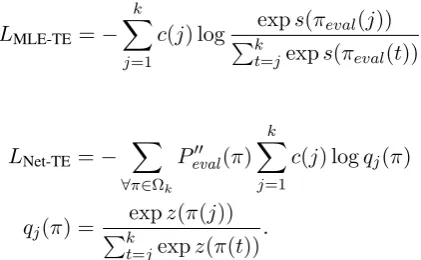
Based on this cost function, we propose simple top-rank enhanced listwise losses as extensions of both the ListNet loss and the ListMLE loss. The loss functions are defined as follows:
LMLE-TE=−
k
X
j=1
c(j) logPkexps(πeval(j))
t=jexps(πeval(t))
LNet-TE=− X
∀π∈Ωk
Peval00 (π)Xk
j=1
c(j) logqj(π)
qj(π) = Pkexpz(π(j)) t=jexpz(π(t))
.
Along similar lines,Xia et al.(2008) also pro-posed a top-n ranking method, which assumes that only the correct ranking of top-n hypothe-ses is useful. Compared to our top-rank enhanced losses, it may be too harsh to discard informa-tion about the rest of the ordering altogether; our method retains the whole ordering but weights it by position.
5 Experiments and Results
5.1 Data and Preparation
We conduct experiments on a large scale Chinese-English translation task. The parallel data comes from LDC corpora1, which consists of 8.2 million
of sentence pairs. Monolingual data includes Xin-hua portion of Gigaword corpus. We use NIST MT03 evaluation test data as the development set, MT02, MT04 and MT05 as the test set.
The Chinese side of the corpora is word seg-mented using ICTCLAS2. Word alignments of the
1The corpora include LDC2002E18, LDC2003E14,
LDC2004E12, LDC2004T08, LDC2005T10 and LDC2007T09
2http://ictclas.nlpir.org/
Data Usage Sents. LDC TM train 8,260,093 Gigaword LM train 14,684,074
MT03 train 919
MT02 test 878
MT04 test 1,788
[image:5.595.76.287.294.424.2]MT05 test 1,082
Table 1: Experimental data and statistics.
parallel data are learned by running GIZA++ (Och and Ney,2003) in both directions and refined un-der the “grow-diag-final-and” method. We train a 5-gram language model on the monolingual data with Modified Kneser-Ney smoothing(Chen and Goodman, 1999). Throughout the experiments, our translation system is an in-house implemen-tation of the hierarchical phrase-based translation system (Chiang,2005). The translation quality is evaluated by 4-gram case-insensitive BLEU ( Pa-pineni et al., 2002). Statistical significance test-ing between systems is conducted by bootstrap re-sampling implemented byClark et al.(2011).
5.2 Tuning Settings
We build baselines for extended and sparse fea-ture sets with two different tuning methods. First, we tune with PRO (Hopkins and May,2011). As reported by Cherry and Foster (2012), it’s hard to find the setting that performs well in general. We use MegaM version (Daum´e III, 2004) with 30 iterations for basic feature set and 100 itera-tions for extended and sparse feature sets. Second, we run the k-best batch MIRA (KB-MIRA) which shows comparable results with online version of MIRA (Cherry and Foster, 2012; Green et al.,
2013). In our experiments, we run KB-MIRA with standard settings in Moses3. For the basic feature
set, the baseline is tuned with MERT (Och,2003). For all our listwise tuning methods, we set batch size to 10. In our experiments, we can’t find a epoch size perform well in general, so we set epoch size to 100 for ListMLE with basic features, 200 for ListMLE with extended and sparse fea-tures, and 300 for ListNet. These values are set to achieve the best performance on the development set.
We set beam size to 20 throughout our exper-iments unless otherwise noted. Following Clark et al.(2011), we run the same training procedure 3 times and present the average results for stabil-ity. All tuning methods are executed for 40
Methods MT02 MT04 MT05 AVG Netm 40.36 38.30 37.93 38.86(+0.00) ListNet 40.75 38.69 38.31 39.25(+0.39) MLEm 39.82 37.88 37.65 38.45(+0.00) ListMLE 40.40 38.21 38.04 38.88(+0.43)
Table 2: The comparison of instances aggre-gating and k-best merging on the extended fea-ture set.(Netm and MLEm denote ListNet and
ListMLE withk-best merging respectively.)
7RSQ
%/(8
'HY 7HVW
[image:6.595.77.288.62.114.2]7HVW 7HVW
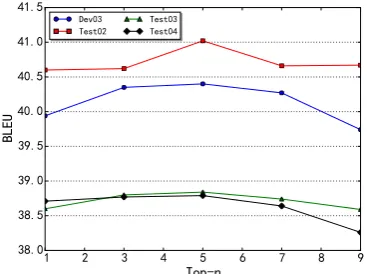
Figure 2: Effect of differentnfor Top-nListMLE. We investigate the effect on the extended feature set.
ations of the outer loop and returned the weights that achieve the best development BLEU scores. For all tuning methods on sparse feature set, we use the weight vector tuned by PRO on the ex-tended feature set as initial weights.
5.3 Experiments of Listwise Learning Framework
We first investigate the effectiveness of our in-stance aggregating training procedure. The results are presented in Table2. The table compare train-ing with instance aggregattrain-ing andk-best merging. As the result suggested, with the instance aggre-gating method, the performance improves on both listwise tuning approaches. For the rest of this pa-per, we use the instance aggregating as standard setting for listwise tuning approaches.
To verify the performance of our proposed list-wise learning framework, we first compare sys-tems with standard listwise losses to the baseline systems. The first four rows in Table 3 show the results. ListNet can outperform PRO by 0.55 BLEU score and 0.26 BLEU score on extended feature set and sparse feature set, respectively. Its main reason is that our listwise methods can obtain structured order information when we take
com-plete translation list as instance.
We also observe that ListMLE can only get a modest performance compare to ListNet. We think the objective function of standard ListMLE which forces the whole list ranking in a correct or-der is too hard. ListNet mainly benefits from its top one permutation probability which only con-cerns the permutation with the best object ranked first.
5.4 Effect of Top-rank Enhanced Losses
To verify our assumption that the correct rank in the top portion of a list is more informative, we conduct this set of experiments. Figure 2 shows the results of top-n ListMLE with different n. Compared to ListMLE in Table 2, we find top-n ListMLE can make significant improvements, which means that the top rank is more important. We can observe an improvement in all test sets when we setnfrom 1 to 5, but when we further increasen, the results dropped. This situation in-dicates that the correct ranking at the top of the list is more informative and forcing the model to rank the bottom correctly as important as the top will sacrifice the ability to guide better search.
In Table3, top-5 ListMLE which only aims to rank the top five translations correctly can out-perform the baseline and standard ListMLE. With our position-dependent attention, the top-rank en-hanced ListMLE can make further improvement over the baseline system(+1.07 and +0.73 on ex-tended and sparse feature sets, respectively.) and achieves the best performance.
The top-nloss might be too loose as an approxi-mation of the measure of BLEU. Compared to top-nListMLE, our top-rank enhanced ListMLE can further utilize the different portions of the list by different weights. To verify the claim, we further examined the learning processes of the two losses. For simplicity, the experiment is conducted on a translation list generated by random parameters. The results are shown in Figure3. We can see that our top-rank enhanced loss almost completely in-versely correlates with BLEU after iteration 70. In contrast, after iteration 150, although top-5 loss is still decreasing, BLEU starts to drop.
[image:6.595.82.266.202.339.2]Method MT02 MT04Extended FeaturesMT05 AVG MT02 MT04Sparse FeaturesMT05 AVG PRO 40.30 38.12 37.69 38.70(+0.00) 40.63 38.46 38.24 39.11(+0.00) KB-MIRA 40.48 37.71 37.37 38.52(-0.18) 40.67 38.48 38.21 39.12(+0.01) ListNet 40.75∗ 38.69+ 38.31∗ 39.25(+0.55) 40.91∗ 38.77∗ 38.42 39.37(+0.26)
ListMLE 40.40 38.21 38.04 38.88(+0.18) 40.63 38.68 38.24 39.18(+0.07) ListMLE-T5 41.02∗ 38.84+ 38.79+ 39.55(+0.85) 41.12∗ 38.91∗ 38.89∗ 39.64(+0.53)
[image:7.595.92.505.62.150.2]ListMLE-TE 41.15+ 39.01+ 39.16+ 39.77(+1.07) 41.25+ 39.00+ 39.27+ 39.84(+0.73)
Table 3: BLEU4 in percentage for comparing of baseline systems and systems with listwise losses.+,∗
marks results that are significant better than the baseline system withp <0.01andp <0.05. (ListMLE-T5 and ListMLE-TE refer to top-5 LisMLE and our top-rank enhanced ListMLE, respectively.)
(SRFKQXPEHU
%/(8
%/(8
/RVV
/RVV
(a)
(SRFKQXPEHU
%/(8
%/(8
/RVV
/RVV
[image:7.595.83.523.221.393.2](b)
Figure 3: Listwise losses v.s. BLEU in (a) top-5 ListMLE and (b) top-rank enhanced ListMLE
Methods MT02 MT04 MT05 AVG
PRO 40.90 38.84 38.64 39.64(+0.00) KB-MIRA 41.09 38.49 38.62 39.40(-0.06) ListNet 41.49+ 39.25∗ 39.17∗ 39.97(+0.51)
ListMLE-T5 41.26∗ 39.63+ 39.32∗ 40.07(+0.61)
ListMLE-TE 41.85+ 39.96+ 39.88+ 40.56(+1.10)
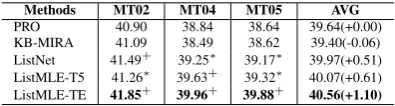
Table 4: Comparison of baselines and listwise ap-proaches with a larger k-best list on extended fea-ture set.
enhanced method is also useful for ListNet, but due to its computational demands it needs to be further investigated.
5.5 Impact of the Size of Candidate Lists
Our listwise tuning methods directly model the or-der of the translation list, it is clear that the choice of the translation list sizekhas an impact on our methods. A larger candidate list size may result in the availability of more information during tuning. In order to verify our tuning methods’ capability of handling the larger translation list, we increasek from 20 to 100. The comparison results are shown in Table4. With a larger sizek, our tuning meth-ods also perform better than baselines. For
List-Net and top-5 ListMLE, we observe that the im-provements over baseline is smaller than size 20. This results show that the order information loss caused by directly drop the bottom is aggravated with larger list size. However, our top-rank en-hanced method still get a slight better result than size 20 and significant improvement over baseline by 1.1 BLEU score. This indicate that our top-rank enhanced method is more stable and can still effectively exploit the larger size translation list.
5.6 Performance on Basic Feature Set
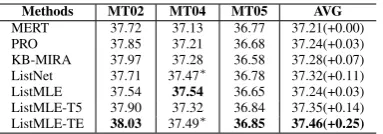
[image:7.595.82.280.439.492.2]Methods MT02 MT04 MT05 AVG
MERT 37.72 37.13 36.77 37.21(+0.00) PRO 37.85 37.21 36.68 37.24(+0.03) KB-MIRA 37.97 37.28 36.58 37.28(+0.07) ListNet 37.71 37.47∗ 36.78 37.32(+0.11)
[image:8.595.87.279.61.128.2]ListMLE 37.54 37.54 36.65 37.24(+0.03) ListMLE-T5 37.90 37.32 36.84 37.35(+0.14) ListMLE-TE 38.03 37.49∗ 36.85 37.46(+0.25)
Table 5: Comparison of baseline and liswise ap-proaches on basic feature set.
MERT by 0.25 BLEU score. These results show that our top-ranked enhanced tuning method can learn more informations of translation list even with a basic feature set.
6 Related Work
The ranking problem is well studied in IR com-munity. There are many methods been pro-posed, including pointwise (Nallapati,2004), pair-wise (Herbrich et al., 1999; Burges et al., 2005) and listwise (Cao et al.,2007;Xia et al.,2008) al-gorithms. Experiment results show that listwise methods deliver better performance than point-wise and pairpoint-wise methods in general (Liu,2010). Most NLP researches take ranking as an extra step after searching from its output space ( Char-niak and Johnson, 2005;Collins and Terry Koo,
2005;Duh,2008). In SMT research, listwise ap-proaches also have been employed for the rerank-ing tasks. For example, Li et al. (2013) uti-lized two listwise approaches to rerank the trans-lation outputs and achieved the best segment-level correlation with human judgments. Niehues et al. (2015) employed ListNet to rescore the k -best translations, which significantly outperforms MERT, KB-MIRA and PRO.Zhang et al. (2016) viewed the log-linear model as a pointwise rank-ing function and shifted it to listwise rankrank-ing func-tion by introducing listwise features and outper-formed the log-linear model. Compared to these efforts, our method takes a further step by inte-grating listwise ranking methods into the iterative training.
There are also some researches use ranking methods for tuning to guide better search. In SMT, previous attempts on using ranking as a tuning methods usually perform pairwise comparisons on a subset of translation pairs (Chiang et al.,2008;
Hopkins and May,2011;Watanabe,2012; Bazraf-shan et al., 2012;Guzm´an et al., 2015). Dreyer and Dong(2015) even took all translation pairs of thek-best list as training instances, which only
ob-tained a comparable result with PRO and the im-plementation is more complicate. In this paper, we model the entire list as a whole unit, and pro-pose training objectives that are sensitive to differ-ent parts of the list.
7 Conclusion
In this paper, we propose a listwise learning framework for statistical machine translation. In order to adapt listwise approaches, we use an iter-ative training framework in which instances from different iterations are aggregated into the train-ing set. To emphasize the top order of the list, we further propose top-rank enhanced listwise learn-ing losses. Compared to previous efforts in SMT tuning, our method directly models the order in-formation of the complete translation list. Experi-ments show our method could lead to significant improvements of translation quality in different feature sets and beam size.
Our current work focuses on the traditional SMT task. For future work, it will be interesting to integrate our methods to modern neural machine translation systems or other structure prediction problems. It may also be interesting to explore more methods on listwise tuning framework, such as investigating different methods to enhance top order of translation list directly w.r.t a given eval-uation metric.
Acknowledgments
The authors would like to thank the anonymous re-viewers for their valuable comments. This work is supported by the National Science Foundation of China (No. 61672277, 61300158 and 61472183). Part of Huadong Chen’s contribution was made while visiting University of Notre Dame. His visit was supported by the joint PhD program of China Scholarship Council.
References
Marzieh Bazrafshan, Tagyoung Chung, and Daniel Gildea. 2012. Tuning as linear regression. In Pro-ceedings of the 2012 Conference of the North Amer-ican Chapter of the Association for Computational Linguistics: Human Language Technologies. Asso-ciation for Computational Linguistics, pages 543– 547. http://aclweb.org/anthology/N12-1062. Chris Burges, Tal Shaked, Erin Renshaw, Ari Lazier,
descent. In Proceedings of the 22Nd Interna-tional Conference on Machine Learning. ACM, New York, NY, USA, ICML ’05, pages 89–96.
https://doi.org/10.1145/1102351.1102363.
Zhe Cao, Tao Qin, Tie-Yan Liu, Ming-Feng Tsai, and Hang Li. 2007. Learning to rank: From pairwise approach to listwise approach. In Proceedings of the 24th International
Con-ference on Machine Learning. ACM, New
York, NY, USA, ICML ’07, pages 129–136.
https://doi.org/10.1145/1273496.1273513.
Eugene Charniak and Mark Johnson. 2005. Coarse-to-fine n-best parsing and maxent discrimina-tive reranking. In Proceedings of the 43rd Annual Meeting of the Association for Com-putational Linguistics (ACL’05). Association for Computational Linguistics, pages 173–180.
http://aclweb.org/anthology/P05-1022.
Boxing Chen, Roland Kuhn, and George Foster. 2013.
Vector space model for adaptation in statistical ma-chine translation. In Proceedings of the 51st An-nual Meeting of the Association for Computational Linguistics (Volume 1: Long Papers). Association for Computational Linguistics, pages 1285–1293.
http://aclweb.org/anthology/P13-1126.
Stanley F Chen and Joshua Goodman. 1999. An empirical study of smoothing techniques for lan-guage modeling. Computer Speech & Language 13(4):359–394.
Colin Cherry and George Foster. 2012. Batch tuning strategies for statistical machine translation. In Pro-ceedings of the 2012 Conference of the North Amer-ican Chapter of the Association for Computational Linguistics: Human Language Technologies. Asso-ciation for Computational Linguistics, pages 427– 436. http://aclweb.org/anthology/N12-1047. David Chiang. 2005. A hierarchical phrase-based
model for statistical machine translation. In Pro-ceedings of the 43rd Annual Meeting of the Associ-ation for ComputAssoci-ational Linguistics (ACL’05). As-sociation for Computational Linguistics, pages 263– 270. http://aclweb.org/anthology/P05-1033. David Chiang, Yuval Marton, and Philip Resnik.
2008. Online large-margin training of syntac-tic and structural translation features. In Pro-ceedings of the 2008 Conference on Empirical Methods in Natural Language Processing. Associa-tion for ComputaAssocia-tional Linguistics, pages 224–233.
http://aclweb.org/anthology/D08-1024.
H. Jonathan Clark, Chris Dyer, Alon Lavie, and A. Noah Smith. 2011. Better hypothesis testing for statistical machine translation: Controlling for opti-mizer instability. InProceedings of the 49th Annual Meeting of the Association for Computational Lin-guistics: Human Language Technologies. Associa-tion for ComputaAssocia-tional Linguistics, pages 176–181.
http://aclweb.org/anthology/P11-2031.
Collins and Michael Terry Koo. 2005. Discrimina-tive reranking for natural language parsing. Compu-tational Linguistics, Volume 31, Number 1, March 2005http://aclweb.org/anthology/J05-1003. Hal Daum´e III. 2004. Notes on CG and LM-BFGS
optimization of logistic regression.
Markus Dreyer and Yuanzhe Dong. 2015. Apro: All-pairs ranking optimization for mt tuning. In Pro-ceedings of the 2015 Conference of the North Amer-ican Chapter of the Association for Computational Linguistics: Human Language Technologies. Asso-ciation for Computational Linguistics, pages 1018– 1023.https://doi.org/10.3115/v1/N15-1106. Kevin Duh. 2008. Ranking vs. regression in machine
translation evaluation. In Proceedings of the Third Workshop on Statistical Machine Transla-tion. Association for Computational Linguistics, Stroudsburg, PA, USA, StatMT ’08, pages 191–194.
http://dl.acm.org/citation.cfm?id=1626394.1626425. Spence Green, Sida Wang, Daniel Cer, and D.
Christo-pher Manning. 2013. Fast and adaptive online train-ing of feature-rich translation models. In Proceed-ings of the 51st Annual Meeting of the Associa-tion for ComputaAssocia-tional Linguistics (Volume 1: Long Papers). Association for Computational Linguistics, pages 311–321. http://aclweb.org/anthology/P13-1031.
John Guiver and Edward Snelson. 2009. Bayesian inference for plackett-luce ranking models. In Proceedings of the 26th Annual International Conference on Machine Learning. ACM, New York, NY, USA, ICML ’09, pages 377–384.
https://doi.org/10.1145/1553374.1553423.
Francisco Guzm´an, Preslav Nakov, and Stephan Vogel. 2015. Analyzing optimization for sta-tistical machine translation: Mert learns ver-bosity, pro learns length. In Proceedings of the Nineteenth Conference on Computational Natu-ral Language Learning. Association for Compu-tational Linguistics, Beijing, China, pages 62–72.
http://www.aclweb.org/anthology/K15-1007. Ralf Herbrich, Thore Graepel, and Klaus Obermayer.
1999. Support vector learning for ordinal regres-sion. InArtificial Neural Networks, 1999. ICANN 99. Ninth International Conference on (Conf. Publ. No. 470). IET, volume 1, pages 97–102.
Mark Hopkins and Jonathan May. 2011.
Tun-ing as rankTun-ing. In Proceedings of the 2011 Conference on Empirical Methods in Nat-ural Language Processing. Association for Computational Linguistics, pages 1352–1362.
http://aclweb.org/anthology/D11-1125.
of the Association for Computational Linguistics.
http://aclweb.org/anthology/N03-1017.
Maoxi Li, Aiwen Jiang, and Mingwen Wang. 2013. Listwise approach to learning to rank for automatic evaluation of machine translation. Proceedings of the XIV Machine Translation Summit.
Chin-Yew Lin and Franz Josef Och. 2004. ORANGE: A method for evaluating automatic evaluation met-rics for machine translation. In Proceedings of the 20th International Conference on Computational Linguistics.
Tie-Yan Liu. 2010. Learning to rank for informa-tion retrieval. In Proceedings of the 33rd In-ternational ACM SIGIR Conference on Research and Development in Information Retrieval. ACM, New York, NY, USA, SIGIR ’10, pages 904–904.
https://doi.org/10.1145/1835449.1835676.
Yang Liu, Qun Liu, and Shouxun Lin. 2006. Tree-to-string alignment template for statistical ma-chine translation. In Proceedings of the 21st International Conference on Computational Lin-guistics and 44th Annual Meeting of the Asso-ciation for Computational Linguistics. Associa-tion for ComputaAssocia-tional Linguistics, pages 609–616.
http://aclweb.org/anthology/P06-1077.
Ramesh Nallapati. 2004.Discriminative models for in-formation retrieval. InProceedings of the 27th An-nual International ACM SIGIR Conference on Re-search and Development in Information Retrieval. ACM, New York, NY, USA, SIGIR ’04, pages 64– 71.https://doi.org/10.1145/1008992.1009006.
Jan Niehues, Quoc-Khanh DO, Alexandre Allauzen, and Alex Waibel. 2015. Listnet-based mt rescor-ing. In Proceedings of the Tenth Workshop on Statistical Machine Translation. Association for Computational Linguistics, pages 248–255.
http://aclweb.org/anthology/W15-3030.
Franz Josef Och. 2003. Minimum error rate train-ing in statistical machine translation. In ACL ’03: Proceedings of the 41st Annual Meeting on Association for Computational Linguis-tics. Association for Computational Linguis-tics, Morristown, NJ, USA, pages 160–167.
https://doi.org/http://dx.doi.org/10.3115/1075096.1075117.
Franz Josef Och and Hermann Ney. 2003. A
systematic comparison of various statistical alignment models. Comput. Linguist.29(1):19–51.
https://doi.org/http://dl.acm.org/citation.cfm?id=778824.
Kishore Papineni, Salim Roukos, Todd Ward, and Wei-Jing Zhu. 2002. Bleu: a method for au-tomatic evaluation of machine translation. In Proceedings of the 40th Annual Meeting of the Association for Computational Linguistics.
http://aclweb.org/anthology/P02-1040.
Taro Watanabe. 2012. Optimized online rank learn-ing for machine translation. In Proceedings of the 2012 Conference of the North American Chap-ter of the Association for Computational Linguis-tics: Human Language Technologies. Associa-tion for ComputaAssocia-tional Linguistics, pages 253–262.
http://aclweb.org/anthology/N12-1026.
Taro Watanabe, Jun Suzuki, Hajime Tsukada, and Hideki Isozaki. 2007. Online large-margin train-ing for statistical machine translation. In Proceed-ings of the 2007 Joint Conference on Empirical Methods in Natural Language Processing and Com-putational Natural Language Learning (EMNLP-CoNLL).http://aclweb.org/anthology/D07-1080. Fen Xia, Tie-Yan Liu, Jue Wang, Wensheng
Zhang, and Hang Li. 2008. Listwise
ap-proach to learning to rank: Theory and algo-rithm. In Proceedings of the 25th International Conference on Machine Learning. ACM, New York, NY, USA, ICML ’08, pages 1192–1199.
https://doi.org/10.1145/1390156.1390306.
Kenji Yamada and Kevin Knight. 2001. A
syntax-based statistical translation model. In Proceedings of the 39th Annual Meeting of the Association for Computational Linguistics.
http://aclweb.org/anthology/P01-1067.
Matthew D Zeiler. 2012. Adadelta: An adaptive learn-ing rate method.arXiv preprint arXiv:1212.5701. M. Zhang, Y. Liu, H. Luan, and M. Sun. 2016. Listwise
ranking functions for statistical machine transla-tion. IEEE/ACM Transactions on Audio, Speech,
and Language Processing 24(8):1464–1472.