Substring-based unsupervised transliteration with phonetic and
contextual knowledge
Anoop Kunchukuttan1, Pushpak Bhattacharyya1, Mitesh M. Khapra2
1Department of Computer Science & Engineering,
Indian Institute of Technology Bombay.
{anoopk,pb}@cse.iitb.ac.in 2IBM Research India. [email protected]
Abstract
We propose an unsupervised approach for
substring-based transliteration which in-corporates two new sources of knowledge in the learning process: (i) context by learning substring mappings, as opposed to single character mappings, and (ii) pho-netic features which capture cross-lingual character similarity via prior distributions.
Our approach is a two-stage iterative, boot-strapping solution, which vastly outperforms Ravi and Knight (2009)’s state-of-the-art unsupervised translitera-tion method and outperforms a rule-based baseline by up to 50% for top-1 accuracy on multiple language pairs. We show that substring-based models are superior to character-based models, and observe that their top-10 accuracy is comparable to the top-1 accuracy of supervised systems.
Our method only requires a phonemic rep-resentation of the words. This is possi-ble for many language-script combinations which have a high grapheme-to-phoneme correspondencee.g. scripts of Indian lan-guages derived from the Brahmi script. Hence, Indian languages were the focus of our experiments. For other languages, a grapheme-to-phoneme converter would be required.
1 Introduction
Transliteration is a key building block for multi-lingual and cross-multi-lingual NLP since it is useful for user-friendly input methods and applications like machine translation and cross-lingual information retrieval. The best performing solutions are su-pervised, discriminative learning methods which
learn transliteration models from parallel translit-eration corpora. However, such corpora are avail-able only for some language pairs. It is also expen-sive and time-consuming to build a parallel corpus. This limitation can be addressed in three ways: (i) train a transliteration model on mined parallel transliterations. The transliterations can be mined from monolingual comparable corpora (Jagarla-mudi and Daumé III, 2012) or parallel translation corpora (Sajjad et al., 2012). However, it may not be possible to mine enough transliteration pairs to train a system for most languages (Irvine et al., 2010). (ii)transliterate via a bridge language (Khapra et al., 2010) when transliteration corpora involving bridge languages is available.(iii)learn transliteration models in an unsupervised setting using only monolingual word lists. Unsupervised transliterationcan be defined as: Learn a translit-eration model (T X) from the source language (F) to the target (E) language given their respective monolingual word lists,WF andWErespectively. We explore this direction in the present work, ad-dressing shortcomings in the previous work (Ravi and Knight, 2009; Chinnakotla et al., 2010).
Our work addresses two major limitations in existing unsupervised transliteration approaches: (i) lack of linguistic signals to drive the learning, and (ii) limited use of context since their model is character-based. Due to this knowledge-lite ap-proach, these model performs poorly. Our pri-mary contributions are novel methods to incor-porate two knowledge sources, phonetic and con-textual, in the training process. These knowledge sources are critical since statistical co-occurrence signals used in supervised learning are not avail-able for unsupervised learning. Unlike transliter-ation mining, our approach can learn effectively even if the source and target corpus do not have any transliteration pairs in common.
We propose atwo-stageiterative, bootstrapping
approach for learning unsupervised transliteration models. In the first stage, a character-based model is learnt which is used to bootstrap and learn a series of improved substring-based models in the second stage.
The first stage incorporates two linguistic sig-nals to drive the learning process: phonemic correspondence and phonetic similarity. This means we make the model aware that two charac-ters represent either the same phoneme (कin Hindi andকin Bengali [IPA: k] ) or similar phonemes (क
[IPA: k] in Hindi andখ[IPA: kh] in Bengali - which differ only in aspiration). We achieve this by in-corporating phonetic information asprior distri-butions in our EM-MAP approach to character-based unsupervised learning. We show that these linguistic signals can improve top-1 accuracy by 20%-100% over a baseline rule-based system. It is also vastly superior to knowledge-lite unsuper-vised methods.
The second stage incorporates contextual knowledge by unsupervised learning of a substring-based transliteration modelviz. learning mappings from substring in one language to another, as opposed to learning single character mappings. In other words, along with learning mappings of the form (khindi → kbengali), we also try to learn mappings of the form (kaahindi → kaabengali). It is known that substring-based transliteration outperforms character-based transliteration in a supervised setting due to the additional context information (Sherif and Kondrak, 2007). To the best of our knowledge, ours is the first unsupervised approach for substring-based transliteration. It outperforms a character-based model by up to 11% in terms of top-1 accuracy and 27% in terms of top-10 accuracy.
The top-10 accuracy of our unsupervised sys-tem is comparable to the top-1 accuracy of a su-pervised system. Hence, the unsusu-pervised system may be a reasonable substitute for supervised sys-tems in applications which require transliteration (e.g. handling untranslated words in MT) and can disambiguate from the top-k transliterations with information available to the application (e.g. LM in MT systems).
The focus of our work was Indian languages using scripts descended from the ancient Brahmi script. We show that our methods can be applied to these languageswithout requiring phoneme
dic-tionaries or grapheme-to-phoneme converters. We achieve this by using scriptural properties and similarity across scriptsto capture phonemic correspondence and phonetic similarity, and show results on 4 languages using 4 different scripts. At least 19 of the Indian subcontinent’s top 30 and 9 of the top 10 most spoken languages use Brahmi-derived scripts. Each of these languages have more than a million speakers with an aggregate speaker population of about 900 million, so our method is widely applicable.
2 Related Work
Unsupervised transliteration has not been widely explored. Chinnakotla et al. (2010) generate transliteration candidates using manually devel-oped character mapping rules and rerank them with a character language model. The major limita-tions are: (i) character transliteration probability is not learnt, so there is undue reliance on the lan-guage model to handle ambiguity, and (ii) signifi-cant manual effort for good coverage of mapping rules.
Ravi and Knight (2009) propose a decipherment framework based approach (Knight et al., 2006) to learn phoneme mappings for transliteration with-out parallel data. In theory, it should be able to learn transliteration probabilities and is a gener-alization of Chinnakotla et al. (2010)’s approach. But its performance is very poor due to lack of linguistic knowledge and has a reasonable perfor-mance only when a unigram word-level LM is used. This signal essentially reduces the approach to a lookup for the generated transliterations in a target language word list; the method resembles transliteration mining. It will perform well only if the unigram LM has a good coverage of all named entities in the source word list. For morphologi-cally rich target languages, it may be difficult to find the exact surface words in the unigram LM.
Our character level model approach is a further generalization of Ravi and Knight (2009)’s work since it also allows modelling of prior linguistic knowledge in the learning process. This over-comes the most significant gap in their work.
representa-Figure 1: Overview of Proposed Approach
tion based interlingual projection for multilingual transliteration mining. To the best of our knowl-edge, ours is the first work to use phonetic feature vectors for transliteration as opposed to transliter-ation mining.
We use a substring-based log-linear model in our second stage. There are some parallels to this approach in the transliteration mining litereature. Some transliteration mining approaches have used a log-linear classifier to incorporate features to dis-tinguish transliterations from non-transliterations (Klementiev and Roth, 2006; Chang et al., 2009). Sajjad et al. (2011) use a substring-based log-linear model trained on a noisy, intermediate translit-eration corpus to iteratively remove bad (low-scoring) transliteration pairs found in the discov-ery process.
3 Unsupervised Substring-based Transliteration
In this section, we give a high-level overview of our approach for learning a substring-based transliteration model in an unsupervised setting (depicted in Figure 1). The inputs are monolingual lists of words,WF andWE, for the source (F) and target (E) languages respectively. Note that these are neither parallel nor comparable lists. We need aphonemic representationof the words.
For Indic scripts, which are used in our ex-periments, we use the orthographic representa-tion itself as the phonemic representarepresenta-tion since there is high grapheme to phoneme correspon-dence. Hence, we use the terms character and
phonemeinterchangeably.
The training is a two-stage process as described below. First, character mappings are learnt fol-lowed by learning of substring mappings by boot-strapping the character-based model. This process
is analogous to phrase-based statistical machine translation, where phrase pairs are extracted from word aligned sentence pairs.
Stage One: In the first stage, character transliter-ation probabilities are learnt from the monolingual word lists.
In a supervised setting, an EM algorithm us-ing maximum likelihood estimation (EM-MLE) (Knight and Graehl, 1998) exploits co-occurrence of characters to learn model parameters. But, prior linguistic knowledge has to be incorporated for ef-fective learning in an unsupervised setting. Hence, we propose an unsupervised Expectation Maxi-mization with Maximum Aposteriori estimation framework (EM-MAP) for learning the character-level transliteration model. Linguistic knowledge is incorporated in the form of prior distributions on the model parameters in this framework. The de-tails of the model and choice of prior distributions are described in Section 4.
We considered two linguistic signals for design-ing the prior distributions. The first isphonemic correspondence i.e. characters in the two lan-guages representing the same phoneme. e.g. The charactersक(ka) in Hindi andক(ka) Bengali rep-resent the same phoneme (IPA: k). But phone-mic correspondence cannot account for phonemes which differ only by some phonetic features. e.g.
vowel length (shortइ[i] in Hindi, longঈ[I] in Ben-gali), aspiration (unaspiratedकin Hindi [IPA: k], aspiratedখ in Bengali [IPA: kh]). Such transfor-mations are common during transliteration, so we use phonetic similarity as our second linguistic signal.
Stage Two: In the second stage, we learn a dis-criminative, log-linear model witharbitrary sub-strings as the unit of transliteration. For learn-ing the substrlearn-ing based model, apseudo-parallel transliteration corpus is first synthesized using the character-level model. We discuss Stage 2 in de-tail in Section 5.
We illustrate the need for substring level mod-els with an example. In Indic scripts, the anus-vaara (nasalization diacritic) can map to any of the 5 nasal consonants depending on the consonant following theansuvaarain the source word. So, in the hi-bn pair (चंबल[ca.mbala],চমব্ল[cambala]), the anusvaara (.m) maps to the nasal consonant (m) since the next character is the labial consonant
[image:3.595.73.279.61.194.2]Substring-Algorithm 1Train character-level model 1: procedureUNSUP-CHAR(WF, LME)
▷ LME: char-level language model for E
2: Θ←initialize-params()
3: i←0
4: whilei≤Ndo▷N: Number of iterations 5: WE′ ←c-decode(WF,Θ, LME) 6: A←gen-alignments(WF, WE′) 7: Θ←arg maxΘQ′W
F(Θ) ▷m-step
8: ifconverged(Θ)then
9: break
10: σ←e-step(A,Θ)
11: returnΘ
based models, which learn substring mappings like
.mba→mba, are one way to incorporate contex-tual information and have been shown to perform better in a supervised setting (Sherif and Kondrak, 2007). Contextual information is especially im-portant in an unsupervised setting.
4 Character-based Unsupervised Transliteration
In the first stage, welearn character transliter-ation probabilitiesfrom monolingual word lists. The generative story for the training data (the source language corpus, WF) is explained below using a noisy channel model.
An unknown target language wordeis selected using a language model P(e). The target word is transformed to a source language word f by a channel whose properties are represented by the transliteration probability distribution (Θ). The target language wordeis a latent variable in the unsupervised setting, so we need to compute the expectation over all possible values ofe.
P(f) =∑
e
P(f|e)P(e) (1)
We use Knight and Graehl (1998)’s transliteration model where, the word pair(f,e) is generated by successively selecting one or more source charac-ters f for each target character e as per a latent alignmenta with probabilityP(f|e) = θf,e. We restrict our model to 1-1 and 1-2 character map-pings from target to source characters. The likeli-hood of a single training instanceis given by:
L(Θ) =∑
e
P(e)∑
a
|e|
∏
i=1
θfai,ei (2)
In the supervised framework of Knight and Graehl (1998), parameters are learnt using the EM al-gorithm where the alignment structure a is the latent variable. The discovery of hidden align-ments helps compute the transliteration probabili-ties based on co-occurrence of characters. In the absence of parallel corpora, co-occurrence is no longer a learning signal and it is not possible to learn the character transliteration probabilities re-liably. To compensate for this, we define Dirich-let priors(De) over each character transliteration probability distributions (Θe), which can be used to encode linguistic knowledge. This leads to our proposedEM-MAP training objectivefor the M-step over the entire training set (WF).
QWF(Θ) =
∑
f∈WF
{ ∑
e
{ δe,f
∑
a
[ σa,f,e
∑
f,e
nf,e,alogθf,e
]
+logP(e) }}
+ ∑
e∈CE
logDe(αf1,e...αf|CF|,e) (3)
s.t
∀e∈CE, j=∑|CF|
j=1
θfj,e = 1
where,
δe,f = P(e|f), σa,f,e = P(a|e,f) are conditional
probabilities of the latent variables computed in the E-step. These are computed using the previous it-eration’s parameter values, whose values are fixed in the current iteration.
nf,e,ais the number of times characterseandfare
aligned in the alignment structurea.
CF andCE are the character sets of the source and
target languages respectively.
In the unsupervised setting, the target word (e) is also an latent variable. As seen in Equation 3, the M-step requires computing an expectation over all latent variables (target word and alignments). Given the target word, it is possible to enumerate all alignments of the word pairs, but it is not pos-sible to enumerate all pospos-sible strings (e). Hence, we approximate the expectation over eby amax
can be done using Knight and Graehl (1998)’s su-pervised framework. The resulting update equa-tion for the transliteraequa-tion probabilities in the M-stepis:
θf,e= λ1 e
{
αf,e−1 +
∑
f∈WF
∑
a
σa,f,enf,e,a
} (4)
where, λe is a normalizing factor ande is the best transliteration of f as per the previous itera-tion’s parameters. Note that δe,f plays no role in
(Q′W
F).
The E-stepupdate to compute the conditional probabilities of the latent alignment variables is given by:
σa,f,e = 1
Z ×
|e|
∏
i=1
θfai,ei (5)
where,Zis a normalizing factor.
The training procedure can thus be understood to follow adecode-train-iterateparadigm. Algo-rithm 1 shows the procedure for character level training. In each iteration, a pseudo-parallel cor-pus by decoding WF using the current set of parameters (Line 5, Viterbi approximation) from which updated parameters are learnt (Line 7) and alignment probabilities recomputed (Line 10).
4.1 Linguistically Informed Priors:
In this section, the different prior distributions we designed to encode phonetic knowledge about characters is described. These are instantiations of Dirichlet priors (De), which serve as a conjugate prior to the multinomial distribution (θf,e). The hyperparameters (αf,e) ofDedetermine the nature of the prior distribution. They can be interpreted as additional, virtual alignment counts of the charac-ter pair(f, e)for maximum likelihood estimation ofθf,e.
Phoneme Correspondence (PC) Prior: This simply establishes a one-one correspondence (de-noted by=b) between the same phonemes (or char-acters representing the same phonemes). It does not capture the notion of similarity between char-acters.
αf,e = β iff=be (6)
= 0.01 elsewhere (7)
Phonemic correspondence is also used to initiize the transliteration probabilities for the EM al-gorithm (PC Init):
Basic Character Type:
vowel, consonant, anusvaara, nukta, halanta, others
Vowel Features Length: short, long
Strength: weak, medium, strong Status: Independent, Dependent Horizontal position: Front, Back
Vertical position: Close, Close-Mid, Open-Mid, Open Lip roundedness: Close, Open
Consonant Features Place of Articulation:
velar, palatal, retroflex, dental, labial Manner of Articulation:
plosive, fricative, flap, approximant (central or lateral) Aspiration, Voicing, Nasal: True, False
Table 1: Phonetic features for Indic scripts
θinit
f,e = ∑αf,e x∈CF
αx,e (8)
Phonetic Similarity Priors This prior captures similarity between two phonemes based on their phonetic properties. The phonetic properties of a phoneme can be encoded as a bit vector (v) as ex-plained in Section 4.2. We experimented with two priors based on phonetic properties.
• Cosine Prior: It is based on the cosine similarity between the two bit vectors.
αf,e = γccos(vf, ve) (9)
• Sim1 Prior: Cosine similarity tends to produce very diffused transliteration probability distribu-tions. We propose a modified prior (calledsim1) which tries to alleviate this problem by making the phonemic differences sharper.
αf,e = γs 5 vf.ve
∑
x∈CF
5vx.ve (10)
β, γc andγs are scale factors for the Dirichlet
distribution.
4.2 Extracting Phonetic Features for Indic scripts
1. The feature vector is represented as a bit vector with a bit for each value of every property.
The logical character set is roughly the same across all Indic scripts, though the visual glyph varies to a great extent. So phonemic correspon-dence can be easily determined for Unicode text since the first 85 characters of all Indic scripts are aligned to each other by virtue of having the same offset from the start of the script’s code-page. These cover all commonly used characters. There are a few exceptions to this simple mapping scheme, most of which can be handled using sim-ple rules.
Notable among these is the Tamil script, which does not have characters for aspirated as well as voiced plosives, so the corresponding unvoiced, unaspirated plosive characters are used to repre-sent these sounds too. In the phonetic feature representation of such characters for Tamil, both the voiced as well as unvoiced bits and aspi-rated/unaspirated bits are set on, reflecting the am-biguity in the grapheme-to-phoneme mapping.
5 Bootstrapping substring-based models
In the second stage, we train adiscriminative, log-linear transliteration model which learns sub-string mappings. We use the log-linear model proposed by Och and Ney (2002) for statistical ma-chine translation and analogous transliteration fea-tures. The features are: substring transliteration probabilities, weighted average character translit-eration probabilities and character language model score. The conditional probability of the target wordegiven the source wordfis:
P(e|f) =
NP
∏
i=1
P( ¯ei|f¯i) = NP
∏
i=1
exp
NF
∑
j=0
λjgj( ¯fi,e¯i)
(11) where,f¯iande¯iare source and target substrings re-spectively,λjandgjare feature weight and feature function respectively for featurej,NP number of substrings andNF is number of features.
We synthesize a pseudo-parallel translitera-tion corpus(WF,WE′) for training the discrimi-native model by transliterating the source language words (WF) using the character level model from the first stage. Since the top-1 transliteration may be incorrect, we consider the top-k transliterations to improve the odds that the pseudo-parallel cor-pus contains the correct transliteration. For
train-ing, the pseudo-parallel corpus containsk translit-eration pairs for every source language word. For tuningthe feature weights, we use a small held-out set of top-1 transliteration pairs from the pseudo-parallel corpus, since it likely to be the most accu-rate one.
We run multiple iterations of the discrimina-tive training process, with each being trained on the pseudo-parallel corpus synthesized using the previous iteration’s models. The models in subse-quent iterations arebootstrappedfrom the earlier models. The training continues for a fixed num-ber of iterations although other convergence meth-ods can also be explored. Like the MAP-EM solu-tion for the first stage, the second stage also uses adecode - train - iterateparadigm for learning a substring-based model.
6 Experiments
Data: We experimented on the following In-dian language pairs representing two language families: Bengali→Hindi, Kannada→Hindi, Hindi→Kannada and Tamil→Kannada. Bengali (bn) and Hindi (hi) are Indo-Aryan languages, while Kannada (kn) and Tamil (ta) are Dravidian languages. We used 10k source language names as training corpus, which were collected from various sources.
We evaluated our systems on the NEWS 2015 Indic dataset. We created this set from the English to Indian language training corpora of the NEWS 2015 shared task (Banchs et al., 2015) by mining name pairs which have English names in common. 1500 words were selected at random to create the testset. The remaining pairs are used to train and tune a skyline supervised transliteration system for comparison. The training sets are small, the num-ber of name pairs being: 2556 (bn-hi), 4022 (kn-hi), 3586 (hi-kn) and 3230 (ta-kn).
Experimental Setup: We trained the charac-ter level unsupervised translicharac-teration systems with source language word lists using a custom imple-mentation 1. We set the the value of the scaling
factors (β, γc, γs) to 100. Viterbi decoding was done with a bigram character language model, fol-lowed by re-ranking with a 5-gram character lan-guage model.
We trained the substring level discriminative transliteration models as well as a skyline
su-1https://github.com/anoopkunchukuttan/
Method A bn-hi hi-kn kn-hi ta-kn
1 F1 A10 A1 F1 A10 A1 F1 A10 A1 F1 A10
PC_Init 12.72 68.95 18.94 0.00 44.76 0.07 0.20 48.84 0.54 0.00 44.46 0.27
Rule 16.13 74.60 16.13 13.75 79.67 13.75 12.90 79.29 12.90 10.25 68.49 10.25
Initialization: PC_Init+
PC_Prior 18.27 75.50 27.04 12.53 77.32 17.89 27.69 81.06 43.55 13.49 69.85 29.06
Cosine Prior 17.74 75.09 26.57 11.38 75.08 18.09 17.54 77.69 32.86 13.21 69.44 26.64
Sim1 Prior 18.07 75.25 29.05 11.72 75.61 20.26 19.69 78.18 37.84 13.55 69.74 28.19
Supervised 32.06 83.03 63.32 30.01 85.93 69.37 54.23 90.05 80.04 30.74 81.62 64.33
Table 2: Results for character-based model (% scores)
pervised transliteration system using the Moses
(Koehn et al., 2007) machine translation system with default parameters. Batch MIRA (Cherry and Foster, 2012) was used to tune the Stage 2 systems with 1000 name pairs and supervised systems with 500 name pairs. The tuning set for the Stage 2 sys-tems were drawn from the the top-1 transliterations in the synthesized, pseudo-parallel corpus; no true parallel corpus is used. Monotone decoding was performed. We used a 5-gram character language model trained with Witten-Bell smoothing on 40k names for all target languages. We ran Stage 2 for 5 iterations.
For a rule-based baseline, we used the script conversion method implemented in theIndic NLP Library2 (Kunchukuttan et al., 2015) which is based on phonemic correspondences.
Evaluation: We used top-1 accuracy based on exact match (A1) and Mean F-score (F1) at the character level as defined in the NEWS shared tasks as our evaluation metrics (Banchs et al., 2015). We also used top-10 accuracy as an evalu-ation metric (A10), since applications like MT and IR can further disambiguate with context informa-tion available to these applicainforma-tions.
7 Results and Discussion
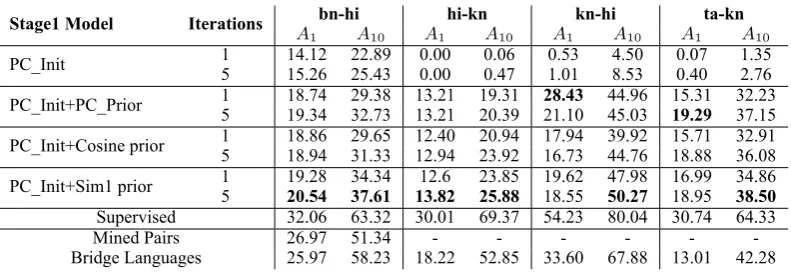
Table 2 shows the results for the rule-based system and various character-based unsupervised models. Table 3 shows results for substring-level models bootstrapped from different character-based mod-els. Results of supervised transliteration on a small training set are also shown in both tables.
Baseline models: Parameter initialization with phoneme correspondence mappings and add-one smoothing prior (PC_Init) is comparable to Ravi and Knight (2009)’s method and performs very
2http://anoopkunchukuttan.github.io/indic_
nlp_library
poorly as reported in their work too. We also ex-perimented with re-ranking the results using a uni-gram word based LM - our approximation to Ravi and Knight (2009)’s use of a word based LM - and its accuracy is comparable to PC_Init. The uni-gram LM was trained on a corpus of 185 million and 42 million tokens forhiandkn respectively. Thus, this knowledge-lite approach cannot learn a transliteration model effectively.
Rule-based transliteration (Rule) performs sig-nificantly better than PC_Init. The phonetic na-ture of Indic scripts makes the rule-based system a stronger baseline, yet this simple approach does not ensure high accuracy transliteration. Phonetic changes like changes in manner/place of articula-tion, voicing,etc. make transliteration non-trivial and phonetic correspondence is not sufficient to ensure good transliteration.
Effect of linguistic priors: The addition of linguistically motivated priors (PC_Prior, Co-sine_Prior, Sim1_Prior) significantly improves the transliteration accuracy over the PC_Init ap-proach. There is a significant improvement in top-1 accuracy over theRuleapproach too for 2 lan-guage pairs (12%, 31% and 133% increase for bn-hi, ta-kn and kn-hi pairs respectively), but a drop of 9% for the hi-kn pair. A major reason for lower accuracy of hi→kn pair is an important difference between Kannada and Hindi writing conventions. Unlike Hindi, Kannada assumes an implicit vowel ‘A’ at the end of a word unless another vowel or nasal character terminates the word. Therefore, the vowel suppressor character (halanta) must be gen-erated during hi→kn transliteration. Our method is poor at this generation, but conversely it does bet-ter at deletion ofhalantafor kn→hi transliteration. There is substantial improvement for the ta-kn pair also, even though there are some grapheme-to-phoneme ambiguities in the Tamil script.
us-Stage1 Model Iterations A bn-hi hi-kn kn-hi ta-kn
1 A10 A1 A10 A1 A10 A1 A10
PC_Init 1 14.12 22.89 0.00 0.06 0.53 4.50 0.07 1.35
5 15.26 25.43 0.00 0.47 1.01 8.53 0.40 2.76
PC_Init+PC_Prior 1 18.74 29.38 13.21 19.31 28.43 44.96 15.31 32.23
5 19.34 32.73 13.21 20.39 21.10 45.03 19.29 37.15
PC_Init+Cosine prior 1 18.86 29.65 12.40 20.94 17.94 39.92 15.71 32.91
5 18.94 31.33 12.94 23.92 16.73 44.76 18.88 36.08
PC_Init+Sim1 prior 1 19.28 34.34 12.6 23.85 19.62 47.98 16.99 34.86
5 20.54 37.61 13.82 25.88 18.55 50.27 18.95 38.50
Supervised 32.06 63.32 30.01 69.37 54.23 80.04 30.74 64.33
Mined Pairs 26.97 51.34 - - -
[image:8.595.101.497.64.200.2]-Bridge Languages 25.97 58.23 18.22 52.85 33.60 67.88 13.01 42.28
Table 3: Results for substring-based model (% scores)
ing phonetic similarity give better top-10 accuracy. The phonetic similarity based priors are smoother compared to the sparsePC_Priorsince they cap-ture character similarity. This allows them to dis-cover more character mappings, resulting in bet-ter top-10 accuracy at the cost of a drop in top-1 accuracy. The sparse sim1prior outperforms the smoother cosine similarity prior.
Effect of learning substring mappings: Substring-based transliteration improves the top-1 as well as top-10 accuracy significantly over the underlying character-based models. Across languages, the best substring-based models im-prove top-1 accuracy by upto 11% and top-10 accuracy by upto 25% over the best character-based models. Therefore, it is clear that contextual information can be harnessed in an unsupervised setting to substantially improve transliteration accuracy.
The iterative procedure is beneficial and translit-eration accuracy increases as improved models are built in successive iterations. Large gains are par-ticularly observed in top-10 accuracy.
While PC_Prior gives best top-1 accuracy re-sults at the character-level, substring-based mod-els bootstrapped from the Sim1 prior give better results for both top-1 and top-10 accuracy metrics. Since the Sim1 prior based character model has better top-10 accuracy, the pseudo-parallel corpus created using this mode is likely to be better than one created usingPC_Prior. We also observe that substring-based models built without using pho-netic priors cannot improve over much over the baseline transliteration.
Illustrative Examples:
• Phonetic similarity based priors were able to discover mappings between similar phonemes.
e.g. The Bengali word ওেয়স্ (keolAdeo) was correctly transliterated to the Hindi wordकेवलादेव
(kevalAdeva), due to discovery of similarity be-tween the labial sounds (v) and (o).
• Substring-based models made use of the con-text to learn the correct transliteration. e.g.The Bengali word কওলােদও (oyaesTa) was correctly transliterated to the Hindi wordवेस्ट(vesta), since the model learnt the substring mappingoya→ve. • Substring-based models could make the right choice between short and long vowels (a major source of errors in character-based models).
Comparison with supervised system and some resource-constrained approaches: We com-pared our best substring-based model (based on
sim1 prior) with a supervised system and the following resource-constrained transliteration sys-tems built using: (i) Mined pairsfrom a transla-tion corpus: We experimented withbn-hion the
Applicability to different languages and scripts: Our experiments span 4 widely-spoken languages from the two major language families in the In-dian subcontinent (Indo-Aryan [IA] and Dravid-ian [DR]). All languages use different Brahmi-descended scripts. We show improvements in IA→IA, DR→DR, DR→IA and IA→DR translit-eration.
The first stage leverages the phonetic nature of Indic scripts to obtain phonetic representations from orthographic representations. There are at least 19 languages in India where this condition holds, so at least 171 language pairs can use this approach without grapheme to phoneme con-verters. Many other script/language pairs also show high grapheme-phoneme correspondence3. Our method, though, can also be applied to non-phonetic scripts also by representing the training data at the phonemic level using grapheme-to-phoneme converters.
The second stage makes no assumptions about language or script.
8 Conclusion and Future work
We show that unsupervised transliteration can substantially benefit from contextual and rich pho-netic knowledge. Phonetic knowledge is incorpo-rated through a novel design of prior distributions for character-level learning, while context is incor-porated via substring-based learning. The top-10 accuracy of our systems is comparable with top-1 accuracy of supervised systems, butrequires only monolingual resources: word lists for Indic lan-guages using Brahmi-derived scripts or phoneme dictionaries for other languages.
In future, we plan to evaluate our method for non-Indic languages and for languages that are less related than the ones studied in this work. Pos-sibilities for improvement include incorporation of phonetic knowledge while learning substring mappings (Stage 2) and better handling of noisy transliterations in the bootstrapping process. It would also be interesting to compare our method with other unsupervised log-linear learning meth-ods like contrastive estimation (Smith and Eisner, 2005).
We would like to note the potential for har-nessing similarities among languages for statisti-cal NLP, especially in an unsupervised setting, as
3http://www.omniglot.com lists grapheme-phoneme
correspondences for many language/script combinations
demonstrated by our use of similarity among Indic scripts. Finally, the iterative, bootstrapping frame-work may be useful for unsupervised translation.
References
Rafael E. Banchs, Min Zhang, Xiangyu Duan, Haizhou
Li, and A Kumaran. 2015. Report of news
2015 machine transliteration shared task. In The
ACL/IJCNLP 2015’s Named Entity Workshop.
Ming-Wei Chang, Dan Goldwasser, Dan Roth, and
Yuancheng Tu. 2009. Unsupervised constraint
driven learning for transliteration discovery. In Pro-ceedings of Human Language Technologies: The 2009 Annual Conference of the North American Chapter of the Association for Computational Lin-guistics.
Colin Cherry and George Foster. 2012. Batch tuning strategies for statistical machine translation. In Pro-ceedings of the 2012 Conference of the North Amer-ican Chapter of the Association for Computational Linguistics: Human Language Technologies.
Manoj K Chinnakotla, Om P Damani, and Avijit Satoskar. 2010. Transliteration for resource-scarce
languages. ACM Transactions on Asian Language
Information Processing (TALIP).
Ann Irvine, Chris Callison-Burch, and Alexandre Kle-mentiev. 2010. Transliterating from all languages. InProceedings of the Conference of the Association for Machine Translation in the Americas (AMTA).
Jagadeesh Jagarlamudi and Hal Daumé III. 2012. Reg-ularized interlingual projections: evaluation on mul-tilingual transliteration. InProceedings of the 2012 Joint Conference on Empirical Methods in Natural Language Processing and Computational Natural Language Learning. Association for Computational Linguistics.
Mitesh M. Khapra, A. Kumaran, and Pushpak Bhat-tacharyya. 2010. Everybody loves a rich cousin: An empirical study of transliteration through bridge
languages. InHuman Language Technologies: The
2010 Annual Conference of the North American Chapter of the Association for Computational Lin-guistics.
Alexandre Klementiev and Dan Roth. 2006. Weakly supervised named entity transliteration and
discov-ery from multilingual comparable corpora. In
Proceedings of the 21st International Conference on Computational Linguistics and the 44th annual meeting of the Association for Computational Lin-guistics.
Kevin Knight and Jonathan Graehl. 1998. Machine transliteration.Computational Linguistics.
Kevin Knight, Anish Nair, Nishit Rathod, and Kenji Yamada. 2006. Unsupervised analysis for
on Main conference poster sessions. Association for Computational Linguistics.
Philipp Koehn, Hieu Hoang, Alexandra Birch, Chris Callison-Burch, Marcello Federico, Nicola Bertoldi, Brooke Cowan, Wade Shen, Christine Moran, Richard Zens, et al. 2007. Moses: Open source toolkit for statistical machine translation. In Pro-ceedings of the 45th Annual Meeting of the ACL on Interactive Poster and Demonstration Sessions.
Anoop Kunchukuttan, Ratish Puduppully, and Pushpak Bhattacharyya. 2015. Brahmi-net: A transliteration and script conversion system for languages of the in-dian subcontinent.
Franz Josef Och and Hermann Ney. 2002. Discrimina-tive training and maximum entropy models for sta-tistical machine translation. InProceedings of the 40th Annual Meeting on Association for Computa-tional Linguistics.
Sujith Ravi and Kevin Knight. 2009. Learning
phoneme mappings for transliteration without
paral-lel data. InProceedings of Human Language
Tech-nologies: The 2009 Annual Conference of the North American Chapter of the Association for Computa-tional Linguistics.
Hassan Sajjad, Alexander Fraser, and Helmut Schmid. 2011. An algorithm for unsupervised transliteration mining with an application to word alignment. In
Proceedings of the 49th Annual Meeting of the Asso-ciation for Computational Linguistics: Human Lan-guage Technologies-Volume 1.
Hassan Sajjad, Alexander Fraser, and Helmut Schmid. 2012. A statistical model for unsupervised and semi-supervised transliteration mining. InProceedings of the 50th Annual Meeting of the Association for Com-putational Linguistics.
Tarek Sherif and Grzegorz Kondrak. 2007. Substring-based transliteration. InProceedings of the 45th An-nual Meeting of the Association of Computational Linguistics.
Noah A Smith and Jason Eisner. 2005. Contrastive estimation: Training log-linear models on unlabeled
data. InProceedings of the 43rd Annual Meeting on
Association for Computational Linguistics.
Tao Tao, Su-Youn Yoon, Andrew Fister, Richard Sproat, and ChengXiang Zhai. 2006. Unsupervised named entity transliteration using temporal and
pho-netic correlation. InProceedings of the 2006