838
©IJRASET: All Rights are Reserved
Utility-based Location-Aware Data Forwarding
Algorithm for Delay-Tolerant Mobile Ad-hoc
Networks
Mohanasundram. S1, Thangavel. P2
1, 2
Institute of Road and Transport Technology
Abstract: Delay-tolerant Mobile Ad-hoc Networks (DT-MANETs) may dearth a continuous end-to-end connection between mobile devices. Data delivery in this network is a challenging endeavor since it must cope with network partitioning, dynamic topology, and long delays. Moreover, conventional data forwarding algorithms in DT-MANETs cannot perform well owing to the failure of its postulate that all the communication links are present forever. In this work, a Utility-based Location-aware Routing Algorithm (ULRA) is designed for DT-MANETs. We formulate a mathematical framework to derive the utility function of the nodes in order to implement a controlled packet duplication technique. For decreasing the overhead ratio due to packet flooding, we implement a criterion to assess the rate of packet duplication. Finally, a packet redundancy controlling technique is added to this algorithm. Extensive simulation studies have been carried out and the results reveal that the proposed ULRA outdoes the other existing data forwarding algorithms like Binary spray and wait, Epidemic, and FirstContact in terms of average hop count (AHC), packet delivery ratio (PDR) and with the acceptable overhead ratio in delay-tolerant network scenario.
Keywords: End-to-end delay; location aware; MANET; packet delivery ratio; routing;
I. INTRODUCTION
MANET is an outstanding distributed wireless network which comprises of randomly moving nodes. Any mobile device fortified with the wireless link can communicate with each other directly through single-hop or multi-hop fashion. Hence each hop (or host) acts as a wireless transmitter, receiver, router or gateway of the data packets. The ubiquitous access of MANET makes them suitable for emergencies like warfare, floods, and other disaster relief efforts as well as vast multimedia applications such as video
conferencing, transfer digital information during traveling, etc., where static infrastructure networks are not imaginable to operate [1]. Practical DT-MANETs has developed from quite vague research efforts to a vigorous research subject enticing both software developers and network architects [2]. In an Internet protocol-based communication model, there are some intrinsic assumptions such as the availability of incessant link connectivity between hops, the symmetric data rates, the less end-to-end data latencies, and the minimum error rates [3]. These assumptions typically fail in DT-MANETs. Hence, TCP/IP protocol based routing algorithms do not perform well in delay tolerant network environments. Moreover, several real-time communication systems show delay-tolerant features, albeit of various types: from sparse MANETs to dense sensor networks. It is also observed that delay tolerance is also considered as the main parameter to define transmission performance and to develop appropriate tools to handle the issues in mobile ad-hoc networks [4].
Even though there are several research successes in ad-hoc networks, most of the algorithms expected that the link connectivity between two nodes always exists. Moreover, not all the internet services (e.g. electronic mail, news bulletin applications, and indoor temperature sensing system, and so on.) need a real-time communication and as a result, these services demand the networks ought to be relaxed with delay tolerance, consequently the idea of ad-hoc networks could become much closer to realism. In order to handle various types of heterogeneity in ad-hoc scenarios, there is a necessity for developing innovative algorithms. All these above-said services explore the significance of effective packet delivery rather than real-time transmission. This specific delay is defined as tolerance.
839
©IJRASET: All Rights are Reserved
Though the nodes are not depending on access points or controllers and add many difficulties in the routing process. There are several motives for paying more attention to DT-MANETs. For instance, for communication in army battlegrounds, a mobile device has the maximum chance to be devastated. This may cause broken links in the communication system. Likewise, the mobility model will vary in line with the strategic plan. As a result, mobile devices need to construct the network spontaneously and then serve as routers to distribute the data packets. For communication in vehicular ad-hoc networks (VANETs), some base stations can be pre-deployed along the road at fixed intervals. But constructing access points is more costly than mount up the mobile nodes on the automobile itself and the process of data propagation depends on their mobility pattern. Most of the existing data forwarding algorithms hinge on collecting information from more than one neighbor node or the assumption of the existence of network topology information. Few algorithms use different packet propagation techniques in order to collect essential data for data delivery. On the one hand, some routing algorithms are impractical to realize owing to network splitting, dynamic topology and long communication latencies which may lead to communication failures. On the other hand, even though these packet propagation techniques performed well the obtained data may be expired or imprecise hence losing their real-time response for packet propagation. This study mainly contrasts previous works in the following facets:
1) The proposed algorithm depends on the information collected from only one neighbour hop. It is not required to distribute the
connectivity information to the entire system or to store the history of link status at every hop.
2) Some existing routing algorithms intended to exploit a parameter assessing the link of the current hop with the receiver. But, this indirect method needs that all the hops have the information of its intended receiver node and it is not possible in DT-MANETs. This work proposes a novel idea to resolve routing issues in DT-MANETs that enable all the hops to guarantee uniform distribution of the packet replicas.
3) It is essential to handle network overloads due to that the packet duplication technique brings maximum packet redundancy in
the DT-MANETs. In this work, we implement the concept of rate of packet redundancy to regulate the number of replicas. The contribution of this paper is threefold:
4) A utility-based location-aware routing algorithm is developed according to the link status of a single neighbour node. Each node only needs to know the location of immediate neighbour nodes to choose the relay node for packet propagation. We assume that each host is fortified with a local positioning manoeuvre to find the locations of its neighbour’s. The proposed algorithm is easy to deploy and does not add abundant computational complexities. Therefore the bounded network resources can be hoarded.
5) In this paper, we adopt a simple yet efficient factor called the rate of packet redundancy (RPR) to calculate the redundancy of the packet.
6) Finally, extensive simulation studies are provided to evaluate the performance of the proposed algorithm. The effectiveness of the proposed routing algorithm is compared with the other three recognized routing algorithms in terms of PDR, AHC and overhead ratio.
The remainder section of this article is arranged as follows: In Section II we discuss some prior studies which match our analysis. Section III describes the preliminary and motivation of the location-aware data forwarding algorithm. Section IV discusses the primary issues related to the packet propagation approaches in DT-MANETs. The working mechanism of ULRA is discussed in Section V. The implementation and evaluation details of the proposed strategy are given Section VI. Finally, we conclude this paper in section VII.
II. RELATEDWORK
Scheming data forwarding strategy for DT-MANETs is very problematic as well as stimulating tasks because it has to handle critical situations including dynamic topology, time-dependent links, and bounded energy sources. Recently, a considerable amount of investigations have been conducted to compact these challenges which lead to the introduction of different data forwarding approaches. Some algorithms are intended to handle very sparse networks with sporadic links and establish connections on demand. Few approaches bring other transmission technologies into the network such as satellites, drones, and other smart devices. Several routing algorithms have been developed to focus on different parameters but no specific protocol or method delivers a complete solution. In recent years, many eminent researchers carried out considerable research works to handle the problems of the data forwarding process in DT-MANETs. Most of them intended to handle very sparse networks or sporadic communication paths to support on-demand connectivity.
840
©IJRASET: All Rights are Reserved
enhance the performance of routing and decrease energy depletion in hosts. The authors extend this work by implementing multiple ferries and developing suitable paths to increase performance and decrease communication latency [6]. Until now, some congestion control algorithms have been designed for the delay-tolerant network which is generally employed in the static communication system or network with constrained mobility with a scheduled interruption period.
Cao et al. develop a dynamic congestion control based data forwarding scheme that drives the designated packet before the congestion occurs [7]. Thompson et al. suggest a new hop-based duplication controlling strategy which reduces buffer congestion by controlling the data duplication [8]. Dvir and Vasilakos exploit statistics about queue overflows, random walk, and transmission scheduling parameters to perform data forwarding verdicts deprived of the insight of complete routes [9]. Ryu et al. propose a two-level Back-Pressure with Source-Routing approach to decrease the number of queues needed at every hop and the dimensions of the queues, thus decreasing the overall latency [10].
In order to circumvent the packet flooding in the network, a direct method is to duplicate the packet based on the utility measure instead of copying blindly. Boloni and Turgut developed the Bridge Protection Algorithm (BPA) which alters the characteristics of a group of topologically significant hops [11]. Such approaches defend the bridge node by enabling a few hops to take over some of the duties of the sink. Though this approach considerably reduces the traffic in the critical zones, it has minimum impact on the performance of the network. Aruna et al. consider delay-tolerant packet forwarding as a resource allocation issue that interprets the routing measures into per-packet utilities that finds in what way data should be duplicated in the network [12]. A random variable is employed to denote the encounter between pairwise hops, consequently hops replicating data in the decreasing order based on a minimal utility. Liu and Wu propose multiple duplicate routing algorithm, namely optimal opportunistic forwarding (OOF), that increase the PDR and reduce the anticipated latency. At the same time, the number of forwarding processes per packet does not go beyond a specific predefined value [13]. El-Azouzi et al. relate the evolutionary games to non-cooperative forwarding control in DT-MANETs, of which the key focus is on methods to rule the contribution of the relays to the distribution of packets in delay-tolerant networks [14]. Abraham introduces a utility function as the difference between the predictable reward and the energy consumed by the relay to endure routing processes [15].
Additionally, there are few brilliant explorations for communication in Wireless Sensor Networks (WSN). Boloni and Turgut study the packet scheduling problem for WSN in the presence of portable sinks [16]. They designed an optimal algorithm based on dynamic programming and defined two algorithms that use only probabilistic frameworks and do not need any information about their upcoming network configurations. Turgut and Boloni propose three heuristic approaches to regulate the communication performance of the hops with portable sinks [17]. The authors also propose a graph-theory-based method for computing transmission parameters according to global information. Conversely, most of the studies do not consider the network configurations where hosts are movable and concurrently operate in an ad-hoc mode. To be precise, there is no secondary hop or predefined base station for data forwarding in dynamic ad-hoc networks. Further, most of the existing data forwarding algorithms extremely hinge on more than one-hop information. Some of them adopt a foreseeable mobility model or information oracle set recognized earlier. Some others use various data forwarding techniques to propagate the required information about network configuration.
All the above said approaches may upturn the difficulty to implement those algorithms in practice. The present study primarily contrasts the existing studies in two ways.
1) The proposed algorithm does not violate the ad-hoc nature of systems, therefore no controlled hops or access points are employed.
2) The data forwarding process is implemented only based on single neighbour-hop geographical information.
The experimental results demonstrate that ULRA has relatively high PDR and minimum AHC with a tolerable overhead ratio.
III.PRELIMINARY
A. Motivation
841
©IJRASET: All Rights are Reserved
To resolve the issues in existing data forwarding algorithms, we design a novel data forwarding algorithm based on the location of its immediate neighbor hop. The major goal of this research is to increase the PDR. Moreover, optimization of total packet latency is not of the vital emergency, high PDR may benefit from fast packet propagation in DT-MANETs, as hops need not preserve the replica of a packet consequently saving the constrained network resources. However, it is very difficult to select a parameter to optimize both PDR and delay. Fortunately, there is a perception that decreasing the distance among the sender and the receiver may increase the PDR.
This notion motivates many researchers to develop a routing algorithm to propagate the packet towards the receiving node as precise as possible. We agree with the authors in [19] who witnessed that packet replication rises the PDR and reduces the network delay. Nevertheless, the simple duplication technique presents awfully maximum traffic into the system. Therefore we need an approach to exploit replication cautiously and achieve a trade-off between decent performance and tolerable overhead ratio. In order to understand the objectives of our proposed work, we firstly define the primary parameters which influence the efficiency of the data forwarding algorithm, and subsequently, we list the assumptions of the DT-MANETs scenario. The proposed approach considers the following points to select network parameters.
1) The performance of some data forwarding algorithms greatly relays on the mobility pattern of devices.
2) Multiple copies of the packet can achieve concurrency in packet propagation by presenting more costs, which cause more traffic and subsequently decreasing the effectiveness of the algorithm.
3) Using different controllers can aid the data forwarding process by improving link stability at the cost of losing ad-hoc nature.
4) A real-world data forwarding strategy in DT-MANETs should perform in a distributed online manner.
Keeping all the above-mentioned points in mind, we made some simple assumptions as follows (i) every mobile device is fortified with a locating facility. We do not employ a global positioning system (GPS) for that since it may reveal the location of each node to the other nodes; (ii) once the node does not want others to identify its present location, it can turn off its locating facility. By considering the above-said parameters, we frame four significant rules of implementing data forwarding processes as follows:
a) The data forwarding algorithm does not make any assumption of the existing mobility model.
b) The amount of replicas for each packet is regulated by suitable methods to evade packet flooding.
c) There is no infrastructure or dedicated controller employed in DT-MANETs to preserve the ad-hoc nature of the entire network. d) There is no assumption of existing global information and hence the proposed approach is more appropriate in real-world
environments.
IV.PRIMARYISSUESINROUTING
In this research, a utility-based location-aware data forwarding algorithm with one-hop information is designed and implemented. The key issues associated with ULRA are how to select relay hops and how many relay hops ought to be selected. Based on rule 1 and rule 4 given in the previous section, we are not aware of the location of the receiver, so the key objective of ULRA is to make uniform messages distribution to realize the maximum success rate of reaching the receiver. Also, we should try to certify that packets propagate as quickly as possible to realize minimum packet delay. In order to implement ULRA, the routing measures
required by a hop X are the location of the hop X ( and the locations of all immediate neighbors of X .
A. Number of duplicate packets
When the network resources like buffer capacity and energy are adequate, employing more relays generally indicates maximum PDR and minimum delivery latency. Actually, whenever packet copies are propagated to many hosts, if some of these hosts vanish (e.g. link failures, energy depletion, switching among active and sleep modes, etc.) the process of packet forwarding is performed by the other enduring live hosts.
Thus the possibility of a host reaching the receiver increases with the number of of relay hosts. For instance, when node X duplicates the packet P to node Y, then node Y is also accountable for distributing message M. The node X and Y individually make their own routing verdict so that two concurrent routes to the intended receiver are created. However, network resources in DT-MANETs are constrained.
842
[image:5.612.212.351.82.207.2]©IJRASET: All Rights are Reserved
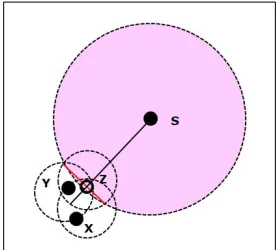
Fig.1. Selection of Two nodes for data propagation
In order to ensure the uniform packet distribution, one approach is to allow the source selects four hops to perform packet duplication. If these hops use the same routing method as source S, one of the routing paths of relay node would be on the way to S. Therefore one duplicate packet would be transferred again to a location near to source, which likewise causes that packets are detained by several hosts within the coverage region, therefore, killing the buffer capacity. Moreover, it is very difficult for a host to select four immediate neighbor hosts consistently in sparse DT-MANETs. In order to handle this problem, we ought to be allowed uniform packet distribution without losing the reliability of the data forwarding approach.
This algorithm enables the transmitting hop to select the adjacent hop and copy packets to it, and then enable both source and adjacent hop to pick their relay hops. The reason why ULRA selects the closest rather than the distant node is that although a remote hop can maximize the packet coverage region momentarily, the coverage region would nearly be an ellipse rather than a circle. To be exact, if the coverage region is non-uniform initially, it would become increasingly non-uniform therefore decreasing the effectiveness of the approach. Hence ULRA mainly attempts to preserve the coverage region analogous to a circle. Then, the transmitter and relay hops propagate the packet in the opposite direction to the transmitter in order to increase the coverage region. The source S of a particular packet and its coverage region are illustrated in Figure 1. The source is the hop currently selected to distribute the packet farther, and we draw a line perpendicular to the line SZ and therefore obtaining two zones where node X and node Y localize. When the process of data forwarding progress in this way ULRA can ensure that the packet coverage region would increase and eventually cover the receiver node.
B. Location of the Immediate Neighbor for Data Propagation
[image:5.612.190.400.557.712.2]After deciding the direction, the selection of distant relay may decrease the redundant coverage region in order to exploit existing resources effectively. As given in Figure 2, assuming that node Q is the present hop to select the path, we can determine it intuitively that best relay node B, as it is the farthest hop to Q. The hop W discovers on the same location of Q and we consider this as the worst selection since duplicating the packet to W does not create any impact of the packet coverage region. As every host makes its own decision and not aware of its neighboring node’s selections, a good technique to ensure the data forwarding process do well from the numerical point of view is to constantly achieve an optimum selection according to the selection of its neighboring hop.
843
©IJRASET: All Rights are Reserved
V. DESIGNINGOFDATAFORWARDINGALGORITHM
A. Selection of the relay node
As we are not aware of the receiver node information such as the direction or the distance, the only tactic to increase the possibility of reaching the receiver node is to distribute the packets as uniformly as possible. In order to explain our algorithm effectively, first we define the term peer hop. For a particular hop X, its peer hop represents the hop also selected as the relay by the direct ancestor of X. As illustrated in Figure 2, hop Y is a peer of X and vice versa, as that both X and Y have been selected as relay hops by their ancestor hop Z. To keep a uniform distribution, the selection of next-hop of each node hinges on the selection of its peer node. Nevertheless, a hop could not depend on a query process to find its peers, else rule 4 is violated, since if that we could not ensure the hop and its peer to be in the consistent coverage area of each other. On the other hand, the query is not a single-node process, therefore violating the rule. The only option to get the peer selection information is to enable every hop to predict the direction that its peer is most liable to select. But, the location of the potential relay hop is calculated by its likelihood to emphasize in every position of the sector. Therefore ULRA aims to obtain the most promising direction for the potential packet delivery. Also from the statistical significance, it is known that the prediction of the direction is the optimal technique and causes less variance. Consequently, we try to predict the shown up direction for a hop in the sector. The set of locations is denoted as L and the cooperation system is constructed as given in Figure 2. Since every hop has an equal chance of showing up in any location of the sector, follows a uniform distribution and consequently, the probability density function (pdf) is derived as
Now the expected direction can be estimated as π /4. So it is advisable to keep uniform packet distribution in order to let every hop to select the neighbor hop to the anticipated direction (i.e., π /4). Similar to other routing algorithms in DT-MANETs, ULRA is also delineating the utility function to describe the suitability of the routing process for a particular packet. The utility function is defined as
For all the nodes N, . As illustrated in Figure 2, the direction from node Q to node X and the direction of the
bisector of the sector are defined by and correspondingly. In equation 2, is the constraint for measuring the
distance. The remainder part of the equation defines the degree of approximation between and the expected optimal direction .
Thus the range of either part is [0, 1/2], and then the value of . Considering the two hops B and W in Figure 2, the direction of node B is and the distance between B and node Q is D. Now, we can calculate the cosine value of the angle formed
by these two vectors as . Then, we can get the maximum utility value from equation 2 as
In the meantime, node W finds on the same location as node Q, and so we have , and . Under
this case, we get the minimum utility as
Similarly, and are calculated as follows.
Now, we have the sequence of the choice priority:
844
©IJRASET: All Rights are Reserved
Fig.3. Overlapping region of packet
B. Controlling Packet Redundancy
Assume is the group of all packets in MANET and is the packets generated by the node X. Any location within the transmission range of node X can be considered as a coverage area and node X is accountable for communication within the
coverage region. Assume that node Y is also preserving a replica of and the distance among the nodes X and Y is smaller than
D. In this case, there is an overlapped region where both nodes X and Y have the capacity to achieve communication for . If the
overlapped region is too big, then it is not necessary for both nodes X and Y to preserve the identical replica of . To be precise, both X or Y takes responsibility for communication and hence killing the network resources. In order to describe the redundancy, a
variant called the rate of packet redundancy (RPR) is defined. Consider is a group of hops that are all preserving the copy of
packet . The kth order rate of packet redundancy (k-RPR) of for by , and it is represented by
where . Figure 3 represents a 2-order RPR of X and Y for defined as . The correlation of and
can be defined as
and
If , then . The overlapping region is about 70% of a consistent coverage region, and it is defined as
2-Margin. If there exists a between any two hops, then a redundant copy of the packet from both hop is
discarded to exploit the resources effectively and reduce the congestion overheads.
C. Routing Protocol
As ULRA does not depend on any global knowledge or beyond single-hop status, we do not require any data forwarding methods including DVR or LSR and therefore simply enable every hop to distribute a HELLO packet when it enters into the network. Hence the control overhead for all the hops is simply related to the hop intensity of the network. A control HELLO packet contains some details of its source such as node_ID, location and a summary vector of all the packets preserved in it [22]. For every hop, all the adjacent hops within its coverage area will get the HELLO packet and then append the corresponding location information to their neighbor’s table. Also, ULRA allows the data packet contains its source location being referred by other relay hops.
Algorithm 1 demonstrates two types of duplication approaches used in ULRA called simple duplication and utility-based duplication. Every hop will first check its packets in sequence, and propagate all the deliverable ones. For the remaining packets, the hop will use either of the two duplication policies for packet propagation. Let Z is the node making the duplication decision. If there is only one active relay node, then Z will check its neighbor’s table and then employ the naive duplication policy. Otherwise, node Z will implement the utility-based duplication approach to evade the packet flooding.
Algorithm 1:
If new packet entered
If more than one active relay node available Copy to two relay nodes selected by the utility value
Else copy to the only one relay node Go to step:1
845
©IJRASET: All Rights are Reserved
The pseudocode for redundancy coping technique and table updatation is given in Algorithm 2. Both mechanisms are achieved by enabling interactions of the “HELLO” packets between hops. As the energy is bounded in DT-MANETs and there is a tradeoff between the energy consumption and listening frequency and of “HELLO” packets [23], ULRA takes full advantage of every “HELLO” packet, and accordingly, it appends the packet duplication policy with the “HELLO” packet. The redundancy handling technique will remove the packet from both hops. ULRA transfers the packet to a hop whose distance from X is less then D/2. In this study, we plan to divide the redundancy handling technique from the duplication process to make the algorithm more simple and clear. Moreover, a “present bad hop” might be a “future good relay”, because hops might travel to a distant location where no hop can cover now. Accordingly, if we did not duplicate the packet to the hop in this condition, we would in some sense miss a chance to propagate the packet further.
Algorithm 2:
If "Hello" is received from a relay node X Update the table of neighbors
If Distance from X is more than half of the signal range
Remove the redundant packets based on the “Hello”
vector
Else go to step:1 Else go to step :1
Furthermore, even the present bad hop is also “a future bad hop”. This problem will be addressed by the redundancy handling technique since every two arrived “HELLO” packet will trigger it. In this case, the hop will check the summary vector contained in the “HELLO” packet with its own, and remove the redundant packets in order to protect the buffer capacity. The “HELLO” packet can help a hop in informing its neighbor(s) presence, and therefore we enable every hop to preserve its neighbor’s table by sending “HELLO” packets. Nevertheless, an adjacent node can be considered exist only if it is alive, which means that we should also have an announcement method for hops to remove the unacceptable neighbors. To handle this, every hop removes the corresponding neighbor entry when its anticipated “HELLO” packet has been lost more than two times. The reason is that one-time “HELLO” missing due to some reason including MAC conflicting or unpredictable latency etc. Though we can recover the removed neighbor entry to the table when a new “HELLO” packet reaches, operations on the table will take some time and consume a considerable amount of energy. Thus a fault-tolerant technique for the “HELLO” packet stated above is essential for resolving this issue.
VI.PERFORMANCEEVALUATION
A. Network model and parameter settings
In this work, ONE simulator is used to evaluate the results. ONE is a clock-stepped simulator and the precision of a result is depending upon the topology-based time-step [24]. A smaller time step causes a faster simulation task. In our experiments, we set the time-step as 0.1 sec.
For compute-intensive circumstances, we marginally rise the time-step to get a suitable processing time. In order to reimburse the imprecision presented by reducing the simulating particle size, each test is performed 5 times. Finally, the results are averaged. Once again, we underline that the global network knowledge or more than single-node status is problematic to achieve. Therefore we select three algorithms, viz.
Binary Spray and Wait (BSW), Epidemic (EPI) and FirstContact (FC) to relate ULRA. All these data forwarding algorithms are not depending upon any global information or any propagation method. EPI takes advantage of system resources as much as possible to realize the maximum PDR; however, its furious flooding presents maximum traffic overhead. If the system resource is adequate, EPI performs the trick. BSW [25] can be considered as a flooding routing bounded in a number of hops and the number of packet replicas. FC [26] is the simplest one-copy data forwarding strategy, which enables all the nodes to route packets to the first faced adjacent node.
846
[image:9.612.179.433.100.367.2]©IJRASET: All Rights are Reserved
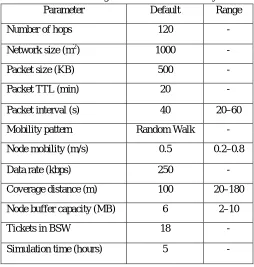
TABLE I
Parameter Settings for The Simulation Study
Parameter Default Range
Number of hops 120 -
Network size (m2) 1000 -
Packet size (KB) 500 -
Packet TTL (min) 20 -
Packet interval (s) 40 20–60
Mobility pattern Random Walk -
Node mobility (m/s) 0.5 0.2–0.8
Data rate (kbps) 250 -
Coverage distance (m) 100 20–180
Node buffer capacity (MB) 6 2–10
Tickets in BSW 18 -
Simulation time (hours) 5 -
The communication nodes are implemented randomly for each run and move all the nodes based on the Random Walk mobility pattern. We set the speed of the node to be a comparatively low value, for the purpose of studying the performance of ULRA with less assistance supported by node mobility. It is observed that ULRA outdoes the other routing strategies when the mobility is comparatively low, which shows that a location-based data forwarding approach might be a good solution for the network set-up where node position is relatively constant. In this work, PDR, average hop count (AHC) and overhead ratio (OR) are considered as the performance metrics and these measures are defined as follows
The experiments are carried out by changing the interval of packet generation, buffer size of the node, node mobility, and coverage range. First, the performances of four routing strategies are evaluated in terms of performance measures and then the stability of ULRA is analyzed by varying the simulation time and density of mobile hops. Then, the parameters that might affect the performance of ULRA are studied by varying the mobility and coverage range.
B. Results and Analysis
847
©IJRASET: All Rights are Reserved
Fig.4. PDR versus Interval of packet generation
From Figure 5 we can observe that EPI has the maximum PDR when the buffer size is adequate. When the buffer dimension is around 4 MB, the PDR of ULRA is approximately equal to EPI, and both of them do well with the existing buffer capacity.
Fig.5. PDR versus the size of the buffer
Conversely, when the buffer capacity is severely limited, the PDR of ULRA is greater than that of EPI due to the exploitation of a utility-based duplication technique rather than an original one. Moreover, ULRA has a redundancy handling technique, so protecting the constrained buffer capacity. BSW and FC still have a non-optimum performance. Figure 6 displays that the PDR of all the four data forwarding approaches marginally increases with the increase in node mobility. If the mobility is comparatively low, BSW and FC do not have optimal performance. Specifically, FC uses the one-copy mechanism and hence it routes packet in a non-concurrent manner. Therefore it has poor performance.
848
©IJRASET: All Rights are Reserved
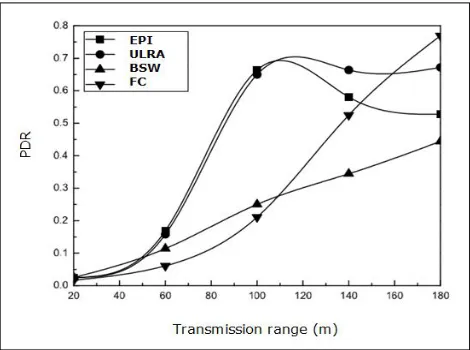
[image:11.612.190.425.162.337.2]Moreover, it is observed that the multi-copy method can be considered as an effective approach for increasing the packet forwarding possibility. Figure 7 shows the PDR performance of all four algorithms against the transmission range. From the figure it is observed that all the four strategies have the minimum PDR due to limited existing links employed in the network. With the increase in the transmission range, the link contact of the entire network remains improving and the PDR of EPI and ULRA increases much more rapidly than BSW and FC. Because both approaches produce a sufficient amount of packet replicas and exploit the network resources completely.
Fig.7. PDR versus transmission range
BSW realizes a reasonable performance if the link connectivity is relatively robust. By employing the technique of the single-copy data forwarding, FC achieves optimum performance in terms of minimum resource consumption. From the study, it is observed that the multi-copy approach is comparatively useful for improving the possibility of packet propagation for low node mobility. Further, ULRA has the maximum PDR as EPI and ULRA is a good choice as compared to EPI when the buffer capacity is limited.
Figure 8 shows the performance of the four algorithms in terms of AHC. The minimum AHC indicates a more competent relay procedure. But, things become very different when considering BSW, for that the higher AHC per packet is bounded by the particular network topology. As we fix the tickets is 18 for the BSW algorithm, the upper bound of the node count for every packet
is smaller than . Consequently, we relate the other three approaches in the AHC assessment. From Figures 8 - 11, it is
[image:11.612.188.420.559.710.2]observed that ULRA has the minimum AHC among the three algorithms due to location-based relay hop selection. Hence, the packet is transferred decisively toward the receiver. In the meantime, when the network capacity is reasonably adequate, the performance of EPI is similar to ULRA. However, in our experiments, the buffer capacity is constantly fixed in a limited range similar to actual network implementations. Therefore, the recurrent packet loss adds extra relay nodes into the data forwarding task. Besides, we can observe that FC always has the maximum AHC owing to its inherent single-copy and original relay node selection strategies.
849
©IJRASET: All Rights are Reserved
Fig.9. AHC versus size of the buffer
Fig.10. AHC versus node mobility
850
©IJRASET: All Rights are Reserved
The performance of all the four routing algorithms in terms of the overhead ratio is shown in Figures 12 - 15. The overhead ratio is a measure that reveals the performance of packet propagation. The direct delivery has a zero-overhead ratio as the number of packets relayed is always equal to the number of packets delivered [28].
Fig.12. Overhead ratio versus Interval of packet generation
Fig.13. Overhead ratio versus the size of node buffer
851
©IJRASET: All Rights are Reserved
In the BSW algorithm, a similar propagation approach is implemented in the “wait” phase. However, the “spray” phase confines the higher amount of replicas of the packet. Consequently, it can be concluded that spray and wait processes should have a less overhead ratio. FC is a single copy data forwarding algorithm and exploits record vector to evade network loops, so . The overhead ratio of FC can be calculated from this inequality and the result shows that its overhead ratio is as low as that of BSW. From Figures 12 – 15, we can observe that ULRA has the maximum overhead ratio than EPI, BSW, and FC.
Fig.15. Overhead ratio versus transmission range
VII. CONCLUSION
In this work, a Utility-based Location-aware Routing Algorithm is designed for DT-MANETs. We formulate a mathematical framework to derive the utility function of the nodes in order to implement a controlled packet duplication technique. For decreasing the overhead ratio due to packet flooding, we implement a criterion to assess the rate of packet duplication. Finally, a packet redundancy controlling technique is added to this algorithm. Extensive simulation studies have been carried out and the results reveal that the proposed ULRA outdoes the other existing data forwarding algorithms like Binary spray and wait, Epidemic, and FirstContact in terms of packet delivery ratio (PDR) and average hop count (AHC) with an acceptable overhead ratio in delay-tolerant network scenario.
REFERENCES
[1] Mohanasundaram S & Thangavel P, ‘A Priority-Based Queue Management approach for AODV Protocol to Support QoS Provision for Real-Time Applications in MANET’, International Journal on Applications in Engineering and Technology Volume 1: Issue 6 :June 2015, pp 4 – 11, ISSN: 2455 – 0523 [2] Maurice J Khabbaz, Chadi M Assi, and Wissam F Fawaz. DisruptionTolerant Networking: A Comprehensive Survey on Recent Developments and Persisting
Challenges. IEEE Communications Surveys & Tutorials, 14(2):607–640, January 2012.
[3] A Voyiatzis. A Survey of Delay-and Disruption-Tolerant Networking Applications. Journal of Internet Engineering, 5(1):331–344, 2012.
[4] J¨org Ott. A Quest For DTN Applications. In Proceedings of the third ACM international workshop on Mobile Opportunistic Networks - MobiOpp ’12, page 3, New York, New York, USA, 2012. ACM Press.
[5] Wenrui Zhao, Mostafa Ammar, Ellen Zegura, and College Computing. A Message Ferrying Approach for Data Delivery in Sparse Mobile Ad Hoc Networks. In Proceedings of the 5th ACM international symposium on Mobile ad hoc networking and computing - MobiHoc ’04, pages 187– 198, New York, New York, USA, 2004. ACM Press.
[6] Wenrui Zhao, Mostafa Ammar, and Ellen Zegura. Multicasting in Delay Tolerant Networks. In Proceeding of the 2005 ACM SIGCOMM workshop on Delay-tolerant networking - WDTN ’05, pages 268–275, New York, New York, USA, 2005. ACM Press.
[7] Yue Cao, Haitham Cruickshank, and Zhili Sun. Active Congestion Control Based Routing for Opportunistic Delay Tolerant Networks. In 2011 IEEE 73rd Vehicular Technology Conference (VTC Spring), pages 1–5. IEEE, May 2011.
[8] Nathanael Thompson, Samuel C Nelson, Mehedi Bakht, Tarek Abdelzaher, and Robin Kravets. Retiring Replicants: Congestion Control for Intermittently-Connected Networks. In 2010 Proceedings IEEE INFOCOM, pages 1–9. IEEE, March 2010.
[9] Amit Dvir and Athanasios V Vasilakos. Backpressure-Based Routing Protocol for DTNs. In Proceedings of the ACM SIGCOMM 2010 conference on SIGCOMM - SIGCOMM ’10, pages 405–406, New York, New York, USA, 2010. ACM Press.
[10] Jung Ryu, Lei Ying, and Sanjay Shakkottai. Back-Pressure Routing for Intermittently Connected Networks. In 2010 Proceedings IEEE INFOCOM, pages 1–5. IEEE, March 2010.
852
©IJRASET: All Rights are Reserved
[12] Aruna Balasubramanian, Brian Neil Levine, and Arun Venkataramani. Replication Routing in DTNs: A Resource Allocation Approach. IEEE/ACM Transactions on Networking, 18(2):596–609, April 2010.
[13] CongLiuandJieWu. OnMulticopyOpportunisticForwardingProtocols in Nondeterministic Delay Tolerant Networks. IEEE Transactions on Parallel and Distributed Systems, 23(6):1121–1128, June 2012.
[14] Rachid El-Azouzi, Francesco De Pellegrini, Habib B.A. Sidi, and Vijay Kamble. Evolutionary forwarding games in delay tolerant networks: Equilibria, mechanism design and stochastic approximation. Computer Networks, 57(4):1003–1018, March 2013.
[15] Abraham Mart´ın-Campillo, Jon Crowcroft, Eiko Yoneki, and Ramon Mart´ı. Evaluating opportunistic networks in disaster scenarios. Journal of Network and Computer Applications, 36(2):870–880, March 2013.
[16] Boloni L. and Turgut D. Should I send now or send later? A decisiontheoretic approach to transmission scheduling in sensor networks with mobile sinks. Special Issue of Wiley’s Wireless Communications and Mobile Computing Journal (WCMC) on Mobility Management and Wireless Access, (March 2008):385–403, 2008.
[17] D. Turgut and L. Boloni. Heuristic Approaches for Transmission Scheduling in Sensor Networks with Multiple Mobile Sinks. The Computer Journal, 54(3):332–344, December 2009.
[18] Michael Demmer and Kevin Fall. DTLSR: Delay Tolerant Routing for Developing Regions. In Proceedings of the 2007 workshop on Networked systems for developing regions - NSDR ’07, pages 1–6, New York, New York, USA, 2007. ACM Press.
[19] Ioannis Psaras, Ning Wang, and Rahim Tafazolli. Six Years Since First DTN Papers. Is There a Clear Target. First Extreme Conference on Communications (ExtremeCom), 2009.
[20] JIANBO LI, Shan Jiang, and Hequn Xian. A probability based adaptive multicast routing scheme for delay tolerant networks. In 2011 2nd International Conference on Control, Instrumentation and Automation (ICCIA), pages 388–392. IEEE, December 2011.
[21] T Spyropoulos, K Psounis, and C.S. Raghavendra. Efficient Routing in Intermittently Connected Mobile Networks: The Multiple-Copy Case. IEEE/ACM Transactions on Networking, 16(1):77–90, February 2008.
[22] A Vahdat and D Becker. Epidemic Routing for Partially Connected ad hoc Networks. Duke University Technical Report, Cs-2000-06(Tech. Rep.), 2000. [23] M Motani and V Srinivasan. Opportunistic Energy-Efficient Contact Probing in Delay-Tolerant Applications. IEEE/ACM Transactions on Networking,
17(5):1592–1605, October 2009.
[24] Ari Ker¨anen, J¨org Ott, and Teemu K¨arkk¨ainen. The ONE simulator for DTN protocol evaluation. In Proceedings of the Second International ICST Conference on Simulation Tools and Techniques, page 55. ICST, 2009.
[25] Thrasyvoulos Spyropoulos, Konstantinos Psounis, and Cauligi S Raghavendra. Spray and Wait: An Efficient Routing Scheme for Intermittently Connected Mobile Networks. In Proceeding of the 2005 ACM SIGCOMM workshop on Delay-tolerant networking - WDTN ’05, pages 252–259, New York, New York, USA, 2005. ACM Press.
[26] Sushant Jain, Kevin Fall, and Rabin Patra. Routing in a delay tolerant network. ACM SIGCOMM Computer Communication Review, 34(4):145–157, October 2004.
[27] Thangavel P & Mohanasundaram S, ‘An Integrated Cross-Layer Design for Efficient Live Multimedia Transmission in Mobile Ad-Hoc Networks’, International Journal on Applications in Information and Communication Engineering Volume 1: Issue 9: September 2015, pp 61–68, ISSN: 2394 – 6237 [28] Matthias Grossglauser and D.N.C. Tse. Mobility increases the capacity of ad hoc wireless networks. IEEE/ACM Transactions on Networking, 10(4):477–486,