Design and Static Structural Analysis of Leaf
Spring using FEA
Shubham Kurmi1, U.K. Joshi2
1
M.E. Scholar, Dept. of Mechanical Engineering, Jabalpur Engineering College, Jabalpur,India
2
Associate Prof., Dept. of Mechanical Engineering, Jabalpur Engineering College, Jabalpur,India
Abstract: A spring is an elastic machine element which deforms under the application of load and tends to regain its original shape upon removal of load. In modern scenario Automobile Industry has shown a lot of interest in reducing weight of the vehicle. The suspension leaf spring is one of the potential items for the weight reduction in Automobiles. Introduction of composite materials made it possible to reduce the weight of leaf spring without losing load carrying capacity since they have high strength to weight ratio.In this research work standard existing multi-leaf spring is modeled in CatiaV5 and analysis is carried out by using ANSYS16.0. The theoretical and software based results are presented and compared for validation. A comparative study has been made between different composite (E-Glass/Epoxy, Carbon Epoxy, Graphite Epoxy, etc.) multi-leaf spring, steel multi-leaf spring and mono composite leaf spring with respect to stress, deformation and weight to find out the best material that have minimum weight and stress for same load carrying capacity.
Keyword: Leaf spring, Static analysis, Composite, Ansys, Catia.
I. INTRODUCTION
A Leaf spring was 1st used in 1804 by Obadiah Elliot for suspending the horse drawn cart. It was than incorporated in early designs of motor vehicles. A spring is an elastic machine element which undergoes deflection for the application of any load and intends to regain its original shape depending upon the magnitude of applied load.
Major application of spring may include its use as a shock and vibration absorber and storing potential energy by its deflection during the application of load. Leaf spring is used in almost all the trucks and light vehicles.
It improves the suspension quality and can support heavy load. Nearly 20% of un-sprung mass of the vehicle is usually leaf spring assembly which makes it attractive option for weight reduction study for the design improvements. Weight reduction is an effective measure for energy conservation. It reduces overall fuel consumption of the vehicle. The strain energy of the material becomes a major factor in designing the springs.
The material having lower modulus and density will have a greater specific strain energy capacity. It helps in achieving the vehicle with improved riding qualities.
Reducing weight while increasing or maintaining strength of products is getting to be highly important research issue in this modern world. Composite materials are one of the material families which are attracting researchers and being solutions of such issue. The leaf spring should absorb the vertical vibrations and impacts due to road irregularities by means of variations in the spring deflection so that the potential energy is stored in spring as strain energy and then released slowly. So, increasing the energy storage capability of a leaf spring ensures a more compliant suspension system. According to the studies made a material with maximum strength and minimum modulus of elasticity in the longitudinal direction is the most suitable material for a leaf spring. Fortunately, composites have these characteristics and have high strength to weight ratio.
II. LITERATURE REVIEW
A. Dara Ashok, M.V. Mallikarjun, and Venkata Ramesh Mamilla
B. MouleeswaranSenthilkumar, SabapathyVijayarangan
This paper describes static and fatigue analysis of steel leaf spring and composite multi leaf spring made up of glass fiber reinforced polymer using life data analysis. Compared to steel spring, the composite leaf spring is found to have 17.35 % lesser stress and weight reduction of 68.15 %is achieved. It is found that the life of composite leaf spring is much higher than that of steel leaf spring.
C. RohitGhosh, SushovanGhosh and ShirishGhimire
Average cost of E-Glass that can be used to manufacture the springs very high as compared to steel leaf spring, hence, ifthe entire spring is made of composite material then it would not be cost effective at all. He further concluded that, stresses in extra full-length leaves were almost 50% more (1.5 times) than that of the graduated-length leaves. Finally, the present work offers an exclusive idea regarding the construction of multi-leaf spring through its proposal for manufacturing the extra full-length leaves with composites, while using steels for the rest of the leaves, to minimize the cost.
D. PinaknathDewanji
This paper deals with the Design and analysis of composite leaf spring. The conventional multi leaf spring weights about 10.27kg whereas the E-glass/Epoxy multi leaf spring weighs only 3.26 kg. Thus, the weight reduction of 67.88% is achieved. By the reduction of weight and the less stresses, the fatigue life of composite leaf spring is to be higher than that of steel leaf spring. Totally it is found that the composite leaf spring is the better that of steel leaf spring.
E. P Sai Krishna
In this paper design and analysis of leaf spring is done. Modeling of leaf spring is done in solidworks 2016 design software. First 4mm thickness leaf spring then 5 and 6mm are modeled. The models are saved as igs files to import in ansys. By analysis It is concluded that already 6mm thickness is existing by we reduced it to 5mm and 4mm by varying the thickness reduction in weight occurred from the analysis carbon steel material for 5mm thickness is showing less stress compared to 4mm thickness leaf spring. Leaf spring containing 4mm thickness undergone maximum stress though the weight reduction is maximum but stability to oppose the load is low but 5mm thickness leaf spring got the values nearer to 6mm and it has low weight compared to 6mm leaf spring. Author has concluded that the leaf spring containing 5mm thickness applied with carbon steel material is showing best results.
III. SCOPE OF PRESENT WORK
In thepresent work finite element analysis is carried out using ANSYS 16.0 to determine the stress and deformation in conventional steel multi-leaf spring and various composite multi-leaf spring to determine the best one.
The objectives of this study are:
A. To develop 3D CAD model of Leaf Spring.
B. To study the behavior of different material of leaf spring under static analysis.
C. To calculate the total deformation and stressdeveloped in steel multi-leaf spring, composite multi-leaf spring, composite mono leaf spring and hybrid multi leaf spring under same loading conditions.
D. To compare all the results and conclude a best material.
IV. METHOD AND MATERIALS
A model is created with the help of computer aided drafting software, CATIA V5. The CATIA model is saved in IGES format and imported in ANSYS Workbench 16.0 for pre-processing and then static structural analysis is carried out. The Analysis involves the discretization called meshing, boundary conditions and loading. Materials taken for analysis are 50Cr1V23 steel, E-Glass/Epoxy, Carbon Epoxy, Graphite Epoxy and Kevlar Epoxy etc.
A. Specifications of Leaf Spring: Dimensions of Tata Sumo standard leaf spring has been taken [7], which are as follows Span of leaf spring (eye to eye) = 1250mm
No. of full length leaves = 2 No. of graduated leaves = 4 Thickness of leaves = 7mm Width of leaves = 60mm
Free Camber at no load conditions = 190mm Total load = 2850kg
Fig: 1 – 3D CATIA model of multi-leaf spring
Fig: 2 - 3D CATIA model of mono leaf spring
B. Properties of Steel Leaf Spring: Material selected - 50Cr1V23 [5]
Composition – 0.45% C, 0.1%-0.3% Si, 0.6%-0.9% Mn, 0.9-1.2% Cr
Parameter Value
Young modulus 200000 Mpa
Poison ratio 0.3
BHN 534-601
Tensile strength ultimate 2000 Mpa
Tensile strength yield 1800 Mpa
Table1. Properties of steel material
Materials
Properties
E-Glass/Epoxy Carbon Epoxy Graphite Epoxy
Tensile modulus (Ex), Mpa 43000 177000 294000
Tensile modulus (Ey), Mpa 6500 10600 6400
Tensile modulus (Ez), Mpa 6500 10600 6400
Poisson’s Ratio (Vxy) 0.27 0.27 0.23
Poisson’s Ratio (Vyz) 0.06 0.02 0.01
Poisson’s Ratio (Vzx) 0.06 0.02 0.01
Shear Modulus (Gxy), Mpa 4500 7600 4900
Shear Modulus (Gyz), Mpa 2500 2500 3000
Shear Modulus (Gzx), Mpa 2500 2500 3000
Density, kg/mm3 0.000002 0.0000016 0.0000015
Table2. Properties of composite material [6]
V. ANALYTICAL CALCULATIONS
Maximum capacity = 2850 kg = 28500N Tata sumo is equipped with 4 no. of leaf spring.
So load acting on each leaf spring 2W = 28500/4 = 7125N Thickness of leaves = 7mm
Width of leaves = 60mm Span length = 1250mm
Bending stress generated in leaf spring,σmax = 6WL/nbt2 = (6*3562.5*625)/(6*60*72)
σmax = 757.334 N/mm2
Maximum deflection of leaf spring, ymax = 12WL3/ [Ebt3 (2ng+3nf)]= (12*3562.5/6253) / (200000*60*73**14)
ymax = 181.12 mm
From theoretical analysis we got maximum stress is 712.91Mpa which is lower than allowable design (1800Mpa) stress so our design is safe.
VI. ANALYSIS OF LEAF SPRING
A. Material – Steel 50Cr1V23
Fig. 4- Total deformation of steel multi-leaf spring at maximum load of 7125N
Result table for analytical and ANSYS based results for steel leaf spring –
Parameter Analytical results Static analysis results Percentage variation
Maximum stress (Mpa) 757.334 719.23 5.03%
Maximum deflection (mm) 181.12 187.86 3.72%
Table3. Comparison of analytical and ANSYS based results for steel leaf spring
From above table we can see that percentage variations in analytical and software based results for steel leaf spring are negligible hence our model is validated.
Now we will do analysis of composite multi-leaf spring and composite mono leaf spring (42mm thick at centre and 7mm thick at eye end) under same applied load.
B. Material – E-Glass/Epoxy
[image:5.612.46.551.441.710.2]Fig.6 – Total deformation of E-Glass/Epoxy multi-leaf spring at maximum load of 7125N
Fig.7 –
Fig.8 – Total deformation of E-Glass/Epoxy mono leaf spring at maximum load of 7125N
C. Material – Carbon Epoxy
Fig.10 – Total deformation of Carbon Epoxy multi-leaf spring at maximum load of 7125N
Fig.12 – Total deformation of Carbon Epoxy mono leaf spring at maximum load of 7125N
D. Material – Graphite epoxy
Fig.14 – Total deformation of Graphite Epoxy multi-leaf spring at maximum load of 7125 N
Fig.16 – Total deformation of Graphite Epoxy mon
leaf spring at maximum load of 7125 N
VII. RESULTS
A. Static Structural analysis Parameters Metal Equivalent stress (Mpa) Total deformation (mm) Weight (Kg) Percentage weight saving Steel 50Cr1V23 (multi-leaf)
719.23 187.86 18.331 -
E-Glass/Epoxy (multi-leaf)
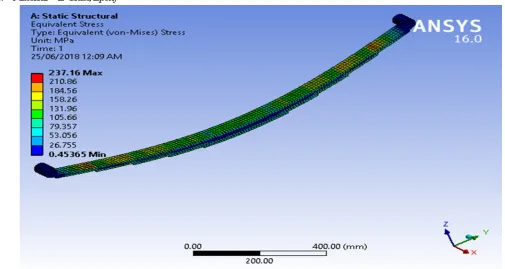
237.16 315.45 4.6703 74.52%
Carbon Epoxy (multi-leaf)
227.47 220.65 3.7363 79.61%
Graphite Epoxy (multi-leaf)
243.05 309.47 3.5027 80.89%
E-Glass/Epoxy (mono leaf)
83.003 129.49 5.3871 70.61%
Carbon Epoxy (mono leaf)
82.948 91.777 4.3097 76.48%
Graphite Epoxy (mono leaf)
VIII. CONCLUSION
From the static analysis results it is found that all the composite material shows better result as compared to conventional steel leaf spring, although when we use multi-leaf spring of composite material, deflection is found to be quite high as compared to steel leaf spring. But when we use mono leaf spring of composite material, stresses and deflections are found to be very low as compared to steel leaf spring and weight saving of around 75% is achieved. Overall Carbon epoxy mono leaf spring is found to have best results among all the leaf springs with respect to strength, deflection and weight saving. Hence we can conclude that composite materials are better replacement for conventional steel leaf spring.
REFERENCES
[1] Dara Ashok, M.V.Mallikarjun and Venkata Ramesh Mamilla, Design And Structural Analysis of Composite Multi Leaf Spring, International Journal of Emerging trends in Engineering and Development, ISSN 2249-6149
[2] MouleeswaranSenthilkumar, SabapathyVijayarangan, Analytical and Experimental studies on fatigue life prediction of steel and composite multi-leaf spring for light passenger vehicles using life data analysis, ISSN 1392–1320 MATERIALS SCIENCE (MEDŽIAGOTYRA). Vol. 13, No. 2. 2007
[3] RohitGhosh, SushovanGhosh and ShirishGhimire, Static Analysis Of Multi-Leaf Spring UsingAnsys Workbench 16.0, International Journal of Mechanical Engineering and Technology (IJMET) Volume 7, Issue 5, September–October 2016, pp.241–249, Article ID: IJMET_07_05_025
[4] PinaknathDewanji, Design and analysis of composite leaf spring, International Journal of Mechanical Engineering and Technology (IJMET) Volume 7, Issue 5, September–October 2016, pp.177–183, Article ID: IJMET_07_05_019
[5] DarshanKapadia, Palak H. Desai, Ajay Sonani, Design and analysis of composite leaf spring for light weight vehicles, International journal of engineering sciences and research technology, ISSN 2277-9655, June 2016.
[6] Jayesh Raj Pal, Arun Singh Kushwah, Design and optimization of multi leaf spring by finite element and Grey relation method, International Journal for Research in Applied Science & Engineering Technology (IJRASET), ISSN: 2321-9653, Volume 5 Issue IX, September 2017.
[7] Santosh Patel, UtkarshMansore, Parametric design and comparative analysis of multi leaf spring for light weight vehicle, International research journal of engineering and technology (IJRET), ISSN 2395-0056, Volume 05, Issue 03, Mar 2017.
[8] S.Rajesh and G.B.Bhaskar, Experimental Investigation on Laminated Composite Leaf springs Subjected to Cyclic Loading,S.Rajesh et al. / International Journal of Engineering and Technology (IJET).