Abstract — In recent years, there has been considerable research interest in social computing and radio frequency identification (RFID) technology. In this paper, we present a Smart Shopping System to provide customers with a smart shopping experience with the help of social vectors and RFID technology. Social vectors provide a systematic and mathematical way to define and quantify social relationships between any entities, while RFID technology allows any object to be easily tracked and identified in an indoor environment. The Smart Shopping System identifies the location of customers using RFID technology and finds similar customers using social vectors with the purpose of providing product recommendations and sending customized marketing messages such as mobile advertisements or e-coupons to customers’ smart phones as soon as the customers come into a shop or are near to the shop. Other innovative functionalities include receiving real-time product reviews from similar customers who have just visited the same shops, and exchanging e-coupons or product information using NFC technology.
Index Terms — social computing, social vectors, RFID, product recommendation
I. INTRODUCTION
ith the popularity of smart phones, mobile marketing is becoming increasingly popular. As an effective marketing technique, mobile marketing provides context-aware information [1] to customers so as to generate values for both customers and sellers [2]. In this paper, we present a Smart Shopping System that sends real-time customized marketing messages (i.e., e-coupons or mobile advertisements of products purchased by similar customers) to customers when they have just come into a shop. There are two issues in the development of the Smart Shopping System: (1) How can customers be identified effectively (e.g., when they have just entered the shop)? (2) How are customized marketing messages to be generated? To address the first issue, radio frequency identification (RFID) technology is employed in the Smart Shopping System so that when a customer comes into a shop, the Smart Shopping System can be notified instantly. To address the second issue, social vectors are introduced to find similar customers. Customized marketing messages can then be generated based on the purchase records of similar customers.
Manuscript received January 8, 2013.
Terry H. S. Chu, Felix C. P. Hui, and Henry C. B. Chan are with the Department of Computing, The Hong Kong Polytechnic University, Hong Kong (e-mail: {cshschu, cscphui, cshchan}@comp.polyu.edu.hk).
There has been considerable research interest in social networks [3][4][5] in recent years. One of the important issues in social networks is that of dealing with the social relationships between people. Many researchers have investigated social groups (i.e., the social relationships for a group of people) in social networks based on techniques used in graph theory. For example, three distributed community detection algorithms have been proposed in [6]. In [7], tightly connected communities are found by using hierarchical agglomerative clustering. In [8], the subgroup structure of a social network is identified based on an optimized modularity function. In [9], social relationships are discovered based on the clique percolation method. While the aforementioned works focus on investigating social groups, we recently proposed a concept called social vectors [10] to provide a systematic and mathematical way of defining and quantifying social relationships (i.e., friend, community, etc.). With respect to a shop, the concept of social vectors can be extended to the activity of finding similar customers for the purpose of making product recommendations and, most importantly, delivering real-time customized marketing messages as soon as the customers come into the shop. In this paper, we will first discuss the basic properties of social vectors and then introduce a rule-based approach and a comparison-based approach based on social vectors to find similar customers. The product recommendations and the customized marketing messages for customers are generated based on the products purchased by most similar customers of the shop.
In recent years, radio frequency identification (RFID) technology [11] has also been widely employed by various industries. RFID technology can provide indoor location tracking, which the Global Positioning System (GPS) cannot provide [12][13]. For the automatic identification and tracking of objects, RFID readers get data from an RFID tag that is attached to each object. In the Smart Shopping System, we use active RFID technology to track the location of customers. By equipping each shop with an active RFID reader and each customer with an RFID-enabled smart card, customers can be identified by the Smart Shopping System as soon as they enter a shop.
The Smart Shopping System makes use of social vectors and RFID technology to provide customers with a smart shopping experience. Social vectors are employed to identify similar customers. The products purchased by a similar customer or most similar customers can then be recommended to the customers. On the other hand, by using RFID technology, the location of customers can be identified instantly when the customers’ RFID-enabled smart cards are in the coverage range of the RFID reader. Therefore, with social vectors and RFID technology,
Smart Shopping System Using Social Vectors
and RFID
Terry H. S. Chu, Felix C. P. Hui, and Henry C. B. Chan
product recommendations and customized marketing messages (i.e., advertisements and e-coupons for the recommended products) can be delivered to customers’ smart phones as soon as the customers come into a shop or are near to the shop. Other innovative functionalities include receiving real-time product reviews from similar customers who have just visited the same shops, and exchanging e-coupons or product information using NFC technology.
The rest of this paper is outlined as follows. Section II presents the concept of social vectors with two innovative approaches to finding similar customers. Section III presents an overview of the Smart Shopping System. Section IV presents system test scenarios of the Smart Shopping System. Section V gives the conclusion and outlines future work.
II. SOCIAL VECTORS
Social vectors are a systematic and mathematical way to define and quantify social relationships between any entities [1]. For example, how can we express the statement “X is a friend of Y” or “X belongs to community C” mathematically? In other words, how can we define and quantify the social relationships in human society? In this section, we further employ social vectors to find similar customers with the purpose of providing product recommendations and delivering customized marketing messages.
A. Basic Properties of Social Vectors
A social vector comprises of continuous, discrete, or Boolean attributes. An m-dimensional social vector ⃑⃑⃑⃑⃑⃑ with m attributes ( , ,… ) can be defined to quantify the relationship between a shop and a customer. In addition, it has similar basic properties as traditional vectors. Some of the basic properties that can be used in the Smart Shopping System are shown as follows.
Unit Social Vector
For the social attribute, a unit vector ⃑⃑⃑⃑⃑⃑ ) can be defined in the dimension or direction to represent the value of attribute .
Magnitude & Angle
The magnitude of ⃑⃑⃑⃑⃑⃑ is the strength of the relationship between a customer C and a shop S, which is defined by:
| ⃑⃑⃑⃑⃑⃑⃑ | √∑ ⃑⃑⃑⃑⃑⃑
(1)
The angle between two social vectors ⃑⃑⃑⃑⃑⃑⃑⃑ and ⃑⃑⃑⃑⃑⃑⃑⃑ is defined by:
∑ ⃑⃑⃑⃑⃑⃑⃑⃑ ⃑⃑⃑⃑⃑⃑⃑⃑
| ⃑⃑⃑⃑⃑⃑⃑⃑ || ⃑⃑⃑⃑⃑⃑⃑⃑ | (2)
In essence, if is more similar to than to , then:
(3)
XNOR Operation
For Boolean attributes, the similarity between two social vectors can be found by using an XNOR operation. Given two social vectors ⃑⃑⃑⃑⃑⃑⃑ and ⃑⃑⃑⃑⃑⃑⃑ with m Boolean attributes:
⃑⃑⃑⃑⃑⃑⃑ ⃑⃑⃑⃑⃑⃑⃑ =
[⃑⃑⃑⃑⃑⃑⃑ ⃑⃑⃑⃑⃑⃑⃑ ⃑⃑⃑⃑⃑⃑⃑ ⃑⃑⃑⃑⃑⃑⃑ , … ⃑⃑⃑⃑⃑⃑⃑ ⃑⃑⃑⃑⃑⃑⃑ ]
(4)
In sub-section B, a rule-based approach to determine whether a given customer is similar to another one is introduced, with the help of the XNOR operation.
Group Social Vector
A group of social vectors can be combined to form a group social vector. Suppose that there are N social vectors:
⃑⃑⃑⃑⃑⃑⃑⃑ , ⃑⃑⃑⃑⃑⃑⃑⃑ , … ⃑⃑⃑⃑⃑⃑⃑⃑⃑ . Their group social vector ⃑⃑⃑⃑⃑⃑⃑ can be expressed as:
⃑⃑⃑⃑⃑⃑⃑ ∑ ⃑⃑⃑⃑⃑⃑⃑⃑
∑ ⃑⃑⃑⃑⃑⃑⃑⃑
∑ ⃑⃑⃑⃑⃑⃑⃑⃑
(5) The vector values of this group social vector define the centroid of the group. In sub-section C, a comparison-based approach to determine whether a given customer is similar to a group of customers is introduced, with the help of the group social vector.
Weighted Social Vector
In some cases, some attributes may be more important than others. A weight vector can therefore be introduced. Define : { , , ... } as the weight vectors. The weighted magnitude for the weighted social vector is defined by:
| ⃑⃑⃑⃑⃑⃑⃑ | √∑ ⃑⃑⃑⃑⃑⃑
(6)
Similarly, the weighted angle between two weighted social vectors is defined by:
∑ ⃑⃑⃑⃑⃑⃑⃑⃑ ⃑⃑⃑⃑⃑⃑⃑⃑
| ⃑⃑⃑⃑⃑⃑⃑⃑ | | ⃑⃑⃑⃑⃑⃑⃑⃑ | (7)
The weighted XNOR result is:
⃑⃑⃑⃑⃑⃑⃑ ⃑⃑⃑⃑⃑⃑⃑ =
[ ⃑⃑⃑⃑⃑⃑⃑ ⃑⃑⃑⃑⃑⃑⃑ , ⃑⃑⃑⃑⃑⃑⃑ (2) ⃑⃑⃑⃑⃑⃑⃑ (2)), … ⃑⃑⃑⃑⃑⃑⃑ ⃑⃑⃑⃑⃑⃑⃑ ] (8)
The weighed group social vector can also be defined as follows:
⃑⃑⃑⃑⃑⃑⃑
∑ ⃑⃑⃑⃑⃑⃑⃑⃑
∑ ⃑⃑⃑⃑⃑⃑⃑⃑
∑ ⃑⃑⃑⃑⃑⃑⃑⃑
(9)
where ∑ ⃑⃑⃑⃑ and in general, .
or to a group of customers G, customer would be recommended the products that customer or most customers in the group of customers G had just purchased.
B. Rule-based Approach for Finding Similar Customers
A rule-based approach can be used to find similar customers based on social vectors. Basically, this approach can be divided into two parts. The first part is to classify customers into various types with respect to a shop. The second part is to determine similar customers based on their preferences in each customer type. For purposes of illustration, we define a simple social vector with m
[image:3.595.40.292.346.449.2]attributes. ⃑⃑⃑⃑⃑⃑ defines the visit duration to a shop S last month. ⃑⃑⃑⃑⃑⃑ defines the number of visits to the shop S last month. ⃑⃑⃑⃑⃑⃑ defines the number of purchases in the shop S last month. ⃑⃑⃑⃑⃑⃑ (for i > 3) are Boolean attributes, indicating whether the customer has a preference for any product in the shop S. For example, if a person likes sports, then is set to 1 for the social vector between the customer and the shop that sells sports products. Otherwise is set to 0, indicating that the customer does not have such a preference.
Table I: Four types of customers
Customer
Type Conditions
Type I a1 ≥ 10 hours, a2 ≥ 10 times, and a3 > 15 units
Type II a1 > 10 hours, a2 > 10 times, and a3≤ 15 units
Type III a1 < 1 hour, a2 < 2 times, and a3 < 3 units
Type IV Others
Every shop can classify its customers into various customer types based on social vectors with customized rules, as shown in Table I. Given a customer C with a social vector ⃑⃑⃑⃑⃑⃑ = [ , 20, 30, 1, 0, 0, 1, 0], we can find that customer C is a Type I customer based on the above rules. Then, by making use of the XNOR operator of the social vector, we can determine which customers under the same type are more similar to customer C. For example, suppose there are five Type I customers V, W, X, Y, and Z for the shop S. The social vectors between the shop S and these customers are shown as follows:
⃑⃑⃑⃑⃑⃑⃑ = [10, 15, 30, 1, 0, 0, 1, 1]
⃑⃑⃑⃑⃑⃑⃑⃑ = [ , 10, 20, 1, 1, 1, 0, 0]
⃑⃑⃑⃑⃑⃑⃑ = [ , 18, 30, 1, 1, 0, 1, 0]
⃑⃑⃑⃑⃑⃑ = [ , 10, 30, 1, 0, 1, 0, 1]
⃑⃑⃑⃑⃑⃑ = [ , 25, 30, 1, 1, 1, 1, 0]
By using the XNOR operator (see (4) and (8)), we can find that:
⃑⃑⃑⃑⃑⃑ XNOR ⃑⃑⃑⃑⃑⃑⃑ = 4
⃑⃑⃑⃑⃑⃑ XNOR ⃑⃑⃑⃑⃑⃑⃑⃑ = 2
⃑⃑⃑⃑⃑⃑ XNOR ⃑⃑⃑⃑⃑⃑⃑ = 3
⃑⃑⃑⃑⃑⃑ XNOR ⃑⃑⃑⃑⃑⃑ = 2
⃑⃑⃑⃑⃑⃑ XNOR ⃑⃑⃑⃑⃑⃑ = 3
Since ⃑⃑⃑⃑⃑⃑ XNOR ⃑⃑⃑⃑⃑⃑⃑ gives the highest value, customers C and V are therefore more similar. Note that in the above calculations, the continuous or discrete attributes are discarded by setting their corresponding weight to zero.
C. Comparison-based Approach for Finding Similar Customers
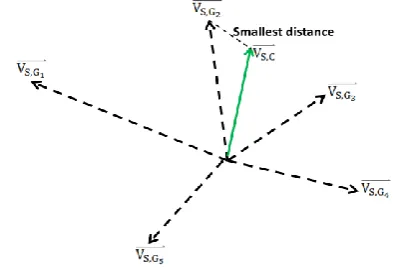
Based on their visit duration, number of visits, purchase records, and personal preferences, customers can be categorized into different groups using various clustering algorithms such as the K-Means Clustering Algorithm and the Genetic Algorithm. (Note that in the Smart Shopping System, customers’ preferences can be collected in an initial registration procedure through their smart phones.) Each group can be represented by a group social vector. Fig. 1 shows an example of how a group of similar customers is found using social vectors. Given some customers of a shop S, they can be grouped into five groups , , , and and are represented as five group social vectors
⃑⃑⃑⃑⃑⃑⃑⃑⃑ , ⃑⃑⃑⃑⃑⃑⃑⃑⃑ , ⃑⃑⃑⃑⃑⃑⃑⃑⃑ , ⃑⃑⃑⃑⃑⃑⃑⃑⃑ and ⃑⃑⃑⃑⃑⃑⃑⃑⃑ . For each group, the group social vector gives the centroid of the community (see (5)). When there is a new social vector ⃑⃑⃑⃑⃑⃑ (i.e., the social vector between the shop S and the customer C), we can determine whether ⃑⃑⃑⃑⃑⃑ is more similar to a group by comparing the distance to the centroid of the two groups. In the example, the new social vector ⃑⃑⃑⃑⃑⃑ should be closer to
⃑⃑⃑⃑⃑⃑⃑⃑⃑ . In other words, the new customer C is similar to those of group . Note that, in some cases, some attributes may be more important than others. Therefore, a weight vector can be employed to highlight the important attributes (see (9)). For example, a shop that sells sports equipment would probably set a higher weight for the attribute that indicates that the customer likes sports.
Fig. 1: Finding a group of similar customers using social vectors
[image:3.595.329.529.473.608.2]range of social computing systems, such as friend recommendation systems.
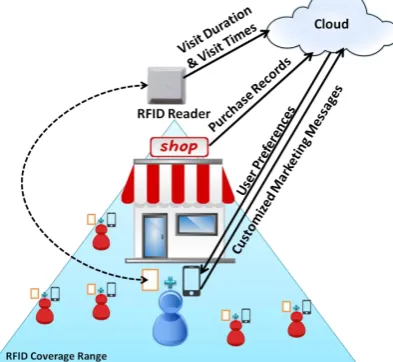
[image:4.595.72.269.302.483.2]III. OVERVIEW OF THE SMART SHOPPING SYSTEM The Smart Shopping System provides customers with a smart shopping experience with the help of social vectors and RFID technology. To use the system, customers first need to download a mobile application and pick up an RFID-enabled smart card from a participating shop. They then need to follow a registration procedure, which requires them to input the identity number of their RFID-enabled smart card and their personal preferences to their smart phones. Once the registration is completed, the customized marketing messages will automatically be sent to the customers’ smart phones as soon as the customer comes into a participating shop. Real-time reviews from similar customers can also be received. Besides, customers can check recommended products and exchange e-coupons or product information with their friends using NFC technology anytime and anywhere.
Fig. 2: The architecture of the Smart Shopping System
A. Architecture
The Smart Shopping System comprises of several main components: RFID readers, RFID-enabled smart cards, web-based terminals in shops, and customers’ smart phones with the mobile application of the Smart Shopping System and the cloud server of the Smart Shopping System. The general architecture of the Smart Shopping System is shown in Fig. 2.
RFID Reader and RFID-enabled Smart Card
The Smart Shopping System employs active RFID technology to track the location of customers. Note that active RFID technology provides a longer coverage range compared with passive RFID technology.
Under the Smart Shopping System, each shop has an RFID reader while each customer has an RFID-enabled smart card (i.e., the smart card is equipped with an RFID tag). Whenever a customer brings that smart card to the shop, the RFID reader can inform the cloud server of the Smart Shopping System and update to the cloud server the visit duration and the number of visits made by that customer.
Smart Phone with Mobile Application
Customers who use the Smart Shopping System need to input the identity number of an RIFD-enabled smart card and their personal preferences (e.g., Games, Music, Sports, etc.) to the mobile application of the Smart Shopping System in the registration stage. After the registration stage, the mobile application can display customized marketing messages received from the cloud server as soon as the customers enter a participating shop. In addition, through the mobile application, product recommendations can be provided to customers anytime and anywhere.
Web-based Terminal
Each shop needs to provide purchase records of customers to a web-based terminal of the Smart Shopping System. The web-based terminal will then update the customers’ purchase records to the cloud server immediately whenever the customers purchase any products. In this paper, the Smart Shopping System records the total number of purchases and the total value of the purchases for each customer.
Cloud Server
The visit duration and the number of visits of customers with respect to a shop are updated whenever the RFID readers of the shops inform the cloud server. In addition, the customers’ purchase records are updated on the cloud server by the web-terminals of the shop, and user registration information is sent from customers’ smart phones to the cloud server after the registration stage. Whenever the RFID reader in a shop notifies the cloud server that a customer has entered the shop, the cloud server will send customized marketing messages based on social vectors to that customer’s smart phone.
[image:4.595.307.553.439.587.2]a b c
Fig. 3: Screen captures of the mobile application in the Smart Shopping System
B. Functionalities
The Smart Shopping System has four main functionalities: 1) recommending products purchased by a similar customer or most similar customers 2) delivering real-time customized marketing messages, 3) providing and receiving real-time product reviews, and 4) exchanging e-coupons or product information.
Recommending Products Purchased by Similar Customers
User Preferences
Purchase Records Visit
Records
Social Vector
Retrieving Purchase Records
Retrieving Most Purchased Products
Recommending Products
A Similar Customer / A Group of Similar Customers
[image:5.595.76.266.47.251.2]Purchase Records of Similar Customers
Fig. 4: Flow chart of product recommendations
Delivering Targeted Marketing Messages
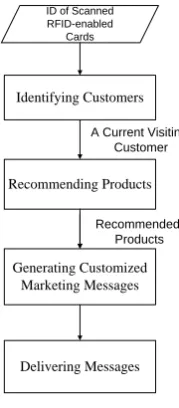
Real-time customized marketing messages (i.e., mobile advertisements or e-coupons of recommended products) can be delivered to customers’ smart phones to motivate customers to make purchases as soon as they come to a shop or are near the shop. For example, the Smart Shopping System will send an e-coupon to Type II customers that other similar Type II customers have already purchased, in order to motivate the customers to make a purchase. Fig. 3b shows the screen capture of a real-time marketing message in a customer’s smart phone.
ID of Scanned RFID-enabled
Cards
Identifying Customers
Recommending Products
Generating Customized Marketing Messages
Delivering Messages A Current Visiting
Customer
[image:5.595.326.525.137.295.2]Recommended Products
Fig. 5: Flow chart of real-time marketing message delivery
Providing and Receiving Real-Time Reviews
Customers can provide product reviews for a shop so that other customers can receive the product reviews from similar customers who have just visited the shop as soon as they come into that shop. The real-time reviews are a collection of human intelligence to help customers make better purchase decisions. Fig. 3c shows the real-time product reviews in a customer’s smart phone.
Exchanging E-Coupons or Product/Service Information
Customers can exchange e-coupons or share product information anytime and anywhere. Whenever a customer gets a new e-coupon or product information from the Smart Shopping System, the customer can share this with their
friends by physically tapping the devices together. This interaction is enabled by NFC technology. Unlike other wireless technologies such as Bluetooth or WiFi-Direct, it does not require any manual device discovery or pairing. The e-coupon or product or service information will be automatically exchanged when two devices come into range.
[image:5.595.310.540.405.577.2]IV. SCENARIOS TESTING
Fig. 6: RFID reader, RFID tags, and Android phones used in the prototype
We used an RFID reader, four RFID active tags, and four Android phones to build a prototype of the Smart Shopping System. The RFID reader, the RFID active tags, and the Android phones that we used are shown in Fig. 6. Some scenario tests were executed to test the prototype of the Smart Shopping System.
Table II: Attributes of social vectors for the scenario tests
a1 a2 a3 a4 a5 a6 a7 a8 a9
A 15 15 20 1 0 1 0 1 0
B 10 10 15 1 1 1 0 0 0
C 20 10 18 1 1 1 1 0 1
D 15 15 5 1 1 0 1 1 1
E 10 10 1 0 0 0 1 1 1
F 20 10 8 0 1 0 1 0 1
G 1 1 0 0 0 0 0 0 1
H 1 1 2 1 0 1 0 0 0
I 10 15 1 1 0 1 1 1 1
J 5 2 20 1 1 1 1 0 0
In our scenarios testing, there are 12 customers A, B, C, D, E, F, G, H, I, and J. The attributes of their social vector are shown in Table II. Note that customers A, D, G, and J have real Android devices and RFID active tags. Others are virtual customers, who do not have real Android devices and RFID active tags. In general, the results were satisfactory. In particular, most customers were able to receive the real-time customized marketing messages within 30 seconds after entering the coverage area of the RFID reader. Two important scenario tests are described below for checking the correctness of the rule-based social vector and the comparison-based social vector approaches, respectively.
Scenario Test for the Rule-based Approach
[image:5.595.125.215.411.616.2]A, B, and C can successfully be classified into Type I customers; customers D, E, and F can be classified into Type II customers; customers G and H can be classified into Type III customers; and customers I and J can be classified into Type IV customers.
In addition, customer A can receive a customized marketing message (i.e., the e-coupon of the products purchased by B) instantly when entering the coverage area of the RFID reader. Note that customers A, B, and C are Type I customers but customers A and B are more similar than customers A and C because ⃑⃑⃑⃑⃑⃑⃑ XNOR ⃑⃑⃑⃑⃑⃑⃑ is larger than ⃑⃑⃑⃑⃑⃑⃑ XNOR ⃑⃑⃑⃑⃑⃑⃑ . Other customers can also receive a customized marketing message (the e-coupon/advertisement of the products purchased from the most similar customers under the same customer type).
Scenario Test for the Comparison-Based Approach
Based on K-Means clustering, customers B, C, D, E, F, G, H, I, and J can be divided into three groups: Group X (customers B, C, and D), Group Y (customers E, F, and G), and Group Z (customers H, I, and J). Since the social vector of customer A is closest to the social vector of Group X, under the scenario test customer A can receive customized marketing messages (i.e., the e-coupons of the products purchased by customers B, C, and D) when customer A enters the coverage area of the RFID reader.
V. CONCLUSIONS AND FUTURE WORK
In this paper, we first presented a concept called social vectors. Social vectors can be used to define and quantify social relationships, which can open up some interesting areas of research such as social vector algebra and calculus. Based on social vectors and RFID technology, we presented a Smart Shopping System to provide customers with a smart shopping experience. The system identifies customers by scanning the RFID-enabled smart cards available in the coverage range of the RFID reader, finding similar customers by using social vectors with the purpose of providing product recommendations, and sending customized marketing messages such as mobile advertisements or e-coupons to customers’ smart phones as soon as they enter a shop or are close to the shop.
For future work, the Smart Shopping System may provide a cross-shops marketing service to customers. For example, it may offer the e-coupons of restaurants or cafes to customers when it thinks that the customers are getting tired of shopping, based on social vectors. We are also investigating the use of various social vectors for various social network applications and protocols.
ACKNOWLEDGMENTS
This work was supported by The Hong Kong Polytechnic University. We would like to thank Prof. Jon Crowcroft, and Dr. Eiko Yoneki for the research collaboration on mobile social networks.
REFERENCES
[1] K. Heikki and L. Matti, “Factors influencing consumers’ willingness to accept mobile advertising: a conceptual model,” Int. J. Mobile
Communications, vol. 3, no. 3, p. 198, 2005.
[2] M. Leppäniemi, “Mobile marketing communications in consumer markets,” Thesis, Faculty of Economics and Business Administration,
Department of Marketing, University of Oulu, p. 21, 2008.
[3] A. Pentland, “Socially aware computation and communication,” IEEE
Computer, vol. 38, no. 3, pp. 33–40, 2005.
[4] F. Wang et al., “Social computing: from social informatics to social intelligence,” IEEE Intelligent Systems, vol. 22, no. 2, pp. 79–83, 2007.
[5] E. F. Churchill et al., “Social networks and social networking,” IEEE
Internet Computing, vol. 9, no. 5, pp. 14–19, 2005.
[6] P. Hui, E. Yoneki, S.-Y. Chan, and J. Crowcroft, “Distributed community detection in delay tolerant networks,” Proc. ACM
SIGCOMM Workshop (MOBIARCH), Aug. 2007.
[7] J. Hopcroft, O. Khan, B. Kulis, and B. Selman, “Natural communities in large linked networks,” Proc. Knowledge Discovery DataMining, pp. 541–546, 2003.
[8] M. E. J. Newman, “Modularity and community structure in networks,” Proc. Nat. Acad. Sci., vol. 103, no. 23, pp. 8577–8582, Jun. 2006.
[9] G. Palla, A. Barabasi, and T. Vicsek, “Quantifying social group evolution,” Nature, vol. 446, no. 7136, pp. 664–667, Apr. 2007. [10] Social Vector [Online]. Available:
http://socialvector.comp.polyu.edu.hk/
[11] S. B. Miles, RFID Technology and Applications, Cambridge University Press, London, 2011.
[12] J. Hightower, R. Want, and G. Borriello, “SpotON: An indoor 3D location sensing technology based on RF signal strength,” University
of Washington, Seattle, Technical Report, UW CSE 2000–02-02, Feb.
2000.